REVIEW 5 major objections 5 minor 20 references
Prompt-Tuned LLM-Augmented DRL for Dynamic O-RAN Network Slicing
T0 review · 5 major / 5 minor · reviewed 2026-08-07 · deepseek-v4-flash
Pith's one-line read The paper claims that adding a few learnable prompt tokens to a frozen O-RAN-specific LLM's state representation lets multi-agent RL slice network resources with faster convergence and better QoS than un-prompted or generic-LLM baselines.
desk verdict A clear, incremental extension of the authors' own ORANSight MARL work, but the experimental evidence is too thin to support the convergence and QoS claims. read the letter →
The pith
A machine-rendered reading of the paper's core claim, the machinery that carries it, and where it could break.
The reading
What carries the argument
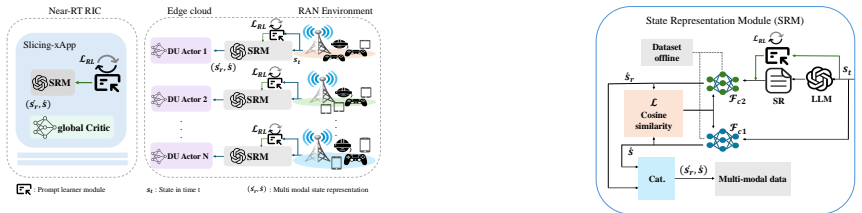
The load-bearing component is the prompt-augmented State Representation Module (SRM) embedded in the actor and critic paths of a multi-agent Soft Actor-Critic setup. The SRM concatenates two adapters' outputs: $F_{c1}$ on the raw metrics $s_t$ and $F_{c2}$ on $h_t = M(p_t \cup T)$, where $M$ is ORANSight, a language model pre-trained on O-RAN knowledge. The learnable prompt tokens $T$ are the only part of the LLM pipeline updated by RL gradients, so the frozen model can still produce task-tuned semantic representations; the paper argues the LLM naturally clusters related concepts such as SNR, power, and throughput, making the state easier for agents to interpret.
What would settle it
Retrain $F_{c2}$ on prompted LLM outputs and rerun the comparison, or replace the learned prompts with random frozen token embeddings while keeping everything else identical; if the convergence and QoS gaps disappear or do not shrink, the claim that learnable prompts drive the gain is falsified.
Extended reading notes
Core claim
The central claim is that prompt alignment, not merely LLM augmentation, is what makes LLM-based state representations useful for dynamic slicing. In PA-MRL, the State Representation Module builds two views of the state: raw network metrics passed through $F_{c1}$, and LLM embeddings passed through $F_{c2}$; the LLM input is the informal prompt $p_t$ concatenated with learnable embeddings $T$, yielding $h_t = M(p_t \cup T)$. The learnable prompts are optimized with the SAC policy gradient, so the representation is pulled toward both semantic structure and RL reward. The paper evaluates this against ORANSight MARL without prompt alignment and GPT PA-MRL with a generic LLM, and reports that the proposed ORANSight PA-MRL achieves the best convergence, final reward, and per-slice QoS, with the largest improvements in the eMBB and mMTC slices.
Load-bearing premise
The adapter networks described in Section IV-C were trained offline on outputs from the earlier un-prompted system, and the paper never re-trains or validates them on the new prompted outputs; the comparison assumes those prompted embeddings stay inside the adapters' training distribution.
Editorial extensions
If this is right
- Operators could adapt slicing policies by tuning only the prompt embeddings, leaving the large language model frozen, which is far cheaper than full fine-tuning in a real-time RIC.
- Applying the same prompt-aligned state representation at both DU actors and the centralized critic lets coordination use semantically structured state without centralizing the policies.
- The number of context tokens behaves as a tunable hyperparameter: too few underfit and too many risk overfitting, so deployments would need a short token-count search.
- Replacing the domain-specific ORANSight LLM with GPT-2 in the same pipeline reduces the gain, so both prompt alignment and domain specialization contribute to the reported improvement.
Reading between the lines
- The authors do not report wall-clock training cost or parameter counts, so their lightweight claim is about convergence and architecture, not measured compute; a direct comparison with LoRA or full fine-tuning under the same compute budget would make the efficiency claim testable.
- The authors do not retrain or validate $F_{c1}$ and $F_{c2}$ on prompted outputs; since those adapters were trained offline on un-prompted representations, prompted outputs could be out of distribution, and retraining them or measuring representation shift would separate prompt-driven gains from adapter mismatch.
- If the learned prompts encode general semantic structure rather than scenario-specific values, the same prompt embeddings could transfer to new slice configurations or traffic mixes; the paper does not test transfer, but that is a natural next step.
- The same contextualization mechanism, freezing a domain LLM and tuning small prompts with the RL objective, could apply to other resource-allocation MDPs with mixed numerical and semantic observations, such as spectrum sharing or edge-computing scheduling.
Editorial analysis
A structured set of objections, weighed in public.
Referee Report
Summary. This manuscript proposes PA-MRL, a prompt-tuned LLM-augmented multi-agent reinforcement learning framework for dynamic O-RAN network slicing. The method uses ORANSight, a domain-specific LLM, together with informal and learnable prompts, and two offline-trained adapter networks Fc1 and Fc2, to fuse raw network state and LLM-generated representations into a unified state for SAC-based MARL agents. The paper reports simulation results over three slices (eMBB, mMTC, URLLC) and six DUs, claiming faster convergence and higher cumulative reward than a GPT-2-based variant and the ORANSight MARL baseline, plus an ablation table and per-user throughput CDFs.
Significance. If the empirical claims were substantiated, the paper would make a useful incremental contribution: parameter-efficient, in-loop adaptation of a domain-specific LLM via learnable prompts for wireless resource allocation, avoiding full fine-tuning. The paper is honest in building on prior work [9] for the simulator, prompt construction, and adapter networks, and it provides an ablation comparing domain-specific vs generic LLMs and prompt vs no-prompt variants. However, the reported evidence is currently too thin to establish the central claim: there are no error bars, seed counts, significance tests, released code, or validation of the frozen adapter under the new prompted distribution. The contribution is promising but needs substantially stronger empirical support.
major comments (5)
- [V-B, Fig. 3] The central claim that ORANSight PA-MRL "consistently outperforms" the other approaches is supported only by a single pair of learning curves with no error bars, seed count, or statistical test. A single MARL run can be dominated by seed noise, especially with stochastic actor-critic training, so the reported gap cannot be distinguished from variance. Please report results over multiple seeds with means and confidence intervals, and ideally a significance test, for cumulative reward and convergence episodes.
- [V-C, Fig. 4] The number of learnable prompt tokens is selected on the evaluation curve: the paragraph states that this value "should be treated as a tunable hyperparameter" and then highlights the "dominant maximum" in Fig. 4. Tuning a hyperparameter on the same data used to report final performance inflates the measured gain. Use a separate validation set or report the full sensitivity curve with a clearly defined training/evaluation split.
- [IV-C, Algorithm 1] Fc2 is trained offline on LLM-generated representations from prior work [9], but Algorithm 1 feeds it h_t = M(p_t ∪ T), i.e., representations produced with the new learnable prompts. The paper provides no evidence that Fc2 remains valid under this distribution shift; if prompted representations fall outside its training distribution, the observed improvement could be an artifact of the mismatch rather than evidence for prompt-based learning. Please retrain or fine-tune the adapters on prompted outputs, or provide an analysis showing that Fc2's embedding space is unaffected by the added prompt tokens.
- [III-C, Eq. (1d)] Constraint (1d) allows relaxed allocations that may assign more than one slice to the same RB, and the text asserts that "final allocations enforce one-slice-per-RB assignments" without specifying the projection or rounding procedure used. Since this procedure determines feasibility and reward, please state it explicitly or include pseudocode; otherwise the optimization problem solved by the agents is not fully defined.
- [V-D, Table I] Table I reports QoS improvements and convergence gains relative to a "plain MARL baseline," but that baseline is not defined, is absent from Fig. 3, and the raw values behind the percentages are not given. This makes the ablation difficult to interpret: for example, a gain of 23.66% in URLLC QoS needs the baseline magnitude to be meaningful. Please define the baseline, show its learning curves, and report absolute metric values with variance.
minor comments (5)
- [V-A, Fig. 3] The x-axis of Fig. 3 has no label or units; the text mentions "after 1000 episodes," but the axis appears to end at 30, which is confusing. Please label the axis clearly as training episodes (or thousands of episodes).
- [IV header] The section title "PROMP-AUGMENTEDMULTIAGENTRL" has a typo and missing spacing; it should be "PROMPT-AUGMENTED MULTI-AGENT RL."
- [III-C and IV-C] Notation is inconsistent: constraint (1d) uses lambda_l, but the text later refers to a "penalty term lambda_k"; please unify the notation.
- [V-C] The section title "Number of Context" should be "Number of Context Tokens" for clarity.
- [Fig. 2] The components "LLMSR Dataset" and the cosine-similarity module in Fig. 2 are not explained in the text; please clarify how the dataset and similarity loss are used.
Circularity Check
No significant circularity; the PA-MRL comparison is an independent empirical variant of the authors' prior ORANSight system, not a definitional reduction.
full rationale
The paper's central contribution is the introduction of learnable prompts into an LLM-augmented MARL pipeline, evaluated empirically against two baselines. No equation in the paper equates the proposed method's output to its inputs by construction: the prompt embeddings T are updated through RL gradients, and the reported reward curves are measured from the simulated environment rather than derived from the fitted adapters or from prior work. The heavy reliance on the authors' own earlier paper [9] for the simulator, adapter networks Fc1/Fc2, informal prompt construction, and the ORANSight MARL baseline is substantial, but it is reuse of system components rather than a circular justification of the new claim. The stated offline training of Fc1/Fc2 on unprompted LLM representations while Algorithm 1 feeds prompted representations through Fc2 is a legitimate distribution-shift concern, as is the lack of error bars and the hyperparameter selection in Fig. 4, but these are correctness and evaluation-validity risks, not self-referential reductions. Because the empirical comparison is distinct from, and not logically implied by, the cited prior results, the appropriate circularity finding is no significant circularity.
Assumptions & free parameters
free parameters (6)
- Reward steepness alpha (Eq. 2) =
Not reported
- Penalty severity delta (Eq. 3) =
Not reported
- Entropy temperature beta (Eq. 4) =
Not reported
- Number of learnable context tokens =
Selected to maximize reward gain (Fig. 4)
- QoS thresholds thr_l =
Not reported
- Relaxation penalty lambda_k (Eq. 1d) =
Not reported
assumptions (6)
- domain assumption OFDM transmission and UE-level rate formulation from Lotfi et al. [9] are correct and applicable.
- domain assumption ORANSight is a domain-specific LLM whose latent embeddings cluster O-RAN metrics (SNR, power, throughput) in a task-useful way.
- ad hoc to paper The offline-trained adapter Fc2 remains valid for LLM representations produced with the new learnable prompts.
- domain assumption The simulated environment with 3 slices and 6 DUs is representative of real O-RAN conditions.
- domain assumption The reward function in Eqs. (2)-(3) with hand-set alpha and delta reflects the true operator objective for slicing.
- ad hoc to paper The relaxed allocation in Eq. (1d) plus some unstated projection yields feasible one-slice-per-RB assignments.
Cite this review
Pith. "Pith review of Prompt-Tuned LLM-Augmented DRL for Dynamic O-RAN Network Slicing." pith.science (2026). https://pith.science/paper/C3MKIYCG
@misc{pith2026250600574,
  author       = {Pith},
  title        = {Pith review of: Prompt-Tuned LLM-Augmented DRL for Dynamic O-RAN Network Slicing},
  year         = {2026},
  howpublished = {\url{https://pith.science/paper/C3MKIYCG}},
  note         = {Machine review of arXiv:2506.00574}
}
read the original abstract
Modern wireless networks must adapt to dynamic conditions while efficiently managing diverse service demands. Traditional deep reinforcement learning (DRL) struggles in these environments, as scattered and evolving feedback makes optimal decision-making challenging. Large Language Models (LLMs) offer a solution by structuring unorganized network feedback into meaningful latent representations, helping RL agents recognize patterns more effectively. For example, in O-RAN slicing, concepts like SNR, power levels and throughput are semantically related, and LLMs can naturally cluster them, providing a more interpretable state representation. To leverage this capability, we introduce a contextualization-based adaptation method that integrates learnable prompts into an LLM-augmented DRL framework. Instead of relying on full model fine-tuning, we refine state representations through task-specific prompts that dynamically adjust to network conditions. Utilizing ORANSight, an LLM trained on O-RAN knowledge, we develop Prompt-Augmented Multi agent RL (PA-MRL) framework. Learnable prompts optimize both semantic clustering and RL objectives, allowing RL agents to achieve higher rewards in fewer iterations and adapt more efficiently. By incorporating prompt-augmented learning, our approach enables faster, more scalable, and adaptive resource allocation in O-RAN slicing. Experimental results show that it accelerates convergence and outperforms other baselines.
Figures


Reference graph
Works this paper leans on
-
[9]
Llm-augmented deep reinforcement learning for dynamic o-ran network slicing,
F. Lotfi, H. Rajoli, and F. Afghah, “Llm-augmented deep reinforcement learning for dynamic o-ran network slicing,”ICC 2025-2025 IEEE International Conference on Communications (ICC), 2025
work page 2025
-
[1]
Near-real-time ran intelligent controller use cases and requirements,
O-RAN WG3, “Near-real-time ran intelligent controller use cases and requirements,” Tech. Rep. O-RAN.WG3.UCR-R003-v6.00 TS, O-RAN Alliance, 2024
work page 2024
-
[2]
Study on enhanced access to and support of network slices,
3GPP TR 22.835 version 18.2.0 Release 18, “Study on enhanced access to and support of network slices,”Tech. Rep, , no. 5, 2021
work page 2021
-
[3]
Understanding o-ran: Architecture, interfaces, algo- rithms, security, and research challenges,
M. Polese et al., “Understanding o-ran: Architecture, interfaces, algo- rithms, security, and research challenges,”IEEE Communications Surveys & Tutorials, vol. 25, no. 2, pp. 1376–1411, 2023
work page 2023
-
[4]
Meta reinforcement learning approach for adaptive resource optimization in o-ran,
F. Lotfi and F. Afghah, “Meta reinforcement learning approach for adaptive resource optimization in o-ran,” 2024
work page 2024
-
[5]
Resource management in wireless networks via multi-agent deep reinforcement learning,
N. Naderializadeh et al., “Resource management in wireless networks via multi-agent deep reinforcement learning,”IEEE Transactions on Wireless Communications, vol. 20, no. 6, pp. 3507–3523, 2021
work page 2021
-
[6]
Large generative ai models for telecom: The next big thing?,
L. Bariah, Q. Zhao, H. Zou, Y . Tian, F. Bader, and M. Debbah, “Large generative ai models for telecom: The next big thing?,”IEEE Communications Magazine, 2024
work page 2024
-
[7]
Understanding telecom language through large language models,
L. Bariah, H. Zou, Q. Zhao, B. Mouhouche, F. Bader, and M. Deb- bah, “Understanding telecom language through large language models,” inGLOBECOM 2023-2023 IEEE Global Communications Conference. IEEE, 2023, pp. 6542–6547
work page 2023
Show all 20 references
-
[8]
Communication and control co-design in 6g: Sequential decision-making with llms,
X. Chen et al., “Communication and control co-design in 6g: Sequential decision-making with llms,”arXiv preprint arXiv:2407.06227, 2024
2024 arXiv
-
[10]
Llm-based intent processing and network optimization using attention-based hierarchical reinforcement learning,
M. Habib et al., “Llm-based intent processing and network optimization using attention-based hierarchical reinforcement learning,”arXiv preprint arXiv:2406.06059, 2024
2024 arXiv
-
[11]
Controlling large language model-based agents for large-scale decision-making: An actor-critic approach,
B. Zhang et al., “Controlling large language model-based agents for large-scale decision-making: An actor-critic approach,”arXiv preprint arXiv:2311.13884, 2023
2023 arXiv
-
[12]
Llm-empowered state representation for reinforcement learning,
B. Wang, Y . Qu, et al., “Llm-empowered state representation for reinforcement learning,”arXiv preprint arXiv:2407.13237, 2024
2024 arXiv
-
[13]
Lora: Low-rank adaptation of large language models.,
E. Hu, Y . Shen, et al., “Lora: Low-rank adaptation of large language models.,”ICLR, vol. 1, no. 2, pp. 3, 2022
2022
-
[14]
Parameter-efficient transfer learning for nlp,
N. Houlsby, A. Giurgiu, et al., “Parameter-efficient transfer learning for nlp,” inInternational conference on machine learning. PMLR, 2019, pp. 2790–2799
2019
-
[15]
Oransight-2.0: Foundational llms for o-ran,
P. Gajjar and V . Shah, “Oransight-2.0: Foundational llms for o-ran,” arXiv preprint arXiv:2503.05200, 2025
2025 arXiv
-
[16]
Oran-bench-13k: An open source benchmark for assessing llms in open radio access networks,
P. Gajjar and V . Shah, “Oran-bench-13k: An open source benchmark for assessing llms in open radio access networks,”arXiv preprint arXiv:2407.06245, 2024
2024 arXiv
-
[17]
The power of scale for parameter-efficient prompt tuning,
B. Lester et al., “The power of scale for parameter-efficient prompt tuning,”arXiv preprint arXiv:2104.08691, 2021
2021 arXiv
-
[18]
Prefix-tuning: Optimizing continuous prompts for generation,
X. Li and P. Liang, “Prefix-tuning: Optimizing continuous prompts for generation,”arXiv preprint arXiv:2101.00190, 2021
2021 arXiv
-
[19]
Soft actor-critic: Off-policy maximum entropy deep reinforcement learning with a stochastic actor,
T. Haarnoja et al., “Soft actor-critic: Off-policy maximum entropy deep reinforcement learning with a stochastic actor,” inInternational conference on machine learning. PMLR, 2018, pp. 1861–1870
2018
-
[20]
5G; NR; physical channels and modulation,
3GPP TS 38.211 version 15.1.0 Release 15, “5G; NR; physical channels and modulation,”Tech. Spec., Jul. 2018
2018
Reviewed August 7, 2026 · model on record in the stance chip above.
Discussion (0). Sign in to comment.