REVIEW 3 major objections 3 minor 1 cited by
Short GRB magnetars obey the same field–spin scaling as long GRBs, a first.
Reviewed by Pith at T0; open to challenge. T0 means a machine referee read the full paper against a public rubric. the ladder, T0–T4 →
T0 review · deepseek-v4-flash
2026-08-01 14:36 UTC pith:C3VPQ7J6
load-bearing objection The universal Bp–P0 slope for sGRBs is probably an artifact of the L0–τ inversion, and the paper has internal contradictions; the qualitative field-strength difference is likely real. the 3 major comments →
Universal scaling between magnetar field and initial spin period for short gamma ray bursts
The pith
A machine-rendered reading of the paper's core claim, the machinery that carries it, and where it could break.
Core claim
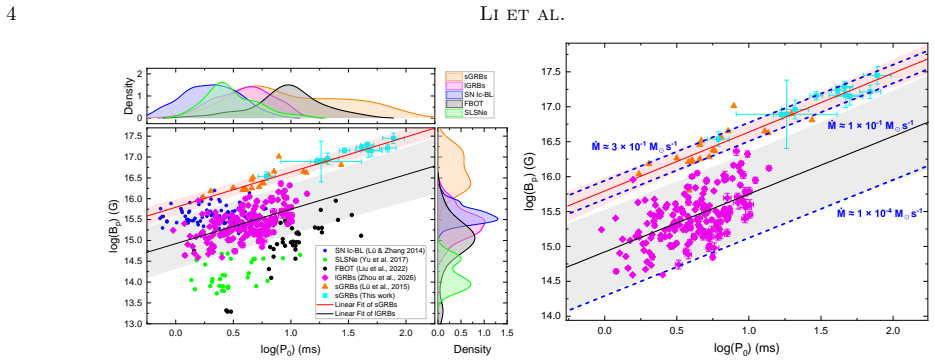
The paper claims the first systematic detection of a Bp–P0 correlation in short GRBs with X-ray plateaus. Using 33 sGRBs (22 from prior literature plus 11 newly analyzed), it derives magnetar parameters spanning P0 ∈ [1.73, 18.28] ms and Bp ∈ [0.06, 2.82]×10^17 G, with sGRB magnetars being, on average, about an order of magnitude more magnetized than lGRB magnetars. The fitted power-law slope for sGRBs, 0.84±0.07, matches the lGRB slope of 0.83±0.09, while the intercepts differ significantly. The authors argue that the slope represents a universal magnetar spin-down / accretion equilibrium (Bp ∝ P0^(7/6) at fixed accretion rate), and the intercept difference encodes progenitor-specific accre
What carries the argument
The central mechanism is the magnetar spin-down model applied to X-ray plateaus: the plateau luminosity L0 and timescale τ are inverted to yield the initial spin period P0 and polar magnetic field Bp via equations (5)–(6), derived from magnetic dipole spin-down. The theoretical backbone is the equilibrium scaling Bp ∝ P0^(7/6) Mdot^(1/2), obtained by equating the Alfvén radius with the corotation radius during fallback accretion. This scaling predicts a steep positive slope in the log Bp–log P0 plane, which the paper tests against the data.
Load-bearing premise
The Bp and P0 values are not measured independently; both are computed from the same two observables (plateau luminosity and plateau timescale) via the magnetar spin-down equations, so the fitted slope between them may be a byproduct of that inversion rather than a physical correlation.
What would settle it
Scramble the plateau luminosity and timescale values across the sample, recompute Bp and P0, and re-fit the correlation; if the scrambled data still produce a slope near 0.84 with similar scatter, the correlation is an artifact of the inversion. Alternatively, independently measure the initial spin period of a magnetar remnant in an sGRB through X-ray timing or gravitational-wave observations and check whether it falls on the claimed relation.
If this is right
- If the correlation is physically real, the Bp–P0 plane becomes a two-dimensional diagnostic that can separate GRB progenitor channels, with slope encoding spin-down physics and intercept encoding accretion rate.
- sGRB magnetars being systematically more magnetized than lGRB magnetars provides a concrete observational constraint for models of compact binary merger remnants.
- The derived mass accretion rates for sGRBs (0.1–0.3 Msun/s) are substantially higher than those for lGRBs, implying different fallback or merger disk conditions around newborn magnetars.
- The overlap between a subset of sGRBs and SNe Ic-BL in the Bp–P0 plane supports the emerging idea that some short bursts arise from massive star core collapse, not only compact binary mergers.
- Future sGRB plateau detections can immediately place the burst onto this correlation and estimate its central engine parameters without re-fitting the full light curve.
Where Pith is reading between the lines
- Because Bp and P0 are both derived from the same two observables (L0 and τ) via the same inversion equations, the steep correlation may be partly baked into the mathematics; a null test that scrambles L0 and τ across the sample, or simulates independent draws from their error distributions, would establish whether the observed slope is physically meaningful or an artifact of the inversion.
- If the correlation is verified with independent measurements of P0 (e.g., from future pulsar timing or gravitational-wave signatures of a magnetar remnant), the intercept offset could be converted into a direct probe of post-merger disk mass and magnetic flux, rather than relying on accretion-rate inference.
- The near-unity slope (~0.84) is close to, but slightly shallower than, the theoretical 7/6 ≈ 1.17; testing whether this difference persists in larger samples could reveal additional spin-down torques beyond magnetic dipole radiation, such as gravitational wave emission.
- The paper's mixed-origin claim for sGRBs, driven by overlap with SNe Ic-BL, suggests that a fraction of sGRB samples selected on plateau signatures may be contaminated by collapsar events; future samples should include a classification based on host galaxy type or supernova association to test this directly.
Editorial analysis
A structured set of objections, weighed in public.
Referee Report
Summary. The paper analyzes X-ray plateaus of short GRBs to derive magnetar initial spin periods P0 and polar magnetic fields Bp via the magnetar spin-down model (Eqs. 3–6). It claims the first systematic detection of a Bp–P0 correlation in sGRBs, with slope 0.84±0.07, consistent with the lGRB slope 0.83±0.09, which the authors interpret as evidence for a universal magnetar spin-down mechanism with different accretion environments. The paper also derives mass accretion rates and compares magnetar parameters across transient classes.
Significance. If the Bp–P0 correlation were based on independent measurements, the near-identical slopes between sGRBs and lGRBs would be an important result. However, the analysis inverts the same two observables (L0 and τ) to compute both Bp and P0, so the fitted Bp–P0 relation is a mathematical projection of the L0–τ joint distribution and does not provide independent evidence for a physical coupling. The paper also contains internal inconsistencies in sample size and statistical reporting. The light-curve fitting and the table of 11 sources are useful data products, but the central conclusion is not supported by the analysis as presented.
major comments (3)
- [§2, Eqs. (5)–(6); §3, Eq. (7)] Equations (5) and (6) define log Bp = −0.5 log L0 − log τ + const and log P0 = −0.5 log L0 − 0.5 log τ + const. Hence any correlation between log Bp and log P0 is induced by the covariance of L0 and τ; it does not measure an independent physical relation. The paper does not perform a null test (e.g., scrambling τ or simulating from independent Bp and P0 distributions) to show that the observed r = 0.93 is not an artifact of the inversion. This is load-bearing because the claimed universal slope comparison with lGRBs (Eqs. 7–8) could arise simply from similar L0–τ covariance in both samples. The central claim is therefore unsupported.
- [Abstract vs. §2 and Table 1] The abstract states 33 sGRBs with P0 in [1.73, 18.28] ms, but §2 says the final clean sample contains 11 sGRBs, and Table 1 lists 11 sources with P0 values up to 77.62 ms. The 22 sources from Lü et al. (2015) mentioned in the Introduction are not tabulated or analyzed. For the 11 listed sources, r = 0.93 corresponds to p ≈ 2×10^−5, not the quoted 2.74×10^−14; the quoted p-value implies n ≈ 33. The statistical results are not reproducible from the presented data.
- [§4, Eq. (9) and discussion of slopes] The statement that "all measured slopes are consistent with the theoretical 7/6 scaling" is contradicted by Eq. (7): 0.84 ± 0.07 is ~4.7σ from 7/6 ≈ 1.167. Additionally, the accretion-rate estimates use Eq. (9) with the fitted slope 0.83, but Eq. (9) assumes a 7/6 slope; using a different slope requires a modified relation. The derived Mdot ranges are therefore not well justified.
minor comments (3)
- [Throughout] There are numerous typos and grammatical errors (e.g., "theroy" in §1, "invovles" and "Accoding" in §2), which should be corrected.
- [References] Several references appear in the bibliography but are not cited in the text (Cook et al. 1994; Duez et al. 2006; Giacomazzo & Perna 2013; Rea et al. 2015).
- [Figure 2 and Table 1] Some light-curve fits have very large parameter uncertainties (e.g., GRB 191031D: τ = 113.97 ± 103.05 s, P0 = 18.28 ± 14.72 ms), yet the paper does not discuss how these uncertainties propagate into the derived Bp and P0 or into the fitted correlation.
Circularity Check
Bp–P0 'universal scaling' is a projection of the L0–τ anti-correlation through the defining inversion equations; no null test is provided.
specific steps
-
fitted input called prediction
[Section 3, Eqs. (5)–(7); see also Table 1]
"Bp,15 = 2.05 G (I45 R−3 6 L−1/2 0,49 τ −1 3) ... P0,−3 = 1.42 s (I 1/2 45 L−1/2 0,49 τ −1/2 3) ... log Bp = (0.84±0.07) log P0 + (15.79±0.07)"
From (5) and (6), in log-space log Bp = −½ log L0 − log τ + c and log P0 = −½ log L0 − ½ log τ + d. Thus log Bp = log P0 − ½ log τ + const, so an OLS regression of log Bp on log P0 has slope (Var L + 2 Var τ + 3 Cov(L,τ))/(Var L + Var τ + 2 Cov(L,τ)) plus selection effects. Table 1 shows F0 (∝ L0) and τ are strongly anticorrelated; the fitted slope 0.84 is therefore the projection of that F0–τ covariance through the defining equations, not an independent measurement of magnetar properties. Eq. (7) is then presented as 'the first systematic detection of the Bp–P0 correlation' and used to infer a universal spin-down mechanism. No null test (e.g., scrambling τ or forward-modeling independent Bp,P0) is performed to show the slope is not forced by the inversion.
full rationale
Equations (5)–(6) give log Bp = −0.5 log L0 − log τ + const and log P0 = −0.5 log L0 − 0.5 log τ + const. Hence the fitted slope in Eq. (7) is not an independent measurement but a deterministic function of the covariance between the two observables L0 and τ (and of sample selection). Table 1 shows F0 (∝ L0) and τ are strongly anticorrelated, so the tight r = 0.93 correlation is expected from the inversion; the paper never runs a null test (scrambling τ, or forward-simulating independent Bp/P0 values). This makes the headline 'universal magnetar spin-down' conclusion underdetermined: the same transformation would be applied to any sample with similar L0–τ distribution, including lGRBs, so the near-identical slopes in Eq. (8) do not independently confirm a universal mechanism. The interpretation also has internal tensions: the abstract claims 33 sGRBs and P0 ∈ [1.73, 18.28] ms, whereas §2 and Table 1 list 11 sGRBs with P0 values up to 77.62 ms; and the fitted slope 0.84 is ~4–5σ from 7/6, contradicting the statement that all measured slopes are consistent with 7/6. These do not by themselves establish circularity, but they reinforce the conclusion that the central claim rests on a fitted projection rather than a model-independent test.
Axiom & Free-Parameter Ledger
free parameters (2)
- Adopted redshift z=0.72 =
0.72
- Canonical NS mass and radius in Eq. (9) =
M=1.4 Msun, R=12 km
axioms (5)
- domain assumption Magnetic dipole spin-down of a newborn magnetar powers the X-ray plateau (Zhang & Mészáros 2001).
- domain assumption The plateau break time τ = tb/(1+z) equals the characteristic spin-down timescale and L0 ≃ Lb.
- domain assumption The internal plateau is defined by a post-break decay index steeper than −2.
- domain assumption Spin-up equilibrium relation B ∝ P^{7/6} Ṁ^{1/2} (Eq. 9).
- standard math Flat ΛCDM cosmology with Ωm = 0.3 and H0 = 70 km s−1 Mpc−1.
read the original abstract
The $B_p$--$P_0$ correlation serves as a critical probe of magnetar engine physics. Although this scaling relation has been firmly established for long gamma-ray bursts (lGRBs), systematic investigations for short GRBs (sGRBs) remain absent, leaving the physical differences between the two populations poorly constrained. Here we analyze 33 Swift sGRBs exhibiting prominent X-ray plateaus from newborn millisecond magnetar spin-down, and derive their initial spin period $P_0$ and polar magnetic field $B_p$. sGRB magnetars span $P_0 \in [1.73,\,18.28]\ \mathrm{ms}$ and $B_p \in [0.06,\,2.82] \times 10^{17}\ \mathrm{G}$ ($\langle B_p \rangle = 7.05 \times 10^{16}\ \mathrm{G}$), significantly more magnetized than lGRB magnetars ($B_p \in [0.39,\,23.08] \times 10^{15}\ \mathrm{G}$; $\langle B_p \rangle = 3.69 \times 10^{15}\ \mathrm{G}$). For the first time, we derive consistent power-law $B_p$--$P_0$ correlations for GRBs : the scaling for sGRBs is $\log B_p = (0.84\pm0.07)\log P_0 + (15.79\pm0.07)$, whose slope is highly consistent with that of lGRBs, $\log B_p = (0.83\pm0.09)\log P_0 + (14.92\pm0.06)$. The near-identical slopes imply a universal magnetar spin-down mechanism, while the vertical offset between intercepts traces divergent progenitor channels. This scaling relation thus offers a new diagnostic to disentangle the formation pathways of GRB. Within the framework of the standard spin-up model, the mass accretion rates of sGRBs ($\dot{M} \sim 1 \times 10^{-1}$ to $3 \times 10^{-1}\,M_\odot\,\mathrm{s}^{-1}$) are substantially higher than those of lGRBs ($\dot{M} \sim 10^{-4}$ to $1 \times 10^{-1}\,M_\odot\,\mathrm{s}^{-1}$). Our work completes the missing $B_p$--$P_0$ statistics for sGRBs, quantitatively unifies their magnetar physics with lGRBs, and provides new observational constraints on the origin diversity of relativistic transients.
Figures

Forward citations
Cited by 1 Pith paper
-
Diverse Morphologies of GRB X-Ray Plateaus within a Common Magnetar Framework
A hierarchical fit of 185 GRB X-ray plateaus finds no statistical need for distinct magnetar populations behind rising, flat, and decaying plateau shapes.
Reference graph
Works this paper leans on
-
[1]
Abbott, B. P., Abbott, R., Abbott, T. D., et al. 2017, ApJL, 848, L13, doi: 10.3847/2041-8213/aa920c
-
[2]
Ahumada, T., Singer, L. P., Anand, S., et al. 2021, Nature Astronomy, 5, 917, doi: 10.1038/s41550-021-01428-7
-
[3]
D., Chincarini, G., Burrows, D
Barthelmy, S. D., Chincarini, G., Burrows, D. N., et al. 2005, Nature, 438, 994, doi: 10.1038/nature04392
-
[4]
Bhattacharya, D., & van den Heuvel, E. P. J. 1991, PhR, 203, 1, doi: 10.1016/0370-1573(91)90064-S
-
[5]
2006, A&A, 454, 113, doi: 10.1051/0004-6361:20064856
Campana, S., Tagliaferri, G., Lazzati, D., et al. 2006, A&A, 454, 113, doi: 10.1051/0004-6361:20064856
-
[6]
Chen, J. H., Jia, X. D., Dong, X. F., & Wang, F. Y. 2024, ApJL, 973, L54, doi: 10.3847/2041-8213/ad7b39
-
[7]
Cook, G. B., Shapiro, S. L., & Teukolsky, S. A. 1994, ApJ, 424, 823, doi: 10.1086/173934
doi:10.1086/173934 1994
-
[8]
Cucchiara, A., Levan, A. J., Fox, D. B., et al. 2011, ApJ, 736, 7, doi: 10.1088/0004-637X/736/1/7 Dall’Osso, S., Stratta, G., Perna, R., De Cesare, G., &
-
[9]
2023, ApJL, 949, L32, doi: 10.3847/2041-8213/acccec
Stella, L. 2023, ApJL, 949, L32, doi: 10.3847/2041-8213/acccec
-
[10]
2024, ApJL, 962, L27, doi: 10.3847/2041-8213/ad22e2
Du, Z., Lü, H., Yuan, Y., Yang, X., & Liang, E. 2024, ApJL, 962, L27, doi: 10.3847/2041-8213/ad22e2
-
[11]
Stephens, B. C. 2006, PhRvL, 96, 031101, doi: 10.1103/PhysRevLett.96.031101
-
[12]
Eichler, D., Livio, M., Piran, T., & Schramm, D. N. 1989, Nature, 340, 126, doi: 10.1038/340126a0
doi:10.1038/340126a0 1989
-
[13]
Evans, P. A., Beardmore, A. P., Page, K. L., et al. 2007, A&A, 469, 379, doi: 10.1051/0004-6361:20077530 —. 2009, MNRAS, 397, 1177, doi: 10.1111/j.1365-2966.2009.14913.x
arXiv 2007
-
[14]
A., Willingale, R., Osborne, J
Evans, P. A., Willingale, R., Osborne, J. P., et al. 2010, A&A, 519, A102, doi: 10.1051/0004-6361/201014819
-
[15]
Ghosh, P., Lamb, F. K., & Pethick, C. J. 1977, ApJ, 217, 578, doi: 10.1086/155606
-
[16]
2013, ApJL, 771, L26, doi: 10.1088/2041-8205/771/2/L26
Giacomazzo, B., & Perna, R. 2013, ApJL, 771, L26, doi: 10.1088/2041-8205/771/2/L26
-
[17]
Gompertz, B. P., Levan, A. J., & Tanvir, N. R. 2020, ApJ, 895, 58, doi: 10.3847/1538-4357/ab8d24
-
[18]
Gompertz, B. P., O’Brien, P. T., & Wynn, G. A. 2014, MNRAS, 438, 240, doi: 10.1093/mnras/stt2165
-
[19]
Hao, C. T., Jing, J. H., Han, X. L., et al. 2026, ApJ, 997, 127, doi: 10.3847/1538-4357/ae24e3
-
[20]
1997, ApJ, 490, 92, doi: 10.1086/512791
Kobayashi, S., Piran, T., & Sari, R. 1997, ApJ, 490, 92, doi: 10.1086/512791
doi:10.1086/512791 1997
-
[21]
Kouveliotou, C., Meegan, C. A., Fishman, G. J., et al. 1993, ApJL, 413, L101, doi: 10.1086/186969
doi:10.1086/186969 1993
-
[22]
2026, ApJ, 997, 173, doi: 10.3847/1538-4357/ae2606
Lan, L., Gao, H., Zhao, L., et al. 2026, ApJ, 997, 173, doi: 10.3847/1538-4357/ae2606
-
[23]
2025, ApJL, 990, L54, doi: 10.3847/2041-8213/adf20e —
Li, Q.-M., Sun, Q.-B., Qian, S.-B., & Li, F.-X. 2025, ApJL, 990, L54, doi: 10.3847/2041-8213/adf20e —. 2026a, ApJL, 997, L15, doi: 10.3847/2041-8213/ae2012
-
[24]
2026b, ApJ, 998, 121, doi: 10.3847/1538-4357/ae2f45
Li, Q.-M., Sun, Q.-B., Qian, S.-B., Zhu, S.-Y., & Li, F.-X. 2026b, ApJ, 998, 121, doi: 10.3847/1538-4357/ae2f45
-
[25]
Li, Q. M., Zhang, Z. B., Han, X. L., et al. 2023, MNRAS, 524, 1096, doi: 10.1093/mnras/stad1648
-
[26]
Lin, W. L., Wang, X. F., Wang, L. J., & Dai, Z. G. 2020, ApJL, 903, L24, doi: 10.3847/2041-8213/abc254
-
[27]
2022, ApJL, 935, L34, doi: 10.3847/2041-8213/ac86d2 Lü, H.-J., & Zhang, B
Liu, J.-F., Zhu, J.-P., Liu, L.-D., Yu, Y.-W., & Zhang, B. 2022, ApJL, 935, L34, doi: 10.3847/2041-8213/ac86d2 Lü, H.-J., & Zhang, B. 2014, ApJ, 785, 74, doi: 10.1088/0004-637X/785/1/74 Lü, H.-J., Zhang, B., Lei, W.-H., Li, Y., & Lasky, P. D. 2015, ApJ, 805, 89, doi: 10.1088/0004-637X/805/2/89
-
[28]
2011, MNRAS, 413, 2031, doi: 10.1111/j.1365-2966.2011.18280.x
Bucciantini, N., & Quataert, E. 2011, MNRAS, 413, 2031, doi: 10.1111/j.1365-2966.2011.18280.x
arXiv 2011
-
[29]
1992, ApJL, 395, L83, doi: 10.1086/186493
Narayan, R., Paczynski, B., & Piran, T. 1992, ApJL, 395, L83, doi: 10.1086/186493
doi:10.1086/186493 1992
-
[30]
1986, ApJL, 308, L43, doi: 10.1086/184740
Paczynski, B. 1986, ApJL, 308, L43, doi: 10.1086/184740
doi:10.1086/184740 1986
-
[31]
Pan, Y. Y., Wang, N., & Zhang, C. M. 2013, Ap&SS, 346, 119, doi: 10.1007/s10509-013-1432-3
-
[32]
1999, PhR, 314, 575, doi: 10.1016/S0370-1573(98)00127-6
Piran, T. 1999, PhR, 314, 575, doi: 10.1016/S0370-1573(98)00127-6
-
[33]
Piro, A. L., & Ott, C. D. 2011, ApJ, 736, 108, doi: 10.1088/0004-637X/736/2/108
-
[34]
Rea, N., Gullón, M., Pons, J. A., et al. 2015, ApJ, 813, 92, doi: 10.1088/0004-637X/813/2/92
-
[35]
2022, ApJ, 932, 1, doi: 10.3847/1538-4357/ac60a2
Rossi, A., Rothberg, B., Palazzi, E., et al. 2022, ApJ, 932, 1, doi: 10.3847/1538-4357/ac60a2
-
[36]
Rowlinson, A., O’Brien, P. T., Metzger, B. D., Tanvir, N. R., & Levan, A. J. 2013, MNRAS, 430, 1061, doi: 10.1093/mnras/sts683
-
[37]
Rowlinson, A., O’Brien, P. T., Tanvir, N. R., et al. 2010, MNRAS, 409, 531, doi: 10.1111/j.1365-2966.2010.17354.x
arXiv 2010
-
[38]
Z., Matheson, T., Garnavich, P
Stanek, K. Z., Matheson, T., Garnavich, P. M., et al. 2003, ApJL, 591, L17, doi: 10.1086/376976
doi:10.1086/376976 2003
-
[39]
G., Dall’Osso, S., Hernandez, X., & De Cesare, G
Stratta, G., Dainotti, M. G., Dall’Osso, S., Hernandez, X., & De Cesare, G. 2018, ApJ, 869, 155, doi: 10.3847/1538-4357/aadd8f
-
[40]
2019, ApJS, 245, 1, doi: 10.3847/1538-4365/ab4711
Tang, C.-H., Huang, Y.-F., Geng, J.-J., & Zhang, Z.-B. 2019, ApJS, 245, 1, doi: 10.3847/1538-4365/ab4711
-
[41]
Woosley, S. E. 1993, ApJ, 405, 273, doi: 10.1086/172359
doi:10.1086/172359 1993
-
[42]
2022, ApJ, 934, 125, doi: 10.3847/1538-4357/ac7c13
Xie, L., Wei, D.-M., Wang, Y., & Jin, Z.-P. 2022, ApJ, 934, 125, doi: 10.3847/1538-4357/ac7c13
-
[43]
2016, ApJS, 224, 20, doi: 10.3847/0067-0049/224/2/20 10Li et al
Yi, S.-X., Xi, S.-Q., Yu, H., et al. 2016, ApJS, 224, 20, doi: 10.3847/0067-0049/224/2/20 10Li et al
-
[44]
2017, ApJ, 840, 12, doi: 10.3847/1538-4357/aa6c27
Yu, Y.-W., Zhu, J.-P., Li, S.-Z., Lü, H.-J., & Zou, Y.-C. 2017, ApJ, 840, 12, doi: 10.3847/1538-4357/aa6c27
-
[45]
Zeh, A., Klose, S., & Hartmann, D. H. 2004, ApJ, 609, 952, doi: 10.1086/421100
doi:10.1086/421100 2004
-
[46]
2014, ApJL, 780, L21, doi: 10.1088/2041-8205/780/2/L21
Zhang, B. 2014, ApJL, 780, L21, doi: 10.1088/2041-8205/780/2/L21
-
[47]
2001, ApJL, 552, L35, doi: 10.1086/320255
Zhang, B., & Mészáros, P. 2001, ApJL, 552, L35, doi: 10.1086/320255
doi:10.1086/320255 2001
-
[48]
2026, ApJL, 1004, L11, doi: 10.3847/2041-8213/ae7329
Zhou, Y.-Q., Yi, S.-X., Yang, Y.-P., et al. 2026, ApJL, 1004, L11, doi: 10.3847/2041-8213/ae7329
-
[49]
2026, arXiv e-prints, arXiv:2604.21759, doi: 10.48550/arXiv.2604.21759
Zhu, J.-P., & Zhang, B. 2026, arXiv e-prints, arXiv:2604.21759, doi: 10.48550/arXiv.2604.21759
-
[50]
2021, MNRAS, 508, 2505, doi: 10.1093/mnras/stab2766
Zou, L., Liang, E.-W., Zhong, S.-Q., et al. 2021, MNRAS, 508, 2505, doi: 10.1093/mnras/stab2766
discussion (0)
Sign in with ORCID, Apple, or X to comment. Anyone can read and Pith papers without signing in.