REVIEW 5 major objections 5 minor 3 references
Large Anomalous Hall Effect in a Noncoplanar Magnetic Heterostructure
T0 review · 5 major / 5 minor · reviewed 2026-08-10 · deepseek-v4-flash
Pith's one-line read A Cr5Te6/Pt heterointerface produces a record anomalous Hall resistivity of 114 nΩ cm at 5 K, driven by interfacial topological spin textures and Berry-curvature reconstruction.
desk verdict A credible new experimental result with an overstated mechanism story; worth refereeing but not as clean as claimed. read the letter →
The pith
A machine-rendered reading of the paper's core claim, the machinery that carries it, and where it could break.
The reading
What carries the argument
The load-bearing object is the Berry curvature $\Omega_n(\mathbf{k})$, a momentum-space quantity that acts like an effective magnetic field and gives electrons a transverse velocity; its integral over occupied bands yields the anomalous Hall conductivity. The paper combines this with the real-space topological charge $\mathbf{m} \cdot (\partial_x \mathbf{m} \times \partial_y \mathbf{m})$, which measures the winding of interfacial spin textures. At the Cr5Te6/Pt interface, strong spin-orbit coupling plus the noncoplanar chromium magnetization breaks time-reversal and inversion symmetry, producing large Berry-curvature peaks near the Fermi level; shifting the Fermi level through temperature or Pt thickness reverses the sign of the integrated conductivity. The interfacial Dzyaloshinskii-Moriya interaction, enabled by broken inversion symmetry at the interface, stabilizes topological spin textures whose emergent magnetic field enters the same Berry-phase language, linking the real-space skyrmions to the measured Hall signal.
What would settle it
A decisive check would be to compute the anomalous Hall conductivity for a structurally realistic model of the amorphous, rough Pt interface instead of a crystalline monolayer; if the large enhancement and the sign reversal with Fermi-level shift disappear, the calculated Berry curvature does not explain the measured 114 nΩ cm signal. A complementary experiment would compare devices with epitaxial versus amorphous Pt to see whether the record Hall value follows the crystalline model.
Extended reading notes
Core claim
The central claim is that a Cr5Te6/Pt heterointerface carries a large intrinsic anomalous Hall effect, with anomalous Hall resistivity 114 nΩ cm at 5 K, exceeding all previously studied magnetic-insulator/heavy-metal systems. The paper attributes this to reconstruction of the Berry curvature at the Fermi level: the nonmagnetic Pt layer gains magnetic influence and strong spin-orbit effects from the adjacent Cr5Te6, breaking both time-reversal and inversion symmetry so that the momentum-space Berry curvature becomes large. First-principles calculations for a monolayer-Pt model show an order-of-magnitude enhancement of anomalous Hall conductivity below the Fermi level compared with isolated Cr5Te6 or Pt. The paper also directly visualizes skyrmion-like topological spin textures at a Cr5Te6/Pt interface by magnetic force microscopy, and Monte Carlo simulations of the interfacial spin system find that the Dzyaloshinskii-Moriya interaction stabilizes them; the AHE signal reversal with temperature and Pt thickness is explained by Fermi-level shifts that reconstruct the Berry curvature. The authors present the result as the first evidence that topological spin textures at a heterointerface can generate a large anomalous Hall effect.
Load-bearing premise
The theory assumes that a perfectly ordered one-atom-thick platinum layer behaves like the rough, partially glassy 3-nanometer platinum layer actually deposited in the experiment.
Editorial extensions
If this is right
- Cr5Te6/Pt becomes the strongest known magnetic-insulator/heavy-metal platform for the anomalous Hall effect, with a value roughly an order of magnitude above the typical ~10 nΩ cm seen in other proximity systems.
- The AHE sign can be flipped by moving the Fermi level through temperature, Pt thickness, or doping, so the heterostructure acts as a tunable Berry-curvature device.
- Because interfacial DMI stabilizes topological spin textures at the interface, the same bilayer design can be extended to other magnetic tellurides and heavy metals for chiral-spintronics studies.
- Inserting a weak-spin-orbit layer such as Cu at the interface eliminates the effect, confirming that the active region is the Cr5Te6/Pt interface rather than the bulk of either layer.
- A large Hall response in a highly resistive magnetic layer with the current carried mainly by Pt makes low-power electrical readout of the magnetic order a practical prospect.
Reading between the lines
- Beyond the paper, the same design rule—a Cr-rich noncoplanar magnetic chalcogenide under a strong-spin-orbit metal—should produce comparable AHE enhancement in other CrxTey compounds, and the dependence on Pt thickness is a natural first screen.
- The claimed link between skyrmion density and the ~0.6 T hump in the Hall curve could be tested quantitatively by counting skyrmions in MFM images at each field and comparing that density with the extracted Hall component.
- A structurally realistic calculation using an amorphous or rough Pt layer would show whether the crystalline monolayer model is the right description of the experimental interface; this is the most direct theoretical check of the mechanism.
- Beyond the paper, a practical extension is to exploit the sign reversal as a readout scheme: a device whose Hall polarity flips with temperature or gate voltage could encode information without moving magnetic domains.
Editorial analysis
A structured set of objections, weighed in public.
Referee Report
Summary. The paper reports a large anomalous Hall resistivity of 114 nΩ cm at 5 K in Cr5Te6/Pt heterostructures, which the authors claim is the highest among magnetic insulator/heavy-metal heterostructures. They attribute the AHE to an interfacial Berry-curvature reconstruction driven by proximity to a noncoplanar magnetic layer, supported by first-principles calculations of a Cr5Te6/Pt interface, and to topological spin textures visualized by magnetic force microscopy and modeled by Monte Carlo simulations. The experimental controls include Cu insertion, Pt-thickness dependence, and a ρ_AHE versus ρ_xx^2 scaling analysis.
Significance. If the mechanism claims were fully supported, this would be a valuable demonstration of a large interfacial AHE with potential spintronic relevance, and the explicit Cu-insertion control and thickness-dependent reversal are useful experimental contributions. The compilation of AHE values across MI/HM heterostructures in Fig. 3 is also a useful resource. However, the theoretical support for the central mechanism is weakened by the mismatch between the calculated crystalline Pt interface and the experimentally amorphous Pt layer, by the lack of a computed thickness-induced sign reversal, and by the use of a different film thickness for the MFM and transport samples. These issues make the central 'verified by first-principles calculations' and 'accounts for the large AHE' claims premature in the current form.
major comments (5)
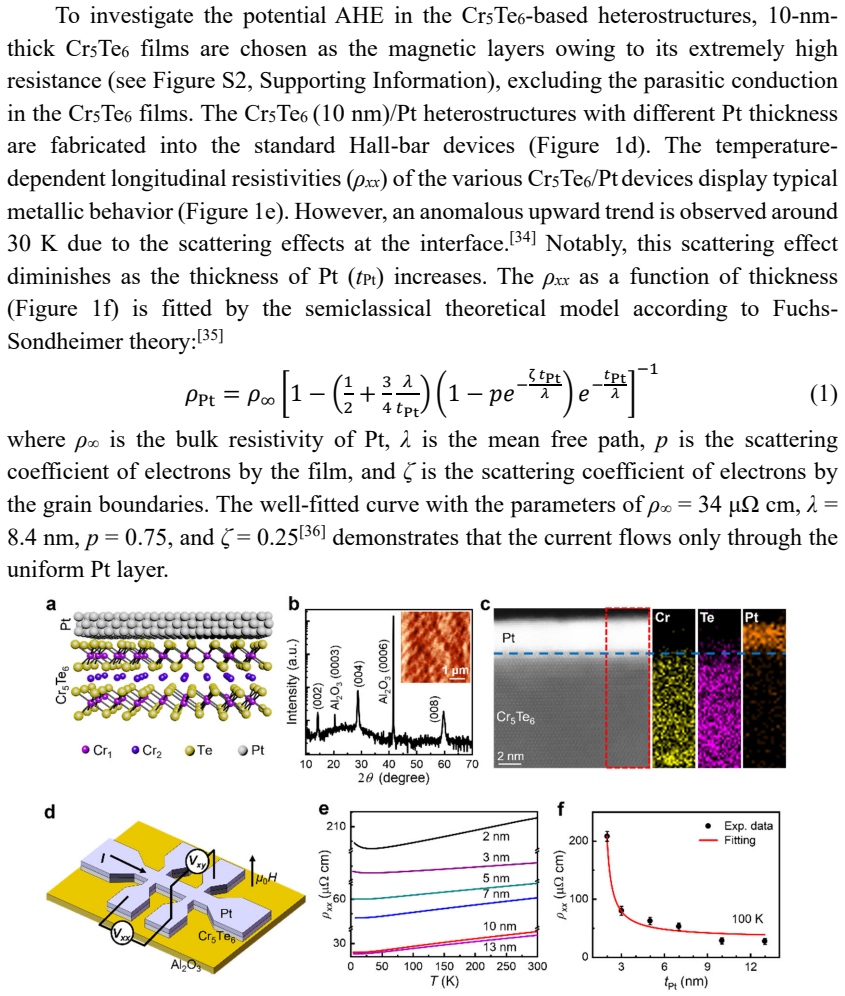
- [§2, Fig. 1c versus Fig. 4] The DFT calculation models a crystalline monolayer or bilayer Pt on Cr5Te6, whereas the cross-sectional STEM image in Fig. 1c shows an amorphous Pt layer about 3 nm thick. Berry curvature and anomalous Hall conductivity are highly sensitive to crystal symmetry, band dispersion, and Fermi-level position, so the computed enhancement and the charge transfer of 0.15 e per Pt atom are not representative of the actual experimental interface. The statement in the text that the Berry-curvature mechanism is 'verified by the first-principles calculations' is therefore not supported for the samples studied. The authors either need calculations that account for the amorphous interface (for example, large supercells with realistic structural disorder) or must reframe the DFT result as a qualitative symmetry-based illustration rather than a verification.
- [§2, Fig. 4c and Fig. S6] The paper claims that increasing Pt thickness leads to a reconstruction of Berry curvature that reverses the AHE sign between 3 nm and 10 nm Pt. However, the calculated anomalous Hall conductivity for monolayer versus bilayer Pt (Fig. 4c and Fig. S6) shows only a slight change in amplitude, not a sign reversal. The experimental thickness-induced sign reversal is thus not reproduced or explained by the presented calculations, leaving a load-bearing part of the mechanism unsupported.
- [§2, Fig. 5] The topological spin textures are visualized by MFM on a Cr5Te6(70 nm)/Pt(3 nm) heterostructure, while the transport measurements that yield the large AHE are performed on Cr5Te6(10 nm)/Pt samples. The authors explicitly state that the 10 nm sample shows no significant MFM signal. The correspondence between the skyrmion density at 0.6–0.65 T in the 70 nm sample and the Hall hump at about 0.6 T is therefore not established for the same system, and the claim that the observed spin textures 'account for the large AHE' in the transport devices is an extrapolation. The manuscript should either provide MFM evidence on the same 10 nm stack or clearly present the 70 nm data as a separate model system with explicit caveats.
- [§4, Eq. (8)] The Heisenberg Hamiltonian in Eq. (8) contains an anisotropy term written as -Σ_i K_i S_i^2. If S_i is a unit vector or has fixed magnitude, this term is a constant and cannot represent magnetic anisotropy; the correct uniaxial form is -Σ_i K_i (S_i^z)^2. As written, the anisotropy term has no physical effect in the Monte Carlo simulations, which directly affects the stability of the simulated topological spin textures and the reported phase diagram. This needs to be corrected and the simulations repeated.
- [§2, Fig. 2f] The observed linear scaling of ρ_AHE with ρ_xx^2 in Fig. 2f is consistent with either an intrinsic Berry-curvature mechanism or an extrinsic side-jump mechanism, and it does not specifically select the proposed topological-spin-texture origin. The text concludes that the intrinsic mechanism dominates because of the strong SOC in Pt, but this inference needs additional support, such as a quantitative comparison of the measured AHE magnitude with the computed anomalous Hall conductivity for the actual experimental structure.
minor comments (5)
- [§4, Eq. (5)] The symmetrization formula in Eq. (5) is written in a confusing way: the notation V_H(+H → -H) and V_H(-H → +H) should be clarified by explicitly defining the voltage measured at each field and current direction.
- [Figure 3 caption] The caption says 'The temperature dependences of the observed saturated ρ_xy^AHE values' but the figure appears to plot multiple symbols for different materials; the caption should identify the symbol for each heterostructure more clearly.
- [§4, First-Principles Calculations] The sentence 'Perdew-Burke-Ernerhof (PBE) projector augmented was adopted' is grammatically incomplete; it should read 'the Perdew-Burke-Ernzerhof functional within the projector augmented wave method was adopted.'
- [Supplementary Table S1] The parameters Cr-Cr exchange constant, second exchange constant, anisotropy constant, and DMI constant are listed only as broad estimated ranges without a description of how they were estimated or whether any were fitted to the experimental Curie temperature or saturation field; this makes the simulation results difficult to reproduce.
- [Abstract and Conclusion] The phrase 'record-high AHE value among all the magnetic insulators/heavy metal heterostructures' is based only on the limited comparison set in Fig. 3; the authors should either explicitly state 'among the systems compared here' or provide a more comprehensive literature survey.
Circularity Check
No significant circularity; the central claim rests on independent transport, MFM, and first-principles calculations, with only minor background self-citations.
full rationale
The paper's derivation chain is not circular. The anomalous Hall resistivity of 114 nΩ cm is a directly measured transport quantity, not a value produced by the DFT or spin simulations. The first-principles calculation computes anomalous Hall conductivity versus Fermi level from Berry curvature without fitting to the measured AHE magnitude; the experimental sign reversal with temperature is inferred from the Hall data and qualitatively compared to the computed Fermi-level dependence. The MFM imaging of skyrmion textures is an independent real-space observation, and the atomic simulations use stated exchange, DMI, and anisotropy parameters rather than fitting the measured AHE. The link between skyrmion density near 0.6 T and the topological Hall hump is an interpretative correlation between independent measurements, not a definitional equivalence. The paper does cite prior work by overlapping authors, notably ref. [28] for Cr5Te6 structural and magnetic properties, but that citation is background characterization corroborated by the present SQUID, XRD, and MFM data; it is not load-bearing in the sense of substituting for derivation. The paper's own caveat that the experimental samples 'may be more complex than the theoretical model' is a validity limitation regarding the crystalline-monolayer DFT model versus the amorphous Pt layer, not evidence of circularity. No fitted parameter is renamed as a prediction, and no uniqueness theorem or ansatz is imported solely from self-citations to force the conclusion. Accordingly, no specific circular step can be exhibited, and the circularity score is low.
Assumptions & free parameters
free parameters (4)
- DMI constant =
0.2-2 meV (estimated)
- Cr-Cr exchange constants =
8-30 meV and -5 to -3 meV (estimated)
- Magnetic anisotropy constant =
4-5e5 J/m^3 (estimated)
- Carrier densities and mobilities =
p=1.74e21 cm^-3, n=4.50e22 cm^-3 (from Hall fit)
assumptions (4)
- domain assumption DFT with PBE and SOC gives reliable Berry curvature and anomalous Hall conductivity for the interface.
- ad hoc to paper A crystalline monolayer Pt on Cr5Te6 represents the experimental interface.
- ad hoc to paper Topological spin textures observed in 70 nm Cr5Te6/Pt are representative of the 10 nm Cr5Te6/Pt transport samples.
- domain assumption The temperature dependence of the Fermi level explains the AHE sign reversal.
Cite this review
Pith. "Pith review of Large Anomalous Hall Effect in a Noncoplanar Magnetic Heterostructure." pith.science (2026). https://pith.science/paper/C56H6UVU
@misc{pith2026250107019,
  author       = {Pith},
  title        = {Pith review of: Large Anomalous Hall Effect in a Noncoplanar Magnetic Heterostructure},
  year         = {2026},
  howpublished = {\url{https://pith.science/paper/C56H6UVU}},
  note         = {Machine review of arXiv:2501.07019}
}
read the original abstract
The anomalous Hall effect (AHE) occurs in magnetic systems and also unexpectedly in non-magnetic materials adjacent to magnetic insulators via the heterointerface interactions. However, the AHE in heterostructures induced by magnetic proximity effect remains quite weak, restricting their practical device applications. Here, we report a large intrinsic AHE with a resistivity of 114 n{\Omega} cm at 5 K in noncoplanar magnetic heterostructures of Cr5Te6/Pt. This is the record-high AHE value among all the magnetic insulators/heavy metal heterostructures. A reversal of the AHE signal occurs due to the reconstruction of Berry curvature at the Fermi level, which is verified by the first-principles calculations. Topological spin textures at the interface are directly visualized via high-magnetic-field magnetic force microscopy, which accounts for the large AHE, as confirmed by the atomic simulations. These findings open a new avenue for exploring the large AHE in heterointerfaces and facilitate the potential applications in topological spintronic devices.
Figures


Figures from the paper (2 more)


Reference graph
Works this paper leans on
- [1]
- [2]
-
[3]
A. Neubauer, C. Pfleiderer, B. Binz, A. Rosch, R. Ritz, P. Niklowitz, P. Böni, Phys. Rev. Lett. 2009, 102, 186602
work page 2009
Reviewed August 10, 2026 · model on record in the stance chip above.
Discussion (0). Continue with ORCID to comment.