REVIEW 5 major objections 5 minor 44 references
LLM-Aided Joint Secrecy Precoding and Trajectory for RSMA-Based Heterogeneous UAV Networks
T0 review · 5 major / 5 minor · reviewed 2026-08-06 · deepseek-v4-flash
Pith's one-line read A two-layer design pairs convex secrecy precoding with LLM-seeded reinforcement learning to improve both secrecy rate and energy efficiency in heterogeneous UAV swarms.
desk verdict Plausible LLM-guided RL + SDR/DC pipeline for secure UAV networks; the LLM's specific value is unproven because there is no scripted-expert control, and the D.C. derivation mislabels concave terms as convex. read the letter →
The pith
A machine-rendered reading of the paper's core claim, the machinery that carries it, and where it could break.
The reading
What carries the argument
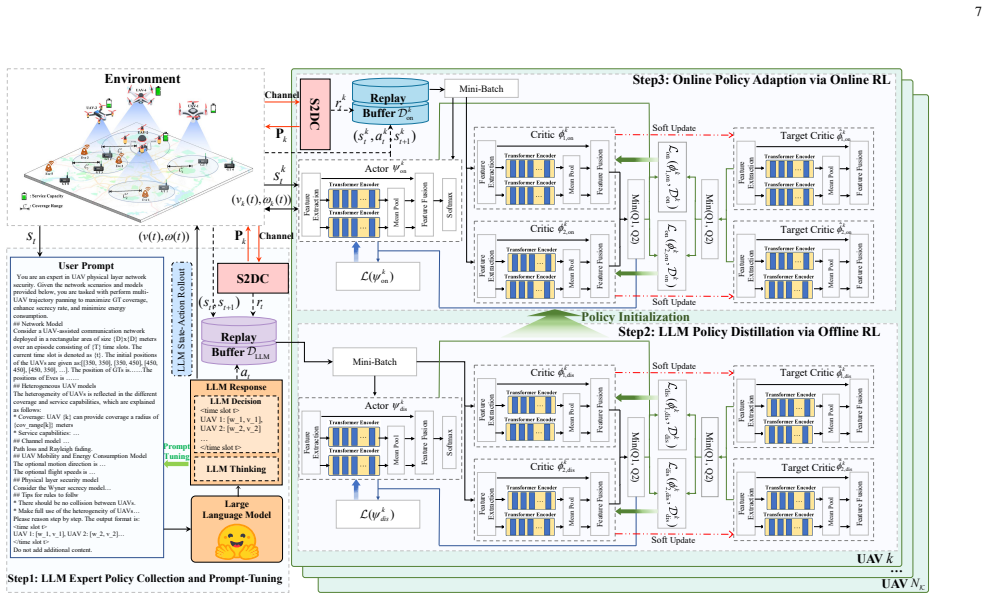
The argument rides on two nested mechanisms. The inner mechanism is S2DC, which applies semidefinite relaxation to the RSMA secrecy precoding problem, rewrites the objective as a difference-of-convex function, pushes the non-convex rank-one constraints into the objective as an exact penalty, and iteratively solves convex programs; it acts as a fixed operator that turns positions into secrecy-rate rewards. The outer mechanism is LLM-HeMARL, in which a large language model, prompted with the network and secrecy models, rolls out expert trajectories that are parsed into a dataset, distilled by conservative Q-learning into a fast policy, and then adapted by online independent soft actor-critic, so the LLM never runs during real-time decisions.
What would settle it
Run the whole pipeline with Eve CSI corrupted by zero-mean Gaussian estimation error at several variances; if the reported ~25 percent reward advantage over ISAC-S2DC disappears or shrinks dramatically, then perfect Eve CSI is the load-bearing assumption.
Extended reading notes
Core claim
The central claim is that LLM-generated expert trajectories, distilled through conservative Q-learning and then fine-tuned by independent soft actor-critic, give heterogeneous UAV agents a heterogeneity-aware starting policy that learns faster and lands on a better secrecy-energy trade-off than any baseline that learns from scratch or shares experience across agents. The paper also establishes, on its own evidence, that the hierarchical split itself is the main performance driver: methods using S2DC for precoding with RL for trajectories outperform coupled RL baselines, and independent replay buffers outperform shared ones when UAV capabilities differ. The reported numbers are the 25 percent reward gain over ISAC-S2DC and the 7 to 16 percent energy saving at ten UAVs, with the advantage growing as the swarm grows.
Load-bearing premise
The load-bearing premise is that the UAVs hold perfect, instantaneous eavesdropper channel state information; if Eve CSI is imperfect or stale, the secrecy-rate numbers that drive both the S2DC precoder and the RL reward are no longer reliable, and the reported gains are not guaranteed. A second premise is that the hand-tuned LLM prompt is a valid expert source, since no non-LLM scripted expert is used as a control.
Editorial extensions
If this is right
- The hierarchical split converts a hopelessly coupled non-convex problem into two tractable pieces, so the same S2DC-plus-RL pattern should transfer to other wireless problems where one subproblem admits convex optimization and the other is a long-horizon decision.
- LLM expert distillation buys a cold-start advantage: agents start with higher reward and converge faster, meaning the LLM's cost is paid once offline rather than on every control step.
- The energy advantage over ISAC-S2DC grows to 7–16 percent as the number of UAVs reaches ten, which supports scalability of the hierarchical architecture as the number of decision variables grows.
- Runtime per decision stays at 15–16 ms regardless of swarm size, whereas S2DC alone grows polynomially and SCA-based trajectory design takes tens of seconds to minutes per slot, so the method is compatible with real-time operation if precoding is computed in parallel.
- Independent replay buffers beat a shared buffer in these heterogeneous swarms, implying that experience-sharing schemes should group agents by capability rather than pooling all agents together.
Reading between the lines
- Editorial inference: because the LLM prompt already spells out heterogeneity-aware and secrecy-aware rules, the experiment does not isolate the LLM's semantic reasoning from the information already encoded in the prompt; a deterministic rule-based expert with the same coverage-aware assignment logic would test whether the gain is really from LLM reasoning or merely from expert seeding.
- Editorial inference: the perfect-eavesdropper-CSI assumption is untested; under estimated or delayed Eve channels the secrecy-rate gap over baselines would likely shrink, and the method's advantage may become an energy-only one.
- Editorial inference: the same offline-distillation pattern could serve other real-time control tasks, such as jamming avoidance or handover management, wherever a cheap environment reward exists and an LLM is consulted only to produce demonstration data.
Editorial analysis
A structured set of objections, weighed in public.
Referee Report
Summary. The paper proposes a hierarchical optimization framework for RSMA-enabled heterogeneous UAV networks, maximizing the worst-case secrecy rate while minimizing propulsion energy consumption. The inner layer (S2DC) uses semidefinite relaxation, exact penalty, and difference-of-convex iterations to compute secrecy precoding at fixed UAV positions; the outer layer (LLM-HeMARL) distills an LLM-generated expert policy into an independent soft actor-critic multi-agent reinforcement learning scheme for trajectory optimization. Experiments compare the proposed method against ISAC, MASAC, and SCA-based baselines under varying random seeds and UAV swarm sizes, reporting improvements in secrecy rate and energy consumption.
Significance. If the claims hold, the paper offers a practical integration of convex precoding with LLM-guided reinforcement learning for a strongly coupled nonconvex problem. The idea of using offline LLM rollouts to warm-start MARL policies, thereby avoiding real-time LLM inference, is timely and addresses a real latency concern. The paper's strengths include a detailed RSMA/heterogeneous-UAV system model, a clear hierarchical decomposition, and evaluations across multiple random seeds and swarm sizes. However, the current version does not establish the correctness of the inner-layer convergence or the feasibility of the reconstructed precoders, and it does not isolate the LLM's specific contribution. The reported empirical gains are therefore not yet convincingly attributed to the proposed mechanism.
major comments (5)
- [Section III, Eqs. (15)-(19)] The statement that \tilde F1,1 through \tilde F1,4 are convex is incorrect: each is the logarithm of an affine function of (P^c, P^p) and is therefore concave. Consequently, \tilde F1 in Eq. (15) is not a difference of convex functions in the standard sense, and the 'D.C. iteration' rationale for solving (28) is not valid as written. The later linearization of \tilde F1,3 and \tilde F1,4 could potentially be recast as a lower-bounding surrogate method, but the paper does not present that argument, and no monotonic-convergence proof is provided. Please correct the convexity claim, replace the D.C. terminology with the appropriate surrogate-based justification, and give a convergence guarantee for the iterates.
- [Section III, Eqs. (24e) and (27)-(32)] The algorithm drops the rank-one constraints (24e) and later reconstructs precoding vectors by taking the principal eigenvector of each matrix. No theorem or numerical evidence shows that the reconstructed precoders satisfy the secrecy rate constraints (13f)/(24c) or achieve the objective value computed from the relaxed solution. The rank-one approximation is therefore unquantified, and the S2DC output fed to the RL reward may not be a feasible or accurate solution of P2. Please provide an approximation bound or report the feasibility and performance gap of the reconstructed precoders in the simulated scenarios.
- [Section IV-A and Table II] The reward function depends on scalarization weights w_sr and w_ec, the collision penalty p_col, the CQL penalty beta in Eq. (38), and the S2DC penalty mu in Eq. (27), but none of these values is reported in Table II or the text. As a result, the episode-reward comparison in Fig. 4 and the 'approximately 25%' improvement over ISAC-S2DC are not reproducible and cannot be interpreted as a specific secrecy/energy trade-off. Please report all hyperparameters, and ideally present a Pareto-front analysis over the weight ratio rather than a single scalarization.
- [Section V-C] The comparison between LLM-HeMARL-S2DC and ISAC-S2DC changes two things simultaneously: the use of a distilled-policy initialization and the LLM as the source of that policy. No non-LLM scripted-expert warm-start or random offline-pretraining control is included, and the prompt in Section IV-B explicitly instructs the LLM to maximize GT coverage, enhance secrecy rate, minimize energy consumption, and follow heterogeneity rules. The reported 25% gain may therefore reflect the benefit of any competent heuristic initialization rather than LLM reasoning. Please add a scripted-expert warm-start baseline and report the decomposed secrecy rate and energy consumption for the LLM-warm-started versus scripted-warm-started agents.
- [Section II.B and Section V] The entire evaluation assumes perfect eavesdropper CSI, and both the S2DC inner layer and the RL reward use this CSI to compute secrecy rates. This assumption is load-bearing for the central claims of secrecy-rate gains, but no experiments with imperfect, delayed, or estimated Eve CSI are reported. Please either add a robustness study against CSI error or clearly delimit the paper's claims to the ideal-CSI regime.
minor comments (5)
- [Section II.E] In problem P1, the optimization variables are listed as omega, v, and P, while constraints (4) and (5) involve the binary scheduling matrix S_I; it is not specified whether S_I is a decision variable, a fixed heuristic, or a deterministic function of coverage and channel quality. Please clarify.
- [Section II.A, Eq. (3)] The definition of E_k(t) uses a summation over t in T inside a per-slot expression; this appears to be a typo and should be E_k = sum_{t in T} P_k(t) Delta t.
- [Section V-C, Figs. 7 and 8] The text and captions refer to comparisons with SCA-S2DC, but the legends of Figs. 7 and 8 do not include SCA-S2DC; please add the baseline to the plots or remove the corresponding text.
- [Section V-B, Fig. 3] The experiment in Section V-B deploys the LLM directly as a planner, but the text describes it as the LLM expert policy; please clarify that this is the untrained LLM planner, not the distilled policy used in the main evaluation.
- [Table I and Section I] The table row 'LLM ✓' for references [14]-[16] is not explained in the text; a sentence describing how those existing LLM-based methods differ from the proposed offline distillation would improve readability.
Circularity Check
The 'LLM naturally produces heterogeneity-aware trajectories' claim is written into the prompt rather than discovered; the downstream secrecy/energy numbers are still independently measured.
-
self definitional
[Section I (Introduction), Section IV.B / Fig. 2 prompt, and Section V.B]
"To validate this intuition, a preliminary experiment (detailed in Section V-B) demonstrates that even a direct LLM planner, without domain-specific training, naturally produces heterogeneity-aware trajectories. ... The prompt: 'You are an expert in UAV physical layer network security. ... you are tasked with perform multi-UAV trajectory panning to maximize GT coverage, enhance secrecy rate, and minimize energy consumption. ... * Make full use of the heterogeneity of UAVs...'"
The 'LLM expert policy' is generated with a hand-tuned prompt that explicitly instructs the model to 'maximize GT coverage, enhance secrecy rate, and minimize energy consumption' and to 'Make full use of the heterogeneity of UAVs.' Section V.B then validates this same policy as evidence that 'LLMs can reason about heterogeneous agent capabilities' and 'naturally produce heterogeneity-aware trajectories.' The behavior used as confirmation is therefore an input to the prompt, not an independent emergent property of the LLM; the expert label re-imports the target behavior. This is partial rather than total circularity because the final secrecy rate and energy results are computed from the channel model and measured independently, so the headline comparison does not reduce to this step.
full rationale
No formal circularity is found in the S2DC precoding derivation: it follows standard SDR, exact-penalty, and D.C. programming steps with external references, and the secrecy/energy quantities are evaluated from the channel model after the optimization, not defined into the objective. The MARL reward is aligned with the evaluation metrics, which is standard practice and not a fitted prediction. The self-citations that appear (e.g., [4], [5]) are contextual references to earlier related work and are not load-bearing. The main circularity concern is confined to the LLM expert-policy motivation: the prompt in Section IV.B explicitly contains the heterogeneity-aware, secrecy-aware, energy-aware behavior that Section V.B later presents as emergent LLM capability. This weakens the claim that the LLM itself contributes expert reasoning beyond the hand-specified prompt, and the 25% improvement over ISAC-S2DC is not isolated from a non-LLM scripted-expert control. Nevertheless, the central performance comparison is an independent empirical measurement, so the appropriate score is 3: one partial, non-derivation-collapsing circular step.
Assumptions & free parameters
free parameters (5)
- Reward weights w_sr, w_ec =
not reported
- Collision penalty p_col =
not reported
- CQL penalty coefficient beta =
not reported
- S2DC penalty parameter mu =
not reported
- LLM prompt content and tuning =
hand-tuned
assumptions (5)
- domain assumption Perfect passive eavesdropper CSI is available at UAVs
- domain assumption Rotary-wing propulsion energy model from Zeng et al. [17] holds
- domain assumption Standard RSMA rate expressions and SIC decoding order apply
- ad hoc to paper D.C. iterations with linearized concave components converge
- ad hoc to paper LLM (DeepSeek-R1) generates expert-level trajectories from the provided prompt
Cite this review
Pith. "Pith review of LLM-Aided Joint Secrecy Precoding and Trajectory for RSMA-Based Heterogeneous UAV Networks." pith.science (2026). https://pith.science/paper/C5XBVCBZ
@misc{pith2026250717188,
  author       = {Pith},
  title        = {Pith review of: LLM-Aided Joint Secrecy Precoding and Trajectory for RSMA-Based Heterogeneous UAV Networks},
  year         = {2026},
  howpublished = {\url{https://pith.science/paper/C5XBVCBZ}},
  note         = {Machine review of arXiv:2507.17188}
}
read the original abstract
This paper investigates secure communications in rate-splitting multiple access (RSMA) enabled heterogeneous UAV networks, where multiple UAVs collaboratively serve ground terminals in the presence of eavesdroppers. By jointly considering secrecy rate maximization and propulsion energy consumption minimization, we formulate a multi-objective optimization problem involving UAV trajectory design, service association, power allocation, and secrecy precoding under mobility, collision-avoidance, service-capacity, and communication constraints. The formulated problem is highly non-convex due to the coupling among UAV trajectories, RSMA transmission variables, and secrecy constraints. To address the resulting non-convex and highly coupled optimization problem, we propose a hierarchical optimization framework. The inner layer uses a semidefinite relaxation (SDR)-based S2DC algorithm combining penalty functions and difference-of-convex (D.C.) programming to solve the secrecy precoding problem with fixed UAV positions. The outer layer introduces a Large Language Model (LLM)-guided heuristic multi-agent reinforcement learning approach (LLM-HeMARL) for trajectory optimization. LLM-HeMARL efficiently incorporates LLM-generated expert heuristic policy, enabling UAVs to learn energy-aware, security-driven trajectories without the inference overhead of real-time LLM calls. The simulation results show that our method outperforms existing baselines in secrecy rate and energy efficiency, with consistent robustness across varying UAV swarm sizes and random seeds.
Figures


Figures from the paper (4 more)


Reference graph
Works this paper leans on
-
[1]
What will the future of UA V cellular communications be? A flight from 5G to 6G,
G. Geraciet al., “What will the future of UA V cellular communications be? A flight from 5G to 6G,”IEEE Commun. Surveys Tuts., vol. 24, no. 3, pp. 1304–1335, Jul. 2022
work page 2022
-
[2]
A tutorial on UA Vs for wireless networks: Applications, challenges, and open problems,
M. Mozaffari, W. Saad, M. Bennis, Y .-H. Nam, and M. Debbah, “A tutorial on UA Vs for wireless networks: Applications, challenges, and open problems,”IEEE Commun. Surveys Tuts., vol. 21, no. 3, pp. 2334– 2360, Mar. 2019
work page 2019
-
[3]
UA V-enabled secure multiuser backscatter communications with planar array,
L. Bai, Q. Chen, T. Bai, and J. Wang, “UA V-enabled secure multiuser backscatter communications with planar array,”IEEE J. Sel. Areas Commun., vol. 40, no. 10, pp. 2946–2961, Oct. 2022
work page 2022
-
[4]
W. Zhang, J. He, Y . Shen, and X. Jiang, “Covert communication in hybrid microwave/mmwave UA V-enabled systems with transmission mode selection,”Comput. Commun., vol. 219, pp. 216–228, 2024
work page 2024
-
[5]
RSMA- enabled multi-UA V secure communication via MARL with multi-task attention DRNN,
L. Zheng, J. He, X. Zhu, Y . Zhang, Y . Shen, and T. Taleb, “RSMA- enabled multi-UA V secure communication via MARL with multi-task attention DRNN,”IEEE Trans. Inf. Forensics Security, vol. 20, pp. 12 624–12 639, 2025
work page 2025
-
[6]
On the physical layer security of the cooperative rate- splitting-aided downlink in UA V networks,
H. Bastamiet al., “On the physical layer security of the cooperative rate- splitting-aided downlink in UA V networks,”IEEE Trans. Inf. Forensics Security, vol. 16, pp. 5018–5033, 2021
work page 2021
-
[7]
Maximizing network throughput in heterogeneous UA V networks,
S. Liet al., “Maximizing network throughput in heterogeneous UA V networks,”IEEE/ACM Trans. Netw., vol. 32, no. 3, pp. 2128–2142, Jun. 2024
work page 2024
-
[8]
J. Liet al., “Multi-objective optimization approaches for physical layer secure communications based on collaborative beamforming in UA V networks,”IEEE/ACM Trans. Netw., vol. 31, no. 4, pp. 1902–1917, Aug. 2023
work page 1902
Show all 44 references
-
[9]
Multi-objective optimization for UA V swarm-assisted iot with virtual antenna arrays,
J. Li, G. Sun, L. Duan, and Q. Wu, “Multi-objective optimization for UA V swarm-assisted iot with virtual antenna arrays,”IEEE Trans. Mobile Comput., vol. 23, no. 5, pp. 4890–4907, May. 2023
2023
-
[10]
Multi-objective optimization for multi-UA V-assisted mobile edge computing,
G. Sunet al., “Multi-objective optimization for multi-UA V-assisted mobile edge computing,”IEEE Trans. Mobile Comput., vol. 23, no. 12, pp. 14 803–14 820, Dec. 2024
2024
-
[11]
Multi-objective aerial collaborative secure com- munication optimization via generative diffusion model-enabled deep reinforcement learning,
C. Zhanget al., “Multi-objective aerial collaborative secure com- munication optimization via generative diffusion model-enabled deep reinforcement learning,”IEEE Trans. Mobile Comput., vol. 24, no. 4, pp. 3041–3058, Apr. 2024
2024
-
[12]
Evolutionary multi-objective reinforcement learning based trajectory control and task offloading in UA V-assisted mobile edge computing,
F. Songet al., “Evolutionary multi-objective reinforcement learning based trajectory control and task offloading in UA V-assisted mobile edge computing,”IEEE Trans. Mobile Comput., vol. 22, no. 12, pp. 7387– 7405, Dec. 2022
2022
-
[13]
Collaborative ground-space communications via evolution- ary multi-objective deep reinforcement learning,
J. Liet al., “Collaborative ground-space communications via evolution- ary multi-objective deep reinforcement learning,”IEEE J. Sel. Areas Commun., vol. 42, no. 12, pp. 3395–3411, Dec. 2024
2024
-
[14]
Large language model based multi-objective optimization for integrated sensing and communications in UA V networks,
H. Li, M. Xiao, K. Wang, D. I. Kim, and M. Debbah, “Large language model based multi-objective optimization for integrated sensing and communications in UA V networks,”IEEE Wireless Commun. Lett., vol. 14, no. 4, pp. 979–983, Apr. 2025
2025
-
[15]
Joint user association and beamforming design for ISAC networks with large language models,
H. Li, M. Xiao, K. Wang, R. Schober, D. I. Kim, and Y . L. Guan, “Joint user association and beamforming design for ISAC networks with large language models,”arXiv:2506.05637
-
[16]
LLM-guided drl for multi-tier LEO satellite networks with hybrid FSO/RF links,
J. Liet al., “LLM-guided drl for multi-tier LEO satellite networks with hybrid FSO/RF links,”arXiv:2505.11978
-
[17]
Energy minimization for wireless communication with rotary-wing UA V,
Y . Zeng, J. Xu, and R. Zhang, “Energy minimization for wireless communication with rotary-wing UA V,”IEEE Trans. Wireless Commun., vol. 18, no. 4, pp. 2329–2345, Apr. 2019
2019
-
[18]
Energy efficient UA V commu- nication with energy harvesting,
Z. Yang, W. Xu, and M. Shikh-Bahaei, “Energy efficient UA V commu- nication with energy harvesting,”IEEE Trans. Veh. Technol., vol. 69, no. 2, pp. 1913–1927, Feb. 2019
1913
-
[19]
Joint RIS and beamforming design for secure and energy-efficient two-way relay communications,
S. Zhao, X. Zhu, Y . Zhang, Z. Zhang, and Y . Shen, “Joint RIS and beamforming design for secure and energy-efficient two-way relay communications,”IEEE Trans. Mobile Comput., vol. 24, no. 8, pp. 7440–7457, Aug. 2025
2025
-
[20]
Detecting passive eavesdroppers in the MIMO wiretap channel,
A. Mukherjee and A. L. Swindlehurst, “Detecting passive eavesdroppers in the MIMO wiretap channel,” in2012 IEEE Int. Conf. on Acoust., Speech and Signal Process. (ICASSP). IEEE, 2012, pp. 2809–2812
2012
-
[21]
Deep reinforcement learning for RIS-aided multiuser full-duplex secure com- munications with hardware impairments,
Z. Peng, Z. Zhang, L. Kong, C. Pan, L. Li, and J. Wang, “Deep reinforcement learning for RIS-aided multiuser full-duplex secure com- munications with hardware impairments,”IEEE Internet Things J., vol. 9, no. 21, pp. 21 121–21 135, Nov. 2022
2022
-
[22]
Optimal LAP altitude for maximum coverage,
A. Al-Hourani, S. Kandeepan, and S. Lardner, “Optimal LAP altitude for maximum coverage,”IEEE Wireless Commun. Lett., vol. 3, no. 6, pp. 569–572, Dec. 2014
2014
-
[23]
Rate-splitting multiple access: Fundamentals, survey, and future research trends,
Y . Mao, O. Dizdar, B. Clerckx, R. Schober, P. Popovski, and H. V . Poor, “Rate-splitting multiple access: Fundamentals, survey, and future research trends,”IEEE Commun. Surveys Tuts., vol. 24, no. 4, pp. 2073– 2126, Jul. 2022
2022
-
[24]
Optimization of rate allocation and power control for rate splitting multiple access (RSMA),
Z. Yang, M. Chen, W. Saad, and M. Shikh-Bahaei, “Optimization of rate allocation and power control for rate splitting multiple access (RSMA),” IEEE Trans. Commun., vol. 69, no. 9, pp. 5988–6002, Sep. 2021
2021
-
[25]
Robust transmission in downlink multiuser MISO systems: A rate-splitting approach,
H. Joudeh and B. Clerckx, “Robust transmission in downlink multiuser MISO systems: A rate-splitting approach,”IEEE Trans. Signal Process., vol. 64, no. 23, pp. 6227–6242, Dec. 2016
2016
-
[26]
Secrecy rate beamforming for multicell networks with information and energy harvesting,
A. A. Nasir, H. D. Tuan, T. Q. Duong, and H. V . Poor, “Secrecy rate beamforming for multicell networks with information and energy harvesting,”IEEE Trans. Signal Process., vol. 65, no. 3, pp. 677–689, Feb. 2016
2016
-
[27]
Robust secure beamforming design for two-user downlink MISO rate-splitting systems,
H. Fu, S. Feng, W. Tang, and D. W. K. Ng, “Robust secure beamforming design for two-user downlink MISO rate-splitting systems,”IEEE Trans. Wireless Commun., vol. 19, no. 12, pp. 8351–8365, Dec. 2020
2020
-
[28]
SpaceRIS: LEO satellite coverage maximization in 6G sub-thz networks by MAPPO DRL and whale optimization,
S. S. Hassan, Y . M. Park, Y . K. Tun, W. Saad, Z. Han, and C. S. Hong, “SpaceRIS: LEO satellite coverage maximization in 6G sub-thz networks by MAPPO DRL and whale optimization,”IEEE J. Sel. Areas Commun., vol. 42, no. 5, pp. 1262–1278, May. 2024
2024
-
[29]
Joint deployment and resource allocation for multi-AeBS networks: A two-timescale optimization framework using MADRL,
Y . Zhaoet al., “Joint deployment and resource allocation for multi-AeBS networks: A two-timescale optimization framework using MADRL,” IEEE Trans. Commun., vol. 73, no. 6, pp. 4272–4289, Jun. 2025
2025
-
[30]
Dynamic role switching scheme with joint trajectory and power control for multi-UA V cooperative secure communication,
A. Gao, Q. Wang, Y . Hu, W. Liang, and J. Zhang, “Dynamic role switching scheme with joint trajectory and power control for multi-UA V cooperative secure communication,”IEEE Trans. Wireless Commun., vol. 23, no. 2, pp. 1260–1275, Feb. 2023
2023
-
[31]
Fast global optimal power allocation in wireless networks by local DC programming,
H. H. Kha, H. D. Tuan, and H. H. Nguyen, “Fast global optimal power allocation in wireless networks by local DC programming,”IEEE Trans. Wireless Commun., vol. 11, no. 2, pp. 510–515, Feb. 2011
2011
-
[32]
Nonsmooth optimization for efficient beamforming in cognitive radio multicast transmission,
A. H. Phan, H. D. Tuan, H. H. Kha, and D. T. Ngo, “Nonsmooth optimization for efficient beamforming in cognitive radio multicast transmission,”IEEE Trans. Signal Process., vol. 60, no. 6, pp. 2941– 2951, Jun. 2012
2012
-
[33]
UA V trajectory and beamforming optimization for integrated periodic sensing and communication,
K. Meng, Q. Wu, S. Ma, W. Chen, and T. Q. S. Quek, “UA V trajectory and beamforming optimization for integrated periodic sensing and communication,”IEEE Wireless Commun. Lett., vol. 11, no. 6, pp. 1211– 1215, Jun. 2022
2022
-
[34]
Joint 3D beamforming-and-trajectory design for UA V- satellite uplink covert communication,
J. Yuet al., “Joint 3D beamforming-and-trajectory design for UA V- satellite uplink covert communication,”IEEE Trans. Commun., vol. 73, no. 5, pp. 3469–3481, May. 2025
2025
-
[35]
Joint resource, trajectory, and artificial noise optimization in secure driven 3-D UA Vs with NOMA and imper- fect CSI,
Y . Li, H. Zhang, and K. Long, “Joint resource, trajectory, and artificial noise optimization in secure driven 3-D UA Vs with NOMA and imper- fect CSI,”IEEE J. Sel. Areas Commun., vol. 39, no. 11, pp. 3363–3377, Nov. 2021
2021
-
[36]
Power allocation in multi- user cellular networks: Deep reinforcement learning approaches,
F. Meng, P. Chen, L. Wu, and J. Cheng, “Power allocation in multi- user cellular networks: Deep reinforcement learning approaches,”IEEE Trans. Wireless Commun., vol. 19, no. 10, pp. 6255–6267, Oct. 2020
2020
-
[37]
A prompt pattern catalog to enhance prompt engineering with chatgpt,
J. Whiteet al., “A prompt pattern catalog to enhance prompt engineering with chatgpt,”arXiv:2302.11382
-
[38]
Chain-of-thought prompting elicits reasoning in large language models,
J. Weiet al., “Chain-of-thought prompting elicits reasoning in large language models,”Advances in Neural Inf. Process. Syst. 35 (NeurIPS 2022), vol. 35, pp. 24 824–24 837, 2022
2022
-
[39]
Soft actor-critic: Off- policy maximum entropy deep reinforcement learning with a stochastic actor,
T. Haarnoja, A. Zhou, P. Abbeel, and S. Levine, “Soft actor-critic: Off- policy maximum entropy deep reinforcement learning with a stochastic actor,” inProc. 35th Int. Conf. Mach. Learn. (ICML), vol. 80. PMLR, 2018, pp. 1861–1870
2018
-
[40]
Stabilizing off- policy Q-learning via bootstrapping error reduction,
A. Kumar, J. Fu, M. Soh, G. Tucker, and S. Levine, “Stabilizing off- policy Q-learning via bootstrapping error reduction,” inAdvances in Neural Inf. Process. Syst. 32 (NeurIPS 2019), vol. 32, Vancouver, BC, Canada, 2019
2019
-
[41]
Conservative Q-learning for offline reinforcement learning,
A. Kumar, A. Zhou, G. Tucker, and S. Levine, “Conservative Q-learning for offline reinforcement learning,” inAdvances in Neural Inf. Process. Syst. 33 (NeurIPS 2020), vol. 33, 2020, pp. 1179–1191
2020
-
[42]
DeepSeek-R1: Incentivizing reasoning capability in llms via reinforcement learning,
D. Guoet al., “DeepSeek-R1: Incentivizing reasoning capability in llms via reinforcement learning,”arXiv:2501.12948
-
[43]
Computation offloading and trajectory planning of multi-UA V-enabled MEC: A knowledge-assisted multiagent reinforcement learning approach,
X. Li, Y . Qin, J. Huo, and W. Huangfu, “Computation offloading and trajectory planning of multi-UA V-enabled MEC: A knowledge-assisted multiagent reinforcement learning approach,”IEEE Trans. Veh. Technol., vol. 73, no. 5, pp. 7077–7088, May. 2023
2023
-
[44]
Modelling the scaling properties of human mobility,
C. Song, T. Koren, P. Wang, and A. Barab ´asi, “Modelling the scaling properties of human mobility,”Nature Physics, vol. 6, no. 10, pp. 818– 823, Oct. 2010
2010
Reviewed August 6, 2026 · model on record in the stance chip above.
Discussion (0). Continue with ORCID to comment.