REVIEW 4 major objections 4 minor 27 references
Puzzling Radii of Calcium Isotopes: $^{40}{\rm Ca} \rightarrow ^{44}{\rm Ca} \rightarrow ^{48}{\rm Ca} \rightarrow ^{52}{\rm Ca}$, and Duality in the Structure of $^{42}_{14}{\rm Si}_{28}$ and $^{48}_{20}{\rm Ca}_{28}$
T0 review · 4 major / 4 minor · reviewed 2026-08-14 · deepseek-v4-flash
Pith's one-line read A triton-based degree of freedom explains the equal charge radii of 40Ca and 48Ca, predicts a radius peak at 54Ca, and traces the neutron's 1/2 effective charge to the isoscalar part of the charge operator.
desk verdict The paper's central explanation is circular: it assumes the 40Ca/48Ca radius equality and then 'derives' it from an asserted vanishing term, so the real content is only the untested 54Ca and 60Ca extrapolations. read the letter →
The pith
A machine-rendered reading of the paper's core claim, the machinery that carries it, and where it could break.
The reading
What carries the argument
The carrier of the argument is the treatment of the triton (a bound state of one proton and two neutrons) as an elementary fermion in neutron-rich nuclei, so that nuclei of the form $3Z\,X_{2Z}$ are $Z$ tritons. For calcium, this gives the decomposition $^{48}\mathrm{Ca} \to {}^{40}\mathrm{Ca} + \nu'(f_{7/2})^8$, where $\nu'$ denotes quasi-neutrons—neutrons that have inherited a charge of $1/2$ from the protons hidden inside tritons. The load-bearing identity is the additive radius formula $R({}^{40+N}\mathrm{Ca})=R({}^{40}\mathrm{Ca})+R(\nu'(f_{7/2})^N)$, combined with the claim that the valence term follows the same $F(F-1)$ bell shape as shell-model B(E2) values and therefore vanishes at both closed-shell endpoints. This machinery simultaneously produces the radius equalities, the $1/2$ effective charge, and the duality of $^{42}\mathrm{Si}$ and $^{48}\mathrm{Ca}$.
What would settle it
Laser-spectroscopy measurement of the charge radius of $^{54}\mathrm{Ca}$: the model predicts it must be larger than that of $^{52}\mathrm{Ca}$, and that $^{60}\mathrm{Ca}$ must match $^{40}\mathrm{Ca}$. If $^{54}\mathrm{Ca}$ is not above $^{52}\mathrm{Ca}$, or if $^{60}\mathrm{Ca}$ differs from $^{40}\mathrm{Ca}$ by more than the experimental uncertainty, the central radius claim fails.
Extended reading notes
Core claim
The central claim is that calcium charge radii follow the tritonic structure $^{48}\mathrm{Ca} \to {}^{40}\mathrm{Ca} + \nu'(f_{7/2})^8$, with the total radius given by $R({}^{40+N}\mathrm{Ca}) = R({}^{40}\mathrm{Ca}) + R(\nu'(f_{7/2})^N)$. The valence quasi-neutron term, of tritonic origin, is asserted to contribute nothing at $N=20$ and $N=28$, so $R({}^{48}\mathrm{Ca})=R({}^{40}\mathrm{Ca})$, and to peak at mid-shell following the same $F(F-1)$ law that describes B(E2) values across a shell. This yields a natural explanation of why $^{44}\mathrm{Ca}$ has the largest radius in the $N=20$–$28$ chain and why $^{52}\mathrm{Ca}$, despite being doubly magic, has a large radius: it sits partway up the next tritonic shell $N=28\to 40$, whose midpoint is $N=34$. The same mechanism gives the neutron an effective charge of $1/2$ from the isoscalar part of the charge operator, matching the empirical E2 effective charge, and predicts that $^{54}\mathrm{Ca}$ will have a radius larger than $^{52}\mathrm{Ca}$ and that $^{60}\mathrm{Ca}$ will have the same radius as $^{40}\mathrm{Ca}$.
Load-bearing premise
The explanation rests on assuming that the quasi-neutron valence term in the radius formula vanishes exactly at $N=20$ and $N=28$, so that the equality of the $^{40}\mathrm{Ca}$ and $^{48}\mathrm{Ca}$ radii—the very fact to be explained—is put into the model at the outset, and that radii across a shell follow the same bell-shaped $F(F-1)$ curve as B(E2) transition strengths.
Editorial extensions
If this is right
- $^{54}\mathrm{Ca}$ will have an even larger charge radius than $^{52}\mathrm{Ca}$, making $N=34$ a peak in the calcium chain.
- $^{60}\mathrm{Ca}$ will have essentially the same charge radius as $^{40}\mathrm{Ca}$, despite having twenty more neutrons beyond the $^{40}\mathrm{Ca}$ core.
- The neutron E2 effective charge is $1/2$, the proton's total charge in a tritonic nucleus is $3/2$, and the isoscalar effective charge is exactly $1$.
- $^{42}\mathrm{Si}$ and $^{48}\mathrm{Ca}$ each require two complementary descriptions: the usual proton–neutron shell-model picture giving magicity and sphericity, and the tritonic picture giving strong deformation.
- Silicon isotopes from $N=28$ to $N=40$ will show B(E2) falling after a peak at $N=28$, and $2^+$ energies rising to a maximum at $N=40$.
Reading between the lines
- If the additive radius formula is generic, then oxygen isotopes around $^{24}\mathrm{O}$, the lightest tritonic closed-shell nucleus, should show the same pattern: radii equal at the endpoints and a mid-shell peak; a dedicated measurement of the $^{22}\mathrm{O}$ and $^{24}\mathrm{O}$ radii could test this beyond calcium.
- The vanishing of $R(\nu'(f_{7/2})^N)$ at $N=28$ is an assumption, not a derived result; a microscopic calculation of the valence quasi-neutron density from a realistic interaction, or a precise measurement of the $^{48}\mathrm{Ca}$ neutron-skin thickness, would show whether the term is truly zero or merely small.
- The wave–particle-like duality proposed for $^{42}\mathrm{Si}$ might be formalized as two different bases of the same many-body space—one where the triton is the inert unit, one where nucleons fill mean-field orbits—and a shell-model calculation reproducing both the $Z=14$ spherical gap and the deformed minimum would make the duality quantitative.
- The $1/2$ effective charge derived from tritonic charge transfer should also appear in magnetic moments or M1 transitions in the calcium isotopes, which are usually analyzed with free proton and neutron $g$-factors; a precision measurement in $^{41}\mathrm{Ca}$ could reveal the predicted $1/2$ shift.
Signed reviews
Editorial analysis
A structured set of objections, weighed in public.
Referee Report
Summary. The manuscript proposes that neutron-rich N=2Z nuclei are bound states of Z elementary tritons. On this basis it claims to explain the calcium isotope charge-radius puzzle: 48Ca is rewritten as 40Ca plus eight quasi-neutrons in the f7/2 shell, Eq. (3), and the charge radius is decomposed additively in Eq. (5). The authors assert that the quasi-neutron term vanishes at the closed-shell endpoints N=20 and N=28, from which they conclude R(48Ca)=R(40Ca), explain the N=24 radius peak, account for the large radius of 52Ca, and predict a peak at N=34 for 54Ca as well as R(60Ca)=R(40Ca). The same tritonic charge-sharing is used to derive a neutron E2 effective charge of 1/2 and to argue for an essential duality between spherical/magic and deformed descriptions of 42Si and 48Ca.
Significance. If the central mechanism were derived rather than assumed, the paper would offer a simple and potentially valuable qualitative account of a long-standing puzzle, together with two sharp falsifiable predictions (maximum radius at 54Ca and R(60Ca)=R(40Ca)) and a connection between the radius anomaly and the familiar E2 effective charge. The paper is also transparent about its starting assumptions. However, the claimed explanation is currently an assumption restated as a conclusion: the vanishing of the quasi-neutron radius term at N=28 is the same statement as the puzzle, no radius is computed from the model, and the effective-charge derivation assigns the value 1/2 by construction. The predictive payoffs therefore do not follow from the model in a testable way.
major comments (4)
- [Eq. (5) and preceding paragraph] The central explanation is circular at the load-bearing step. The text explicitly begins the radius discussion with 'first assuming that both 40-Ca and 48-Ca have the same radii', then Eq. (5) writes R(40+N Ca)=R(40Ca)+R(ν′(f7/2)^N). The following sentence, 'the second term does not contribute to the N=20 and 28 cases', is asserted without derivation, and its N=28 case is exactly the equality R(48Ca)=R(40Ca) that the paper then presents as the explained conclusion. The analogy with B(E2) ∝ F(F−1), imported from transition-strength systematics, does not prove that a static charge-radius contribution vanishes at shell closure, and no microscopic expression for R(ν′(f7/2)^N) is provided.
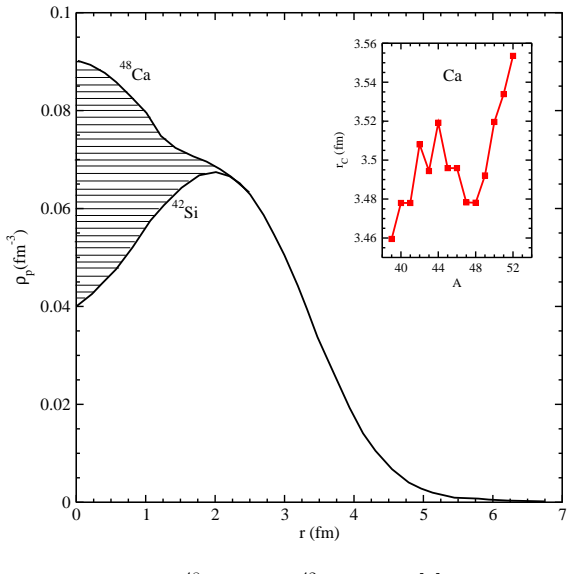
- [Eq. (3), Fig. 3 inset] No radius is computed from the model. Eq. (3) is a bookkeeping identity that re-expresses 48Ca as 40Ca plus eight quasi-neutrons, but the model does not specify the spatial wavefunction or density of the quasi-neutron component. The agreement with the experimental radii shown in the inset of Fig. 3 is visual only: there is no fitted or predicted numerical curve, no amplitude, and no uncertainty. The predictions for 54Ca and 60Ca are direct consequences of the assumed parabolic form with fixed endpoints, so they do not constitute an independent test of the tritonic mechanism.
- [Eq. (4) and preceding paragraph] The derivation of the effective charge 1/2 is definitional rather than explanatory. The text says that because charge transfer within a triton is isospin-independent, 'charge of a single quasi-neutron comes from the isoscalar part (Z+N)/2, and hence is of value 1/2'. The quantity (Z+N)/2 is a global isoscalar number, not a per-nucleon charge, and the conclusion that a quasi-neutron carries 1/2 simply assumes that the proton's single unit of charge is shared equally by the two neutrons. Eq. (4) then writes Q_n=0+1/2=1/2, i.e., the desired result is inserted at the start.
- [42Si discussion and Eq. (1)] The proposed duality between magicity/sphericity and strong deformation in 42Si is not given operational content. The paper states that the conflicting experimental results are 'complementary/dual' and draws an analogy with wave-particle duality, but no dual transformation, domain of validity, or quantitative relation between the (p,n) and triton descriptions is specified. As written, the duality is an interpretive claim that accommodates both experiments by asserting they are both correct, rather than a model prediction that could be falsified.
minor comments (4)
- [Eq. (1) and Fig. 1 caption] The isotope notation is inconsistent: '60 20Ca20 = 20t' appears in Eq. (1) and in the caption of Fig. 1, but 60Ca has N=40, not N=20; the correct expression should be 60 20Ca40 = 20t.
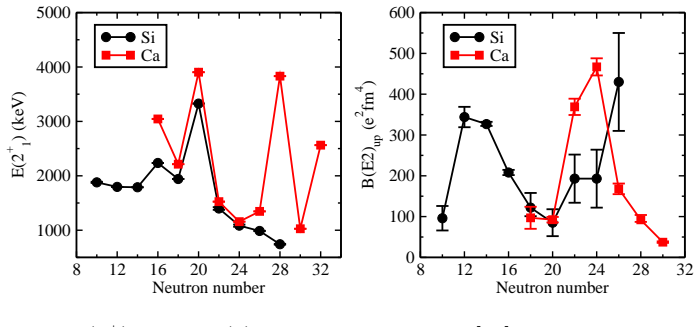
- [Fig. 2] The experimental E(2+) and B(E2) data in Fig. 2 are shown without error bars; since the argument depends on a 'sharp fall' and a 'gradual fall', error bars are needed to assess whether the claimed trends are significant.
- [Radii discussion, Eq. (5)] The relation 'radius ∝ F(F−1)' is dimensionally incomplete: an overall length scale is not specified or predicted, so the statement can at most describe the shape of a curve and not the magnitude of the radius change.
- [Abstract and introduction] The abstract introduces 52Ca as 'well known to be doubly magical' and then quotes Ref. [1] as saying that the large radius 'challenges the doubly magic nature of 52Ca'; a brief clarification of what remains doubly magic is needed.
Circularity Check
Central explanation is circular: Eq. (5) assumes R(48Ca)=R(40Ca) by defining a quasi-neutron term that vanishes at N=28 by construction.
-
self definitional
[Section on calcium radii, unnumbered Eq. (5) and preceding paragraph]
"first assuming that both 40-Ca and 48-Ca have the same radii, we correctly obtain the maximum radius at 44-Ca... we define total radius as... R(40+N 20 Ca20+N ) = R(40 20Ca20) + R(ν ′(f 7 2 ) N ) (5)... Thus the second term does not contribute to the N=20 and 28 cases. Therefore the radius of 48 20Ca 28 is the same as that of 40 20Ca 20."
The puzzle is that 48Ca has essentially the same charge radius as 40Ca. The paper explicitly assumes this equality, then defines Eq. (5) with a quasi-neutron term R(ν'(f7/2)^N) and asserts it does not contribute at N=20 and N=28. The vanishing at N=28 is exactly the statement R(48Ca)=R(40Ca). No independent derivation of this vanishing is given; the radius relation 'radius ∝ F(F−1)' imported from B(E2) systematics has a zero at F=1, which is precisely the conclusion being explained. Thus the premise and the conclusion are the same statement.
-
fitted input called prediction
[After Eq. (6), prediction section for 54Ca and 60Ca]
"for the radii, we have minimum values at the two extremes following the relation: radius R ∝ X(X − 1), where X is the fractional filling of the shells, which here is, X = (N −28)/12 ... Here we also make another significant prediction, that the radius of 60Ca should also be the same as that of 40Ca."
The prediction that R(60Ca)=R(40Ca) is built into the assumed parabolic relation R∝X(X−1), which vanishes at X=0 (N=28) and X=1 (N=40). The peak at X=1/2 corresponds to N=34, the midpoint of an assumed degenerate shell, selected to match the known large radii. These predictions are not independent consequences of the tritonic model; they are forced by the same functional form that was chosen to encode the empirical radii pattern, so calling them predictions is circular.
full rationale
The paper's central claim is that it explains the puzzling calcium radius data, specifically that R(48Ca)=R(40Ca) despite eight extra neutrons. The derivation is circular. The text first states, 'first assuming that both 40-Ca and 48-Ca have the same radii, we correctly obtain the maximum radius at 44-Ca', and then defines Eq. (5) in which the total radius is the sum of the 40Ca core radius and a quasi-neutron term. The quasi-neutron term is asserted to vanish at N=20 and N=28, which directly yields R(48Ca)=R(40Ca). The vanishing at N=28 is not derived from the tritonic model; it is the same empirical fact the paper set out to explain. The only justification offered is an analogy with B(E2) systematics, where B(E2)∝F(F−1) for a valence shell, and the radii are claimed to behave the same way. But the zero of that function at shell filling F=1 is precisely the assertion that the eight quasi-neutrons contribute nothing to the radius at N=28. Extending the same construction to N=28–40, the paper predicts R(60Ca)=R(40Ca) and a peak at N=34, but these are also encoded in the assumed X(X−1) form rather than derived. The effective charge of 1/2 is derived from the triton model's charge transfer, which is a model assumption rather than a circular step, but it does not rescue the radius derivation. Because the load-bearing explanation reduces to an assumption of the very equality it claims to derive, the circularity score is high. The paper is not self-contained against external benchmarks; it fits the data pattern by construction.
Assumptions & free parameters
free parameters (4)
- Radius parabola endpoints for the N=20 to 28 shell, F = (N-20)/8 =
N=20 and N=28 endpoints
- Upper valence shell for N=28 to 40, X = (N-28)/12 =
Shell from N=28 to N=40, midpoint N=34
- Amplitude of the quasi-neutron radius contribution =
Unspecified
- Quasi-neutron effective charge =
1/2
assumptions (5)
- ad hoc to paper Neutron-rich nuclei of the form ^(3Z)_Z X_(2Z) are bound states of Z elementary tritons (triton as elementary entity)
- ad hoc to paper Charge radius is additive: R(40+N Ca) = R(40Ca) + R(ν′(f7/2)^N), with the quasi-neutron term exactly zero at N=20 and N=28 (Eq. 5)
- domain assumption Charge radii in a valence shell follow B(E2) quadrupole systematics, radius ∝ F(F−1) and ∝ X(X−1)
- ad hoc to paper Charge transfer from proton to neutron within a triton is isospin-independent, so the quasi-neutron charge is 1/2
- standard math Standard shell model and effective-charge framework (de-Shalit)
invented entities (2)
-
Quasi-neutron ν′ (tritonic quasiparticle carrying electric charge 1/2)
-
Tritonic degree of freedom (elementary triton clusters inside neutron-rich nuclei)
Cite this review
Pith. "Pith review of Puzzling Radii of Calcium Isotopes: $^{40}{\rm Ca} \rightarrow ^{44}{\rm Ca} \rightarrow ^{48}{\rm Ca} \rightarrow ^{52}{\rm Ca}$, and Duality in the Structure of $^{42}_{14}{\rm Si}_{28}$ and $^{48}_{20}{\rm Ca}_{28}$." pith.science (2026). https://pith.science/paper/C6ACADK6
@misc{pith2026190804026,
  author       = {Pith},
  title        = {Pith review of: Puzzling Radii of Calcium Isotopes: $^40\rm Ca \rightarrow ^44\rm Ca \rightarrow ^48\rm Ca \rightarrow ^52\rm Ca$, and Duality in the Structure of $^42_14\rm Si_28$ and $^48_20\rm Ca_28$},
  year         = {2026},
  howpublished = {\url{https://pith.science/paper/C6ACADK6}},
  note         = {Machine review of arXiv:1908.04026}
}
abstract
In this paper we study the issue of the puzzle of the radii of calcium isotopes. Despite an excess of eight neutrons, strangely $^{48}{\rm Ca}$ exhibits essentially the same charge radius as $^{40}{\rm Ca}$ does. A fundamental microscopic description of this is still lacking. Also strange is a peak in charge radius of calcium at N = 24. The $^{52}{\rm Ca}$ (N = 32) nucleus, well known to be doubly magical, amazingly has recently been found to have a very large charge radius. Also amazing is the property of $^{42}_{14}{\rm Si}_{28}$ which simultaneously appears to be both magical/spherical and strongly deformed as well. We use a Quantum Chromodynamics based model, which treats triton as elementary entity to make up $^{42}_{14}{\rm Si}_{28}$. We show here how this QCD based model is able to provide a consistent physical understanding of simultaneity of magicity/sphericity and strong deformation of a single nucleus. This brings in an essential duality in the structure of $^{42}_{14}{\rm Si}_{28}$ and subsequently also that of $^{48}_{20}{\rm Ca}_{28}$ We also provide consistent understanding of the puzzling radii of calcium isotopes. We predict that the radius of $^{54}{\rm Ca}$ should be even bigger than that of $^{52}{\rm Ca}$; and also that the radius of $^{60}{\rm Ca}$ should be the same as that of $^{40}{\rm Ca}$. In addition we also show wherefrom arises the neutron E2 effective charge of $\frac{1}{2}$.
Figures

Reference graph
Works this paper leans on
-
[1]
(keV) Si Ca 8 12 16 20 24 28 32 Neutron number 0 100 200 300 400 500 600 B(E2)up (e 2 fm 4 ) Si Ca Figure 2: E(2+) and BE (2) experimental values [20] for isotopes of silicon and calcium . up regularly and uniformly. Thus all the complexity of the nucleus 42 14Si28, unlike that of nuclei P and S, appears to be making it look like 42 14Si28 = 34 14Si20 + ν...
-
[2]
These are counterpart of the quasi-protons [7], that were useful to explain the success of the Fridmann experiments [2,3]. Hence the concept of quasi-neut rons, in a conjugate/dual manner, should be able to explain the deformatio n picture of 42Si, as obtained by Bastin et al. [4] and Takeuchi et al. [5]. Next we look at Jurado et al. work on mass measure...
work page 2000
-
[3]
3, with the BE(2 ) values of the same nuclei in Fig
Compare the calcium radii as given in the inset in Fig. 3, with the BE(2 ) values of the same nuclei in Fig. 2. The similarity is striking, indication that the radii here re also behaving as a per above discussion on BE( 2) of calcium isotopes. Thus N = 20 → 28, in 48 20Ca28 → 40 20Ca20 + ν′(f 7 2 )N , for the radii, we have minimum values at the two extr...
- [4]
-
[5]
R. F. Garcia Ruiz, M. L. Bissell, K. Blaum, A. Ekstroem, N. Froem- mgen, G. Hagen, M. Hammen, K. Hebeler, J. D. Holt, G. R. Jansen, M . Kowalska, K. Kreim, W. Nazarewicz, R. Neugart, G. Neyens, W. Nrt er- shuser, T. Papenbrock, J. Papuga, A. Schwenk, J. Simonis, K. A. Wendt and D. T. Yordanov, Nat. Phys. 12 (2016) 594
work page 2016
- [6]
- [7]
-
[8]
S. A. Abbas, ”Fusion of halo nucleus....”, Mod. Phys. Lett. A - IN PRESS Aug. 2019; DOI: 10.1142/S0217732319502213
Show all 27 references
-
[9]
Takeuchi et al
S. Takeuchi et al. , Phys. Rev. Lett. 109 (2012) 182501
2012
-
[10]
Gade et al
A. Gade et al. , Phys. Rev. Lett. 122 (2019) 222501
2019
-
[11]
S. A. Abbas, A. A. Usmani, U. Rahaman, M. Ikram, arXiv:1907.103 42
1907
-
[12]
Abbas, Phys
A. Abbas, Phys. Lett. B 167 (1986) 150; Prog. Part. Nucl. Ph ys., 20 (1988) 181
1986
-
[13]
Raabe et al
R. Raabe et al. , Nature 431 (2004) 823
2004
-
[14]
Hinde and M
D. Hinde and M. Dasgupta, Nature 431 (2004) 748
2004
-
[15]
Abbas, Mod
A. Abbas, Mod. Phys. Lett. A 16 (2001) 755
2001
-
[16]
de-Shalit, Phys
A. de-Shalit, Phys. Rev. 113 (1959) 547
1959
-
[17]
S. A. Abbas, ”Group Theory in Particle, Nuclear, and Hadron Physics”, Taylor and Francis Group, USA, 2016
2016
-
[18]
A. A. Usmani, S. A. Abbas, U. Rahaman, M. Ikram and F. H. Bhat , Int. J. Mod. Phys. E 27 (2018) 1850060
2018
-
[19]
Jurado et al
B. Jurado et al. , Phys. Lett. B 649 (2007) 43
2007
-
[20]
Pritychenko et al
B. Pritychenko et al. , At. Data Nucl. Data Tables 107 (2016) 1
2016
-
[21]
Piekarewicz, J
J. Piekarewicz, J. Phys. G: Nucl. Part. Phys. 34 (2007) 467
2007
-
[22]
Satula, J
W. Satula, J. Dobaczewski, W. Nazarewicz,Phys. Rev. Lett. 81 (1998) 3599
1998
-
[23]
Dobaczewski, P
J. Dobaczewski, P. Magierski, W Nazarewicz, W. Satula, and Z. Szymanski, Phys. Rev. C 63 (2001) 024308
2001
-
[24]
Now for silicon identical behaviour at N = 22 and N = 24
Then 2 + for calcium first has a sharp fall at N = 22 and then a gradual fall to N = 24. Now for silicon identical behaviour at N = 22 and N = 24. But instead of upturn as for calcium at N = 24, in the silicon case the sa me gradual fall continues at N = 24, 26, and 28. As N = ...
-
[25]
Sorlin and M-G
O. Sorlin and M-G. Porquet, Phys. Scr. T152 (2013) 014003
2013
-
[26]
Zamick, M
L. Zamick, M. Golin and S. Moszkowski, Phys. Lett. B 66 (1977) 1 16; A. K. Dhar and K. H. Bhatt, Phys. Rev. C 16 (1977) 792; T. Minamiso no et al, Z. Naturforsch. 57 a (2002) 595; T. K. Alexander, B. Castel, I . S. Towner, Nucl. Phys. A 445 (1985) 189
1977
-
[27]
Abbas and L
A. Abbas and L. Zamick, Phys. Rev. C 21 (1980) 731 16
1980
Reviewed August 14, 2026 · model on record in the stance chip above.
Discussion (0). Continue with ORCID to comment.