REVIEW 3 major objections 4 minor 5 references
Resonant Far-Infrared Spectroscopy of Flat-Band Fermions in Magic Angle Graphene
T0 review · 3 major / 4 minor · reviewed 2026-08-16 · deepseek-v4-flash
Pith's one-line read Magic-angle graphene's flat bands emit bright far-infrared resonances explained by the topological heavy-fermion model.
desk verdict First real FIR spectra of MATBG flat bands and a genuinely new experimental capability, but the mode assignment leans on an uncalibrated photodetection chain and on THF parameters fitted to the very spectra they are asked to predict. read the letter →
The pith
A machine-rendered reading of the paper's core claim, the machinery that carries it, and where it could break.
The reading
What carries the argument
The load-bearing object is the topological heavy-fermion (THF) model, which decomposes the MATBG flat bands into itinerant topological Dirac fermions (c-electrons) and localized heavy fermions (f-electrons) at AA stacking sites, coupled by a momentum-dependent hybridization. The paper computes the optical conductivity of interacting Landau levels in this model and identifies the modes m1-m3 as bright c-to-c inter-Landau-level transitions across the hybridization gap, with frequencies set by f-electron interactions such as the Hubbard U1 and the c-f repulsions W1 and W3. In the rotationally invariant limit, an emergent SO(2) symmetry labels Landau levels by angular momentum m, and the Γ3 irreducible representation of the ΓM-point states shifts the conduction-band index by one, yielding the selection rule Δm = ±1. This machinery connects the spectra to microscopic interaction parameters and explains why the light c-sector dominates the optical response while the heavy f-sector renormalizes the resonance positions.
What would settle it
Measure the m1-m3 modes under circularly polarized far-infrared light at v=+4: the claimed Δm = ±1 selection rule predicts that left- and right-circular polarizations should excite different sets of inter-Landau-level transitions, so a null polarization dependence would refute the assignment. Alternatively, a device with a twist angle measurably further from the magic angle should show the predicted W3/U1-driven changes in the m1 slope and the m3 intercept, testing the c-f interaction picture without relying on the same fitted parameters.
Extended reading notes
Core claim
The central claim is that the observed far-infrared resonances in MATBG are genuine optical excitations of its interacting flat bands, and that the topological heavy-fermion model describes them quantitatively. At v=+4, the modes m1-m3 are bright inter-Landau-level transitions of the itinerant c-electrons, with energies renormalized by hybridization with localized f-electrons, and they obey the optical selection rule Δm = ±1. This selection rule is forced by an angular momentum offset at the ΓM point that originates from the Γ3 irreducible representation; without this offset, the negatively dispersing m1 mode would be dark, so the joint appearance of m1-m3 validates the hidden rotational symmetry. At charge neutrality, resonances centered around 12-24 meV lie below the on-site Coulomb energy U1 ~ 45 meV, indicating that they arise from many-body or composite modes rather than simple single-particle flat-band transitions, and an unidentified mode near 40 meV develops at high fields.
Load-bearing premise
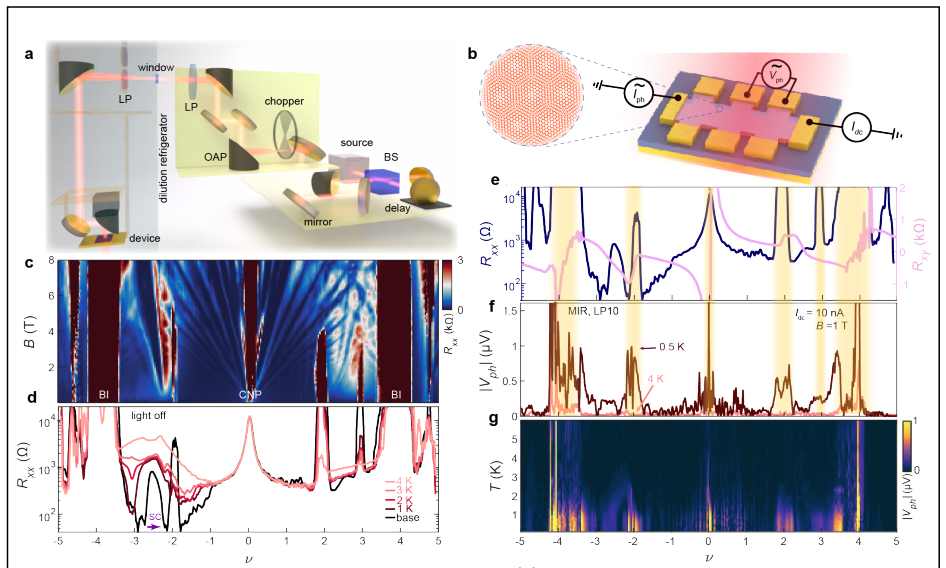
The inference that the measured photovoltage or photocurrent interferograms, after normalization by the blackbody spectrum, faithfully represent the optical absorption of the MATBG flat bands rests on the premise that no spurious wavelength-dependent bolometric, thermoelectric, or gate-dependent detection artifact shapes the spectra; this premise enters where the conductivity change due to light absorption is monitored via Iph or Vph in the Millikelvin FIR Spectroscopy section.
Editorial extensions
If this is right
- The v=+4 spectrum provides a direct measure of the interacting band structure: the negative magnetic-field slope of m1 bounds the interacting flat-band width from below, and the zero-field intercept of m3 measures the gap to the remote bands at the ΓM point.
- Because c-electrons dominate the optical coupling, the brightness pattern of the resonances (m3 strongest, m1 and m2 weaker) becomes a fingerprint of light-heavy hybridization, allowing interaction parameters such as W1, W3, and U1 to be extracted from spectroscopy.
- The selection rule Δm = ±1 with a Γ3-induced angular momentum offset is testable: without the offset, m1 would be dark, so the observation of m1-m3 together validates the hidden SO(2) organizing symmetry of the THF description.
- The platform extends resonant FIR spectroscopy into the millikelvin regime, making correlated insulator states and possibly superconductivity of small moiré devices accessible to optical study.
- At charge neutrality, the sub-U1 resonances indicate many-body modes distinct from single-particle flat-band transitions, and the unidentified high-field mode near 40 meV marks a concrete open problem for future theory.
Reading between the lines
- A natural extension is to apply the same c-antenna picture to other moiré flat-band systems such as twisted bilayer MoTe2: if the light-sector dominance is generic, their FIR spectra should also show sharp c-like transitions with energies renormalized by heavy-sector interactions, a prediction testable with the same platform.
- The Γ3 angular-momentum offset predicts a circular-dichroic signature: circularly polarized FIR should excite different inter-Landau-level transitions for left and right polarization, offering a direct way to map the hidden symmetry without relying on parameter fitting.
- The low-energy charge-neutrality resonances may be collective, flat-band exciton-like modes; a discriminating test would be to follow them under in-plane magnetic field or as a function of temperature, since single-particle c-to-c transitions and collective modes typically respond differently to these knobs.
Signed reviews
Editorial analysis
A structured set of objections, weighed in public.
Referee Report
Summary. The manuscript reports far-infrared (FIR) photocurrent and photovoltage spectroscopy of magic-angle twisted bilayer graphene (MATBG) at millikelvin temperatures, using a custom-built platform. At filling v=+4, the authors observe magnetic-field-dependent resonances (m1–m3) that they attribute to inter-Landau-level transitions of itinerant c-electrons renormalized by hybridization with localized f-electrons, based on calculations within the topological heavy-fermion (THF) model. They further extract an optical selection rule Δm=±1 that they trace to an angular momentum offset originating from the Γ3 irreducible representation. At charge neutrality, they report low-energy resonances below the on-site Coulomb energy, which they leave largely unexplained. The paper includes transport characterization of three devices and detailed THF simulations of the optical conductivity.
Significance. If the central assignment is correct, this work would constitute the first observation of characteristic FIR resonances of flat-band electrons in MATBG, providing direct spectroscopic access to the c-f hybridization and to the symmetry that organizes the low-energy states. The experimental platform itself, enabling FIR spectroscopy at millikelvin temperatures and in magnetic fields, is a valuable technical advance, and the use of three independent devices with consistent transport and photo-response data is a notable strength. The THF-based calculations are detailed and include parameter-sensitivity studies. However, the current evidence for the central claim is weakened by two load-bearing issues: the uncalibrated photodetection transfer function, and the fact that the THF parameters are fitted to the same spectra that are then presented as 'theoretical predictions.' These issues currently prevent the manuscript from fully establishing the uniqueness of the resonance assignment.
major comments (3)
- [Millikelvin FIR Spectroscopy (main text) and Fig. 3] The measured photocurrent/photovoltage is not demonstrated to be proportional to the intrinsic optical absorption of the MATBG flat bands. The spectra in Fig. 3 are normalized to their maximum value at each magnetic field, and the normalization by the blackbody source spectrum (Extended Data Fig. 3) removes only the source envelope, not the frequency-dependent detection efficiency of the bolometric/photothermoelectric response, the beam path, or the contacts. Because the same uncalibrated detection chain is used for all fillings and the device resistance at v=+4 is large and strongly temperature-dependent, the apparent resonances could in principle arise from gate-dependent bolometric sensitivity or from spectral features in the optical path. To support the assignment of m1–m3 to inter-Landau-level transitions, the authors should provide a reference measurement with a known flat spectral response (e.g., a bolometer in the same optical configuration, or a material with known FIR absorption) or otherwise calibrate the detection transfer function.
- [Fig. 3c and Extended Data Table 1] The gray curves labeled 'theoretical prediction' in Fig. 3c are not independent predictions: the THF parameters in Extended Data Table 1 are obtained by best fitting to the same experimental spectra, as stated in the main text ('systematic extraction of interacting parameters by best fitting to experimental spectra'). The agreement therefore reflects a fit, and the statement 'remarkable agreement with the experimental data' overstates the evidential value. To make the comparison meaningful, the authors should either perform an out-of-sample test (e.g., using the D2 parameters to predict the D1 spectra, or predicting the v=-4 spectra or CNP response) or explicitly present the curves as fits and quantify the parameter uncertainties and degeneracies.
- [Fig. 3h and 'Optical Selection Rules'] The optical selection rule Δm=±1 and the angular momentum offset from the Γ3 irrep are derived within the same fitted THF model. Because the model's parameters are adjusted to reproduce the observed peak positions, the selection-rule assignment is not independently corroborated; for example, the claim that the m1 mode would be dark without the offset depends on the fitted band structure and matrix elements. An independent symmetry-based argument, or a calculation using parameters constrained by other measurements (e.g., transport or QTM data), would strengthen this central conclusion.
minor comments (4)
- [Abstract and Introduction] The phrase 'an record electron temperature' should read 'a record electron temperature'.
- [Fig. 3c] The term 'theoretical prediction' in the figure caption is misleading given that the parameters are fitted to the experiment; consider replacing with 'best-fit calculation'.
- [Extended Data Table 1] The table lists parameter values such as n* = -4658.0 and n'* = 1671.0 without explicit units; please state the units (e.g., meV for energies, or the appropriate THF-model units) in the table caption.
- [Fig. 4 and CNP discussion] The CNP resonances are presented without a model, and the text explicitly states 'we currently do not understand its exact origin.' This is acceptable for a reported observation, but the statement 'new many-body modes' in the abstract is somewhat stronger than the evidence presented; consider softening it.
Circularity Check
The quantitative 'theoretical prediction' for the v=+4 modes is generated from THF parameters best-fit to the same experimental spectra, so the agreement is partly by construction.
-
fitted input called prediction
[The step appears in the Fig. 3c caption and in the 'Signatures of Light and Heavy-Fermions' section of the main text, around the discussion of Extended Data Table 1.]
"The theoretical prediction for these excitations (m1-m3, extracted from e) is presented by the gray curves. In the main text: 'The simulation (Extended Data Figs. 7 & 8), which includes lattice relaxation, shows remarkable agreement with the experimental data (m1-m3 modes)...' and 'The conclusion is further supported by a systematic extraction of interacting parameters by best fitting to experimental spectra (Extended Data Table 1).'"
The gray 'theoretical prediction' curves in Fig. 3c come from the THF simulation whose parameters were best-fit to the same experimental spectra (Extended Data Table 1; dielectric constant optimized in Extended Data Fig. 8). The computed m1-m3 energies therefore agree with the measured peaks by construction, so this agreement is an in-sample fit, not an independent prediction. The paper uses that agreement as the main evidence that the modes are bright c-electron inter-Landau-level transitions renormalized by f-hybridization; that attribution is not independently confirmed by the quoted match. The selection rule and the negative slope of m1 are further model-based interpretations, but the quantitative validation is partly circular.
full rationale
The experimental part of the paper is not circular: the photovoltage/photocurrent interferograms are new data, and the filling- and field-dependent resonances are genuine observations. The circularity is confined to the modeling loop. The THF model parameters are fit to the very spectra they are then used to 'predict' (Fig. 3c gray curves and Extended Data Table 1), so the quantitative match does not independently confirm the c/f assignment. The paper's self-citations to the THF framework (refs 22-25, which include overlapping authors) are not in themselves circular, since that framework is prior published work with external constraints; however, the present paper's load-bearing quantitative claim relies on parameters extracted from the target data. The uncalibrated photovoltage transfer function is a correctness risk about whether the peaks are absorption features, but it is not a circularity of the derivation chain, so it is not scored here. Overall, the central observation stands, but the 'theoretical prediction' of the mode energies is partly by construction, giving partial circularity.
Assumptions & free parameters
free parameters (13)
- lambda (f-electron Wannier localization length) =
D1: 0.359, D2: 0.353
- n* (c-electron velocity) =
D1: -4658.0, D2: -4510.0
- n'* (momentum-dependent f-c hybridization) =
D1: 1671.0, D2: 1631.0
- g (f-c hybridization at Gamma_M) =
D1: -49.66, D2: -40.59
- M (splitting of G1 and G2 c-electrons) =
D1: 3.25, D2: 2.04
- U1 (on-site Hubbard repulsion on f-electrons) =
D1: 48.49, D2: 45.52 (meV)
- U2 (nearest-neighbor Hubbard repulsion) =
D1: 4.28, D2: 3.07
- W1 (repulsion between f and G3 c-electrons) =
D1: 62.74, D2: 48.42
- W3 (repulsion between f and G1 c-electrons) =
D1: 65.96, D2: 52.37
- J (exchange interaction between f and Gamma_1 c-electrons) =
D1: 16.10, D2: 14.54
- mu1 (local chemical potential shift to Gamma_3 c-electrons) =
D1: 10.8, D2: 28.8
- mu2 (local chemical potential shift to Gamma_1+Gamma_2 c-electrons) =
D1: 5.0, D2: 5.0
- Dielectric constant epsilon (screening environment) =
Optimized between 4 and 10 per device (Extended Data Fig. 8)
assumptions (5)
- domain assumption The topological heavy-fermion model correctly describes the low-energy physics of MATBG.
- domain assumption The f-electron velocity operator is negligible, so optical coupling is dominated by c-electrons.
- domain assumption An emergent SO(2) rotational symmetry holds at integer fillings, with the Gamma_3 irrep producing an angular momentum offset of 1.
- domain assumption The THF model can be canonically quantized in a magnetic field without solving the full Hofstadter problem, controlled at low B.
- domain assumption Photocurrent and photovoltage signals are proportional to the optical absorption of the MATBG channel.
Cite this review
Pith. "Pith review of Resonant Far-Infrared Spectroscopy of Flat-Band Fermions in Magic Angle Graphene." pith.science (2026). https://pith.science/paper/C6B5L5DB
@misc{pith2026260812553,
  author       = {Pith},
  title        = {Pith review of: Resonant Far-Infrared Spectroscopy of Flat-Band Fermions in Magic Angle Graphene},
  year         = {2026},
  howpublished = {\url{https://pith.science/paper/C6B5L5DB}},
  note         = {Machine review of arXiv:2608.12553}
}
read the original abstract
Moir\'e engineering in twisted two-dimensional (2D) materials radically alters low-energy bands, interactions and topological quantum states. Despite extensive studies, optical spectroscopy of interacting moir\'e bands in the characteristic far-infrared (FIR) regime has remained largely unexplored due to extreme experimental challenges. Using a newly developed millikelvin FIR platform, we report the observation of the long-sought-after characteristic FIR resonances of flat-band electrons in magic-angle twisted bilayer graphene (MATBG). We observe highly tunable spectroscopic signatures of interacting light and heavy fermions that constitute the flat bands in MATBG. Using the topological heavy-fermion model (THF), we show that itinerant topological electrons act as an "antenna" that couples strongly to the optical field, with resonant frequencies renormalized by the hybridization with localized heavy electrons. We establish optical selection rules of MATBG which uncovers the key symmetry governing light-heavy fermion hybridization. At charge neutrality, we observe pronounced resonances at energies below the on-site Coulomb energy, implying the emergence of new many-body modes. Our experiments and modeling provide a fundamental understanding of light-matter interactions in MATBG and enable resonant optical spectroscopy of moir\'e bands down to millikelvin temperatures.
Figures
Reference graph
Works this paper leans on
-
[2]
as well as the recent QTM measurements64. The QTM experiments revealed an anomalous low energy mode64 which may further complicate the interpretation of optical resonances in this regime. However, we note that our observation of strong low energy optical resonances is consistent with the recent predictions that the c sector excitations remain sharp67–69. ...
work page 2013
-
[14]
Serlin, M. et al. Intrinsic Quantized Anomalous Hall Effect in a Moiré Heterostructure. Science 367, 900-903 (2020). 15. Sharpe, A. L. et al. Emergent Ferromagnetism near Three-Quarters Filling in Twisted Bilayer Graphene. Science 365, 605-608 (2019). 16. Wong, D. et al. Cascade of electronic transitions in magic-angle twisted bilayer graphene. Nature 582...
work page 2020
-
[34]
Faugeras, C. et al. Landau level spectroscopy of electron-electron interactions in graphene. Phys. Rev. Lett. 114, (2015). 35. Pack, J. et al. Broken Symmetries and Kohn’s Theorem in Graphene Cyclotron Resonance. Phys. Rev. X 10, (2020). 36. Kumar, A., Xie, M. & MacDonald, A. H. Lattice collective modes from a continuum model of magic-angle twisted bilaye...
arXiv 2015
-
[55]
E., Soejima, T., Hauschild, J., Zaletel, M
Parker, D. E., Soejima, T., Hauschild, J., Zaletel, M. P. & Bultinck, N. Strain-Induced Quantum Phase Transitions in Magic-Angle Graphene. Phys. Rev. Lett. 127, (2021). 56. Saito, Y., Ge, J., Watanabe, K., Taniguchi, T. & Young, A. F. Independent superconductors and correlated insulators in twisted bilayer graphene. Nat. Phys. 16, 926–930 (2020). 57. Zhan...
arXiv 2021
-
[75]
Ledwith, P. J., Dong, J., Vishwanath, A. & Khalaf, E. Nonlocal Moments and Mott Semimetal in the Chern Bands of Twisted Bilayer Graphene. Phys. Rev. X 15, 021087 (2025). 76. Hu, H., Song, Z.-D. & Bernevig, B. A. Projected and Solvable Topological Heavy Fermion Model of Twisted Bilayer Graphene. arXiv.2502.14039 (2025). 77. Xie, H.-Y., Ghaemi, P., Mitrano,...
arXiv 2025
Reviewed August 16, 2026 · model on record in the stance chip above.
Discussion (0). Continue with ORCID to comment.