An Extensible and Lightweight Unified Architecture for Demosaicing Pixel-bin Image Sensors
Pith reviewed 2026-06-27 07:17 UTC · model grok-4.3
The pith
A single modular architecture demosaics multiple pixel-bin sensor types with higher image quality than specialized models.
A machine-rendered reading of the paper's core claim, the machinery that carries it, and where it could break.
Core claim
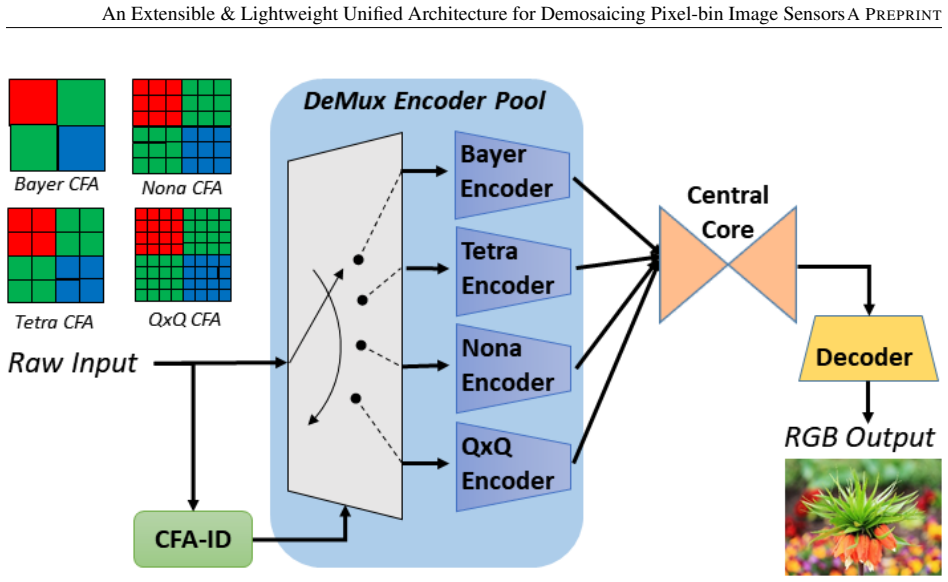
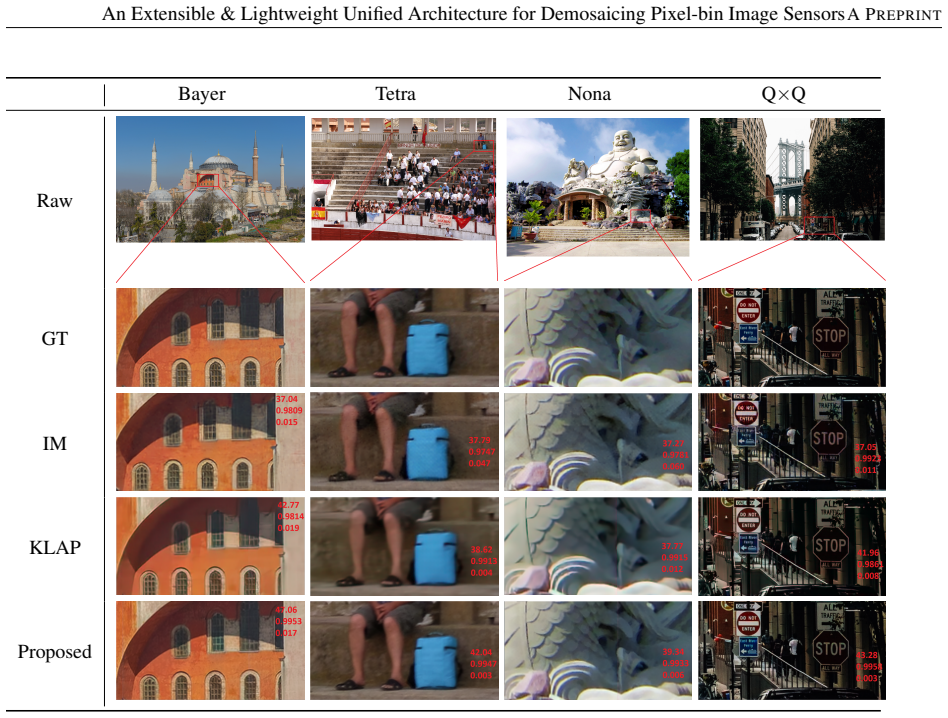
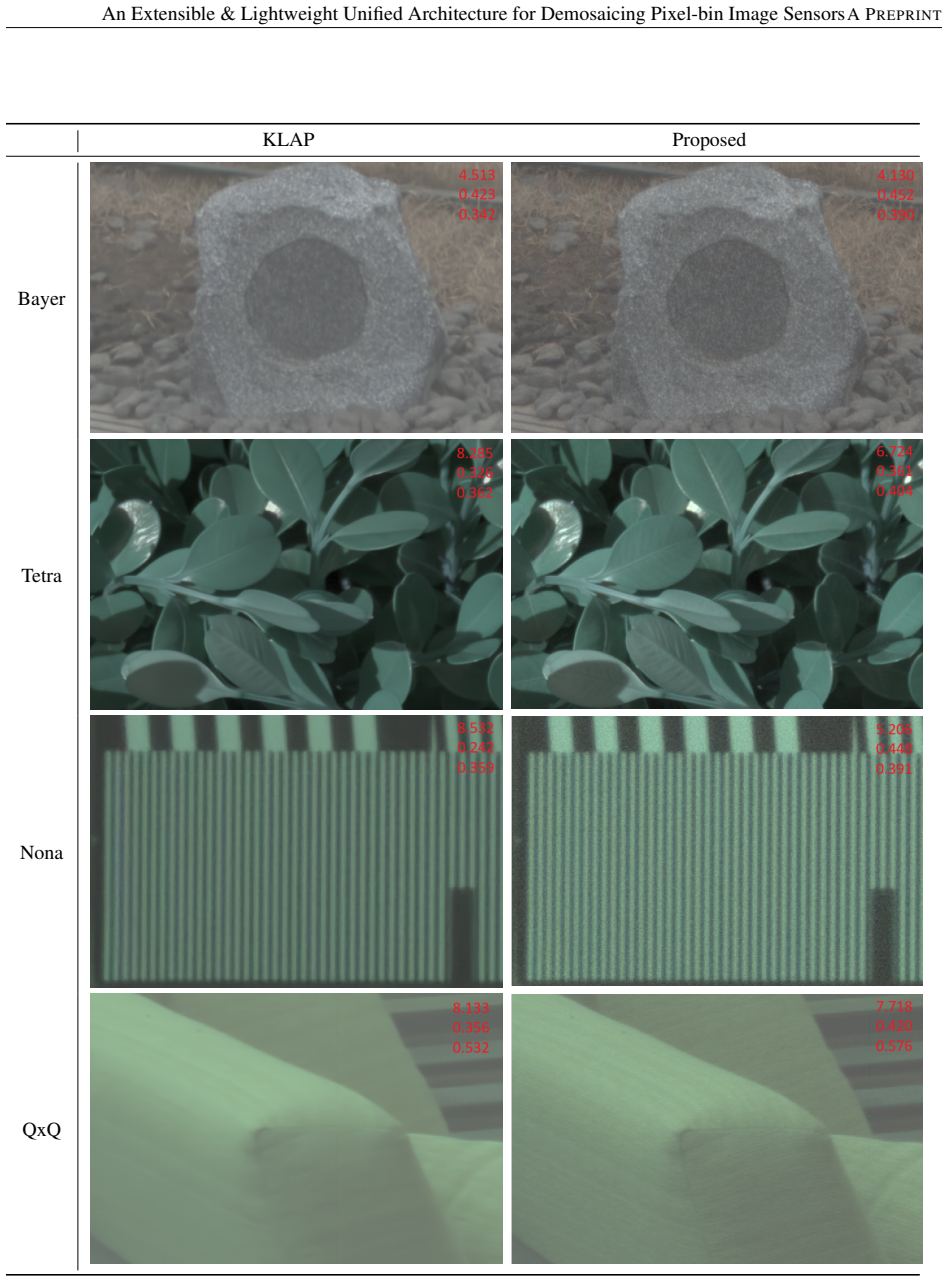
The authors present a modular unified architecture for demosaicing pixel-bin image sensors that achieves higher image quality than CFA-specific methods, remains lightweight and extensible to new patterns, and incorporates a learning-free CFA-identification module that accurately detects the color filter array type from raw input to enable seamless operation across sensor types.
What carries the argument
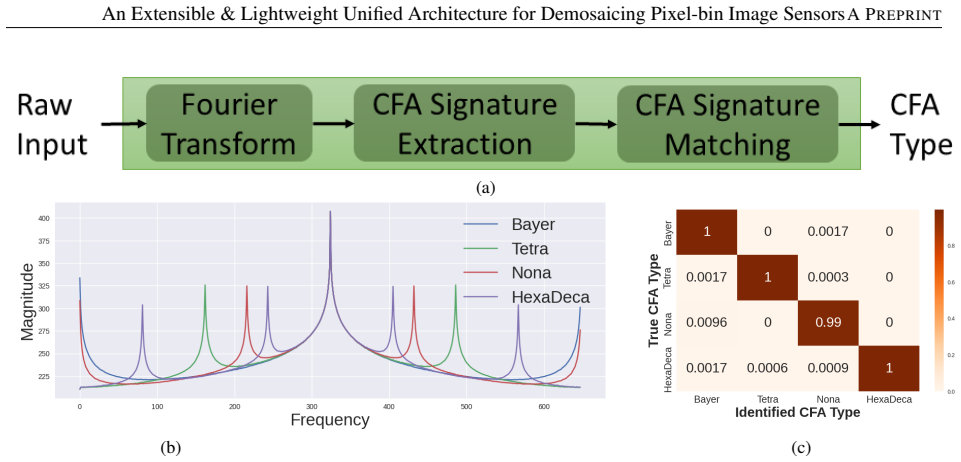
The modular unified demosaicing architecture paired with the learning-free CFA-identification module, which allows the system to adapt to different pixel-bin CFA patterns without retraining or separate models.
If this is right
- A single trained model can replace the set of separate models now required for each CFA variant.
- On-device memory and compute budgets for demosaicing drop because only one network is loaded.
- New sensor patterns can be added by extending the modular blocks rather than training and shipping an additional model.
- Raw data from any supported sensor can be processed immediately once the CFA type is identified automatically.
- Development effort for supporting future pixel-bin sensors is reduced to architecture extension instead of full model retraining.
Where Pith is reading between the lines
- The same modular structure could be reused when new pixel-bin layouts appear in future phone generations without rewriting the entire pipeline.
- Integration into camera firmware might lower the cost of supporting multiple sensor suppliers in a single device line.
- The learning-free identification step could be inserted upstream of other raw-processing stages that also depend on knowing the CFA layout.
- A natural next measurement would be to count the actual memory footprint and inference time when the unified model runs on representative mobile hardware.
Load-bearing premise
That one modular architecture can be extended across different pixel-bin sensor patterns while still delivering higher image quality than specialized per-CFA models.
What would settle it
A side-by-side test on real raw captures from several pixel-bin sensors that measures whether the unified model exceeds the quality of per-CFA baselines and whether the identification module labels every CFA type correctly with no errors.
Figures
read the original abstract
Pixel-bin image sensors are becoming the default choice for smartphone cameras due to their resolution vs light-gathering trade-off. However, their larger inter-color separation compared to the Bayer color filter array (CFA) makes them challenging to demosaic. Furthermore, existing deep learning-based demosaicing methods are CFA-specific, requiring multiple individual models that take up precious onboard resources and demand larger development and maintenance efforts. In this work, we propose a modular unified architecture for demosaicing various pixel-bin sensors that provides higher image quality while being extensible and lightweight. Additionally, to enable plug-and-play operation, we introduce a learning-free CFA-identification module to detect the CFA type of raw data accurately.
Editorial analysis
A structured set of objections, weighed in public.
Referee Report
Summary. The paper proposes a modular unified architecture for demosaicing pixel-bin image sensors that is claimed to deliver higher image quality than existing CFA-specific deep models while remaining extensible and lightweight. It additionally introduces a learning-free CFA-identification module to enable accurate, plug-and-play detection of CFA type from raw data.
Significance. If the central claims hold, the work could meaningfully reduce the need for multiple per-CFA models in resource-constrained smartphone pipelines, lowering memory footprint and maintenance overhead. The learning-free identification component would further support practical deployment across varying sensor patterns.
major comments (2)
- [Abstract] The central claim that a single modular architecture outperforms per-CFA specialist models across multiple pixel-bin patterns (Abstract) is load-bearing but unsupported by any quantitative comparison or ablation in the provided text; the results section must demonstrate that generalization does not incur quality loss relative to dedicated baselines.
- [Abstract] The learning-free CFA-identification module is asserted to detect CFA types 'accurately' on real-world raw data (Abstract), yet no error rates, confusion matrices, or robustness tests on noisy or varied raw inputs are referenced; failure here would directly degrade downstream demosaicing quality.
minor comments (1)
- Notation for the modular components and CFA patterns should be introduced with explicit definitions early in the manuscript to improve readability.
Simulated Author's Rebuttal
We thank the referee for the detailed and constructive feedback. The comments highlight the need for stronger empirical validation of the central claims. We address each point below and commit to revisions that add the requested quantitative evidence without altering the core contributions.
read point-by-point responses
-
Referee: [Abstract] The central claim that a single modular architecture outperforms per-CFA specialist models across multiple pixel-bin patterns (Abstract) is load-bearing but unsupported by any quantitative comparison or ablation in the provided text; the results section must demonstrate that generalization does not incur quality loss relative to dedicated baselines.
Authors: We agree that the abstract claim requires direct supporting evidence. The manuscript presents the unified architecture and its extensibility but does not include the requested head-to-head quantitative comparisons. In the revised version we will expand the experimental section with PSNR/SSIM tables and ablations comparing the single modular model against dedicated per-CFA baselines on multiple pixel-bin patterns, explicitly demonstrating that generalization incurs no quality loss. revision: yes
-
Referee: [Abstract] The learning-free CFA-identification module is asserted to detect CFA types 'accurately' on real-world raw data (Abstract), yet no error rates, confusion matrices, or robustness tests on noisy or varied raw inputs are referenced; failure here would directly degrade downstream demosaicing quality.
Authors: We acknowledge that accuracy claims for the identification module must be backed by quantitative metrics. The current text describes the learning-free approach but omits error rates and robustness analysis. The revision will add error rates, confusion matrices evaluated on real-world raw data, and additional tests under varying noise levels and sensor conditions to confirm reliable detection before demosaicing. revision: yes
Circularity Check
No circularity in proposed modular architecture or identification module
full rationale
The paper presents a new modular unified architecture for demosaicing pixel-bin sensors and a separate learning-free CFA-identification module as independent design contributions. These are framed as engineering choices for extensibility, lightness, and plug-and-play operation rather than any derived quantity, fitted parameter, or first-principles result that reduces to its own inputs. No equations, self-citations, or uniqueness theorems are invoked in a load-bearing way that would create circularity. The claims rest on empirical performance comparisons, which are external to the design itself and therefore self-contained.
Axiom & Free-Parameter Ledger
axioms (1)
- domain assumption Pixel-bin image sensors have larger inter-color separation than Bayer CFA, making demosaicing more challenging.
Reference graph
Works this paper leans on
-
[1]
United States Patent, no
Apparatus and method for adaptively interpolating a full color image utilizing chrominance gradients , author=. United States Patent, no. 5373322 , year=
-
[2]
1997 , publisher=
Adaptive color plane interpolation in single sensor color electronic camera , author=. 1997 , publisher=
1997
-
[3]
IEEE Transactions on Consumer Electronics , volume=
Adaptive demosaicing with the principal vector method , author=. IEEE Transactions on Consumer Electronics , volume=. 2002 , publisher=
2002
-
[4]
IEEE Transactions on Image Processing , volume=
Demosaicing using optimal recovery , author=. IEEE Transactions on Image Processing , volume=. 2005 , publisher=
2005
-
[5]
IEEE transactions on image processing , volume=
New edge-directed interpolation , author=. IEEE transactions on image processing , volume=. 2001 , publisher=
2001
-
[6]
Visual Communications and Image Processing 2008 , volume=
Image demosaicing: A systematic survey , author=. Visual Communications and Image Processing 2008 , volume=. 2008 , organization=
2008
-
[7]
Visual Comm
Image demosaicing: A systematic survey , author=. Visual Comm. and Image Processing 2008 , volume=. 2008 , organization=
2008
-
[8]
Electronic Imaging , volume=
Deep image demosaicing for submicron image sensors , author=. Electronic Imaging , volume=. 2019 , publisher=
2019
-
[9]
Proceedings of the IEEE/CVF conference on computer vision and pattern recognition , pages=
Beyond joint demosaicking and denoising: An image processing pipeline for a pixel-bin image sensor , author=. Proceedings of the IEEE/CVF conference on computer vision and pattern recognition , pages=
-
[10]
Proceedings of the IEEE/CVF CVPR , pages=
Beyond joint demosaicking and denoising: An image processing pipeline for a pixel-bin image sensor , author=. Proceedings of the IEEE/CVF CVPR , pages=
-
[11]
European Conference on Computer Vision , pages=
Mipi 2022 challenge on quad-bayer re-mosaic: Dataset and report , author=. European Conference on Computer Vision , pages=. 2022 , organization=
2022
-
[12]
2023 IEEE International Conference on Image Processing (ICIP) , pages=
Joint demosaicing and denoising with gradient guidance in quad Bayer CFA , author=. 2023 IEEE International Conference on Image Processing (ICIP) , pages=. 2023 , organization=
2023
-
[13]
Proceedings of the AAAI Conference on Artificial Intelligence , volume=
Quad Bayer Joint Demosaicing and Denoising Based on Dual Encoder Network with Joint Residual Learning , author=. Proceedings of the AAAI Conference on Artificial Intelligence , volume=
-
[14]
Proceedings of the AAAI Conference , volume=
Quad Bayer Joint Demosaicing and Denoising Based on Dual Encoder Network with Joint Residual Learning , author=. Proceedings of the AAAI Conference , volume=
-
[15]
2021 ieee region 10 symposium (tensymp) , pages=
On recent results in demosaicing of Samsung 108MP CMOS sensor using deep learning , author=. 2021 ieee region 10 symposium (tensymp) , pages=. 2021 , organization=
2021
-
[16]
IEEE Access , volume=
PyNET-Q Q: An Efficient PyNET Variant for Q Q Bayer Pattern Demosaicing in CMOS Image Sensors , author=. IEEE Access , volume=. 2023 , publisher=
2023
-
[17]
Proceedings of the IEEE/CVF International Conference on Computer Vision , pages=
Efficient Unified Demosaicing for Bayer and Non-Bayer Patterned Image Sensors , author=. Proceedings of the IEEE/CVF International Conference on Computer Vision , pages=
-
[18]
Proceedings of the IEEE/CVF ICCV , pages=
Efficient Unified Demosaicing for Bayer and Non-Bayer Patterned Image Sensors , author=. Proceedings of the IEEE/CVF ICCV , pages=
-
[19]
IEEE transactions on knowledge and data engineering , volume=
A survey on multi-task learning , author=. IEEE transactions on knowledge and data engineering , volume=. 2021 , publisher=
2021
-
[20]
Artificial neural networks , pages=
Siamese neural networks: An overview , author=. Artificial neural networks , pages=. 2021 , publisher=
2021
-
[21]
ECCV Workshop , year =
MIPI 2022 Challenge on Quad-Bayer Re-mosaic: Dataset and Report , author =. ECCV Workshop , year =
2022
-
[22]
Proceedings of the IEEE/CVF conference on computer vision and pattern recognition , pages=
Unprocessing images for learned raw denoising , author=. Proceedings of the IEEE/CVF conference on computer vision and pattern recognition , pages=
-
[23]
Proceedings of the IEEE/CVF conference on CVPR , pages=
Unprocessing images for learned raw denoising , author=. Proceedings of the IEEE/CVF conference on CVPR , pages=
-
[24]
ACM Computing Surveys , volume=
ISP Meets Deep Learning: A Survey on Deep Learning Methods for Image Signal Processing , author=. ACM Computing Surveys , volume=. 2025 , publisher=
2025
-
[25]
2013 , month=jun # " 11", publisher=
Method and apparatus for improving low-light performance for small pixel image sensors , author=. 2013 , month=jun # " 11", publisher=
2013
-
[26]
Digital Photography II , volume=
Improving low-light CMOS performance with four-transistor four-shared pixel architecture and charge-domain binning , author=. Digital Photography II , volume=. 2006 , organization=
2006
-
[27]
British Machine Vision Conference , year=
SAGAN: Adversarial Spatial-asymmetric Attention for Noisy Nona-Bayer Reconstruction , author=. British Machine Vision Conference , year=
-
[28]
Proceedings of the IEEE/CVF conference on computer vision and pattern recognition workshops , pages=
Replacing mobile camera isp with a single deep learning model , author=. Proceedings of the IEEE/CVF conference on computer vision and pattern recognition workshops , pages=
-
[29]
1976 , month=jul # " 20", note=
Color imaging array , author=. 1976 , month=jul # " 20", note=
1976
-
[30]
DTDeMo: A Deep Learning-Based Two-Stage Image Demosaicing Model With Interpolation and Enhancement , year=
Hou, Jingchao and Gendy, Garas and Chen, Guo and Wang, Liangchao and He, Guanghui , journal=. DTDeMo: A Deep Learning-Based Two-Stage Image Demosaicing Model With Interpolation and Enhancement , year=
-
[31]
IEEE Transactions on computational imaging , volume=
Loss functions for image restoration with neural networks , author=. IEEE Transactions on computational imaging , volume=. 2016 , publisher=
2016
-
[32]
Adam: A Method for Stochastic Optimization
Adam: A method for stochastic optimization , author=. arXiv preprint arXiv:1412.6980 , year=
work page internal anchor Pith review Pith/arXiv arXiv
-
[33]
On weight initialization in deep neural networks
On weight initialization in deep neural networks , author=. arXiv preprint arXiv:1704.08863 , year=
work page internal anchor Pith review Pith/arXiv arXiv
-
[34]
The IEEE Conference on Computer Vision and Pattern Recognition (CVPR) Workshops , month =
Agustsson, Eirikur and Timofte, Radu , title =. The IEEE Conference on Computer Vision and Pattern Recognition (CVPR) Workshops , month =
-
[35]
Martin and C
D. Martin and C. Fowlkes and D. Tal and J. Malik , title =. Proc. 8th Int'l Conf. Computer Vision , year =
-
[36]
Proceedings of the IEEE conference on computer vision and pattern recognition , pages=
Single image super-resolution from transformed self-exemplars , author=. Proceedings of the IEEE conference on computer vision and pattern recognition , pages=
-
[37]
Proceedings of the IEEE CVPR , pages=
Single image super-resolution from transformed self-exemplars , author=. Proceedings of the IEEE CVPR , pages=
-
[38]
and Bovik, Alan C
Mittal, Anish and Moorthy, Anush K. and Bovik, Alan C. , booktitle=. Blind/Referenceless Image Spatial Quality Evaluator , year=
-
[39]
completely blind
Making a “completely blind” image quality analyzer , author=. IEEE Signal processing letters , volume=. 2012 , publisher=
2012
-
[40]
completely blind
Making a “completely blind” image quality analyzer , author=. IEEE Signal processing lett. , volume=. 2012 , publisher=
2012
-
[41]
Proceedings of the IEEE/CVF Winter Conference on Applications of Computer Vision , pages=
Arniqa: Learning distortion manifold for image quality assessment , author=. Proceedings of the IEEE/CVF Winter Conference on Applications of Computer Vision , pages=
-
[42]
2023 IEEE/CVF Conference on Computer Vision and Pattern Recognition (CVPR) , pages=
All-in-one image restoration for unknown degradations using adaptive discriminative filters for specific degradations , author=. 2023 IEEE/CVF Conference on Computer Vision and Pattern Recognition (CVPR) , pages=. 2023 , organization=
2023
-
[43]
Proceedings of IEEE/CVF CVPR , pages=
All-in-one image restoration for unknown degradations using adaptive discriminative filters for specific degradations , author=. Proceedings of IEEE/CVF CVPR , pages=. 2023 , organization=
2023
-
[44]
2025 IEEE International Conference on Computational Photography (ICCP) , pages=
Examining Joint Demosaicing and Denoising for Single-, Quad-, and Nona-Bayer Patterns , author=. 2025 IEEE International Conference on Computational Photography (ICCP) , pages=. 2025 , organization=
2025
-
[45]
Proceedings of the IEEE conference on computer vision and pattern recognition , pages=
Convolutional neural networks for no-reference image quality assessment , author=. Proceedings of the IEEE conference on computer vision and pattern recognition , pages=
discussion (0)
Sign in with ORCID, Apple, or X to comment. Anyone can read and Pith papers without signing in.