REVIEW 4 major objections 4 minor 15 references
Beyond Squeezing \`a la Virasoro Algebra
T0 review · 4 major / 4 minor · reviewed 2026-08-14 · deepseek-v4-flash
Pith's one-line read At small squeeze, higher-order squeezing yields more particles
desk verdict The Virasoro framing of higher-order squeezing is a neat idea, but the central particle-number formula is contradicted by the paper's own exact n=2 result, so the main claim is unsupported. read the letter →
The pith
A machine-rendered reading of the paper's core claim, the machinery that carries it, and where it could break.
The reading
What carries the argument
The load-bearing object is the family of operators $L_n = -\frac{i}{2}(x^{n+1}p+p x^{n+1})$, claimed to satisfy the centerless Virasoro (Witt) algebra $[L_n,L_m]=(n-m)L_{n+m}$. These operators act as local scale deformations on $x$ and $p$, with the usual squeezing operator recovered at $n=0$. The argument then uses the generalized Bogoliubov-like transformation induced by $e^{\theta L_n}$ on the annihilation operator, encoded in the operator functions $\hat\Omega(n,\hat x)$ and $\hat K(n,\hat x)$, to reduce the expectation value of the number operator in $|\theta\rangle_n$ to a one-dimensional integral (17); expanding that integral in $\theta$ yields the central formula (18).
What would settle it
Compute the commutator $[L_n,L_m]$ explicitly with the ordering $L_n=-\frac{i}{2}(x^{n+1}p+p x^{n+1})$: a nonzero central term, or a failure of the identity $[L_n,L_m]=(n-m)L_{n+m}$, would invalidate Eqs. (14)-(18). An independent cross-check is to compare the exact integral (17) with the small-$\theta$ expansion (18) for $n=2$ and $n=4$ numerically; any discrepancy at order $\theta^2$ would indicate an error in the Bogoliubov coefficients or the expansion.
Extended reading notes
Core claim
On its own terms, the paper establishes that the N-th order squeezing operator $e^{\theta L_n}$ generated by the centerless Virasoro algebra produces a squeezed state whose particle content, for small $\theta$, is governed by Eq. (18), with leading term proportional to $\theta^2 (n+2)^2 \Gamma((n+1)/2)$. Since this leading coefficient increases with $n$, higher-order squeezing generates more particles for the same small parameter than the standard $n=0$ squeezing. The derivation runs through a generalized Bogoliubov transformation for the operators $a_\theta = e^{-\theta L_n} a e^{\theta L_n}$, expressed through the functions $\hat\Omega(n,x) = \log(1+n\theta x^n)/(n-1/2)$ and $\hat K(n,x) = (1+n\theta x^n)^{1/2}$, and connects time evolution under a time-dependent anharmonic oscillator with potential $\lambda(t)x^{n+2}$ to a product of successive N-th order squeezing operators. The paper also derives the perturbative uncertainty product and the Husimi phase-space function for these states.
Load-bearing premise
The load-bearing premise is that the symmetric operator ordering in Eq. (1) gives the centerless Virasoro algebra without a central charge; as the paper's footnote admits, a more detailed analysis could introduce a central term that would change all subsequent transformations and particle-number formulas.
Editorial extensions
If this is right
- Time-dependent potentials of the form $x^{n+2}$ should produce more particles at small squeezing parameter than the standard quadratic squeezing potential, with the leading count set by $\theta^2(n+2)^2\Gamma((n+1)/2)/4$.
- The N-th order squeezed state does not preserve the minimum uncertainty product; the first correction is linear in $\theta$ for even $n$ and quadratic for odd $n$.
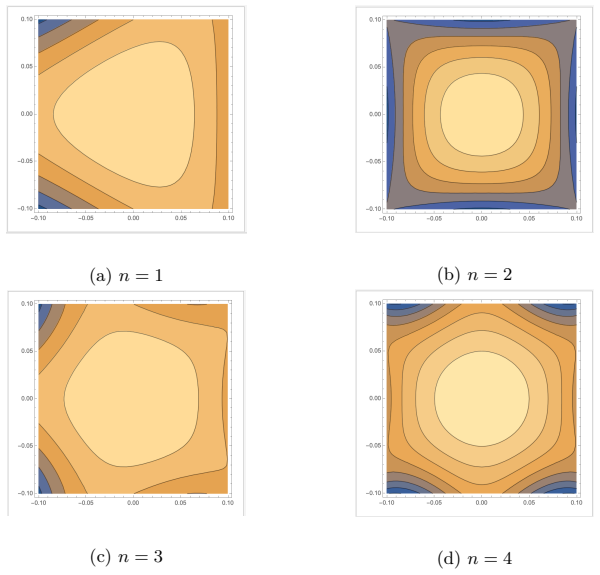
- The Husimi function of the N-th order squeezed state shows phase-space contours that narrow in proportion to the $(2+n)$-th root, so higher-order squeezing deforms phase space anisotropically.
- Time evolution under a time-dependent anharmonic oscillator with potential $\lambda(t)x^{n+2}$ factorizes into successive applications of N-th order squeezing operators, generalizing the standard time-dependent-oscillator derivation.
- Rotating the generators by a phase angle connects the construction to the $w_\infty$ algebra, suggesting a link between N-th order squeezing and integrable systems.
Reading between the lines
- If a nonzero central charge appears from a different operator ordering, the Bogoliubov coefficients and Eq. (18) would need revision; the clean test is to compute $[L_n,L_m]$ explicitly for the ordering in Eq. (1).
- The small-$\theta$ growth in particle number suggests an experimental signature: in systems with tunable $x^4$ or $x^6$ couplings, the generated particle count should scale as $\theta^2$ with coefficients $2\sqrt{\pi}$ for $n=2$ and $27\sqrt{\pi}/4$ for $n=4$, which a measurement could compare against.
- The connection to conformal mechanics and near-horizon physics noted in the Discussion suggests that N-th order squeezing states could serve as a toy model for particle production near extremal black holes or in reheating after inflation, though the paper does not develop this.
- Extending the construction to two-mode Bogoliubov transformations or fermionic versions, as the authors suggest, would place the result in a broader class of pair-production problems and might connect to condensed-matter models such as BCS superconductivity.
Signed reviews
Editorial analysis
A structured set of objections, weighed in public.
Referee Report
Summary. The paper proposes a generalization of quantum-optical squeezing by exponentiating operators L_n defined in Eq. (1) as L_n = -i/2(x^{n+1}p + p x^{n+1}), which the authors claim obey the centerless Virasoro algebra. It defines the N-th order squeezed state |θ>_n = e^{θ L_n}|0>, argues in Sec. 4.2 that such states arise from time-dependent x^{n+2} potentials, and derives in Sec. 5 a small-θ formula, Eq. (18), for the number of produced particles. The central claim, stated in the abstract and Discussion, is that higher-order squeezing generates more particles for small θ. The paper also computes uncertainty relations and Husimi functions in Secs. 6 and 7.
Significance. The motivation is attractive: organizing generalized squeezing through Virasoro-type generators could connect quantum optics, conformal mechanics, and w∞ algebras, and Eq. (18) would provide a concrete falsifiable hierarchy of particle production. To the paper's credit, the particle number is defined directly from the squeezed state and the n=0 standard squeezing result is used as a consistency benchmark. However, the central derivation is not sound: the stated algebra in Eq. (1) is not satisfied by the given operators, the small-θ formula (18) fails the n=0 control, the exact n=2 formula (19) contradicts Eq. (18) and unitarity, and the time-evolution factorization in Eq. (12) is asserted rather than derived. These are load-bearing defects, not presentation issues.
major comments (4)
- [Sec. 4.1, Eq. (1)] The operators defined in Eq. (1) do not satisfy the centerless Virasoro algebra stated below Eq. (1). In the position representation, p = -i∂_x, so L_n = -x^{n+1}∂_x - (n+1)/2 x^n. A direct computation gives [L_n,L_m] = (m-n)/2 x^{n+m+1}∂_x + (m-n)(m+n+1)/2 x^{n+m}, which is not (n-m)L_{n+m}; the derivative term has the wrong coefficient. This discrepancy is present for n+m≠0, so the footnote's caveat about a possible central charge does not cover it. Since the x- and p-transformations, the Bogoliubov coefficients in Eqs. (14)-(15), and the particle-number formula (18) all use this algebra, the central construction is unsupported.
- [Sec. 5, Eqs. (17)-(18)] The small-θ expansion (18) does not reduce to the n=0 control result stated in the text. For standard second-order squeezing, 0<θ|N|θ>0 = (sinh θ)^2 = θ^2 + O(θ^4). Setting n=0 in Eq. (18) gives (1/4)(2)^2 Γ(1/2) θ^2 = √π θ^2; with the normalization A0=(ω0/π)^{1/4} used in Eq. (17), the prefactor is π^{1/4}ω0^{1/4}, and even setting ω0=1 leaves π^{1/4}, not 1. The n=0 limit is a stated benchmark, and Eq. (18) fails it, indicating a spurious gamma-function or normalization factor in the step from Eq. (17) to Eq. (18).
- [Sec. 5, Eq. (19)] The exact n=2 formula (19) is internally inconsistent with Eq. (18) and with unitarity. As θ→0+, the second term of Eq. (19) behaves as √π/(8θ) and diverges, while the first term is O(√θ); hence 2<θ|N|θ>2 → ∞. But e^{θL_2} is unitary, so the expectation value must tend to <0|N|0>=0, and Eq. (18) predicts θ^2 → 0. The exact n=2 result is therefore unphysical, and Figure 1, if it uses Eq. (19), does not support the claimed small-θ hierarchy.
- [Sec. 4.2, Eq. (12)] The factorization of the time evolution under a time-dependent x^{n+2} potential into successive applications of N-th order squeezing operators is asserted by analogy with the n=0 case but is not derived. In the interaction picture, the anharmonic perturbation is not proportional to L_n at every instant; for n>0 it involves time-dependent combinations of x and p through x_I(t), and the delta-function pulse argument used in Sec. 3 does not extend automatically. Since the interpretation of Eq. (18) as particle production by time-dependent anharmonic potentials depends on Eq. (12), this is a load-bearing gap.
minor comments (4)
- [Sec. 2] The sentence 'L−1, L0 and L−1 satisfies' should read 'L_{-1}, L_0 and L_1 satisfy'.
- [Sec. 4.1, Eq. (3)] The text says 'applying the unitary operator L_n to the vacuum'; it should say 'applying the unitary operator e^{θ L_n}'.
- [Sec. 5, Eq. (17)] The prefactor A0=(ω0/π)^{1/4} is not the normalization of exp(-x^2) unless the integration measure and the exponent are made consistent; the exponent should carry the ω0 dependence if x has the dimensions implied by Sec. 3. This normalization issue is related to the n=0 failure noted above.
- [Figure 1 caption] The caption contains a typo: 'cross thst' should be 'crosses that'.
Circularity Check
No significant circularity: the particle-number formula is derived from explicit definitions and standard operator manipulations, with no fitted input or load-bearing self-citation.
full rationale
The paper's central claim, the small-θ particle-number formula Eq. (18), is reached by a direct derivation from the stated definitions: the Virasoro-like generator L_n in Eq. (1), the Nth-order squeezed state |θ⟩_n = e^{θL_n}|0⟩ in Eq. (3), and the generalized Bogoliubov transformation in Eqs. (14)–(15). These ingredients are not defined in terms of the final particle number, and no parameter is fitted to any data or target quantity. The n = 0 limit is checked against the standard squeezing result (sinh θ)^2 as an independent consistency benchmark. The assumptions that are load-bearing, such as the operator-ordering choice for L_n and the factorization of time evolution in Eq. (12), are explicit modeling assumptions flagged in the paper (including Footnote 1's admission that a central charge may appear), not circular reductions. The paper does not rely on self-citations or imported uniqueness theorems to force its conclusions. The skeptical observation that Eq. (19) appears inconsistent with Eq. (18) at small θ concerns algebraic or normalization errors in the claimed expansion, which is a soundness issue outside the scope of circularity analysis; it does not amount to the output being equivalent to the input by construction. Therefore the derivation is self-contained for circularity purposes, and the appropriate score is 0.
Assumptions & free parameters
assumptions (4)
- domain assumption L_n=-i/2(x^{n+1}p+p x^{n+1}) satisfies the centerless Virasoro algebra [L_n,L_m]=(n-m)L_{n+m} with no central charge.
- domain assumption Time evolution under a time-dependent anharmonic oscillator can be represented as a product of squeezing operators e^{θ_m L_n(t_m)} (Eq. 12).
- ad hoc to paper The ground-state integral in Eq. (17) is normalized with prefactor A0=(ω0/π)^{1/4} and e^{-x^2}.
- ad hoc to paper In Eq. (8), x and p may be treated as commuting to describe the phase-space volume transformation.
Cite this review
Pith. "Pith review of Beyond Squeezing \`a la Virasoro Algebra." pith.science (2026). https://pith.science/paper/C6DHC77U
@misc{pith2026190806308,
  author       = {Pith},
  title        = {Pith review of: Beyond Squeezing \`a la Virasoro Algebra},
  year         = {2026},
  howpublished = {\url{https://pith.science/paper/C6DHC77U}},
  note         = {Machine review of arXiv:1908.06308}
}
read the original abstract
The generalization of squeezing is realized in terms of the Virasoro algebra. The higher-order squeezing can be introduced through the higher-order time-dependent potential, in which the standard squeezing operator is generalized to higher-order Virasoro operators. We give a formula that describes the number of particles generated by the higher-order squeezing when a parameter specifying the degree of squeezing is small. The formula (18) shows that the higher the order of squeezing becomes the larger the number of generated particles grows.
Figures

Reference graph
Works this paper leans on
-
[1]
Loudon R., and Knight P. L., “Squeezed light.” J. Mod. Opt. 34.6-7 (1987): 709-759
work page 1987
-
[2]
Towards the theory of re- heating after inflation
Kofman L., Linde A, and Starobinsky A. A., “Towards the theory of re- heating after inflation.” Phys. Rev. D 56.6 (1997): 3258
work page 1997
-
[3]
Quantum cryptography with squeezed states
Hillery M., “Quantum cryptography with squeezed states.” Phys. Rev. A 61.2 (2000): 022309
work page 2000
-
[4]
Multiphoton quantum optics and quantum state engineering
DellâĂŹAnno F., De Siena S., and Illuminati F., “Multiphoton quantum optics and quantum state engineering.” Phys. Rep. 428.2-3 (2006): 53-168
work page 2006
-
[5]
Braunstein S. L., and McLachlan R. I., “Generalized squeezing.” Phys. Rev. A 35.4 (1987): 1659
work page 1987
-
[6]
Phase and homodyne statistics of generalized squeezed states
Braunstein S. L., and Caves C. M., “Phase and homodyne statistics of generalized squeezed states.” Phys. Rev. A 42.7 (1990): 4115. 15
work page 1990
-
[7]
Ginsparg P., “Applied conformal field theory.” arXiv preprint hep- th/9108028 (1988)
arXiv 1988
-
[8]
Bombay lectures on highest weight representations of infinite dimensional Lie algebras
Kac V. G., Raina A. K., and Rozhkovskaya N., “Bombay lectures on highest weight representations of infinite dimensional Lie algebras.” Vol. 29. World scientific, 2013
work page 2013
Show all 15 references
-
[9]
Aspects ofW∞ Symmetry
Sezgin E., “Aspects ofW∞ Symmetry.” arXiv preprint hep-th/9112025 (1991)
1991 arXiv
-
[10]
Some Formal Properties of the Density Matrix
Husimi K., “Some Formal Properties of the Density Matrix” Proc.Phys. Math. Soc. Jpn. 22:264-314
-
[11]
SDiff (2) KP hierarchy
Takasaki K., and Takebe T., “SDiff (2) KP hierarchy.” Int. J. Mod. Phys. A 7.supp01b (1992): 889-922
1992
-
[12]
w algebras, conformal mechanics and black holes
Cacciatori S., Klemm D, and Zanon D., “w algebras, conformal mechanics and black holes.” Class. Quantum Gravity 17.8 (2000): 1731
2000
-
[13]
Conformal invariance in quantum mechanics
de Alfaro V, Fubini S., and Furlan G., “Conformal invariance in quantum mechanics.” Il Nuovo Cimento A (1965-1970) 34.4 (1976): 569-612
1976
-
[14]
Inflationary cosmology after Planck
Linde A., “Inflationary cosmology after Planck. ” Post-Planck Cosmology: Lecture Notes of the Les Houches Summer School: Volume 100, July 2013 100 (2015): 231
2015
-
[15]
Microscopic Theory of Superconductivity
Bardeen J., Cooper L. N., and Schrieffer J. R., “Microscopic Theory of Superconductivity”, Phys. Rev. 106, 162 - 164 (1957). 16
1957
Reviewed August 14, 2026 · model on record in the stance chip above.
Discussion (0). Continue with ORCID to comment.