REVIEW 4 major objections 5 minor 256 references
AblationBench: Evaluating Automated Planning of Ablations in Empirical AI Research
T0 review · 4 major / 5 minor · reviewed 2026-08-06 · deepseek-v4-flash
Pith's one-line read Frontier language models asked to plan ablation experiments for research papers recover at most 45% of the ablations that human authors or reviewers chose, and PhD-level humans still beat the best model by a wide margin.
desk verdict AblationBench is a genuinely useful, released benchmark for ablation planning, but its headline 'below-human' gap is a statement about reference recovery, not general planning quality, and the write-up has several numeric inconsistencies. read the letter →
The pith
A machine-rendered reading of the paper's core claim, the machinery that carries it, and where it could break.
The reading
What carries the argument
The central object is the benchmark suite itself, whose gold labels are human practice rather than synthetic answers. In AuthorAblation, each of 83 papers is truncated to its method section and paired with the 230 ablations the original authors ran, manually extracted as structured JSON entries (ablated component, action, replacement, metrics); in ReviewerAblation, each of 350 ICLR submissions is paired with the ablation requests found in its official reviews, and ablation order in the source papers serves as a proxy for importance. The load-bearing mechanism is the LM-based judge, a three-model majority-vote ensemble with randomized side assignment and shuffling that counters intra-model, contextual, and positional bias, deciding whether a generated plan matches a gold ablation under conservative criteria; the judge's agreement with human annotations (kappa approximately 0.62) is itself validated on a dedicated JudgeEval set. Matching requires the same ablated component, an action the reference ablation explicitly allows, and at least one shared replacement when one is specified.
What would settle it
Take the non-matching top-k proposals a top planner generates on the benchmark's test papers and have independent machine-learning researchers rate each for relevance, feasibility, and scientific value; if those proposals are rated on par with the gold ablations, then the reported 45% recall and 0.35 F1 reflect scoring against a single reference set rather than a true capability ceiling.
Extended reading notes
Core claim
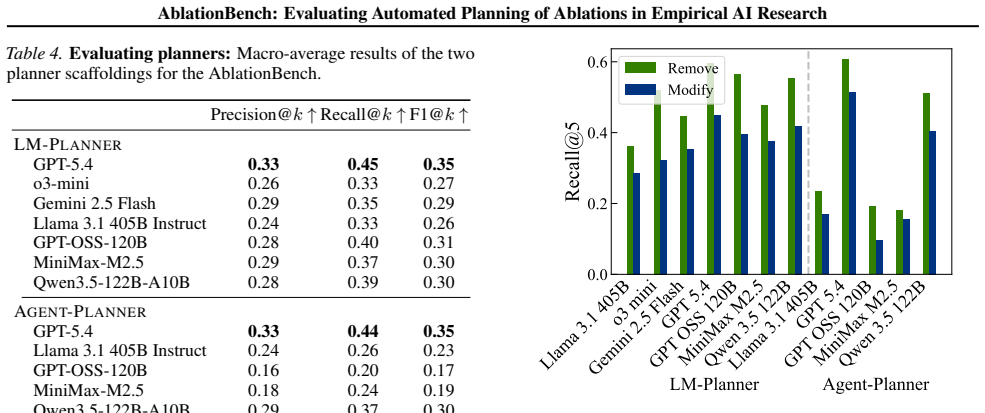
On the paper's own terms, the discovery is that automated ablation planning from raw paper text is now measurable and currently far from solved. A chain-of-thought-prompted GPT-5.4 reaches an overall F1 around 0.35 (0.39 on AuthorAblation at k=5 proposals, 0.31 on ReviewerAblation at k=2), and no tested model beats a single CoT prompt, including SWE-agent-style agents that may inspect files and iterate. The human gap is large: on a ten-paper subset, machine-learning PhD students recover the gold ablations at F1 approximately 0.65 with precision 0.62, versus approximately 0.42 for the best model. The authors read the pattern through model grounding: models that adhere closely to the paper text decompose methods well for the author task but propose fewer reviewer-style missing ablations, while less grounded models show the opposite trade-off, and standardized CV papers yield higher F1 (0.45) than more varied NLP papers (0.30).
Load-bearing premise
Overlap with what the original authors happened to run and what reviewers happened to request is treated as the definition of good ablation planning, so a system that proposes correct, valuable ablations that appear in neither reference set is scored as failing.
Editorial extensions
If this is right
- No current frontier model is close to human-level ablation planning: the best system recovers under half of the ablations an author or reviewer would name, so claims about end-to-end AI research agents should be read with that ceiling in mind.
- A single chain-of-thought prompt with the full paper in context outperforms an agent that can browse, edit, and iterate, so for this skill reasoning over complete context beats tool use, and agent scaffolds must be redesigned rather than scaled.
- Removal-type ablations are substantially easier for models than modification-type ablations that require proposing feasible replacements, which marks the replacement problem as the higher-value target for future work.
- Because human experts recover the gold ablations at high F1, the ground-truth target is a fair standard, and the roughly 0.2 F1 gap to the best model defines concrete headroom for improvement.
- The inverse author/reviewer trend means a single model is unlikely to excel at both perspectives, and performance on one planning task does not indicate capability on the other.
Reading between the lines
- The ground truth inherits the contingency of what authors chose to run and reviewers happened to request; a planner that proposes a scientifically better ablation than anything in the reference set receives a false negative, so the true capability gap may be smaller than the 45% figure suggests.
- A direct test follows: take a planner's non-matching proposals on the test papers and have independent machine-learning researchers rate them for relevance, feasibility, and scientific value; if those rate on par with the gold ablations, matching-only scoring understates model capability.
- Individual judges agree with humans at kappa around 0.45-0.59, so the matching subtask itself is not solved; improving judge reliability through calibrated confidence or pairwise comparisons would sharpen every downstream planner score.
- The ReviewerAblation pipeline is fully automatic and could be pointed at other conferences and years, which would let the community track whether future models close the gap across settings or improve only on this benchmark's reference set.
Signed reviews
Editorial analysis
A structured set of objections, weighed in public.
Referee Report
Summary. AblationBench introduces a two-task benchmark for evaluating how well LM-based systems plan ablation studies from raw papers: AuthorAblation (83 papers, ground truth from the original papers) and ReviewerAblation (350 ICLR submissions, ground truth from official reviews). The paper develops LM-based judges with ensemble voting, validates them against a small human-annotated evaluation set, and evaluates LM and SWE-agent planners across several frontier LMs. The central empirical claim is that the best system achieves only 0.35 F1@k (45% recall) overall and remains below human performance on an AuthorAblation subset. The paper also reports an inverse performance trend between the author and reviewer tasks and concludes that chain-of-thought prompting outperforms an agent-based approach.
Significance. If the benchmark results hold, AblationBench is a useful resource for the rapidly growing area of AI co-scientist evaluation: it ships data and code, provides two complementary task formulations, and is one of the few attempts to evaluate ablation planning from raw paper text rather than curated summaries. The judge validation against human annotations (63 AuthorEval and 60 ReviewerEval plans) is a genuine strength, as is the explicit comparison of LM and agent scaffolds. However, the headline claims are currently stronger than the quantitative support in the paper: the stated inverse trend is not visible in the aggregate tables, the conclusion's best F1 number contradicts Table 4, and the human-baseline description is internally inconsistent. The central metric measures reference recovery rather than unimpeded planning quality, and the paper's own limitations section acknowledges this; the abstract and introduction should therefore qualify the 'below human-level' claim accordingly.
major comments (4)
- [Section 7.4 and Abstract; Tables 7 and 8] The abstract states that the paper observes an inverse performance trend between the author and reviewer tasks, and Section 7.4 claims that 'models that perform well on one task tend to perform poorly on the other.' The aggregate tables do not support this claim. In Table 7, GPT-5.4 has the highest AuthorAblation F1@5 (0.39 for LM-PLANNER, 0.40 for AGENT-PLANNER), and in Table 8 it also has the highest ReviewerAblation F1@2 (0.31 and 0.30). The cross-model correlation between the two task scores is near zero for the LM-PLANNER rows (Pearson r approximately 0.1), not negative. The qualitative Qwen-vs-Llama contrast in Appendix B is anecdotal and cannot carry a general claim of an inverse trend. The quantitative data need to be analyzed with a correlation or the claim should be substantially softened.
- [Section 8 vs. Table 4] The conclusion reports that 'the best model achieves an F1 score of 0.30 on AblationBench,' but Table 4 reports the best F1@k as 0.35 for both LM-PLANNER and AGENT-PLANNER with GPT-5.4. Since Section 7.2 defines the AblationBench score as the average of the two tasks, the value in Table 4 is the correct reported result, and the conclusion should be reconciled with it. The discrepancy is small but load-bearing because the headline number of the paper is the benchmark's best F1 score.
- [Section 7.5 vs. Appendix B.3] The human baseline is described inconsistently. Section 7.5 says 'We recruit 10 participants' and reports humans achieving F1@5 of 0.66 compared with 0.43 for GPT-5.4 on the same subset. Appendix B.3 states that 15 participants were recruited, 5 responses were excluded, and the remaining 10 were compared against the 'best-performing model on this task, Qwen 3.5.' These two accounts disagree about the recruited sample size and about which model was compared. The paper must state the correct participant count, the exclusion procedure, and the exact model used in the comparison, and should provide the per-paper subset results in a table.
- [Section 3 and Limitations] The benchmark scores every generated ablation against the reference set of ablations chosen by the original authors or reviewers. Section 3 explicitly acknowledges that models may propose new ablation ideas for which no ground truth exists, and the Limitations section repeats this concern. Consequently, a system that proposes a valid, feasible ablation not present in the reference set receives zero credit, and the reported F1@k and recall values measure reference recovery rather than ablation-planning quality per se. The human baseline is measured on the same recovery metric, so this concern does not invalidate the comparison, but the abstract's unqualified statement that the best system is 'below human-level performance' overstates what the metric establishes. The paper should consistently phrase the headline claim as 'below human-level performance at recovering the reference ablations' or provide additional evidence that non-reference proposals are not systematically better than the scored ones.
minor comments (5)
- [Section 7.5] The human-baseline results are currently reported only in prose; including a small table with the subset size, human F1, model F1, precision, and recall would make the comparison easier to verify.
- [Abstract and Table 4] The abstract's '45% of the original ablations' corresponds to recall@k in Table 4; the paper should state this explicitly so that readers do not confuse it with the F1@k value of 0.35.
- [Tables 3-8 and Appendix B] The model name 'Qwen3.5-122B-A10B' appears with and without a hyphen in different tables and in the text; the naming should be unified.
- [Appendix A.2] The text says the pipeline 'results in 5,960 papers in ReviewerAblation' and then states that 50 development and 300 test papers are sampled; since the main text says the benchmark contains 350 instances, clarify that 5,960 is the full filtered pool and 350 is the benchmark subset.
- [Section 8] The sentence 'The best model achieve an F1 score' contains a subject-verb agreement error and should read 'achieves.'
Circularity Check
No significant circularity: AblationBench measures reference-ablation recovery against externally sourced ground truth, and its LM judge is validated separately.
full rationale
Walking the derivation chain of AblationBench, the central measurements are planner recall, precision, and F1 computed by matching model-generated ablation plans against external ground truth: ablations explicitly labeled by paper authors (AuthorAblation) and ablation suggestions extracted from official ICLR reviews (ReviewerAblation). These labels come from the source papers and reviews, not from the evaluated planners, so no reported number is equivalent to its own input by construction. The LM-based judges are the only learned evaluation component, and they are independently validated on human-annotated plans, with majority-vote ensembles and bias mitigation; the paper does not use the evaluated planners to generate the judge labels. The acknowledged limitation that models may propose valid ablations not in the ground truth is a construct-validity caveat explicitly stated in the Limitations section: 'models may produce meaningful and feasible ablations that are not included in the GT.' Under the benchmark's stated definition, evaluation is reference recovery, so this caveat limits what the 45% figure means but does not make the derivation circular. I found no load-bearing self-citations and no imported uniqueness theorem or ansatz; the paper is self-contained as a benchmark construction with external validation of its judge.
Assumptions & free parameters
free parameters (2)
- Number of generated ablations k =
5 (AuthorAblation), 2 (ReviewerAblation)
- Judge ensemble composition =
Three best models by kappa per scaffolding
assumptions (4)
- domain assumption The ground-truth ablations are the original ablations performed by paper authors and ablations suggested by ICLR reviewers.
- domain assumption Ablation order in the paper reflects relative importance, used for nDCG.
- domain assumption Reviewer comments mentioning 'ablat' and passing a GPT-4o filter are a representative sample of missing ablations.
- domain assumption Ablation categories REMOVE, REPLACE, ADD and the matching criteria capture what makes an ablation valid.
Cite this review
Pith. "Pith review of AblationBench: Evaluating Automated Planning of Ablations in Empirical AI Research." pith.science (2026). https://pith.science/paper/C6MKQSQR
@misc{pith2026250708038,
  author       = {Pith},
  title        = {Pith review of: AblationBench: Evaluating Automated Planning of Ablations in Empirical AI Research},
  year         = {2026},
  howpublished = {\url{https://pith.science/paper/C6MKQSQR}},
  note         = {Machine review of arXiv:2507.08038}
}
read the original abstract
Language model agents are increasingly used to automate scientific research, yet evaluating their scientific contributions remains a challenge. A key mechanism to obtain such insights is through ablation experiments. To this end, we introduce AblationBench, a benchmark suite for evaluating agents on ablation planning tasks in empirical AI research. It includes two tasks: AuthorAblation, which helps authors propose ablation experiments based on a method section and contains 83 instances, and ReviewerAblation, which helps reviewers find missing ablations in a full paper and contains 350 instances. For both tasks, we develop LM-based judges that serve as an automatic evaluation framework. Our experiments with frontier LMs show that these tasks remain challenging, with the best-performing LM system identifying only 45% of the original ablations on average, below human-level performance. We observe an inverse performance trend between the author and reviewer tasks, which we attribute to differences in model grounding. Lastly, we analyze the limitations of current LMs on these tasks, and find that chain-of-thought prompting outperforms an agent-based approach. Our data is available on https://huggingface.co/collections/ai-coscientist/ablationbench, and our code is available on https://github.com/ai-scientist-bench/ablation-bench .
Figures


Figures from the paper (42 more)




Reference graph
Works this paper leans on
-
[1]
This filtering is performed via keyword search ("ablat") and manual validation
Filtering for papers with ablations.We collect the T EX source of all candidate papers and discard those that do not include ablation studies. This filtering is performed via keyword search ("ablat") and manual validation
-
[2]
Partial paper creation.For each remaining paper, we create a truncated version containing only the sections up to and including the method. To ensure that only content relevant to the model’s task is included, we apply the arXiv LATEX cleaner utility (Google Research, 2025) to remove comments and any unreferenced files, such as figures or tables associate...
2025
-
[3]
URL https://openreview.net/forum? id=w4C4z80w59. X. Chen, N. Zhang, L. Li, Y . Yao, S. Deng, C. Tan, F. Huang, L. Si, and H. Chen. Good visual guidance make a better extractor: Hierarchical visual prefix for multimodal entity and relation extraction. In M. Carpuat, M.-C. de Marn- effe, and I. V . Meza Ruiz, editors,Findings of the Associ- ation for Comput...
arXiv 2022
-
[4]
URL https://api.semanticscholar. org/CorpusID:256662188. L. Gessler, S. Behzad, Y . J. Liu, S. Peng, Y . Zhu, and A. Zeldes. DisCoDisCo at the DISRPT2021 shared task: A system for discourse segmentation, classifica- tion, and connective detection. In A. Zeldes, Y . J. Liu, M. Iruskieta, P. Muller, C. Braud, and S. Badene, edi- tors,Proceedings of the 2nd ...
arXiv 2021
-
[5]
URL https://api.semanticscholar. org/CorpusID:257804696. C. Lu, C. Lu, R. T. Lange, J. Foerster, J. Clune, and D. Ha. The ai scientist: Towards fully automated open-ended sci- entific discovery, 2024. URL https://arxiv.org/ abs/2408.06292. B. Ma, Z. Han, Y .-S. Liu, and M. Zwicker. Neural-pull: Learning signed distance functions from point clouds by learn...
arXiv 2024
-
[6]
Varying the amount of labeled data during fine-tuning. Both models successfully identify the main components of the method: attribute generation, edge generation, node separation, and adaptive queue—which correspond to the core mechanisms targeted in the first four GT ablations. Qwen’s reasoning trace ( Figure 11) shows a clear methodological analysis: it...
-
[7]
URL https://api.semanticscholar. org/CorpusID:258558102. P. Wang, L. Li, L. Chen, Z. Cai, D. Zhu, B. Lin, Y . Cao, L. Kong, Q. Liu, T. Liu, and Z. Sui. Large language models are not fair evaluators. In L.-W. Ku, A. Mar- tins, and V . Srikumar, editors,Proceedings of the 62nd Annual Meeting of the Association for Computational Linguistics (V olume 1: Long ...
-
[8]
Always make sure to look at the currently open file and the current working directory (which appears right after the currently open file). The currently open file might be in a different directory than the working directory! Note that some commands, such as ’create’, open files, so they might change the current open file. STRATEGY: 44 AblationBench: Evalu...
Show all 256 references
-
[10]
URL https://openreview.net/forum? id=ek9a0qIafW. Z. Zhang, A. Zhu, L. Yang, Y . Xu, L. Li, P. M. Phothilimthana, and Z. Jia. Accelerating retrieval- augmented language model serving with speculation,
-
[11]
URL https://openreview.net/forum? id=vkzPuZJ80a. B. Zhao, H. Hajishirzi, and Q. Cao. Apt: Adaptive prun- ing and tuning pretrained language models for efficient training and inference, 2024. Y . Zhao, W. Chen, Z. Xu, M. Patwardhan, C. Wang, Y . Liu, L. Vig, and A. Cohan. AbGen...
2024
-
[12]
URL https: //aclanthology.org/2025.acl-long.611/
doi: 10.18653/v1/2025.acl-long.611. URL https: //aclanthology.org/2025.acl-long.611/. J. Zheng, Q. Ma, S. Qiu, Y . Wu, P. Ma, J. Liu, H. Feng, X. Shang, and H. Chen. Preserving commonsense knowl- edge from pre-trained language models via causal in- ference, 2023a. URL https://...
2025 arXiv
-
[15]
ablation
Ground-truth (GT) extraction.The ablation plan described in the full paper is manually extracted into a structured JSON format, which serves as the GT output for evaluation. The instructions for annotators are given in Figure 6. All extracted annotations are manually inspected...
2023
-
[16]
Submission collection and basic filtering.We collect all ∼89,100 reviews associated with ∼22,800 ICLR submissions from 2023 to 2025 and filter for those containing the substring "ablat"
2023
-
[17]
Filtering for reviews suggesting new ablations.We apply an LM (GPT-4o) with CoT prompting (Figure 7) to identify reviews that explicitly suggest new ablation experiments not already included in the paper. We calibrate this filter on the development set by manually annotating t...
-
[18]
This produces a standardized and machine-readable version of the full paper used as input to models
Paper collection.For each selected submission, we retrieve the submitted preprint PDF and convert it to markdown format using the marker tool (Paruchuri, 2025). This produces a standardized and machine-readable version of the full paper used as input to models. Instance Prompt...
2025
-
[19]
The review explicitly mentions the word ablation or ablate, and
-
[20]
It refers to a study that the paper did not perform, and
-
[21]
You should answer with a number = 0 if:
The reviewer is asking for that study to be added or noting that it is missing. You should answer with a number = 0 if:
-
[22]
The review only discusses existing ablations
-
[23]
The review mentions comparisons to baselines, datasets, or methods but not as ablation studies
-
[24]
ablation
The word "ablation" appears in a different context (e.g., praising existing ablations)
-
[25]
EXAMPLES:
The reviewer mentions the lack of ablation study but doesn’t give any specific suggestions. EXAMPLES:
-
[26]
This would be an interesting result to many
"Lack of Ablation Study: An ablation study investigating the impact of different components of the advanced memory module (e.g., summary length, specific aspects included) would provide a deeper understanding of its effectiveness. This would be an interesting result to many. A...
-
[27]
Lack of ablation study
"Lack of ablation study."→The reviewer mentions the lack of ablation studies but doesn’t suggest any specific ones.→0
-
[28]
"The improvement over GeoDiff is not significant to me. Could the author provide more ablation study about the fσ function in Eq7, which can help to verify the importance of the proposed MB diffusion distribution." → The reviewer specifically mentions that the paper lacks an a...
-
[29]
The experiments are limited. A more comprehensive evaluation is needed to trust the effectiveness of the proposed method
"The experiments are limited. A more comprehensive evaluation is needed to trust the effectiveness of the proposed method." → The reviewer mentions the lack of experiments but doesn’t refer to ablation study.→0 Figure 7.The instance prompt for filtering ICLR reviews to get the...
2002
-
[30]
Removing the attribute generation component
-
[31]
Removing the edge generation component
-
[32]
Removing both attribute generation and node separation
-
[33]
Removing edge generation together with the adaptive queue
-
[34]
Replacing the GNN architecture (GCN, GAT, RGCN, HAN)
-
[36]
A novel attributed graph generation task that factorizes into Attribute Generation and Edge Generation
-
[37]
An efficient framework to conduct generative pre-training
-
[38]
Handling of large-scale graphs using sub-graph sampling and adaptive embedding queue Key ablation studies should focus on:
-
[39]
The importance of the dual-generation approach (attributes and edges)
-
[40]
not found
The effectiveness of the adaptive queue for negative samples 20 AblationBench: Evaluating Automated Planning of Ablations in Empirical AI Research Table 9.Analysis of prediction errors for AuthorAblation judge, using LMJUDGEpowered by o3-mini and GPT OSS, measured on AuthorEva...
-
[41]
The impact of separating nodes into Attribute Generation and Edge Generation types
-
[42]
masked edges
The sampling strategy for observed vs. masked edges
-
[43]
The sub-graph sampling approach for large graphs I’ll rank these by importance and formulate specific ablation experiments: Figure 11.The reasoning of LM-PLANNERwith Qwen 3.5 in generating the ablation plans for GPT-GNN. Reasoning - Llama 3.1 405B To design ablation studies fo...
-
[44]
This will allow us to investigate the importance of the self-supervised task in the GPT-GNN framework
**Ablation of the self-supervised attributed graph generation task**: In this ablation study, we can remove the self-supervised attributed graph generation task and instead use a traditional supervised learning approach to train the GNN model. This will allow us to investigate...
-
[45]
This will allow us to investigate the importance of modeling the attributes of the nodes in the graph
**Ablation of the Attribute Generation component**: In this ablation study, we can remove the Attribute Generation component and only use the Edge Generation component to generate the graph. This will allow us to investigate the importance of modeling the attributes of the nod...
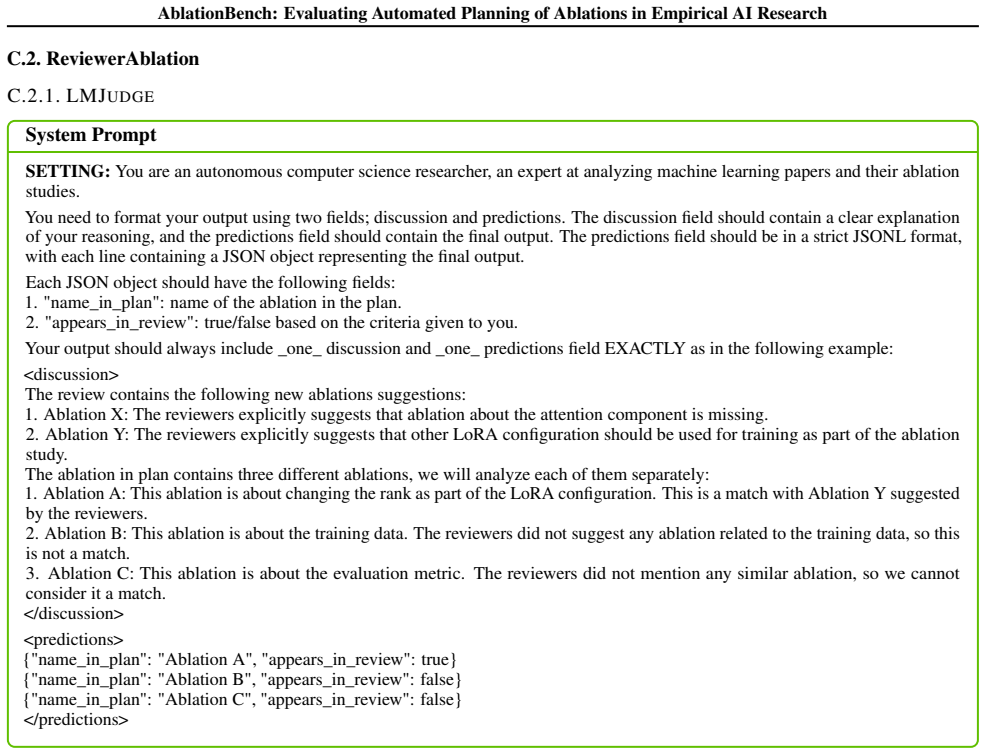
-
[46]
This will allow us to investigate the importance of modeling the edges between the nodes in the graph
**Ablation of the Edge Generation component**: In this ablation study, we can remove the Edge Generation component and only use the Attribute Generation component to generate the graph. This will allow us to investigate the importance of modeling the edges between the nodes in...
-
[47]
and instead use a traditional negative sampling approach
**Ablation of the adaptive node embedding queue**: In this ablation study, we can remove the adaptive node embedding queue 21 AblationBench: Evaluating Automated Planning of Ablations in Empirical AI Research CV General ML NLP Conference Type 0.0 0.1 0.2 0.3 0.4 0.5Score Preci...
-
[48]
This will allow us to investigate the importance of the pre-training task in the GPT-GNN framework
**Ablation of the pre-training task**: In this ablation study, we can remove the pre-training task and instead train the GNN model from scratch on the downstream task. This will allow us to investigate the importance of the pre-training task in the GPT-GNN framework. By conduc...
2022
-
[49]
Replacing the FCN-based temporal model with alternative temporal models (Gaussian filtering, TCNs, and Transform- ers)
-
[50]
Replacing the proposed motion-aware temporal network with a simpler residual FCN
-
[51]
Varying the temporal window size
-
[52]
Removing the acceleration loss
-
[53]
Removing the pose loss
-
[54]
Replacing the motion modality representation
-
[55]
Both models identify the key components of the method, including the motion-aware temporal network and temporal modeling choices
Replacing the normalization strategy. Both models identify the key components of the method, including the motion-aware temporal network and temporal modeling choices. Qwen demonstrates strong alignment with the paper’s main contributions (Figure 13) and successfully recovers ...
-
[56]
The motion-aware architecture - The paper introduces velocity and acceleration branches which should be validated
-
[57]
The temporal modeling approach - The authors chose FCN over TCN and Transformer, which needs validation
-
[58]
The loss function components - The paper uses both pose and acceleration losses
-
[59]
The temporal window size - This is a critical hyperparameter that affects the model’s ability to capture long-range dependencies
-
[60]
I’ll suggest ablation studies to validate these key design choices, focusing on the most important aspects first
The independence of joint processing - The model processes each axis independently. I’ll suggest ablation studies to validate these key design choices, focusing on the most important aspects first. The metrics used in the paper are: - MPJPE (Mean Per Joint Position Error) for ...
-
[61]
Replacing pixel-level nodes with patch-based nodes
-
[62]
Replacing degree-flexible graphs with KNN graphs
-
[63]
Removing the local graph construction
-
[64]
breaking rigidity
Removing the global graph construction. Qwen demonstrates strong alignment with the paper’s method (Figure 15), explicitly identifying all three key components and successfully recovering all four GT ablations. Since the planner is prompted to produce up to five ablations, Qwe...
-
[65]
Degree Flexibility: Using a detail-rich indicator (D_F) to assign different node degrees to pixels based on their reconstruction needs
-
[66]
Pixel-level Nodes: Using pixels as graph nodes instead of patches to avoid misalignment issues
-
[67]
Based on these key components, I suggest the following ablation studies:
Dual-scale Graph Construction: Using both local and global sampling strategies to construct graphs at different scales. Based on these key components, I suggest the following ablation studies:
-
[68]
Test the importance of degree flexibility by comparing against fixed degree for all nodes
-
[69]
Validate the benefit of pixel-level nodes vs patch-level nodes
-
[70]
Evaluate the contribution of dual-scale graphs vs single-scale
-
[71]
Examine the effectiveness of the detail-rich indicator metric
-
[72]
Figure 15.The reasoning of LM-PLANNERwith Qwen 3.5 in generating the ablation plans for IPG
Test the importance of relative position encoding I’ll prioritize the most critical ones that directly validate the paper’s main claims about breaking rigidity. Figure 15.The reasoning of LM-PLANNERwith Qwen 3.5 in generating the ablation plans for IPG. Reasoning - Llama 3.1 4...
-
[73]
This will help to understand the impact of degree flexibility on the model’s performance
**Degree flexibility**: Remove the degree flexibility component and use a fixed degree for all nodes. This will help to understand the impact of degree flexibility on the model’s performance
-
[74]
patch nodes**: Replace pixel nodes with patch nodes to see how it affects the model’s performance
**Pixel nodes vs. patch nodes**: Replace pixel nodes with patch nodes to see how it affects the model’s performance. This will help to understand the importance of using pixel nodes in the IPG model
-
[75]
This will help to understand the impact of local sampling on the model’s performance
**Local and global sampling**: Remove the local sampling strategy and only use global sampling. This will help to understand the impact of local sampling on the model’s performance
-
[76]
This will help to understand the impact of the aggregation method on the model’s performance
**Graph aggregation**: Replace the edge-conditioned aggregation with a different aggregation method, such as max-pooling. This will help to understand the impact of the aggregation method on the model’s performance
-
[77]
This will help to understand the importance of relative position encoding in the IPG model
**Relative position encoding**: Remove the relative position encoding component and see how it affects the model’s performance. This will help to understand the importance of relative position encoding in the IPG model. These ablation studies will help to understand the contri...
2021
-
[78]
Replacing the kernel type used in LDS and FDS (e.g., Gaussian, Laplacian, Triangular)
-
[79]
Replacing the regression loss function used jointly with LDS and FDS
-
[80]
Varying kernel hyperparameters (kernel size and standard deviation)
-
[81]
Both models correctly identify LDS and FDS as the core contributions of the paper, and they recover the kernel-type replace- ment ablation present in the GT
Testing robustness under different skewed label distributions. Both models correctly identify LDS and FDS as the core contributions of the paper, and they recover the kernel-type replace- ment ablation present in the GT. This shows that both models can capture the primary comp...
-
[82]
Label Distribution Smoothing (LDS) - which uses kernel density estimation to learn the effective imbalance in datasets with continuous targets
-
[83]
Feature Distribution Smoothing (FDS) - which performs distribution smoothing on the feature space to calibrate potentially biased feature estimates Based on these components, I’ll suggest ablation studies focusing on:
-
[84]
The impact of kernel choice in LDS since it’s fundamental to how the label distribution is smoothed
-
[85]
The effectiveness of FDS’s momentum update mechanism
-
[86]
The necessity of feature calibration in FDS
-
[87]
The importance of bin size selection for grouping features
-
[88]
Delving into Deep Imbalanced Regression
The combined effect of LDS and FDS versus using them individually These ablations will help understand which components contribute most to the method’s performance and how sensitive it is to different design choices. Figure 17.The reasoning of LM-PLANNERwith Qwen 3.5 in genera...
-
[89]
This will help understand the impact of LDS on the model’s ability to handle imbalanced data
**Remove LDS**: Train the model without LDS to see how much it contributes to the overall performance. This will help understand the impact of LDS on the model’s ability to handle imbalanced data
-
[90]
**Replace FDS with a different feature calibration method**: Replace FDS with a different feature calibration method, such as batch normalization or instance normalization, to see if FDS is the most effective method for feature calibration
-
[91]
**Add a different kernel to LDS**: Add a different kernel, such as a Gaussian or Laplacian kernel, to LDS to see if the choice of kernel affects the performance of the model
-
[92]
**Apply FDS to a different layer**: Apply FDS to a different layer of the network, such as the input layer or a hidden layer, to see if the location of FDS affects the performance of the model
-
[93]
These ablation studies will help understand the contributions of each component of the proposed method and provide insights into how to further improve its performance
**Compare with other imbalanced regression methods**: Compare the performance of the proposed method with other imbalanced regression methods, such as SMOTE or cost-sensitive learning, to see if the proposed method is more effective. These ablation studies will help understand...
2021
-
[94]
Removing the geometric network initialization (GNI)
-
[95]
Replacing the query location sampling strategy with random sampling over the full 3D space
-
[96]
Adding a gradient constraint that enforces unit-norm gradients. Both models correctly identify the main components of Neural-Pull, including the pulling operation, query location sampling strategy, and geometric network initialization, and they recover several of the GT ablati...
-
[97]
The adaptive sampling strategy for query locations using isotropic Gaussian functions 3
The pulling operation that uses both predicted signed distance values and gradients 2. The adaptive sampling strategy for query locations using isotropic Gaussian functions 3. The geometric network initialization (GNI) to approximate sphere SDFs 4. The loss function based on m...
-
[98]
NeuralPull: Learning Signed Distance Functions from Point Clouds by Learning to Pull Space onto Surfaces
Test the importance of the pulling operation by comparing with direct distance prediction 2. Evaluate different query location sampling strategies 3. Assess the impact of the geometric network initialization 4. Examine alternative loss formulations 5. Test different gradient c...
-
[99]
This will help us understand the importance of the gradient information in the Neural-Pull method
**Removing the gradient component**: We will remove the gradient component from the pulling operation and only use the predicted signed distance values to move the query locations. This will help us understand the importance of the gradient information in the Neural-Pull method
-
[100]
**Replacing the pulling operation with a different transformation**: We will replace the pulling operation with a different transformation, such as a simple translation or scaling, to see if the Neural-Pull method is sensitive to the choice of transformation
-
[101]
This will help us understand the robustness of the method to noisy data
**Adding noise to the point cloud**: We will add noise to the point cloud and evaluate the performance of Neural-Pull. This will help us understand the robustness of the method to noisy data
-
[102]
**Using a different loss function**: We will replace the mean squared error loss function used in Neural-Pull with a different loss function, such as mean absolute error or cross-entropy loss, to see if the choice of loss function affects the performance of the method
-
[103]
This will help us understand the importance of the sampling strategy in the method
**Evaluating the effect of query location sampling**: We will evaluate the effect of different query location sampling strategies on the performance of Neural-Pull. This will help us understand the importance of the sampling strategy in the method. Figure 20.The reasoning of L...
-
[104]
The causal graph framework for fine-tuning that introduces colliding effects between pre-trained data and target data
-
[105]
The K-Nearest Neighbors (KNN) approach to estimate causal effects, where neighbors are selected based on similarity of gold answers
-
[106]
The unified objective that combines vanilla fine-tuning with causal effects preservation. 26 AblationBench: Evaluating Automated Planning of Ablations in Empirical AI Research Table 11.Macro-average recall@2 results of the two planner scaffoldings for the ReviewerAblation spli...
2023
-
[107]
The similarity thresholdΘthat controls which samples get KNN treatment
-
[108]
I’ll suggest ablation studies focusing on these key components, ranked by importance:
The weighting parameterW 0 that balances between anchor sample and its neighbors. I’ll suggest ablation studies focusing on these key components, ranked by importance:
-
[109]
First, we should verify the effectiveness of the causal framework by removing it completely
-
[110]
The KNN approach and similarity threshold are critical design choices that should be tested
-
[111]
The weighting scheme between anchor and neighbors is important for balancing knowledge preservation
-
[112]
Preserving Commonsense Knowledge from Pre-trained Language Models via Causal Inference,
Alternative similarity metrics for finding neighbors could be explored. The metrics used in the paper are primarily accuracy on commonsense QA datasets, so we’ll use those. Figure 21.The reasoning of LM-PLANNERwith Qwen 3.5 in generating the ablation plans for Preserving Commo...
-
[113]
This ablation study will help us understand the contribution of the causal objective in preserving commonsense knowledge
**Ablation of the causal objective**: Remove the causal objective from the overall objective function and fine-tune the model using only the vanilla fine-tuning objective. This ablation study will help us understand the contribution of the causal objective in preserving common...
-
[114]
This ablation study will help us understand the importance of using KNNs to estimate the colliding effect
**Ablation of the KNN-based colliding effect estimation**: Replace the KNN-based colliding effect estimation with a random or uniform estimation method. This ablation study will help us understand the importance of using KNNs to estimate the colliding effect
-
[115]
This ablation study will help us understand the impact of the similarity threshold on the model’s performance
**Ablation of the similarity threshold**: Remove the similarity threshold ( Θ) and use a fixed number of nearest neighbors for all samples. This ablation study will help us understand the impact of the similarity threshold on the model’s performance
-
[116]
This ablation study will help us understand the importance of controlling the strength of colliding effects
**Ablation of the weight controlling the strength of colliding effects (W0)**: Set W0 to 0 or 1 and analyze the impact on the model’s performance. This ablation study will help us understand the importance of controlling the strength of colliding effects
-
[117]
Boosting Membership Inference Attacks with Upstream Modification
**Ablation of the heuristic approximation for estimating the causal effect on commonsense QA**: Replace the heuristic approximation with a different method, such as using the euclidean distance or cosine similarity between the average last hidden states of PLMs. This ablation ...
2025
-
[118]
This will help understand the contribution of the sampling bias modification to the overall improvement in attack accuracy
**Ablation A:** Evaluate the impact of reducing the drop rate during dataset partitioning on the attack success, without modifying the attack aggregation step. This will help understand the contribution of the sampling bias modification to the overall improvement in attack accuracy
-
[119]
This will help understand the contribution of the attack aggregation modification to the overall improvement in attack accuracy
**Ablation B:** Evaluate the impact of using only the outliers for the MIA, without modifying the sampling bias. This will help understand the contribution of the attack aggregation modification to the overall improvement in attack accuracy. These ablation studies will provide...
-
[120]
Sampling bias modification (Step 2): They reduce the drop rate during dataset partitioning from 50
-
[121]
Attack aggregation modification (Step 4): They use outlier detection methods (specifically ApB - Accuracy per Batch) to identify vulnerable points instead of using the entire dataset. The paper already includes ablations for: - Different drop rates (50%, 40%, 30%, 20%, 10%) - ...
-
[122]
This is crucial since it directly affects both the computational cost and attack effectiveness
The effect of the number of vulnerable points selected: The paper fixes this to 5,000 points but doesn’t ablate this hyperparameter. This is crucial since it directly affects both the computational cost and attack effectiveness
-
[123]
Accelerating Retrieval-augmented Language Model Serving with Speculation
The robustness of the ApB outlier detection method: While ApB performs best, the paper doesn’t ablate its key parameter - the frequency of accuracy measurement (currently done after each batch). This is important since it affects both computational overhead and outlier detecti...
2024
-
[124]
However, it does not provide a detailed analysis of how different speculation strides affect the performance of RaLMSpec
**Ablation study on the impact of speculation stride on the performance of RaLMSpec**: The paper mentions that the speculation stride is a crucial parameter that affects the trade-off between speculation overhead and latency saving. However, it does not provide a detailed anal...
-
[125]
**Ablation study on the effect of cache size on the performance of RaLMSpec**: The paper mentions that RaLMSpec uses a local cache to store retrieved documents, but it does not investigate the effect of cache size on the performance of RaLMSpec. An ablation study on the effect...
-
[126]
The authors only test prefetch sizes of 20 and 256 documents, but don’t explore the fundamental trade-off between cache size, hit rate, and memory overhead
Cache Size Impact: While the paper uses a local cache for speculative retrieval, there is no systematic study of how the cache size affects performance. The authors only test prefetch sizes of 20 and 256 documents, but don’t explore the fundamental trade-off between cache size...
-
[127]
Unpacking SDXL Turbo: Interpreting Text-to-Image Models with Sparse Autoencoders
Verification Batch Size: The paper relies heavily on batched verification but doesn’t analyze how different batch sizes affect the overall performance across different retrievers. While they show that batched retrieval is more efficient than sequential retrieval, they don’t ex...
2024
-
[128]
Ablating the number of layers in the SAEs: The authors use a fixed number of layers in the SAEs, but it would be interesting to see how the performance of the SAEs changes when the number of layers is increased or decreased
-
[129]
Ablating the type of activation function used in the SAEs: The authors use the ReLU activation function in the SAEs, but it would be interesting to see how the performance of the SAEs changes when different activation functions are used. These ablation studies could provide fu...
-
[130]
Qualitative analysis of learned features through visualization
-
[131]
Quantitative analysis of feature interpretability using CLIP similarity
-
[132]
Causality analysis comparing empty prompt interventions with feature captions
-
[133]
Sensitivity analysis checking if features activate on relevant contexts
-
[134]
Analysis of texture and color properties of different transformer blocks However, I notice two important missing ablation studies:
-
[135]
The choice of which intermediate representations to analyze - the authors chose to train SAEs on the updates performed by transformer blocks, but did not justify this choice compared to alternatives like training on the full residual stream or individual attention heads
-
[136]
growth inhibitors
The architecture of the SAE itself - while they followed standard practices, they did not ablate key architectural choices like the number of features (nf) or sparsity level (k) to demonstrate their impact on feature interpretability and specificity. These ablations would help...
2025
-
[137]
However, it would be interesting to see how GIE performs without the adapter, using a fixed suppression scale instead
**Ablation of the adapter**: The paper proposes using an adapter to infer the suppression scale of GIE. However, it would be interesting to see how GIE performs without the adapter, using a fixed suppression scale instead. This ablation study would help to understand the impor...
-
[138]
However, it would be interesting to see how GIE performs when injecting the growth inhibitor at different positions in the attention map group
**Ablation of the attention map group injection position**: The paper injects the growth inhibitor into the attention map group at the position preceding m[EOT]. However, it would be interesting to see how GIE performs when injecting the growth inhibitor at different positions...
-
[139]
Comparing fixed suppression scales vs adaptive scales via the adapter (Appendix C)
-
[140]
Testing impact of prompt lengths (Appendix E)
-
[141]
Testing effectiveness across different Stable Diffusion models (Appendix G) However, there are two critical missing ablation studies that would help better understand the method’s key components:
-
[142]
The authors extract features from the attention maps corresponding to target tokens, but don’t validate if this is the optimal approach
The most important missing ablation is on the feature extraction process. The authors extract features from the attention maps corresponding to target tokens, but don’t validate if this is the optimal approach. Alternative feature extraction methods could potentially improve p...
-
[143]
UniPAD: A Universal Pre-training Paradigm for Autonomous Driving
The second important missing ablation is on the adapter architecture. The authors use a 2-layer MLP with specific dimensions (64->32), but don’t justify this choice. Testing different architectures could reveal if this is optimal. These ablations would help understand the cont...
-
[144]
Ablation study on the 3D differentiable rendering module: This study would involve removing or replacing the 3D differentiable rendering module with a different rendering method to assess its impact on the model’s performance
-
[145]
Ablation study on the masking strategy: This study would involve varying the masking ratio or using different masking strategies to assess their impact on the model’s performance. These ablation studies would provide valuable insights into the effectiveness of the 3D different...
-
[146]
Decoder depth and width studies
-
[147]
Different rendering techniques comparison
-
[148]
Ray sampling strategies evaluation
-
[149]
Feature projection analysis
-
[150]
Pre-trained components analysis However, there are two critical components that lack proper ablation studies:
-
[151]
This is crucial since the voxel resolution directly impacts both the computational cost and the representation quality
The volumetric representation resolution (X×Y×Z): The paper uses a fixed voxel resolution of 180×180×5, but doesn’t investigate how this choice affects performance. This is crucial since the voxel resolution directly impacts both the computational cost and the representation quality
-
[152]
4), but doesn’t investigate the relative importance of each loss term or explore different loss weightings (λRGB and λdepth)
The rendering loss components: The paper uses a combination of RGB and depth losses (Eq. 4), but doesn’t investigate the relative importance of each loss term or explore different loss weightings (λRGB and λdepth). Understanding the contribution of each loss component is essen...
2020
-
[153]
Question 2: Please choose one paper with the following rules: • A paper the you are NOT familiar with
General Machine Learning. Question 2: Please choose one paper with the following rules: • A paper the you are NOT familiar with. • Do not search the paper online, use the provided link to get the paper PDF (which includes all the section up to and including the method section)...
-
[154]
If the action is Replace or Add, please include in the ’replacement’ a list of all replacements/additions you think are relevant to test
Action:The action to perform on the ablated part (one of: Remove, Replace, Add). If the action is Replace or Add, please include in the ’replacement’ a list of all replacements/additions you think are relevant to test
-
[155]
Provide a list of all the replacements you think are relevant to test
Replacement:Include this field only if the action is Replace or Add. Provide a list of all the replacements you think are relevant to test. 4.Metrics:A list of metrics to evaluate the ablation study. 5.Rationale:Why you think this ablation is relevant in the context of the pap...
-
[156]
name_in_A
“name_in_A”: name(s) of the matching ablations in the ablations given in side A under <ablations_in_A></ablations_in_A>
-
[157]
name_in_B
“name_in_B”: name(s) of the matching ablations in the ablations given in side B under <ablations_in_B></ablations_in_B>. Your output should always include _one_ discussion and _one_ predictions field EXACTLY as in the following example: <discussion> The ablations in side A con...
-
[158]
The ablations in side B contain a similar ablation (Ablation X) with the same ablated part and action, so we consider it a match
Ablation A: This ablation is about the model architecture. The ablations in side B contain a similar ablation (Ablation X) with the same ablated part and action, so we consider it a match
-
[159]
Ablation B: This ablation is about the training data. The ablations in side B contain a similar ablation with a different name (Ablation Y), but the ablated part, action, and replacement content match exactly, so we consider it a match
-
[160]
The ablations in side B do not contain any similar ablation, so we cannot consider it a match
Ablation C: This ablation is about the evaluation metric. The ablations in side B do not contain any similar ablation, so we cannot consider it a match. Side B:
-
[161]
Ablation X: was matched to Ablation A from side A
-
[162]
Ablation Y: was matched to Ablation B from side A
-
[163]
Ablation Z: there is no matching ablation in side A
-
[164]
name_in_A
Ablation W: there is no matching ablation in side A. </discussion> <predictions> {"name_in_A": "Ablation A", "name_in_B": "Ablation X"} {"name_in_A": "Ablation B", "name_in_B": "Ablation Y"} {"name_in_A": "Ablation C", "name_in_B": null} {"name_in_A": null, "name_in_B": "Ablat...
-
[165]
ablated_part
The “ablated_part” (i.e., the component or mechanism being ablated) must refer to the same component
-
[166]
The “action” in one ablation must be explicitly allowed by an ablation in the other side
-
[167]
replacement
If the action is REPLACE or ADD, the “replacement” content must have at least one valid option match. Examples: - REMOVE X→REPLACE X with [remove, Y] MATCH - REPLACE X with Y→REMOVE X NO MATCH - REMOVE X→REMOVE X MATCH - REPLACE X with [Y , Z]→REPLACE X with [Z, W] MATCH - ADD...
-
[168]
name_in_A
The “name_in_A” and “name_in_B” should match exactly to the ablation names in side A and side B, respectively
-
[170]
This holds to the other direction as well (side B to side A)
It is OK if one ablation from side A is split into multiple ablations in side B, or merged several side A ablations into one — as long as the matching criteria (per ablation in side A) are met, the match is still valid. This holds to the other direction as well (side B to side...
-
[171]
For each ablation in side A, you should decide based on the criteria above if there is a valid match in side B, and vice versa
-
[172]
Please make sure to include in the discussion field the reasoning behind your decision for each ablation
-
[173]
name_in_B
After that, you should have the information to fill in the “name_in_B” / “name_in_A” fields for each ablation in side A and side B, respectively. If the ablation is considered a match to one (or more) of the ablations in the other side, you should fill the appropriate ablation...
-
[174]
Robustness of HybrIK to noise
HybrIK Variant Comparison: This ablation replaces Adaptive HybrIK mechanism with several variants. In side B, the ablation "Robustness of HybrIK to noise" deals with the adaptive HybrIK, it does replace it with one variant (GT joints) that matches side A variant (Naive HybrIK ...
-
[175]
Effect of shape parameters (β)
Shape Parameter Study: This ablation replaces SMPL shape parameter prediction with different methods. In side B, "Effect of shape parameters (β)" replaces shape parameters with ground-truth and zero β, which does not align with the replacement criteria. Therefore, no match
-
[176]
Analysis of the twist rotation
Twist-Swing Ablation: This ablation replaces the twist-and-swing decomposition with other methods. In side B, "Analysis of the twist rotation" is the closest one, though it focuses on twist angles specifically. Therefore, no match
-
[177]
None of the ablations in side B address this component, so no match
3D Keypoint Estimation Study: This ablation replaces the 3D keypoint estimation component with various alternatives. None of the ablations in side B address this component, so no match
-
[178]
Analysis of the twist rotation
Twist angle prediction: This ablation replaces the twist angle prediction network with different methods. In side B, "Analysis of the twist rotation" again focuses on twist angles with one replacement (zero twist angles) that matches. Therefore, we have a match here. Side B:
-
[179]
Twist angle prediction
Analysis of the twist rotation: was matched to "Twist angle prediction" from side A
-
[180]
Error correction capability of HybrIK: There is no matching ablation in side A, as none of the ablations in side A address error correction on the predicted pose
-
[181]
Shape Parameter Study
Effect of shape parameters ( β): There is no matching ablation in side A, the closest one is "Shape Parameter Study", but the replacements do not align
-
[182]
HybrIK Variant Comparison
Robustness of HybrIK to noise: was matched to "HybrIK Variant Comparison" from side A. </discussion> <predictions> {"name_in_A": "HybrIK Variant Comparison", "name_in_B": "Robustness of HybrIK to noise"} {"name_in_A": "Shape Parameter Study", "name_in_B": null} {"name_in_A": "...
-
[183]
The ‘ablated_part‘ (i.e., the component or mechanism being ablated) must refer to the same component
-
[184]
The ‘action‘ in one ablation must be explicitly allowed by an ablation in the other side
-
[185]
name_in_A
If the action is REPLACE or ADD, the ‘replacement‘ content must have at least one valid option match. Examples: - REMOVE X→REPLACE X with [remove, Y] MATCH - REPLACE X with Y→REMOVE X NO MATCH - REMOVE X→REMOVE X MATCH - REPLACE X with [Y , Z]→REPLACE X with [Z, W] MATCH - ADD...
-
[186]
The file should be initialized using the command ‘create_final_score‘, after that you just need to edit it and fill in the ‘name_in_B‘ or ‘name_in_A‘ (where applicable) field
-
[187]
The ‘name_in_A‘ and ‘name_in_B‘ should match exactly to the ablation names in side A and side B, respectively
-
[188]
You must go over ALL the ablations in side A and all ablations in side B, _each one of them should be in your prediction_
-
[189]
This holds to the other direction as well (side B to side A)
It is OK if one ablation from side A is split into multiple ablations in side B, or merged several side A ablations into one — as long as the matching criteria (per ablation in side A) are met, the match is still valid. This holds to the other direction as well (side B to side A)
-
[190]
Please note that all information is in the following text and not in any file or directories in the environment, so you should base your decision only using the information below
-
[191]
STRATEGY:
Any operations on the environment besides creating the ‘/repo/final_score.jsonl‘ file and editing it are not necessary. STRATEGY:
-
[192]
First call the ‘create_final_score‘ command to create the file
-
[193]
Then, for each ablation in side A, you should decide based on the criteria above if there is a valid match in side B, and vice versa
-
[194]
After that, you should have the information to fill in the ‘name_in_B‘ / ‘name_in_A‘ fields for each ablation in side A and side B, respectively. If the ablation is considered a match to one (or more) of the ablations in the other side, you should fill the appropriate ablation...
-
[195]
Submit your final score using the ‘submit‘ command. 37 AblationBench: Evaluating Automated Planning of Ablations in Empirical AI Research PLEASE NOTE THAT THE SUBMISSION FILE NEEDS TO BE INITIALIZED USING THE ‘create_final_score‘ COMMAND. When you are done, run the ‘submit‘ co...
-
[199]
name": "Ablation A
"metrics": a list of metrics to report of the ablation experiment. Please pay special attention and use the metrics that are also used in the paper. Your output should always include _one_ discussion and _one_ predictions field EXACTLY as in the following example: <discussion>...
-
[205]
38 AblationBench: Evaluating Automated Planning of Ablations in Empirical AI Research STRATEGY:
Less is more - don’t aim to change completely the method, take the important parts and investigate them. 38 AblationBench: Evaluating Automated Planning of Ablations in Empirical AI Research STRATEGY:
-
[209]
<paper_source> {{paper_source}} </paper_source> Figure 39.The task instance prompt for LM planner for AuthorAblation
Remember that ablation studies does not necessarily mean removing parts of the method, but also changing them. <paper_source> {{paper_source}} </paper_source> Figure 39.The task instance prompt for LM planner for AuthorAblation. C.1.4. AGENT-PLANNER The agent planner system pr...
-
[216]
Don’t try to run extensive operations, remember that we just want to create the plan and to execute it for now
-
[219]
Always make sure to look at the currently open file and the current working directory (which appears right after the currently open file). The currently open file might be in a different directory than the working directory! Note that some commands, such as ’create’, open file...
-
[220]
Read the paper sections, especially the method section, to understand the method
-
[221]
Look at the main components of the method and think about what would happen if you change them
-
[222]
Keep in mind that ablation studies aim to attribute the method’s performance to its major components
-
[223]
(Open file: {{open_file}}) (Current directory: {{working_dir}}) bash-$ Figure 40.The task instance prompt for SWE-agent planner for AuthorAblation
Remember that ablation studies does not necessarily mean removing parts of the method, but also changing them. (Open file: {{open_file}}) (Current directory: {{working_dir}}) bash-$ Figure 40.The task instance prompt for SWE-agent planner for AuthorAblation. 39 AblationBench: ...
-
[224]
name_in_plan
"name_in_plan": name of the ablation in the plan
-
[225]
appears_in_review
"appears_in_review": true/false based on the criteria given to you. Your output should always include _one_ discussion and _one_ predictions field EXACTLY as in the following example: <discussion> The review contains the following new ablations suggestions:
-
[226]
Ablation X: The reviewers explicitly suggests that ablation about the attention component is missing
-
[227]
The ablation in plan contains three different ablations, we will analyze each of them separately:
Ablation Y: The reviewers explicitly suggests that other LoRA configuration should be used for training as part of the ablation study. The ablation in plan contains three different ablations, we will analyze each of them separately:
-
[228]
This is a match with Ablation Y suggested by the reviewers
Ablation A: This ablation is about changing the rank as part of the LoRA configuration. This is a match with Ablation Y suggested by the reviewers
-
[229]
The reviewers did not suggest any ablation related to the training data, so this is not a match
Ablation B: This ablation is about the training data. The reviewers did not suggest any ablation related to the training data, so this is not a match
-
[230]
name_in_plan
Ablation C: This ablation is about the evaluation metric. The reviewers did not mention any similar ablation, so we cannot consider it a match. </discussion> <predictions> {"name_in_plan": "Ablation A", "appears_in_review": true} {"name_in_plan": "Ablation B", "appears_in_revi...
-
[233]
replacement
If the action is REPLACE or ADD, the replacement content must match (if it exists in the review text ablation suggestion). * If the field "replacement" contains multiple valid options, your match is valid if at least one correct replacement is identified in the suggested plan....
-
[234]
Thename_in_planshould match exactly to the ablations in the suggested plan
-
[237]
For example, the review text may contain suggestions for other experiments which are NOT ablations
You should treat the review _ONLY FOR NEW ABLATION SUGGESTIONS_, and not for existing ones or other aspects of the paper or the review. For example, the review text may contain suggestions for other experiments which are NOT ablations
-
[238]
For example, the paper source contains already the ablation studies performed in the paper, which can help you understand better the ablation suggestions in the review
You are given the paper source — use it to better understand the context of the review and the ablation suggestions. For example, the paper source contains already the ablation studies performed in the paper, which can help you understand better the ablation suggestions in the...
-
[239]
You should extract from each review the missing ablation that the reviewer suggests to add. A missing ablation refers to an experiment that the reviewer believes should have been conducted, in which a specific component, module, feature, or design choice is removed, replaced, ...
-
[240]
If the ablation is considered a match to one of the reviews, you should setappears_in_reviewto true, otherwise false
After that, you should have the information to fill in the appears_in_review field for each ablation in the suggested plan. If the ablation is considered a match to one of the reviews, you should setappears_in_reviewto true, otherwise false. Here are the review(s) of the paper...
-
[241]
Now let’s analyze the ablation in the suggested plan:
Angular information integration ablation: The reviewer explicitly requests ablation studies to demonstrate the benefits of incorporating angular information, indicating that this is a missing ablation. Now let’s analyze the ablation in the suggested plan:
-
[242]
The review does not mention anything about radial ACSFs, so this is not a match
Remove Radial ACSFs: This ablation focuses on removing the radial component of ACSFs. The review does not mention anything about radial ACSFs, so this is not a match
-
[243]
This directly corresponds to the reviewer’s request for ablation studies on angular information integration
Remove Angular ACSFs: This ablation involves removing the angular component of ACSFs. This directly corresponds to the reviewer’s request for ablation studies on angular information integration. Although the reviewer does not mention the specific action of removal, the ablated...
-
[244]
name_in_plan
Replace Gating Mechanism: This ablation suggests replacing the gating mechanism in ACSFs with alternatives like simple summation or weighted average. The review does not mention anything about the gating mechanism, so this is not a match. </discussion> 41 AblationBench: Evalua...
-
[245]
The ablated_part (i.e., the component or mechanism being ablated) matches exactly to one of the ablation suggestions in the review text
-
[246]
Theactionin one ablation must match exactly (if it exists in the review text ablation suggestion)
-
[247]
replacement
If the action is REPLACE or ADD, the replacement content must match (if it exists in the review text ablation suggestion). * If the field "replacement" contains multiple valid options, your match is valid if at least one correct replacement is identified in the suggested plan....
-
[248]
42 AblationBench: Evaluating Automated Planning of Ablations in Empirical AI Research
The file should be initialized using the command create_final_score, after that you just need to edit it and fill in the appears_in_review(where applicable) field. 42 AblationBench: Evaluating Automated Planning of Ablations in Empirical AI Research
-
[249]
DO NOT modify the fieldname_in_planat all
-
[250]
You must go over all the ablations in the suggested plan
-
[251]
Please note that all review information is in the following text, so you should base your decision only using the information below
-
[252]
For example, the review text may contain suggestions for other experiments which are NOT ablations
You should treat the review _ONLY FOR NEW ABLATION SUGGESTIONS_, and not for the existing ones or other aspects of the paper or the review. For example, the review text may contain suggestions for other experiments which are NOT ablations
-
[253]
For example, the paper source contains already the ablation studies performed in the paper, which can help you understand better the ablation suggestions in the review
You are given the paper source in the /paper directory — use it to better understand the context of the review and the ablation suggestions. For example, the paper source contains already the ablation studies performed in the paper, which can help you understand better the abl...
-
[254]
First call thecreate_final_scorecommand to create the file
-
[255]
Then, you should extract from each review the missing ablation that the reviewer suggests to add. A missing ablation refers to an experiment that the reviewer believes should have been conducted, in which a specific component, module, feature, or design choice is removed, repl...
-
[256]
If the ablation is considered a match to one of the reviews, you should setappears_in_reviewto true, otherwise false
After that, you should have the information to fill in the appears_in_review field for each ablation in the suggested plan. If the ablation is considered a match to one of the reviews, you should setappears_in_reviewto true, otherwise false
-
[257]
Submit your final score using thesubmitcommand. PLEASE NOTE THAT THE SUBMISSION FILE NEEDS TO BE INITIALIZED USING THEcreate_final_score COM- MAND WHICH INITIALIZES ALL V ALUES WITH FALSE AS THE appears_in_review, YOU SHOULD CHANGE IT _FOR EACH_ OF THE LINES IF THERE IS A V AL...
-
[261]
Please pay special attention and use the metrics that are also used in the paper
"metrics": a list of metrics to report of the ablation experiment. Please pay special attention and use the metrics that are also used in the paper. When you’re satisfied with your ablation studies plan, you can submit your plan. GENERAL IMPORTANT TIPS:
-
[262]
The paper source is provided below, after all of the instructions
-
[263]
43 AblationBench: Evaluating Automated Planning of Ablations in Empirical AI Research
Remember that we are looking for _MISSING IMPORTANT ABLATIONS_, and as such they should attribute to the method’s major components. 43 AblationBench: Evaluating Automated Planning of Ablations in Empirical AI Research
-
[264]
STRATEGY:
Less is more - don’t aim to change completely the method, take the important parts and investigate them. STRATEGY:
-
[266]
You must first understand and extract the ablation studies that already exist in the paper (use them in your discussion field to better reason about missing ablations)
-
[269]
<paper_source> {{paper_source}} </paper_source> Figure 45.The task instance prompt for LM planner for ReviewerAblation
Remember that ablation studies does not necessarily mean removing parts of the method, but also changing them. <paper_source> {{paper_source}} </paper_source> Figure 45.The task instance prompt for LM planner for ReviewerAblation. C.2.4. AGENT-PLANNER The agent planner system ...
-
[270]
"name": name of the ablation experiment
-
[271]
ablated_part
"ablated_part": high-level description of the part of the method in the research that you want to ablate
-
[272]
action": the action you want to take on the ablated part (REMOVE, REPLACE, ADD). If the action is REPLACE or ADD please add a field named
"action": the action you want to take on the ablated part (REMOVE, REPLACE, ADD). If the action is REPLACE or ADD please add a field named "replacement" and specify a list of possible replacements/additions, for example if you want to change the value of a parameter please spe...
-
[273]
Please pay special attention and use the metrics that are also used in the paper
"metrics": a list of metrics to report of the ablation experiment. Please pay special attention and use the metrics that are also used in the paper. Your terminal session has started and you’re in the repository’s root directory. You can use any bash commands or the special in...
-
[274]
To view the paper you should first run ‘cd /paper‘
-
[275]
Remember that we are looking for _MISSING IMPORTANT ABLATIONS_, and as such they should attribute to the method’s major components
-
[276]
Less is more - don’t aim to change completely the method, take the important parts and investigate them
-
[277]
Don’t try to run extensive operations, remember that we just want to get the missing ablations plan for now
-
[278]
A command that did not work once will not work the second time unless you modify it!
If you run a command and it doesn’t work, try running a different command. A command that did not work once will not work the second time unless you modify it!
-
[279]
YOU SHOULD NOT USE ANY DOUBLE QUOTES TO OPEN THE FILE AT ALL
Please note that in order to open a file that contains spaces you MUST use single quotes like this: ‘open ’file that contains spaces.md’‘. YOU SHOULD NOT USE ANY DOUBLE QUOTES TO OPEN THE FILE AT ALL
-
[280]
Instead, use the goto 583 command
If you open a file and need to get to an area around a specific line that is not in the first 100 lines, say line 583, don’t just use the scroll_down command multiple times. Instead, use the goto 583 command. It’s much quicker
-
[282]
Read the paper sections, especially the method section, to understand the method, and pay attention to the ablation section which is usually under the experiment section or in the appendix
-
[283]
You must first understand and extract the ablation studies that already exist in the paper (don’t save them to a file, just use them in your process to generate new ablations)
-
[284]
Then, look at the main components of the method and think about what would happen if you change them
-
[285]
Keep in mind that ablation studies aim to attribute the method’s performance to its major components, so think about what the ablation studies in the paper are currently missing
-
[286]
(Open file: {{open_file}}) (Current directory: {{working_dir}}) bash-$ Figure 46.The task instance prompt for LM planner for ReviewerAblation
Remember that ablation studies does not necessarily mean removing parts of the method, but also changing them. (Open file: {{open_file}}) (Current directory: {{working_dir}}) bash-$ Figure 46.The task instance prompt for LM planner for ReviewerAblation. 45
-
[511]
acl-long.511/
URL https://aclanthology.org/2024. acl-long.511/. J. Wei, X. Wang, D. Schuurmans, M. Bosma, brian ichter, F. Xia, E. H. Chi, Q. V . Le, and D. Zhou. Chain of thought prompting elicits reasoning in large language models. In A. H. Oh, A. Agarwal, D. Belgrave, and K. Cho, edi- to...
2024
-
[2022]
URL https://openreview.net/forum? id=_VjQlMeSB_J. J. Wei, X. Wang, D. Schuurmans, M. Bosma, B. Ichter, F. Xia, E. Chi, Q. Le, and D. Zhou. Chain-of-thought prompting elicits reasoning in large language mod- els, 2023. URL https://arxiv.org/abs/2201. 11903. H. Wijk, T. Lin, J. ...
2023 arXiv
-
[2023]
org/CorpusID:260887105
URL https://api.semanticscholar. org/CorpusID:260887105. J. S. Chan, N. Chowdhury, O. Jaffe, J. Aung, D. Sherburn, E. Mays, G. Starace, K. Liu, L. Maksin, T. Patwardhan, L. Weng, and A. M ˛ adry. Mle-bench: Evaluating machine learning agents on machine learning engineering, 20...
2025 arXiv
-
[2024]
URL https://openreview.net/forum? id=Ch8s4FdUXS. J. Tang, L. Xia, Z. Li, and C. Huang. Ai-researcher: Au- tonomous scientific innovation, 2025. URL https: //arxiv.org/abs/2505.18705. Q. Team. Qwen3.5-omni technical report, 2026. URL https://arxiv.org/abs/2604.15804. M. Tian, L...
2025 arXiv
-
[2025]
org/CorpusID:278033255
URL https://api.semanticscholar. org/CorpusID:278033255. B. Bogin, K. Yang, S. Gupta, K. Richardson, E. Bran- som, P. Clark, A. Sabharwal, and T. Khot. Super: Eval- uating agents on setting up and executing tasks from research repositories, 2024. URL https://arxiv. org/abs/240...
2024 arXiv
Reviewed August 6, 2026 · model on record in the stance chip above.
Discussion (0). Continue with ORCID to comment.