REVIEW 3 major objections 6 minor 81 references
Reasoning fine-tuning reorganizes how language models structure computation over time, into discrete latent policy states that can be measured, transplanted, and pruned.
Reviewed by Pith at T0; open to challenge. T0 means a machine referee read the full paper against a public rubric. the ladder, T0–T4 →
T0 review · deepseek-v4-flash
2026-08-01 15:09 UTC pith:C6RBPSOP
load-bearing objection A credible empirical study with a real model-order confound in the headline metric and an internal contradiction in the CEBRA claim; still worth refereeing, with specific fixes. the 3 major comments →
Reasoning Fine-Tuning Induces Persistent Latent Policy States
The pith
A machine-rendered reading of the paper's core claim, the machinery that carries it, and where it could break.
Core claim
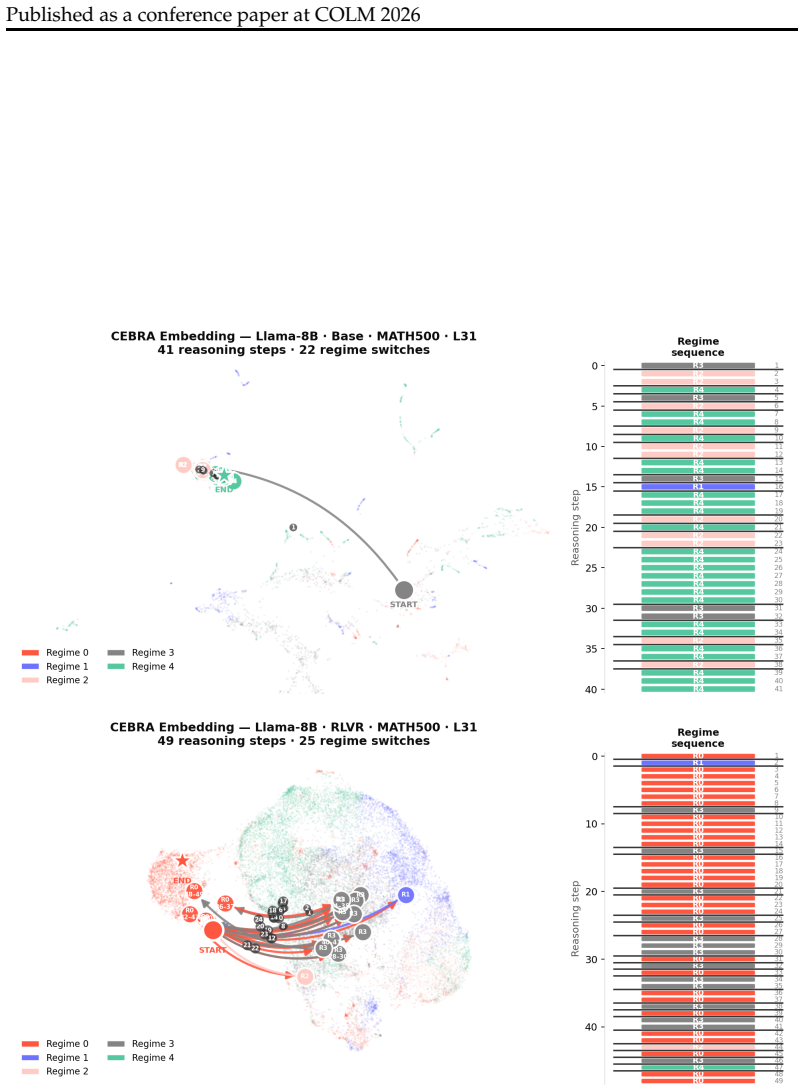
The central claim is that reasoning fine-tuning globally reorganizes latent dynamics: chain-of-thought reasoning unfolds through a small number of discrete, persistent, switchable policy states, and fine-tuning makes these states more differentiated in transition structure without uniformly increasing persistence. Using a switching dynamical system fitted to sentence-level activation trajectories, the paper reports that across four benchmarks and model scales from 1.5B to 32B parameters, reasoning models consistently show higher transition differentiation than base models, while state utilization, persistence, and mixing change in model-dependent ways. The regimes are functionally specialize
What carries the argument
The load-bearing object is a linear-Gaussian switching dynamical system (SDS): a discrete Markov chain of latent regimes, each with its own affine dynamics z(t+1) = A_k z(t) + b_k + noise, governing the evolution of a low-dimensional embedding of the model's residual stream. The embeddings come from a time-aware contrastive encoder trained with temporal adjacency, and the system is fit with expectation-maximization and forward-backward smoothing, with regime count selected by Bayesian information criterion. The paper measures organizational differences through transition differentiation (mean total-variation distance from uniform switching), persistence (self-transition probability), effecti
Load-bearing premise
The load-bearing premise is that sentence-level, last-token activation trajectories, fit as a first-order linear-Gaussian switching system with BIC-selected regime counts, produce regime sequences whose base-versus-reasoning differences reflect true latent policy organization rather than artifacts of model order or temporal resolution; the paper itself concedes that persistence is not identifiable once the selected number of regimes exceeds the true order, which is the regime
What would settle it
Fit the same SDS pipeline to a base model and its reasoning-fine-tuned counterpart at every candidate K, and compare the transition-structure and persistence gaps at matched K values across all model-dataset pairs. If the gaps vanish or reverse when K is held equal, or when the pipeline is applied to two random seeds of the same model with no fine-tuning difference, the claim that reasoning fine-tuning reorganizes latent dynamics collapses.
If this is right
- If the central claim is correct, reasoning gains are explainable and measurable as latent policy organization, not just improved token competence.
- The recovered regimes are functionally meaningful: misapplying them degrades predictive fit, while transplanting them into base models improves performance on hard problems.
- Trajectory-level structure can be exploited at inference: SDS-guided pruning of failure-prone prefixes outperforms self-consistency in 11 of 12 settings.
- The theory predicts that trajectory-level rewards induce persistent states by making continuation reward-relevant, offering a mechanism connecting fine-tuning to latent dynamics.
- The framework provides a new lens for process-level control of reasoning models, beyond output-level interventions.
Where Pith is reading between the lines
- A fairer comparison would hold the state budget fixed between base and reasoning models across the full K sweep, isolating whether reorganization is about richer state repertoires or more differentiated transitions among the same number of states.
- Because transplantation improves a base model without weight changes, a natural extension is to use the recovered policy as a lightweight inference-time controller for models that have not been reasoning-fine-tuned.
- The framework's temporal resolution is one sentence; re-running the SDS recovery at token or thought level could reveal whether persistent states survive finer granularity or are partly an artifact of sentence-level aggregation.
- If the trajectory-level reward explanation is right, other reward-based post-training schemes should also induce persistent latent states, a prediction testable by running the same analysis on instruction-tuned or RLHF'd checkpoints.
Editorial analysis
A structured set of objections, weighed in public.
Referee Report
Summary. The paper proposes a switching dynamical system (SDS) framework, with CEBRA-based dimensionality reduction and EM estimation, to infer discrete latent policy states from sentence-level activation trajectories of base and reasoning-fine-tuned LLMs. Across four model pairs and four benchmarks, it reports that reasoning models exhibit 'richer latent-policy organization,' most consistently expressed as higher TVD of the transition matrix, along with model-dependent changes in effective state usage, persistence, and mixing. Controls include time shuffling, randomized CEBRA pairs, Dirichlet-prior sensitivity, paired-correct traces, and cross-dataset transfer. Causal claims are supported by state-swap ablations, cross-model predictive transfer, and a steering intervention that transplants reasoning SDS dynamics into base models. A practical application, PREFIXGUARD, prunes failure-prone prefixes and outperforms self-consistency in 11/12 settings.
Significance. If correct, the paper offers a novel and actionable description of how reasoning fine-tuning reorganizes internal dynamics, with a publicly available codebase and a rich set of controls. The cross-model transfer asymmetry and the prefix-pruning results are particularly interesting. However, the primary evidence for the headline claim—higher TVD—is entangled with the model-order selection procedure, and the causal steering experiment lacks a key control. With additional fixed-order analyses and control interventions, the paper could substantially strengthen its conclusions.
major comments (3)
- [3.4, Appendix A (Eq. 14), Table 1, Figure 4] The headline TVD result is computed at BIC-selected K (Eq. 14), and Figure 4 shows reasoning models systematically select larger K than base models. Because TVD measures distance of each transition row to a K-dimensional uniform distribution, the metric is not comparable across models with different K. The fixed-K=5 control in Appendix E.2.3 (Table 6) uses randomized non-adjacent CEBRA positive pairs rather than the default adjacent-positive encoder, so it does not directly rule out a model-order confound for the default pipeline. Please recompute Tables 1 and 3 at a fixed K (e.g., K=5) using the default CEBRA objective, and report whether the TVD separation persists; also report the distribution of BIC-selected K across trajectories.
- [Appendix C.1, Remark C.5] Theorem C.4/Remark C.5 prove that for K>K⋆ there exist observationally equivalent solutions with strictly lower persistence and different transition structure. Since the pipeline selects K per trajectory and aggregates metrics across trajectories, it is unclear how many trajectories are in the over-specified regime where persistence/TVD are not identified. Please provide a sensitivity analysis—e.g., a simulation study showing BIC recovery of K⋆ and the effect on TVD under model-order mis-specification, plus an empirical breakdown of selected K per model/dataset.
- [§8.1, Appendix I.2 (Table 10)] The transplantation experiment reports that steering the base model with reasoning-SDS dynamics improves pass@8, but it lacks a control condition. Without a control using the base model's own SDS dynamics or a shuffled/random transition matrix, the improvement cannot be attributed specifically to the recovered reasoning dynamics. Add such a control to support the causal interpretation.
minor comments (6)
- [Abstract and §4] The term 'richer latent-policy organization' is operationalized through several metrics whose directions differ across model families; consider restating the central claim to emphasize TVD, which is the only consistent metric, and clearly separate the model-dependent findings.
- [Figure 2] The CK-residual plot lacks a quantitative test; please report the fraction of runs below the diagonal and a permutation test p-value.
- [Appendix E.2.3, Table 6] Report standard deviations over the three seeds for the randomized-pair results.
- [Section 8.2] The fixed scoring rule for PREFIXGUARD is not fully specified; provide the exact formula or a precise reference to the appendix.
- [Section 5.2] State-swap ablations are reported for two depth groups, but the main text says 'across all model families and datasets'; consider adding a summary table or pointing explicitly to Figures 16–17.
- [Running header] The running header on page 2 reads 'Reasoning Fine-T uning'; please correct.
Circularity Check
No significant circularity: the central claim is not forced by construction or by self-citation.
full rationale
The paper’s headline comparison (Table 1) is a fitted descriptive metric, not a prediction of a fitted parameter. The TVD/persistence gap is computed from EM-fitted transition matrices on CEBRA embeddings; the only prior touching the transition matrix (Eq. 13, kappa=1) smooths rows toward uniform rather than inflating self-transitions, and Appendix E.2.4 reports that removing it leaves the base/reasoning separation unchanged. The main confound raised by the skeptic—that BIC-selected K differs between base and reasoning models and TVD’s uniform reference depends on K—is a comparability caveat, not a circular reduction: Table 6 provides a fixed-K=5 control in which reasoning models still exceed base models in pstay and TVD across all 12 settings. Identifiability is imported from external results (Douc et al. 2004; Yakowitz & Spragins 1968), and the paper explicitly disclaims that its idealized assumptions are imposed on the empirical pipeline. No load-bearing step cites prior work by the same authors. The out-of-sample handles (state-swap, cross-model transfer, transplantation on pass@8=0 problems, PREFIXGUARD gains) are independent of the fitting procedure and give the central claim external content. Remaining concerns (per-trajectory BIC aggregation, missing pstay rows in Table 7, in-sample state-swap sanity check) are robustness issues, not by-construction circularity.
Axiom & Free-Parameter Ledger
free parameters (8)
- Latent regime count K (BIC-selected per trajectory) =
varies; reasoning models select larger K than base (Fig. 4)
- Dirichlet persistence prior κ (default 1) =
1
- CEBRA embedding dimension and temperature τ =
not stated in text
- EM ridge regularization λ =
1e-4
- Layer selection per model =
L22/L28/L20 middle; L31/L47/L27 final (used in main tables)
- State utility V(s) fitted from correctness outcomes =
estimated from trajectory correctness
- Transplantation steering hyperparameters =
α=8, β=8, τ=20 tokens, T=0.7, 8 samples
- PREFIXGUARD scoring weights =
unspecified
axioms (6)
- domain assumption Sentence-level last-token activations at a single layer are a sufficient statistic for the reasoning state
- domain assumption Switching dynamical system with first-order Markov latent states and linear-Gaussian emissions approximates LLM activation trajectories
- ad hoc to paper Identifiability/MLE-consistency assumptions (A1)–(A4): ergodicity, distinct emissions, compactness, uniform filter forgetting
- standard math Gaussian-mixture identifiability (Yakowitz & Spragins 1968) and MLE consistency (Douc et al. 2004)
- ad hoc to paper Under RLVR, the continuation margin γi(xt)=Vi(xt)-max_j Vj(xt) is ≥ γ with probability ≥ 1-δ
- domain assumption BIC is a valid model-order selector for these trajectories
invented entities (1)
-
Latent policy states (regimes)
independent evidence
read the original abstract
Reasoning-specialized language models show large performance gains over base models, yet the internal changes responsible for improved multi-step reasoning remain poorly understood. It is unclear whether reasoning fine-tuning improves local token-level competence or globally reorganizes how models structure inference over time. We address this question by modeling Chain-of-Thought reasoning as a switching dynamical system (SDS), in which internal representations evolve under discrete latent policy states. Our framework combines time-aware contrastive representation learning with discrete regime discovery to recover latent policies from activation trajectories. Across four benchmarks and model scales from 1.5B to 32B parameters, reasoning-fine-tuned models exhibit richer latent-policy organization than their base counterparts, characterized by more differentiated transition structure and model-dependent changes in state utilization, persistence, and mixing. The recovered regimes exhibit functional specialization aligned with distinct reasoning stages, and extensive controls confirm that their structure is not explained by correctness, representation learning, or modeling priors, but depends on the coherent temporal organization of reasoning trajectories. Causal interventions further show that the regimes are functionally meaningful: state-swap ablations reduce one-step predictive fit, while transplanting reasoning dynamics into base models improves performance on challenging reasoning problems. Finally, SDS-guided pruning of failure-prone reasoning prefixes outperforms self-consistency in 11 of 12 model-dataset settings, with gains of up to 12.5 percentage points. Together, our results suggest that reasoning fine-tuning globally reorganizes latent dynamics, offering a new lens for mechanistic analysis and process-level control of reasoning models.
Figures




Reference graph
Works this paper leans on
-
[1]
2023 , eprint=
Chain-of-Thought Prompting Elicits Reasoning in Large Language Models , author=. 2023 , eprint=
2023
-
[2]
ICML 2025 Workshop on Reliable and Responsible Foundation Models , year=
A Statistical Physics of Language Model Reasoning , author=. ICML 2025 Workshop on Reliable and Responsible Foundation Models , year=
2025
-
[3]
Proceedings of the 41st International Conference on Machine Learning , articleno =
Balsells-Rodas, Carles and Wang, Yixin and Li, Yingzhen , title =. Proceedings of the 41st International Conference on Machine Learning , articleno =. 2024 , publisher =
2024
-
[5]
2026 , eprint=
Learning a Generative Meta-Model of LLM Activations , author=. 2026 , eprint=
2026
-
[6]
The Thirty-ninth Annual Conference on Neural Information Processing Systems , year=
Quantifying Elicitation of Latent Capabilities in Language Models , author=. The Thirty-ninth Annual Conference on Neural Information Processing Systems , year=
-
[7]
2025 , eprint=
Does Reinforcement Learning Really Incentivize Reasoning Capacity in LLMs Beyond the Base Model? , author=. 2025 , eprint=
2025
-
[8]
On the Limits of
Fang Wu and Yejin Choi , booktitle=. On the Limits of. 2025 , url=
2025
-
[9]
2025 , eprint=
Beyond the 80/20 Rule: High-Entropy Minority Tokens Drive Effective Reinforcement Learning for LLM Reasoning , author=. 2025 , eprint=
2025
-
[10]
2025 , eprint=
Thought Branches: Interpreting LLM Reasoning Requires Resampling , author=. 2025 , eprint=
2025
-
[11]
2025 , eprint=
Reasoning-Finetuning Repurposes Latent Representations in Base Models , author=. 2025 , eprint=
2025
-
[12]
2025 , eprint=
Base Models Know How to Reason, Thinking Models Learn When , author=. 2025 , eprint=
2025
-
[13]
2025 , eprint=
Rank-1 LoRAs Encode Interpretable Reasoning Signals , author=. 2025 , eprint=
2025
-
[14]
in Hidden Markov Models , author=
-
[16]
and Spragins, John D
Yakowitz, Sidney J. and Spragins, John D. , title =. The Annals of Mathematical Statistics , volume =. 1968 , month =
1968
-
[17]
On the Direction of
Kexin Huang and Haoming Meng and Junkang Wu and Jinda Lu and Chiyu Ma and Ziqian Chen and Xue Wang and Bolin Ding and Jiancan Wu and Xiang Wang and Xiangnan He and Guoyin Wang and Jingren Zhou , booktitle=. On the Direction of. 2026 , url=
2026
-
[19]
2026 , eprint=
On the Entropy Dynamics in Reinforcement Fine-Tuning of Large Language Models , author=. 2026 , eprint=
2026
-
[20]
2025 , eprint=
The CoT Encyclopedia: Analyzing, Predicting, and Controlling how a Reasoning Model will Think , author=. 2025 , eprint=
2025
-
[21]
and Fu, K
Ackerson, G. and Fu, K. , journal=. On state estimation in switching environments , year=
-
[22]
Neural computation , volume=
Variational learning for switching state-space models , author=. Neural computation , volume=. 2000 , publisher=
2000
-
[23]
2017 , editor =
Linderman, Scott and Johnson, Matthew and Miller, Andrew and Adams, Ryan and Blei, David and Paninski, Liam , booktitle =. 2017 , editor =
2017
-
[24]
2025 , eprint=
The Reasoning Boundary Paradox: How Reinforcement Learning Constrains Language Models , author=. 2025 , eprint=
2025
-
[25]
The Fourteenth International Conference on Learning Representations , year=
Narrow Finetuning Leaves Clearly Readable Traces in the Activation Differences , author=. The Fourteenth International Conference on Learning Representations , year=
-
[27]
Mechanistic Interpretability Workshop at NeurIPS 2025 , year=
Towards a Mechanistic Understanding of Robustness in Finetuned Reasoning Models , author=. Mechanistic Interpretability Workshop at NeurIPS 2025 , year=
2025
-
[28]
Towards Understanding Fine-Tuning Mechanisms of
Xu Wang and Yan Hu and Wenyu Du and Reynold Cheng and Benyou Wang and Difan Zou , booktitle=. Towards Understanding Fine-Tuning Mechanisms of. 2025 , url=
2025
-
[29]
ICLR 2025 Workshop on Building Trust in Language Models and Applications , year=
Towards Understanding Distilled Reasoning Models: A Representational Approach , author=. ICLR 2025 Workshop on Building Trust in Language Models and Applications , year=
2025
-
[30]
Demystifying Reasoning Dynamics with Mutual Information: Thinking Tokens are Information Peaks in
Chen Qian and Dongrui Liu and Haochen Wen and Zhen Bai and Yong Liu and Jing Shao , booktitle=. Demystifying Reasoning Dynamics with Mutual Information: Thinking Tokens are Information Peaks in. 2025 , url=
2025
-
[31]
2025 , eprint=
Thought Anchors: Which LLM Reasoning Steps Matter? , author=. 2025 , eprint=
2025
-
[32]
Workshop on Reasoning and Planning for Large Language Models , year=
Understanding Reasoning in Thinking Language Models via Steering Vectors , author=. Workshop on Reasoning and Planning for Large Language Models , year=
-
[34]
Measuring Chain of Thought Faithfulness by Unlearning Reasoning Steps
Tutek, Martin and Hashemi Chaleshtori, Fateme and Marasovic, Ana and Belinkov, Yonatan. Measuring Chain of Thought Faithfulness by Unlearning Reasoning Steps. Proceedings of the 2025 Conference on Empirical Methods in Natural Language Processing. 2025. doi:10.18653/v1/2025.emnlp-main.504
-
[36]
2021 , eprint=
Measuring Mathematical Problem Solving With the MATH Dataset , author=. 2021 , eprint=
2021
-
[38]
2024 , eprint=
MMLU-Pro: A More Robust and Challenging Multi-Task Language Understanding Benchmark , author=. 2024 , eprint=
2024
-
[39]
2024 , url =
Llama 3 Model Card , author=. 2024 , url =
2024
-
[42]
QwQ-32B: Embracing the Power of Reinforcement Learning , url =
Qwen Team , month =. QwQ-32B: Embracing the Power of Reinforcement Learning , url =
-
[44]
2025 , eprint=
1.4 Million Open-Source Distilled Reasoning Dataset to Empower Large Language Model Training , author=. 2025 , eprint=
2025
-
[45]
2025 , eprint=
DeepSeek-R1: Incentivizing Reasoning Capability in LLMs via Reinforcement Learning , author=. 2025 , eprint=
2025
-
[46]
2025 , eprint=
Tulu 3: Pushing Frontiers in Open Language Model Post-Training , author=. 2025 , eprint=
2025
-
[47]
2024 , eprint=
DeepSeekMath: Pushing the Limits of Mathematical Reasoning in Open Language Models , author=. 2024 , eprint=
2024
-
[48]
2024 , month = aug, journal =
GPT-4o System Card , author =. 2024 , month = aug, journal =
2024
-
[49]
2026 , url=
Junda Wu and Yuxin Xiong and Xintong Li and Sheldon Yu and Zhengmian Hu and Tong Yu and Rui Wang and Xiang Chen and Jingbo Shang and Julian McAuley , booktitle=. 2026 , url=
2026
-
[50]
2025 , url=
Runjin Chen and Zhenyu Zhang and Junyuan Hong and Souvik Kundu and Zhangyang Wang , booktitle=. 2025 , url=
2025
-
[51]
G. Ackerson and K. Fu. On state estimation in switching environments. IEEE Transactions on Automatic Control, 15 0 (1): 0 10--17, 1970. doi:10.1109/TAC.1970.1099359
arXiv 1970
-
[52]
Llama 3 model card
AI@Meta. Llama 3 model card. 2024. URL https://github.com/meta-llama/llama3/blob/main/MODEL_CARD.md
2024
-
[53]
Jinze Bai, Shuai Bai, Yunfei Chu, Zeyu Cui, Kai Dang, Xiaodong Deng, Yang Fan, Wenbin Ge, Yu Han, Fei Huang, Binyuan Hui, Luo Ji, Mei Li, Junyang Lin, Runji Lin, Dayiheng Liu, Gao Liu, Chengqiang Lu, Keming Lu, Jianxin Ma, Rui Men, Xingzhang Ren, Xuancheng Ren, Chuanqi Tan, Sinan Tan, Jianhong Tu, Peng Wang, Shijie Wang, Wei Wang, Shengguang Wu, Benfeng X...
Pith/arXiv arXiv 2023
-
[54]
On the identifiability of switching dynamical systems
Carles Balsells-Rodas, Yixin Wang, and Yingzhen Li. On the identifiability of switching dynamical systems. In Proceedings of the 41st International Conference on Machine Learning, ICML'24. JMLR.org, 2024
2024
-
[55]
Bogdan, Uzay Macar, Neel Nanda, and Arthur Conmy
Paul C. Bogdan, Uzay Macar, Neel Nanda, and Arthur Conmy. Thought anchors: Which llm reasoning steps matter?, 2025. URL https://arxiv.org/abs/2506.19143
arXiv 2025
-
[56]
A statistical physics of language model reasoning
Jack David Carson. A statistical physics of language model reasoning. In ICML 2025 Workshop on Reliable and Responsible Foundation Models, 2025. URL https://openreview.net/forum?id=MbJXVbwSir
2025
-
[57]
SEAL : Steerable reasoning calibration of large language models for free
Runjin Chen, Zhenyu Zhang, Junyuan Hong, Souvik Kundu, and Zhangyang Wang. SEAL : Steerable reasoning calibration of large language models for free. In Second Conference on Language Modeling, 2025. URL https://openreview.net/forum?id=klPszYDIRT
2025
-
[58]
Training verifiers to solve math word problems
Karl Cobbe, Vineet Kosaraju, Mohammad Bavarian, Mark Chen, Heewoo Jun, Lukasz Kaiser, Matthias Plappert, Jerry Tworek, Jacob Hilton, Reiichiro Nakano, Christopher Hesse, and John Schulman. Training verifiers to solve math word problems. arXiv preprint arXiv:2110.14168, 2021
Pith/arXiv arXiv 2021
-
[59]
Deepseek-r1: Incentivizing reasoning capability in llms via reinforcement learning, 2025
DeepSeek-AI. Deepseek-r1: Incentivizing reasoning capability in llms via reinforcement learning, 2025. URL https://arxiv.org/abs/2501.12948
Pith/arXiv arXiv 2025
-
[60]
Randal Douc, Éric Moulines, and Tobias Rydén. Asymptotic properties of the maximum likelihood estimator in autoregressive models with markov regime. The Annals of Statistics, 32 0 (5), October 2004. ISSN 0090-5364. doi:10.1214/009053604000000021. URL http://dx.doi.org/10.1214/009053604000000021
-
[61]
Variational learning for switching state-space models
Zoubin Ghahramani and Geoffrey E Hinton. Variational learning for switching state-space models. Neural computation, 12 0 (4): 0 831--864, 2000
2000
-
[62]
Measuring mathematical problem solving with the math dataset, 2021
Dan Hendrycks, Collin Burns, Saurav Kadavath, Akul Arora, Steven Basart, Eric Tang, Dawn Song, and Jacob Steinhardt. Measuring mathematical problem solving with the math dataset, 2021. URL https://arxiv.org/abs/2103.03874
Pith/arXiv arXiv 2021
-
[63]
On the direction of RLVR updates for LLM reasoning: Identification and exploitation
Kexin Huang, Haoming Meng, Junkang Wu, Jinda Lu, Chiyu Ma, Ziqian Chen, Xue Wang, Bolin Ding, Jiancan Wu, Xiang Wang, Xiangnan He, Guoyin Wang, and Jingren Zhou. On the direction of RLVR updates for LLM reasoning: Identification and exploitation. In The Fourteenth International Conference on Learning Representations, 2026. URL https://openreview.net/forum...
2026
-
[64]
Miranda, Alisa Liu, Nouha Dziri, Shane Lyu, Yuling Gu, Saumya Malik, Victoria Graf, Jena D
Nathan Lambert, Jacob Morrison, Valentina Pyatkin, Shengyi Huang, Hamish Ivison, Faeze Brahman, Lester James V. Miranda, Alisa Liu, Nouha Dziri, Shane Lyu, Yuling Gu, Saumya Malik, Victoria Graf, Jena D. Hwang, Jiangjiang Yang, Ronan Le Bras, Oyvind Tafjord, Chris Wilhelm, Luca Soldaini, Noah A. Smith, Yizhong Wang, Pradeep Dasigi, and Hannaneh Hajishirzi...
Pith/arXiv arXiv 2025
-
[65]
The cot encyclopedia: Analyzing, predicting, and controlling how a reasoning model will think, 2025
Seongyun Lee, Seungone Kim, Minju Seo, Yongrae Jo, Dongyoung Go, Hyeonbin Hwang, Jinho Park, Xiang Yue, Sean Welleck, Graham Neubig, Moontae Lee, and Minjoon Seo. The cot encyclopedia: Analyzing, predicting, and controlling how a reasoning model will think, 2025. URL https://arxiv.org/abs/2505.10185
Pith/arXiv arXiv 2025
-
[66]
Clue: Non-parametric verification from experience via hidden-state clustering
Zhenwen Liang, Ruosen Li, Yujun Zhou, Linfeng Song, Dian Yu, Xinya Du, Haitao Mi, and Dong Yu. Clue: Non-parametric verification from experience via hidden-state clustering. arXiv preprint arXiv:2510.01591, 2025
arXiv 2025
-
[67]
Bayesian Learning and Inference in Recurrent Switching Linear Dynamical Systems
Scott Linderman, Matthew Johnson, Andrew Miller, Ryan Adams, David Blei, and Liam Paninski. Bayesian Learning and Inference in Recurrent Switching Linear Dynamical Systems . In Aarti Singh and Jerry Zhu (eds.), Proceedings of the 20th International Conference on Artificial Intelligence and Statistics, volume 54 of Proceedings of Machine Learning Research,...
2017
-
[68]
Learning a generative meta-model of llm activations, 2026
Grace Luo, Jiahai Feng, Trevor Darrell, Alec Radford, and Jacob Steinhardt. Learning a generative meta-model of llm activations, 2026. URL https://arxiv.org/abs/2602.06964
arXiv 2026
-
[69]
Bogdan, Senthooran Rajamanoharan, and Neel Nanda
Uzay Macar, Paul C. Bogdan, Senthooran Rajamanoharan, and Neel Nanda. Thought branches: Interpreting llm reasoning requires resampling, 2025. URL https://arxiv.org/abs/2510.27484
Pith/arXiv arXiv 2025
-
[70]
Narrow finetuning leaves clearly readable traces in the activation differences
Julian Minder, Cl \'e ment Dumas, Stewart Slocum, Helena Casademunt, Cameron Holmes, Robert West, and Neel Nanda. Narrow finetuning leaves clearly readable traces in the activation differences. In The Fourteenth International Conference on Learning Representations, 2026. URL https://openreview.net/forum?id=qyVzZsrsnS
2026
-
[71]
Diab, Virginia Smith, and Dawn Song
Aashiq Muhamed, Xuandong Zhao, Mona T. Diab, Virginia Smith, and Dawn Song. Towards a mechanistic understanding of robustness in finetuned reasoning models. In Mechanistic Interpretability Workshop at NeurIPS 2025, 2025. URL https://openreview.net/forum?id=rqe4zQCURe
2025
- [72]
-
[73]
Arkil Patel, Satwik Bhattamishra, and Navin Goyal. Are NLP models really able to solve simple math word problems? In Proceedings of the 2021 Conference of the North American Chapter of the Association for Computational Linguistics: Human Language Technologies, pp.\ 2080--2094, Online, June 2021. Association for Computational Linguistics. doi:10.18653/v1/2...
-
[74]
Demystifying reasoning dynamics with mutual information: Thinking tokens are information peaks in LLM reasoning
Chen Qian, Dongrui Liu, Haochen Wen, Zhen Bai, Yong Liu, and Jing Shao. Demystifying reasoning dynamics with mutual information: Thinking tokens are information peaks in LLM reasoning. In The Thirty-ninth Annual Conference on Neural Information Processing Systems, 2025. URL https://openreview.net/forum?id=E1FrjgaG1J
2025
-
[75]
Learnable latent embeddings for joint behavioural and neural analysis
Steffen Schneider, Jin Hwa Lee, and Mackenzie Weygandt Mathis. Learnable latent embeddings for joint behavioural and neural analysis. Nature, 617 0 (7960): 0 360–368, May 2023. ISSN 1476-4687. doi:10.1038/s41586-023-06031-6. URL http://dx.doi.org/10.1038/s41586-023-06031-6
-
[76]
Zhihong Shao, Peiyi Wang, Qihao Zhu, Runxin Xu, Junxiao Song, Xiao Bi, Haowei Zhang, Mingchuan Zhang, Y. K. Li, Y. Wu, and Daya Guo. Deepseekmath: Pushing the limits of mathematical reasoning in open language models, 2024. URL https://arxiv.org/abs/2402.03300
Pith/arXiv arXiv 2024
-
[77]
Understanding reasoning in thinking language models via steering vectors
Constantin Venhoff, Iv \'a n Arcuschin, Philip Torr, Arthur Conmy, and Neel Nanda. Understanding reasoning in thinking language models via steering vectors. In Workshop on Reasoning and Planning for Large Language Models, 2025 a . URL https://openreview.net/forum?id=OwhVWNOBcz
2025
-
[78]
Base models know how to reason, thinking models learn when, 2025 b
Constantin Venhoff, Iván Arcuschin, Philip Torr, Arthur Conmy, and Neel Nanda. Base models know how to reason, thinking models learn when, 2025 b . URL https://arxiv.org/abs/2510.07364
Pith/arXiv arXiv 2025
-
[79]
Shenzhi Wang, Le Yu, Chang Gao, Chujie Zheng, Shixuan Liu, Rui Lu, Kai Dang, Xionghui Chen, Jianxin Yang, Zhenru Zhang, Yuqiong Liu, An Yang, Andrew Zhao, Yang Yue, Shiji Song, Bowen Yu, Gao Huang, and Junyang Lin. Beyond the 80/20 rule: High-entropy minority tokens drive effective reinforcement learning for llm reasoning, 2025 a . URL https://arxiv.org/a...
Pith/arXiv arXiv 2025
-
[80]
Towards understanding fine-tuning mechanisms of LLM s via circuit analysis
Xu Wang, Yan Hu, Wenyu Du, Reynold Cheng, Benyou Wang, and Difan Zou. Towards understanding fine-tuning mechanisms of LLM s via circuit analysis. In ICLR 2025 Workshop on Building Trust in Language Models and Applications, 2025 b . URL https://openreview.net/forum?id=Z9qzta1yiK
2025
-
[81]
Mmlu-pro: A more robust and challenging multi-task language understanding benchmark, 2024
Yubo Wang, Xueguang Ma, Ge Zhang, Yuansheng Ni, Abhranil Chandra, Shiguang Guo, Weiming Ren, Aaran Arulraj, Xuan He, Ziyan Jiang, Tianle Li, Max Ku, Kai Wang, Alex Zhuang, Rongqi Fan, Xiang Yue, and Wenhu Chen. Mmlu-pro: A more robust and challenging multi-task language understanding benchmark, 2024. URL https://arxiv.org/abs/2406.01574
Pith/arXiv arXiv 2024
-
[82]
Reasoning-finetuning repurposes latent representations in base models, 2025 a
Jake Ward, Chuqiao Lin, Constantin Venhoff, and Neel Nanda. Reasoning-finetuning repurposes latent representations in base models, 2025 a . URL https://arxiv.org/abs/2507.12638
Pith/arXiv arXiv 2025
-
[83]
Rank-1 loras encode interpretable reasoning signals
Jake Ward, Paul Riechers, and Adam Shai. Rank-1 loras encode interpretable reasoning signals. arXiv preprint arXiv:2511.06739, 2025 b
arXiv 2025
-
[84]
On the limits of RLVR : Support, entropy, and the illusion of reasoning
Fang Wu and Yejin Choi. On the limits of RLVR : Support, entropy, and the illusion of reasoning. In 2nd AI for Math Workshop @ ICML 2025, 2025. URL https://openreview.net/forum?id=KXtLWJAzgh
2025
-
[85]
CTRLS : Chain-of-thought reasoning via latent state transition
Junda Wu, Yuxin Xiong, Xintong Li, Sheldon Yu, Zhengmian Hu, Tong Yu, Rui Wang, Xiang Chen, Jingbo Shang, and Julian McAuley. CTRLS : Chain-of-thought reasoning via latent state transition. In The 29th International Conference on Artificial Intelligence and Statistics, 2026. URL https://openreview.net/forum?id=afld4XGbQe
2026
-
[86]
Sidney J. Yakowitz and John D. Spragins. On the identifiability of finite mixtures. The Annals of Mathematical Statistics, 39 0 (1): 0 209--214, February 1968. doi:10.1214/aoms/1177698520
arXiv 1968
-
[87]
An Yang, Baosong Yang, Binyuan Hui, Bo Zheng, Bowen Yu, Chang Zhou, Chengpeng Li, Chengyuan Li, Dayiheng Liu, Fei Huang, Guanting Dong, Haoran Wei, Huan Lin, Jialong Tang, Jialin Wang, Jian Yang, Jianhong Tu, Jianwei Zhang, Jianxin Ma, Jin Xu, Jingren Zhou, Jinze Bai, Jinzheng He, Junyang Lin, Kai Dang, Keming Lu, Keqin Chen, Kexin Yang, Mei Li, Mingfeng ...
Pith/arXiv arXiv 2024
-
[88]
An Yang, Baosong Yang, Beichen Zhang, Binyuan Hui, Bo Zheng, Bowen Yu, Chengyuan Li, Dayiheng Liu, Fei Huang, Haoran Wei, Huan Lin, Jian Yang, Jianhong Tu, Jianwei Zhang, Jianxin Yang, Jiaxi Yang, Jingren Zhou, Junyang Lin, Kai Dang, Keming Lu, Keqin Bao, Kexin Yang, Le Yu, Mei Li, Mingfeng Xue, Pei Zhang, Qin Zhu, Rui Men, Runji Lin, Tianhao Li, Tianyi T...
Pith/arXiv arXiv 2024
-
[89]
Yang Yue, Zhiqi Chen, Rui Lu, Andrew Zhao, Zhaokai Wang, Yang Yue, Shiji Song, and Gao Huang. Does reinforcement learning really incentivize reasoning capacity in llms beyond the base model?, 2025. URL https://arxiv.org/abs/2504.13837
Pith/arXiv arXiv 2025
-
[90]
1.4 million open-source distilled reasoning dataset to empower large language model training, 2025
Han Zhao, Haotian Wang, Yiping Peng, Sitong Zhao, Xiaoyu Tian, Shuaiting Chen, Yunjie Ji, and Xiangang Li. 1.4 million open-source distilled reasoning dataset to empower large language model training, 2025. URL https://arxiv.org/abs/2503.19633
Pith/arXiv arXiv 2025
discussion (0)
Sign in with ORCID, Apple, or X to comment. Anyone can read and Pith papers without signing in.