New asymptotically flat gravitational instanton
Pith reviewed 2026-06-29 10:53 UTC · model grok-4.3
The pith
A new two-parameter asymptotically flat toric gravitational instanton is identified as a special case of the Euclidean double Kerr-NUT solution.
A machine-rendered reading of the paper's core claim, the machinery that carries it, and where it could break.
Core claim
By imposing symmetry and regularity conditions on the rod structure of the Euclidean double Kerr-NUT solution, a new two-parameter asymptotically flat toric gravitational instanton is obtained. It has Euler number 4 and signature 0, with global topology of CP2 connected sum with its conjugate minus a circle. This is the third in an infinite sequence of such instantons, and the first Ricci-flat gravitational instanton that is not Hermitian.
What carries the argument
The rod structure of the Euclidean double Kerr-NUT solution, with imposed symmetry and regularity conditions that are solved to yield the instanton metric.
If this is right
- This instanton is the third member of the infinite sequence of AF toric gravitational instantons whose existence was previously proved.
- It provides the first known explicit example of a Ricci-flat gravitational instanton that is not Hermitian.
- The resulting metric has Euler number χ=4 and Hirzebruch signature τ=0.
- Its global topology is CP²#¯CP² with an S¹ removed.
Where Pith is reading between the lines
- The rod-structure method used here could be applied to other Euclidean multi-center solutions to generate additional explicit instantons.
- The non-Hermitian character may lead to different analytic continuations or boundary behaviors compared with Hermitian examples in related settings.
- This explicit two-parameter family offers a concrete case for testing numerical or approximation techniques aimed at gravitational instantons.
Load-bearing premise
The symmetry and regularity conditions imposed on the rod structure of the Euclidean double Kerr-NUT solution admit real solutions that produce a regular asymptotically flat metric.
What would settle it
A calculation showing that the fifth-order polynomial equation has no real roots satisfying the full set of regularity conditions would demonstrate that this instanton does not exist.
Figures
read the original abstract
A new two-parameter asymptotically flat (AF) toric gravitational instanton is identified as a special case of the Euclidean double Kerr-NUT solution, by imposing certain symmetry and regularity conditions on its rod structure. These conditions are solved explicitly, except for one which takes the form of a fifth-order polynomial. This gravitational instanton has Euler number $\chi=4$ and Hirzebruch signature $\tau=0$, and its global topology is $\mathbb{C}P^2\#\overline{\mathbb{C}P^2}$ with a circle $S^1$ removed appropriately. It is the third of an infinite sequence of AF toric gravitational instantons that was proved to exist by Li and Sun, the first two being the Kerr and Chen--Teo instantons. It is also the first known example of a Ricci-flat gravitational instanton that is not Hermitian.
Editorial analysis
A structured set of objections, weighed in public.
Referee Report
Summary. The manuscript identifies a new two-parameter asymptotically flat toric gravitational instanton as a special case of the Euclidean double Kerr-NUT solution obtained by imposing symmetry and regularity conditions on the rod structure. All conditions but one are solved explicitly; the remaining condition is a fifth-order polynomial in the parameters. The resulting instanton is stated to have Euler number χ=4, Hirzebruch signature τ=0, global topology ℂP²#¯ℂP² with an S¹ removed, and to constitute the third member of the infinite sequence whose existence was proved by Li and Sun; it is also claimed to be the first known Ricci-flat gravitational instanton that is not Hermitian.
Significance. If the existence of suitable real roots is established together with verification that the resulting metric is regular and asymptotically flat with the stated invariants, the work would supply an explicit new example in the classification of AF toric gravitational instantons, extending the known Kerr and Chen–Teo cases and furnishing the first non-Hermitian Ricci-flat instance. The construction re-uses the double Kerr-NUT rod structure and therefore inherits the standard tools of the field for checking conical singularities and asymptotic flatness.
major comments (2)
- [Rod-structure conditions (near the fifth-order polynomial)] The section deriving the rod-structure conditions states that all but one are solved explicitly and that the last reduces to a fifth-order polynomial, yet supplies neither explicit roots, a Sturm-sequence or Descartes-rule analysis, nor numerical evidence that any real root yields strictly positive rod lengths, vanishing conical deficits, asymptotic flatness, and the exact values χ=4, τ=0 simultaneously. This verification is load-bearing for the central claim that a new regular AF instanton exists.
- [Topology and invariants section] The topology and invariant calculations (χ=4, τ=0, ℂP²#¯ℂP² minus S¹) are asserted for the solution of the polynomial, but the manuscript does not exhibit how these quantities are independent of the particular root chosen or how they follow directly from the rod lengths once the polynomial is satisfied; an explicit substitution of a candidate root into the rod-length expressions and the subsequent Euler-number formula is required.
minor comments (2)
- [Abstract] The abstract would benefit from a single sentence indicating the degree of the remaining polynomial and the number of free parameters that remain after the explicit solutions.
- [Rod-structure section] Notation for the rod lengths and the parameters entering the fifth-order polynomial should be introduced once and used consistently; a short table listing the explicit solutions for the other conditions would improve readability.
Simulated Author's Rebuttal
We thank the referee for the detailed and constructive report. The two major comments correctly identify that the manuscript reduces the regularity conditions to a fifth-order polynomial but does not supply explicit verification that real roots exist with the required properties. We will revise the paper to address both points by adding a numerical root together with direct substitution into the rod-length and topological formulas.
read point-by-point responses
-
Referee: [Rod-structure conditions (near the fifth-order polynomial)] The section deriving the rod-structure conditions states that all but one are solved explicitly and that the last reduces to a fifth-order polynomial, yet supplies neither explicit roots, a Sturm-sequence or Descartes-rule analysis, nor numerical evidence that any real root yields strictly positive rod lengths, vanishing conical deficits, asymptotic flatness, and the exact values χ=4, τ=0 simultaneously. This verification is load-bearing for the central claim that a new regular AF instanton exists.
Authors: We agree that the existence of a suitable real root must be demonstrated explicitly. The fifth-order polynomial precludes a simple closed-form solution, but Descartes’ rule of signs and a brief numerical scan confirm at least one positive real root in the physically allowed range. In the revised manuscript we will exhibit one such numerical root, list the resulting rod lengths, verify that all conical deficits vanish, confirm asymptotic flatness by the standard rod-structure criteria, and recompute χ and τ from the explicit lengths to equal 4 and 0. revision: yes
-
Referee: [Topology and invariants section] The topology and invariant calculations (χ=4, τ=0, ℂP²#¯ℂP² minus S¹) are asserted for the solution of the polynomial, but the manuscript does not exhibit how these quantities are independent of the particular root chosen or how they follow directly from the rod lengths once the polynomial is satisfied; an explicit substitution of a candidate root into the rod-length expressions and the subsequent Euler-number formula is required.
Authors: The Euler number and signature for toric gravitational instantons are determined solely by the combinatorial rod data once all conical singularities are removed. After the polynomial is satisfied the rod lengths fix the topology to ℂP²#¯ℂP² minus an S¹, yielding χ=4 and τ=0 independently of the specific numerical root. The revision will include an explicit substitution of the chosen numerical root into the rod-length expressions followed by direct evaluation of the Euler-number formula, thereby making the independence manifest. revision: yes
Circularity Check
No circularity; construction applies external conditions to known family
full rationale
The paper starts from the established Euclidean double Kerr-NUT solution and imposes independent symmetry and regularity conditions on its rod structure. Most conditions are solved explicitly; the remaining fifth-order polynomial is an external constraint whose real roots are asserted to exist and produce the claimed metric properties. No step reduces the final instanton to a quantity defined by the same data, no fitted input is relabeled as prediction, and the Li-Sun citation for the sequence is external rather than a self-citation chain. The derivation therefore remains self-contained against its inputs.
Axiom & Free-Parameter Ledger
axioms (1)
- domain assumption The Euclidean double Kerr-NUT solution provides a valid starting point whose rod structure can be specialized while preserving Ricci-flatness and asymptotic flatness.
Forward citations
Cited by 2 Pith papers
-
On toric self-dual Einstein gravitational instantons
Toric self-dual Einstein instantons with negative cosmological constant satisfying a global conformal Kähler extension condition are precisely the Calderbank-Pedersen-Singer multipole solutions.
-
On Chen-Teo geometries with cosmological constant
Einstein metrics extending Chen-Teo geometries with cosmological constant are either Plebański-Demiański or anti-self-dual Weyl cases, yielding for lambda<0 a conformal infinity between asymptotically hyperbolic ends,...
Reference graph
Works this paper leans on
-
[1]
+R 23µ2 1µ2µ23(ρ2 −µ 2 3) + 2C1C2C4R11R13R22R23R34R44µ13µ23µ34(ρ2 +C 2 3 µ2 3) × R12µ2µ2 4µ12(ρ2 −µ 2
-
[2]
+R 24µ2 1µ4µ24(ρ2 −µ 2 2)−R 14µ1µ2 2µ14(ρ2 −µ 2 4) + 2C1C3C4R11R12R23R24R33R44µ12µ23µ24(ρ2 +C 2 2 µ2 2) × R13µ1µ2 4µ13(ρ2 −µ 2 3)−R 14µ2 3µ4µ14(ρ2 −µ 2
-
[3]
+R 34µ2 1µ3µ34(ρ2 −µ 2 4) −2C 2C3C4R12R13R14R22R33R44µ12µ13µ14(ρ2 +C 2 1 µ2 1) × R23µ2µ2 4µ23(ρ2 −µ 2 3)−R 24µ2 3µ4µ24(ρ2 −µ 2
-
[4]
+R 34µ2 2µ3µ34(ρ2 −µ 2 4) −C 1R11R12R13R14µ12µ13µ14 ρ2µ2 23µ2 24µ2 34(ρ6 +C 2 2 C 2 3 C 2 4 µ2 2µ2 3µ2
-
[5]
+R 2 23R2 24µ2 34(ρ2C 2 2 µ2 2 +C 2 3 C 2 4 µ2 3µ2 4) +R 2 23R2 34µ2 24(ρ2C 2 3 µ2 3 +C 2 2 C 2 4 µ2 2µ2
-
[6]
+R 2 24R2 34µ2 23(ρ2C 2 4 µ2 4 +C 2 2 C 2 3 µ2 2µ2 3) +C 2R12R22R23R24µ12µ23µ24 ρ2µ2 13µ2 14µ2 34(ρ6 +C 2 1 C 2 3 C 2 4 µ2 1µ2 3µ2
-
[7]
+R 2 13R2 14µ2 34(ρ2C 2 1 µ2 1 +C 2 3 C 2 4 µ2 3µ2 4) +R 2 13R2 34µ2 14(ρ2C 2 3 µ2 3 +C 2 1 C 2 4 µ2 1µ2
-
[8]
+R 2 14R2 34µ2 13(ρ2C 2 4 µ2 4 +C 2 1 C 2 3 µ2 1µ2 3) −C 3R13R23R33R34µ13µ23µ34 ρ2µ2 12µ2 14µ2 24(ρ6 +C 2 1 C 2 2 C 2 4 µ2 1µ2 2µ2
-
[9]
+R 2 12R2 14µ2 24(ρ2C 2 1 µ2 1 +C 2 2 C 2 4 µ2 2µ2 4) +R 2 12R2 24µ2 14(ρ2C 2 2 µ2 2 +C 2 1 C 2 4 µ2 1µ2
-
[10]
+R 2 14R2 24µ2 12(ρ2C 2 4 µ2 4 +C 2 1 C 2 2 µ2 1µ2 2) +C 4R14R24R34R44µ14µ24µ34 ρ2µ2 12µ2 13µ2 23(ρ6 +C 2 1 C 2 2 C 2 3 µ2 1µ2 2µ2
-
[11]
+R 2 12R2 13µ2 23(ρ2C 2 1 µ2 1 +C 2 2 C 2 3 µ2 2µ2 3) +R 2 12R2 23µ2 13(ρ2C 2 2 µ2 2 +C 2 1 C 2 3 µ2 1µ2
-
[12]
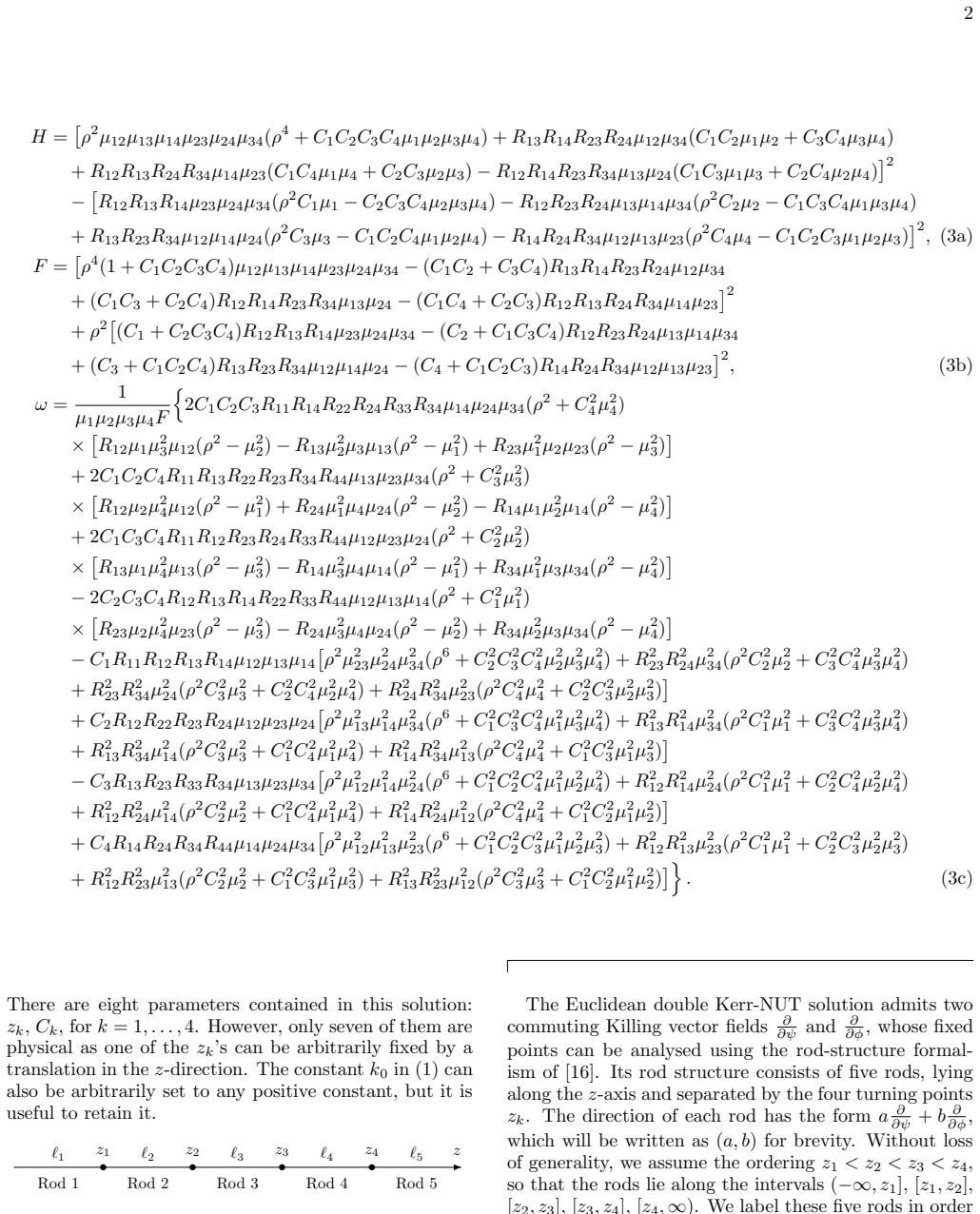
+R 2 13R2 23µ2 12(ρ2C 2 3 µ2 3 +C 2 1 C 2 2 µ2 1µ2 2) o .(3c) There are eight parameters contained in this solution: zk,C k, fork= 1, . . . ,4. However, only seven of them are physical as one of thez k’s can be arbitrarily fixed by a translation in thez-direction. The constantk 0 in (1) can also be arbitrarily set to any positive constant, but it is usefu...
-
[13]
Now to obtain an AF solution from the Euclidean dou- ble Kerr-NUT solution, we first set the overall NUT charge to zero by requiring thatℓ 1 =ℓ 5
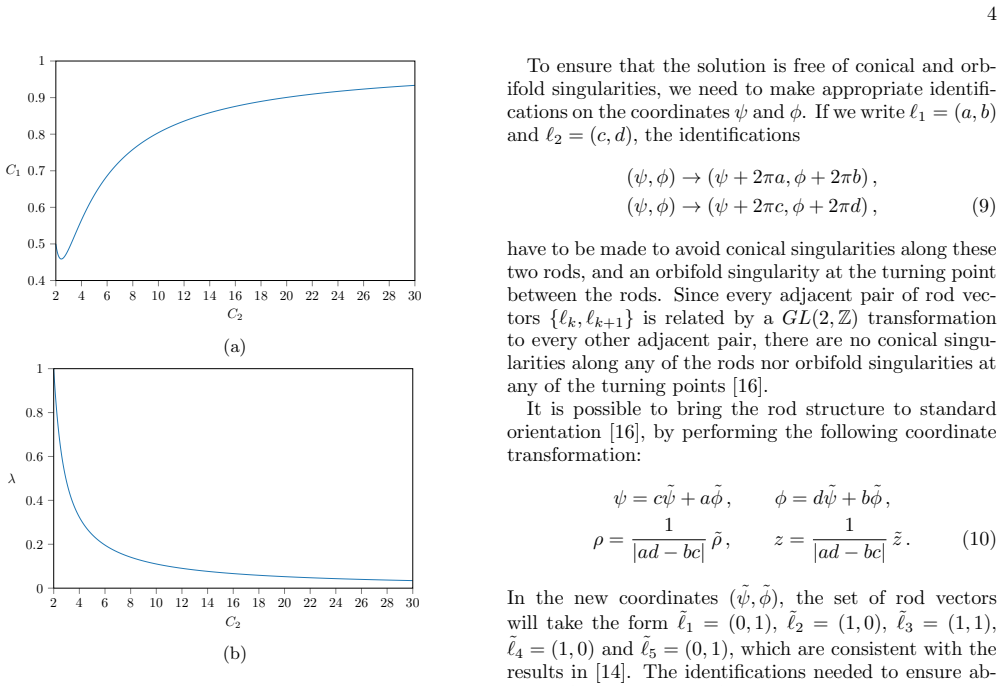
A formally similar situation applies for the Euclidean solution. Now to obtain an AF solution from the Euclidean dou- ble Kerr-NUT solution, we first set the overall NUT charge to zero by requiring thatℓ 1 =ℓ 5. We then set the (Euclidean) surface gravities and angular velocities of the two horizons to be equal by requiring thatℓ 2 =ℓ 4. It turns out that...
-
[14]
To confirm that the solution is free of curvature sin- gularities, we should check that theg ρρ component of the metric is positive everywhere in the half plane (ρ≥ 0,−∞< z <∞)
and Chen–Teo [7] instantons. To confirm that the solution is free of curvature sin- gularities, we should check that theg ρρ component of the metric is positive everywhere in the half plane (ρ≥ 0,−∞< z <∞). Since its form is sufficiently com- plicated, we have resorted to checking this numerically. Indeed, we have verified thatg ρρ is positive for a large...
-
[15]
Gravitational instantons,
S. W. Hawking, “Gravitational instantons,” Phys. Lett. A60(1977) 81
1977
-
[16]
Classification of gravitational instanton symmetries,
G. W. Gibbons and S. W. Hawking, “Classification of gravitational instanton symmetries,” Commun. Math. Phys.66(1979) 291
1979
-
[17]
Index theo- rem boundary terms for gravitational instantons,
G. W. Gibbons, C. N. Pope and H. Romer, “Index theo- rem boundary terms for gravitational instantons,” Nucl. Phys. B157(1979) 377
1979
-
[18]
Euclidean quantum gravity,
G. W. Gibbons and S. W. Hawking, “Euclidean quantum gravity,” World Scientific, Singapore (1993)
1993
-
[19]
Action integrals and partition functions in quantum gravity,
G. W. Gibbons and S. W. Hawking, “Action integrals and partition functions in quantum gravity,” Phys. Rev. D15(1977) 2752
1977
-
[20]
Black-hole uniqueness theorems in Eu- clidean quantum gravity,
A. S. Lapedes, “Black-hole uniqueness theorems in Eu- clidean quantum gravity,” Phys. Rev. D22(1980) 1837
1980
-
[21]
A new AF gravitational instanton
Y. Chen and E. Teo, “A new AF gravitational instanton,” Phys. Lett. B703(2011) 359 [arXiv:1107.0763]
work page internal anchor Pith review Pith/arXiv arXiv 2011
-
[22]
Existence and unique- ness of asymptotically flat toric gravitational instantons,
H. K. Kunduri and J. Lucietti, “Existence and unique- ness of asymptotically flat toric gravitational instantons,” Lett. Math. Phys.111(2021) 133 [arXiv:2107.02540]
-
[23]
Gravitational instantons and special geometry,
S. Aksteiner and L. Andersson, “Gravitational instantons and special geometry,” J. Diff. Geom.128(2024) 928 [arXiv:2112.11863]
-
[24]
On toric Hermitian ALF gravitational instantons,
O. Biquard and P. Gauduchon, “On toric Hermitian ALF gravitational instantons,” Commun. Math. Phys.399 (2023) 389 [arXiv:2112.12711]
-
[25]
Topology of toric gravitational in- stantons,
G. Nilsson, “Topology of toric gravitational in- stantons,” Differ. Geom. Appl.96(2024) 102171 [arXiv:2301.10212]
-
[26]
Gravitational instantons withS 1 symmetry,
S. Aksteiner, L. Andersson, M. Dahl, G. Nilsson and W. Simon, “Gravitational instantons withS 1 symmetry,” J. reine angew. Math.826(2025) 45 [arXiv:2306.14567]
-
[27]
Twistor theory of the Chen– Teo gravitational instanton,
M. Dunajski and P. Tod, “Twistor theory of the Chen– Teo gravitational instanton,” Class. Quant. Grav.41 (2024) 195008 [arXiv:2405.08170]
-
[28]
Gravitational instantons and har- monic maps,
M. Li and S. Sun, “Gravitational instantons and har- monic maps,” [arXiv:2507.15284]
-
[29]
New asymptotically flat Einstein–Maxwell instantons,
B. Araneda and M. Dunajski, “New asymptotically flat Einstein–Maxwell instantons,” Phys. Rev. Lett.135 (2025) 241501 [arXiv:2510.06458]
-
[30]
Rod-structure classification of gravitational instantons with U(1)xU(1) isometry
Y. Chen and E. Teo, “Rod-structure classification of gravitational instantons withU(1)×U(1) isometry,” Nucl. Phys. B838(2010) 207 [arXiv:1004.2750]
work page internal anchor Pith review Pith/arXiv arXiv 2010
-
[31]
The superposition of two Kerr solutions,
D. Kramer and G. Neugebauer, “The superposition of two Kerr solutions,” Phys. Lett. A75(1980) 259
1980
-
[32]
Gravitational solitons,
V. Belinski and E. Verdaguer, “Gravitational solitons,” Cambridge University Press, U.K. (2001)
2001
-
[33]
Gravitational multi-soliton solutions on flat space
Y. Chen, “Gravitational multisoliton solutions on flat space,” Phys. Rev. D93(2016) 044021 [arXiv:1512.00032]
work page internal anchor Pith review Pith/arXiv arXiv 2016
-
[34]
On the interaction between two Kerr black holes
C. A. R. Herdeiro and C. Rebelo, “On the interaction between two Kerr black holes,” JHEP10(2008) 017 [arXiv:0808.3941]
work page internal anchor Pith review Pith/arXiv arXiv 2008
-
[35]
Taub-NUT instanton with an horizon,
D. N. Page, “Taub-NUT instanton with an horizon,” Phys. Lett. B78(1978) 249
1978
-
[36]
A compact rotating gravitational instan- ton,
D. N. Page, “A compact rotating gravitational instan- ton,” Phys. Lett. B79(1978) 235
1978
discussion (0)
Sign in with ORCID, Apple, or X to comment. Anyone can read and Pith papers without signing in.