REVIEW 5 major objections 5 minor 44 references
TaskVAE: Task-Specific Variational Autoencoders for Exemplar Generation in Continual Learning for Human Activity Recognition
T0 review · 5 major / 5 minor · reviewed 2026-08-15 · deepseek-v4-flash
Pith's one-line read TaskVAE replaces stored exemplars with generated samples from one small VAE per task, beating replay baselines at equal memory in human activity recognition.
desk verdict Solid empirical HAR continual learning paper with a real mechanism gap worth fixing before acceptance. read the letter →
The pith
A machine-rendered reading of the paper's core claim, the machinery that carries it, and where it could break.
The reading
What carries the argument
The central object is the task-specific VAE, a three-component network (encoder, decoder, auxiliary classifier) trained on a single task's raw sensor windows. The mechanism that carries the argument is latent-space replay: each VAE's latent dimensions are bounded by the minimum and maximum values seen in training, uniform vectors are drawn inside that box, decoded into pseudo-windows, labeled by the auxiliary classifier, and filtered at a confidence threshold of $p = 0.60$. This turns a fixed per-task parameter budget (392 KB, equivalent to 60 stored samples) into an unlimited stream of replay examples, and it avoids the plasticity-stability problem that would affect a single generator updated across all tasks.
What would settle it
Hold out a fifth of one old task's real windows after training its VAE, then train a fresh classifier on TaskVAE's generated windows for those classes only; if its accuracy on the held-out real windows is substantially below a classifier trained on the same number of real windows, the generated exemplars are not faithful and the reported retention gain must be explained by something else. A second check is to give the best replay baseline the same 60-window-per-task budget plus simple data augmentation such as time warping or sensor noise; if augmentation closes the gap, the advantage is volume or diversity, not VAE fidelity.
Extended reading notes
Core claim
On its own terms, TaskVAE claims that per-task variational autoencoders yield a better memory-accuracy trade-off than storing real exemplars in class-incremental HAR. Each task receives one VAE with an encoder, a decoder, and an auxiliary classifier; at replay time the method samples uniformly inside each latent space's bounding box, decodes the samples into sensor windows, labels them with the auxiliary classifier, and discards any below confidence 0.60. Across five datasets, 30 runs per configuration, and scenarios with two to six tasks, the paper reports that TaskVAE reaches the best accuracy in 11 of 35 instances, ties for best in 15 more, and shows smaller run-to-run variance than the replay baselines while using the same memory as a 60-sample-per-task exemplar budget. The old-class accuracy after later tasks is the main claimed advantage, indicating less catastrophic forgetting rather than better learning of new classes.
Load-bearing premise
The argument collapses if synthetic windows drawn uniformly from a task VAE's latent bounding box and accepted at classifier confidence above 0.60 are not faithful stand-ins for that task's real data.
Editorial extensions
If this is right
- A wearable HAR system could keep learning new activities indefinitely with a fixed memory overhead per task instead of a growing store of raw windows.
- Individual-user continual learning becomes viable: the per-task VAE captures one person's motion patterns and does not require pooling data across users.
- The confidence filter means generated replay can be quality-controlled at generation time; tuning this threshold changes the stability-plasticity balance without touching the classifier.
- Because the number or order of future classes need not be known, TaskVAE can be deployed in open-ended settings where activities are added one at a time.
Reading between the lines
- Beyond the paper: replacing uniform sampling inside the latent bounding box with a class-conditional Gaussian or mixture sampler could reduce the number of low-confidence samples discarded by the $p = 0.60$ filter, improving sample efficiency.
- Beyond the paper: because only VAEs are retained, not raw sensor windows, the scheme has a privacy property worth testing formally: old raw data can be deleted after each task, with replay relying entirely on generated signals.
- Beyond the paper: the same per-task VAE design should transfer to other multivariate time-series domains, such as ECG monitoring or industrial vibration analysis, whenever new classes arrive in labeled batches.
Signed reviews
Editorial analysis
A structured set of objections, weighed in public.
Referee Report
Summary. The paper proposes TaskVAE, a class-incremental learning framework for human activity recognition from raw IMU sensor data. For each task, a task-specific VAE (encoder, decoder, and a latent-space classifier) is trained; at later tasks, synthetic exemplars are generated by sampling latent vectors uniformly from per-dimension bounding boxes, labeling them with the VAE classifier, decoding them, and filtering them by a confidence threshold p=0.60. These synthetic exemplars are combined with the current task's real data to train a single continual-learning classifier. The method is evaluated on five HAR datasets with three participants each and multiple class-incremental scenarios, comparing against random replay, EWC-Replay, iCaRL, and LUCIR with matching or larger exemplar budgets; 30-run average accuracies are reported. The central claim is that TaskVAE outperforms these experience replay methods while using memory equivalent to 60 real samples per task.
Significance. If the claimed results hold, the contribution is practically relevant: a fixed-size per-task generative model can provide replay at bounded memory without prior knowledge of the total class count, and the multi-scenario benchmark on five standard datasets is a useful empirical resource. The authors also provide a repository link with code and complete results, which supports reproducibility. However, the current evidence does not fully support the headline claim because the confidence threshold is tuned on the same evaluation datasets, the filtering mechanism does not directly assess decoded-sample fidelity, and the reported averages lack variance or significance measures. These issues affect the central comparative claim and require substantial revision.
major comments (5)
- [IV-E] The confidence threshold p=0.60 is not a fixed design choice but is selected after an exploration on the same evaluation datasets: Section IV-E states that p in [0.75, 0.97] was tried, p=0.8 was best for some datasets, and p was lowered to 0.60 because high-confidence samples could not be obtained on more complex datasets. Because the filter is central to the method (Section III-C), all Table III results are produced with a threshold tuned to those exact datasets. Please use a pre-registered threshold or nested validation, and report sensitivity of the comparison to p.
- [III-C and III-D] The filter operates on the VAE classifier's softmax confidence on the latent vector, not on any measure of decoded-sample quality. Since latent vectors are sampled uniformly from a 64-dimensional bounding box, and the KL loss coefficient is only 0.001 (Table I), the latent space is far from a standard prior and uniform sampling concentrates mass near the box surface, where the VAE was not necessarily trained. A high-confidence latent code can therefore decode to an off-manifold or unrealistic raw sequence, yet pass the filter. No evaluation of generated-sample fidelity is provided (e.g., nearest-neighbor distances, reconstruction error, or old-class accuracy when generated samples are used), leaving the mechanism behind the reported stability gains unverified.
- [Table III and IV-B] Table III reports only mean accuracies; despite 30 runs per cell, no standard deviations, confidence intervals, or pairwise significance tests are given. Many differences between TaskVAE and baselines are small (e.g., several rows differ by less than 0.02), so the claim that TaskVAE 'outperforms' replay methods is not supported at the precision reported. Please add variability measures and statistical tests, and clarify how the bold-face 'best' designation handles ties, since the text acknowledges 15 equal-performance instances.
- [IV-A and III-E] The per-user evaluation uses only three randomly selected participants per dataset, and the paper does not report per-participant variability or a user-level analysis beyond stating that trends are confirmed for P1 and P2 via the repository. Given the paper's motivation of person-specific HAR, three users are too few to support broad generalization claims. At minimum, report all participants' results and run statistics across users.
- [III-A and V] The task-specific design is a central claimed advantage over 'a single VAE for all tasks' and over prior generative replay approaches, but the paper does not compare against a single shared VAE or against generative replay baselines such as DGR [30] or VCL [29]. The comparison set contains only real-data replay methods. An ablation or baseline comparison isolating the task-specific component is needed to validate that contribution.
minor comments (5)
- [III-A] Section III-A states that the framework is applicable 'as long as tasks share the same number of classes,' but the scenarios in Table II and the text (e.g., 4-5-2) have different numbers of classes per task; this should be corrected or clarified.
- [IV-E] The memory equivalence claim would be easier to verify if the per-sample memory cost and the total VAE parameter count were given explicitly; currently 392 KB and '60/task' are stated without derivation.
- [IV-D] There is a typo in 'hearding sampling': it should be 'herding sampling'.
- [V] The statement that trends are confirmed for P1 and P2 'see repository link' is not verifiable from the manuscript; please include a summary table or appendix for all participants.
- [General] The document uses inconsistent spacing 'V AE' vs 'VAE' throughout; this is stylistic but should be normalized.
Circularity Check
No circular derivation found; TaskVAE is an empirical benchmarking paper with self-contained method description and no equation-level circularity.
full rationale
The paper's central claim is empirical: TaskVAE outperforms experience replay methods on HAR benchmarks. There is no derivation chain in which a predicted quantity reduces by construction to a fitted parameter or to an input definition. The VAE-based generation pipeline is fully specified in Sections III-B through III-D: a per-task VAE is trained on raw sensor data, latent vectors are sampled uniformly from per-dimension min/max bounds, the VAE classifier assigns labels, and the decoder produces synthetic samples that are mixed with current-task data. The filtering threshold p=0.60 is a hyperparameter chosen from previous experiments and the need to obtain samples across datasets, not a fitted parameter that is later relabeled as a prediction. The old-class, new-class, and all-class accuracies are measured on held-out real test data (Section IV-A), not on the generated samples, so the reported accuracies are not forced by the generation procedure. The paper's self-citations, e.g., reference [40] for the task-specific VAE approach and reference [22] for prior regularization experiments, document the authors' earlier work but are not load-bearing: the architecture, training losses (reconstruction, KL with coefficient 0.001, classification), sampling strategy, and experimental setup are all described in the manuscript itself. No uniqueness theorem or prior result is invoked to forbid alternatives, and no ansatz is smuggled in via citation. The concern raised in the reader's take—that latent-space confidence may not guarantee decoded-sample fidelity—is a correctness/robustness question, not a circularity one, because the empirical comparison remains a genuine benchmark. Therefore no specific circular step can be quoted, and the appropriate score is 0.
Assumptions & free parameters
free parameters (3)
- Confidence threshold p =
0.60
- KL divergence coefficient =
0.001
- Latent sampling strategy =
Uniform within per-dimension min/max
assumptions (3)
- domain assumption The VAE is trained with reconstruction loss, KL divergence weighted 0.001, and classification cross-entropy (Table I).
- domain assumption Raw 128-sample windows at 50 Hz with 50% overlap are sufficient inputs for HAR classification (Section IV-A).
- domain assumption Class-incremental learning is modeled as disjoint tasks of random class subsets, and the test set contains all seen classes (Section III-D).
Cite this review
Pith. "Pith review of TaskVAE: Task-Specific Variational Autoencoders for Exemplar Generation in Continual Learning for Human Activity Recognition." pith.science (2026). https://pith.science/paper/CBCZ2BC4
@misc{pith2026250601965,
  author       = {Pith},
  title        = {Pith review of: TaskVAE: Task-Specific Variational Autoencoders for Exemplar Generation in Continual Learning for Human Activity Recognition},
  year         = {2026},
  howpublished = {\url{https://pith.science/paper/CBCZ2BC4}},
  note         = {Machine review of arXiv:2506.01965}
}
read the original abstract
As machine learning based systems become more integrated into daily life, they unlock new opportunities but face the challenge of adapting to dynamic data environments. Various forms of data shift-gradual, abrupt, or cyclic-threaten model accuracy, making continual adaptation essential. Continual Learning (CL) enables models to learn from evolving data streams while minimizing forgetting of prior knowledge. Among CL strategies, replay-based methods have proven effective, but their success relies on balancing memory constraints and retaining old class accuracy while learning new classes. This paper presents TaskVAE, a framework for replay-based CL in class-incremental settings. TaskVAE employs task-specific Variational Autoencoders (VAEs) to generate synthetic exemplars from previous tasks, which are then used to train the classifier alongside new task data. In contrast to traditional methods that require prior knowledge of the total class count or rely on a single VAE for all tasks, TaskVAE adapts flexibly to increasing tasks without such constraints. We focus on Human Activity Recognition (HAR) using IMU sensor-equipped devices. Unlike previous HAR studies that combine data across all users, our approach focuses on individual user data, better reflecting real-world scenarios where a person progressively learns new activities. Extensive experiments on 5 different HAR datasets show that TaskVAE outperforms experience replay methods, particularly with limited data, and exhibits robust performance as dataset size increases. Additionally, memory footprint of TaskVAE is minimal, being equivalent to only 60 samples per task, while still being able to generate an unlimited number of synthetic samples. The contributions lie in balancing memory constraints, task-specific generation, and long-term stability, making it a reliable solution for real-world applications in domains like HAR.
Figures


Figures from the paper (2 more)

Reference graph
Works this paper leans on
-
[30]
Continual activity recognition with generative adversarial networks,
J. Ye, P. Nakwijit, M. Schiemer, S. Jha, and F. Zambonelli, “Continual activity recognition with generative adversarial networks,”ACM Trans- actions on Internet of Things, vol. 2, no. 2, pp. 1–25, 2021
work page 2021
-
[29]
Variational continual learning,
C. V . Nguyen, Y . Li, T. D. Bui, and R. E. Turner, “Variational continual learning,”arXiv preprint arXiv:1710.10628, 2017
arXiv 2017
-
[1]
Pervasive comput- ing middleware: current trends and emerging challenges,
C. Becker, C. Julien, P. Lalanda, and F. Zambonelli, “Pervasive comput- ing middleware: current trends and emerging challenges,”CCF Trans. on Pervasive Computing and Interaction, vol. 1, no. 1, 2019
work page 2019
-
[2]
Xware—a customizable interoperability framework for pervasive computing systems,
F. Roth, C. Becker, G. Vega, and P. Lalanda, “Xware—a customizable interoperability framework for pervasive computing systems,”Pervasive and Mobile Computing, vol. 47, 03 2018
work page 2018
-
[3]
A. Stisen, H. Blunck, S. Bhattacharya, T. S. Prentow, M. B. Kjærgaard, A. Dey, T. Sonne, and M. M. Jensen, “Smart devices are different: Assessing and mitigatingmobile sensing heterogeneities for activity recognition,” inProceedings of the 13th ACM conference on embedded networked sensor systems, pp. 127–140, 2015
work page 2015
-
[4]
Introducing a new benchmarked dataset for activity monitoring,
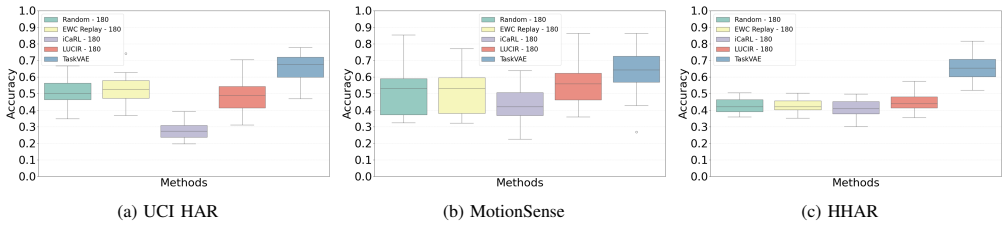
A. Reiss and D. Stricker, “Introducing a new benchmarked dataset for activity monitoring,” in2012 16th international symposium on wearable computers, pp. 108–109, IEEE, 2012. (a) UCI HAR (b) MotionSense (c) HHAR Fig. 4: Accuracy box plots by tasks (30 runs) on the last task for participant P0 in a 3-task scenario (2-2-2), exemplar size eq. V AE (60/task),...
work page 2012
-
[5]
Mobile sensor data anonymization,
M. Malekzadeh, R. G. Clegg, A. Cavallaro, and H. Haddadi, “Mobile sensor data anonymization,” inProceedings of the International Con- ference on Internet of Things Design and Implementation, IoTDI ’19, (New York, NY , USA), pp. 49–58, ACM, 2019
work page 2019
-
[6]
Deep learning based human activity recognition (har) using wearable sensor data,
S. Gupta, “Deep learning based human activity recognition (har) using wearable sensor data,”International Journal of Information Management Data Insights, vol. 1, no. 2, p. 100046, 2021
work page 2021
Show all 44 references
-
[7]
A distillation- based approach integrating continual learning and federated learning for pervasive services,
A. Usmanova, F. Portet, P. Lalanda, and G. Vega, “A distillation- based approach integrating continual learning and federated learning for pervasive services,”arXiv preprint arXiv:2109.04197, 2021
2021 arXiv
-
[8]
A tutorial on human activity recognition using body-worn inertial sensors,
A. Bulling, U. Blanke, and B. Schiele, “A tutorial on human activity recognition using body-worn inertial sensors,”ACM Computing Surveys (CSUR), vol. 46, no. 3, pp. 1–33, 2014
2014
-
[9]
Deep, convolutional, and recurrent models for human activity recognition using wearables,
N. Y . Hammerla, S. Halloran, and T. Pl ¨otz, “Deep, convolutional, and recurrent models for human activity recognition using wearables,”arXiv preprint arXiv:1604.08880, 2016
2016 arXiv
-
[10]
The opportunity challenge: A bench- mark database for on-body sensor-based activity recognition,
R. Chavarriaga, H. Sagha, A. Calatroni, S. T. Digumarti, G. Tr ¨oster, J. d. R. Mill ´an, and D. Roggen, “The opportunity challenge: A bench- mark database for on-body sensor-based activity recognition,”Pattern Recognition Letters, vol. 34, no. 15, 2013
2013
-
[11]
Online recognition of human activities and adaptation to habit changes by means of learning automata and fuzzy temporal windows,
M. Ros, M. P. Cu ´ellar, M. Delgado, and A. Vila, “Online recognition of human activities and adaptation to habit changes by means of learning automata and fuzzy temporal windows,”Information Sciences, vol. 220, pp. 86–101, 2013
2013
-
[12]
Incremental learning of human activities in smart homes,
S.-L. Chua, L. K. Foo, H. W. Guesgen, and S. Marsland, “Incremental learning of human activities in smart homes,”Sensors, vol. 22, no. 21, p. 8458, 2022
2022
-
[13]
Incremental learning in human action recognition based on snippets,
R. Minhas, A. A. Mohammed, and Q. J. Wu, “Incremental learning in human action recognition based on snippets,”IEEE Transactions on Circuits and Systems for Video Technology, vol. 22, no. 11, pp. 1529– 1541, 2011
2011
-
[14]
Few-shot class-incremental learning for medical time series classification,
L. Sun, M. Zhang, B. Wang, and P. Tiwari, “Few-shot class-incremental learning for medical time series classification,”IEEE Journal of Biomed- ical and Health Informatics, 2023
2023
-
[15]
Net2net: Accelerating learning via knowledge transfer,
T. Chen, I. Goodfellow, and J. Shlens, “Net2net: Accelerating learning via knowledge transfer,”arXiv preprint arXiv:1511.05641, 2015
2015 arXiv
-
[16]
Progressive neural networks,
A. A. Rusu, N. C. Rabinowitz, G. Desjardins, H. Soyer, J. Kirkpatrick, K. Kavukcuoglu, R. Pascanu, and R. Hadsell, “Progressive neural networks,”arXiv preprint arXiv:1606.04671, 2016
2016 arXiv
-
[17]
Rein- forced continual learning for graphs,
A. Rakaraddi, L. Siew Kei, M. Pratama, and M. De Carvalho, “Rein- forced continual learning for graphs,” inProceedings of the 31st ACM TABLE III: Summary of results for P0, all scenarios, all datasets, all holdout sizes, all methods and TaskV AE with and without filter. Best p...
-
[18]
Learning without forgetting,
Z. Li and D. Hoiem, “Learning without forgetting,”IEEE transactions on pattern analysis and machine intelligence, vol. 40, no. 12, pp. 2935– 2947, 2017
2017
-
[19]
Mea- suring catastrophic forgetting in neural networks,
R. Kemker, M. McClure, A. Abitino, T. Hayes, and C. Kanan, “Mea- suring catastrophic forgetting in neural networks,” inProceedings of the AAAI conference on artificial intelligence, vol. 32, 2018
2018
-
[20]
Memory aware synapses: Learning what (not) to forget,
R. Aljundi, F. Babiloni, M. Elhoseiny, M. Rohrbach, and T. Tuytelaars, “Memory aware synapses: Learning what (not) to forget,” inProceedings of the European conference on computer vision (ECCV), pp. 139–154, 2018
2018
-
[21]
Incremental learning in online scenario,
J. He, R. Mao, Z. Shao, and F. Zhu, “Incremental learning in online scenario,” inProceedings of the IEEE/CVF conference on computer vision and pattern recognition, pp. 13926–13935, 2020
2020
-
[22]
Evaluation of regularization-based continual learning approaches: Application to har,
B. Kann, S. Castellanos-Paez, and P. Lalanda, “Evaluation of regularization-based continual learning approaches: Application to har,” in2023 IEEE International Conference on Pervasive Computing and Communications Workshops and other Affiliated Events (PerCom Work- shops), pp. ...
2023
-
[23]
icarl: Incremental classifier and representation learning,
S.-A. Rebuffi, A. Kolesnikov, G. Sperl, and C. H. Lampert, “icarl: Incremental classifier and representation learning,” inProceedings of the IEEE conference on Computer Vision and Pattern Recognition, pp. 2001–2010, 2017
2001
-
[24]
Gradient episodic memory for continual learning,
D. Lopez-Paz and M. Ranzato, “Gradient episodic memory for continual learning,”Advances in neural information processing systems, vol. 30, 2017
2017
-
[25]
Learning to remember: A synaptic plasticity driven framework for continual learning,
O. Ostapenko, M. Puscas, T. Klein, P. Jahnichen, and M. Nabi, “Learning to remember: A synaptic plasticity driven framework for continual learning,” inProceedings of the IEEE/CVF conference on computer vision and pattern recognition, 2019
2019
-
[26]
Generative adversarial networks,
I. Goodfellow, J. Pouget-Abadie, M. Mirza, B. Xu, D. Warde-Farley, S. Ozair, A. Courville, and Y . Bengio, “Generative adversarial networks,” Communications of the ACM, vol. 63, no. 11, pp. 139–144, 2020
2020
-
[27]
Auto-encoding variational bayes,
D. P. Kingma and M. Welling, “Auto-encoding variational bayes,”arXiv preprint arXiv:1312.6114, 2013
2013 arXiv
-
[28]
Continual learning with deep generative replay,
H. Shin, J. K. Lee, J. Kim, and J. Kim, “Continual learning with deep generative replay,”Advances in neural information processing systems, vol. 30, 2017
2017
-
[31]
Continual learning in sensor-based human activity recognition: An empirical benchmark analysis,
S. Jha, M. Schiemer, F. Zambonelli, and J. Ye, “Continual learning in sensor-based human activity recognition: An empirical benchmark analysis,”Information Sciences, vol. 575, pp. 1–21, 2021
2021
-
[32]
Learning a unified clas- sifier incrementally via rebalancing,
S. Hou, X. Pan, C. C. Loy, Z. Wang, and D. Lin, “Learning a unified clas- sifier incrementally via rebalancing,” inProceedings of the IEEE/CVF conference on computer vision and pattern recognition, pp. 831–839, 2019
2019
-
[33]
A survey on human activity recognition using wearable sensors,
O. D. Lara and M. A. Labrador, “A survey on human activity recognition using wearable sensors,”IEEE communications surveys & tutorials, vol. 15, no. 3, pp. 1192–1209, 2012
2012
-
[34]
Detecting abnormal events on binary sensors in smart home environments,
J. Ye, G. Stevenson, and S. Dobson, “Detecting abnormal events on binary sensors in smart home environments,”Pervasive and Mobile Computing, vol. 33, pp. 32–49, 2016
2016
-
[35]
On-body localization of wearable devices: An investigation of position-aware activity recognition,
T. Sztyler and H. Stuckenschmidt, “On-body localization of wearable devices: An investigation of position-aware activity recognition,” in2016 IEEE international conference on pervasive computing and communi- cations (PerCom), pp. 1–9, IEEE, 2016
2016
-
[36]
A public domain dataset for human activity recognition using smart- phones.,
D. Anguita, A. Ghio, L. Oneto, X. Parra, J. L. Reyes-Ortiz,et al., “A public domain dataset for human activity recognition using smart- phones.,” inEsann, vol. 3, p. 3, 2013
2013
-
[37]
Human activity recognition using inertial sensors in a smartphone: An overview,
W. Sousa Lima, E. Souto, K. El-Khatib, R. Jalali, and J. Gama, “Human activity recognition using inertial sensors in a smartphone: An overview,” Sensors, vol. 19, no. 14, p. 3213, 2019
2019
-
[38]
Real-time human activity recognition from accelerometer data using convolutional neural networks,
A. Ignatov, “Real-time human activity recognition from accelerometer data using convolutional neural networks,”Applied Soft Computing, vol. 62, pp. 915–922, 2018
2018
-
[39]
Federated continual learning through distillation in pervasive computing,
A. Usmanova, F. Portet, P. Lalanda, and G. Vega, “Federated continual learning through distillation in pervasive computing,” in2022 IEEE International Conference on Smart Computing (SMARTCOMP), pp. 86– 91, IEEE, 2022
2022
-
[40]
Lever- aging task-specific vaes for efficient exemplar generation in har,
B. Kann, S. Castellanos-Paez, R. Rombourg, and P. Lalanda, “Lever- aging task-specific vaes for efficient exemplar generation in har,” in Internet of Things(G. Rey, J.-Y . Tigli, and E. Franquet, eds.), (Cham), pp. 207–225, Springer Nature Switzerland, 2025
2025
-
[41]
Overcoming catastrophic forgetting in neural networks,
J. Kirkpatrick, R. Pascanu, N. Rabinowitz, J. Veness, G. Desjardins, A. A. Rusu, K. Milan, J. Quan, T. Ramalho, A. Grabska-Barwinska, et al., “Overcoming catastrophic forgetting in neural networks,”Pro- ceedings of the national academy of sciences, vol. 114, no. 13, pp. 3521– ...
2017
-
[42]
Herding dynamical weights to learn,
M. Welling, “Herding dynamical weights to learn,” inProceedings of the 26th annual international conference on machine learning, pp. 1121– 1128, 2009
2009
-
[43]
Deep unsupervised learning using nonequilibrium thermodynamics,
J. Sohl-Dickstein, E. Weiss, N. Maheswaranathan, and S. Ganguli, “Deep unsupervised learning using nonequilibrium thermodynamics,” inInternational conference on machine learning, pp. 2256–2265, 2015
2015
-
[44]
Gaussian mixture models.,
D. A. Reynoldset al., “Gaussian mixture models.,”Encyclopedia of biometrics, vol. 741, no. 659-663, p. 3, 2009
2009
Reviewed August 15, 2026 · model on record in the stance chip above.
Discussion (0). Continue with ORCID to comment.