REVIEW 2 major objections 2 minor 74 references
Time-optimal controls generate Fock and Schrödinger cat states at unit fidelity in Jaynes-Cummings and Rabi systems.
Reviewed by Pith at T0; open to challenge. T0 means a machine referee read the full paper against a public rubric. the ladder, T0–T4 →
T0 review · grok-4.3
2026-06-30 12:45 UTC pith:CBSKKOVZ
load-bearing objection Applies brachistochrone to JC and Rabi models for Fock and cat states but the open-system robustness claims rest on closed-system controls tested in simulation. the 2 major comments →
Time optimal quantum state engineering
The pith
A machine-rendered reading of the paper's core claim, the machinery that carries it, and where it could break.
Core claim
The quantum brachistochrone formalism yields time-optimal controls for the time-dependent Jaynes-Cummings and quantum Rabi Hamiltonians that achieve deterministic generation of Fock states and highly entangled Schrödinger cat states at unit fidelity. These controls operate at the speed limit, which reduces energetic cost and confers robustness to dissipation, relaxation, and dephasing across broad environmental conditions. Nonclassical properties are characterized using joint Wigner phase-space distributions.
What carries the argument
Quantum brachistochrone formalism applied to time-dependent Jaynes-Cummings and quantum Rabi Hamiltonians to find shortest-time controls for state engineering.
Load-bearing premise
The quantum brachistochrone formalism directly yields implementable time-optimal controls for the time-dependent Jaynes-Cummings and quantum Rabi Hamiltonians even when the systems are subject to realistic dissipation and dephasing.
What would settle it
A simulation or experiment in which the derived controls fail to reach unit fidelity or lose the claimed robustness once dissipation and dephasing are included would falsify the central result.
If this is right
- Fock states are generated deterministically at unit fidelity.
- Highly entangled Schrödinger cat states are generated deterministically at unit fidelity.
- State preparation occurs at the quantum speed limit.
- Energetic cost of preparation is reduced relative to slower protocols.
- Generated states remain robust against dissipation, relaxation, and dephasing over a wide range of conditions.
Where Pith is reading between the lines
- The same control method could be tested on other light-matter Hamiltonians not examined in the paper.
- Faster preparation times might allow these states to be used as resources inside larger quantum circuits that have their own timing limits.
- Lower energy cost could reduce the power budget needed in experimental hardware.
- Increased robustness might permit operation in less isolated laboratory environments.
Editorial analysis
A structured set of objections, weighed in public.
Referee Report
Summary. The manuscript applies the quantum brachistochrone formalism to derive time-optimal 'wind controls' for the time-dependent Jaynes-Cummings and quantum Rabi models. It claims deterministic generation of Fock states and highly entangled Schrödinger cat states at unit fidelity, characterized via joint Wigner phase-space distributions, with operation at the quantum speed limit yielding reduced energetic cost and robustness to dissipation, relaxation, and dephasing across a broad range of environmental conditions.
Significance. If substantiated, the results would advance efficient nonclassical state preparation in hybrid light-matter systems by achieving minimal preparation times with lower energy expenditure and enhanced noise resilience, offering a practical alternative to adiabatic protocols for quantum technologies.
major comments (2)
- [Abstract and control derivation] The central claim that brachistochrone-derived controls achieve unit fidelity and remain optimal/robust under Lindblad dissipation is load-bearing but unsupported; the quantum brachistochrone is formulated for closed unitary dynamics on the projective Hilbert space, and simply inserting the resulting controls into the open-system master equation does not guarantee either property (see abstract and the derivation of the controls).
- [Results on robustness] No explicit re-derivation or numerical verification is indicated for how the speed-limit property and unit fidelity are preserved (or approximately preserved) when non-unitary terms are included; this must be shown to support the robustness claims across environmental conditions.
minor comments (2)
- [Abstract] The term 'wind control' appears without prior definition or reference in the abstract; introduce and motivate the terminology in the introduction or methods.
- [Characterization section] Clarify whether the joint Wigner distributions are computed for the full light-matter Hilbert space or a reduced subsystem, and specify the quadrature operators used.
Simulated Author's Rebuttal
We thank the referee for the careful reading and for highlighting important distinctions between closed- and open-system dynamics. We address each major comment below and indicate the revisions that will be made to strengthen the presentation.
read point-by-point responses
-
Referee: [Abstract and control derivation] The central claim that brachistochrone-derived controls achieve unit fidelity and remain optimal/robust under Lindblad dissipation is load-bearing but unsupported; the quantum brachistochrone is formulated for closed unitary dynamics on the projective Hilbert space, and simply inserting the resulting controls into the open-system master equation does not guarantee either property (see abstract and the derivation of the controls).
Authors: We agree that the quantum brachistochrone formalism yields time-optimal controls only for closed unitary evolution on projective Hilbert space. The wind controls are derived under this closed-system assumption to reach the quantum speed limit with unit fidelity for the target Fock and cat states. The manuscript then inserts these controls into the Lindblad master equation and reports numerical results indicating that high fidelity is retained together with lower energetic cost and resilience to dissipation. We acknowledge that the abstract and derivation sections do not sufficiently distinguish the closed-system optimality from the open-system numerical performance. We will revise the abstract and add a clarifying paragraph in the control-derivation section stating the scope of the brachistochrone result and the role of the subsequent open-system simulations. revision: partial
-
Referee: [Results on robustness] No explicit re-derivation or numerical verification is indicated for how the speed-limit property and unit fidelity are preserved (or approximately preserved) when non-unitary terms are included; this must be shown to support the robustness claims across environmental conditions.
Authors: The manuscript contains numerical integrations of the open-system master equation under the closed-system-derived controls, with results shown for a range of dissipation, relaxation and dephasing rates. These simulations demonstrate that fidelity remains close to unity and energetic cost stays below that of adiabatic protocols. However, we accept that an explicit side-by-side comparison of closed- versus open-system fidelity and a clearer statement that the speed-limit property is strictly for the unitary case are not currently highlighted. We will add a dedicated subsection with additional panels that overlay closed- and open-system trajectories, quantify the deviation from the closed-system speed limit, and tabulate fidelity versus environmental parameters to make the verification explicit. revision: yes
Circularity Check
No circularity: standard brachistochrone formalism applied without self-referential reduction or fitted predictions.
full rationale
The abstract and description invoke the established quantum brachistochrone formalism for time-optimal controls on Jaynes-Cummings and Rabi Hamiltonians, then report resulting state generation and robustness properties. No equations, parameter fits, or self-citations are exhibited that would reduce any claimed prediction or optimality condition to the input data or prior author work by construction. The derivation chain therefore remains independent of the target results and is self-contained against external benchmarks.
Axiom & Free-Parameter Ledger
read the original abstract
The efficient generation of highly nonclassical quantum states is essential for emerging quantum technologies, yet it remains challenging due to decoherence and the long preparation times associated with conventional adiabatic protocols. Here, we employ time-optimal control methods based on the quantum brachistochrone formalism to engineer nonclassical states in light--matter systems described by the time-dependent Jaynes--Cummings and quantum Rabi models. We demonstrate the deterministic generation of Fock states and highly entangled Schr\"odinger cat states at unit fidelity, and characterize their nonclassical properties through joint Wigner phase-space distributions. We further show that the wind control generates these non-classical states at speed limit which leads to a reduced energetic cost and robustness against dissipation, relaxation, and dephasing across a broad range of environmental conditions. Our results establish time-optimal control as an efficient and experimentally feasible approach for fast and nonclassical state engineering in hybrid quantum platforms.
Figures




Reference graph
Works this paper leans on
-
[1]
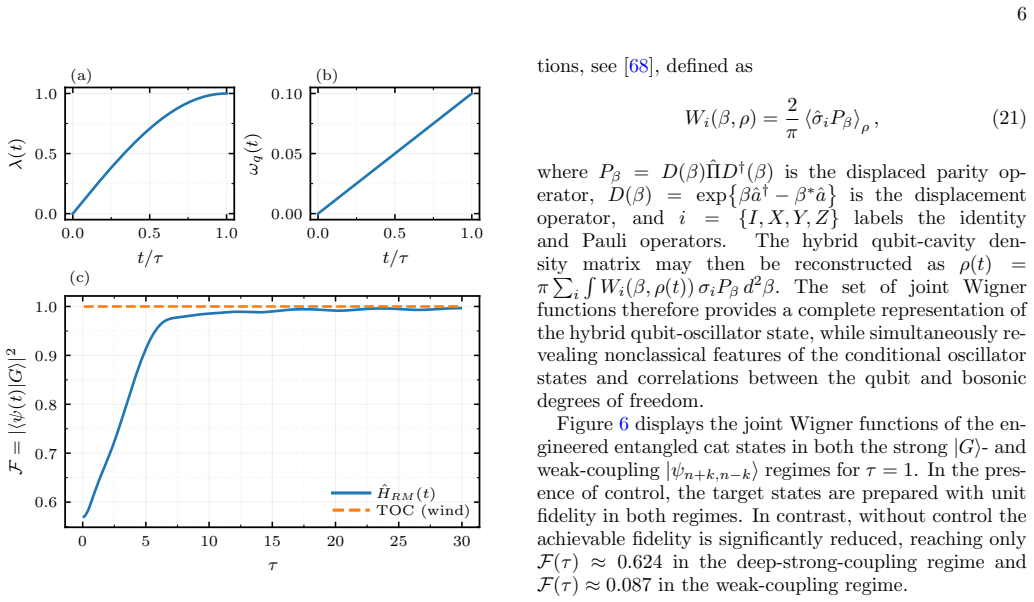
ˆHJC (t) =ω cˆa†ˆa+ωq(t) 2 ˆσz +λ(t)(ˆaˆσ+ + ˆa†ˆσ−) which is known to conserve the total number of excitations in the system, i.e., [ ˆN , ˆH] = 0 where ˆN= ˆa†ˆa+|e⟩ ⟨e|. Hence, the JC Hamiltonian can be block diagonalized in the excitation number subspaceH n ={|e, n⟩,|g, n+ 1⟩} 0 1 t/τ 0.0 0.1 0.2 λ(t) (a) 0 1 t/τ 0 1 2ωq(t) (b) linear quadratic cubic ...
-
[2]
After the population inversion, an entan- gled cat state of the form|ψ n+1,n−1⟩= (|g, n+ 1⟩+ |e, n−1⟩)/ √ 2 is obtained, which can then be trans- formed into|ψ n+2,n−2⟩= (|g, n+ 2⟩+|e, n−2⟩)/ √ 2 by applying anotherπpulse and population inversion. Re- peating this procedure allows us to build any entan- gled cat state of the form|ψ n+k,n−k⟩= (|g, n+k⟩+ |e...
- [3]
-
[4]
C. P. Koch, U. Boscain, T. Calarco, G. Dirr, S. Fil- ipp, S. J. Glaser, R. Kosloff, S. Montangero, T. Schulte- Herbr¨ uggen, D. Sugny, and F. K. Wilhelm, EPJ Quan- tum Technology9, 19 (2022)
work page 2022
-
[5]
J. Larson and T. Mavrogordatos,The Jaynes–Cummings Model and Its Descendants, 2053-2563 (IOP Publishing, 2021). 9
work page 2053
- [6]
-
[7]
A. Gilchrist, K. Nemoto, W. J. Munro, T. C. Ralph, S. Glancy, S. L. Braunstein, and G. J. Milburn, Journal of Optics B: Quantum and Semiclassical Optics6, S828 (2004)
work page 2004
- [8]
-
[9]
M. Mirrahimi, Z. Leghtas, V. V. Albert, S. Touzard, R. J. Schoelkopf, L. Jiang, and M. H. Devoret, New Journal of Physics16, 045014 (2014)
work page 2014
-
[10]
J. Joo, W. J. Munro, and T. P. Spiller, Phys. Rev. Lett. 107, 083601 (2011)
work page 2011
-
[11]
M. Kira, S. Koch, R. Smith, A. Hunter, and S. Cundiff, Nature Physics7, 800 (2011)
work page 2011
-
[12]
J. C. Wright, Analytical chemistry92, 8638 (2020)
work page 2020
-
[13]
D. S. Schlegel, F. Minganti, and V. Savona, Phys. Rev. A106, 022431 (2022)
work page 2022
- [14]
-
[15]
M. Hofheinz, E. M. Weig, M. Ansmann, R. C. Bialczak, E. Lucero, M. Neeley, A. D. O’Connell, H. Wang, J. M. Martinis, and A. N. Cleland, Nature454, 310 (2008)
work page 2008
-
[16]
M. Uria, P. Solano, and C. Hermann-Avigliano, Phys. Rev. Lett.125, 093603 (2020)
work page 2020
- [17]
- [18]
-
[19]
S. Cao, B. Wu, F. Chen, M. Gong, Y. Wu, Y. Ye, C. Zha, H. Qian, C. Ying, S. Guo, Q. Zhu, H.-L. Huang, Y. Zhao, S. Li, S. Wang, J. Yu, D. Fan, D. Wu, H. Su, H. Deng, H. Rong, Y. Li, K. Zhang, T.-H. Chung, F. Liang, J. Lin, Y. Xu, L. Sun, C. Guo, N. Li, Y.-H. Huo, C.-Z. Peng, C.- Y. Lu, X. Yuan, X. Zhu, and J.-W. Pan, Nature619, 738 (2023)
work page 2023
-
[20]
M. H. Mu˜ noz Arias, I. H. Deutsch, and P. M. Poggi, PRX Quantum4, 020314 (2023)
work page 2023
-
[21]
A. C. Santos, A. Cidrim, C. J. Villas-Boas, R. Kaiser, and R. Bachelard, Phys. Rev. A105, 053715 (2022)
work page 2022
-
[22]
S. Bartolucci, P. M. Birchall, M. Gimeno-Segovia, E. Johnston, K. Kieling, M. Pant, T. Rudolph, J. Smith, C. Sparrow, and M. D. Vidrighin, arXiv preprint arXiv:2106.13825 10.48550/arXiv.2106.13825 (2021), arXiv:2106.13825 [quant-ph]
-
[23]
Z.-Z. Li, W. Chen, M. Abbasi, K. W. Murch, and K. B. Whaley, Phys. Rev. Lett.131, 100202 (2023)
work page 2023
-
[24]
M. Cosacchi, T. Seidelmann, J. Wiercinski, M. Cygorek, A. Vagov, D. E. Reiter, and V. M. Axt, Phys. Rev. Res. 3, 023088 (2021)
work page 2021
-
[25]
K. Takase, J.-i. Yoshikawa, W. Asavanant, M. Endo, and A. Furusawa, Phys. Rev. A103, 013710 (2021)
work page 2021
- [26]
-
[27]
W. Qin, A. Miranowicz, H. Jing, and F. Nori, Phys. Rev. Lett.127, 093602 (2021)
work page 2021
- [28]
- [29]
- [30]
-
[31]
U. Poschinger, A. Walther, K. Singer, and F. Schmidt- Kaler, Phys. Rev. Lett.105, 263602 (2010)
work page 2010
-
[32]
K. G. Johnson, J. D. Wong-Campos, B. Neyenhuis, J. Mizrahi, and C. Monroe, Nature Communications8, 697 (2017)
work page 2017
- [33]
-
[34]
W. S. Warren, H. Rabitz, and M. Dahleh, Science259, 1581 (1993)
work page 1993
-
[35]
O. V. Morzhin and A. N. Pechen, Quantum Information Processing22, 241 (2023)
work page 2023
- [36]
-
[37]
A. Mena, S. K. Mann, A. Cowley-Semple, E. Bryan, S. Heutz, D. R. McCamey, M. Attwood, and S. L. Bayliss, Phys. Rev. Lett.133, 120801 (2024)
work page 2024
-
[38]
J. Vaneecloo, S. Garcia, and A. Ourjoumtsev, Phys. Rev. X12, 021034 (2022)
work page 2022
-
[39]
E. Medina-Guerra, P. Kumar, I. V. Gornyi, and Y. Gefen, Phys. Rev. Res.6, 023159 (2024)
work page 2024
-
[40]
D. Volya and P. Mishra, IEEE Transactions on Quantum Engineering5, 1 (2024)
work page 2024
-
[41]
J. Rivera-Dean, T. Lamprou, E. Pisanty, M. F. Ciappina, P. Tzallas, M. Lewenstein, and P. Stammer, Phys. Rev. A112, 013110 (2025)
work page 2025
-
[42]
D. A. Puente, F. Motzoi, T. Calarco, G. Morigi, and M. Rizzi, Quantum8, 1299 (2024)
work page 2024
-
[43]
N. Lambert, M. Cirio, J.-D. Lin, P. Menczel, P. Liang, and F. Nori, Phys. Rev. Res.6, 043229 (2024)
work page 2024
- [44]
-
[46]
L. Innocenti, G. De Chiara, M. Paternostro, and R. Puebla, New Journal of Physics22, 093050 (2020)
work page 2020
-
[47]
Y.-H. Chen, W. Qin, X. Wang, A. Miranowicz, and F. Nori, Phys. Rev. Lett.126, 023602 (2021)
work page 2021
-
[48]
S.-W. Xu, Z.-Z. Zhang, Y.-Y. Guo, Y.-H. Chen, and Y. Xia, arXiv preprint arXiv:2408.00464 10.48550/arXiv.2408.00464 (2024), arXiv:2408.00464 [quant-ph]
- [49]
- [50]
-
[51]
S. J. Glaser, U. Boscain, T. Calarco, C. P. Koch, W. K¨ ockenberger, R. Kosloff, I. Kuprov, B. Luy, S. Schirmer, T. Schulte-Herbr¨ uggen, D. Sugny, and F. K. Wilhelm, The European Physical Journal D69, 279 (2015)
work page 2015
- [52]
-
[53]
O. Abah, R. Puebla, A. Kiely, G. De Chiara, M. Pa- ternostro, and S. Campbell, New Journal of Physics21, 103048 (2019)
work page 2019
- [54]
- [55]
-
[56]
J. Xu, Y. Zhang, W. Zheng, H. Cai, H. Zhou, X. Li, X. Liao, Y. Zhang, S. Li, D. Lan, X. Tan, and Y. Yu, Chinese Physics Letters41, 040202 (2024)
work page 2024
-
[57]
Y. Dong, W. Jiang, X.-D. Gao, C. Yu, Y. Liu, S.-C. Zhang, X.-D. Chen, I. d. P. R. Moreira, J. M. Bofill, G. Sent´ ıs, R. Ramos, G. Albareda, G.-C. Guo, and F.- W. Sun, npj Quantum Information10, 108 (2024)
work page 2024
-
[58]
Y. Dong, W. Jiang, Z.-W. Liu, Y. Liu, S.-C. Zhang, D. P. Pires, D. O. Soares-Pinto, X.-D. Chen, G.-C. Guo, and F.-W. Sun, npj Quantum Information11, 199 (2025)
work page 2025
-
[59]
A. Carlini, A. Hosoya, T. Koike, and Y. Okudaira, Phys. Rev. Lett.96, 060503 (2006)
work page 2006
-
[60]
A. Carlini, A. Hosoya, T. Koike, and Y. Okudaira, Phys. Rev. A75, 042308 (2007)
work page 2007
-
[61]
A. Carlini, A. Hosoya, T. Koike, and Y. Okudaira, Jour- nal of Physics A: Mathematical and Theoretical41, 045303 (2008)
work page 2008
-
[62]
I. I. Rabi, Phys. Rev.51, 652 (1937)
work page 1937
-
[63]
J. Larson and T. Mavrogordatos,The Jaynes–Cummings Model and its Descendants (Second Edition), 2053-2563 (IOP Publishing, 2024)
work page 2053
- [64]
-
[65]
O. Abah, R. Puebla, and M. Paternostro, Phys. Rev. Lett.124, 180401 (2020)
work page 2020
- [66]
- [67]
- [68]
- [69]
-
[70]
B. Vlastakis, A. Petrenko, N. Ofek, L. Sun, Z. Legh- tas, K. Sliwa, Y. Liu, M. Hatridge, J. Blumoff, L. Frun- zio, M. Mirrahimi, L. Jiang, M. H. Devoret, and R. J. Schoelkopf, Nature Communications6, 8970 (2015)
work page 2015
-
[71]
S. Deffner and S. Campbell, Journal of Physics A: Math- ematical and Theoretical50, 453001 (2017)
work page 2017
-
[73]
L. Mandelstam and I. Tamm, The uncertainty relation between energy and time in non-relativistic quantum me- chanics, inSelected Papers, edited by B. M. Bolotovskii, V. Y. Frenkel, and R. Peierls (Springer Berlin Heidelberg, Berlin, Heidelberg, 1991) pp. 115–123
work page 1991
- [74]
- [75]
- [76]
discussion (0)
Sign in with ORCID, Apple, or X to comment. Anyone can read and Pith papers without signing in.