REVIEW 3 major objections 4 minor 2 cited by
About electroweak domain walls in Majoron models
T0 review · 3 major / 4 minor · reviewed 2026-08-07 · deepseek-v4-flash
Pith's one-line read Electroweak instantons generate a potential for the Majoron only when B+L is explicitly broken, and even then the induced mass is so small that the proposed domain walls cannot harm cosmology.
desk verdict The rotation-away argument is right and the 2019 PRL claim does not survive; but the quantitative mass estimate feeding the cosmology is built on an operator the appendix shows is Majoron-blind in the minimal model, so the parameter-space plots are not yet trustworthy. read the letter →
The pith
A machine-rendered reading of the paper's core claim, the machinery that carries it, and where it could break.
The reading
What carries the argument
The load-bearing object is the coupling of the Majoron to the electroweak topological term, $(g_W^2/32\pi^2)(j/v_L) W\widetilde W$, together with the $U(1)_{B+L}\otimes \mathrm{SU}(2)_W^2$ anomaly identity that lets field redefinitions shuffle the Majoron between operators. When no explicit $B+L$ violation exists, the Majoron is aligned with the anomaly-free combination $U(1)_{B-L}$ and the coupling is pure gauge; the mass estimate then relies on a dimension-six $B+L$-violating operator, a single-instanton 't Hooft vertex with three insertions of that operator, and the instanton-size integral of Ref.~[77], which is UV-dominated and carries the exponential factor $\exp(-8\pi^2/g_W^2(M_{\rm UV}))$. The numerical smallness can be softened by adding scalar $\mathrm{SU}(2)_W$ multiplets that flatten the gauge-coupling running, encoded in Eqs. (15)--(16). The appendix's chiral vector-like doublets of Eq. (18) are the mechanism that actually makes the $B+L$ operator pick up the Majoron phase in the minimal fermion content.
What would settle it
A first-principles instanton calculation, or a lattice computation, of the effective potential in a model containing Eq. (5) plus the vector-like doublets of Eq. (18) would settle the claim: if the induced Majoron mass turns out to be independent of the $B+L$-violating coefficient $c_L$, or nonzero when $B+L$ is not explicitly broken, the central argument fails.
Extended reading notes
Core claim
On the paper's own terms, the central discovery is that electroweak $\mathrm{SU}(2)_W$ instantons do not generate a potential for the Majoron unless $B+L$ is explicitly broken by additional interactions. The reason is a field-redefinition identity: rephasing lepton and quark doublets shifts the electroweak vacuum angle, so a Majoron inserted into $W\widetilde W$ can be moved into other operators; without explicit $B+L$ violation every such operator is invariant along an anomaly-free $U(1)_{B-L}$ direction, and the Majoron mass vanishes. With a dimension-six $B+L$-violating operator of the form $LQQQ/M_{\rm UV}^2$, the paper estimates the induced mass using a one-instanton 't Hooft-vertex calculation and obtains a value suppressed by $\exp(-8\pi^2/g_W^2)$, of order $10^{-29}\,$eV for benchmark parameters. The associated domain-wall energy-density fractions are at most about $10^{-16}$ today, far below observational bounds, and thermal sphalerons do not change the picture because they act as friction rather than generating a potential. The paper then shows that the tiny electroweak mass can serve as a bias term that collapses walls generated by a larger lepton-number-breaking source, producing ultralight Majoron dark matter, or, if it is the leading contribution, can implement an electroweak Majoron as dynamical dark energy.
Load-bearing premise
Everything quantitative rests on the assumption that an explicit baryon-plus-lepton-number-violating interaction really does pick up the Majoron field after fermion redefinitions; the appendix shows this requires adding new fermions that are not vector-like under baryon-minus-lepton number, because the minimal Standard-Model operator accidentally conserves that combination.
Editorial extensions
If this is right
- In generic Majoron models without explicit $B+L$ breaking, electroweak instantons generate no Majoron potential, so the domain walls proposed in Ref. [61] do not form.
- When $B+L$ is broken, the instanton-induced mass is exponentially small; the present-day energy fraction of the resulting walls is of order $10^{-16}$ or less, so no cosmological catastrophe follows.
- The tiny electroweak mass can act as a bias term that collapses a wall network generated by a larger lepton-number-breaking source, and the decay can produce the observed ultralight Majoron dark-matter relic density.
- If the electroweak instanton is the leading source of the Majoron mass, the Majoron can serve as thawing-quintessence dark energy, although the preferred parameter region conflicts with the weak gravity and swampland distance conjectures.
- Thermal sphalerons do not generate the Majoron potential; their effect is friction, so wall formation and evolution should be described by the instanton-induced potential rather than by the sphaleron mass scale.
Reading between the lines
- The rotation argument is more general than the Majoron: any pseudo-Goldstone boson of a global symmetry whose only anomaly is electroweak will be blind to instantons unless an explicit $B+L$-breaking operator survives field redefinitions, so the same test should be applied to other lepton-number-like symmetries.
- The appendix's accidental $B-L$ conservation suggests that many would-be $B+L$-violating operators built from Standard-Model fermions cannot generate a Majoron mass at all; model builders should classify operators by their $B-L$ charge before estimating instanton effects.
- The reversal of the axion bias-term logic, using the smallest explicit-breaking contribution to collapse walls produced by a larger one, may extend to other pseudo-Goldstone dark-matter and dark-energy scenarios where the hierarchy of explicit breakings is usually assumed to work in the opposite direction.
- A concrete next step is to compute Eq. (19) in an explicit ultraviolet completion with the vector-like doublets, since the NDA estimate's cancellation for $N_S=1$ suggests an exact result worth checking.
Editorial analysis
A structured set of objections, weighed in public.
Referee Report
Summary. The paper revisits the claim of Ref. [61] that electroweak SU(2)_W instantons generate a potential for the Majoron and thereby lead to cosmological domain walls in Majoron models. The authors argue, using the anomaly structure and chiral field redefinitions, that in the absence of explicit B+L breaking the Majoron can be rotated away from the electroweak topological term, so no instanton-induced potential or domain-wall network arises. They then estimate the instanton-induced Majoron mass from a B+L-violating operator using the NDA one-instanton method of Ref. [77], and study the cosmological consequences: the resulting domain walls are harmless, the tiny mass can act as a bias term to collapse domain walls from a larger lepton-number-breaking source (potentially producing ultralight Majoron dark matter), or the Majoron can serve as a dynamical-dark-energy candidate. An appendix, however, concedes that the operator used in the main text conserves B−L and does not couple to the Majoron in the minimal SM fermion content; the repair requires vector-like fermions chiral under B−L, which modify the mass estimate.
Significance. If the technical issues are resolved, the paper would provide a useful and largely correct correction to a recent PRL claim. The central symmetry argument is standard and applied cleanly: the absence of a Majoron potential without B+L breaking follows from the anomaly-free nature of U(1)_{B−L} and the ability to remove the Majoron from the topological term by field redefinitions. The paper is also commendably explicit about its assumptions, including the axion-quality-like problem for the bias potential and the strong UV sensitivity of the one-instanton estimate. Its main quantitative applications, however, currently rest on a mass formula whose operator is admitted in the appendix not to couple to the Majoron in the minimal model; this makes the cosmological parameter windows and dark-energy discussion conditional on the corrected estimate. The paper does not contain machine-checked proofs or code, but its symmetry argument is checkable analytically and the appendix already flags the main subtlety.
major comments (3)
- [The Argument, Eq. (6); Appendix] The derivation of m_j^2 in Eq. (6) assumes that the B+L-violating operator in Eq. (5) acquires a Majoron phase under the field redefinitions described in the text. The appendix shows that this is false for the minimal SM fermion content: the operator conserves B−L, while the Majoron couples through α_B − α_L, and Eq. (5) transforms with α_B + α_L and therefore remains j-independent. Thus Eq. (6) is not the correlator that generates the Majoron mass in the minimal model. The repair in Eq. (18) introduces new fermionic zero modes and changes the estimate to Eq. (19). Because Eqs. (7)–(14), the enhancement in Eq. (15), and Figs. 2–3 all use Eq. (6) (plus scalar-only beta-function enhancement), the paper's quantitative cosmology is computed with a mass formula whose operator does not couple to the Majoron in the stated minimal setup. The appendix's assertion that the conclusions are unchanged needs to be substantiated by redoing the relevant figures and constraints with Eq. (19), including the relation M_Ψ = Y_Ψ v_L/√2.
- [Appendix, Eq. (19)] The text claims that for N_S = 1 the suppression from the fermionic zero modes is exactly canceled by the enhancement from the changed running. However, substituting N_S = 1 into Eq. (19) gives m_j^2 → m_j^2 × (M_Ψ/M_UV) × (M_UV/M_Ψ)^{5/3} = m_j^2 (M_UV/M_Ψ)^{2/3}, which is an enhancement for M_UV > M_Ψ, not an exact cancellation. Please clarify the definition of N_S or correct Eq. (19) and the surrounding discussion. This point matters because the appendix uses this cancellation to argue that the main-text estimates are unaffected.
- [Abstract and Introduction] The statement that the Majoron can only couple to the electroweak topological term if B+L is explicitly broken is, as the appendix shows, only a necessary condition. The explicit operator must also break B−L, or the theory must contain B−L-chiral fermions (as in Eq. (18)), for the Majoron to acquire a coupling. The paper should state this qualification in the main text and abstract rather than relegating it to the appendix, since the illustrative operator in Eq. (5) does not work in the minimal SM content.
minor comments (4)
- [Dark Energy section] The text contains an artifact, 'https://www.overleaf.com/learn', immediately before 'm_j ≃ H_0'; this should be deleted.
- [Fig. 1 caption] The phrase 'closed up by three insertions' is awkward; consider 'contracted' or 'closed off' instead.
- [Eq. (8)] The definition of |˜c_L| is hasty; write explicitly |c_L| [cos(θ_EW + 3δ_L)]^{1/3} to avoid ambiguity with powers of the cosine.
- [Eq. (3) and surrounding text] The text presents a single-generation toy model in Eq. (3) but uses N_g = 3 in the anomaly argument in Eq. (2); clarify that the single-generation choice is for illustration only and that the anomaly count is taken from the full three-generation Standard Model.
Circularity Check
No significant circularity: the central symmetry argument is derived from anomaly structure and field redefinitions, and the sole self-citation is contextual and not load-bearing.
full rationale
The central claim, that electroweak instantons do not generate a Majoron potential unless B+L is explicitly broken, is established in the text by an explicit field-redefinition and anomaly argument centered on Eq. (2), not by assuming the conclusion. The rotation of the Majoron into the topological term and back is shown step by step for the lepton and quark doublets, and the conclusion is benchmarked against prior independent work cited in Refs. [57, 68-73]. The mass estimate in Eq. (6) is taken from the independent instanton-NDA framework of Ref. [77]; no parameter is fitted to the quantity being predicted, so there is no fitted-input-renamed-as-prediction. The only self-citation, Ref. [159], appears in a list of prior thawing-quintessence attempts and carries no load-bearing weight in the derivation. The appendix's concession that the operator in Eq. (5) 'does not actually pick up a coupling to the Majoron' in the minimal field content is an internal-consistency correction to the numerical bridge: it changes the estimate via Eq. (19) and affects the applicability of Figs. 2-3, but it is not a circular reduction, because the mass formula is not assumed in order to derive itself. It is derived from Ref. [77] and then amended when the operator is shown to be B-L conserving. The DESI dark-energy section similarly compares model parameter space with the preferred ranges from Ref. [138] rather than fitting an input and calling it a prediction. I therefore find no step in which an output is equivalent by construction to an input; the score reflects only the presence of a single non-load-bearing self-citation and the internal inconsistency flagged in the appendix, which is a correctness concern rather than circularity.
Assumptions & free parameters
free parameters (6)
- c_L =
O(1), assumed real in benchmarks
- M_UV =
10^16 GeV in benchmarks
- v_L =
10^13 GeV for bias benchmarks; O(10^18 GeV) for dark energy
- M_j (dominant Majoron mass from other breaking) =
10^-18 or 10^-17 eV benchmarks
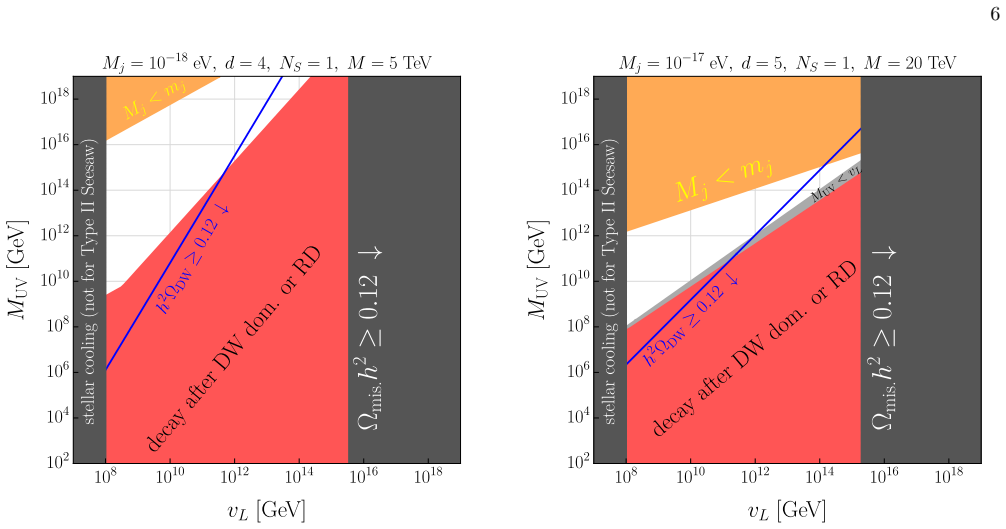
- Additional scalar representations (d, M, N_S) =
d=4, M=5 TeV; d=5, M=20 TeV; d=3, M=10 TeV
- n (dimension of operator in Eq. 11) =
n=17 for v_L=10^13 GeV, M_j=10^-18 eV
assumptions (5)
- domain assumption The U(1)_{B+L} x SU(2)_W^2 anomaly is the only non-perturbative source of Majoron potential at the electroweak scale.
- standard math Constrained instanton (one-instanton) approximation with IR cutoff 1/(g_W v_H) and UV cutoff 1/M_UV.
- domain assumption The Standard Model fermion content with N_g=3 and no new fermionic zero modes unless explicitly added.
- ad hoc to paper No other sources of explicit lepton number breaking contribute in the pure instanton scenario.
- ad hoc to paper A mechanism exists to protect the quality of the bias potential, suppressing all lower-dimensional operators in Eq. (11).
invented entities (1)
-
Vector-like doublet fermions Psi_L,R with chiral B-L charges
Cite this review
Pith. "Pith review of About electroweak domain walls in Majoron models." pith.science (2026). https://pith.science/paper/CCMKIWU5
@misc{pith2026250602910,
  author       = {Pith},
  title        = {Pith review of: About electroweak domain walls in Majoron models},
  year         = {2026},
  howpublished = {\url{https://pith.science/paper/CCMKIWU5}},
  note         = {Machine review of arXiv:2506.02910}
}
abstract
Some time ago it was claimed in "Spontaneous Breaking of Lepton Number and Cosmological Domain Wall Problem" (Phys. Rev. Lett. 122, 151301 (2019)) that non perturbative instantons of the weak interaction $\text{SU}(2)_\text{W}$ lead to the formation of domain walls in Majoron models owing to the anomaly of the spontaneously broken global lepton number $L$ symmetry $\text{U}(1)_L$ with respect to $\text{SU}(2)_\text{W}$. We point out that it has long been known, that this effect can be completely rotated away unless there is a source of explicit $B+L$ breaking present, where $B$ denotes baryon number. We further estimate the tiny instanton induced Majoron mass from $B+L$ breaking and analyze the cosmological impact of such domain walls including possible finite temperature effects. In general this scenario does not lead to a cosmological catastrophe and we demonstrate that the tiny instanton induced mass can act as a bias term to collapse walls induced by a larger source of lepton number breaking. Alternatively this electroweak Majoron could act as dynamical dark energy.
Figures


Forward citations
Cited by 2 Pith papers
-
Majoron Dark Energy via Freezing Induced by Quantum Coherence
Quantum coherence lag in a hidden pseudo-Dirac sterile reservoir can freeze a physical Majoron into a metastable w≈−1 phase even when m_φ ≫ H_0.
-
A New Route to the Annihilation of Multi-Wall String Topological Configurations
Small bare fermion masses generate a bias via radiative corrections that triggers annihilation of multi-wall cosmic string networks in gravitationally broken global U(1) models, illustrated in a majoron framework with...
Reference graph
Works this paper leans on
-
[61]
Spontaneous Breaking of Lepton Number and the Cosmological Domain Wall Problem,
G. Lazarides, M. Reig, Q. Shafi, R. Srivastava, and J. W. F. Valle, “Spontaneous Breaking of Lepton Number and the Cosmological Domain Wall Problem,” Phys. Rev. Lett.122no. 15, (2019) 151301, arXiv:1806.11198 [hep-ph]
arXiv 2019
-
[77]
Instanton NDA and applications to axion models,
C. Cs´ aki, R. T. D’Agnolo, E. Kuflik, and M. Ruhdorfer, “Instanton NDA and applications to axion models,”JHEP04(2024) 074, arXiv:2311.09285 [hep-ph]
arXiv 2024
-
[1]
Cosmological Consequences of the Spontaneous Breakdown of Discrete Symmetry,
Y. B. Zeldovich, I. Y. Kobzarev, and L. B. Okun, “Cosmological Consequences of the Spontaneous Breakdown of Discrete Symmetry,”Zh. Eksp. Teor. Fiz.67(1974) 3–11
1974
-
[2]
Vilenkin and E
A. Vilenkin and E. P. S. Shellard,Cosmic Strings and Other Topological Defects. Cambridge University Press, 7, 2000
2000
-
[3]
Dynamical Evolution of Domain Walls in an 10 Expanding Universe,
W. H. Press, B. S. Ryden, and D. N. Spergel, “Dynamical Evolution of Domain Walls in an 10 Expanding Universe,”Astrophys. J.347(1989) 590–604
1989
-
[4]
Scaling in numerical simulations of domain walls,
T. Garagounis and M. Hindmarsh, “Scaling in numerical simulations of domain walls,”Phys. Rev. D 68(2003) 103506,arXiv:hep-ph/0212359
arXiv 2003
-
[5]
Accurate Calibration of the Velocity-dependent One-scale Model for Domain Walls,
A. M. M. Leite, C. J. A. P. Martins, and E. P. S. Shellard, “Accurate Calibration of the Velocity-dependent One-scale Model for Domain Walls,”Phys. Lett. B718(2013) 740–744, arXiv:1206.6043 [hep-ph]
arXiv 2013
-
[6]
On the estimation of gravitational wave spectrum from cosmic domain walls,
T. Hiramatsu, M. Kawasaki, and K. Saikawa, “On the estimation of gravitational wave spectrum from cosmic domain walls,”JCAP02(2014) 031,arXiv:1309.5001 [astro-ph.CO]
arXiv 2014
Show all 172 references
-
[7]
Cosmology of Biased Discrete Symmetry Breaking,
G. B. Gelmini, M. Gleiser, and E. W. Kolb, “Cosmology of Biased Discrete Symmetry Breaking,” Phys. Rev. D39(1989) 1558. [8]PlanckCollaboration, Y. Akramiet al., “Planck 2018 results. X. Constraints on inflation,”Astron. Astrophys.641(2020) A10,arXiv:1807.06211 [astro-ph.CO]
1989 arXiv
-
[9]
The Inflationary Universe: A Possible Solution to the Horizon and Flatness Problems,
A. H. Guth, “The Inflationary Universe: A Possible Solution to the Horizon and Flatness Problems,”Phys. Rev. D23(1981) 347–356
1981
-
[10]
Stability of domain wall network with initial inflationary fluctuations and its implications for cosmic birefringence,
D. Gonzalez, N. Kitajima, F. Takahashi, and W. Yin, “Stability of domain wall network with initial inflationary fluctuations and its implications for cosmic birefringence,”Phys. Lett. B843(2023) 137990, arXiv:2211.06849 [hep-ph]
2023 arXiv
-
[11]
Gauge and Global Symmetries at High Temperature,
S. Weinberg, “Gauge and Global Symmetries at High Temperature,”Phys. Rev. D9(1974) 3357–3378
1974
-
[12]
Gravitational Field of Vacuum Domain Walls and Strings,
A. Vilenkin, “Gravitational Field of Vacuum Domain Walls and Strings,”Phys. Rev. D23(1981) 852–857
1981
-
[13]
Beyond freeze-in: Dark matter via inverse phase transition and gravitational wave signal,
S. Ramazanov, E. Babichev, D. Gorbunov, and A. Vikman, “Beyond freeze-in: Dark matter via inverse phase transition and gravitational wave signal,”Phys. Rev. D105no. 6, (2022) 063530, arXiv:2104.13722 [hep-ph]
2022 arXiv
-
[14]
Gravitational shine of dark domain walls,
E. Babichev, D. Gorbunov, S. Ramazanov, and A. Vikman, “Gravitational shine of dark domain walls,”JCAP04no. 04, (2022) 028, arXiv:2112.12608 [hep-ph]
2022 arXiv
-
[15]
Topology of Cosmic Domains and Strings,
T. W. B. Kibble, “Topology of Cosmic Domains and Strings,”J. Phys. A9(1976) 1387–1398
1976
-
[16]
Of Axions, Domain Walls and the Early Universe,
P. Sikivie, “Of Axions, Domain Walls and the Early Universe,”Phys. Rev. Lett.48(1982) 1156–1159
1982
-
[17]
Gravitational waves from domain walls in Pulsar Timing Array datasets,
R. Z. Ferreira, A. Notari, O. Pujolas, and F. Rompineve, “Gravitational waves from domain walls in Pulsar Timing Array datasets,”JCAP02 (2023) 001,arXiv:2204.04228 [astro-ph.CO]. [18]NANOGravCollaboration, G. Agazieet al., “The NANOGrav 15 yr Data Set: Evidence for a Gravitati...
2023 arXiv
-
[20]
Search for an Isotropic Gravitational-wave Background with the Parkes Pulsar Timing Array,
D. J. Reardonet al., “Search for an Isotropic Gravitational-wave Background with the Parkes Pulsar Timing Array,”Astrophys. J. Lett.951no. 1, (2023) L6,arXiv:2306.16215 [astro-ph.HE]
2023 arXiv
-
[21]
Searching for the Nano-Hertz Stochastic Gravitational Wave Background with the Chinese Pulsar Timing Array Data Release I,
H. Xuet al., “Searching for the Nano-Hertz Stochastic Gravitational Wave Background with the Chinese Pulsar Timing Array Data Release I,”Res. Astron. Astrophys.23no. 7, (2023) 075024,arXiv:2306.16216 [astro-ph.HE]. [22]International Pulsar Timing ArrayCollaboration, G. Agaziee...
2023 arXiv
-
[23]
A new light boson?,
S. Weinberg, “A new light boson?,”Phys. Rev. Lett. 40(Jan, 1978) 223–226.https: //link.aps.org/doi/10.1103/PhysRevLett.40.223
1978 doi
-
[24]
Problem of strongpandtinvariance in the presence of instantons,
F. Wilczek, “Problem of strongpandtinvariance in the presence of instantons,”Phys. Rev. Lett.40(Jan,
-
[25]
CP conservation in the presence of pseudoparticles,
R. D. Peccei and H. R. Quinn, “CP conservation in the presence of pseudoparticles,”Phys. Rev. Lett.38 (Jun, 1977) 1440–1443.https: //link.aps.org/doi/10.1103/PhysRevLett.38.1440
1977 doi
-
[26]
Constraints Imposed by CP Conservation in the Presence of Instantons,
R. D. Peccei and H. R. Quinn, “Constraints Imposed by CP Conservation in the Presence of Instantons,” Phys. Rev. D16(1977) 1791–1797
1977
-
[27]
Topology of cosmic domains and strings,
T. W. B. Kibble, “Topology of cosmic domains and strings,”Journal of Physics A: Mathematical and General9no. 8, (Aug, 1976) 1387–1398. https://doi.org/10.1088/0305-4470/9/8/029
1976 doi
-
[28]
Walls bounded by strings,
T. W. B. Kibble, G. Lazarides, and Q. Shafi, “Walls bounded by strings,”Phys. Rev. D26(Jul, 1982) 435–439.https: //link.aps.org/doi/10.1103/PhysRevD.26.435
1982 doi
-
[29]
Some implications of a cosmological phase transition,
T. Kibble, “Some implications of a cosmological phase transition,”Physics Reports67no. 1, (1980) 183–199. https://www.sciencedirect.com/science/article/ pii/0370157380900915
1980
-
[30]
Cosmic Strings and Domain Walls in Models with Goldstone and PseudoGoldstone Bosons,
A. Vilenkin and A. E. Everett, “Cosmic Strings and Domain Walls in Models with Goldstone and PseudoGoldstone Bosons,”Phys. Rev. Lett.48(1982) 1867–1870
1982
-
[31]
Some aspects of axion cosmology in unified and superstring models,
S. M. Barr, K. Choi, and J. E. Kim, “Some aspects of axion cosmology in unified and superstring models,” Nucl. Phys. B283(1987) 591–604
1987
-
[32]
Ruling out light axions: The writing is on the wall,
K. A. Beyer and S. Sarkar, “Ruling out light axions: The writing is on the wall,”SciPost Phys.15no. 1, (2023) 003,arXiv:2211.14635 [hep-ph]
2023 arXiv
-
[33]
New Confining Force Solution of the QCD Axion Domain-Wall Problem,
S. M. Barr and J. E. Kim, “New Confining Force Solution of the QCD Axion Domain-Wall Problem,” Phys. Rev. Lett.113no. 24, (2014) 241301, arXiv:1407.4311 [hep-ph]
2014 arXiv
-
[34]
On the high-scale instanton interference effect: axion models without domain wall problem,
M. Reig, “On the high-scale instanton interference effect: axion models without domain wall problem,” JHEP08(2019) 167,arXiv:1901.00203 [hep-ph]
2019 arXiv
-
[35]
Imperfect Axion Precludes the Domain Wall Problem,
Y. Zhang, “Imperfect Axion Precludes the Domain Wall Problem,”Phys. Rev. Lett.132no. 8, (2024) 081003,arXiv:2305.15495 [hep-ph]
2024 arXiv
-
[36]
µ→eγat a Rate of One Out of 10 9 Muon Decays?,
P. Minkowski, “µ→eγat a Rate of One Out of 10 9 Muon Decays?,”Phys. Lett. B67(1977) 421–428
1977
-
[37]
Horizontal gauge symmetry and masses of neutrinos,
T. Yanagida, “Horizontal gauge symmetry and masses of neutrinos,”Conf. Proc. C7902131(1979) 95–99
1979
-
[38]
Complex Spinors and Unified Theories,
M. Gell-Mann, P. Ramond, and R. Slansky, “Complex Spinors and Unified Theories,”Conf. Proc. C790927 (1979) 315–321,arXiv:1306.4669 [hep-th]
1979 arXiv
-
[39]
The Future of Elementary Particle 11 Physics,
S. L. Glashow, “The Future of Elementary Particle 11 Physics,”NATO Sci. Ser. B61(1980) 687
1980
-
[40]
Horizontal Symmetry and Masses of Neutrinos,
T. Yanagida, “Horizontal Symmetry and Masses of Neutrinos,”Prog. Theor. Phys.64(1980) 1103
1980
-
[41]
Neutrino mass and spontaneous parity nonconservation,
R. N. Mohapatra and G. Senjanovi´ c, “Neutrino mass and spontaneous parity nonconservation,”Phys. Rev. Lett.44(Apr, 1980) 912–915.https: //link.aps.org/doi/10.1103/PhysRevLett.44.912
1980 doi
-
[42]
Seesaw Neutrino Masses Induced by a Triplet of Leptons,
R. Foot, H. Lew, X. G. He, and G. C. Joshi, “Seesaw Neutrino Masses Induced by a Triplet of Leptons,”Z. Phys. C44(1989) 441
1989
-
[43]
Proton Lifetime and Fermion Masses in an SO(10) Model,
G. Lazarides, Q. Shafi, and C. Wetterich, “Proton Lifetime and Fermion Masses in an SO(10) Model,” Nucl. Phys. B181(1981) 287–300
1981
-
[44]
Neutrino Masses in SU(2) x U(1) Theories,
J. Schechter and J. W. F. Valle, “Neutrino Masses in SU(2) x U(1) Theories,”Phys. Rev. D22(1980) 2227
1980
-
[45]
Neutrino Masses and Mixings in Gauge Models with Spontaneous Parity Violation,
R. N. Mohapatra and G. Senjanovic, “Neutrino Masses and Mixings in Gauge Models with Spontaneous Parity Violation,”Phys. Rev. D23(1981) 165
1981
-
[46]
Neutrino masses, mixings, and oscillations in su(2) x u(1) models of electroweak interactions,
T. P. Cheng and L.-F. Li, “Neutrino masses, mixings, and oscillations in su(2) x u(1) models of electroweak interactions,”Phys. Rev. D22(Dec, 1980) 2860–2868. https: //link.aps.org/doi/10.1103/PhysRevD.22.2860
1980 doi
-
[47]
Neutrino Masses and the Scale of B-L Violation,
C. Wetterich, “Neutrino Masses and the Scale of B-L Violation,”Nucl. Phys. B187(1981) 343–375
1981
-
[48]
Spontaneously Broken Lepton Number and Cosmological Constraints on the Neutrino Mass Spectrum,
Y. Chikashige, R. N. Mohapatra, and R. D. Peccei, “Spontaneously Broken Lepton Number and Cosmological Constraints on the Neutrino Mass Spectrum,”Phys. Rev. Lett.45(1980) 1926
1980
-
[49]
Are There Real Goldstone Bosons Associated with Broken Lepton Number?,
Y. Chikashige, R. N. Mohapatra, and R. D. Peccei, “Are There Real Goldstone Bosons Associated with Broken Lepton Number?,”Phys. Lett. B98(1981) 265–268
1981
-
[50]
Left-Handed Neutrino Mass Scale and Spontaneously Broken Lepton Number,
G. B. Gelmini and M. Roncadelli, “Left-Handed Neutrino Mass Scale and Spontaneously Broken Lepton Number,”Phys. Lett. B99(1981) 411–415
1981
-
[51]
Observable Majoron emission in neutrinoless double beta decay,
Z. G. Berezhiani, A. Y. Smirnov, and J. W. F. Valle, “Observable Majoron emission in neutrinoless double beta decay,”Phys. Lett. B291(1992) 99–105, arXiv:hep-ph/9207209
1992 arXiv
-
[52]
Neutrino Decay and Spontaneous Violation of Lepton Number,
J. Schechter and J. W. F. Valle, “Neutrino Decay and Spontaneous Violation of Lepton Number,”Phys. Rev. D25(1982) 774
1982
-
[53]
DARK MATTER NEUTRINOS AND NATURAL MASS HIERARCHY IN SINGLET - TRIPLET MAJORON MODEL,
K. Choi, C. W. Kim, W. P. Lam, and A. Santamaria, “DARK MATTER NEUTRINOS AND NATURAL MASS HIERARCHY IN SINGLET - TRIPLET MAJORON MODEL,”
-
[54]
17-KeV neutrino in a singlet - triplet majoron model,
K. Choi and A. Santamaria, “17-KeV neutrino in a singlet - triplet majoron model,”Phys. Lett. B267 (1991) 504–508
1991
-
[55]
Neutrino Lines from Majoron Dark Matter,
C. Garcia-Cely and J. Heeck, “Neutrino Lines from Majoron Dark Matter,”JHEP05(2017) 102, arXiv:1701.07209 [hep-ph]
2017 arXiv
-
[56]
Massive Majorons and constraints on the Majoron-neutrino coupling,
T. Brune and H. P¨ as, “Massive Majorons and constraints on the Majoron-neutrino coupling,”Phys. Rev. D99no. 9, (2019) 096005,arXiv:1808.08158 [hep-ph]
2019 arXiv
-
[57]
Majoron at two loops,
J. Heeck and H. H. Patel, “Majoron at two loops,” Phys. Rev. D100no. 9, (2019) 095015, arXiv:1909.02029 [hep-ph]
2019 arXiv
-
[58]
Light majoron cold dark matter from topological defects and the formation of boson stars,
M. Reig, J. W. F. Valle, and M. Yamada, “Light majoron cold dark matter from topological defects and the formation of boson stars,”JCAP09(2019) 029, arXiv:1905.01287 [hep-ph]
2019 arXiv
-
[59]
Updated constraints and future prospects on majoron dark matter,
K. Akita and M. Niibo, “Updated constraints and future prospects on majoron dark matter,”JHEP07 (2023) 132,arXiv:2304.04430 [hep-ph]
2023 arXiv
-
[60]
Insights on the Cosmic Origin of Matter from Proton Stability,
A. Greljo, X. Ponce D ´ ıaz, and A. E. Thomsen, “Insights on the Cosmic Origin of Matter from Proton Stability,”arXiv:2505.18259 [hep-ph]
-
[62]
Axial vector vertex in spinor electrodynamics,
S. L. Adler, “Axial vector vertex in spinor electrodynamics,”Phys. Rev.177(1969) 2426–2438
1969
-
[63]
A PCAC puzzle:π 0 →γγ in theσmodel,
J. S. Bell and R. Jackiw, “A PCAC puzzle:π 0 →γγ in theσmodel,”Nuovo Cim. A60(1969) 47–61
1969
-
[64]
Axion Models with No Domain Wall Problem,
G. Lazarides and Q. Shafi, “Axion Models with No Domain Wall Problem,”Phys. Lett. B115(1982) 21–25
1982
-
[65]
Families, the Invisible Axion, and Domain Walls,
S. M. Barr, D. B. Reiss, and A. Zee, “Families, the Invisible Axion, and Domain Walls,”Phys. Lett. B 116(1982) 227–230
1982
-
[66]
Leptogenesis in Majoron models without domain walls,
T. Brune, “Leptogenesis in Majoron models without domain walls,”Phys. Rev. D107no. 9, (2023) 096023, arXiv:2201.12239 [hep-ph]
2023 arXiv
-
[67]
Leptogenesis in a Majoron+Triplet model,
T. Brune, “Leptogenesis in a Majoron+Triplet model,” arXiv:2501.11529 [hep-ph]
-
[68]
Baryon nonconservation in standard model and Yukawa interaction,
A. A. Anselm and A. A. Johansen, “Baryon nonconservation in standard model and Yukawa interaction,”Nucl. Phys. B407(1993) 313–330
1993
-
[69]
Can electroweak theta term be observable?,
A. A. Anselm and A. A. Johansen, “Can electroweak theta term be observable?,”Nucl. Phys. B412(1994) 553–573,arXiv:hep-ph/9305271
1994 arXiv
-
[70]
Three-form gauging of axion symmetries and gravity,
G. Dvali, “Three-form gauging of axion symmetries and gravity,”arXiv:hep-th/0507215
-
[71]
The Electroweak Vacuum Angle,
P. Fileviez Perez and H. H. Patel, “The Electroweak Vacuum Angle,”Phys. Lett. B732(2014) 241–243, arXiv:1402.6340 [hep-ph]
2014 arXiv
-
[72]
Electroweak vacuum angle at finite temperature and implications for baryogenesis,
A. J. Long, H. H. Patel, and M. Trodden, “Electroweak vacuum angle at finite temperature and implications for baryogenesis,”Phys. Rev. D92no. 4, (2015) 043513,arXiv:1507.00654 [hep-ph]
2015 arXiv
-
[73]
(In)dependence of Θ in the Higgs regime without axions,
M. Shifman and A. Vainshtein, “(In)dependence of Θ in the Higgs regime without axions,”Mod. Phys. Lett. A32no. 14, (2017) 1750084,arXiv:1701.00467 [hep-th]
2017 arXiv
-
[74]
Axions are blind to anomalies,
J. Quevillon and C. Smith, “Axions are blind to anomalies,”Eur. Phys. J. C79no. 10, (2019) 822, arXiv:1903.12559 [hep-ph]
2019 arXiv
-
[75]
Baryon and lepton number intricacies in axion models,
J. Quevillon and C. Smith, “Baryon and lepton number intricacies in axion models,”Phys. Rev. D102 no. 7, (2020) 075031,arXiv:2006.06778 [hep-ph]
2020 arXiv
-
[76]
Variations on the SU(5) axion,
J. Quevillon and C. Smith, “Variations on the SU(5) axion,”Eur. Phys. J. Plus137no. 1, (2022) 141, arXiv:2010.13683 [hep-ph]
2022 arXiv
-
[78]
Quintessence axion potential induced by electroweak instanton effects,
Y. Nomura, T. Watari, and T. Yanagida, “Quintessence axion potential induced by electroweak instanton effects,”Phys. Lett. B484(2000) 103–111, arXiv:hep-ph/0004182
2000 arXiv
-
[79]
Electroweak Instantons, Axions, and the 12 Cosmological Constant,
L. McLerran, R. Pisarski, and V. Skokov, “Electroweak Instantons, Axions, and the 12 Cosmological Constant,”Phys. Lett. B713(2012) 301–303,arXiv:1204.2533 [hep-ph]
2012 arXiv
-
[80]
Quintessence Axion Revisited in Light of Swampland Conjectures,
M. Ibe, M. Yamazaki, and T. T. Yanagida, “Quintessence Axion Revisited in Light of Swampland Conjectures,”Class. Quant. Grav.36no. 23, (2019) 235020,arXiv:1811.04664 [hep-th]
2019 arXiv
-
[81]
Electroweakη w meson,
G. Dvali, A. Kobakhidze, and O. Sakhelashvili, “Electroweakη w meson,”arXiv:2408.07535 [hep-th]
-
[82]
Two-component spinor techniques and Feynman rules for quantum field theory and supersymmetry,
H. K. Dreiner, H. E. Haber, and S. P. Martin, “Two-component spinor techniques and Feynman rules for quantum field theory and supersymmetry,”Phys. Rept.494(2010) 1–196,arXiv:0812.1594 [hep-ph]
2010 arXiv
-
[83]
An EFT approach to baryon number violation: lower limits on the new physics scale and correlations between nucleon decay modes,
A. B. Beneito, I, J. Gargalionis, J. Herrero-Garcia, A. Santamaria, and M. A. Schmidt, “An EFT approach to baryon number violation: lower limits on the new physics scale and correlations between nucleon decay modes,”JHEP07(2024) 004, arXiv:2312.13361 [hep-ph]
2024
-
[84]
Model-independent estimates for loop-induced baryon-number-violating nucleon decays,
J. Gargalionis, J. Herrero-Garc ´ ıa, and M. A. Schmidt, “Model-independent estimates for loop-induced baryon-number-violating nucleon decays,”JHEP06 (2024) 182,arXiv:2401.04768 [hep-ph]
2024 arXiv
-
[85]
Unity of All Elementary Particle Forces,
H. Georgi and S. L. Glashow, “Unity of All Elementary Particle Forces,”Phys. Rev. Lett.32(1974) 438–441
1974
-
[86]
Invisible Axions and Light Neutrinos: Are They Connected?,
P. Langacker, R. D. Peccei, and T. Yanagida, “Invisible Axions and Light Neutrinos: Are They Connected?,”Mod. Phys. Lett. A1(1986) 541
1986
-
[87]
Light Neutrino Masses and Strong CP Problem,
M. Shin, “Light Neutrino Masses and Strong CP Problem,”Phys. Rev. Lett.59(1987) 2515. [Erratum: Phys.Rev.Lett. 60, 383 (1988)]
1987
-
[88]
Unifying inflation with the axion, dark matter, baryogenesis and the seesaw mechanism,
G. Ballesteros, J. Redondo, A. Ringwald, and C. Tamarit, “Unifying inflation with the axion, dark matter, baryogenesis and the seesaw mechanism,” Phys. Rev. Lett.118no. 7, (2017) 071802, arXiv:1608.05414 [hep-ph]
2017 arXiv
-
[89]
Standard Model—axion—seesaw—Higgs portal inflation. Five problems of particle physics and cosmology solved in one stroke,
G. Ballesteros, J. Redondo, A. Ringwald, and C. Tamarit, “Standard Model—axion—seesaw—Higgs portal inflation. Five problems of particle physics and cosmology solved in one stroke,”JCAP08(2017) 001, arXiv:1610.01639 [hep-ph]
2017 arXiv
-
[90]
Symmetry Breaking Through Bell-Jackiw Anomalies,
G. ’t Hooft, “Symmetry Breaking Through Bell-Jackiw Anomalies,”Phys. Rev. Lett.37(1976) 8–11
1976
-
[91]
Computation of the Quantum Effects Due to a Four-Dimensional Pseudoparticle,
G. ’t Hooft, “Computation of the Quantum Effects Due to a Four-Dimensional Pseudoparticle,”Phys. Rev. D14(1976) 3432–3450. [Erratum: Phys.Rev.D 18, 2199 (1978)]
1976
-
[92]
On Constrained Instantons,
I. Affleck, “On Constrained Instantons,”Nucl. Phys. B 191(1981) 429
1981
-
[93]
Cosmology of the Invisible Axion,
J. Preskill, M. B. Wise, and F. Wilczek, “Cosmology of the Invisible Axion,”Phys. Lett. B120(1983) 127–132
1983
-
[94]
A Cosmological Bound on the Invisible Axion,
L. F. Abbott and P. Sikivie, “A Cosmological Bound on the Invisible Axion,”Phys. Lett. B120(1983) 133–136
1983
-
[95]
The Not So Harmless Axion,
M. Dine and W. Fischler, “The Not So Harmless Axion,”Phys. Lett. B120(1983) 137–141
1983
-
[96]
A Note on Proton Stability in the Standard Model,
S. Koren, “A Note on Proton Stability in the Standard Model,”Universe8no. 6, (2022) 308, arXiv:2204.01741 [hep-ph]
2022 arXiv
-
[97]
Evolution of String-Wall Networks and Axionic Domain Wall Problem,
T. Hiramatsu, M. Kawasaki, and K. Saikawa, “Evolution of String-Wall Networks and Axionic Domain Wall Problem,”JCAP08(2011) 030, arXiv:1012.4558 [astro-ph.CO]
2011 arXiv
-
[98]
The QCD axion, precisely,
G. Grilli di Cortona, E. Hardy, J. Pardo Vega, and G. Villadoro, “The QCD axion, precisely,”JHEP01 (2016) 034,arXiv:1511.02867 [hep-ph]
2016 arXiv
-
[99]
Domain walls as dark energy,
A. Friedland, H. Murayama, and M. Perelstein, “Domain walls as dark energy,”Phys. Rev. D67 (2003) 043519,arXiv:astro-ph/0205520
2003 arXiv
-
[100]
The Sphaleron Strikes Back,
P. B. Arnold and L. D. McLerran, “The Sphaleron Strikes Back,”Phys. Rev. D37(1988) 1020
1988
-
[101]
Sphalerons and Axion Dynamics in High Temperature QCD,
L. D. McLerran, E. Mottola, and M. E. Shaposhnikov, “Sphalerons and Axion Dynamics in High Temperature QCD,”Phys. Rev. D43(1991) 2027–2035
1991
-
[102]
Majorons and Supernova Cooling,
K. Choi and A. Santamaria, “Majorons and Supernova Cooling,”Phys. Rev. D42(1990) 293–306
1990
-
[103]
Grand Unified Models With an Automatic Peccei-Quinn Symmetry,
H. M. Georgi, L. J. Hall, and M. B. Wise, “Grand Unified Models With an Automatic Peccei-Quinn Symmetry,”Nucl. Phys. B192(1981) 409–416
1981
-
[104]
String Theory and the Strong CP Problem,
M. Dine and N. Seiberg, “String Theory and the Strong CP Problem,”Nucl. Phys. B273(1986) 109–124
1986
-
[105]
WORMHOLES MADE WITHOUT MASSLESS MATTER FIELDS,
S. R. Coleman and K.-M. Lee, “WORMHOLES MADE WITHOUT MASSLESS MATTER FIELDS,” Nucl. Phys. B329(1990) 387–409
1990
-
[106]
Wormholes and Global Symmetries,
L. F. Abbott and M. B. Wise, “Wormholes and Global Symmetries,”Nucl. Phys. B325(1989) 687–704
1989
-
[107]
Solutions to the strong CP problem in a world with gravity,
R. Holman, S. D. H. Hsu, T. W. Kephart, E. W. Kolb, R. Watkins, and L. M. Widrow, “Solutions to the strong CP problem in a world with gravity,”Phys. Lett. B282(1992) 132–136,arXiv:hep-ph/9203206
1992 arXiv
-
[108]
Planck scale physics and the Peccei-Quinn mechanism,
M. Kamionkowski and J. March-Russell, “Planck scale physics and the Peccei-Quinn mechanism,”Phys. Lett. B282(1992) 137–141,arXiv:hep-th/9202003
1992 arXiv
-
[109]
Planck scale corrections to axion models,
S. M. Barr and D. Seckel, “Planck scale corrections to axion models,”Phys. Rev. D46(1992) 539–549
1992
-
[110]
Instability of the invisible axion,
S. Ghigna, M. Lusignoli, and M. Roncadelli, “Instability of the invisible axion,”Phys. Lett. B283 (1992) 278–281
1992
-
[111]
Gravity and global symmetries,
R. Kallosh, A. D. Linde, D. A. Linde, and L. Susskind, “Gravity and global symmetries,”Phys. Rev. D52 (1995) 912–935,arXiv:hep-th/9502069
1995 arXiv
-
[112]
Wormholes and masses for Goldstone bosons,
R. Alonso and A. Urbano, “Wormholes and masses for Goldstone bosons,”JHEP02(2019) 136, arXiv:1706.07415 [hep-ph]
2019 arXiv
-
[113]
Cosmology and broken discrete symmetry,
J. Preskill, S. P. Trivedi, F. Wilczek, and M. B. Wise, “Cosmology and broken discrete symmetry,”Nucl. Phys. B363(1991) 207–220
1991
-
[114]
Testing clockwork axion with gravitational waves,
C.-W. Chiang and B.-Q. Lu, “Testing clockwork axion with gravitational waves,”JCAP05(2021) 049, arXiv:2012.14071 [hep-ph]
2021 arXiv
-
[115]
Gravitational waves from domain wall collapse, and application to nanohertz signals with QCD-coupled axions,
N. Kitajima, J. Lee, K. Murai, F. Takahashi, and W. Yin, “Gravitational waves from domain wall collapse, and application to nanohertz signals with QCD-coupled axions,”Phys. Lett. B851(2024) 138586,arXiv:2306.17146 [hep-ph]
2024 arXiv
-
[116]
QCD-collapsed domain walls: QCD phase transition and gravitational wave spectroscopy,
Y. Bai, T.-K. Chen, and M. Korwar, “QCD-collapsed domain walls: QCD phase transition and gravitational wave spectroscopy,”JHEP12(2023) 194, arXiv:2306.17160 [hep-ph]
2023 arXiv
-
[117]
Axionic domain walls at Pulsar Timing Arrays: QCD bias and particle friction,
S. Blasi, A. Mariotti, A. Rase, and A. Sevrin, “Axionic domain walls at Pulsar Timing Arrays: QCD bias and particle friction,”JHEP11(2023) 169, arXiv:2306.17830 [hep-ph]
2023 arXiv
-
[118]
Clockwork axion footprint on nanohertz stochastic gravitational wave background,
B.-Q. Lu, C.-W. Chiang, and T. Li, “Clockwork axion footprint on nanohertz stochastic gravitational wave background,”Phys. Rev. D109no. 10, (2024) 13 L101304,arXiv:2307.00746 [hep-ph]
2024 arXiv
-
[119]
Gravitational Waves from Collapsing Domain Walls,
T. Hiramatsu, M. Kawasaki, and K. Saikawa, “Gravitational Waves from Collapsing Domain Walls,” JCAP05(2010) 032,arXiv:1002.1555 [astro-ph.CO]
2010 arXiv
-
[120]
Ultralight fuzzy dark matter review,
A. Eberhardt and E. G. M. Ferreira, “Ultralight fuzzy dark matter review,”arXiv:2507.00705 [astro-ph.CO]
-
[121]
Strong Bound on Canonical Ultralight Axion Dark Matter from the Lyman-Alpha Forest,
K. K. Rogers and H. V. Peiris, “Strong Bound on Canonical Ultralight Axion Dark Matter from the Lyman-Alpha Forest,”Phys. Rev. Lett.126no. 7, (2021) 071302,arXiv:2007.12705 [astro-ph.CO]
2021 arXiv
-
[122]
Black hole spin constraints on the mass spectrum and number of axionlike fields,
M. J. Stott and D. J. E. Marsh, “Black hole spin constraints on the mass spectrum and number of axionlike fields,”Phys. Rev. D98no. 8, (2018) 083006,arXiv:1805.02016 [hep-ph]
2018 arXiv
-
[123]
Searching for the QCD Dark Matter Axion,
M. Baryakhtar, L. Rosenberg, and G. Rybka, “Searching for the QCD Dark Matter Axion,” arXiv:2504.10607 [hep-ex]
-
[124]
Discovering the QCD Axion with Black Holes and Gravitational Waves,
A. Arvanitaki, M. Baryakhtar, and X. Huang, “Discovering the QCD Axion with Black Holes and Gravitational Waves,”Phys. Rev. D91no. 8, (2015) 084011,arXiv:1411.2263 [hep-ph]
2015 arXiv
-
[125]
Solving the Hierarchy Problem Discretely,
A. Hook, “Solving the Hierarchy Problem Discretely,” Phys. Rev. Lett.120no. 26, (2018) 261802, arXiv:1802.10093 [hep-ph]
2018 arXiv
-
[126]
An even lighter QCD axion,
L. Di Luzio, B. Gavela, P. Quilez, and A. Ringwald, “An even lighter QCD axion,”JHEP05(2021) 184, arXiv:2102.00012 [hep-ph]
2021 arXiv
-
[127]
The quality/cosmology tension for a post-inflation QCD axion,
Q. Lu, M. Reece, and Z. Sun, “The quality/cosmology tension for a post-inflation QCD axion,”JHEP07 (2024) 227,arXiv:2312.07650 [hep-ph]
2024 arXiv
-
[128]
(Non-)Perturbative Dynamics of a Light QCD Axion: Dark Matter and the Strong CP Problem,
R. T. Co, T. Lee, and O. P. Leonard, “(Non-)Perturbative Dynamics of a Light QCD Axion: Dark Matter and the Strong CP Problem,” arXiv:2508.00979 [hep-ph]
-
[129]
String theory and grand unification suggest a submicroelectronvolt QCD axion,
J. N. Benabou, K. Fraser, M. Reig, and B. R. Safdi, “String theory and grand unification suggest a submicroelectronvolt QCD axion,”Phys. Rev. D112 no. 6, (2025) 066003,arXiv:2505.15884 [hep-ph]
2025 arXiv
-
[130]
On the Addition of a Large Scalar Multiplet to the Standard Model,
D. Jurˇ ciukonis and L. Lavoura, “On the Addition of a Large Scalar Multiplet to the Standard Model,”PTEP 2024no. 8, (2024) 083B06,arXiv:2404.07897 [hep-ph]
2024 arXiv
-
[131]
phantom mirage
and the SU(2) W gauge couplings remain perturba- tive below the Planck scale as long asd <7 [132]. Of course there exist other constraints on additional scalar representations such as electroweak precision observables or Higgs vacuum stability, but here we are merely inter- es...
2025
-
[132]
Constraints on large scalar multiplets from perturbative unitarity,
K. Hally, H. E. Logan, and T. Pilkington, “Constraints on large scalar multiplets from perturbative unitarity,” Phys. Rev. D85(2012) 095017,arXiv:1202.5073 [hep-ph]
2012 arXiv
-
[133]
Minimal dark matter,
M. Cirelli, N. Fornengo, and A. Strumia, “Minimal dark matter,”Nucl. Phys. B753(2006) 178–194, arXiv:hep-ph/0512090
2006 arXiv
-
[134]
Axion cosmology with long-lived domain walls,
T. Hiramatsu, M. Kawasaki, K. Saikawa, and T. Sekiguchi, “Axion cosmology with long-lived domain walls,”JCAP01(2013) 001,arXiv:1207.3166 [hep-ph]. [134]DESICollaboration, A. G. Adameet al., “DESI 2024 VI: Cosmological Constraints from the Measurements of Baryon Acoustic Oscill...
2013 arXiv
-
[143]
The Pantheon+ Analysis: Cosmological Constraints,
D. Broutet al., “The Pantheon+ Analysis: Cosmological Constraints,”Astrophys. J.938no. 2, (2022) 110,arXiv:2202.04077 [astro-ph.CO]
2022 arXiv
-
[144]
Union Through UNITY: Cosmology with 2,000 SNe Using a Unified Bayesian Framework,
D. Rubinet al., “Union Through UNITY: Cosmology with 2,000 SNe Using a Unified Bayesian Framework,” arXiv:2311.12098 [astro-ph.CO]. [145]DESCollaboration, T. M. C. Abbottet al., “The Dark Energy Survey: Cosmology Results with∼1500 New High-redshift Type Ia Supernovae Using the...
2024 arXiv
-
[146]
Origin of the Gravitational Constant and Particle Masses in Scale Invariant Scalar - Tensor Theory,
Y. Fujii, “Origin of the Gravitational Constant and Particle Masses in Scale Invariant Scalar - Tensor Theory,”Phys. Rev. D26(1982) 2580
1982
-
[147]
Cosmological-constant damping by unstable scalar fields,
L. H. Ford, “Cosmological-constant damping by unstable scalar fields,”Phys. Rev. D35(Apr, 1987) 2339–2344
1987
-
[148]
Cosmology and the Fate of Dilatation Symmetry,
C. Wetterich, “Cosmology and the Fate of Dilatation Symmetry,”Nucl. Phys. B302(1988) 668–696, arXiv:1711.03844 [hep-th]
1988 arXiv
-
[149]
Cosmological Consequences of a Rolling Homogeneous Scalar Field,
B. Ratra and P. J. E. Peebles, “Cosmological Consequences of a Rolling Homogeneous Scalar Field,” Phys. Rev. D37(1988) 3406
1988
-
[150]
Model for the cosmological constant,
M. Fukugita and T. Yanagida, “Model for the cosmological constant,”
-
[151]
Cosmology with ultralight pseudo Nambu-Goldstone bosons,
J. A. Frieman, C. T. Hill, A. Stebbins, and I. Waga, “Cosmology with ultralight pseudo Nambu-Goldstone bosons,”Phys. Rev. Lett.75(1995) 2077–2080, arXiv:astro-ph/9505060
1995 arXiv
-
[152]
String or M theory axion as a quintessence,
K. Choi, “String or M theory axion as a quintessence,” Phys. Rev. D62(2000) 043509, arXiv:hep-ph/9902292
2000 arXiv
-
[153]
A Quintessential axion,
J. E. Kim and H. P. Nilles, “A Quintessential axion,” 14 Phys. Lett. B553(2003) 1–6,arXiv:hep-ph/0210402
2003 arXiv
-
[154]
Evolving dark energy with w deviating from -1,
L. J. Hall, Y. Nomura, and S. J. Oliver, “Evolving dark energy with w deviating from -1,”Phys. Rev. Lett.95(2005) 141302,arXiv:astro-ph/0503706
2005 arXiv
-
[155]
Dark energy and right-handed neutrinos,
R. Barbieri, L. J. Hall, S. J. Oliver, and A. Strumia, “Dark energy and right-handed neutrinos,”Phys. Lett. B625(2005) 189–195,arXiv:hep-ph/0505124
2005 arXiv
-
[156]
Hilltop Quintessence,
S. Dutta and R. J. Scherrer, “Hilltop Quintessence,” Phys. Rev. D78(2008) 123525,arXiv:0809.4441 [astro-ph]
2008 arXiv
-
[157]
Quintessential interpretation of the evolving dark energy in light of DESI observations,
Y. Tada and T. Terada, “Quintessential interpretation of the evolving dark energy in light of DESI observations,”Phys. Rev. D109no. 12, (2024) L121305,arXiv:2404.05722 [astro-ph.CO]
2024 arXiv
-
[158]
Cosmological tests of quintessence in quantum gravity,
S. Bhattacharya, G. Borghetto, A. Malhotra, S. Parameswaran, G. Tasinato, and I. Zavala, “Cosmological tests of quintessence in quantum gravity,”JCAP04(2025) 086,arXiv:2410.21243 [astro-ph.CO]
2025
-
[159]
Kick it like DESI: PNGB quintessence with a dynamically generated initial velocity,
M. Berbig, “Kick it like DESI: PNGB quintessence with a dynamically generated initial velocity,”JCAP 03(2025) 015,arXiv:2412.07418 [astro-ph.CO]
2025 arXiv
-
[160]
Updated cosmological constraints on axion dark energy with DESI,
L. A. Ure˜ na-L´ opezet al., “Updated cosmological constraints on axion dark energy with DESI,” arXiv:2503.20178 [astro-ph.CO]
-
[161]
Testing quintessence axion dark energy with recent cosmological results,
W. Lin, L. Visinelli, and T. T. Yanagida, “Testing quintessence axion dark energy with recent cosmological results,”JCAP10(2025) 023, arXiv:2504.17638 [astro-ph.CO]
2025
-
[162]
The String landscape, black holes and gravity as the weakest force,
N. Arkani-Hamed, L. Motl, A. Nicolis, and C. Vafa, “The String landscape, black holes and gravity as the weakest force,”JHEP06(2007) 060, arXiv:hep-th/0601001
2007 arXiv
-
[163]
On the Geometry of the String Landscape and the Swampland,
H. Ooguri and C. Vafa, “On the Geometry of the String Landscape and the Swampland,”Nucl. Phys. B 766(2007) 21–33,arXiv:hep-th/0605264
2007 arXiv
-
[164]
A Phantom menace?,
R. R. Caldwell, “A Phantom menace?,”Phys. Lett. B 545(2002) 23–29,arXiv:astro-ph/9908168
2002 arXiv
-
[165]
Phantom energy and cosmic doomsday,
R. R. Caldwell, M. Kamionkowski, and N. N. Weinberg, “Phantom energy and cosmic doomsday,” Phys. Rev. Lett.91(2003) 071301, arXiv:astro-ph/0302506
2003 arXiv
-
[166]
Interpreting DESI 2024 BAO: Late-time dynamical dark energy or a local effect?,
I. D. Gialamas, G. H¨ utsi, K. Kannike, A. Racioppi, M. Raidal, M. Vasar, and H. Veerm¨ ae, “Interpreting DESI 2024 BAO: Late-time dynamical dark energy or a local effect?,”Phys. Rev. D111no. 4, (2025) 043540,arXiv:2406.07533 [astro-ph.CO]
2025 arXiv
-
[167]
Accelerating universes with scaling dark matter,
M. Chevallier and D. Polarski, “Accelerating universes with scaling dark matter,”Int. J. Mod. Phys. D10 (2001) 213–224,arXiv:gr-qc/0009008
2001 arXiv
-
[168]
Exploring the expansion history of the universe,
E. V. Linder, “Exploring the expansion history of the universe,”Phys. Rev. Lett.90(2003) 091301, arXiv:astro-ph/0208512
2003 arXiv
-
[169]
The Phantom menaced: Constraints on low-energy effective ghosts,
J. M. Cline, S. Jeon, and G. D. Moore, “The Phantom menaced: Constraints on low-energy effective ghosts,” Phys. Rev. D70(2004) 043543, arXiv:hep-ph/0311312
2004 arXiv
-
[170]
The viability of phantom dark energy: A review,
K. J. Ludwick, “The viability of phantom dark energy: A review,”Mod. Phys. Lett. A32no. 28, (2017) 1730025,arXiv:1708.06981 [astro-ph.CO]
2017 arXiv
-
[171]
Hints of Nonminimally Coupled Gravity in DESI 2024 Baryon Acoustic Oscillation Measurements,
G. Ye, M. Martinelli, B. Hu, and A. Silvestri, “Hints of Nonminimally Coupled Gravity in DESI 2024 Baryon Acoustic Oscillation Measurements,”Phys. Rev. Lett. 134no. 18, (2025) 181002,arXiv:2407.15832 [astro-ph.CO]
2025 arXiv
-
[172]
Matching current observational constraints with nonminimally coupled dark energy,
W. J. Wolf, P. G. Ferreira, and C. Garc ´ ıa-Garc ´ ıa, “Matching current observational constraints with nonminimally coupled dark energy,”Phys. Rev. D111 no. 4, (2025) L041303,arXiv:2409.17019 [astro-ph.CO]
2025 arXiv
-
[173]
Assessing Cosmological Evidence for Nonminimal Coupling,
W. J. Wolf, C. Garc ´ ıa-Garc ´ ıa, T. Anton, and P. G. Ferreira, “Assessing Cosmological Evidence for Nonminimal Coupling,”Phys. Rev. Lett.135no. 8, (2025) 081001,arXiv:2504.07679 [astro-ph.CO]
2025 arXiv
-
[174]
Coupled quintessence,
L. Amendola, “Coupled quintessence,”Phys. Rev. D 62(2000) 043511,arXiv:astro-ph/9908023
2000 arXiv
-
[175]
Super-acceleration as signature of dark sector interaction,
S. Das, P. S. Corasaniti, and J. Khoury, “Super-acceleration as signature of dark sector interaction,”Phys. Rev. D73(2006) 083509, arXiv:astro-ph/0510628
2006 arXiv
-
[176]
Apparent ω;−1 and a lowerS 8 from dark axion and dark baryons interactions,
J. Khoury, M.-X. Lin, and M. Trodden, “Apparent ω;−1 and a lowerS 8 from dark axion and dark baryons interactions,”Phys. Rev. Lett.135(Oct,
-
[177]
Evolving Dark Sector and the Dark Dimension Scenario,
A. Bedroya, G. Obied, C. Vafa, and D. H. Wu, “Evolving Dark Sector and the Dark Dimension Scenario,”arXiv:2507.03090 [astro-ph.CO]
-
[178]
Phantom Mirage from Axion Dark Energy,
R. Liu, Y. Zhu, W. Hu, and V. Miranda, “Phantom Mirage from Axion Dark Energy,”arXiv:2510.14957 [astro-ph.CO]
-
[179]
New Extraction of the Cosmic Birefringence from the Planck 2018 Polarization Data,
Y. Minami and E. Komatsu, “New Extraction of the Cosmic Birefringence from the Planck 2018 Polarization Data,”Phys. Rev. Lett.125no. 22, (2020) 221301,arXiv:2011.11254 [astro-ph.CO]
2020 arXiv
-
[180]
Cosmic Birefringence from the Planck Data Release 4,
P. Diego-Palazueloset al., “Cosmic Birefringence from the Planck Data Release 4,”Phys. Rev. Lett.128 no. 9, (2022) 091302,arXiv:2201.07682 [astro-ph.CO]
2022 arXiv
-
[181]
Improved constraints on cosmic birefringence from the WMAP and Planck cosmic microwave background polarization data,
J. R. Eskilt and E. Komatsu, “Improved constraints on cosmic birefringence from the WMAP and Planck cosmic microwave background polarization data,” Phys. Rev. D106no. 6, (2022) 063503, arXiv:2205.13962 [astro-ph.CO]. [182]ACTCollaboration, T. Louiset al., “The Atacama Cosmolog...
2022 arXiv
-
[183]
Collider Probes of Axion-Like Particles,
M. Bauer, M. Neubert, and A. Thamm, “Collider Probes of Axion-Like Particles,”JHEP12(2017) 044, arXiv:1708.00443 [hep-ph]
2017 arXiv
-
[184]
Non-anomalous axions: lessons from the Majoron,
A. Herrero-Brocal, “Non-anomalous axions: lessons from the Majoron,”arXiv:2602.22311 [hep-ph]
-
[1978]
279–282.https: //link.aps.org/doi/10.1103/PhysRevLett.40.279
-
[2025]
181001,arXiv:2503.16415 [astro-ph.CO]
Reviewed August 7, 2026 · model on record in the stance chip above.
Discussion (0). Sign in to comment.