Minimally Destructive Fast Imaging of Single Atoms in an Optical Tweezer Array with Coherent Excitation
Pith reviewed 2026-06-30 14:19 UTC · model grok-4.3
The pith
Alternating counter-propagating pi-pulses enable fast, low-loss single-atom imaging with half the heating of incoherent schemes.
A machine-rendered reading of the paper's core claim, the machinery that carries it, and where it could break.
Core claim
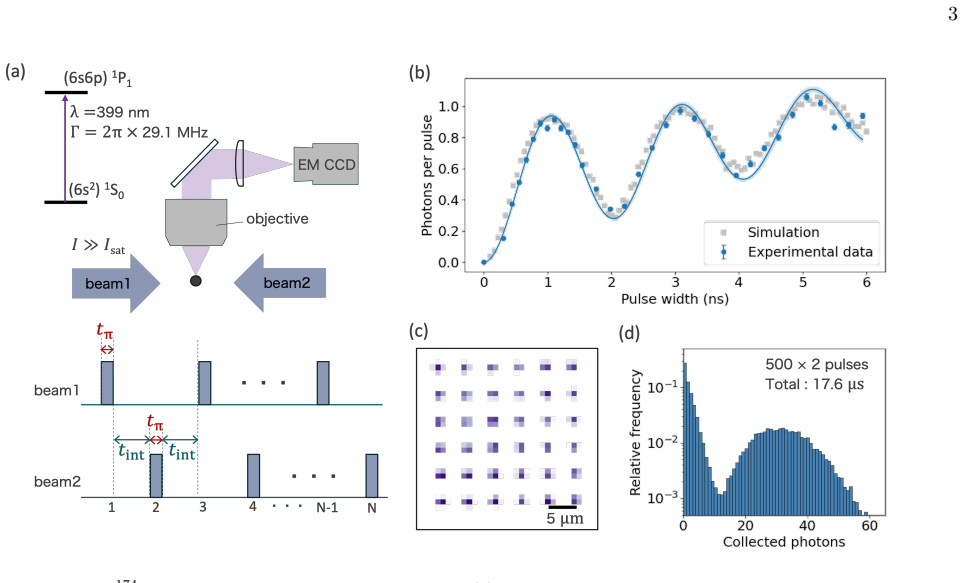
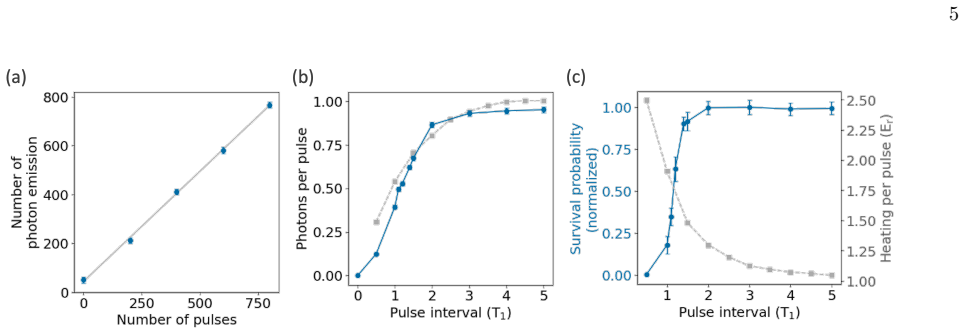
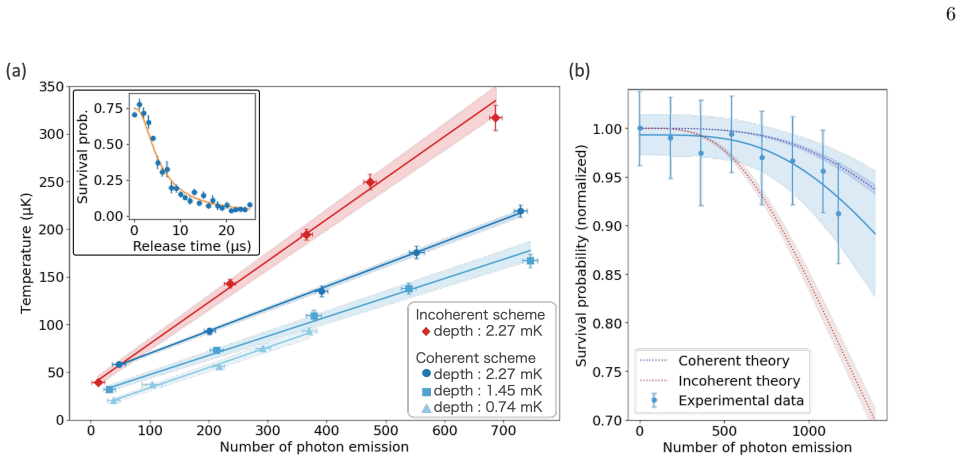
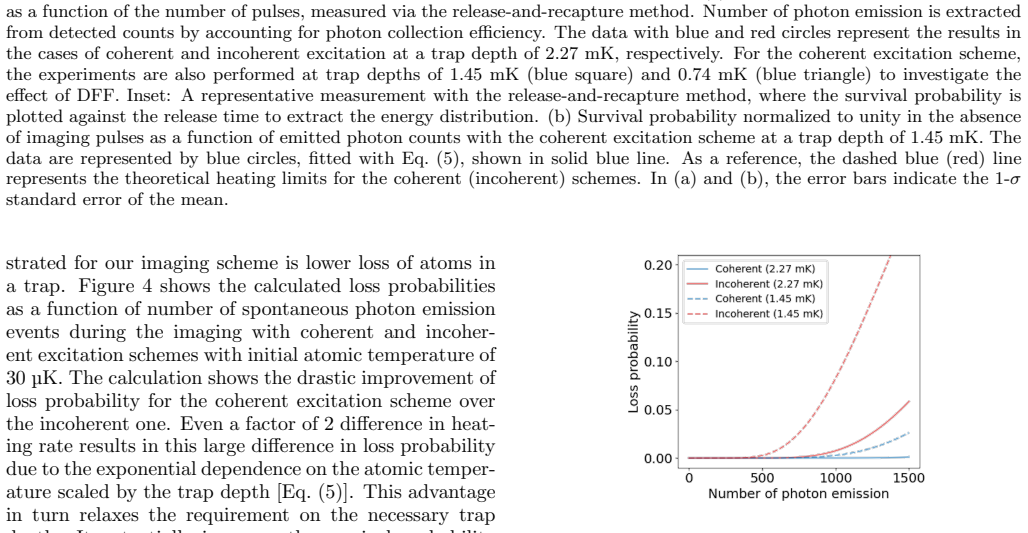
Using ytterbium-174 atoms trapped in an optical tweezer array, deterministic coherent excitation via alternately applied pi-pulses from counter-propagating directions yields single-atom imaging with 99.89(5) percent discrimination fidelity and 98.80(44) percent survival probability in 17.6 microseconds, together with a heating rate approximately half that obtained from incoherent excitation.
What carries the argument
Deterministic coherent excitation via alternately applied pi-pulses from counter-propagating directions, which replaces stochastic photon absorption and emission to reduce net recoil heating.
If this is right
- Imaging time can be shortened without raising atom loss, allowing more frequent readout in the same trap depth.
- Shallower traps become viable for large tweezer arrays because heating per image is lower.
- The same atoms can be imaged repeatedly with less cumulative disturbance to their motional state.
- The method extends directly to other atomic species that support coherent cycling transitions.
Where Pith is reading between the lines
- The halved heating rate may permit imaging while atoms remain in shallower traps that are easier to stabilize over large areas.
- Because the excitation is deterministic, the scheme could be synchronized with gate operations to reduce decoherence from position jitter.
- Lower per-image heating opens the possibility of non-destructive imaging sequences that preserve entanglement across multiple measurements.
Load-bearing premise
That alternately directed coherent pi-pulses will reliably suppress the random momentum transfer that occurs in ordinary absorption.
What would settle it
An experiment that measures the same or higher heating rate and lower survival probability when the alternating coherent pulses are used instead of standard incoherent illumination.
Figures
read the original abstract
Ultracold neutral atoms in an optical lattice and an optical tweezer array offer highly-controllable quantum many-body systems, utilized for various quantum science and technology such as quantum computing, quantum metrology, and quantum simulation. By combining high-fidelity imaging of individual atoms, one can further enhance the capability of such experimental platforms as quantum gas microscopes, tweezer clocks, and tweezer-array-based quantum computers. In this work, we propose a minimally destructive single-atom imaging by deterministic coherent excitation of atoms with alternately applied pi-pulses from counter-propagating directions, mitigating the fundamental heating effect associated with the stochastic absorption process. Using ytterbium-174 atoms trapped in an optical tweezer array, we experimentally demonstrate fast and low-loss single-atom imaging with a discrimination fidelity of 99.89(5) % and a survival probability of 98.80(44) % in 17.6 microseconds. Importantly, our scheme exhibits the lower heating rate, about half of that of the former scheme utilizing the incoherent excitation. This fast and minimally destructive imaging scheme is beneficial for relaxing the requirement on the trap depth, thereby enabling scalable atom imaging across a wide range of quantum science platforms.
Editorial analysis
A structured set of objections, weighed in public.
Referee Report
Summary. The manuscript proposes and experimentally demonstrates a minimally destructive single-atom imaging technique for ytterbium-174 atoms in an optical tweezer array. The method relies on deterministic coherent excitation using alternately applied π-pulses from counter-propagating beams to reduce recoil heating relative to stochastic incoherent excitation. Reported performance includes a discrimination fidelity of 99.89(5)% and survival probability of 98.80(44)% achieved in 17.6 μs, with the heating rate stated to be approximately half that of prior incoherent schemes.
Significance. If the factor-of-two heating reduction is robustly verified, the approach would relax trap-depth requirements and improve scalability for atom-array platforms in quantum computing, metrology, and simulation. The combination of sub-20 μs imaging time with high fidelity and survival is a practical advance over existing methods.
major comments (2)
- [Abstract and results on heating comparison] The central claim that the coherent scheme yields a heating rate 'about half' that of the incoherent scheme (abstract) is load-bearing for the paper's novelty and for the assertion of mitigated stochastic absorption. No quantitative details are supplied on the heating-rate extraction procedure, the data or figures used for the comparison, the number of experimental repetitions, or the uncertainty on the reported factor of two.
- [Scheme proposal and experimental implementation] The assumption that alternately applied counter-propagating π-pulses produce reliable net-recoil cancellation (and thus the observed heating reduction) requires supporting evidence on pulse-area uniformity, beam counter-propagation alignment tolerance, and phase stability. Without such checks, residual random-walk heating cannot be ruled out at the level needed to substantiate the factor-of-two improvement.
minor comments (1)
- [Abstract] The parenthetical uncertainties on fidelity and survival are given without an explicit statement of whether they represent statistical or total error; adding this clarification would improve reproducibility.
Simulated Author's Rebuttal
We thank the referee for the careful reading of our manuscript and the constructive comments. Below we respond to each major comment and indicate the revisions we will make.
read point-by-point responses
-
Referee: [Abstract and results on heating comparison] The central claim that the coherent scheme yields a heating rate 'about half' that of the incoherent scheme (abstract) is load-bearing for the paper's novelty and for the assertion of mitigated stochastic absorption. No quantitative details are supplied on the heating-rate extraction procedure, the data or figures used for the comparison, the number of experimental repetitions, or the uncertainty on the reported factor of two.
Authors: We agree that quantitative details on the heating-rate comparison are required to substantiate the central claim. In the revised manuscript we will add a dedicated subsection describing the extraction procedure, including the temperature-measurement protocol, the number of repetitions (typically several hundred per data point), the linear-fit method used to obtain heating rates, and the resulting uncertainties. A supplementary figure will be included that directly compares temperature versus imaging time for the coherent and incoherent schemes, allowing independent verification of the reported factor-of-two reduction. revision: yes
-
Referee: [Scheme proposal and experimental implementation] The assumption that alternately applied counter-propagating π-pulses produce reliable net-recoil cancellation (and thus the observed heating reduction) requires supporting evidence on pulse-area uniformity, beam counter-propagation alignment tolerance, and phase stability. Without such checks, residual random-walk heating cannot be ruled out at the level needed to substantiate the factor-of-two improvement.
Authors: We acknowledge that explicit checks on the conditions for net-recoil cancellation strengthen the interpretation. In the revised manuscript we will add experimental data on pulse-area uniformity obtained from Rabi-oscillation measurements, a characterization of alignment tolerance by controlled beam-offset scans and the resulting heating rates, and a description of the active phase-stabilization system together with an estimate of residual phase noise over the 17.6 μs imaging window. These additions will demonstrate that residual stochastic recoil is negligible at the level needed to support the observed heating reduction. revision: yes
Circularity Check
No circularity: experimental demonstration with direct measurements
full rationale
This is an experimental paper reporting measured performance metrics (fidelity 99.89(5)%, survival 98.80(44)%, heating rate comparison) for a proposed imaging scheme. No derivation chain, equations, or fitted parameters are presented that reduce results to inputs by construction. The heating-rate claim is an empirical comparison to prior work, not a self-referential prediction. No self-citations are load-bearing for the central results, and the paper is self-contained against external benchmarks as a direct experimental validation.
Axiom & Free-Parameter Ledger
axioms (1)
- domain assumption Coherent pi-pulses applied alternately from counter-propagating directions mitigate heating from stochastic photon absorption in trapped atoms.
Reference graph
Works this paper leans on
-
[1]
W. S. Bakr, J. I. Gillen, A. Peng, S. F¨ olling, and M. Greiner, A quantum gas microscope for detecting sin- gle atoms in a hubbard-regime optical lattice, Nature 462, 74 (2009)
2009
-
[2]
Sherson, C
J. Sherson, C. Weitenberg, M. Endres, M. Cheneau, I. Bloch, and S. Kuhr, Single-atom-resolved fluorescence imaging of an atomic mott insulator, Nature467, 68 (2010)
2010
-
[3]
Gross and W
C. Gross and W. S. Bakr, Quantum gas microscopy for single atom and spin detection, Nature Physics17, 1316 (2021)
2021
-
[4]
H. Kim, W. Lee, H.-g. Lee, H. Jo, Y. Song, and J. Ahn, In situ single-atom array synthesis using dynamic holo- graphic optical tweezers, Nature Communications7, 13317 (2016)
2016
-
[5]
Barredo, S
D. Barredo, S. de L´ es´ eleuc, V. Lienhard, T. Lahaye, and A. Browaeys, An atom-by-atom assembler of defect-free arbitrary two-dimensional atomic arrays, Science354, 1021 (2016)
2016
-
[6]
Endres, H
M. Endres, H. Bernien, A. Keesling, H. Levine, E. R. Anschuetz, A. Krajenbrink, C. Senko, V. Vuletic, M. Greiner, and M. D. Lukin, Atom-by-atom assembly of defect-free one-dimensional cold atom arrays, Science 354, 1024 (2016)
2016
-
[7]
A. M. Kaufman and K.-K. Ni, Quantum science with optical tweezer arrays of ultracold atoms and molecules, Nature Physics17, 1324 (2021)
2021
-
[8]
Saffman, T
M. Saffman, T. G. Walker, and K. Mølmer, Quantum information with rydberg atoms, Rev. Mod. Phys.82, 2313 (2010)
2010
-
[9]
Saffman, Quantum computing with atomic qubits and rydberg interactions: progress and challenges, Journal of Physics B: Atomic, Molecular and Optical Physics49, 202001 (2016)
M. Saffman, Quantum computing with atomic qubits and rydberg interactions: progress and challenges, Journal of Physics B: Atomic, Molecular and Optical Physics49, 202001 (2016)
2016
-
[10]
Henriet, L
L. Henriet, L. Beguin, A. Signoles, T. Lahaye, A. Browaeys, G.-O. Reymond, and C. Jurczak, Quantum computing with neutral atoms, Quantum4, 327 (2020)
2020
-
[11]
Wintersperger, F
K. Wintersperger, F. Dommert, T. Ehmer, A. Hour- sanov, J. Klepsch, W. Mauerer, G. Reuber, T. Strohm, M. Yin, and S. Luber, Neutral atom quantum computing hardware: performance and end-user perspective, EPJ Quantum Technol.10(2023)
2023
-
[12]
M. Saffman, Quantum computing with atomic qubit arrays: confronting the cost of connectivity (2025), arXiv:2505.11218 [quant-ph]
-
[13]
I. S. Madjarov, A. Cooper, A. L. Shaw, J. P. Covey, V. Schkolnik, T. H. Yoon, J. R. Williams, and M. Endres, An atomic-array optical clock with single-atom readout, Phys. Rev. X9, 041052 (2019)
2019
-
[14]
M. A. Norcia, A. W. Young, W. J. Eckner, E. Oelker, J. Ye, and A. M. Kaufman, Seconds-scale coherence on an optical clock transition in a tweezer array, Science 366, 93 (2019)
2019
-
[15]
Finkelstein, R
R. Finkelstein, R. B. S. Tsai, X. Sun, N. Schine, and M. Endres, Universal quantum operations and ancilla- based read-out for tweezer clocks, Nature634, 321 (2024)
2024
-
[16]
R. Kaubruegger and A. M. Kaufman, Progress in quan- tum metrology and applications for optical atomic clocks (2025), arXiv:2512.02202 [quant-ph]
-
[17]
Bloch, J
I. Bloch, J. Dalibard, and S. Nascimb` ene, Quantum sim- ulations with ultracold quantum gases, Nature Physics 8, 267–276 (2012)
2012
-
[18]
Gross and I
C. Gross and I. Bloch, Quantum simulations with ultra- cold atoms in optical lattices, Science357, 995 (2017)
2017
-
[19]
Sch¨ afer, T
F. Sch¨ afer, T. Fukuhara, S. Sugawa, Y. Takasu, and Y. Takahashi, Tools for quantum simulation with ultra- cold atoms in optical lattices, Nature Reviews Physics2, 411–425 (2020)
2020
-
[20]
Browaeys and T
A. Browaeys and T. Lahaye, Many-body physics with in- dividually controlled rydberg atoms, Nature Physics16, 132–142 (2020)
2020
-
[21]
Ott, Single atom detection in ultracold quantum gases: a review of current progress, Reports on Progress in Physics79, 054401 (2016)
H. Ott, Single atom detection in ultracold quantum gases: a review of current progress, Reports on Progress in Physics79, 054401 (2016)
2016
-
[22]
J. P. Covey, I. S. Madjarov, A. Cooper, and M. En- dres, 2000-times repeated imaging of strontium atoms in clock-magic tweezer arrays, Phys. Rev. Lett.122, 173201 (2019)
2000
-
[23]
H. Zhou, C. Duckering, C. Zhao, D. Bluvstein, M. Cain, A. Kubica, S.-T. Wang, and M. D. Lukin, Resource anal- ysis of low-overhead transversal architectures for recon- figurable atom arrays, inProceedings of the 52nd An- nual International Symposium on Computer Architec- ture, SIGARCH ’25 (ACM, 2025) p. 1432–1448
2025
- [24]
-
[25]
P. Webster, L. Berent, O. Chandra, E. T. Hockings, N. Baspin, F. Thomsen, S. C. Smith, and L. Z. Cohen, The pinnacle architecture: Reducing the cost of breaking rsa-2048 to 100 000 physical qubits using quantum ldpc codes (2026), arXiv:2602.11457 [quant-ph]
work page internal anchor Pith review Pith/arXiv arXiv 2048
-
[26]
M. Cain, Q. Xu, R. King, L. R. B. Picard, H. Levine, M. Endres, J. Preskill, H.-Y. Huang, and D. Bluvstein, Shor’s algorithm is possible with as few as 10,000 recon- figurable atomic qubits (2026), arXiv:2603.28627 [quant- ph]
work page internal anchor Pith review Pith/arXiv arXiv 2026
-
[27]
Factoring $2048$ bit RSA integers with a half-million-qubit modular atomic processor
T. Xue and J. P. Covey, Factoring 2048 bit rsa inte- gers with a half-million-qubit modular atomic processor 12 (2026), arXiv:2605.03951 [quant-ph]
work page internal anchor Pith review Pith/arXiv arXiv 2048
-
[28]
Miranda, R
M. Miranda, R. Inoue, Y. Okuyama, A. Nakamoto, and M. Kozuma, Site-resolved imaging of ytterbium atoms in a two-dimensional optical lattice, Phys. Rev. A91, 063414 (2015)
2015
-
[29]
L. Su, A. Douglas, M. Szurek, A. H. H´ ebert, A. Krahn, R. Groth, G. A. Phelps, O. Markovi´ c, and M. Greiner, Fast single atom imaging for optical lattice arrays, Nature Communications16, 1017 (2025)
2025
-
[30]
Muzi Falconi, R
A. Muzi Falconi, R. Panza, S. Sbernardori, R. Forti, R. Klemt, O. Abdel Karim, M. Marinelli, and F. Scazza, Microsecond-scale high-survival and number-resolved de- tection of ytterbium atom arrays, Phys. Rev. Lett.135, 203402 (2025)
2025
-
[31]
J. R. Schaibley, A. P. Burgers, G. A. McCracken, D. G. Steel, A. S. Bracker, D. Gammon, and L. J. Sham, Di- rect detection of time-resolved rabi oscillations in a sin- gle quantum dot via resonance fluorescence, Phys. Rev. B87, 115311 (2013)
2013
-
[32]
Johansson, P
J. Johansson, P. Nation, and F. Nori, Qutip 2: A python framework for the dynamics of open quan- tum systems, Computer Physics Communications184, 1234–1240 (2013)
2013
-
[33]
M. A. Norcia, A. W. Young, and A. M. Kaufman, Mi- croscopic control and detection of ultracold strontium in optical-tweezer arrays, Phys. Rev. X8, 041054 (2018)
2018
-
[34]
Holman, Y
A. Holman, Y. Xu, X. Sun, J. Wu, M. Wang, Z. Zhu, B. Seo, N. Yu, and S. Will, Trapping of single atoms in metasurface optical tweezer arrays, Nature649, 859–865 (2026)
2026
-
[35]
Bergschneider, V
A. Bergschneider, V. M. Klinkhamer, J. H. b. Becher, R. Klemt, G. Z¨ urn, P. M. Preiss, and S. Jochim, Spin- resolved single-atom imaging of 6Li in free space, Phys. Rev. A97, 063613 (2018)
2018
-
[36]
This behavior is likely attributed to the mitigation of excess atom loss during the subsequent imaging phase following the release-and- recapture sequence
We note that the measured temperature exhibits a de- pendence on the cooling applied after the recapture pro- cess; specifically, the inclusion of this post-cooling leads to a lower temperature evaluation. This behavior is likely attributed to the mitigation of excess atom loss during the subsequent imaging phase following the release-and- recapture seque...
-
[37]
Martinez-Dorantes, W
M. Martinez-Dorantes, W. Alt, J. Gallego, S. Ghosh, L. Ratschbacher, and D. Meschede, State-dependent flu- orescence of neutral atoms in optical potentials, Phys. Rev. A97, 023410 (2018)
2018
-
[38]
Tuchendler, A
C. Tuchendler, A. M. Lance, A. Browaeys, Y. R. P. Sor- tais, and P. Grangier, Energy distribution and cooling of a single atom in an optical tweezer, Phys. Rev. A78, 033425 (2008)
2008
-
[39]
Ang’ong’a, C
J. Ang’ong’a, C. Huang, J. P. Covey, and B. Gadway, Gray molasses cooling of 39K atoms in optical tweezers, Phys. Rev. Research4, 013240 (2022)
2022
-
[40]
W. Alt, D. Schrader, S. Kuhr, M. M¨ uller, V. Gomer, and D. Meschede, Single atoms in a standing-wave dipole trap, Phys. Rev. A67, 033403 (2003)
2003
-
[41]
J. E. Golub, Y. S. Bai, and T. W. Mossberg, Radia- tive and dynamical properties of homogeneously pre- pared atomic samples, Phys. Rev. A37, 119 (1988)
1988
-
[42]
Nakamura, T
Y. Nakamura, T. Kusano, R. Yokoyama, K. Saito, K. Hi- gashi, N. Ozawa, T. Takano, Y. Takasu, and Y. Taka- hashi, Hybrid atom tweezer array of nuclear spin and optical clock qubits, Phys. Rev. X14, 041062 (2024)
2024
discussion (0)
Sign in with ORCID, Apple, or X to comment. Anyone can read and Pith papers without signing in.