Huge ultrafast spin Seebeck effect mediated by laser-excited superdiffusive magnon currents
Pith reviewed 2026-05-21 03:16 UTC · model grok-4.3
The pith
Laser excitation in iron films generates a huge ultrafast spin Seebeck effect through superdiffusive magnon currents.
A machine-rendered reading of the paper's core claim, the machinery that carries it, and where it could break.
Core claim
The model predicts an ultrafast spin Seebeck effect, characterized by a strong burst of fast-moving magnonic spin current reaching technologically relevant amplitudes. Furthermore, we identify a superdiffusive transport regime: a crossover from initially ballistic magnon transport to a diffusive regime at later times. To connect our theoretical predictions to experimentally accessible observables, we calculate the magneto-optical Kerr angles resulting from the predicted depth-resolved magnetization profiles.
What carries the argument
Quantum Boltzmann equation with ab initio scattering parameters, which tracks nonthermal magnon scattering and transport dynamics in the film.
If this is right
- The calculated depth-resolved magnetization profiles produce specific magneto-optical Kerr angles that can be directly compared with pump-probe experiments.
- The superdiffusive crossover explains why standard diffusion equations fail to describe early-time spin transport after laser excitation.
- The framework supplies a parameter-free route to simulate ultrafast nonthermal magnon currents beyond phenomenological models.
- Predicted magnonic spin currents reach amplitudes relevant for designing ultrafast spintronic devices.
Where Pith is reading between the lines
- If the ballistic-to-diffusive crossover holds, similar laser-driven magnon currents may appear in other ferromagnets once their scattering rates are computed ab initio.
- The approach could be extended to include electron-magnon and phonon-magnon coupling strengths that vary with film thickness or interface quality.
- Experimental mapping of the spin-current burst duration versus laser fluence would test whether the transport regime shift depends on the initial nonequilibrium population.
Load-bearing premise
The quantum Boltzmann equation with the chosen ab initio scattering parameters is assumed to capture the essential nonthermal magnon scattering and transport dynamics on subpicosecond timescales without missing dominant channels or requiring additional phenomenological terms.
What would settle it
Time-resolved measurements on bcc Fe films that show no strong burst of magnonic spin current or no initial ballistic transport phase before diffusion would falsify the predicted ultrafast spin Seebeck effect and superdiffusive regime.
Figures


read the original abstract
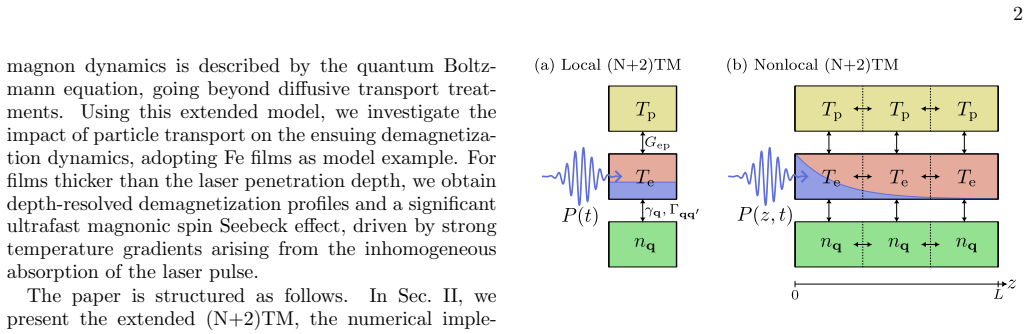
Subpicosecond laser excitation of ferromagnetic metals induces strongly nonequilibrium dynamics involving scattering and transport of electrons, phonons, and magnons. Widely used theoretical approaches, such as the three-temperature model and diffusion equations, are ill-suited to capture these processes on ultrafast timescales. Here, we present an ab initio-parameterized microscopic framework that incorporates nonthermal magnon scattering and transport via the quantum Boltzmann equation. We apply this approach to simulate ultrafast laser-induced demagnetization in bcc Fe films. The model predicts an ultrafast spin Seebeck effect, characterized by a strong burst of fast-moving magnonic spin current reaching technologically relevant amplitudes. Furthermore, we identify a superdiffusive transport regime: a crossover from initially ballistic magnon transport to a diffusive regime at later times. To connect our theoretical predictions to experimentally accessible observables, we calculate the magneto-optical Kerr angles resulting from the predicted depth-resolved magnetization profiles. Our framework provides a route to describe ultrafast nonthermal magnon transport beyond diffusive models and will aid in the design and interpretation of time-resolved spin-transport experiments.
Editorial analysis
A structured set of objections, weighed in public.
Referee Report
Summary. The manuscript develops an ab initio-parameterized microscopic framework based on the quantum Boltzmann equation to describe nonthermal magnon scattering and transport following subpicosecond laser excitation of ferromagnetic metals. Applied to bcc Fe films, the model predicts a strong ultrafast spin Seebeck effect arising from a burst of fast-moving magnonic spin current with technologically relevant amplitudes, identifies a superdiffusive regime featuring an initial ballistic-to-diffusive crossover in magnon transport, and computes the resulting depth-resolved magneto-optical Kerr angles as an experimentally accessible observable.
Significance. If the predictions are robust, the work represents a meaningful step beyond the three-temperature model and diffusive approximations by providing a microscopic treatment of nonthermal magnon dynamics grounded in ab initio scattering parameters. The explicit identification of superdiffusive transport and the link to Kerr-effect observables could aid interpretation of time-resolved spin-transport experiments and inform spintronic applications. The ab initio parameterization and avoidance of direct fitting to the target spin-current amplitude are notable strengths.
major comments (1)
- [Model description / quantum Boltzmann equation] Model section (quantum Boltzmann equation implementation): the collision integrals are described as incorporating nonthermal magnon scattering via ab initio-parameterized rates, yet the treatment appears to focus on phonon and impurity channels. On sub-100-fs timescales in ferromagnetic metals, electron-magnon scattering and Stoner excitations are typically dominant for demagnetization; if these are not included as explicit momentum- and energy-dependent terms (or are reduced to effective lifetimes), the quantitative amplitude of the predicted magnonic spin current and the timing of the ballistic-diffusive crossover can be affected. This point is load-bearing for the central claim of a 'huge' ultrafast spin Seebeck effect.
minor comments (2)
- [Results / figures] Figure captions and axis labels in the results section would benefit from explicit annotation of the time window corresponding to the ballistic regime versus the onset of diffusion to make the superdiffusive crossover more immediately visible.
- [Methods] The abstract states that the framework is 'ab initio-parameterized' without direct fitting; a brief statement in the methods confirming that no adjustable parameters were tuned to the final spin-current amplitude would strengthen this claim.
Simulated Author's Rebuttal
We thank the referee for the positive evaluation of our work and for the constructive feedback on the model implementation. We address the major comment below and have revised the manuscript to improve clarity on the treatment of scattering channels.
read point-by-point responses
-
Referee: Model section (quantum Boltzmann equation implementation): the collision integrals are described as incorporating nonthermal magnon scattering via ab initio-parameterized rates, yet the treatment appears to focus on phonon and impurity channels. On sub-100-fs timescales in ferromagnetic metals, electron-magnon scattering and Stoner excitations are typically dominant for demagnetization; if these are not included as explicit momentum- and energy-dependent terms (or are reduced to effective lifetimes), the quantitative amplitude of the predicted magnonic spin current and the timing of the ballistic-diffusive crossover can be affected. This point is load-bearing for the central claim of a 'huge' ultrafast spin Seebeck effect.
Authors: We appreciate the referee drawing attention to this point. Our quantum Boltzmann equation framework for magnons uses ab initio-parameterized collision integrals that focus on phonon and impurity scattering channels because these dominate magnon transport and relaxation following the initial excitation. The generation of the nonthermal magnon population itself incorporates electron-magnon scattering and Stoner excitations through the initial distribution function and source terms, which are parameterized from separate ab initio electron dynamics calculations. To address the concern explicitly, we have revised the model section to clarify the separation between magnon generation (including electron-magnon and Stoner processes via effective momentum-dependent rates) and subsequent transport. We have also added a brief analysis showing that variations in the effective lifetimes do not qualitatively alter the superdiffusive crossover or the order of magnitude of the spin current. These changes strengthen the presentation without changing the central predictions. revision: yes
Circularity Check
No circularity: predictions emerge from ab initio QBE solution
full rationale
The framework solves the quantum Boltzmann equation with ab initio scattering parameters to obtain depth-resolved magnetization and spin current profiles. The ultrafast spin Seebeck burst and ballistic-to-diffusive crossover are direct numerical outputs of that integration, not quantities defined in terms of themselves or obtained by fitting to the target amplitudes. No self-citation chain, ansatz smuggling, or renaming of known results is required for the central claims. The derivation therefore remains self-contained against external ab initio inputs and is not forced by construction.
Axiom & Free-Parameter Ledger
free parameters (1)
- ab initio scattering parameters
axioms (1)
- domain assumption The quantum Boltzmann equation sufficiently describes nonthermal magnon scattering and transport on subpicosecond timescales.
Lean theorems connected to this paper
-
IndisputableMonolith/Cost/FunctionalEquation.leanwashburn_uniqueness_aczel unclear?
unclearRelation between the paper passage and the cited Recognition theorem.
quantum Boltzmann equation ... ˙nq =−vq ∂nq/∂z + sq({nq},Te) ... crossover from initially ballistic magnon transport to a diffusive regime
-
IndisputableMonolith/Foundation/RealityFromDistinction.leanreality_from_one_distinction unclear?
unclearRelation between the paper passage and the cited Recognition theorem.
ab initio-parameterized microscopic framework ... parameters ... from first principles
What do these tags mean?
- matches
- The paper's claim is directly supported by a theorem in the formal canon.
- supports
- The theorem supports part of the paper's argument, but the paper may add assumptions or extra steps.
- extends
- The paper goes beyond the formal theorem; the theorem is a base layer rather than the whole result.
- uses
- The paper appears to rely on the theorem as machinery.
- contradicts
- The paper's claim conflicts with a theorem or certificate in the canon.
- unclear
- Pith found a possible connection, but the passage is too broad, indirect, or ambiguous to say the theorem truly supports the claim.
Reference graph
Works this paper leans on
-
[1]
E. Beaurepaire, J.-C. Merle, A. Daunois, and J.-Y. Bigot, Ultrafast spin dynamics in ferromagnetic nickel, Phys. Rev. Lett.76, 4250 (1996)
work page 1996
-
[2]
A. Kirilyuk, A. V. Kimel, and T. Rasing, Ultrafast op- tical manipulation of magnetic order, Rev. Mod. Phys. 82, 2731 (2010). 14
work page 2010
- [3]
-
[4]
X. Chen, R. Adam, D. E. B¨ urgler, F. Wang, Z. Lu, L. Pan, S. Heidtfeld, C. Greb, M. Liu, Q. Liu, J. Wang, C. M. Schneider, and D. Cao, Ultrafast demagnetization in ferromagnetic materials: Origins and progress, Phys. Rep.1102, 1 (2025)
work page 2025
- [5]
-
[7]
A. B. Schmidt, M. Pickel, M. Donath, P. Buczek, A. Ernst, V. P. Zhukov, P. M. Echenique, L. M. San- dratskii, E. V. Chulkov, and M. Weinelt, Ultrafast Magnon Generation in an Fe Film on Cu(100), Phys. Rev. Lett.105, 197401 (2010)
work page 2010
-
[8]
E. Carpene, H. Hedayat, F. Boschini, and C. Dallera, Ultrafast demagnetization of metals: Collapsed ex- change versus collective excitations, Phys. Rev. B91, 174414 (2015)
work page 2015
-
[9]
E. Turgut, D. Zusin, D. Legut, K. Carva, R. Knut, J. M. Shaw, C. Chen, Z. Tao, H. T. Nembach, T. J. Silva, S. Mathias, M. Aeschlimann, P. M. Oppeneer, H. C. Kapteyn, M. M. Murnane, and P. Grychtol, Stoner versus Heisenberg: Ultrafast exchange reduction and magnon generation during laser-induced demagnetiza- tion, Phys. Rev. B94, 220408 (2016)
work page 2016
-
[10]
S. Eich, M. Pl¨ otzing, M. Rollinger, S. Emmerich, R. Adam, C. Chen, H. C. Kapteyn, M. M. Murnane, L. Plucinski, D. Steil, B. Stadtm¨ uller, M. Cinchetti, M. Aeschlimann, C. M. Schneider, and S. Mathias, Band structure evolution during the ultrafast ferromagnetic- paramagnetic phase transition in cobalt, Sci. Adv.3, e1602094 (2017)
work page 2017
-
[11]
K. Yamamoto, Y. Kubota, M. Suzuki, Y. Hirata, K. Carva, M. Berritta, K. Takubo, Y. Uemura, R. Fukaya, K. Tanaka, W. Nishimura, T. Ohkochi, T. Katayama, T. Togashi, K. Tamasaku, M. Yabashi, Y. Tanaka, T. Seki, K. Takanashi, P. M. Oppeneer, and H. Wadati, Ultrafast demagnetization of Pt mag- netic moment in L10-FePt probed by magnetic circular dichroism at ...
work page 2019
-
[12]
B. Frietsch, A. Donges, R. Carley, M. Teichmann, J. Bowlan, K. D¨ obrich, K. Carva, D. Legut, P. M. Oppe- neer, U. Nowak, and M. Weinelt, The role of ultrafast magnon generation in the magnetization dynamics of rare-earth metals, Sci. Adv.6, eabb1601 (2020)
work page 2020
-
[13]
H.-S. Rhie, H. A. D¨ urr, and W. Eberhardt, Femtosecond electron and spin dynamics in Ni/W(110) films, Phys. Rev. Lett.90, 247201 (2003)
work page 2003
-
[14]
M. Cinchetti, M. S´ anchez Albaneda, D. Hoffmann, T. Roth, J.-P. W¨ ustenberg, M. Krauß, O. Andreyev, H. C. Schneider, M. Bauer, and M. Aeschlimann, Spin- flip processes and ultrafast magnetization dynamics in Co: Unifying the microscopic and macroscopic view of femtosecond magnetism, Phys. Rev. Lett.97, 177201 (2006)
work page 2006
-
[15]
B. Koopmans, G. Malinowski, F. Dalla Longa, D. Steiauf, M. F¨ ahnle, T. Roth, M. Cinchetti, and M. Aeschlimann, Explaining the paradoxical diversity of ultrafast laser-induced demagnetization, Nature Mater. 9, 259 (2010)
work page 2010
-
[16]
A. J. Schellekens and B. Koopmans, Comparing ultra- fast demagnetization rates between competing models for finite temperature magnetism, Phys. Rev. Lett.110, 217204 (2013)
work page 2013
-
[17]
T. Griepe and U. Atxitia, Evidence of electron-phonon mediated spin flip as driving mechanism for ultrafast magnetization dynamics in 3dferromagnets, Phys. Rev. B107, L100407 (2023)
work page 2023
-
[18]
M. Battiato, K. Carva, and P. M. Oppeneer, Superdiffu- sive spin transport as a mechanism of ultrafast demag- netization, Phys. Rev. Lett.105, 027203 (2010)
work page 2010
-
[19]
M. Battiato, K. Carva, and P. M. Oppeneer, Theory of laser-induced ultrafast superdiffusive spin transport in layered heterostructures, Phys. Rev. B86, 024404 (2012)
work page 2012
-
[20]
G. Malinowski, F. Dalla Longa, J. H. H. Rietjens, P. V. Paluskar, R. Huijink, H. J. M. Swagten, and B. Koop- mans, Control of speed and efficiency of ultrafast de- magnetization by direct transfer of spin angular mo- mentum, Nature Phys.4, 855 (2008)
work page 2008
-
[21]
D. Rudolf, C. La-O-Vorakiat, M. Battiato, R. Adam, J. M. Shaw, E. Turgut, P. Maldonado, S. Mathias, P. Grychtol, H. T. Nembach, T. J. Silva, M. Aeschli- mann, H. C. Kapteyn, M. M. Murnane, C. M. Schnei- der, and P. M. Oppeneer, Ultrafast magnetization en- hancement in metallic multilayers driven by superdiffu- sive spin current, Nature Commun.3, 1037 (2012)
work page 2012
-
[22]
N. Bergeard, M. Hehn, S. Mangin, G. Lengaigne, F. Montaigne, M. L. M. Lalieu, B. Koopmans, and G. Malinowski, Hot-electron-induced ultrafast demag- netization in Co/Pt multilayers, Phys. Rev. Lett.117, 147203 (2016)
work page 2016
-
[23]
Y. Xu, M. Deb, G. Malinowski, M. Hehn, W. Zhao, and S. Mangin, Ultrafast magnetization manipulation using single femtosecond light and hot-electron pulses, Adv. Mater.29, 1703474 (2017)
work page 2017
-
[24]
M. Hofherr, P. Maldonado, O. Schmitt, M. Berritta, U. Bierbrauer, S. Sadashivaiah, A. J. Schellekens, B. Koopmans, D. Steil, M. Cinchetti, B. Stadtm¨ uller, P. M. Oppeneer, S. Mathias, and M. Aeschlimann, Speed and efficiency of femtosecond spin current in- jection into a nonmagnetic material, Phys. Rev. B96, 100403 (2017)
work page 2017
-
[25]
R. Gupta, F. Cosco, R. S. Malik, X. Chen, S. Saha, A. Ghosh, T. Pohlmann, J. R. L. Mardegan, S. Fran- coual, R. Stefanuik, J. S¨ oderstr¨ om, B. Sanyal, O. Karis, P. Svedlindh, P. M. Oppeneer, and R. Knut, Element- resolved evidence of superdiffusive spin current arising from ultrafast demagnetization process, Phys. Rev. B 108, 064427 (2023)
work page 2023
-
[26]
C. Dornes, Y. Acremann, M. Savoini, M. Kubli, M. J. Neugebauer, E. Abreu, L. Huber, G. Lantz, C. A. F. Vaz, H. Lemke, E. M. Bothschafter, M. Porer, V. Es- posito, L. Rettig, M. Buzzi, A. Alberca, Y. W. Windsor, P. Beaud, U. Staub, D. Zhu, S. Song, J. M. Glownia, and S. L. Johnson, The ultrafast Einstein–de Haas ef- fect, Nature565, 209 (2019)
work page 2019
-
[27]
S. R. Tauchert, M. Volkov, D. Ehberger, D. Kazenwadel, M. Evers, H. Lange, A. Donges, A. Book, W. Kreuz- 15 paintner, U. Nowak, and P. Baum, Polarized phonons carry angular momentum in ultrafast demagnetization, Nature602, 73 (2022)
work page 2022
-
[28]
C.-K. Sun, F. Vall´ ee, L. Acioli, E. P. Ippen, and J. G. Fujimoto, Femtosecond investigation of electron ther- malization in gold, Phys. Rev. B48, 12365 (1993)
work page 1993
-
[29]
C.-K. Sun, F. Vall´ ee, L. H. Acioli, E. P. Ippen, and J. G. Fujimoto, Femtosecond-tunable measurement of electron thermalization in gold, Phys. Rev. B50, 15337 (1994)
work page 1994
-
[30]
N. Del Fatti, R. Bouffanais, F. Vall´ ee, and C. Flytza- nis, Nonequilibrium electron interactions in metal films, Phys. Rev. Lett.81, 922 (1998)
work page 1998
-
[31]
N. Del Fatti, C. Voisin, M. Achermann, S. Tzortza- kis, D. Christofilos, and F. Vall´ ee, Nonequilibrium elec- tron dynamics in noble metals, Phys. Rev. B61, 16956 (2000)
work page 2000
-
[32]
C. Guo, G. Rodriguez, and A. J. Taylor, Ultrafast dy- namics of electron thermalization in gold, Phys. Rev. Lett.86, 1638 (2001)
work page 2001
-
[33]
Carpene, Ultrafast laser irradiation of metals: Be- yond the two-temperature model, Phys
E. Carpene, Ultrafast laser irradiation of metals: Be- yond the two-temperature model, Phys. Rev. B74, 024301 (2006)
work page 2006
-
[34]
B. Y. Mueller, A. Baral, S. Vollmar, M. Cinchetti, M. Aeschlimann, H. C. Schneider, and B. Rethfeld, Feedback effect during ultrafast demagnetization dy- namics in ferromagnets, Phys. Rev. Lett.111, 167204 (2013)
work page 2013
-
[35]
E. G. Tveten, A. Brataas, and Y. Tserkovnyak, Electron-magnon scattering in magnetic heterostruc- tures far out of equilibrium, Phys. Rev. B92, 180412 (2015)
work page 2015
-
[36]
P. Maldonado, K. Carva, M. Flammer, and P. M. Oppe- neer, Theory of out-of-equilibrium ultrafast relaxation dynamics in metals, Phys. Rev. B96, 174439 (2017)
work page 2017
-
[37]
P. Maldonado, T. Chase, A. H. Reid, X. Shen, R. K. Li, K. Carva, T. Payer, M. Horn von Hoegen, K. Sokolowski-Tinten, X. J. Wang, P. M. Oppeneer, and H. A. D¨ urr, Tracking the ultrafast nonequilibrium energy flow between electronic and lattice degrees of freedom in crystalline nickel, Phys. Rev. B101, 100302 (2020)
work page 2020
-
[38]
R. B. Wilson and S. Coh, Parametric dependence of hot electron relaxation timescales on electron-electron and electron-phonon interaction strengths, Commun. Phys. 3, 179 (2020)
work page 2020
-
[39]
U. Ritzmann, P. M. Oppeneer, and P. Maldonado, The- ory of out-of-equilibrium electron and phonon dynamics in metals after femtosecond laser excitation, Phys. Rev. B102, 214305 (2020)
work page 2020
- [40]
- [41]
-
[42]
V. Shokeen, M. Heber, D. Kutnyakhov, X. Wang, A. Yaroslavtsev, P. Maldonado, M. Berritta, N. Wind, L. Wenthaus, F. Pressacco, C.-H. Min, M. Nissen, S. K. Mahatha, S. Dziarzhytski, P. M. Oppeneer, K. Rossnagel, H.-J. Elmers, G. Sch¨ onhense, and H. A. D¨ urr, Real-time observation of non-equilibrium phonon- electron energy and angular momentum flow in lase...
work page 2024
-
[43]
M. Weißenhofer and P. M. Oppeneer, Ultrafast de- magnetization through femtosecond generation of non- thermal magnons, Adv. Phys. Res.4, 2300103 (2024)
work page 2024
-
[44]
P. Bal´ aˇ z, M.ˇZonda, K. Carva, P. Maldonado, and P. M. Oppeneer, Transport theory for femtosecond laser-induced spin-transfer torques, J. Phys.: Condens. Matter30, 115801 (2018)
work page 2018
-
[45]
P. Bal´ aˇ z, M. Zwierzycki, F. Cosco, K. Carva, P. Maldon- ado, and P. M. Oppeneer, Theory of superdiffusive spin transport in noncollinear magnetic multilayers, Phys. Rev. B107, 174418 (2023)
work page 2023
-
[46]
J. Xiao, G. E. W. Bauer, K.-c. Uchida, E. Saitoh, and S. Maekawa, Theory of magnon-driven spin Seebeck ef- fect, Phys. Rev. B81, 214418 (2010)
work page 2010
-
[47]
L. J. Cornelissen, K. J. H. Peters, G. E. W. Bauer, R. A. Duine, and B. J. van Wees, Magnon spin transport driven by the magnon chemical potential in a magnetic insulator, Phys. Rev. B94, 014412 (2016)
work page 2016
-
[48]
D. Zahn, F. Jakobs, Y. W. Windsor, H. Seiler, T. Vasileiadis, T. A. Butcher, Y. Qi, D. Engel, U. Atxi- tia, J. Vorberger, and R. Ernstorfer, Lattice dynamics and ultrafast energy flow between electrons, spins, and phonons in a 3d ferromagnet, Phys. Rev. Res.3, 023032 (2021)
work page 2021
-
[49]
D. Zahn, F. Jakobs, H. Seiler, T. A. Butcher, D. Engel, J. Vorberger, U. Atxitia, Y. W. Windsor, and R. Ern- storfer, Intrinsic energy flow in laser-excited 3dferro- magnets, Phys. Rev. Res.4, 013104 (2022)
work page 2022
-
[50]
Zener, Interaction between thedshells in the transi- tion metals, Phys
C. Zener, Interaction between thedshells in the transi- tion metals, Phys. Rev.81, 440 (1951)
work page 1951
-
[51]
Zener, Interaction between thed-Shells in the Tran- sition Metals
C. Zener, Interaction between thed-Shells in the Tran- sition Metals. III. Calculation of the Weiss Factors in Fe, Co, and Ni, Phys. Rev.83, 299 (1951)
work page 1951
-
[52]
A. H. Mitchell, Ferromagnetic relaxation by the ex- change interaction between ferromagnetic electrons and conduction electrons, Phys. Rev.105, 1439 (1957)
work page 1957
-
[53]
B. Heinrich, D. Fraitov´ a, and V. Kambersk´ y, The influ- ence of s-d exchange on relaxation of magnons in metals, phys. status solidi (b)23, 501 (1967)
work page 1967
-
[54]
Y. Tserkovnyak, G. A. Fiete, and B. I. Halperin, Mean- field magnetization relaxation in conducting ferromag- nets, Appl. Phys. Lett.84, 5234 (2004)
work page 2004
-
[55]
S. Zhang and Z. Li, Roles of nonequilibrium conduction electrons on the magnetization dynamics of ferromag- nets, Phys. Rev. Lett.93, 127204 (2004)
work page 2004
-
[56]
A. Manchon, Q. Li, L. Xu, and S. Zhang, Theory of laser-induced demagnetization at high temperatures, Phys. Rev. B85, 064408 (2012)
work page 2012
- [57]
- [58]
-
[59]
Remy, Ultrafast magnetization reversal in ferromag- netic spin valves: Ans−dmodel perspective, Phys
Q. Remy, Ultrafast magnetization reversal in ferromag- netic spin valves: Ans−dmodel perspective, Phys. Rev. B107, 174431 (2023)
work page 2023
-
[60]
P. B. Allen, Theory of thermal relaxation of electrons in metals, Phys. Rev. Lett.59, 1460 (1987)
work page 1987
-
[61]
M. Aeschlimann, M. Bauer, S. Pawlik, W. Weber, R. Burgermeister, D. Oberli, and H. C. Siegmann, Ul- 16 trafast spin-dependent electron dynamics in fcc Co, Phys. Rev. Lett.79, 5158 (1997)
work page 1997
-
[62]
Nowak, Classical spin models, inHandbook of Mag- netism and Advanced Magnetic Materials, edited by H
U. Nowak, Classical spin models, inHandbook of Mag- netism and Advanced Magnetic Materials, edited by H. Kronm¨ uller and S. Parkin (John Wiley & Sons, 2007) Chap. Micromagnetism, pp. 858–876
work page 2007
-
[63]
N. Kazantseva, U. Nowak, R. W. Chantrell, J. Hohlfeld, and A. Rebei, Slow recovery of the magnetisation after a sub-picosecond heat pulse, Europhys. Lett.81, 27004 (2007)
work page 2007
-
[64]
T. A. Ostler, J. Barker, R. F. L. Evans, R. W. Chantrell, U. Atxitia, O. Chubykalo-Fesenko, S. El Moussaoui, L. Le Guyader, E. Mengotti, L. J. Heyderman, F. Nolt- ing, A. Tsukamoto, A. Itoh, D. Afanasiev, B. A. Ivanov, A. M. Kalashnikova, K. Vahaplar, J. Mentink, A. Kir- ilyuk, T. Rasing, and A. V. Kimel, Ultrafast heating as a sufficient stimulus for mag...
work page 2012
-
[65]
A. J. Schellekens, W. Verhoeven, T. N. Vader, and B. Koopmans, Investigating the contribution of su- perdiffusive transport to ultrafast demagnetization of ferromagnetic thin films, Appl. Phys. Lett.102, 252408 (2013)
work page 2013
- [66]
-
[67]
H. Qiu, O. Franke, Y. Tian, Z. Kaˇ spar, R. Rouzegar, O. Gueckstock, J. Wu, M. Zhu, B. Jin, Y. Xu, T. S. Seifert, D. Wu, P. W. Brouwer, and T. Kampfrath, Hall- marks of ballistic terahertz magnon currents in an an- tiferromagnetic insulator, Phys. Rev. Lett.135, 176703 (2025)
work page 2025
-
[68]
V. Chardonnet, M. Hennes, R. Jarrier, R. Delaunay, N. Jaouen, M. Kuhlmann, C. Leveill´ e, C. von Ko- rff Schmising, D. Schick, K. Yao, X. Liu, G. S. Chi- uzb˘ aian, J. L¨ uning, B. Vodungbo, and E. Jal, Depth- resolved magnetization dynamics in Fe thin films af- ter ultrafast laser excitation (2026), arXiv:2603.11913 [cond-mat.mtrl-sci]
-
[69]
E. A. Uehling and G. E. Uhlenbeck, Transport phenom- ena in Einstein-Bose and Fermi-Dirac gases. I, Phys. Rev.43, 552 (1933)
work page 1933
-
[70]
J.-J. Zhou, J. Park, I.-T. Lu, I. Maliyov, X. Tong, and M. Bernardi, Perturbo: A software package for ab ini- tio electron–phonon interactions, charge transport and ultrafast dynamics, Computer Physics Commun.264, 107970 (2021)
work page 2021
-
[71]
F. Caruso and D. Novko, Ultrafast dynamics of electrons and phonons: from the two-temperature model to the time-dependent Boltzmann equation, Adv. Phys.: X7, 2095925 (2022)
work page 2022
-
[72]
H. Lee, S. Ponc´ e, K. Bushick, S. Hajinazar, J. Lafuente- Bartolome, J. Leveillee, C. Lian, J.-M. Lihm, F. Macheda, H. Mori, H. Paudyal, W. H. Sio, S. Tiwari, M. Zacharias, X. Zhang, N. Bonini, E. Kioupakis, E. R. Margine, and F. Giustino, Electron–phonon physics from first principles using the EPW code, npj Comput. Mater.9, 156 (2023)
work page 2023
-
[73]
R. Haberman,Applied Partial Differential Equations with Fourier Series and Boundary Value Problems, 5th ed. (Pearson, 2012) p. 7
work page 2012
-
[74]
R. B. Wilson and D. G. Cahill, Anisotropic failure of Fourier theory in time-domain thermoreflectance exper- iments, Nature Commun.5, 5075 (2014)
work page 2014
-
[75]
C. S. Awsaf, S. Thakur, M. Weißenhofer, J. G¨ ordes, M. Walter, M.-A. Mawass, N. Pontius, C. Sch¨ ußler- Langeheine, P. M. Oppeneer, and W. Kuch, Element-selective probing of ultrafast ferromagnetic- antiferromagnetic order dynamics in Fe/CoO bilayers, Phys. Rev. Lett.136, 126705 (2026)
work page 2026
- [76]
-
[77]
Jeannin,pyGTM(2023), available athttps:// pygtm.readthedocs.io
M. Jeannin,pyGTM(2023), available athttps:// pygtm.readthedocs.io. Accessed: 2025-11-10
work page 2023
-
[78]
N. C. Passler and A. Paarmann, Generalized 4×4 ma- trix formalism for light propagation in anisotropic strat- ified media: study of surface phonon polaritons in polar dielectric heterostructures, J. Opt. Soc. Am. B34, 2128 (2017)
work page 2017
-
[79]
N. C. Passler and A. Paarmann, Generalized 4×4 ma- trix formalism for light propagation in anisotropic strat- ified media: study of surface phonon polaritons in polar dielectric heterostructures: erratum, J. Opt. Soc. Am. B36, 3246 (2019)
work page 2019
-
[80]
N. C. Passler, M. Jeannin, and A. Paarmann, Layer- resolved absorption of light in arbitrarily anisotropic heterostructures, Phys. Rev. B101, 165425 (2020)
work page 2020
-
[81]
R. J. LeVeque,Finite Difference Methods for Ordinary and Partial Differential Equations: Steady-State and Time-dependent Problems(Society for Industrial and Applied Mathematics, 2007)
work page 2007
discussion (0)
Sign in with ORCID, Apple, or X to comment. Anyone can read and Pith papers without signing in.