REVIEW 4 major objections 6 minor 37 references
Specialized LLM agents plus pheromone-style consensus can turn weak, distributed smart-city attack signals into stable collective threat decisions.
Reviewed by Pith at T0; open to challenge. T0 means a machine referee read the full paper against a public rubric. the ladder, T0–T4 →
T0 review · grok-4.5
2026-07-12 01:04 UTC pith:CCZSHALF
load-bearing objection Coherent multi-agent LLM packaging of ACO-style belief aggregation for smart-city security; empirics are real but partly by construction and do not fully stress the dual-impact adversary claim. the 4 major comments →
Swarm-Driven Multi-Agent Reasoning for Smart City Security
The pith
A machine-rendered reading of the paper's core claim, the machinery that carries it, and where it could break.
Core claim
The paper claims that decomposing smart-city security analysis into role-specialized LLM agents and aggregating their hypotheses with a pheromone-inspired consensus mechanism (TPSC, extended by AV-TPSC) produces stable, low-risk collective threat decisions even when evidence is incomplete, contradictory, or adversarially manipulated, outperforming both a monolithic LLM and multi-agent majority voting on consensus margin, risk, and accuracy metrics.
What carries the argument
Threat-Pheromone Swarm Consensus (TPSC): each agent deposits a pheromone signal proportional to confidence, evidence strength and urgency; the swarm reinforces consistent hypotheses, applies contradiction penalties, and evaporates stale belief over time so the highest-margin hypothesis is accepted; AV-TPSC further multiplies emission by verification quality and scales inhibition by inter-agent disagreement.
Load-bearing premise
The paper's own risk scores and sliding-window ToN-IoT scenarios are assumed to stand in for real multi-stage attacks that also corrupt the agents' reasoning inputs, while the coordination and verification modules themselves stay trusted.
What would settle it
Run the same multi-stage attack sequences with injected misleading logs, prompt injections, and corrupted telemetry against TPSC-Sec and the two baselines; if measured consensus margin collapses below ~1.3, aggregate risk rises above ~0.30, or true multi-stage detection accuracy falls to the majority-vote level, the stability claim fails.
Editorial analysis
A structured set of objections, weighed in public.
Referee Report
Summary. The paper proposes TPSC-Sec, an LLM multi-agent system for smart-city security that decomposes analysis into specialized agents (traffic, protocol, identity, temporal, planner) and aggregates their hypotheses via Threat-Pheromone Swarm Consensus (TPSC), an ACO-inspired belief update with reinforcement, contradiction inhibition, and temporal evaporation. Adaptive Verified TPSC (AV-TPSC) adds verification-aware calibration, context weighting, and disagreement-adaptive control. On ToN-IoT-derived sliding windows over 500 runs, the authors report high consensus acceptance (0.97±0.02), near-unity belief concentration, consensus margin 2.08±0.21, aggregate risk 0.23±0.04, Acc/F1 0.94/0.92, and gains over majority voting and a single-agent LLM, plus adaptive agent selection that halves active agents while improving fitness ~11.6%. The threat model emphasizes dual impact: adversaries that alter observables and fragment multi-agent belief.
Significance. If the evaluation truly instantiates dual-impact adversarial conditions and the stability/risk numbers track real detection under manipulated evidence, this would be a useful contribution at the intersection of multi-agent LLMs, swarm consensus, and CPS security: it reframes smart-city defense as collective semantic reasoning rather than isolated IDS classification, supplies explicit algorithms (Algorithms 1–3) and ablations (Tables XVI–XX), and reports multi-run statistics with confidence intervals. The dual-impact framing and verification-aware pheromone design are conceptually interesting for adversary-resilient multi-agent reasoning. Those strengths are currently limited by underspecified metrics and incomplete linkage between the threat model and the experimental protocol.
major comments (4)
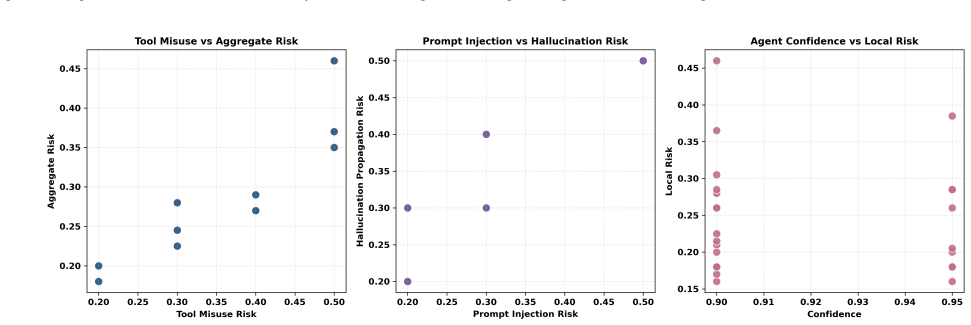
- [§VI.A, Table I] §V–VI and Tables I, VII, XV, XVIII: The headline claim of adversary-resilient reasoning rests on internal metrics (aggregate risk 0.23, prompt-injection/hallucination/tool-misuse risks, consensus margin, acceptance). The manuscript never defines how these risk scores are computed from Et, agent outputs zi, or verification scores vi. Without operational definitions, ground-truth mapping, and sensitivity analysis, the reported risk reductions cannot be independently interpreted or compared to standard security metrics.
- [§III, §V] §III (dual impact, belief fragmentation Ft, margin Δ̄t) vs §V experimental protocol: The threat model asserts adversaries that both alter telemetry and attack the reasoning path (misleading logs, prompt injection, contradictory evidence) while only coordination/verification remain trusted (§III.E). The evaluation describes ToN-IoT sliding windows and scenario-driven attack patterns (recon, DoS, protocol misuse, multi-stage) but does not specify how dual-impact attacks on agent beliefs are injected, labeled, or measured. If windows are ordinary IDS-style detection inputs, the stability numbers do not establish the dual-impact claim as stated.
- [§IV.B, Tables VII, XVIII, XX] §IV.B, pheromone update Pt+1(h)=(1−ρ)Pt(h)+ηΦt(h)−μΨt(h) and acceptance when Pt(h*)>τt: Near-unity belief concentration (>0.99), high acceptance (0.97), and large margins are partly attractors of this designed dynamics. Ablations vs majority voting help, but the paper should more clearly separate (i) external correctness (Acc/F1 against labeled multi-stage campaigns under adversarial evidence) from (ii) internal consensus stability, and report how often high-margin consensus is wrong under dual-impact inputs.
- [§V] §V Experimental Setup: Reproducibility is insufficient for a load-bearing multi-agent LLM claim. The LLM family/version, full role prompts, seeds, and numerical values of free parameters (ρ, η, μ, τ0, βi, αc/αe/αu, λ0, κ, ξi, ζ, ν, wi update rule) are not reported—only that parameters are “fixed” and temperature is 0.2. Without these, the 500-run results cannot be reproduced or stress-tested.
minor comments (6)
- [§I, §VII–IX] Section numbering jumps: after §VI Experimental Results comes §VII Comparison with Baselines, then §VIII Discussion; the introduction promised §VIII discussion and §IX limitations—align the outline with the body.
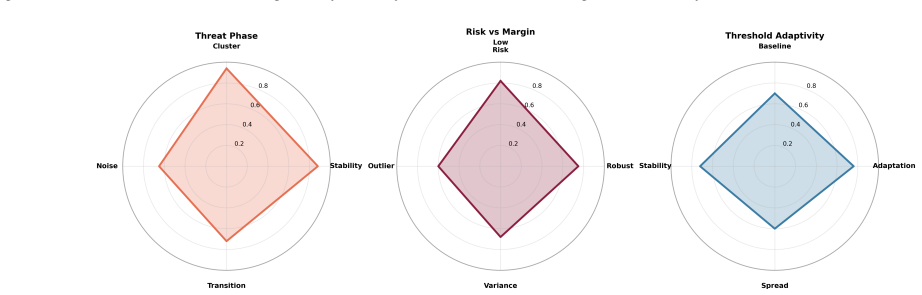
- [§VI figures] Several figures (2–14) are described only by captions; ensure axes, units, and run counts are legible and that “bimodal risk” claims in text are visible in Fig. 2.
- [§IV] Notation: both Pt(h) (pheromone) and Pt (protocol features in Et) appear; disambiguate. Similarly Φ vs ΦAV and S(h) vs Sglobal(t).
- [§II.D] Related work could more sharply contrast TPSC with reliability-weighted multi-LLM consensus (e.g., FAIR-Swarm [33]) on the security-specific contradiction and temporal-evaporation design rather than only domain difference.
- [Abstract, §I] Typos/style: “TPSC-Secformulates”, “A V-TPSC” spacing, “Montr ´eal”, and occasional missing spaces after periods in the abstract/intro.
- [Table XVII/XIX] Table XIX qualitative “example interpretable outputs” is useful; expand slightly with how zi is audited against Et for one multi-stage case.
Circularity Check
Partial circularity in stability claims: high acceptance/concentration/margin are designed attractors of the pheromone update rule, not fully independent measurements (Acc/F1 and ablations remain non-circular).
specific steps
-
self definitional
[Section IV.B (TPSC dynamics and acceptance); Section VI.D / Table VII (reported Best Belief, Margin, Acceptance Rate)]
"Pt+1(h)=(1-ρ)Pt(h)+ηΦt(h)-μΨt(h) ... h∗t=arg maxh Pt(h), subject to: Pt(h∗t)>τt. ... Best Belief 0.997 ... Consensus Margin 2.08 ... Acceptance Rate 0.97"
The update is constructed so that consistent evidence accumulates pheromone while contradictions are inhibited and outdated belief evaporates; the acceptance rule simply thresholds the resulting max. Consequently near-unity belief concentration, large margin, and acceptance rate ≈0.97 are the designed attractors of the dynamical system (when agent hypotheses are not fully fragmented). Reporting them as primary experimental evidence of 'stable consensus formation' therefore reduces by construction to the definition of the consensus rule itself, rather than constituting an independent measurement of stability (Acc/F1 vs voting provides partial external check but does not remove the reduction for the stability metrics).
full rationale
TPSC-Sec is an engineering systems paper proposing a multi-agent LLM + ACO-inspired consensus method and evaluating it empirically on ToN-IoT windows over 500 runs, with baselines (single-agent LLM, multi-agent majority voting) and ablations (w/o TPSC, w/o verification, w/o AV-TPSC). There is no self-citation load-bearing uniqueness theorem, no ansatz smuggled from prior author work, no fitted parameter renamed as an out-of-sample prediction, and no renaming of a known empirical law. The Acc/F1 gains (0.94/0.92 vs 0.88/0.86 and 0.84/0.82) and risk reductions are measured against external baselines and component removals, so the central superiority claim retains independent content. However, the headline stability numbers (acceptance 0.97, belief concentration >0.99, margin 2.08) reduce in part by construction to the dynamics that were explicitly engineered to produce them: the update reinforces supported hypotheses, inhibits contradictions, and evaporates outdated belief, so near-unity concentration and high acceptance are the designed fixed-point behavior whenever agent outputs are not maximally fragmented. Reporting these as primary evidence of 'stable consensus formation' is therefore partially tautological to the mechanism itself (comparisons to voting mitigate but do not eliminate the reduction). No other circular steps meet the quote-and-exhibit threshold. Score 4 reflects one clear by-construction reduction on the stability metrics while the overall empirical claims remain non-circular.
Axiom & Free-Parameter Ledger
free parameters (7)
- Pheromone evaporation/reinforcement/contradiction (ρ, η, μ)
- Acceptance threshold τt and adaptive coefficients (τ0, β1, β2, β3)
- Emission exponents αc, αe, αu and contradiction scale λ / λ0, κ
- Verification mix ξ1,ξ2,ξ3, threshold ζ, attenuation ν
- Agent reliability weights wi and trust-adaptation rule
- LLM decoding temperature (0.2) and role prompts
- Response cost weights δ1–δ3 / utility trade-off α1–α3
axioms (6)
- domain assumption Smart-city security state is a partially observed sequential process Et~P(E|s,a) with multi-stage latent attacks.
- domain assumption Coordination, verification, and control modules are trusted; external nodes may be compromised.
- ad hoc to paper ACO-style pheromone reinforcement/evaporation transfers from path optimization to semantic hypothesis aggregation.
- ad hoc to paper Adversaries have dual impact on environment observables and on multi-agent belief fragmentation/consensus margin.
- domain assumption Structured LLM outputs (label, confidence, evidence, urgency) are sufficiently calibrated for weighted aggregation after verification.
- standard math Standard arithmetic/probability normalizations (softmax/belief margins) are well-defined with ε safeguards.
invented entities (4)
-
Threat-Pheromone Swarm Consensus (TPSC)
no independent evidence
-
Adaptive Verified TPSC (AV-TPSC)
no independent evidence
-
Internal multi-factor ‘aggregate risk’ ledger (prompt injection, hallucination propagation, tool misuse, leakage)
no independent evidence
-
Role-specialized security analyst agents (Traffic Sentinel, Protocol Analyst, Identity Monitor, Temporal Reasoner, Planner)
no independent evidence
read the original abstract
Modern smart cities are interconnected cyber-physical ecosystems where heterogeneous devices exchange data and control commands. Coordinated attacks may appear as weak and distributed indicators, including low-rate scanning, abnormal credential use, protocol misuse, or delayed lateral movement, with each signal remaining below local alert thresholds. Therefore, smart-city security is not only an anomaly detection task but also a reasoning task under uncertainty, partial observability, and adversarial manipulation. This work presents TPSC-Sec, an LLM-based multi-agent approach for stable security reasoning in smart cities. TPSC-Sec decomposes analysis across specialized agents that inspect traffic behavior, protocol interactions, identity usage, and temporal attack progression. Their independent threat hypotheses are aggregated by the proposed Threat-Pheromone Swarm Consensus mechanism, which reinforces supported hypotheses, suppresses contradictions, and preserves temporal consistency, thereby driving competing interpretations toward a stable collective decision. We further introduce Adaptive Verified TPSC, which adds verification-aware calibration, context-sensitive weighting, and disagreement-adaptive control to reduce unsupported LLM outputs and reasoning inconsistency. Experiments over 500 runs show that TPSC-Sec achieves a high consensus acceptance rate of 0.97 plus or minus 0.02, hypothesis-support concentration above 0.99, a consensus margin of 2.08 plus or minus 0.21, low aggregate risk of 0.23 plus or minus 0.04, high inter-agent agreement of 0.82 plus or minus 0.06, and strong support-quality correlation of r equals 0.93. Adaptive agent selection reduces the number of active agents by 50 percent while improving system fitness by 11.6 percent. These results demonstrate robust, interpretable, and efficient security reasoning for adversary-resilient smart-city environments.
Figures






Reference graph
Works this paper leans on
-
[1]
Impact of integrating artificial intelligence and the internet of things in urban system management,
A. A. Firoozi and A. A. Firoozi, “Impact of integrating artificial intelligence and the internet of things in urban system management,” 2025
2025
-
[2]
Xai-driven data mining for self-defending iot systems: Enhancing cybersecurity transparency in the age of smart cities,
F. M. Khan, A. Zeb, T. Rahman, M. A. Al-Khasawneh, Y . I. Daradkeh, I. F. Siddiqui, A. K. Bashir, and I. Ullah, “Xai-driven data mining for self-defending iot systems: Enhancing cybersecurity transparency in the age of smart cities,”Cognitive Computation, vol. 18, no. 1, p. 16, 2026
2026
-
[3]
Iot applications in urban infrastructure and governance,
M. S. H. Ansari, N. A. Farooqui, M. Ishrat, and W. Khan, “Iot applications in urban infrastructure and governance,” inRevolutionizing Urban Development and Governance With Emerging Technologies. IGI Global Scientific Publishing, 2025, pp. 343–386
2025
-
[4]
On-device ai and digital twins: a synergistic approach to intelli- gent cyber-physical systems,
A. Barbone, N. Bicocchi, M. Martinelli, R. Morandi, and M. Picone, “On-device ai and digital twins: a synergistic approach to intelli- gent cyber-physical systems,”Future Generation Computer Systems, p. 108068, 2025
2025
-
[5]
Cyber-physical systems and internet of things (iot): Convergence, architectures, and engineering applications,
D. Mishra, R. K. Mishra, and R. Agarwal, “Cyber-physical systems and internet of things (iot): Convergence, architectures, and engineering applications,”Advances in Engineering Science and Applications, pp. 17–46, 2025
2025
-
[6]
Fault-tolerant differential privacy routing of human-cyber-physical fu- sion systems for large language models security,
L. Lin, Y . Huang, X. Wang, S. Garg, S. Moussa, and M. Alrashoud, “Fault-tolerant differential privacy routing of human-cyber-physical fu- sion systems for large language models security,”IEEE Internet of Things Journal, 2025
2025
-
[7]
Addressing cybersecurity challenges in robotics: A comprehensive overview,
J. A. Tanimu and W. Abada, “Addressing cybersecurity challenges in robotics: A comprehensive overview,”Cyber Security and Applications, vol. 3, p. 100074, 2025
2025
-
[8]
Cybersecurity solutions for industrial internet of things– edge computing integration: Challenges, threats, and future directions,
T. Zhukabayeva, L. Zholshiyeva, N. Karabayev, S. Khan, and N. Al- nazzawi, “Cybersecurity solutions for industrial internet of things– edge computing integration: Challenges, threats, and future directions,” Sensors, vol. 25, no. 1, p. 213, 2025
2025
-
[9]
S. S. Hossain-McKenzie, N. Jacobs, C. E. Goes, M. Livesay, A. K. Summers, L. K. Blakely, G. Fragkos, S. Sun, E. Payne, A. Layton et al., “Intergraph-cps: A graph-theoretic approach to characterize cross- domain cyber-physical interdependencies and uncertainties in electric grid systems for improved decision-making in operation and response,” Sandia Nation...
2025
-
[10]
Cyber-physical interdependence for power system operation and control,
I. Zografopoulos, A. Srivastava, C. Konstantinou, J. Zhao, A. A. Jahromi, A. Chawla, B. Nguyen, B. Siqi, C. Li, F. Tenget al., “Cyber-physical interdependence for power system operation and control,”IEEE Trans- actions on Smart Grid, vol. 16, no. 3, pp. 2554–2573, 2025
2025
-
[11]
A review on multi-step attack detection,
S. U. Shaukat, S. Khan, and S. Parkinson, “A review on multi-step attack detection,”IEEE Access, 2025
2025
-
[12]
A review of resilient iot systems: trends, challenges, and future directions,
B. Alotaibi, “A review of resilient iot systems: trends, challenges, and future directions,” 2025
2025
-
[13]
A multi-stage framework for scalable and context-aware intrusion detection in iot-cloud systems using deep latent modeling and graph-based attack classification,
R. Ponnumani, N. Vasudeva, T. Elumalai, P. Kaliyaperumal, B. Balusamy, and F. Benedetto, “A multi-stage framework for scalable and context-aware intrusion detection in iot-cloud systems using deep latent modeling and graph-based attack classification,”Computers and Electrical Engineering, vol. 131, p. 110949, 2026
2026
-
[14]
Deep learning solutions for smart city challenges in urban development,
P. Wu, Z. Zhang, X. Peng, and R. Wang, “Deep learning solutions for smart city challenges in urban development,”Scientific Reports, vol. 14, no. 1, p. 5176, 2024
2024
-
[15]
Continual learning for smart city: A survey,
L. Yang, Z. Luo, S. Zhang, F. Teng, and T. Li, “Continual learning for smart city: A survey,”IEEE Transactions on Knowledge and Data Engineering, vol. 36, no. 12, pp. 7805–7824, 2024
2024
-
[16]
Swarm intelligence- based task scheduling for enhancing security for iot devices,
J. Zhou, Y . Shen, L. Li, C. Zhuo, and M. Chen, “Swarm intelligence- based task scheduling for enhancing security for iot devices,”IEEE Transactions on Computer-Aided Design of Integrated Circuits and Systems, vol. 42, no. 6, pp. 1756–1769, 2022
2022
-
[17]
Dynamic swarm orchestration and semantics in iot edge devices: A systematic literature review,
B. Anuraj, D. Calvaresi, J.-M. Aerts, and J.-P. Calbimonte, “Dynamic swarm orchestration and semantics in iot edge devices: A systematic literature review,”Ieee access, vol. 12, pp. 116 917–116 938, 2024
2024
-
[18]
A survey on uxv swarms and the role of artificial intelligence as a technological enabler,
A. Dimos, D. N. Skoutas, N. Nomikos, and C. Skianis, “A survey on uxv swarms and the role of artificial intelligence as a technological enabler,” Drones, vol. 9, no. 10, p. 700, 2025
2025
-
[19]
A novel tunicate swarm algorithm with hybrid deep learning enabled attack detection for secure iot environment,
F. Taher, M. Elhoseny, M. K. Hassan, and I. M. El-Hasnony, “A novel tunicate swarm algorithm with hybrid deep learning enabled attack detection for secure iot environment,”IEEE Access, vol. 10, pp. 127 192– 127 204, 2022
2022
-
[20]
Bpso-ahdl-ids: Binary particle swarm optimization-based automated hybrid deep learning model for intrusion detection of internet of things,
K.-D. Lu, Y .-W. Yang, G.-Q. Zeng, C. Peng, G.-G. Geng, and J. Weng, “Bpso-ahdl-ids: Binary particle swarm optimization-based automated hybrid deep learning model for intrusion detection of internet of things,” IEEE Transactions on Automation Science and Engineering, 2025
2025
-
[21]
Heterogeneous swarms: Jointly optimizing model roles and weights for multi-llm systems,
S. Feng, Z. Wang, P. Goyal, Y . Wang, W. Shi, H. Xia, H. Palangi, L. Zettlemoyer, Y . Tsvetkov, C.-Y . Leeet al., “Heterogeneous swarms: Jointly optimizing model roles and weights for multi-llm systems,”arXiv preprint arXiv:2502.04510, 2025
arXiv 2025
-
[22]
Y . Zhu, H. Zhou, R. Su, P. Zhuang, and L. Bai, “Swarm intelligence enhanced reasoning: A density-driven framework for llm-based multi- agent optimization,”arXiv preprint arXiv:2505.17115, 2025
Pith/arXiv arXiv 2025
-
[23]
Distributed intelligence for iot-based smart cities: A survey,
I. A. Hashem, A. Siddiqa, F. A. Alaba, M. Bilal, and S. M. Alhashmi, “Distributed intelligence for iot-based smart cities: A survey,”Neural Computing and Applications, vol. 36, no. 27, pp. 16 621–16 656, 2024
2024
-
[24]
D. Kong, S. Lin, Z. Xu, Z. Wang, M. Li, Y . Li, Y . Zhang, H. Peng, X. Chen, Z. Shaet al., “A survey of llm-driven ai agent communication: Protocols, security risks, and defense countermeasures,”arXiv preprint arXiv:2506.19676, 2025
arXiv 2025
-
[25]
Intelligent security frameworks for modern networks,
H. Rezaei, “Intelligent security frameworks for modern networks,” Ph.D. dissertation, Doctoral dissertation, University of Portsmouth, 2025
2025
-
[26]
When deep learning-based soft sensors encounter reliability challenges: A practical knowledge-guided adversar- ial attack and its defense,
R. Guo, H. Liu, and D. Liu, “When deep learning-based soft sensors encounter reliability challenges: A practical knowledge-guided adversar- ial attack and its defense,”IEEE Transactions on Industrial Informatics, vol. 20, no. 2, pp. 2702–2714, 2023
2023
-
[27]
Robustness in deep learning models for medical diagnostics: security and adversarial challenges 19 towards robust ai applications,
H. Javed, S. El-Sappagh, and T. Abuhmed, “Robustness in deep learning models for medical diagnostics: security and adversarial challenges 19 towards robust ai applications,”Artificial Intelligence Review, vol. 58, no. 1, p. 12, 2024
2024
-
[28]
Fortifying secure semantic communication: A next-generation defense framework against model inversion and adversarial threats,
J. Xu, X. Wang, L. Chen, L. Lin, J. Hu, S. A. Khowaja, and K. Dev, “Fortifying secure semantic communication: A next-generation defense framework against model inversion and adversarial threats,”IEEE Wire- less Communications, vol. 32, no. 5, pp. 64–71, 2025
2025
-
[29]
A comprehensive review of ai-native 6g: integrating semantic communications, reconfigurable intelligent surfaces, and edge intelligence for next-generation connec- tivity,
F. C. Ogenyi, C. N. Ugwu, and O. P.-C. Ugwu, “A comprehensive review of ai-native 6g: integrating semantic communications, reconfigurable intelligent surfaces, and edge intelligence for next-generation connec- tivity,”Frontiers in Communications and Networks, vol. 6, p. 1655410, 2025
2025
-
[30]
Ant colony optimization: A component-wise overview,
M. L ´opez-Ib´a˜nez, T. St ¨utzle, and M. Dorigo, “Ant colony optimization: A component-wise overview,” inHandbook of heuristics. Springer, 2025, pp. 543–581
2025
-
[31]
Intelligent intrusion detection framework for multi- clouds—iot environment using swarm-based deep learning classifier. j. cloud comput. 12 (1), 134 (2023),
S. Nizamudeen, “Intelligent intrusion detection framework for multi- clouds—iot environment using swarm-based deep learning classifier. j. cloud comput. 12 (1), 134 (2023),” 2023
2023
-
[32]
A swarm intelligence enabled multi-agent reinforcement learning scheme for computational task offloading in internet of things blockchain,
Z. Chen, J. Yi, X. Zhu, Q. Wang, J. Yao, and W. Luo, “A swarm intelligence enabled multi-agent reinforcement learning scheme for computational task offloading in internet of things blockchain,”Future Generation Computer Systems, p. 108446, 2026
2026
-
[33]
Fair-swarm: Fault-tolerant multi-agent llm systems for scientific hypothesis discovery,
M. Roy and S. Roy, “Fair-swarm: Fault-tolerant multi-agent llm systems for scientific hypothesis discovery,” inLLM-based Multi-Agent Systems: Towards Responsible, Reliable, and Scalable Agentic Systems, 2026
2026
-
[34]
Llm-powered swarms: A new frontier or a conceptual stretch?
M. A. U. Rahman, M. Schranz, and S. Hayat, “Llm-powered swarms: A new frontier or a conceptual stretch?”arXiv preprint arXiv:2506.14496, 2025
arXiv 2025
-
[35]
Llm-based agents suffer from hallucina- tions: A survey of taxonomy, methods, and directions,
X. Lin, Y . Ning, J. Zhang, Y . Dong, Y . Liu, Y . Wu, X. Qi, N. Sun, Y . Shang, K. Wanget al., “Llm-based agents suffer from hallucina- tions: A survey of taxonomy, methods, and directions,”arXiv preprint arXiv:2509.18970, 2025
arXiv 2025
-
[36]
Mitigating llm hallucination snowballing in multia- gent systems via context-aware semantic consistency reasoning,
X. Xu and J. Wu, “Mitigating llm hallucination snowballing in multia- gent systems via context-aware semantic consistency reasoning,”IEEE Transactions on Neural Networks and Learning Systems, 2026
2026
-
[37]
The ton iot datasets,
N. Moustafa, “The ton iot datasets,” https://research.unsw.edu.au/ projects/toniot-datasets, 2019, uNSW Canberra Cyber Range and IoT Labs, accessed 2026
2019
discussion (0)
Sign in with ORCID, Apple, or X to comment. Anyone can read and Pith papers without signing in.