Optimal Auctions for Constrained Buyers
Pith reviewed 2026-07-01 01:42 UTC · model grok-4.3
The pith
For revenue goals in auctions with constrained buyers, Myerson-style mechanisms remain optimal, but consumer-surplus goals allow strictly better designs that exploit buyer limits.
A machine-rendered reading of the paper's core claim, the machinery that carries it, and where it could break.
Core claim
In the presence of monotone constraints that limit the manner of bidding or spending rather than total budgets, revenue-aligned objectives admit a unified optimal-auction theory parallel to Myerson via measure-theoretic tools, while consumer-aligned objectives permit the seller to strictly outperform any classically incentive-compatible mechanism, with explicit optimal deterministic auctions constructed for buyers unable to tolerate temporary debt.
What carries the argument
Monotone bidding and outcome constraints that expand the implementable-mechanism space, combined with measure-theoretic tools that recover Myerson-style optimality for revenue-aligned objectives.
If this is right
- Myerson-style virtual-value auctions remain optimal for revenue, welfare, and any linear combination of the two.
- For consumer-surplus maximization, deterministic auctions can be constructed that beat every classical incentive-compatible mechanism.
- The expanded design space created by the constraints is exploitable only for consumer-aligned objectives, not revenue-aligned ones.
- The revelation principle and envelope theorem fail, but a measure-theoretic parallel to Myerson's lemma restores optimality for revenue goals.
Where Pith is reading between the lines
- The separation suggests that platforms prioritizing buyer participation may benefit from deliberately designing around constraints such as debt limits, while revenue-focused platforms can continue using familiar mechanisms.
- The results may extend to repeated or dynamic settings where outcome constraints arise naturally from timing, allowing sellers to improve long-run buyer welfare without sacrificing revenue.
- Non-monotone constraints could break the Myerson parallel and create revenue gains from the expanded space, offering a natural direction for further mechanism design.
Load-bearing premise
The constraints are monotone and affect only the manner of bidding or spending, not the buyers' total resources.
What would settle it
An instance with monotone constraints in which some non-virtual-value auction achieves strictly higher revenue than the Myerson-style candidate for a revenue-aligned objective.
Figures
read the original abstract
We study multi-unit multi-buyer auctions, where buyers are subject to constraints that affect their bidding strategy. These may take the form of \emph{bidding constraints} (e.g., no-overbidding, in cases where bids are partially verifiable), or of \emph{outcome constraints} (e.g., in the case of auctions that unfold over time, an inability to go into debt even temporarily). The constraints fundamentally redefine the design space: the revelation principle, the envelope theorem, and Myerson's lemma do not apply in this constrained setting. Consequently, the space of implementable mechanisms expands significantly, admitting auctions that are incentive compatible with respect to the constrained buyers' utility, but would not be incentive compatible in the classical sense. In this paper we focus on monotone constraints where it is not the buyers' total budget that is restricted, but rather the manner in which they can bid or spend their budget. Our results show a separation between \emph{revenue-aligned} objectives (e.g., revenue, welfare, or any linear combination of the two) and \emph{consumer-aligned} objectives (e.g., consumer surplus). For revenue-aligned objectives, we rely on measure-theoretic tools to establish a unified theory parallel to Myerson, showing that despite the expanded design space, Myerson-style auctions remain optimal. For consumer-aligned objectives, the picture is different: we show that the seller can leverage the buyers' strategic limitations to strictly outperform classically incentive compatible mechanisms. We design the optimal deterministic auction for a wide class of instances, focusing in particular on buyers who cannot tolerate temporary debt. Overall, our work provides theoretical underpinnings for this area and shows that a rigorous and systematic approach can reveal general insights regarding optimal auction design.
Editorial analysis
A structured set of objections, weighed in public.
Referee Report
Summary. The paper studies multi-unit multi-buyer auctions in which buyers face monotone bidding or outcome constraints (e.g., no-overbidding or inability to incur temporary debt). These constraints invalidate the revelation principle, envelope theorem, and Myerson's lemma, expanding the set of implementable mechanisms. The central claims are a separation of objectives: for revenue-aligned objectives (revenue, welfare, or linear combinations), measure-theoretic arguments establish that Myerson-style auctions remain optimal despite the larger design space; for consumer-aligned objectives (e.g., consumer surplus), the seller can strictly outperform classically incentive-compatible mechanisms, and the paper gives an explicit optimal deterministic auction for the no-temporary-debt case.
Significance. If the derivations hold, the work supplies a unified, Myerson-parallel theory for a practically relevant class of constrained environments and demonstrates a clean objective-based separation with concrete mechanism constructions. The measure-theoretic approach to optimality under expanded implementability is a substantive technical contribution.
minor comments (2)
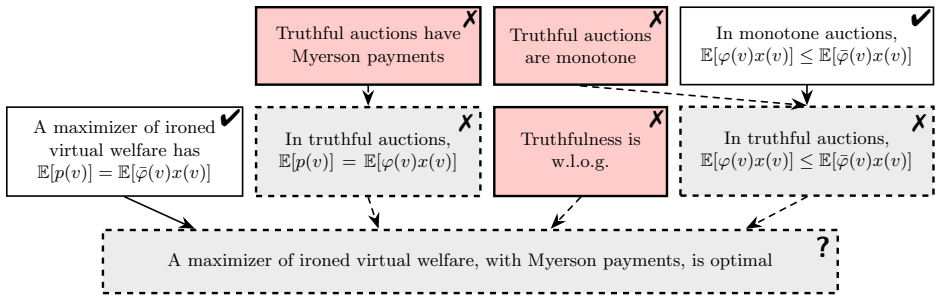
- The abstract states that the measure-theoretic tools 'establish a unified theory parallel to Myerson' but supplies no proof outline or key lemma; a one-paragraph sketch of the main argument (e.g., how the virtual-value characterization survives the constraint) would improve readability.
- The monotonicity assumption on constraints is stated as the key enabler; a brief discussion of what fails without monotonicity (even if outside the paper's scope) would help readers assess the result's robustness.
Simulated Author's Rebuttal
We thank the referee for their positive and accurate summary of our work on constrained multi-unit auctions, as well as for recognizing its technical contributions and the objective-based separation. We appreciate the recommendation for minor revision. No major comments were provided in the report, so we have no specific points requiring rebuttal or clarification at this stage. We remain available to address any minor issues during revision.
Circularity Check
No significant circularity detected
full rationale
The paper's derivation for revenue-aligned objectives relies on measure-theoretic tools to establish a Myerson-style optimality result under explicitly stated monotone constraints, without reducing any prediction or optimality claim to a fitted parameter or self-citation chain. The separation between revenue-aligned and consumer-aligned objectives is presented as a direct consequence of the expanded design space and monotonicity assumption, with no equations or steps shown to be equivalent to inputs by construction. The analysis is self-contained against external benchmarks like Myerson's lemma (which is noted as not applying directly), yielding an independent theoretical parallel rather than a renaming or self-referential fit.
Axiom & Free-Parameter Ledger
Reference graph
Works this paper leans on
-
[1]
International Workshop on Agent-Mediated Electronic Commerce , pages=
Mechanism for optimally trading off revenue and efficiency in multi-unit auctions , author=. International Workshop on Agent-Mediated Electronic Commerce , pages=. 2003 , organization=
2003
-
[2]
International Colloquium on Automata, Languages, and Programming , pages=
Efficiency-revenue trade-offs in auctions , author=. International Colloquium on Automata, Languages, and Programming , pages=. 2012 , organization=
2012
-
[3]
arXiv preprint arXiv:2310.08881 , year=
Online resource sharing via dynamic max-min fairness: efficiency, robustness and non-stationarity , author=. arXiv preprint arXiv:2310.08881 , year=
-
[4]
Proceedings of the 57th Annual ACM Symposium on Theory of Computing , pages=
Multi-Parameter Mechanisms for Consumer Surplus Maximization , author=. Proceedings of the 57th Annual ACM Symposium on Theory of Computing , pages=
-
[5]
Proceedings of the 2016 ACM Conference on Economics and Computation , pages=
The fedex problem , author=. Proceedings of the 2016 ACM Conference on Economics and Computation , pages=
2016
-
[6]
Proceedings of the 2017 ACM Conference on Economics and Computation , pages=
The optimal mechanism for selling to a budget constrained buyer: The general case , author=. Proceedings of the 2017 ACM Conference on Economics and Computation , pages=
2017
-
[7]
Journal of Economic theory , volume=
The optimal mechanism for selling to a budget-constrained buyer , author=. Journal of Economic theory , volume=. 2000 , publisher=
2000
-
[8]
The Review of Economic Studies , volume=
Partially verifiable information and mechanism design , author=. The Review of Economic Studies , volume=. 1986 , publisher=
1986
-
[9]
ZEW-Centre for European Economic Research Discussion Paper , number=
Revenue maximization with partially verifiable information , author=. ZEW-Centre for European Economic Research Discussion Paper , number=
-
[10]
Proceedings of the 2019 ACM Conference on Economics and Computation , pages=
Probabilistic verification in mechanism design , author=. Proceedings of the 2019 ACM Conference on Economics and Computation , pages=
2019
-
[11]
Proceedings of the 26th ACM Conference on Economics and Computation , pages=
Dynamic Rental Games with Stagewise Individual Rationality , author=. Proceedings of the 26th ACM Conference on Economics and Computation , pages=
-
[12]
Mathematics of operations research , volume=
Optimal auction design , author=. Mathematics of operations research , volume=. 1981 , publisher=
1981
-
[13]
Available at SSRN 2636040 , year=
Learning and the possibility of losing own money reduce overbidding: Delayed payment in experimental auctions , author=. Available at SSRN 2636040 , year=
-
[14]
International Symposium on Algorithmic Game Theory , pages=
Two-buyer sequential multiunit auctions with no overbidding , author=. International Symposium on Algorithmic Game Theory , pages=. 2020 , organization=
2020
-
[15]
International Colloquium on Automata, Languages, and Programming , pages=
Bayesian combinatorial auctions , author=. International Colloquium on Automata, Languages, and Programming , pages=. 2008 , organization=
2008
-
[16]
Proceedings of the twenty-second annual ACM-SIAM symposium on Discrete Algorithms , pages=
Welfare guarantees for combinatorial auctions with item bidding , author=. Proceedings of the twenty-second annual ACM-SIAM symposium on Discrete Algorithms , pages=. 2011 , organization=
2011
-
[17]
2010 IEEE 51st Annual Symposium on Foundations of Computer Science , pages=
Pure and Bayes-Nash price of anarchy for generalized second price auction , author=. 2010 IEEE 51st Annual Symposium on Foundations of Computer Science , pages=. 2010 , organization=
2010
-
[18]
Proceedings of the twenty-first annual ACM-SIAM symposium on Discrete Algorithms , pages=
Price of anarchy for greedy auctions , author=. Proceedings of the twenty-first annual ACM-SIAM symposium on Discrete Algorithms , pages=. 2010 , organization=
2010
-
[19]
Journal of Artificial Intelligence Research , volume=
The price of anarchy in auctions , author=. Journal of Artificial Intelligence Research , volume=
-
[20]
Fifth Workshop on Ad Auctions , year=
Sponsored search equilibria for conservative bidders , author=. Fifth Workshop on Ad Auctions , year=
-
[21]
Models of strategic rationality , pages=
Reexamination of the perfectness concept for equilibrium points in extensive games , author=. Models of strategic rationality , pages=. 1988 , publisher=
1988
-
[22]
2003 , publisher=
The philosophy of taxation and public finance , author=. 2003 , publisher=
2003
-
[23]
2003 , publisher=
To queue or not to queue: Equilibrium behavior in queueing systems , author=. 2003 , publisher=
2003
-
[24]
Proceedings of the 2019 ACM Conference on Economics and Computation , pages=
Allocation for social good: auditing mechanisms for utility maximization , author=. Proceedings of the 2019 ACM Conference on Economics and Computation , pages=
2019
-
[25]
Advances in Neural Information Processing Systems , year =
Multidimensional Bayesian Utility Maximization: Tight Approximations to Welfare , author =. Advances in Neural Information Processing Systems , year =
-
[26]
Theory of Computing Systems , volume=
Efficient money burning in general domains , author=. Theory of Computing Systems , volume=. 2016 , publisher=
2016
-
[27]
arXiv preprint arXiv:2301.12462 , year=
Combinatorial pen testing (or consumer surplus of deferred-acceptance auctions) , author=. arXiv preprint arXiv:2301.12462 , year=
-
[28]
Proceedings of the 23rd International Conference on Autonomous Agents and Multiagent Systems , pages=
Towards Efficient Auction Design with ROI Constraints , author=. Proceedings of the 23rd International Conference on Autonomous Agents and Multiagent Systems , pages=
-
[29]
Advances in Neural Information Processing Systems , volume=
Robust auction design in the auto-bidding world , author=. Advances in Neural Information Processing Systems , volume=
-
[30]
Proceedings of the 26th International Conference on World Wide Web , pages=
Budget management strategies in repeated auctions , author=. Proceedings of the 26th International Conference on World Wide Web , pages=
-
[31]
Balseiro, Santiago and Kim, Anthony and Mahdian, Mohammad and Mirrokni, Vahab , title =. 2020 , isbn =. doi:10.1145/3391403.3399472 , booktitle =
-
[32]
ACM Transactions on Economics and Computation , volume=
Polyhedral clinching auctions for indivisible goods , author=. ACM Transactions on Economics and Computation , volume=. 2025 , publisher=
2025
-
[33]
International Conference on Web and Internet Economics , pages=
Auction design for bidders with ex post roi constraints , author=. International Conference on Web and Internet Economics , pages=. 2023 , organization=
2023
-
[34]
International Colloquium on Automata, Languages, and Programming , pages=
Efficiency guarantees in auctions with budgets , author=. International Colloquium on Automata, Languages, and Programming , pages=. 2014 , organization=
2014
-
[35]
Proceedings of the Web Conference 2021 , pages=
Auction design for roi-constrained buyers , author=. Proceedings of the Web Conference 2021 , pages=
2021
-
[36]
Journal of Economic Theory , volume=
Optimal auctions with financially constrained buyers , author=. Journal of Economic Theory , volume=. 2014 , publisher=
2014
-
[37]
Games and Economic Behavior , volume=
Mechanism design with weaker incentive compatibility constraints , author=. Games and Economic Behavior , volume=. 2006 , publisher=
2006
-
[38]
Dynamic screening with liquidity constraints: D
Kr. Dynamic screening with liquidity constraints: D. Kr. Economic Theory , volume=. 2025 , publisher=
2025
-
[39]
Journal of Economic Theory , pages=
Unidirectional incentive compatibility , author=. Journal of Economic Theory , pages=. 2025 , publisher=
2025
-
[40]
Econometrica: Journal of the Econometric Society , pages=
Global incentive constraints in auction design , author=. Econometrica: Journal of the Econometric Society , pages=. 1984 , publisher=
1984
-
[41]
Journal of Mathematical Analysis and Applications , volume=
Measure preserving transformations and rearrangements , author=. Journal of Mathematical Analysis and Applications , volume=. 1970 , publisher=
1970
-
[42]
and Roughgarden, Tim , title =
Jason D. Hartline and Tim Roughgarden , editor =. Optimal mechanism design and money burning , booktitle =. 2008 , url =. doi:10.1145/1374376.1374390 , timestamp =
-
[43]
2019 , publisher=
Probability: theory and examples , author=. 2019 , publisher=
2019
-
[44]
1997 , publisher=
Foundations of modern probability , author=. 1997 , publisher=
1997
-
[45]
and Loss, Michael , title =
Lieb, Elliott H. and Loss, Michael , title =. 2001 , publisher =
2001
-
[46]
Operations Research , volume=
Sequential mechanisms with ex post individual rationality , author=. Operations Research , volume=. 2023 , publisher=
2023
-
[47]
1999 , publisher=
An ex-post efficient auction , author=. 1999 , publisher=
1999
-
[48]
Proceedings of the 26th ACM Conference on Economics and Computation , pages=
Budget-Feasible Contracts , author=. Proceedings of the 26th ACM Conference on Economics and Computation , pages=
-
[49]
1952 , publisher=
Inequalities , author=. 1952 , publisher=
1952
-
[50]
Reduction theory , author=
On rings of operators. Reduction theory , author=. Annals of Mathematics , volume=. 1949 , publisher=
1949
-
[51]
Review of Economic Design , volume=
Optimal procurement mechanisms for divisible goods with capacitated suppliers , author=. Review of Economic Design , volume=. 2008 , publisher=
2008
-
[52]
On the sufficiency of unidirectional incentive compatibility in auctions
On the sufficiency of unidirectional incentive compatibility in auctions , author=. arXiv preprint arXiv:2606.03051 , year=
work page internal anchor Pith review Pith/arXiv arXiv
-
[53]
Proceedings of the International Conference on Machine Learning (ICML) , year=
From Welfare to Utility: Generalized Objectives in Budget-Feasible Procurement , author=. Proceedings of the International Conference on Machine Learning (ICML) , year=
discussion (0)
Sign in with ORCID, Apple, or X to comment. Anyone can read and Pith papers without signing in.