REVIEW 2 major objections 4 minor 2 cited by
The Effect of Magnetic Impurities on Superfluid $^3$He in Aerogel
T0 review · 2 major / 4 minor · reviewed 2026-08-14 · deepseek-v4-flash
Pith's one-line read The critical field for superfluid 3He in compressed silica aerogel arises from anisotropic magnetic impurities suppressing the A phase, not from aerogel geometry alone.
desk verdict Clean control experiment pins the critical field on anisotropic magnetic scattering; the low-pressure phase identification is softer than the abstract implies. read the letter →
The pith
A machine-rendered reading of the paper's core claim, the machinery that carries it, and where it could break.
The reading
What carries the argument
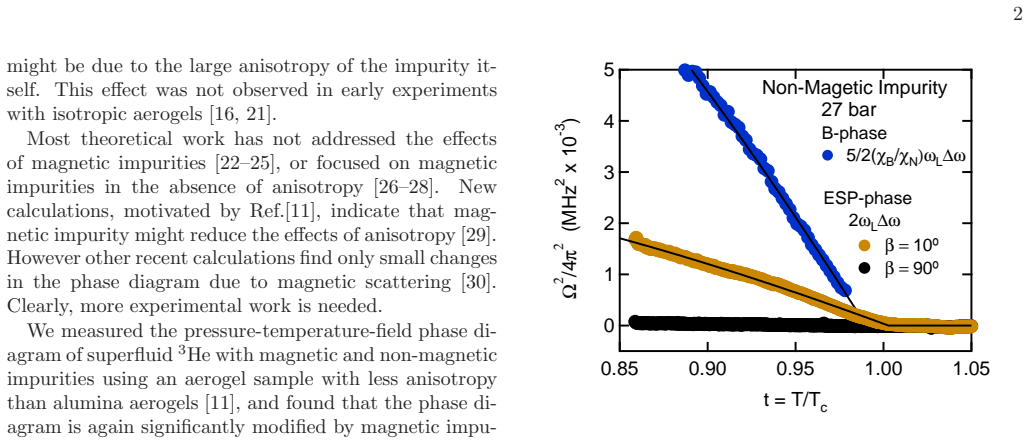
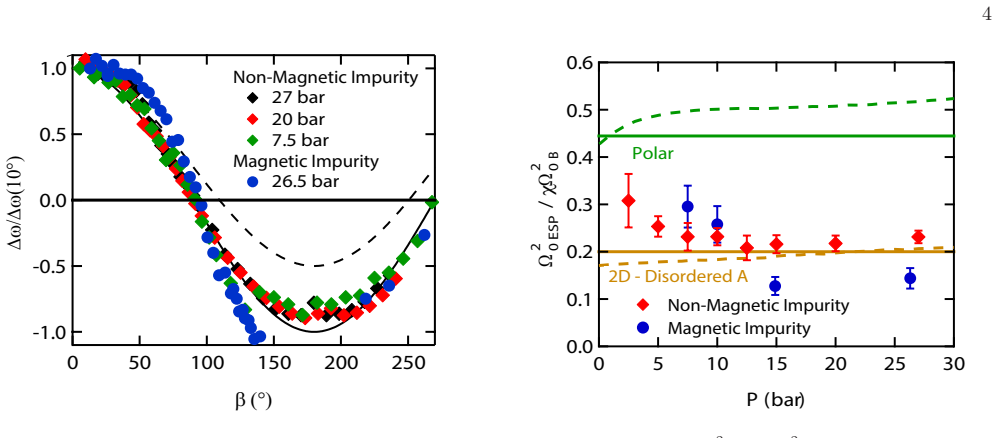
The load-bearing measurement is the longitudinal NMR resonance frequency ratio $\Omega$^2_0ESP/(chi $\Omega$^2_0B), formed from the initial slopes of the ESP and B-phase resonance frequencies near Tc. This ratio is fixed by the symmetry of the order parameter: Eq. (3) gives 1/5 (Delta_A/Delta_B)^2 for a 2D-disordered A phase and Eq. (4) gives 4/5 (Delta_P/Delta_B)^2 for the Polar phase, so comparing the measured ratio to these values identifies which ESP state is present. The B phase is identified by its unique tip-angle dependence and by the linear pressure dependence of chi $\Omega$^2_0B that is a known marker of the B phase in pure 3He, isotropic aerogel, and anisotropic aerogel.
What would settle it
Measure the longitudinal resonance ratio for the ESP phase with non-magnetic impurities at pressures below 10 bar with higher resolution: if it tracks the Polar-phase prediction 4/5 (Delta_P/Delta_B)^2 instead of the 2D-disordered-A line, the identification of the ESP phase as the A phase, and with it the claimed recovery of A-B relative symmetry, fails.
Extended reading notes
Core claim
The central discovery is that an anisotropic distribution of magnetic impurities is responsible for the critical field Hc reported earlier: magnetic quasiparticle scattering suppresses the A-phase order parameter while the B phase is immune. Replacing the paramagnetic solid 3He layer on the aerogel strands with non-magnetic 4He eliminates Hc at every pressure measured. In the non-magnetic case, the longitudinal resonance frequencies show that the ESP phase is the 2D-disordered A phase and the non-ESP phase is the B phase, preserving the same relative symmetry as in isotropic aerogel and pure 3He; magnetic impurity distorts the A phase and violates that symmetry relation.
Load-bearing premise
The conclusion leans on identifying the equal-spin-pairing phase in non-magnetic compressed aerogel as the 2D-disordered A phase, using a resonance-frequency ratio that at low pressure falls between the A-phase and Polar-phase predictions.
Editorial extensions
If this is right
- Removing magnetic impurities eliminates the critical field Hc, so Hc is magnetic in origin rather than a purely geometric effect of aerogel anisotropy.
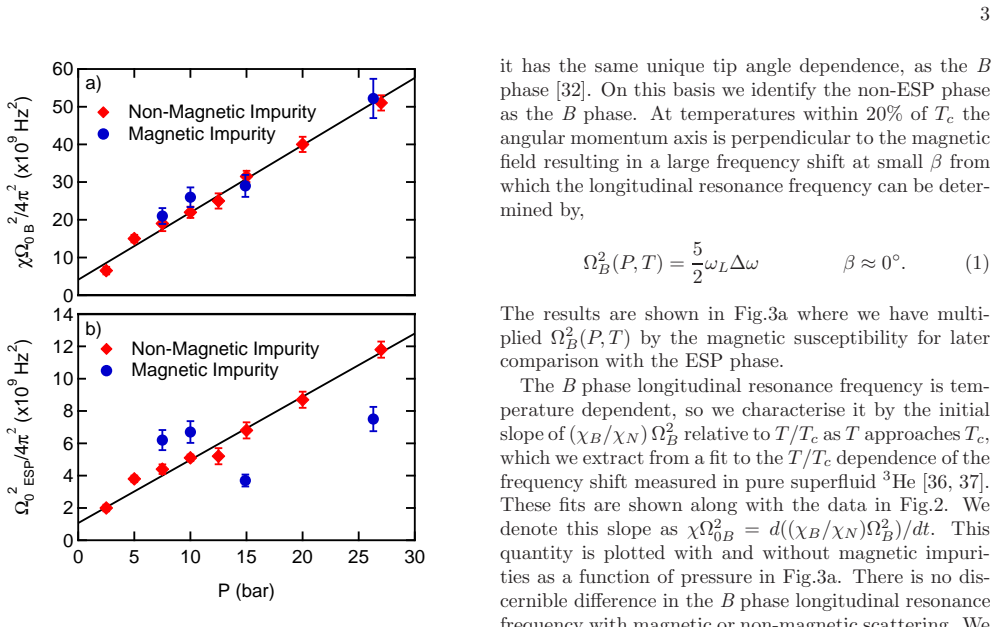
- The B phase order parameter is unaffected by magnetic impurities, since its longitudinal resonance slope is unchanged when the surface 3He is replaced by 4He.
- In non-magnetic anisotropic silica aerogel, the A and B phases have the same relative symmetry as in isotropic aerogel and in pure superfluid 3He.
- Anisotropic magnetic impurity scattering suppresses the A phase and changes its order-parameter symmetry relative to B, breaking the A-B symmetry relation that holds without magnetic scattering.
- Magnetic impurities, not just the geometry of the aerogel strands, play a decisive role in which superfluid phase is stabilized.
Reading between the lines
- If Hc is magnetic in origin, earlier interpretations of phase stability in other anisotropic aerogels may need revisiting: replacing surface 3He with 4He in those systems could separate magnetic from geometric effects on the Polar phase and on Tc.
- Anisotropic magnetic scattering may act as an experimental tuning knob for unconventional superconductors, potentially masking or mimicking intrinsic order-parameter symmetry in candidate triplet or spin-fluctuation systems.
- The supplementary information reports a 2-5% Tc change with magnetic impurities, so the claimed B-phase immunity is not literally total: a dedicated low-pressure measurement of the B-phase resonance could determine whether the small Tc shift reflects a tiny B-phase response or a purely normal-state effect.
- A theoretical calculation of the strong-scattering limit for anisotropic magnetic impurities, extended beyond current perturbative treatments, could predict how much A-phase suppression and what Hc(P) trend follow from the measured impurity distribution.
Signed reviews
Editorial analysis
A structured set of objections, weighed in public.
Referee Report
Summary. The paper reports pulsed NMR measurements of superfluid 3He in an axially compressed 98% porous silica aerogel, comparing the phase diagram with magnetic impurities (the native solid-3He surface layer) and after the surface layer is replaced by non-magnetic 4He. With magnetic impurities, the authors observe a critical field Hc at the tricritical point where the ESP/non-ESP transition meets Tc at pressures between 10 and 27 bar; after replacing the surface 3He with 4He, Hc disappears. The non-ESP phase is identified as the B phase from its tip-angle dependence, and the ESP phase is identified as a 2D-disordered A phase at high pressure from the ratio of longitudinal resonance slopes Ω²0ESP/(χΩ²0B) compared with theoretical ratios for the 2D-disordered A and Polar phases. The authors conclude that an anisotropic distribution of magnetic impurities suppresses the A phase, producing Hc, while the B phase is unaffected, and that in the absence of magnetic scattering the A and B phases preserve the same relative symmetry as in pure superfluid 3He.
Significance. The central experimental result is a clean, same-sample comparison: replacing the paramagnetic solid-3He surface layer with 4He makes Hc disappear, directly demonstrating that the critical field has a magnetic origin rather than a purely geometric one. The B-phase longitudinal resonance slope is unchanged by the surface change, and the high-pressure ESP-phase ratio agrees with the 2D-disordered A-phase prediction; the analysis uses fixed theoretical ratios normalized to the B phase in the same sample, so the comparison is not a fit with free parameters. If the phase identification holds over the full pressure range, the paper would establish that non-magnetic anisotropic disorder preserves the pure-3He A/B symmetry relation and would identify magnetic quasiparticle scattering as the mechanism that breaks it. The main limitation, which the authors themselves flag, is the low-pressure phase identification; this limits the all-pressure interpretation but does not undermine the demonstrated magnetic origin of Hc.
major comments (2)
- [Fig. 5 and Eqs. (3)-(4)] The identification of the ESP phase as the 2D-disordered A phase is not uniquely established at low pressures, and the text explicitly concedes this ambiguity in the paragraph following Eq. (4). At pressures near and below 10 bar, Ω²0ESP/(χΩ²0B) lies between the 2D-disordered A and Polar predictions, so the data are consistent with a Polar-distorted A phase; since Eq. (3) assumes ΔA/ΔB ≈ 1 and no Polar admixture, the low-pressure branch of the data does not discriminate between the possibilities. Consequently, the abstract's claim that the relative symmetry of A and B phase order parameters is the same as in isotropic aerogel across the measured pressure range is not supported by the evidence as presented. The authors should either restrict the claim to pressures where the 2D-disordered A identification holds, or add a quantitative analysis of Polar distortion that accounts for the low-pressure ratio.
- [Fig. 3a and SI Fig. SI1] The statement that the B phase is 'immune' to magnetic impurities is stronger than the presented evidence. The B-phase longitudinal resonance slope χΩ²0B is unchanged within error, but the supplementary information reports a 2-5% reduction of Tc when magnetic impurities are present, so the word 'immune' should be qualified to refer specifically to the measured longitudinal resonance and the associated order-parameter amplitude, not to an absence of any magnetic-scattering effect on the B phase.
minor comments (4)
- [Fig. 2 caption] The caption contains a typo: 'Non-Magetic Impurity' should be 'Non-Magnetic Impurity'.
- [Eq. (1)] The notation 'β ≈ 0°' attached to Eq. (1) is ambiguous; it should be stated as the measurement condition under which the relation holds rather than appearing as part of the equation.
- [Fig. 3 caption] The color/label scheme in the Fig. 3 caption ('Blue circles (red diamonds) are measurements with (without) magnetic impurities') should be checked for consistency with the legends in Fig. 1, since the main text and figures elsewhere use different color conventions for magnetic and non-magnetic impurity data.
- [Abstract] The phrase 'the relative symmetry of A and B phase order parameters is the same as in isotropic aerogel, just as it is in pure superfluid 3He' is redundant; consider tightening the wording to avoid overstating the precision of the result.
Circularity Check
No significant circularity: the central Hc contrast is an independent measurement, and phase identification uses fixed theoretical benchmarks rather than fitted inputs.
full rationale
The paper's central result is an experimental contrast: replacing magnetic solid 3He with non-magnetic 4He in the same anisotropic silica aerogel eliminates the critical field Hc. This is a self-contained measurement, not a derived prediction from a fitted parameter. The phase identifications rely on comparison of measured longitudinal resonance ratios to fixed theoretical benchmarks (Eqs. 3 and 4), with ΔA/ΔB ≈ 1 taken from prior independent work [33,42], and the Polar-phase ratio from weak-coupling theory [39]. These are not parameters fitted to the present data, so the classification is not circular. The paper explicitly concedes the low-pressure ambiguity: the ratio lies between the A-phase and Polar predictions, and 'may be due to Polar distortion of the A phase at low pressures, or a change in the A phase itself.' That is an unresolved identification, not a circular derivation. Self-citations are used as experimental baselines (e.g., prior Hc measurements [5,6] and B-phase tip-angle identification [32]) but the new non-magnetic contrast is an independent observation; the conclusions would stand or fall on the measured data. The claim that the B phase is 'immune' is stronger than the null result quantitatively supports (SI reports 2–5% Tc changes), but that is an overstatement concern, not circularity. No fitted input is renamed as a prediction, and no uniqueness theorem or ansatz is imported from the authors' prior work to force the conclusion.
Assumptions & free parameters
assumptions (5)
- domain assumption The non-ESP phase is the B phase, identified by its unique NMR tip-angle dependence.
- domain assumption The ESP phase with non-magnetic impurities is the 2D-disordered A phase, not the Polar phase.
- domain assumption Replacing solid 3He with 4He removes magnetic quasiparticle scattering without significantly changing specularity at high pressures.
- domain assumption The B phase order parameter is unaffected by magnetic impurities, inferred from unchanged longitudinal resonance frequency.
- domain assumption Weak-coupling value (ΔP/ΔB)^2 = 5/9 is used for the Polar phase ratio.
Cite this review
Pith. "Pith review of The Effect of Magnetic Impurities on Superfluid $^3$He in Aerogel." pith.science (2026). https://pith.science/paper/CEFJHFX3
@misc{pith2026190801739,
  author       = {Pith},
  title        = {Pith review of: The Effect of Magnetic Impurities on Superfluid $^3$He in Aerogel},
  year         = {2026},
  howpublished = {\url{https://pith.science/paper/CEFJHFX3}},
  note         = {Machine review of arXiv:1908.01739}
}
abstract
The critical field for superfluid $^3$He in axially compressed, anisotropic silica aerogel is shown to be the result of an anisotropic distribution of magnetic impurities affecting the superfluid $A$ phase. The critical field results from the fact that the $A$ phase is suppressed relative to the $B$ phase which is immune to the effects of magnetic impurities. In the absence of magnetic quasiparticle scattering in anisotropic aerogel, we find that the relative symmetry of $A$ and $B$ phase order parameters is the same as in isotropic aerogel, just as it is in pure superfluid $^3$He. These results are of potential importance for understanding unconventional superconductivity.
Figures

Figures from the paper (1 more)
Forward citations
Cited by 2 Pith papers
-
Impact of Strong Anisotropy on Phase Diagram of Superfluid $^3$He in Aerogels
For superfluid 3He in a model aerogel with finite uniaxial anisotropy, the polar-phase transition temperature stays nearly independent of impurity scattering, extending Anderson's theorem beyond the infinitely anisotr...
-
Topological nodal line in superfluid $^3$He and the Anderson theorem
Measurement of the polar-phase gap in 3He in nafen shows the predicted T^3 temperature law, providing the first experimental evidence for a Dirac nodal line and supporting a generalized Anderson theorem.
Reference graph
Works this paper leans on
-
[1]
D. Vollhardt and P. W¨ olfle, The Superfluid Phases of Helium 3 (Taylor and Francis, 1990)
work page 1990
-
[2]
Halperin, Annual Review of Condensed Matter Physics 10, 155 (2019)
W. Halperin, Annual Review of Condensed Matter Physics 10, 155 (2019)
work page 2019
-
[3]
J. Pollanen, J. I. A. Li, C. A. Collett, W. J. Gannon, W. P. Halperin, and J. A. Sauls, Nature Phys. 8, 317 (2012)
work page 2012
-
[4]
J. I. A. Li, A. M. Zimmerman, J. Pollanen, C. A. Collett, W. J. Gannon, and W. P. Halperin, J. Low Temp. Phys. 175, 31 (2014)
work page 2014
-
[5]
J. I. A. Li, A. M. Zimmerman, J. Pollanen, C. A. Collett, W. J. Gannon, and W. P. Halperin, Phys. Rev. Lett. 112, 115303 (2014)
work page 2014
-
[6]
J. I. A. Li, A. M. Zimmerman, J. Polla- nen, C. A. Collett, and W. P. Halperin, Phys. Rev. Lett. 114, 105302 (2015)
work page 2015
- [7]
-
[8]
V. E. Asadchikov, R. S. Askhadullin, V. V. Volkov, V. V. Dmitriev, N. K. Kitaeva, P. N. Martynov, A. A. Osipov, A. A. Senin, A. A. Soldatov, D. I. Chekrygina, and A. N. Yudin, JETP Letters 101, 556 (2015)
work page 2015
Show all 46 references
-
[9]
V. V. Dmitriev, A. A. Senin, A. A. Soldatov, and A. N. Yudin, Phys. Rev. Lett. 115, 165304 (2015)
2015
-
[10]
Autti, V
S. Autti, V. V. Dmitriev, J. T. Mkinen, A. A. Soldatov, G. E. Volovik, A. N. Yudin, V. V. Zavjalov, and V. B. Eltsov, Phys. Rev. Lett. 117, 255301 (2016)
2016
-
[11]
V. V. Dmitriev, A. A. Soldatov, and A. N. Yudin, Phys. Rev. Lett. 120, 075301 (2018)
2018
-
[12]
V. V. Dmitriev, L. A. Melnikovsky, A. A. Senin, A. A. Soldatov, and A. N. Yudin, JETP Letters 101, 808 (2015)
2015
-
[13]
J. A. Sauls, Y. M. Bunkov, E. Collin, H. Godfrin, and P. Sharma, Phys. Rev. B 72, 024507 (2005)
2005
-
[14]
Collin, S
E. Collin, S. Triqueneaux, Y. M. Bunkov, and H. God- frin, Phys. Rev. B 80, 094422 (2009)
2009
-
[15]
Schuhl, S
A. Schuhl, S. Maegawa, M. W. Meisel, and M. Chapel- lier, Phys. Rev. B 36, 6811 (1987)
1987
-
[16]
D. T. Sprague et al. , Phys. Rev. Lett. 77, 4568 (1996)
1996
-
[17]
M. R. Freeman and R. C. Richardson, Phys. Rev. B 41, 11011 (1990)
1990
-
[18]
S. M. Tholen and J. M. Parpia, Phys. Rev. Lett. 67, 334 (1991)
1991
-
[19]
S. B. Kim, J. Ma, and M. H. W. Chan, Phys. Rev. Lett. 71, 2268 (1993)
1993
-
[20]
Murakawa, M
S. Murakawa, M. Wasai, K. Akiyama, Y. Wada, Y. Tamura, R. Nomura, and Y. Okuda, Phys. Rev. Lett. 108, 025302 (2012)
2012
-
[21]
V. V. Dmitriev, I. V. Kosarev, N. Mul- ders, V. V. Zavjalov, and D. Y. Zmeev, Physica B: Condensed Matter 329-333, 320 (2003), proceedings of the 23rd International Conference on Low Temperature Physics
2003
-
[22]
E. V. Thuneberg, S. K. Yip, M. Fogelstr¨ om, and J. A. Sauls, Phys. Rev. Lett. 80, 2861 (1998)
1998
-
[23]
J. A. Sauls, Phys. Rev. B. 88, 214503 (2013)
2013
-
[24]
Aoyama and R
K. Aoyama and R. Ikeda, Phys. Rev. B 73, 060504(R) (2006)
2006
-
[25]
Aoyama and R
K. Aoyama and R. Ikeda, Phys. Rev. B. 72, 012515 (2005)
2005
-
[26]
J. A. Sauls and P. Sharma, Phys. Rev. B 68, 224502 (2003)
2003
-
[27]
Baramidze and G
G. Baramidze and G. Kharadze, Physica B: Condensed Matter 284-288, 305 (2000)
2000
-
[28]
Ikeda and K
R. Ikeda and K. Aoyama, Phys. Rev. B. 79, 064527 (2009)
2009
-
[29]
V. P. Mineev, Phys. Rev. B 98, 014501 (2018)
2018
-
[30]
I. A. Fomin, JETP 127, 933 (2018)
2018
-
[31]
See Supplemental Material [URL will be inserted by pub- lisher] for additional information on changes in the tran- siton temperature
-
[32]
A. M. Zimmerman, J. I. A. Li, M. D. Nguyen, and W. P. Halperin, Phys. Rev. Lett. 121, 255303 (2018)
2018
-
[33]
Pollanen, J
J. Pollanen, J. I. A. Li, C. A. Collett, W. J. Gannon, and W. P. Halperin, Phys. Rev. Lett. 107, 195301 (2011)
2011
-
[34]
J. I. A. Li, J. Pollanen, A. M. Zimmerman, C. A. Collett, W. J. Gannon, and W. P. Halperin, Nature Physics 9, 775 (2013)
2013
-
[35]
C. L. Vicente, H. C. Choi, J. S. Xia, W. P. Halperin, N. Mulders, and Y. Lee, Phys. Rev. B 72, 094519 (2005)
2005
-
[36]
P. E. Schiffer, Studies of the Superfluid Phases of Helium Three and The Magnetization of Thin Solid Films of He- lium Three, Ph.D. thesis, Stanford University (1993)
1993
-
[37]
Schiffer, M
P. Schiffer, M. T. O’Keefe, H. Fukuyama, and D. D. Osheroff, Phys. Rev. Lett. 69, 3096 (1992)
1992
-
[38]
M. R. Rand et al. , Phys. Rev. Lett. 77, 1314 (1996)
1996
-
[39]
A. M. Zimmerman, M. D. Nguyen, and W. P. Halperin, Journal of Low Temperature Physics 195, 358 (2019)
2019
-
[40]
R. S. Askhadullin, V. V. Dmitriev, D. A. Krasnikhin, P. N. Martinov, A. A. Osipov, A. A. Senin, and A. N. Yudin, JETP Lett. 95, 326 (2012)
2012
-
[41]
R. S. Askhadullin, V. V. Dmitriev, P. N. Martynov, A. A. Osipov, A. A. Senin, and A. N. Yudin, JETP Letters 100, 662 (2015). 6
2015
-
[42]
D. D. Osheroff, Phys. Rev. Lett. 33, 1009 (1974)
1974
-
[43]
M. R. Rand et al. , Physica B 194, 805 (1994)
1994
-
[44]
A. J. Leggett, Rev. Mod. Phys. 47, 331 (1975)
1975
-
[45]
The Effect of Magnetic Impurities on Superfluid 3He in Aerogel
H. Choi, J. P. Davis, J. Pollanen, T. M. Haard, and W. P. Halperin, Phys. Rev. B 75, 174503 (2007). arXiv:1908.01739v2 [cond-mat.supr-con] 16 Aug 2019 Supplementary Information: “The Effect of Magnetic Impurities on Superfluid 3He in Aerogel” A.M. Zimmerman, ∗ M.D. Nguyen, J.W. ...
2007 arXiv
-
[88]
6 mT), and 10 bar ( Hc = 66
6 mT) 15 bar ( Hc = 82. 6 mT), and 10 bar ( Hc = 66. 4 mT) in the presence of magnet scattering, but is absent at lower pressure. b) With non-magnetic impurity Hc = 0. note that the addition of 4He also modifies the specularity of quasiparticle scattering, although this effect s...
Reviewed August 14, 2026 · model on record in the stance chip above.
Discussion (0). Continue with ORCID to comment.