REVIEW 3 major objections 5 minor 30 references
Updated line list for the principal isotopologue of carbon monoxide
T0 review · 3 major / 5 minor · reviewed 2026-08-07 · deepseek-v4-flash
Pith's one-line read The paper argues that the previously used 1-0 band measurements for CO are systematically wrong, removes them from the fit, and produces an updated line list with new predictions.
desk verdict A careful, reproducible update of the CO line list whose central 1-0 prediction is conditional on an unpublished HITRAN2024 result; worth reviewing, but not ready to adopt. read the letter →
The pith
A machine-rendered reading of the paper's core claim, the machinery that carries it, and where it could break.
The reading
What carries the argument
The load-bearing object is the irregular dipole-moment function (DMF), a semi-empirical function $d(r)$ giving the electric dipole moment of CO as a function of internuclear distance; it is fitted to transition dipole moments converted from measured line intensities and constrained by ab initio points and by the limiting behavior $d(r)\propto r^3$ at $r\to 0$ and $d(r)\approx d_4 r^{-4}$ at $r\to\infty$. It carries the argument because line intensities are integrals of this function with vibrational wave functions, and high-overtone intensities are extremely sensitive to its analytic behavior. The paper fits three models with different analytical properties, including a rational DMF with five pairs of complex-conjugate poles, and selects the irregular DMF because it stays smooth in the complex plane and reproduces the NIDL, the overtone intensity-decay law, while the regular DMF does not.
What would settle it
A direct high-precision measurement of several CO fundamental-band line intensities at the 0.1-0.5% level would settle the question: if the measured values land about 2% below their HITRAN2016 values, near HITRAN2020, then excluding the older 1-0 data was unjustified. Publishing and comparing the announced HITRAN2024 cold- and hot-fundamental intensities to Table 2 would provide essentially the same test.
Extended reading notes
Core claim
The authors claim that the new sub-permille 3-0 measurements and the first 7-0 measurements cannot be reconciled with the two fundamental-band datasets used in their previous fits. On that basis they remove all 1-0 data from the fitting set, sharply increase the uncertainties assigned to ab initio dipole-moment points, and re-fit three model dipole-moment functions to the remaining data. They conclude that the re-fit describes all accepted data well, that the irregular and rational dipole-moment functions give mutually consistent predictions, and that the irregular dipole-moment function yields a 1-0 band in agreement with HITRAN2016 to about 0.5%, meaning HITRAN2020's 1.02 scaling was driven by flawed measurements. The paper presents new 1-0 and 8-0 intensity tables and a full updated line list.
Load-bearing premise
The claim rests on treating the older 1-0 band measurements as systematically wrong and on trusting the announced but not yet published HITRAN2024 fundamental-band measurements; if those older data are actually right, or the new announcement follows HITRAN2020, the re-fitted dipole-moment function is biased and its 1-0 prediction fails.
Editorial extensions
If this is right
- If the updated line list is correct, the 1-0 CO band intensities should match HITRAN2016 values within about 0.5%, and HITRAN2020's uniform 2% reduction should be reversed.
- The still-unmeasured 8-0 band now comes with explicit intensity predictions, enabling a direct test when high-overtone measurements reach that band.
- Because the irregular and rational DMFs agree within about 1% for the 7-0 band and about 2% for the 8-0 band far from anomalies, the predicted intensities are largely independent of the DMF parameterization.
- The regular DMF, although it fits the measured low bands, violates the NIDL and behaves non-physically in the complex plane, so it should not be used for extrapolated overtone intensities.
Reading between the lines
- If the 1-0 exclusion survives the publication of the HITRAN2024 fundamental-band data, databases that adopted the 2% downward scaling in HITRAN2020 would need revision, which would propagate into atmospheric retrievals that use CO columns.
- The agreement of two analytically very different DMFs after the new constraints suggests a practical validation recipe for overtone line lists: predictive reliability is indicated when structurally unrelated fitting functions agree outside the fitted region.
- A natural extension is to repeat the fit with the announced hot-fundamental-band measurements, which would test whether the same dipole-moment function also works for vibrationally excited lower states.
Editorial analysis
A structured set of objections, weighed in public.
Referee Report
Summary. The paper updates the authors' 2022 CO line list by refitting the semi-empirical irregular dipole-moment function (DMF) to a data set that includes new high-precision measurements of the 3-0 (Hodges25, Bielska22) and 7-0 (Balashov23) bands, while excluding all previously used 1-0 band intensity data (Zou02, Devi18). The authors report that the new 3-0 and 7-0 data cannot be fitted simultaneously with the old 1-0 data, and after 'try[ing] them one by one' they conclude that the 1-0 data are systematically wrong. The final Fit 2 uses three model DMFs (irregular, rational, and regular) with increased ab initio uncertainty bars; the irregular and rational DMFs give consistent predictions for the unobserved 1-0 and 8-0 bands. The paper claims excellent agreement with independent high-level ab initio calculations for the 3-0 band and predicts 1-0 intensities close to HITRAN2016, with a full line list and code provided as supplementary material.
Significance. If the central claim is correct, the updated line list represents a meaningful improvement over the authors' previous Medvedev&Ushakov22 list: the 1-0 band intensities would be ~2% higher than HITRAN2020, reverting toward HITRAN2016, and the new 3-0 and 7-0 data would be reproduced within experimental uncertainties. The paper is also of practical value to the spectroscopic database community because it provides concrete predictions for the 1-0 and 8-0 bands that can be tested once the announced HITRAN2024 fundamental-band measurements are published. The authors are to be credited for releasing the FORTRAN code and full line list, and for comparing against independent high-level ab initio calculations (SUCL) for the 3-0 band, which shows agreement to ~0.05%. However, the significance of the work is tempered by the fact that the load-bearing exclusion of all 1-0 data rests on an unpublished announcement (Ref. [9]) and on a data-dependent fitting decision, rather than on a robust outlier or systematic-error analysis.
major comments (3)
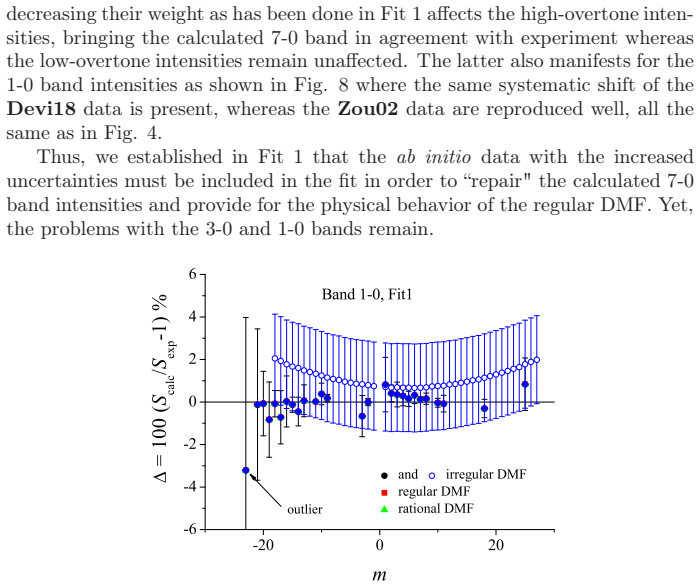
- [Section 3, final Fit 2] The exclusion of all 1-0 band data (both Zou02 and Devi18) is the central decision of the paper, yet the justification is essentially a one-by-one trial ('we tried them one by one and found that these were the data of Zou02') supplemented by an unpublished HITRAN2024 announcement (Ref. [9], 'in preparation'). The reasoning is circular in a practical sense: the 1-0 data are removed because they cannot be fitted simultaneously with the 3-0/7-0 data, and the resulting fit is then used (Table 1, Fig. 12) to assert that the removed data are systematically wrong. To make this load-bearing claim credible, the paper should provide a quantitative outlier analysis (e.g., standardized residuals, influence diagnostics, or a test of consistency with the 2-0 and other low-overtone bands), and a sensitivity analysis showing how the fitted DMF and 1-0 prediction change when subsets of the 1-0 data are retained. The paper should also explicitly discuss the status of Ref. [9] as unpublished and explain what independent information it provides beyond the raw statement of agreement with HITRAN2016.
- [Section 5, Table 2] The predicted 1-0 and 8-0 band intensities are quoted to five or more significant digits (e.g., S1-0 = 9.6582E-20 cm/molecule) without any uncertainty estimate. Given that the DMF parameters are fitted with finite precision and that the exclusion of the 1-0 data is contested, the headline predictions need an error budget. The consistency between the irregular and rational DMFs (within ~1% for 7-0 and ~2% for 8-0) is useful but does not capture systematic errors from the data-selection decision or from the ad hoc inflation of ab initio uncertainties. The authors should report at least a conservative uncertainty on the tabulated S1-0 and S8-0 values, ideally propagating fit uncertainties and showing the spread among acceptable DMF models.
- [Section 3, Fit 1] The treatment of ab initio uncertainty is ad hoc: the original uncertainties are multiplied by 200 for r < 0.5 Å and by max(0.3 D, 10σ_orig) for r > 0.5 Å. The choice of these inflation factors is not justified, and no sensitivity test is performed. Since the weight of the theoretical DMF in the fit directly affects the final intensities (the authors themselves show that Fit 0 without such inflation fails to reproduce the 7-0 band), the paper should demonstrate that the final 1-0 and 8-0 predictions are robust to reasonable variations of these inflation factors, e.g., by repeating the fit with σ multiplied by 5, 10, 50, and 200.
minor comments (5)
- [Abstract] The abstract states that the line list was 'calculated earlier by the present authors [1, 2] with the irregular dipole-moment function', but the paper actually fits three different model DMFs and only later selects the irregular one; this is slightly misleading.
- [Section 2] The sentence 'Both these measurements gave the intensities ... weaker by about 2% than in HITRAN2016' is grammatically awkward and could be clarified, especially regarding the abundance recalculation of the Zou02 data.
- [Figure 13] The abbreviation 'SUCL' is used in the caption and text but never explicitly defined; please provide the full name (e.g., 'Semiempirical Universal Carbon monoxide Line list' or similar) at first use.
- [Table 1] The footnote 'Possible misprints in the experimental uncertainties of individual lines, e.g. 0.03% for line P11' is vague; please specify which data set this refers to and what action was taken (e.g., were those lines given reduced weight or excluded?).
- [Throughout] The acronym 'NIDL' is used without expansion at first occurrence (Figure 14 and text); consider defining it as, e.g., 'nonlinear intensity decay law' to aid the reader.
Circularity Check
No formal circularity: the 1-0 and 8-0 intensities are genuine predictions outside the fit set, though the headline 1-0 result is contingent on excluding the old 1-0 data.
full rationale
The derivation chain is not circular in the formal sense. The DMF parameters are fitted to a dataset that includes the new 3-0 (Hodges25, Bielska22) and 7-0 (Balashov23) intensities and excludes the 1-0 band, so the 3-0/7-0 agreement is a fit result rather than an independent validation. However, the 1-0 and 8-0 predictions are not fit targets, so they are not forced by construction. The exclusion of the 1-0 data is motivated by an internal consistency check ('we tried them one by one and found that these were the data of Zou02') and by the announced but unpublished HITRAN2024 update; this is a data-selection and robustness concern, not a self-referential reduction. No equation defines a predicted quantity in terms of the fitted quantity. The irregular DMF is taken from the authors' prior work, but it is re-fit here against external measurements and cross-checked against the rational DMF and independent ab initio calculations, so the central claim does not reduce to a self-citation. The main caveat is epistemic: the paper's 1-0 prediction depends on the assumption that the old 1-0 measurements are systematically wrong, which is supported only by internal fit residuals and by an as-yet-unpublished database update, not by an independent published measurement. This lowers confidence but does not constitute circularity under the specified patterns.
Assumptions & free parameters
free parameters (5)
- Irregular DMF parameters =
not reported in text
- Rational DMF parameters =
not reported in text
- Regular DMF parameters =
not reported in text
- d4 asymptotic coefficient =
-5.1 DÅ4 fixed; -3.9 DÅ4 when floated for rational DMF
- Ab initio uncertainty inflation factors =
200 at r<0.5 Å; max(0.3 D, 10 sigma_orig) at r>0.5 Å
assumptions (4)
- domain assumption The CO potential energy curve from previous work is accurate enough not to be refitted.
- domain assumption The true dipole-moment function is well represented by one of the three model forms (irregular, regular, rational) with specified asymptotic behavior and no singularities near the integration path.
- standard math Quantum mechanical transition dipole moment integrals computed within the Born-Oppenheimer separation give reliable line intensities.
- ad hoc to paper The new HITRAN2024 fundamental-band measurements, announced but not yet published, are correct and agree with HITRAN2016, supporting the exclusion of the 1-0 data.
Cite this review
Pith. "Pith review of Updated line list for the principal isotopologue of carbon monoxide." pith.science (2026). https://pith.science/paper/CEPANRHE
@misc{pith2026250612216,
  author       = {Pith},
  title        = {Pith review of: Updated line list for the principal isotopologue of carbon monoxide},
  year         = {2026},
  howpublished = {\url{https://pith.science/paper/CEPANRHE}},
  note         = {Machine review of arXiv:2506.12216}
}
read the original abstract
The line list for the principal isotopologue of CO calculated earlier by the present authors [1, 2] with the irregular dipole-moment function (DMF) is updated with use of the recent high-precision measurements in the 3-0 [3, 4] (Bielska et al. 2022, Hodges et al. 2025) and 7-0 [5] (Balashov et al. 2023) bands. The new data came in contradiction with the experimental data on the 1-0 band [6, 7]. Therefore, we performed fitting several model DMFs to the modified original data set of Meshkov et al. [8] by including the new above-referenced data and by excluding the data for the 1-0 band. The updated line list is calculated with the irregular DMF. In particular, excellent agreement with recent high-level ab initio calculations on the 3-0 band [3] is emphasized and predictions for the 1-0 and 8-0 bands are outlined. In the new update of the HITRAN database [9], new high-precision measurements in the cold and hot fundamental bands are announced. When these data are published, they will be compared with the predictions of our new line list.
Figures


Figures from the paper (16 more)




Reference graph
Works this paper leans on
-
[3]
K. Bielska, A. A. Kyuberis, Z. D. Reed, G. Li, A. Cygan, R. C iuryło, E. M. Adkins, L. Lodi, N. F. Zobov, V. Ebert, D. Lisak, J. T. Hod ges, J. Tennyson, O. L. Polyansky, Subpromille measurements and calcula- tions of CO (3-0) overtone line intensities, Phys. Rev. Lett . 129 (2022). doi:10.1103/PhysRevLett.129.043002
-
[9]
I. E. Gordon, L. S. Rothman, R. J. Hargreaves, et al., The H ITRAN2024 molecular spectroscopic database, JQSRT (2025, in prepara tion)
work page 2025
-
[1]
E. S. Medvedev, V. G. Ushakov, Irregular semi-empirical dipole- moment function for carbon monoxide and line lists for all it s isotopo- logues verified for extremely high overtone transitions, Ze nodo (2022). doi:10.5281/zenodo.6346087
-
[2]
E. S. Medvedev, V. G. Ushakov, Irregular semi-empirical dipole-moment function for carbon monoxide and line lists for all its isoto pologues veri- fied for extremely high overtone transitions, J. Quant. Spec trosc. Radiat. Transfer 288 (2022) 108255. doi:10.1016/j.jqsrt.2022.10 8255
-
[4]
J. T. Hodges, K. Bielska, M. Birk, R. Guo, G. Li, J. S. Lim, D . Lisak, Z. D. Reed, G. Wagner, International comparison CCQM-P229 p ilot study to measure line intensities of selected 12C16O transitions, Metrologia 62 (2025) 08006. doi:10.1088/0026-1394/62/1A/08006
-
[5]
A. A. Balashov, K. Bielska, G. Li, A. A. Kyuberis, S. Wójte wicz, J. Domysławska, R. Ciuryło, N. F. Zobov, D. Lisak, J. Tennyso n, O. L. Polyansky, Measurement and calculation of CO (7-0) overton e line intensi- ties, J. Chem. Phys. 158 (2023) 234306. doi:10.1063/5.0152 996
-
[6]
Q. Zou, P. Varanasi, New laboratory data on the spectral l ine parameters in the 1-0 and 2-0 bands of 12C16O relevant to atmospheric remote sensing, J. Quant. Spectrosc. Rad. Transfer 75 (2002) 63–92. doi:10. 1016/S0022- 4073(02)00007-9
work page 2002
-
[7]
V. M. Devi, D. C. Benner, K. Sung, T. J. Crawford, G. Li, R. R . Gamache, M. A. H. Smith, I. E. Gordon, A. W. Mantz, Positions, intensities and line shape parameters for the 1 ← 0 bands of CO isotopologues, J. Quant. Spectrosc. Rad. Transfer 218 (201 8) 203–230. doi:https://doi.org/10.1016/j.jqsrt.2018.06.007
Show all 30 references
-
[8]
V. V. Meshkov, A. Y. Ermilov, A. V. Stolyarov, E. S. Medved ev, V. G. Ushakov, I. E. Gordon, Semi-empirical dipole-moment funct ion of carbon monoxide and line lists for all its isotopologues revisited , J. Quant. Spec- trosc. Rad. Transfer 280 (2022) 108090. doi:10.1016/j.jqs...
2022
-
[10]
Aenchbacher, M
W. Aenchbacher, M. Naftaly, R. Dudley, Line strengths a nd self- broadening of pure rotational lines of carbon monoxide meas ured by 18 terahertz time-domain spectroscopy, Appl. Opt. 49 (2010) 2 490–2496. doi:10.1364/AO.49.002490
2010 doi
-
[11]
M. Birk, D. Hausamann, G. Wagner, J. W. Johns, Determina tion of line strengths by Fourier-transform spectroscopy, Appl. Opt. 3 5 (1996) 2971–
1996
-
[12]
V. M. Devi, D. C. Benner, M. A. H. Smith, A. W. Mantz, K. Sun g, L. R. Brown, Spectral line parameters including temperature dep endences of air- broadening for the 2 ← 0 bands of 13C16O and 12C18O at 2.3 µm, J. Mol. Spectrosc. 276-277 (2012) 33–48 [Corrigendum: JMS 283 (2013)...
2012 doi
-
[13]
J. Loos, M. Birk, G. Wagner, D. Mondelain, A. Campargue, Scientific Ex- ploitation of Operational Missions − Improved Atmospheric Spectroscopy Database ESA/AO/1-7566/13/I-BG, http://www.wdc.dlr.de /seom-ias/ (2017)
2017
-
[14]
Y. G. Borkov, A. M. Solodov, A. A. Solodov, T. M. Petrova, E. V. Karlovets, V. I. Perevalov, Fourier transform CO spect ra near 1.6 µm, J. Quant. Spectrosc. Radiat Transfer 253 (2020) 107064. doi:10.1016/j.jqsrt.2020.107064
2020
-
[15]
Cygan, P
A. Cygan, P. Wcisło, S. Wójtewicz, G. Kowzan, M. Zaborow ski, D. Charczun, K. Bielska, R. S. Trawiński, R. Ciuryło, P. Masł owski, D. Lisak, High-accuracy and wide dynamic range frequency-b ased disper- sion spectroscopy in an optical cavity, Optics Express 27 (2 019) 21810. d...
-
[16]
Z. Reed, O. Polyansky, J. Hodges, Line-shapes and inten sities of carbon monoxide transitions in the (3-0) and (4-1) bands (20 17). doi:10.1364/CLEO_SI.2017.SW4J.4
2017 doi
-
[17]
K. Sung, P. Varanasi, Intensities, collision-broaden ed half-widths, and collision-induced line shifts in the second overtone band o f 12C16O, J. Quant. Spectrosc. Rad. Transfer 83 (2004) 445–458. doi:10. 1016/S0022- 4073(03)00015-3
2004
-
[18]
Y. G. Borkov, A. M. Solodov, T. M. Petrova, A. A. Solodov, E. V. Karlovets, V. I. Perevalov, Fourier transform CO spect ra near 1.19 µm, J. Quant. Spectrosc. Rad. Transfer 242 (2020) 106790. doi:10.1016/j.jqsrt.2019.106790
2020
-
[19]
Campargue, E
A. Campargue, E. V. Karlovets, S. Kassi, The 4-0 band of c ar- bon monoxide by high sensitivity cavity ring down spectrosc opy near 8200 cm −1, J. Quant. Spectrosc. Radiat. Transfer 154 (2015) 113–119. doi:10.1016/j.jqsrt.2014.12.011. 19
2015 doi
-
[20]
Bordet, S
B. Bordet, S. Kassi, A. Campargue, Line parameters of th e 4-0 band of carbon monoxide by high sensitivity cavity ring down spec troscopy near 1.2 µm, J. Quant. Spectrosc. Rad. Transfer 260 (2020) 107453. doi:10.1016/j.jqsrt.2020.107453
2020
-
[21]
G. Li, A. Domanskaya, A. Kyuberis, E. Volker, FTIR measu rements of the third overtone band of 12C16O, Book of Abstracts, 25th International Con- ference on High Resolution Molecular Spectroscopy, Bilbao , Spain (2018) 257
2018
-
[22]
Chung, J
C.-Y. Chung, J. F. Ogilvie, Y.-P. Lee, Detection of vibr ation-rotational band 5-0 of 12C16O X 1Σ+ with cavity ringdown absorption near 0.96 mm, J. Phys. Chem. A 109 (2005) 7854–7858. doi:10.1021/jp05203 5x
2005 doi
-
[23]
Y. Tan, J. Wang, X. Q. Zhao, A. W. Liu, S. M. Hu, Cavity ring -down spec- troscopy of the fifth overtone of CO, J. Quant. Spectrosc. Rad iat. Transfer 187 (2017) 274–279. doi:10.1016/j.jqsrt.2016.10.003
2017 doi
-
[24]
Wójtewicz, K
S. Wójtewicz, K. Stec, P. Masłowski, A. Cygan, D. Lisak, R. S. Trawiński, R. Ciuryło, Low pressure line-shape study of self-broadene d CO transitions in the (3←0) band, J. Quant. Spectrosc. Radiat. Transfer 130 (2013) 19 1–
2013
-
[25]
M. F. Weisbach, C. Chackerian Jr., Linewidths and trans ition probabilities for the carbon monoxide laser lines, J. Chem. Phys. 59 (1973) 4272–4276. doi:10.1063/1.1680621
1973 doi
-
[26]
E. S. Medvedev, Towards understanding the nature of the intensities of overtone vibrational transitions, J. Chem. Phys. 137 (20 12) 174307. doi:10.1063/1.4761930
-
[27]
L. D. Landau, E. M. Lifshitz, Quantum Mechanics: Non-Re lativistic The- ory, Pergamon, 1977
1977
-
[28]
Medvedev, Determination of a new molecular constant from overtone vibrational spectra, J
E. Medvedev, Determination of a new molecular constant from overtone vibrational spectra, J. Mol. Spectrosc. 114 (1985) 1–12. do i:10.1016/0022- 2852(85)90330-3. 20
1985 doi
-
[200]
doi:10.1016/j.jqsrt.2013.06.005
2013 doi
-
[2985]
doi:10.1364/AO.35.002971
Reviewed August 7, 2026 · model on record in the stance chip above.
Discussion (0). Sign in to comment.