REVIEW 3 major objections 5 minor 3 cited by
Vision in Action: Learning Active Perception from Human Demonstrations
T0 review · 3 major / 5 minor · reviewed 2026-08-06 · deepseek-v4-flash
Pith's one-line read A policy trained on a single active head camera, with gaze behavior learned from VR demonstrations, outperforms fixed chest and wrist camera setups by 45% on occluded bimanual tasks.
desk verdict Good systems paper, but the headline 45% number rests on a confounded baseline comparison. read the letter →
The pith
A machine-rendered reading of the paper's core claim, the machinery that carries it, and where it could break.
The reading
What carries the argument
The load-bearing mechanism is the shared-observation VR teleoperation interface with an intermediate 3D point-cloud scene representation. It renders stereo views instantly from the operator's latest head pose in the world frame while asynchronously updating the robot head pose from aggregated movements, reducing motion-to-photon latency below 7 ms and letting the robot head track the human's search behavior. This recorded head pose is then part of the action space the diffusion policy must predict, so the policy learns to move the camera to find, track, and focus on task-relevant regions.
What would settle it
Re-run the three tasks with the bag task using more than two unseen test objects and additional distractors inside the bag; if the 45% success advantage over the fixed chest-and-wrist setup shrinks dramatically on those new configurations, the active-perception edge is specific to the tested objects rather than a general learning effect. A second check: train ViA on demonstrations collected with a direct stereo-RGB streaming interface instead of the point-cloud rendering; if success does not drop, the intermediate representation is not the decisive design element.
Extended reading notes
Core claim
The central claim is that active perception for manipulation can be acquired by imitation rather than engineered: a visuomotor policy conditioned on a single active head camera, trained with behavior cloning on human VR demonstrations, outperforms standard camera configurations on occluded bimanual tasks. The paper reports a 45% average improvement in task success over a fixed chest-plus-wrist setup, and a specific result that augmenting the active head view with wrist views reduces success by 18.33% on average, supporting the authors' position that the moving viewpoint itself—not additional static coverage—is what carries the task-relevant information.
Load-bearing premise
The whole pipeline rests on the assumption that head movements demonstrated inside the lower-fidelity point-cloud VR scene are a faithful and sufficient training signal for real-world active perception, so that the policy's learned gaze transfers to the physical robot's noisier observations.
Editorial extensions
If this is right
- A policy that controls its own viewpoint can succeed at tasks where static or arm-mounted cameras are occluded, making active perception practical for real-world bimanual manipulation.
- Adding more camera views is not automatically beneficial in low-data imitation learning; task-relevant views from a controlled head camera can dominate redundant wrist views.
- Learned gaze behavior transfers through behavior cloning to a diffusion policy without task-specific search heuristics or reinforcement learning.
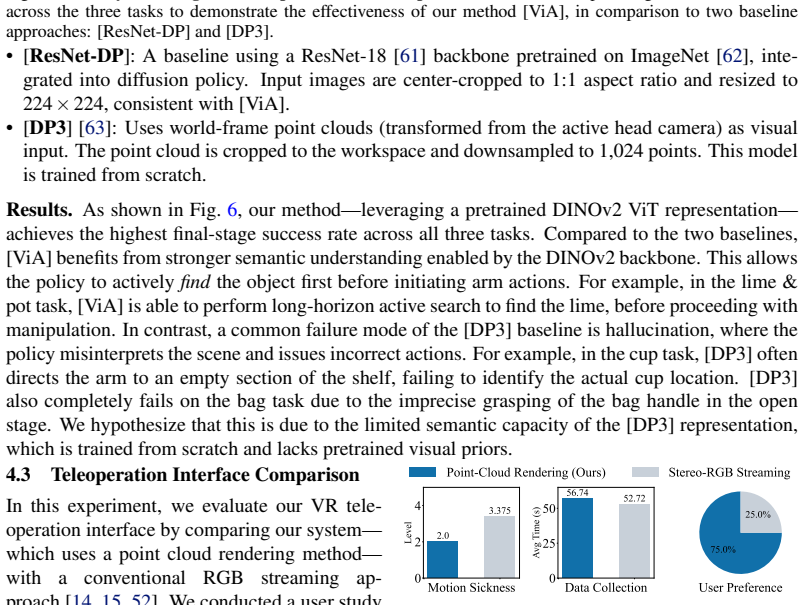
- The asynchronous point-cloud teleoperation interface reduces VR motion sickness by decoupling rendering latency from robot actuation latency, which may make VR data collection more comfortable and scalable.
Reading between the lines
- A natural extension beyond the three reported tasks is to test whether the active-head advantage persists in mobile manipulation or in tasks with little occlusion, where a fixed camera might already provide sufficient information.
- Because the interface removes the observation mismatch between human and robot, the recorded head poses could be reused as supervisory labels for explicit attention or next-best-view models without retraining the whole policy.
- Replacing the point-cloud scene with denser dynamic fusion (for example, 4D Gaussian splatting) could raise rendering fidelity; if the low-latency rendering property is preserved, it might improve both operator comfort and final task performance.
- The policy currently lacks memory of previously searched viewpoints, which the paper itself identifies as a limitation; adding such memory is a concrete next step for search-heavy tasks like the Lime and Pot task.
Editorial analysis
A structured set of objections, weighed in public.
Referee Report
Summary. This paper presents Vision in Action (ViA), a system for learning active perception from human demonstrations for bimanual manipulation. The hardware uses a 6-DoF robot arm as a movable neck with an RGB-D camera, and a VR teleoperation interface that renders a point-cloud scene in real time based on the operator's head pose while asynchronously updating the robot's camera. The policy is a Diffusion Policy with a DINOv2 visual encoder that takes the active head camera image and proprioceptive state and outputs neck and arm actions. The system is evaluated on three multi-stage occluded manipulation tasks (bag retrieval, cup arrangement, lime-and-pot alignment), comparing camera setups, visual representations, and the teleoperation interface. The paper reports that the active head camera improves average task performance by 45% over a fixed chest-plus-wrist camera setup and that adding wrist views decreases performance by 18.33%, with a user study showing reduced motion sickness.
Significance. The contribution is potentially significant. The idea of using a standard robot arm as a 6-DoF neck and the asynchronous point-cloud VR interface to capture human gaze strategies is elegant and addresses a real bottleneck in imitation learning. The three tasks are well chosen to expose occlusion and active search. If the quantitative claims hold, the system would be a useful step toward learning active perception from demonstration. Strengths include the concrete hardware/interface design, the internal consistency of training all baselines on the same demonstrations, and the inclusion of a user study. The main weaknesses are the potential confound in the camera-setup comparison and the absence of statistical validation.
major comments (3)
- [Section 4.1] The comparison between ViA and the Chest & Wrist Cameras baseline is confounded by the demonstration collection protocol. All demonstrations were collected while the human operator viewed only the active head camera feed and used that view to guide arm and neck actions (Section 3.2). The Chest & Wrist policy is therefore trained on observations that were not available to the demonstrator when choosing actions; the arm-action labels encode information visible only in the head view. This likely underestimates what a fixed-camera policy could achieve if demonstrations were collected under that fixed-camera condition, and it inflates the reported 45% advantage. The authors should either collect separate demonstrations for each camera condition or provide evidence (e.g., teleoperation success under chest/wrist views) that the fixed-camera information is sufficient for the demonstrated actions.
- [Section 4.1, Figures 5-6] No error bars, confidence intervals, or significance tests are reported. With 10-20 rollouts per condition (Section 4), the differences between conditions (e.g., 80% vs 65% in the cup task) are within plausible sampling noise. All quantitative claims (45% improvement, 18.33% decrease) should be accompanied by standard errors, bootstrap confidence intervals, or a statement of per-seed variance, and ideally multiple training seeds.
- [Sections 3.2 and 6] The human demonstrator observes a rendered point-cloud view, whereas the policy is trained on the raw RGB image from the active head camera (Section 3.3). The paper calls this a shared observation space, but the point-cloud rendering may contain depth/geometric cues not present in RGB and is acknowledged to be lower fidelity than RGB streaming. This observation mismatch could limit the transfer of the learned active perception strategy to the physical robot and should be addressed explicitly, for example by ablating whether the policy is trained on the rendered views or by analyzing how much of the human's head movements are recoverable from the RGB stream alone.
minor comments (5)
- [Section 3.1] The iPhone 15 Pro is cited as [6], which is "Robot Utility Models"; this appears to be a citation error and should be replaced with a hardware/manual reference or removed.
- [Figures 5 and 6] The bar labels are dense and hard to read; the figures would benefit from clearer annotations and a description of how the final "average task performance" numbers are computed from the stage-wise success rates.
- [Section 4] The paper reports 150, 125, and 260 demonstrations but does not state the number of training seeds or the variance across seeds; please add this information to the supplement.
- [Figure 1 caption] The repeated "Target Visible / Target Not Visible" text in the caption appears garbled and should be cleaned up.
- [Section 3.2] The paper would benefit from a brief discussion of why the point-cloud rendering refresh rate (10 Hz) and control frequency (<10 Hz) are sufficient for the three tasks, since this may not hold for faster manipulation.
Circularity Check
No circularity found: ViA's 45% active-head advantage is an empirical, held-out comparison; the shared-demonstration chest/wrist baseline is a validity confound, not a circular reduction.
full rationale
The paper's load-bearing claim is an empirical evaluation on held-out test configurations: unseen bag objects and fresh cup/lime configurations, with success measured by physical task completion. No parameter is fitted to the reported success rates, and the 45% improvement is not computed from the head-camera input by any equation or definition. The chest/wrist baseline is trained on the same recorded demonstrations, which is standard for an observation-modality ablation, though it does not isolate the data-collection viewpoint; this is a legitimate external-validity concern about whether the margin would persist under fixed-camera demonstrations, but it is not circularity under the provided taxonomy. The Diffusion Policy backbone is a same-group citation but is a widely reproduced external method, not an unverified self-supporting uniqueness argument. No ansatz is smuggled in via citation, no known result is renamed, and no author-imported uniqueness theorem is invoked. The limitation about point-cloud fidelity is an honest acknowledgment of transfer risk, not a circular step. Overall, the derivation chain is self-contained as an empirical system evaluation, so the circularity score is 0.
Assumptions & free parameters
assumptions (3)
- domain assumption Human head movements captured through the VR point-cloud interface encode task-relevant active perception strategies that can be learned by a diffusion policy.
- domain assumption The point-cloud rendered view, despite acknowledged lower fidelity, preserves enough task-relevant information for the operator to perform fine manipulation.
- domain assumption DINOv2 pretrained visual features are a sufficient semantic representation for active search and manipulation in these tasks.
Cite this review
Pith. "Pith review of Vision in Action: Learning Active Perception from Human Demonstrations." pith.science (2026). https://pith.science/paper/CFTSVW66
@misc{pith2026250615666,
  author       = {Pith},
  title        = {Pith review of: Vision in Action: Learning Active Perception from Human Demonstrations},
  year         = {2026},
  howpublished = {\url{https://pith.science/paper/CFTSVW66}},
  note         = {Machine review of arXiv:2506.15666}
}
read the original abstract
We present Vision in Action (ViA), an active perception system for bimanual robot manipulation. ViA learns task-relevant active perceptual strategies (e.g., searching, tracking, and focusing) directly from human demonstrations. On the hardware side, ViA employs a simple yet effective 6-DoF robotic neck to enable flexible, human-like head movements. To capture human active perception strategies, we design a VR-based teleoperation interface that creates a shared observation space between the robot and the human operator. To mitigate VR motion sickness caused by latency in the robot's physical movements, the interface uses an intermediate 3D scene representation, enabling real-time view rendering on the operator side while asynchronously updating the scene with the robot's latest observations. Together, these design elements enable the learning of robust visuomotor policies for three complex, multi-stage bimanual manipulation tasks involving visual occlusions, significantly outperforming baseline systems.
Figures


Figures from the paper (4 more)


Forward citations
Cited by 3 Pith papers
-
EgoVerse: An Egocentric Human Dataset for Robot Learning from Around the World
EgoVerse releases 1,362 hours of standardized egocentric human data across 1,965 tasks and shows via multi-lab experiments that robot policy performance scales with human data volume when the data aligns with robot ob...
-
B-spline Policy: Accelerating Manipulation Policies via B-spline Action Representations
Predicting continuous B-spline action curves instead of discrete chunks lets visuomotor policies finish real and simulated manipulation tasks substantially faster without large success-rate loss.
-
Act, Sense, Act: Learning Active Perception from Large-Scale Egocentric Human Data
CoMe-VLA combines cognitive subtask labels and dual-track memory with human egocentric pretraining, reaching 83% mean success on five active-perception manipulation tasks.
Reference graph
Works this paper leans on
-
[1]
R. Bajcsy. Active perception.Proceedings of the IEEE, 76(8):966–1005, 1988. doi:10.1109/ 5.5968
work page 1988
-
[2]
T. Z. Zhao, V . Kumar, S. Levine, and C. Finn. Learning fine-grained bimanual manipulation with low-cost hardware.arXiv preprint arXiv:2304.13705, 2023
arXiv 2023
-
[3]
Z. Fu, T. Z. Zhao, and C. Finn. Mobile aloha: Learning bimanual mobile manipulation with low-cost whole-body teleoperation. InConference on Robot Learning (CoRL), 2024
2024
- [4]
-
[5]
C. Wang, H. Shi, W. Wang, R. Zhang, L. Fei-Fei, and C. K. Liu. Dexcap: Scalable and portable mocap data collection system for dexterous manipulation.arXiv preprint arXiv:2403.07788, 2024
arXiv 2024
-
[6]
H. Etukuru, N. Naka, Z. Hu, S. Lee, J. Mehu, A. Edsinger, C. Paxton, S. Chintala, L. Pinto, and N. M. M. Shafiullah. Robot utility models: General policies for zero-shot deployment in new environments.arXiv preprint arXiv:2409.05865, 2024
arXiv 2024
-
[7]
C. Chi, Z. Xu, C. Pan, E. Cousineau, B. Burchfiel, S. Feng, R. Tedrake, and S. Song. Universal manipulation interface: In-the-wild robot teaching without in-the-wild robots. InProceedings of Robotics: Science and Systems (RSS), 2024
2024
-
[8]
F. Lin, Y . Hu, P. Sheng, C. Wen, J. You, and Y . Gao. Data scaling laws in imitation learning for robotic manipulation.arXiv preprint arXiv:2410.18647, 2024
arXiv 2024
Show all 68 references
-
[9]
K. Shaw, Y . Li, J. Yang, M. K. Srirama, R. Liu, H. Xiong, R. Mendonca, and D. Pathak. Bimanual dexterity for complex tasks. In8th Annual Conference on Robot Learning, 2024
2024
-
[10]
C. Chi, S. Feng, Y . Du, Z. Xu, E. Cousineau, B. Burchfiel, and S. Song. Diffusion policy: Visuomotor policy learning via action diffusion. InProceedings of Robotics: Science and Systems (RSS), 2023
2023
-
[11]
Shigemi.ASIMO and Humanoid Robot Research at Honda, pages 55–90
S. Shigemi.ASIMO and Humanoid Robot Research at Honda, pages 55–90. Springer Nether- lands, Dordrecht, 2019. ISBN 978-94-007-6046-2. doi:10.1007/978-94-007-6046-2 9. URL https://doi.org/10.1007/978-94-007-6046-2_9
2019 doi
-
[12]
Kaneko, K
K. Kaneko, K. Harada, F. Kanehiro, G. Miyamori, and K. Akachi. Humanoid robot hrp-3. In2008 IEEE/RSJ International Conference on Intelligent Robots and Systems, pages 2471– 2478, 2008. doi:10.1109/IROS.2008.4650604
2008
-
[13]
Elmogy, C
M. Elmogy, C. Habel, and J. Zhang. Online motion planning for hoap-2 humanoid robot navigation. In2009 IEEE/RSJ International Conference on Intelligent Robots and Systems, pages 3531–3536, 2009. doi:10.1109/IROS.2009.5354572
2009
-
[14]
Cheng, J
X. Cheng, J. Li, S. Yang, G. Yang, and X. Wang. Open-television: Teleoperation with immer- sive active visual feedback.arXiv preprint arXiv:2407.01512, 2024
2024 arXiv
-
[15]
B. Sen, M. Wang, N. Thakur, A. Agarwal, and P. Agrawal. Learning to look around: Enhancing teleoperation and learning with a human-like actuated neck, 2024. URLhttps://arxiv. org/abs/2411.00704
2024 arXiv
-
[16]
Zheng, Y
W. Zheng, Y . Sun, H. Wu, H. Sun, and D. Zhang. The interaction of top–down and bottom–up attention in visual working memory.Scientific Reports, 14(1):17397, 2024
2024
-
[17]
Itti and C
L. Itti and C. Koch. Computational modelling of visual attention.Nature Reviews Neuro- science, 2(3):194–203, Mar 2001. 10
2001
-
[18]
L. Itti, C. Koch, and E. Niebur. A model of saliency-based visual attention for rapid scene analysis.IEEE Transactions on Pattern Analysis and Machine Intelligence, 20(11):1254–1259, Nov 1998
1998
-
[19]
J. K. Tsotsos, S. M. Culhane, W. Y . K. Wai, Y . Lai, N. Davis, and F. Nuflo. Modeling visual attention via selective tuning.Artificial Intelligence, 78(1–2):507 – 545, 1995. ISSN 0004-
1995
-
[20]
Rasolzadeh, M
B. Rasolzadeh, M. Bj ¨orkman, K. Huebner, and D. Kragic. An active vision system for detect- ing, fixating and manipulating objects in the real world.The International Journal of Robotics Research, 29(2-3):133–154, 2010. doi:10.1177/0278364909346069
2010 doi
-
[21]
Grotz, T
M. Grotz, T. Habra, R. Ronsse, and T. Asfour. Autonomous view selection and gaze stabiliza- tion for humanoid robots. In2017 IEEE/RSJ International Conference on Intelligent Robots and Systems (IROS), pages 1427–1434, 2017. doi:10.1109/IROS.2017.8205944
2017
-
[22]
J. Bohg, K. Welke, B. Le ´on, M. Do, D. Song, W. Wohlkinger, M. Madry, A. Ald ´oma, M. Przybylski, T. Asfour, H. Mart ´ı, D. Kragic, A. Morales, and M. Vincze. Task- based grasp adaptation on a humanoid robot.IFAC Proceedings Volumes, 45(22): 779–786, 2012. ISSN 1474-6670. doi...
2012 doi
-
[23]
R. Pito. A solution to the next best view problem for automated surface acquisition.IEEE Transactions on Pattern Analysis and Machine Intelligence, 21(10):1016–1030, 1999. doi: 10.1109/34.799908
1999 doi
-
[24]
Bajcsy, Y
R. Bajcsy, Y . Aloimonos, and J. K. Tsotsos. Revisiting active perception.CoRR, abs/1603.02729, 2016
2016 arXiv
-
[25]
D. H. Ballard. Animate vision.Artificial intelligence, 48(1):57–86, 1991
1991
-
[26]
Aloimonos, I
J. Aloimonos, I. Weiss, and A. Bandyopadhyay. Active vision.International Journal of Com- puter Vision, 1:333 – 356, 1988
1988
-
[27]
H. Shi, W. Wang, S. Song, and C. K. Liu. Toddlerbot: Open-source ml-compatible humanoid platform for loco-manipulation, 2025. URLhttps://arxiv.org/abs/2502.00893
2025
-
[28]
Righetti, M
L. Righetti, M. Kalakrishnan, P. Pastor, J. Binney, J. Kelly, R. V oorhies, G. Sukhatme, and S. Schaal. An autonomous manipulation system based on force control and optimization. Autonomous Robots, 36:11–30, 01 2014. doi:10.1007/s10514-013-9365-9
2014 doi
-
[29]
Asfour, K
T. Asfour, K. Welke, P. Azad, A. Ude, and R. Dillmann. The karlsruhe humanoid head. In Humanoids 2008 - 8th IEEE-RAS International Conference on Humanoid Robots, pages 447– 453, 2008. doi:10.1109/ICHR.2008.4755993
2008
-
[30]
Pahlavan and J.-O
K. Pahlavan and J.-O. Eklundh. A head-eye system—analysis and design.CVGIP: Image Un- derstanding, 56(1):41–56, 1992. ISSN 1049-9660. doi:https://doi.org/10.1016/1049-9660(92) 90084-G. URLhttps://www.sciencedirect.com/science/article/pii/ 104996609290084G. Purposive, Qualitati...
1992 doi
-
[31]
Kappler, F
D. Kappler, F. Meier, J. Issac, J. Mainprice, C. G. Cifuentes, M. W¨uthrich, V . Berenz, S. Schaal, N. Ratliff, and J. Bohg. Real-time perception meets reactive motion generation.IEEE Robotics and Automation Letters, 3(3):1864–1871, 2018. doi:10.1109/LRA.2018.2795645
2018
-
[32]
Olson and R
T. Olson and R. Potter. Real time vergence control. InProceedings CVPR ’89: IEEE Computer Society Conference on Computer Vision and Pattern Recognition, pages 404–409, 1989. doi: 10.1109/CVPR.1989.37878. 11
1989
-
[33]
J. L. Crowley, P. Bobet, and M. Mesrabi. Gaze control for a binocular camera head. In G. Sandini, editor,Computer Vision — ECCV’92, pages 588–596, Berlin, Heidelberg, 1992. Springer Berlin Heidelberg. ISBN 978-3-540-47069-4
1992
-
[34]
Lenz and S
C. Lenz and S. Behnke. Bimanual telemanipulation with force and haptic feedback through an anthropomorphic avatar system.Robotics and Autonomous Systems, 161:104338, 2023. ISSN 0921-8890. doi:https://doi.org/10.1016/j.robot.2022.104338. URLhttps://www. sciencedirect.com/scienc...
2023
-
[35]
J. Lv, Y . Feng, C. Zhang, S. Zhao, L. Shao, and C. Lu. SAM-RL: Sensing-Aware Model- Based Reinforcement Learning via Differentiable Physics-Based Simulation and Rendering. InProceedings of Robotics: Science and Systems, Daegu, Republic of Korea, July 2023. doi: 10.15607/RSS.2...
2023 doi
-
[36]
R. Zeng, Y . Wen, W. Zhao, and Y .-J. Liu. View planning in robot active vision: A survey of systems, algorithms, and applications.Computational Visual Media, 6(3):225–245, Sept
-
[37]
Krainin, B
M. Krainin, B. Curless, and D. Fox. Autonomous generation of complete 3d object models us- ing next best view manipulation planning. In2011 IEEE International Conference on Robotics and Automation, pages 5031–5037, 2011. doi:10.1109/ICRA.2011.5980429
2011
-
[38]
S. Dass, J. Hu, B. Abbatematteo, P. Stone, and R. Mart ´ın-Mart´ın. Learning to look: Seeking information for decision making via policy factorization.arXiv preprint arXiv:2410.18964, 2024
2024 arXiv
-
[39]
Cheng, A
R. Cheng, A. Agarwal, and K. Fragkiadaki. Reinforcement learning of active vision for manip- ulating objects under occlusions, 2019. URLhttps://arxiv.org/abs/1811.08067
2019 arXiv
-
[40]
Shang and M
J. Shang and M. S. Ryoo. Active vision reinforcement learning under limited visual observ- ability, 2023. URLhttps://arxiv.org/abs/2306.00975
2023 arXiv
-
[41]
Jayaraman and K
D. Jayaraman and K. Grauman. Learning to look around: Intelligently exploring unseen envi- ronments for unknown tasks, 2017. URLhttps://arxiv.org/abs/1709.00507
2017 arXiv
-
[42]
Uppal, A
S. Uppal, A. Agarwal, H. Xiong, K. Shaw, and D. Pathak. Spin: Simultaneous perception interaction and navigation. InProceedings of the IEEE/CVF Conference on Computer Vision and Pattern Recognition (CVPR), pages 18133–18142, June 2024
2024
-
[43]
J. Wu, W. Chong, R. Holmberg, A. Prasad, Y . Gao, O. Khatib, S. Song, S. Rusinkiewicz, and J. Bohg. Tidybot++: An open-source holonomic mobile manipulator for robot learning. In Conference on Robot Learning, 2024
2024
-
[44]
Mandlekar, D
A. Mandlekar, D. Xu, J. Wong, S. Nasiriany, C. Wang, R. Kulkarni, L. Fei-Fei, S. Savarese, Y . Zhu, and R. Mart´ın-Mart´ın. What matters in learning from offline human demonstrations for robot manipulation.arXiv preprint arXiv:2108.03298, 2021
2021 arXiv
-
[45]
Jiang, R
Y . Jiang, R. Zhang, J. Wong, C. Wang, Y . Ze, H. Yin, C. Gokmen, S. Song, J. Wu, and L. Fei- Fei. Behavior robot suite: Streamlining real-world whole-body manipulation for everyday household activities, 2025. URLhttps://arxiv.org/abs/2503.05652
2025 arXiv
-
[46]
X. Xu, D. Bauer, and S. Song. Robopanoptes: The all-seeing robot with whole-body dexterity. arXiv preprint arXiv:2501.05420, 2025
2025
-
[47]
P. Wu, Y . Shentu, Z. Yi, X. Lin, and P. Abbeel. Gello: A general, low-cost, and intuitive teleoperation framework for robot manipulators. In2024 IEEE/RSJ International Conference on Intelligent Robots and Systems (IROS), pages 12156–12163. IEEE, 2024. 12
2024
-
[48]
Y . Liu, X. Xu, W. Chen, H. Yuan, H. Wang, J. Xu, R. Chen, and L. Yi. Enhancing generalizable 6d pose tracking of an in-hand object with tactile sensing.IEEE Robotics and Automation Letters, 9(2):1106–1113, 2023
2023
-
[49]
A. Iyer, Z. Peng, Y . Dai, I. Guzey, S. Haldar, S. Chintala, and L. Pinto. Open teach: A versatile teleoperation system for robotic manipulation.arXiv preprint arXiv:2403.07870, 2024
2024 arXiv
-
[50]
M. Seo, S. Han, K. Sim, S. H. Bang, C. Gonzalez, L. Sentis, and Y . Zhu. Deep imitation learn- ing for humanoid loco-manipulation through human teleoperation. InIEEE-RAS International Conference on Humanoid Robots (Humanoids), 2023
2023
-
[51]
Y . Liu, S. Mu, X. Chao, Z. Li, Y . Mu, T. Chen, S. Li, C. Lyu, X.-p. Zhang, and W. Ding. Avr: Active vision-driven robotic precision manipulation with viewpoint and focal length optimiza- tion.arXiv preprint arXiv:2503.01439, 2025
2025
-
[52]
Chuang, A
I. Chuang, A. Lee, D. Gao, M.-M. Naddaf-Sh, and I. Soltani. Active vision might be all you need: Exploring active vision in bimanual robotic manipulation, 2025. URLhttps: //arxiv.org/abs/2409.17435
2025 arXiv
-
[53]
Zhang, Z
T. Zhang, Z. McCarthy, O. Jow, D. Lee, X. Chen, K. Goldberg, and P. Abbeel. Deep im- itation learning for complex manipulation tasks from virtual reality teleoperation. In2018 IEEE International Conference on Robotics and Automation (ICRA), pages 5628–5635, 2018. doi:10.1109/I...
2018
-
[54]
Y . Ze, Z. Chen, W. Wang, T. Chen, X. He, Y . Yuan, X. B. Peng, and J. Wu. Generalizable humanoid manipulation with 3d diffusion policies, 2025. URLhttps://arxiv.org/ abs/2410.10803
2025 arXiv
-
[55]
U. A. Chattha, U. I. Janjua, F. Anwar, T. M. Madni, M. F. Cheema, and S. I. Janjua. Motion sickness in virtual reality: An empirical evaluation.IEEE Access, 8:130486–130499, 2020. doi:10.1109/ACCESS.2020.3007076
2020
-
[56]
J. Zhao, R. S. Allison, M. Vinnikov, and S. Jennings. Estimating the motion-to-photon latency in head mounted displays. In2017 IEEE Virtual Reality (VR), pages 313–314, 2017. doi: 10.1109/VR.2017.7892302
2017
-
[57]
Wilder-Smith, V
M. Wilder-Smith, V . Patil, and M. Hutter. Radiance fields for robotic teleoperation.arXiv, 2024
2024
-
[58]
H. Ha, Y . Gao, Z. Fu, J. Tan, and S. Song. UMI on legs: Making manipulation policies mobile with manipulation-centric whole-body controllers. InProceedings of the 2024 Conference on Robot Learning, 2024
2024
-
[59]
M. Yang, J. Zhang, and L. Yu. Perceptual tolerance to motion-to-photon latency with head movement in virtual reality. In2019 Picture Coding Symposium (PCS), pages 1–5, 2019. doi:10.1109/PCS48520.2019.8954518
2019
-
[60]
Oquab, T
M. Oquab, T. Darcet, T. Moutakanni, H. V o, M. Szafraniec, V . Khalidov, P. Fernandez, D. Haz- iza, F. Massa, A. El-Nouby, et al. Dinov2: Learning robust visual features without supervision. arXiv preprint arXiv:2304.07193, 2023
2023 arXiv
-
[61]
K. He, X. Zhang, S. Ren, and J. Sun. Deep residual learning for image recognition. InPro- ceedings of the IEEE conference on computer vision and pattern recognition, pages 770–778, 2016
2016
-
[62]
J. Deng, W. Dong, R. Socher, L.-J. Li, K. Li, and L. Fei-Fei. Imagenet: A large-scale hierar- chical image database. In2009 IEEE conference on computer vision and pattern recognition, pages 248–255. Ieee, 2009. 13
2009
-
[63]
Y . Ze, G. Zhang, K. Zhang, C. Hu, M. Wang, and H. Xu. 3d diffusion policy.arXiv e-prints, pages arXiv–2403, 2024
2024
-
[64]
G. Wu, T. Yi, J. Fang, L. Xie, X. Zhang, W. Wei, W. Liu, Q. Tian, and X. Wang. 4d gaussian splatting for real-time dynamic scene rendering. InProceedings of the IEEE/CVF Conference on Computer Vision and Pattern Recognition (CVPR), pages 20310–20320, June 2024
2024
-
[65]
X. Xu, H. Ha, and S. Song. Dynamics-guided diffusion model for robot manipulator design. arXiv preprint arXiv:2402.15038, 2024
2024 arXiv
-
[66]
Schneider, D
R. Schneider, D. Honerkamp, T. Welschehold, and A. Valada. Task-driven co-design of mobile manipulators.arXiv preprint arXiv:2412.16635, 2024. 14
2024 arXiv
-
[2020]
doi:10.1007/s41095-020-0179-3
ISSN 2096-0662. doi:10.1007/s41095-020-0179-3. URLhttps://doi.org/10. 1007/s41095-020-0179-3
-
[3702]
Special V olume on Computer Vision
doi:http://dx.doi.org/10.1016/0004-3702(95)00025-9. Special V olume on Computer Vision
Reviewed August 6, 2026 · model on record in the stance chip above.
Discussion (0). Sign in to comment.