REVIEW 3 major objections 6 minor 75 references
This paper claims that glass surfaces can be detected more accurately by comparing a flash photo with a no-flash photo, using the way reflections appear or disappear on glass as the cue.
Reviewed by Pith at T0; open to challenge. T0 means a machine referee read the full paper against a public rubric. the ladder, T0–T4 →
T0 review · deepseek-v4-flash
2026-08-03 21:01 UTC pith:CGLJRVVG
load-bearing objection A new flash/no-flash protocol and dataset for glass detection, with an honest ablation, but the headline claim is only shown on a benchmark where the cue is guaranteed by construction. the 3 major comments →
Glass Surface Detection: Leveraging Reflection Dynamics in Flash/No-flash Imagery
The pith
A machine-rendered reading of the paper's core claim, the machinery that carries it, and where it could break.
Core claim
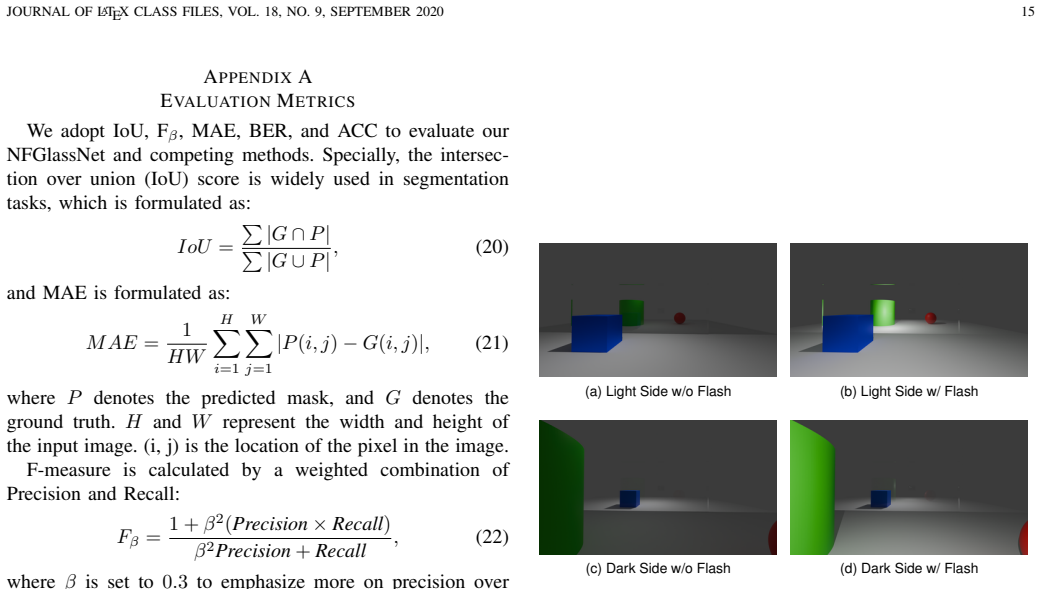
On the paper's own terms, the central claim is that reflection dynamics in flash/no-flash image pairs constitute a reliable, intrinsic cue for glass surface detection. The authors observe that when the camera is on the brighter side of a glass surface, existing reflections weaken or vanish after the flash is applied; conversely, when the camera is on the darker side, the flash makes reflections appear. NFGlassNet encodes this dynamic by subtracting features from the two images in a Reflection Contrast Mining Module, then fusing reflection and glass features with a Reflection Guided Attention Module, and it outperforms prior RGB-only and multimodal methods on the introduced NFGD benchmark (Io
What carries the argument
The central mechanism is the flash-induced change in reflection visibility on glass. The paper operationalizes this with the Reflection Contrast Mining Module (RCMM), which subtracts feature maps extracted from the flash and no-flash images under multiple dilated receptive fields to isolate reflection differences, and the Reflection Guided Attention Module (RGAM), which uses dual parallel cross-attention branches to fuse reflection features with glass features, combining the two attention maps into a shared map that enhances regions exhibiting both reflection and glass-frame properties. The training signal comes from the new NFGD dataset of 3,312 no-flash/flash pairs annotated for glass regi
Load-bearing premise
The method's entire signal rests on the assumption that illumination intensity in front of a glass surface usually differs from that behind it, so that a flash flips the visibility of reflections on glass; if the two sides are equally lit, or the glass has no reflective layer, the no-flash/flash difference no longer localizes glass.
What would settle it
Collect a set of flash/no-flash pairs of glass surfaces where the illumination on both sides of the glass is matched (e.g., an evenly lit room with glass partitions, or outdoor scenes with overcast light and no bright source behind the glass) and show that NFGlassNet's glass IoU drops toward that of a single-image baseline; alternatively, find a sequence of glossy floor or wall tiles that exhibit the same reflection appear/disappear behavior as glass and where the method systematically over-detects them.
If this is right
- A standard phone or DSLR flash, used to capture a no-flash/flash pair in quick succession, can serve as a practical sensor for glass detection, avoiding the cost and alignment issues of depth, thermal, polarization, or NIR sensors.
- The same contrast-between-two-exposures idea can be transferred to other transparent or glossy objects that change reflection behavior under active illumination.
- The method generalizes to single-image glass detection benchmarks (GDD and GSD) when both branches take the same RGB image, suggesting the learned features include usable static glass cues as well.
- The pseudo-ground-truth reflection supervision pipeline allows training a reflection detector without manually labeling reflections, only glass masks.
Where Pith is reading between the lines
- The underlying physical assumption — that the spaces in front of and behind a glass surface usually differ in illumination — is scene-dependent; the paper does not quantify how often it holds in the new dataset, so a natural extension is to measure performance conditioned on the measured front/back brightness ratio.
- The method may struggle on glossy non-glass surfaces such as polished tiles or mirrors, which also show flash-dependent reflections; a material-aware or context-based discriminator could be a necessary addition for real-world deployment.
- The two-backbone encoder design (no weight sharing) is not ablated against a weight-sharing or single-branch variant, so the specific necessity of separate backbones remains an open question for efficiency-minded follow-ups.
- The reflection dynamics cue could be combined with video motion cues, as the authors themselves propose, enabling glass detection without a user-toggled flash.
Editorial analysis
A structured set of objections, weighed in public.
Referee Report
Summary. The paper proposes NFGlassNet, a glass surface detection method that takes a no-flash/flash image pair as input and exploits the appearance/disappearance of reflections on glass caused by the flash. Two modules are introduced: RCMM extracts reflection contrast features from the two images, and RGAM fuses reflection and glass features through dual cross-attention with a shared attention map. The authors also collect NFGD, a dataset of ~3.3k no-flash/flash pairs with glass masks. On NFGD the method reports state-of-the-art results (IoU 86.17, Fβ 0.922, MAE 0.052, BER 0.053, ACC 0.934) and ablations attribute a +2.89 IoU gain to RCMM. Results on existing single-image benchmarks (GDD, GSD) and multimodal benchmarks (RGB-T, RGB-NIR) are also reported, with more modest gains or second-best performance. The central claim is that flash/no-flash reflection dynamics provide a reliable, sensor-free cue for glass localization.
Significance. If the central claim holds, the paper offers a practical and low-cost glass detection cue using only a standard camera flash, avoiding extra sensors such as depth, thermal, polarization, or NIR. The strengths are the fair retraining protocol on NFGD, the size of the new dataset, and the thorough module-level ablations. However, the significance is conditional on two unresolved issues: the reflection pseudo-labels are constructed using the ground-truth glass mask, which injects the target into the training signal for the reflection branch; and the claimed advantage is demonstrated mainly on a self-constructed dataset where the phenomenon is guaranteed by curation. Until these are addressed, the quantitative gains cannot be unambiguously attributed to the proposed reflection-dynamics mechanism.
major comments (3)
- [IV-B, Eq. (17), Table V] The reflection pseudo-labels are generated by 'first apply[ing] the ground-truth glass mask to cover the input image pair, and then adopt[ing] LANet to obtain the pseudo ground-truth reflections.' These labels supervise R^flash and R^no-flash through Eq. (17). This means the ground-truth glass mask is used to create the supervision for the reflection branch, so the RCMM is effectively told where glass is during training. The +2.89 IoU improvement of 'Base + RCMM' over 'Base' in Table V therefore likely includes a mask-leakage effect and cannot be cleanly attributed to exploitation of reflection dynamics. Please retrain the reflection branch with pseudo-labels that do not use the glass mask (e.g., raw no-flash/flash difference or flash-only cues) and re-report the ablations.
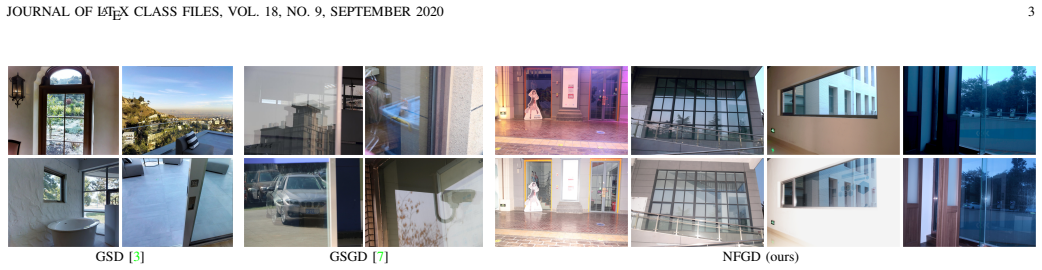
- [Abstract, Sec. I, Sec. III, Fig. 3, Tables III-IV] The claim of 'outperform[ing] the state-of-the-art methods' is supported on NFGD, a dataset whose every pair 'exhibits the appearance and disappearance phenomenon of reflections on glass surfaces' (Fig. 3 caption). The physical premise that 'in most real-world scenes, the illumination intensity in front of the glass surface differs from that behind it' (Sec. I) is never quantified, and no accuracy is reported conditioned on the presence or absence of the flash-induced reflection change. On external benchmarks the advantage is modest or reversed: Table IV shows second-best on RGB-T and RGB-NIR, and Table III on GDD gives +0.88 IoU over GhostingNet. Please report the prevalence of the phenomenon in a random sample of scenes and condition performance on the illumination imbalance; otherwise the abstract's unqualified claim should be tempered.
- [V-D, Fig. 12] The failure cases on smooth floor and wall tiles directly challenge the core discriminative claim: these non-glass surfaces exhibit the same flash-driven reflection change and are mis-detected as glass. The paper acknowledges this but only suggests future sensors. Since glossy non-glass surfaces are common indoors, this is not a peripheral failure mode but a counterexample to the specificity of the differential signal. Please quantify how frequently such glossy non-glass surfaces appear (in NFGD and in a naturalistic test set), and discuss or evaluate possible remedies within the current input modality, or explicitly restrict the claim to scenes where such surfaces are absent.
minor comments (6)
- [Appendix A, Eq. (24)] The formula for ACC is given as N_tp / N_p, which is recall, not pixel accuracy. The standard pixel accuracy is (TP+TN)/(P+N). The reported ACC numbers are inconsistent with the stated definition; please correct the formula and recompute if necessary.
- [Eq. (19)] The IoU loss term is written without parentheses, making the denominator ambiguous. It should be 1 - (G∩P)/(G∪P) or an equivalent expression consistent with Eq. (20).
- [Tables I-VIII] No error bars or multiple-seed variance are reported. Many ablation differences are small (e.g., Table VII, rows E vs. G: 85.35 vs. 86.17 IoU) and could be within random seed variability. Please report mean±std over at least three seeds for key tables.
- [Table IV] The table heading says 'Qualitative results' but the table contains quantitative numbers. This is likely a typo.
- [References and citations] There are citation inconsistencies: CIRNet is cited as [33] in the text but [47] in Table IV; WaveNet is [34] in one place and [47] in another; Table III has a stray 'TOD' label for TransLab/Trans2Seg. Please clean up citations and table labels.
- [Table II] The caption says 'four methods' but the table lists five methods including the proposed one. Please rephrase.
Circularity Check
Reflection supervision is constructed from the target glass mask, partially engineering the claimed reflections→glass cue; final inference on real pairs and external benchmarks keeps the central result from being fully circular.
specific steps
-
self definitional
[Sec. IV-B, 'Pseudo Ground Truth for Reflection'; loss Eqs. (17)-(18); ablation Table V]
"we first apply the ground-truth glass mask to cover the input image pair, and then adopt LANet [19] to obtain the pseudo ground-truth reflections ( ˆRno−flash, ˆRflash) from the masked no-flash and flash images."
The pseudo ground-truth for the reflection branch is generated by masking the input with the target glass mask, so the auxiliary reflection label is a function of Y (the glass annotation). Eq. (17) supervises RCMM's R^j_i with this label, so the 'reflection cues' that Table V credits with +2.89 IoU are not independently measured from flash/no-flash dynamics; the training signal already encodes where glass is. The RGAM then selects regions with 'both reflection and glass frame features', closing a loop in which the target defines the cue that is claimed to predict the target. This is partial: at inference the final mask is computed from real input pairs and is cross-checked on GDD/GSD/RGB-T/RGB-NIR, where gains are smaller or absent.
full rationale
The network itself is not a derivation that collapses to its inputs: RCMM/RGAM are trained and evaluated on actual flash/no-flash pairs, and Tables III–IV provide external benchmarks (GDD, GSD, RGB-T, RGB-NIR) where the method is competitive or second-best, so the central glass-mask prediction is not forced by construction. The one significant circular element is the pseudo-ground-truth reflection supervision: the reflection labels are obtained by masking the images with the GT glass mask (Sec. IV-B), so the auxiliary branch is told where glass is during training. This makes the causal claim 'reflection dynamics → glass' partly engineered. The NFGD itself is explicitly curated so 'each no-flash and flash image pair ... exhibits the appearance and disappearance phenomenon' (Fig. 3), so the large Table I margins do not measure prevalence of the phenomenon in natural scenes, and Fig. 12's tile failures confirm that glossy non-glass surfaces produce the same flash-driven reflection signal. These are validity limitations rather than additional definitional reductions; the self-citations (LANet [19], GSDNet [3]) are to published tools/baselines and are not load-bearing uniqueness claims. Overall score 4: partial circularity in the auxiliary supervision, while the central claim retains independent content.
Axiom & Free-Parameter Ledger
free parameters (4)
- λ (reflection loss weight) =
0.8
- RCMM dilation rates =
{1,2,4,8}
- Input resolution =
384×384
- Flash intensity settings =
×1/2, ×1/4, ×1/8 of 60GN
axioms (4)
- domain assumption Reflection-dynamics premise: in most scenes, illumination differs between the front and back of glass, so a flash flips reflection visibility on glass but not on non-glass surfaces.
- domain assumption LANet's reflection estimates, masked by the GT glass mask, are valid pseudo ground truths for the reflection branch.
- domain assumption No pixel offset exists between each no-flash and flash pair.
- domain assumption The NFGD ground-truth glass annotations are accurate.
read the original abstract
Glass surfaces are ubiquitous in daily life, typically appearing colorless, transparent, and lacking distinctive features. These characteristics make glass surface detection a challenging computer vision task. Existing glass surface detection methods always rely on boundary cues (\textit{e.g.}, window and door frames) or reflection cues to locate glass surfaces, but they fail to fully exploit the intrinsic properties of the glass itself for accurate localization. We observed that in most real-world scenes, the illumination intensity in front of the glass surface differs from that behind it, which results in variations in the reflections visible on the glass surface. Specifically, when standing on the brighter side of the glass and applying a flash towards the darker side, existing reflections on the glass surface tend to disappear. Conversely, while standing on the darker side and applying a flash towards the brighter side, distinct reflections will appear on the glass surface. Based on this phenomenon, we propose \textit{NFGlassNet}, a novel method for glass surface detection that leverages the reflection dynamics present in flash/no-flash imagery. Specifically, we propose a Reflection Contrast Mining Module (RCMM) for extracting reflections, and a Reflection Guided Attention Module (RGAM) for fusing features from reflection and glass surface for accurate glass surface detection. For learning our network, we also construct a dataset consisting of $\sim$3.3$K$ no-flash and flash image pairs captured from various scenes with corresponding ground truth annotations. Extensive experiments demonstrate that our method outperforms the state-of-the-art methods. Our code, model, and dataset will be available upon acceptance of the manuscript.
Figures






Reference graph
Works this paper leans on
-
[1]
Don’t hit me! glass detection in real-world scenes,
H. Mei, X. Yang, Y . Wang, Y . Liu, S. He, Q. Zhang, X. Wei, and R. W. Lau, “Don’t hit me! glass detection in real-world scenes,” in CVPR, 2020. 1, 2, 8, 9, 10, 15
2020
-
[2]
Segmenting transparent objects in the wild,
E. Xie, W. Wang, W. Wang, M. Ding, C. Shen, and P. Luo, “Segmenting transparent objects in the wild,” in ECCV, 2020. 3, 8, 10
2020
-
[3]
Rich context aggregation with reflection prior for glass surface detection,
J. Lin, Z. He, and R. W. Lau, “Rich context aggregation with reflection prior for glass surface detection,” in CVPR, 2021. 1, 2, 3, 4, 6, 7, 8, 9, 10, 15
2021
-
[4]
Enhanced boundary learning for glass-like object segmentation,
H. He, X. Li, G. Cheng, J. Shi, Y . Tong, G. Meng, V . Prinet, and L. Weng, “Enhanced boundary learning for glass-like object segmentation,” in CVPR, 2021. 1, 2, 8, 10
2021
-
[5]
Progressive glass segmentation,
L. Yu, H. Mei, W. Dong, Z. Wei, L. Zhu, Y . Wang, and X. Yang, “Progressive glass segmentation,” IEEE Trans. on Image Processing, vol. 31, 2022. 1, 2, 4, 7
2022
-
[6]
Glass makes blurs: Learning the visual blurriness for glass surface detection,
F. Qi, X. Tan, Z. Zhang, M. Chen, Y . Xie, and L. Ma, “Glass makes blurs: Learning the visual blurriness for glass surface detection,” IEEE Trans. on Industrial Informatics, vol. 20, no. 4, pp. 6631–6641, 2024. 2 TABLE VII ABLATION STUDY OF BLOCKS ON THE PROPOSEDRGAM. “M SHARED → MRELFE ,M GLASS ”REFERS TORGAMWITHOUT USING SHARED ATTENTION MAP BUT USE DUA...
arXiv 2024
-
[7]
Ghostingnet: A novel approach for glass surface detection with ghosting cues,
T. Yan, J. Gao, K. Xu, X. Zhu, H. Huang, H. Li, B. Wah, and R. W. H. Lau, “Ghostingnet: A novel approach for glass surface detection with ghosting cues,” IEEE Trans. on Pattern Analysis and Machine Intelligence, vol. 47, no. 1, pp. 323–337, 2025. 1, 2, 3, 8, 9, 10
2025
-
[8]
Gem: Boost simple network for glass surface segmentation via vision foundation models,
J. Hao, M. Liu, J. Yang, and K. F. Hung, “Gem: Boost simple network for glass surface segmentation via vision foundation models,” IEEE Trans. on Multimedia, pp. 1– 13, 2025. 1
2025
-
[9]
Depth-aware mirror segmentation,
H. Mei, B. Dong, W. Dong, P. Peers, X. Yang, Q. Zhang, and X. Wei, “Depth-aware mirror segmentation,” in CVPR, 2021. 4, 8, 9, 10, 11, 15
2021
-
[10]
Glass segmen- tation using intensity and spectral polarization cues,
H. Mei, B. Dong, W. Dong, J. Yang, S.-H. Baek, F. Heide, P. Peers, X. Wei, and X. Yang, “Glass segmen- tation using intensity and spectral polarization cues,” in CVPR, 2022. 1, 2, 4, 8
2022
-
[11]
Depth-aware glass surface detection with cross-modal context mining,
J. Lin, Y . H. Yeung, and R. W. Lau, “Depth-aware glass surface detection with cross-modal context mining,” arXiv:2206.11250, 2022
Pith/arXiv arXiv 2022
-
[12]
Exploiting semantic relations for glass surface detection,
J. Lin, Y .-H. Yeung, and R. Lau, “Exploiting semantic relations for glass surface detection,” in NeurIPS, 2022. 3, 8, 9, 10, 15
2022
-
[13]
Nrglassnet: Glass surface detection from visible and near-infrared image pairs,
T. Yan, S. Xu, H. Huang, H. Li, L. Tan, X. Chang, and R. W. Lau, “Nrglassnet: Glass surface detection from visible and near-infrared image pairs,” Knowledge-Based Systems, vol. 294, p. 111722, 2024. 1, 3, 4, 8, 10, 11, 15, 18
2024
-
[14]
Glass segmentation with rgb-thermal image pairs,
D. Huo, J. Wang, Y . Qian, and Y .-H. Yang, “Glass segmentation with rgb-thermal image pairs,” IEEE Trans. on Image Processing, vol. 32, pp. 1911–1926, 2023. 1, 3, 4, 8, 9, 10, 11, 15, 17 JOURNAL OF LATEX CLASS FILES, VOL. 18, NO. 9, SEPTEMBER 2020 13
1911
-
[15]
A dataset of flash and ambient illumination pairs from the crowd,
Y . Aksoy, C. Kim, P. Kellnhofer, S. Paris, M. Elgharib, M. Pollefeys, and W. Matusik, “A dataset of flash and ambient illumination pairs from the crowd,” in ECCV,
-
[16]
Robust reflection removal with reflection-free flash-only cues,
C. Lei and Q. Chen, “Robust reflection removal with reflection-free flash-only cues,” in CVPR, 2021. 2
2021
-
[17]
Light flickering guided reflection removal,
Y . Hong, Y . Chang, J. Liang, L. Ma, T. Huang, and B. Shi, “Light flickering guided reflection removal,” International Journal of Computer Vision, vol. 132, p. 3933–3953, 2024. 2
2024
-
[18]
A generic deep architecture for single image reflection removal and image smoothing,
Q. Fan, J. Yang, G. Hua, B. Chen, and D. Wipf, “A generic deep architecture for single image reflection removal and image smoothing,” in ICCV, 2017. 7
2017
-
[19]
Location-aware single image reflection removal,
Z. Dong, K. Xu, Y . Yang, H. Bao, W. Xu, and R. W. Lau, “Location-aware single image reflection removal,” in ICCV, 2021. 6, 15
2021
-
[20]
Single image reflection removal through cascaded refinement,
C. Li, Y . Yang, K. He, S. Lin, and J. E. Hopcroft, “Single image reflection removal through cascaded refinement,” in CVPR, 2020. 6
2020
-
[21]
Progressive mirror detection,
J. Lin, G. Wang, and R. W. Lau, “Progressive mirror detection,” in CVPR, 2020. 3, 8
2020
-
[22]
Cs- fwinformer: Cross-space-frequency window transformer for mirror detection,
Z. Xie, S. Wang, Q. Yu, X. Tan, and Y . Xie, “Cs- fwinformer: Cross-space-frequency window transformer for mirror detection,” IEEE Trans. on Image Processing, vol. 33, pp. 1853–1867, 2024. 3, 8, 9, 10, 15
2024
-
[23]
Utl- net: Uncertainty-aware transformer localization network for rgb-depth mirror segmentation,
W. Zhou, Y . Cai, L. Zhang, W. Yan, and L. Yu, “Utl- net: Uncertainty-aware transformer localization network for rgb-depth mirror segmentation,” IEEE Trans. on Multimedia, vol. 26, pp. 4564–4574, 2023. 4
2023
-
[24]
Glgfn: Global-local grafting fu- sion network for high-resolution image deraining,
T. Yan, X. Zhu, X. Chen, W. He, C. Wang, Y . Yang, Y . Wang, and X. Chang, “Glgfn: Global-local grafting fu- sion network for high-resolution image deraining,” IEEE Trans. on Circuits and Systems for Video Technology, vol. 34, no. 11, pp. 10 860–10 873, 2024
2024
-
[25]
Swin transformer v2: Scaling up capacity and resolution,
Z. Liu, H. Hu, Y . Lin, Z. Yao, Z. Xie, Y . Wei, J. Ning, Y . Cao, Z. Zhang, L. Dong et al., “Swin transformer v2: Scaling up capacity and resolution,” in CVPR, 2022. 4, 7
2022
-
[26]
Aggre- gated residual transformations for deep neural networks,
S. Xie, R. Girshick, P. Doll ´ar, Z. Tu, and K. He, “Aggre- gated residual transformations for deep neural networks,” in CVPR, 2017. 4
2017
-
[27]
Multi-modal reflection removal using convolutional neural networks,
J. Sun, Y . Chang, C. Jung, and J. Feng, “Multi-modal reflection removal using convolutional neural networks,” IEEE Signal Processing Letters, vol. 26, no. 7, pp. 1011– 1015, 2019. 6
2019
-
[28]
Guided slot attention for unsupervised video object segmentation,
M. Lee, S. Cho, D. Lee, C. Park, J. Lee, and S. Lee, “Guided slot attention for unsupervised video object segmentation,” in CVPR, 2024. 6, 12
2024
-
[29]
Dabert: Dual attention enhanced bert for semantic matching,
S. Wang, D. Liang, J. Song, Y . Li, and W. Wu, “Dabert: Dual attention enhanced bert for semantic matching,” ICCL, 2022
2022
-
[30]
A tutorial on the cross-entropy method,
P.-T. De Boer, D. P. Kroese, S. Mannor, and R. Y . Rubinstein, “A tutorial on the cross-entropy method,” Annals of Operations Research, vol. 134, pp. 19–67,
-
[31]
Basnet: Boundary-aware salient object detection,
X. Qin, Z. Zhang, C. Huang, C. Gao, M. Dehghan, and M. Jagersand, “Basnet: Boundary-aware salient object detection,” in CVPR, 2019. 7
2019
-
[32]
Specificity-preserving rgb-d saliency detec- tion,
T. Zhou, H. Fu, G. Chen, Y . Zhou, D.-P. Fan, and L. Shao, “Specificity-preserving rgb-d saliency detec- tion,” in ICCV, 2021. 8
2021
-
[33]
Cir-net: Cross-modality interaction and refinement for rgb-d salient object detection,
R. Cong, Q. Lin, C. Zhang, C. Li, X. Cao, Q. Huang, and Y . Zhao, “Cir-net: Cross-modality interaction and refinement for rgb-d salient object detection,” IEEE Tran. on Image Processing, vol. 31, pp. 6800–6815, 2022. 8
2022
-
[34]
Does thermal really always matter for rgb-t salient object detection?
R. Cong, K. Zhang, C. Zhang, F. Zheng, Y . Zhao, Q. Huang, and S. Kwong, “Does thermal really always matter for rgb-t salient object detection?” IEEE Trans. on Multimedia, vol. 25, pp. 6971–6982, 2022. 8, 9
2022
-
[35]
Segmenting transparent object in the wild with transformer,
E. Xie, W. Wang, W. Wang, P. Sun, H. Xu, D. Liang, and P. Luo, “Segmenting transparent object in the wild with transformer,” in IJCAI, 2021. 3, 10
2021
-
[36]
Trans4trans: Efficient transformer for transparent object segmentation to help visually impaired people navigate in the real world,
J. Zhang, K. Yang, A. Constantinescu, K. Peng, K. M ¨uller, and R. Stiefelhagen, “Trans4trans: Efficient transformer for transparent object segmentation to help visually impaired people navigate in the real world,” in ICCV, 2021
2021
-
[37]
Trans4trans: Efficient transformer for transparent object and semantic scene segmentation in real-world navigation assistance,
J. Zhang, K. Yang, A. Constantinescu, K. Peng, K. M ¨uller, and R. Stiefelhagen, “Trans4trans: Efficient transformer for transparent object and semantic scene segmentation in real-world navigation assistance,” IEEE Trans. Intell. Transp. Syst., vol. 23, no. 10, pp. 19 173– 19 186, 2022. 3
2022
-
[38]
Transfusion: A novel slam method focused on transparent objects,
Y . Zhu, J. Qiu, and B. Ren, “Transfusion: A novel slam method focused on transparent objects,” in ICCV, 2021. 3, 8
2021
-
[39]
Monocular depth estimation for glass walls with context: a new dataset and method,
Y . Liang, B. Deng, W. Liu, J. Qin, and S. He, “Monocular depth estimation for glass walls with context: a new dataset and method,” IEEE Trans. on Pattern Analysis and Machine Intelligence, vol. 45, no. 12, pp. 15 081– 15 097, 2023. 3
2023
-
[40]
Deep polarization cues for transparent object segmentation,
A. Kalra, V . Taamazyan, S. K. Rao, K. Venkataraman, R. Raskar, and A. Kadambi, “Deep polarization cues for transparent object segmentation,” in CVPR, 2020. 3
2020
-
[41]
Transcut: Transparent object segmentation from a light- field image,
Y . Xu, H. Nagahara, A. Shimada, and R.-i. Taniguchi, “Transcut: Transparent object segmentation from a light- field image,” in ICCV, 2015. 3
2015
-
[42]
Where is my mirror?
X. Yang, H. Mei, K. Xu, X. Wei, B. Yin, and R. W. Lau, “Where is my mirror?” in ICCV, 2019. 3
2019
-
[43]
Symmetry-aware transformer-based mirror de- tection,
T. Huang, B. Dong, J. Lin, X. Liu, R. W. Lau, and W. Zuo, “Symmetry-aware transformer-based mirror de- tection,” in AAAI, 2023. 3
2023
-
[44]
Learning semantic associations for mirror detection,
H. Guan, J. Lin, and R. W. Lau, “Learning semantic associations for mirror detection,” in CVPR, 2022. 3
2022
-
[45]
Mirror detection with the visual chirality cue,
X. Tan, J. Lin, K. Xu, P. Chen, L. Ma, and R. W. Lau, “Mirror detection with the visual chirality cue,” IEEE Trans. on Pattern Analysis and Machine Intelligence, vol. 45, no. 3, pp. 3492–3504, 2022. 3
2022
-
[46]
blender,
Blender, “blender,” https://www.blender.org/, 2024. 2
2024
-
[47]
Wavenet: Wavelet network with knowledge distillation for rgb-t salient object detection,
W. Zhou, F. Sun, Q. Jiang, R. Cong, and J.-N. Hwang, “Wavenet: Wavelet network with knowledge distillation for rgb-t salient object detection,” IEEE Trans. on Image Processing, 2023. 9, 11, 15
2023
-
[48]
Decoupled weight decay regularization,
I. Loshchilov and F. Hutter, “Decoupled weight decay regularization,” in ICLR, 2019. 7
2019
-
[49]
Efficient inference in JOURNAL OF LATEX CLASS FILES, VOL. 18, NO. 9, SEPTEMBER 2020 14 fully connected crfs with gaussian edge potentials,
P. Kr ¨ahenb¨uhl and V . Koltun, “Efficient inference in JOURNAL OF LATEX CLASS FILES, VOL. 18, NO. 9, SEPTEMBER 2020 14 fully connected crfs with gaussian edge potentials,” in NeurIPS, 2011. 7
2020
-
[50]
Frequency-tuned salient region detection,
R. Achanta, S. Hemami, F. Estrada, and S. Susstrunk, “Frequency-tuned salient region detection,” in CVPR,
-
[51]
Cbam: Convolutional block attention module,
S. Woo, J. Park, J.-Y . Lee, and I. S. Kweon, “Cbam: Convolutional block attention module,” in ECCV, 2018. 9, 12
2018
-
[52]
Imagenet: A large-scale hierarchical image database,
J. Deng, W. Dong, R. Socher, L.-J. Li, K. Li, and L. Fei-Fei, “Imagenet: A large-scale hierarchical image database,” in CVPR, 2009. 7
2009
-
[53]
U-net: Con- volutional networks for biomedical image segmentation,
O. Ronneberger, P. Fischer, and T. Brox, “U-net: Con- volutional networks for biomedical image segmentation,” in MICCAI, 2015. 6
2015
-
[54]
Leveraging rgb-d data with cross-modal context mining for glass surface detection,
J. Lin, Y .-H. Yeung, S. Ye, and R. W. Lau, “Leveraging rgb-d data with cross-modal context mining for glass surface detection,” in AAAI, 2025. 1, 2, 4, 8
2025
-
[55]
Reflection removal via recurrent learning guided by physics prior and focal perceptual loss,
Z. Shi, Y . Li, and F. Zhang, “Reflection removal via recurrent learning guided by physics prior and focal perceptual loss,” IEEE Trans. on Circuits and Systems for Video Technology, vol. 34, no. 10, pp. 10 152–10 165,
-
[56]
Few-shot learn- ing for image denoising,
B. Jiang, Y . Lu, B. Zhang, and G. Lu, “Few-shot learn- ing for image denoising,” IEEE Trans. on Circuits and Systems for Video Technology, vol. 33, no. 9, pp. 4741– 4753, 2023
2023
-
[57]
Dual domain perception and progressive refinement for mirror detection,
M. Zha, F. Fu, Y . Pei, G. Wang, T. Li, X. Tang, Y . Yang, and H. Tao Shen, “Dual domain perception and progressive refinement for mirror detection,” IEEE Trans. on Circuits and Systems for Video Technology, vol. 34, no. 11, pp. 11 942–11 953, 2024. 3
2024
-
[58]
Highly efficient rgb-d salient object detection with adaptive fusion and attention regulation,
H. Gao, F. Wang, M. Wang, F. Sun, and H. Li, “Highly efficient rgb-d salient object detection with adaptive fusion and attention regulation,” IEEE Trans. on Circuits and Systems for Video Technology, pp. 1–1, 2024. 4, 8
2024
-
[59]
Dgpinet-kd: Deep guided and progressive integration network with knowledge distillation for rgb- d indoor scene analysis,
W. Zhou, B. Jian, M. Fang, X. Dong, Y . Liu, and Q. Jiang, “Dgpinet-kd: Deep guided and progressive integration network with knowledge distillation for rgb- d indoor scene analysis,” IEEE Trans. on Circuits and Systems for Video Technology, vol. 34, no. 9, pp. 7844– 7855, 2024
2024
-
[60]
Rgb- t semantic segmentation with location, activation, and sharpening,
G. Li, Y . Wang, Z. Liu, X. Zhang, and D. Zeng, “Rgb- t semantic segmentation with location, activation, and sharpening,” IEEE Trans. on Circuits and Systems for Video Technology, vol. 33, no. 3, pp. 1223–1235, 2023. 8
2023
-
[61]
Depth injection framework for rgbd salient object detection,
S. Yao, M. Zhang, Y . Piao, C. Qiu, and H. Lu, “Depth injection framework for rgbd salient object detection,” IEEE Trans. on Image Processing, vol. 32, pp. 5340– 5352, 2023
2023
-
[62]
Encoder deep interleaved network with multi-scale aggregation for rgb- d salient object detection,
G. Feng, J. Meng, L. Zhang, and H. Lu, “Encoder deep interleaved network with multi-scale aggregation for rgb- d salient object detection,” Pattern Recognition, vol. 128, p. 108666, 2022
2022
-
[63]
Towards deeply unified depth-aware panoptic segmentation with bi-directional guidance learning,
J. He, Y . Wang, L. Wang, H. Lu, B. Luo, J.-Y . He, J.- P. Lan, Y . Geng, and X. Xie, “Towards deeply unified depth-aware panoptic segmentation with bi-directional guidance learning,” in ICCV, 2023
2023
-
[64]
Cross-modal and cross-level attention interaction net- work for salient object detection,
F. Wang, Y . Su, R. Wang, J. Sun, F. Sun, and H. Li, “Cross-modal and cross-level attention interaction net- work for salient object detection,” IEEE Trans. on Artificial Intelligence, vol. 5, no. 6, pp. 2907–2920, 2024. 4
2024
-
[65]
Panoglassnet: Glass detection with panoramic rgb and intensity images,
Q. Chang, H. Liao, X. Meng, S. Xu, and Y . Cui, “Panoglassnet: Glass detection with panoramic rgb and intensity images,” IEEE Trans. on Instrumentation and Measurement, vol. 73, pp. 1–15, 2024. 1
2024
-
[66]
Specificity-preserving RGB-D saliency detection,
T. Zhou, H. Fu, G. Chen, Y . Zhou, D. Fan, and L. Shao, “Specificity-preserving RGB-D saliency detection,” in ICCV, 2021. 11, 15
2021
-
[67]
Saliency detection with flash and no-flash image pairs,
S. He and R. W. Lau, “Saliency detection with flash and no-flash image pairs,” in ECCV, 2014, pp. 110–124. 3
2014
-
[68]
Deep denoising of flash and no-flash pairs for photography in low-light environments,
Z. Xia, M. Gharbi, F. Perazzi, K. Sunkavalli, and A. Chakrabarti, “Deep denoising of flash and no-flash pairs for photography in low-light environments,” in CVPR, 2021, pp. 2063–2072. 3
2021
-
[69]
Laplacian gradient consistency prior for flash guided non-flash image denoising,
J. Xu, X. Deng, C. Zhang, S. Li, and M. Xu, “Laplacian gradient consistency prior for flash guided non-flash image denoising,” IEEE Trans. on Image Processing,
-
[70]
Digital photography with flash and no-flash image pairs,
G. Petschnigg, R. Szeliski, M. Agrawala, M. Cohen, H. Hoppe, and K. Toyama, “Digital photography with flash and no-flash image pairs,” ACM trans. on graphics (TOG), vol. 23, no. 3, pp. 664–672, 2004. 3
2004
-
[71]
Stereoscopic flash and no-flash photog- raphy for shape and albedo recovery,
X. Cao, M. Waechter, B. Shi, Y . Gao, B. Zheng, and Y . Matsushita, “Stereoscopic flash and no-flash photog- raphy for shape and albedo recovery,” in CVPR, 2020, pp. 3430–3439. 3
2020
-
[72]
Siamese dense network for reflection removal with flash and no-flash image pairs,
Y . Chang, C. Jung, J. Sun, and F. Wang, “Siamese dense network for reflection removal with flash and no-flash image pairs,” International Journal of Computer Vision, vol. 128, no. 6, pp. 1673–1698, 2020. 3
2020
-
[73]
Computational flash photography through intrinsics,
S. S. Maralan, C. Careaga, and Y . Aksoy, “Computational flash photography through intrinsics,” in CVPR, 2023, pp. 16 654–16 662. 3
2023
-
[74]
Rfenet: Towards reciprocal feature evolution for glass segmentation,
K. Fan, C. Wang, Y . Wang, C. Wang, R. Yi, and L. Ma, “Rfenet: Towards reciprocal feature evolution for glass segmentation,” in IJCAI, 2023. 10
2023
-
[75]
Sam 3: Segment anything with concepts,
N. Carion, L. Gustafson, Y . T. Hu, et al., “Sam 3: Segment anything with concepts,” arXiv preprint arXiv:2511.16719, 2025. 8 JOURNAL OF LATEX CLASS FILES, VOL. 18, NO. 9, SEPTEMBER 2020 15 APPENDIXA EVALUATIONMETRICS We adopt IoU, F β, MAE, BER, and ACC to evaluate our NFGlassNet and competing methods. Specially, the intersec- tion over union (IoU) score...
Pith/arXiv arXiv 2025
discussion (0)
Sign in with ORCID, Apple, or X to comment. Anyone can read and Pith papers without signing in.