REVIEW 2 minor 41 references
Reviewed by Pith at T0; open to challenge.
T0 means a machine referee read the full paper against a public rubric. The mark states how deep the mechanical check went, never who wrote it. the ladder, T0–T4 →
T0 review · grok-4.3
Mean-field master equation yields closed analytical spinodal surfaces for active particles on six Bravais lattices.
2026-06-27 20:18 UTC pith:CGQH3RPZ
load-bearing objection This paper supplies closed analytical spinodals for an active lattice gas by reducing all geometry dependence to one coefficient A evaluated on six Bravais lattices.
Exact mean-field phase diagram for self-avoiding active particles in a lattice
The pith
A machine-rendered reading of the paper's core claim, the machinery that carries it, and where it could break.
Core claim
Linearization of the mean-field master equation around the homogeneous stationary state, followed by Bloch's theorem, reduces the stability analysis to a z-dimensional tight-binding eigenvalue problem. A perturbation expansion in wavenumber near zero then produces the spinodal surface in closed form for the linear, square, hexagonal, simple cubic, body-centered cubic, and face-centered cubic lattices, with all geometric influence captured by one coefficient A that is evaluated exactly in each case. Translational diffusion is shown to smooth the interface between dense and dilute phases, and the rotational probability currents associated with the inhomogeneous states are computed explicitly.
What carries the argument
The z-dimensional tight-binding eigenvalue problem obtained after linearizing the mean-field master equation and applying Bloch's theorem, whose small-wavenumber expansion isolates lattice geometry into the single coefficient A.
Load-bearing premise
The general mean-field approximation to the master equation is sufficient to locate the linear instability of the homogeneous state.
What would settle it
Numerical comparison of the analytically predicted spinodal densities against direct stochastic simulations of the underlying master equation on the same six lattices.
If this is right
- The spinodal density is obtained as an explicit algebraic function of the model parameters for each lattice.
- All effects of lattice geometry are confined to the single exactly computed coefficient A.
- Translational diffusion reduces the sharpness of the dense-dilute interface.
- Inhomogeneous stationary states carry nonzero rotational probability currents that signal broken detailed balance.
Where Pith is reading between the lines
- The same reduction to a tight-binding problem could be applied to lattices with longer-range hops or to continuous-space limits.
- The explicit form of A for each lattice supplies a quantitative ranking of how strongly geometry stabilizes or destabilizes the uniform phase.
- The rotational currents computed for the phase-separated states offer a measurable signature that distinguishes active from passive phase separation in experiments.
Editorial analysis
A structured set of objections, weighed in public.
Referee Report
Summary. The manuscript develops a mean-field theory for motility-induced phase separation in a lattice gas of self-propelled particles subject to hard-core exclusion, internal director bias, rotational diffusion, and translational diffusion. Starting from the master equation under a general mean-field closure, the homogeneous state is linearized; Bloch's theorem reduces the stability problem to a z-dimensional tight-binding eigenvalue problem whose small-k expansion yields a closed-form spinodal surface. Lattice geometry enters solely through a single exactly evaluated coefficient A for the linear, square, hexagonal, simple-cubic, bcc and fcc lattices. Translational diffusion is shown to smooth interfaces and rotational probability currents are computed for the inhomogeneous states.
Significance. If the derivation holds, the work supplies parameter-free, analytically closed spinodal expressions across six Bravais lattices, a clean reduction of all geometric dependence to the single scalar A, and explicit non-equilibrium currents. These features constitute a reproducible, falsifiable benchmark for lattice active-matter models and enable direct comparison with simulations without fitting parameters.
minor comments (2)
- [Abstract] The abstract states that the spinodal is obtained 'in closed analytical form'; a brief remark in the main text confirming that the final expression for the critical density contains no implicit numerical roots would strengthen this claim.
- A compact table listing the exact numerical values of A for each of the six lattices would improve readability and allow immediate cross-lattice comparison.
Simulated Author's Rebuttal
We thank the referee for their positive assessment of the manuscript and for recommending acceptance. The referee's summary accurately reflects the derivation of the exact mean-field spinodal surfaces via the Bloch reduction and the role of the single coefficient A across the six lattices.
Circularity Check
No significant circularity identified
full rationale
The paper derives the spinodal surface via direct linearization of its stated mean-field master equation, followed by Bloch's theorem reduction to a tight-binding eigenvalue problem and a small-k perturbation expansion. These steps are algebraic consequences of the model's own equations and standard lattice symmetry arguments; lattice dependence collapses to a single exactly computed coefficient A with no fitted inputs, no self-citations invoked as load-bearing premises, and no renaming or ansatz smuggling. The derivation is therefore self-contained against the paper's own closure and does not reduce to its inputs by construction.
Axiom & Free-Parameter Ledger
axioms (2)
- domain assumption Mean-field approximation closes the master equation by factoring joint probabilities into single-particle densities.
- domain assumption Linearization around the homogeneous stationary state identifies the onset of phase separation.
read the original abstract
We investigate motility-induced phase separation in a lattice gas of self-propelled particles with hard-core exclusion, where an internal director biases particle hopping along the lattice coordination directions while undergoing rotational diffusion, together with a thermal-like translational diffusion. Rather than employing stochastic simulations, we adopt a master-equation formalism within a general mean-field approximation. By linearizing the mean-field master equation around the homogeneous stationary state and applying Bloch's theorem, the stability analysis is reduced to a $z$-dimensional tight-binding eigenvalue problem. A perturbation expansion in the wavenumber near $\vk = 0$ then yields the spinodal surface in closed analytical form for six Bravais lattices: linear, square, hexagonal, simple cubic, body-centered cubic, and face-centered cubic. The influence of lattice geometry is shown to enter exclusively through a single coefficient $\mathcal{A}$ which we evaluate exactly for each case. We further show that translational diffusion smooths the interface between the dense and dilute phases. Finally, we determine the rotational probability currents associated with the inhomogeneous stationary states, a distinctive signature of the broken detailed balance underlying active-system dynamics.
Figures


Reference graph
Works this paper leans on
-
[1]
That is, if the target site is unoccupied, the hop occurs with probability wa dt, where dt is an infinitesimal time increment
Active motion: a particle attempts to move in the direction of its current internal director with rate wa. That is, if the target site is unoccupied, the hop occurs with probability wa dt, where dt is an infinitesimal time increment
-
[2]
As before, the move is accepted only if the target site is empty
Translational diffusion: independently of its inter- nal director, a particle attempts to move to a ran- domly chosen nearest-neighbor site with rate wt. As before, the move is accepted only if the target site is empty
-
[3]
up”, the director may rotate to “left
Rotational diffusion of the director: the internal di- rector can rotate to any of its adjacent directions with rate wr. Our adjacency criterium is of mini- mal angle between lattice directions. For instance, on a square lattice, if the current direction is “up”, the director may rotate to “left” or “right” with probability wr dt each. III. THE MEAN-FIELD...
-
[4]
0 0. 2 0. 4 0. 6 0. 8
-
[5]
contracted
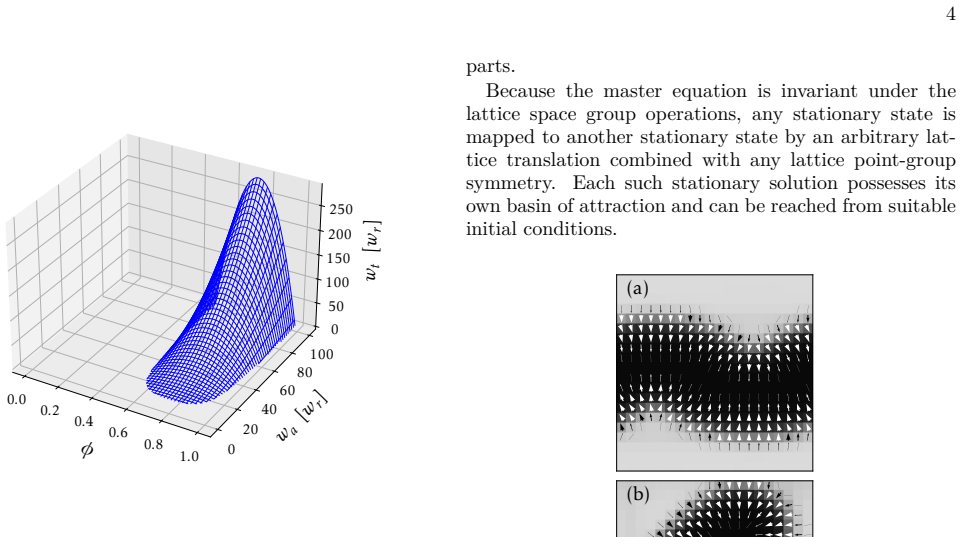
0φ 0 20 40 60 80 100 wa [wr] 0 50 100 150 200 250 w t [w r] FIG. 1. The spinodal surface in parameter space for the square lattice. wa and wt are the active motion and transla- tional diffusion rates respectively (both expressed in terms of the rotational diffusion rate wr), ϕ is the lattice filling frac- tion. The homogeneous stationary state is locally ...
-
[6]
compresses
00 0 . 25 0 . 50 0 . 75 1 . 00 ρ FIG. 2. A verage site occupation (grayscale) and persistence velocity (arrow thickness) for two stationary solutions of the ME at wt = 0, wa = 20 wr, ϕ = 0.6 on a 20×20 square lattice. The homogeneous state is locally unstable for these param- eters, while both solutions are locally stable and represent distinct manifestat...
-
[7]
All three parameters deep inside the domain of instability of the homogeneous state
The effect of the translational diffusion Still in a 20 × 20 square lattice, Figure 3 shows the average site occupation of three locally stable stationary solutions of the ME, with parameters wa = 60 wr, ϕ = 0.75 and wt = 0 in panel (a), wt = 5 wr in panel (b), and wt = 10 wr in panel (c). All three parameters deep inside the domain of instability of the ...
-
[8]
00 0 . 25 0 . 50 0 . 75 1 . 00 ρ FIG. 3. A verage site occupation (grayscale) for three stationary ME solutions in a 20 × 20 square lattice at wa = 60 , wr, ϕ = 0 .75, and increasing wt: (a) 0, (b) 5 wr, (c) 10 wr. Motility-induced phase separation appears as a gas pocket within a dense phase; as wt increases, the interface becomes progressively more diffuse
-
[9]
All inhomogeneous station- ary solutions of the ME display a non-zero, hence purely rotational, probability current
The rotational probability current The master equation can be viewed as a discrete prob- ability continuity equation, and its stationary states have divergenceless probability currents (see the lattice expres- sion for the current in the SI). All inhomogeneous station- ary solutions of the ME display a non-zero, hence purely rotational, probability curren...
-
[10]
Following this escape, trajectories evolve toward a stable inhomogeneous state
Homogeneous state escape time We consider the mean escape time of an initial condi- tion in the vicinity of the unstable homogeneous steady state. Following this escape, trajectories evolve toward a stable inhomogeneous state. The escape time is gov- erned by the number and magnitude of the eigenvalues of JH with positive real parts, as well as by the pro...
-
[11]
00 0 . 25 0 . 50 0 . 75 1 . 00 ρ FIG. 4. A verage site occupation (grayscale) and probability current (arrow thickness) of the two inhomogenous station- ary states shown in Fig. 2. The rotational steady probability current in the low concentration region. We followed the time evolution of the decrease of the dimensionless entropy per particle, ∆S(t) ≡ − 1...
-
[12]
00 0 . 25 0 . 50 0 . 75 1 . 00 ρ FIG. 6. A verage site occupation (gray tones) and (a) aver- age site persistence velocity; and (b) site probability current (in both cases, magnitude indicated by arrow thickness) of a particular, locally stable, inhomogeneous stationary state of the ME obtained with {wt = 0 , wa = 20 wr, ϕ = 0 .5}, i.e., outside the spino...
2013
-
[13]
Statistical mechanics of interacting run-and-tumble bacteria,
J. Tailleur and M. E. Cates, “Statistical mechanics of interacting run-and-tumble bacteria,” Phys. Rev. Lett. , vol. 100, p. 218103, May 2008
2008
-
[14]
Athermal phase separation of self-propelled particles with no alignment,
Y. Fily and M. C. Marchetti, “Athermal phase separation of self-propelled particles with no alignment,” Phys. Rev. Lett., vol. 108, p. 235702, June 2012
2012
-
[15]
Struc- ture and dynamics of a phase-separating active colloidal fluid,
G. S. Redner, M. F. Hagan, and A. Baskaran, “Struc- ture and dynamics of a phase-separating active colloidal fluid,” Phys. Rev. Lett. , vol. 110, p. 055701, Jan. 2013
2013
-
[16]
Dynamical clustering and phase separation in suspensions of self-propelled colloidal particles,
I. Buttinoni, J. Bialke, F. Kümmel, H. Löwen, C. Bechinger, and T. Speck, “Dynamical clustering and phase separation in suspensions of self-propelled colloidal particles,” Phys. Rev. Lett. , vol. 110, p. 238301, May 2013
2013
-
[17]
Hydro- dynamics of soft active matter,
M. C. Marchetti, J. F. Joanny, S. Ramaswamy, T. B. Liverpool, J. Prost, M. Rao, and R. A. Simha, “Hydro- dynamics of soft active matter,” Rev. Mod. Phys., vol. 85, pp. 1143–1189, July 2013
2013
-
[18]
Motility-induced phase separation,
M. E. Cates and J. Tailleur, “Motility-induced phase separation,” Annu. Rev. Condens. Matter Phys. , vol. 6, pp. 219–244, Mar. 2015
2015
-
[19]
The 2020 motile active matter roadmap,
G. Gompper, R. G. Winkler, T. Speck, A. Solon, C. Nar- dini, F. Peruani, H. Löwen, R. Golestanian, U. B. Kaupp, L. Alvarez, T. Kjørboe, E. Lauga, W. C. K. Poon, A. DeSimone, S. Muños-Landin, A. Fischer, N. A. Söker, F. Cichos, R. Kapral, P. Gaspard, M. Ripoll, F. Sagues, A. Doostmohammadi, J. M. Yeomans, I. S. Aranson, C. Bechinger, H. Stark, C. K. Hemelr...
2020
-
[20]
Lattice models of nonequilibrium bacterial dynamics,
A. G. Thompson, J. Tailleur, M. E. Cates, and R. A. Blythe, “Lattice models of nonequilibrium bacterial dynamics,” J. Stat. Mech: Theory Exp. , vol. 2011, p. P02029, Feb. 2011
2011
-
[21]
Revisiting the flocking tran- sition using active spins,
A. P. Solon and J. Tailleur, “Revisiting the flocking tran- sition using active spins,” Phys. Rev. Lett. , vol. 111, p. 078101, Aug. 2013
2013
-
[22]
Flocking with discrete sym- metry: The two-dimensional active ising model,
A. P. Solon and J. Tailleur, “Flocking with discrete sym- metry: The two-dimensional active ising model,” Phys. Rev. E , vol. 92, p. 042119, Oct. 2015
2015
-
[23]
Run-and-tumble dynamics in a crowded environment: Persistent exclusion process for swimmers,
R. Soto and R. Golestanian, “Run-and-tumble dynamics in a crowded environment: Persistent exclusion process for swimmers,” Phys. Rev. E , vol. 89, p. 012706, Jan. 2014
2014
-
[24]
Critical behavior in active lattice models of motility-induced phase sepa- ration,
F. Dittrich, T. Speck, and P. Virnau, “Critical behavior in active lattice models of motility-induced phase sepa- ration,” Eur. Phys. J. E , vol. 44, Apr. 2021
2021
-
[25]
Phase sepa- ration and large deviations of lattice active matter,
S. Whitelam, K. Klymko, and D. Mandal, “Phase sepa- ration and large deviations of lattice active matter,” J. Chem. Phys. , vol. 148, p. 154902, Apr. 2018
2018
-
[26]
Interfacial and density fluctua- tions in a lattice model of motility-induced phase sepa- ration,
L. Yao and R. L. Jack, “Interfacial and density fluctua- tions in a lattice model of motility-induced phase sepa- ration,” J. Chem. Phys. , vol. 162, p. 114902, Mar. 2025
2025
-
[27]
When are active brownian particles and run-and-tumble particles equivalent? con- sequences for motility-induced phase separation,
M. E. Cates and J. Tailleur, “When are active brownian particles and run-and-tumble particles equivalent? con- sequences for motility-induced phase separation,” Euro- phys. Lett. , vol. 101, p. 20010, Jan. 2013
2013
-
[28]
Continuum theory of phase separation kinetics for active Brownian particles,
J. Stenhammar, A. Tiribocchi, R. J. Allen, D. Maren- duzzo, and M. E. Cates, “Continuum theory of phase separation kinetics for active Brownian particles,” Phys. Rev. Lett., vol. 111, p. 145702, Oct. 2013
2013
-
[29]
Microscopic theory for the phase separation of self-propelled repulsive disks,
J. Bialké, H. Löwen, and T. Speck, “Microscopic theory for the phase separation of self-propelled repulsive disks,” Europhys. Lett., vol. 103, p. 30008, aug 2013
2013
-
[30]
Diffusive transport without detailed bal- ance in motile bacteria: Does microbiology need statisti- cal physics?,
M. E. Cates, “Diffusive transport without detailed bal- ance in motile bacteria: Does microbiology need statisti- cal physics?,” Rep. Prog. Phys. , vol. 75, p. 042601, Mar. 2012
2012
-
[31]
Nonequilibrium physics in biology,
X. Fang, K. Kruse, T. Lu, and J. Wang, “Nonequilibrium physics in biology,” Rev. Mod. Phys. , vol. 91, p. 045004, Dec. 2019
2019
-
[32]
Nonequilibrium thermodynamics in cell biology: Extending equilibrium formalism to cover living systems,
X. Fang and J. Wang, “Nonequilibrium thermodynamics in cell biology: Extending equilibrium formalism to cover living systems,” Annu. Rev. Biophys. , vol. 49, pp. 227– 246, May 2020
2020
-
[33]
How far from equilibrium Is active matter?,
É. Fodor, C. Nardini, M. E. Cates, J. Tailleur, P. Visco, and F. van Wijland, “How far from equilibrium Is active matter?,” Phys. Rev. Lett., vol. 117, p. 038103, July 2016
2016
-
[34]
Entropy production in field theories without Time-Reversal symmetry: Quan- tifying the non-equilibrium character of active matter,
C. Nardini, É. Fodor, E. Tjhung, F. van Wijland, J. Tailleur, and M. E. Cates, “Entropy production in field theories without Time-Reversal symmetry: Quan- tifying the non-equilibrium character of active matter,” Phys. Rev. X , vol. 7, p. 021007, Apr. 2017
2017
-
[35]
Self- starting micromotors in a bacterial bath,
L. Angelani, R. Di Leonardo, and G. Ruocco, “Self- starting micromotors in a bacterial bath,” Phys. Rev. Lett., vol. 102, p. 048104, Jan. 2009
2009
-
[36]
Bac- terial ratchet motors,
R. Di Leonardo, L. Angelani, D. Dell’Arciprete, G. Ruocco, V. Iebba, S. Schippa, M. P. Conte, F. Mecarini, F. De Angelis, and E. Di Fabrizio, “Bac- terial ratchet motors,” Proc. Natl. Acad. Sci. , vol. 107, pp. 9541–9545, May 2010
2010
-
[37]
Bro- ken detailed balance at mesoscopic scales in active bi- ological systems,
C. Battle, C. P. Broedersz, N. Fakhri, V. F. Geyer, J. Howard, C. F. Schmidt, and F. C. MacKintosh, “Bro- ken detailed balance at mesoscopic scales in active bi- ological systems,” Science, vol. 352, pp. 604–607, Apr. 2016. 8
2016
-
[38]
Exact hydrodynamic description of active lattice gases,
M. Kourbane-Houssene, C. Erignoux, T. Bodineau, and J. Tailleur, “Exact hydrodynamic description of active lattice gases,” Phys. Rev. Lett. , vol. 120, p. 268003, June 2018
2018
-
[39]
Role of translational noise in motility-induced phase separation of hard active particles,
F. Hawthorne, P. d. Castro, and J. A. Freire, “Role of translational noise in motility-induced phase separation of hard active particles,” Phys. Rev. E , vol. 112, Oct. 2025
2025
-
[40]
Freezing and phase separation of self-propelled disks,
Y. Fily, S. Henkes, and M. C. Marchetti, “Freezing and phase separation of self-propelled disks,” Soft Matter , vol. 10, no. 13, pp. 2132–2140, 2014
2014
-
[41]
Motility- induced phase separation Is reentrant,
J. Su, M. Feng, Y. Du, H. Jiang, and Z. Hou, “Motility- induced phase separation Is reentrant,” Commun. Phys. , vol. 6, p. 58, Mar. 2023. Supporting Information for Exact mean-field phase diagram for self-avoiding active particles in a lattice Felipe Hawthorne, 1, 2 Cristiano F. Woellner, 1, 2 and José A. Freire 1, ∗ 1Department of Physics, Federal Univer...
2023
discussion (0)
Sign in with ORCID, Apple, or X to comment. Anyone can read and Pith papers without signing in.