REVIEW 3 major objections 6 minor 40 references
Performance Analysis and Optimization of STAR-RIS-Aided Cell-Free Massive MIMO Systems Relying on Imperfect Hardware
T0 review · 3 major / 6 minor · reviewed 2026-08-10 · deepseek-v4-flash
Pith's one-line read A closed-form downlink SE is derived for imperfect-hardware STAR-RIS cell-free MIMO, and joint design lifts the worst-user SINR.
desk verdict Solid closed-form SE analysis for STAR-RIS cell-free MIMO under hardware impairments; the AO convergence proof does not match the algorithm as written. read the letter →
The pith
A machine-rendered reading of the paper's core claim, the machinery that carries it, and where it could break.
The reading
What carries the argument
The load-bearing object is the linear MMSE cascaded-channel estimator and its covariance: $\hat{\mathbf{h}}_{mk}(0)=\sqrt{\gamma_T\gamma_R p \tau_p}\mathbf{R}_{mk}\mathbf{\Psi}_{mk}^{-1}\mathbf{z}_{mk}(0)$ with $\mathbf{\Psi}_{mk}$ in (5), built from the channel covariance $\mathbf{R}_{mk}=\mathbf{R}^d_{mk}+\mathbf{R}_{A,m}\mathrm{tr}(\mathbf{R}^f_{mk})$ that folds in STAR-RIS phase errors through the characteristic-function coefficient $\varsigma_p$. Proposition 1's SINR formula carries the argument: it turns every impairment--phase noise, RIS phase error, transceiver distortion, pilot contamination--into explicit trace terms that depend only on statistics. The optimization machinery is an alternating algorithm: adaptive particle swarm optimization for the $3N$ STAR-RIS amplitude and phase parameters, and a bisection method over second-order-cone feasibility for power control.
What would settle it
Set up the same system with a deterministic line-of-sight component in the AP-RIS channel (for example a Rician factor of 5-10 dB) while keeping all other parameters fixed, and compare the downlink ergodic spectral efficiency from Monte Carlo with the closed-form prediction of Eq. (13); a systematic gap that grows with the Rician factor would show that the Rayleigh-product assumption, not just the estimation bound, carries the result.
Extended reading notes
Core claim
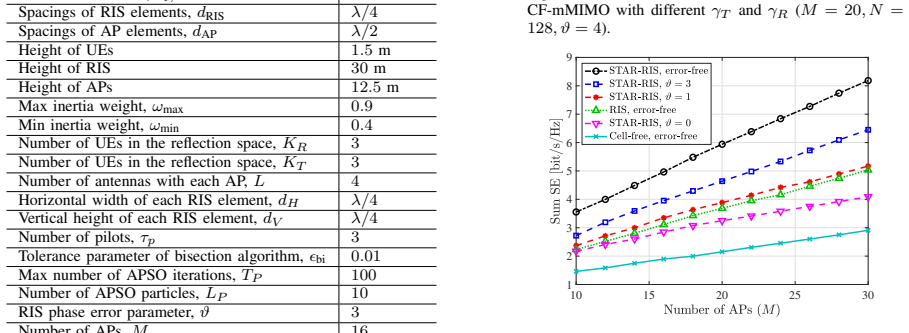
The central claim is Proposition 1: for maximum-ratio precoding and arbitrary STAR-RIS passive beamforming, the downlink ergodic SINR of each user has the exact closed form in (15)-(16), with the desired-signal power $\gamma_R\gamma_T\rho e^{-\delta^2 t}|\mathrm{tr}(\boldsymbol{\eta}_k^{1/2}\boldsymbol{\Omega}_k)|^2$ and a denominator $D_k(t)$ that collects beamforming uncertainty, pilot-contamination interference, transmitter and receiver distortions, and noise. Each term is written in channel covariance matrices, MMSE error covariances, hardware quality factors, and phase-noise variances, so the spectral efficiency in (13) is computable from channel statistics alone. The proof decomposes the received signal into desired, beamforming-uncertainty, inter-user interference, and hardware-distortion terms and evaluates each with Gaussian-moment identities. The paper further claims that the resulting expression is accurate against Monte Carlo, and that the STAR-RIS system with imperfect hardware still beats reflection-only RIS and cell-free baselines, with receiver hardware quality the more sensitive parameter.
Load-bearing premise
The entire analysis assumes the access-point-to-RIS channel is a Rayleigh product with no line-of-sight component and that direct AP-user links are completely blocked, so a real deployment with a strong direct AP-user path or a dominant line-of-sight AP-RIS component would fall outside the formulas and optimization conclusions.
Editorial extensions
If this is right
- Network performance can be predicted from large-scale fading statistics alone, without Monte Carlo simulation, for finite numbers of access points, users, and RIS elements.
- The relative damage of each imperfection becomes quantifiable: receiver hardware quality affects spectral efficiency more than access-point hardware quality, and RIS phase errors degrade the system in a predictable way.
- The closed-form SINR enables max-min fairness optimization, and the proposed alternating algorithm (APSO plus bisection) improves the worst-user spectral efficiency over random passive beamforming with equal power.
- STAR-RIS with simultaneous transmission and reflection outperforms reflection-only RIS and cell-free massive MIMO baselines even under imperfect hardware and worst-case RIS phase errors.
- The analytical formula also shows that extra RIS elements beyond a certain count yield diminishing returns under maximum-ratio precoding, while weighted MMSE precoding can keep exploiting them at higher complexity.
Reading between the lines
- Editorial inference: Because the SINR formula is expressed purely in covariance and error statistics, the same expression can serve as an objective or constraint for other resource-allocation tasks, such as energy efficiency or user scheduling, without re-deriving the analysis.
- Editorial inference: The numerical ordering that UE-side hardware quality dominates AP-side quality suggests a practical budget rule--improve user oscillators and RF chains before upgrading access points--though the paper itself stops short of stating such a rule.
- Editorial inference: The closed form rests on a blocked direct AP-UE link and a Rayleigh AP-RIS product; if a deployment has a residual direct path or a line-of-sight AP-RIS component, the predicted STAR-RIS advantage could shrink or grow, so a natural extension is to re-derive the covariance with a Rician AP-RIS channel.
- Editorial inference: The fast convergence of the proposed alternating algorithm, within the 1 ms coherence interval assumed here, suggests the approach is practical as a real-time passive-beamforming update rule rather than only an offline design tool.
Signed reviews
Editorial analysis
A structured set of objections, weighed in public.
Referee Report
Summary. The paper investigates a STAR-RIS-aided cell-free massive MIMO system under spatially correlated fading, transceiver hardware impairments, time-varying phase noise, RIS phase errors, and pilot contamination. It derives a linear MMSE cascaded channel estimator (Section III) and a closed-form downlink ergodic spectral efficiency expression under MR precoding (Proposition 1, Eqs. (13)-(16)), with validation by Monte Carlo simulations in Section VI. It then formulates a max-min SINR problem for joint STAR-RIS passive beamforming and power control, and proposes an alternating optimization (AO) algorithm combining adaptive particle swarm optimization (APSO) and a bisection method. Numerical results demonstrate SE improvements over RIS-aided and conventional CF-mMIMO baselines and show convergence of the AO algorithm.
Significance. The closed-form SE derivation is a solid contribution: it handles finite numbers of APs, UEs, and RIS elements, incorporates realistic impairments in a structured way, and is validated by Monte Carlo simulation without curve fitting. The optimization part is more fragile: the convergence guarantee stated in Section V-D does not match Algorithm 3 as printed, and the APSO particle update in Algorithm 1 does not enforce feasibility. These are fixable within the manuscript's scope, so the paper merits revision rather than rejection. If the optimization claims are repaired (or downgraded to heuristic improvement with numerical evidence), the paper would be a useful addition to the STAR-RIS/cell-free MIMO literature.
major comments (3)
- [Section V-D and Algorithm 3] The monotone-convergence proof is inconsistent with Algorithm 3 as written. Step 5 updates the power coefficients z^{[tA]} using Algorithm 2 with the previous passive beamforming Φ^{[tA-1]}_T and Φ^{[tA-1]}_R, whereas the proof's chain F(η^{[tA]},Φ^{[tA]}) ≤ F(η^{[tA]},Φ^{[tA+1]}) ≤ F(η^{[tA+1]},Φ^{[tA+1]}) requires the power subproblem to be solved with the just-updated Φ^{[tA]}. As printed, each subproblem is optimized against stale variables, so the objective value is not guaranteed nondecreasing and the stated convergence guarantee does not follow. Please either change step 5 to use Φ^{[tA]}_T and Φ^{[[tA]}_R, or provide a different convergence argument (or empirical verification) for the Jacobi-style update actually implemented.
- [Algorithm 1 (Section V-B)] The APSO particle update x^{[tP+1]}_{lP} = x^{[tP]}_{lP} + v^{[tP+1]}_{lP} is applied without any projection or clamping, even though the decision variables must satisfy β_{T,n} ∈ [0,1] (with β_{R,n}=1-β_{T,n}) and θ_{T,n},θ_{R,n} ∈ [0,2π). Consequently, particles can leave the feasible set during the search, and the 'global best' returned in step 15 may be infeasible. This undermines the claim that the AO algorithm provides a feasible max-min solution. Please add an explicit projection or repair step (e.g., clipping β to [0,1] and wrapping θ modulo 2π) after each velocity update, and state this in the algorithm.
- [Section V-D and Algorithm 1] The convergence proof depends on the statement that 'the updates of Φ and η can attain the max-min SINR when the other variable remains fixed.' This is not justified for the Φ-subproblem: APSO is a stochastic heuristic with no per-iteration improvement guarantee, and the cited reference [37] analyzes standard PSO dynamics, not monotone ascent on a given objective. Even if the stale-variable issue in Algorithm 3 is fixed, the inequality (a) requires at least that the APSO update does not decrease the worst-user SINR; without a repair strategy or a monotone variant, this should be stated as a heuristic claim supported by the numerical convergence plots rather than as a formal guarantee.
minor comments (6)
- [Section II-C] There is a typo in 'opreate' (should be 'operate').
- [Section VI-C] 'Inter Core i9-14900HX' should be 'Intel Core i9-14900HX'.
- [Table II] The row 'Number of UEs in the reflection space, KT 3' should read 'transmission space' rather than 'reflection space' for KT.
- [Section V-B, after Eq. (18)] The sentence 'the global optimal solution of is nontrivial to attain' is missing a word; it should read 'of (18)' or similar.
- [Algorithm 1, line 12] Minor wording: 'Updated particles' should be 'Update particles'.
- [Appendix C, Eq. (35)] The notation in the upper-level set condition mixes 'η_mk' and 'z_mk' in the same expression; please unify the notation (z_mk = sqrt(η_mk)) to avoid confusion.
Circularity Check
The paper's central closed-form SE derivation is self-contained under its stated channel and hardware model; the AO convergence mismatch is a proof-consistency issue, not a circular reduction.
full rationale
No circular step is present. The channel covariance in Eq. (1), the linear MMSE estimator in Eq. (5), and the closed-form SINR/SE expressions in Proposition 1, Eqs. (13)-(16), are obtained from the explicitly stated Rayleigh AP-RIS / Rician RIS-UE channel model, the Gaussian phase-noise model of Eq. (2), the EVM hardware-impairement model, and the standard statistical lemmas given in Appendix A (Lemmas 1 and 2, cited from the literature), with the full derivation carried out in Appendix B. The closed-form result is then validated against independent Monte-Carlo simulations in Fig. 2, so the analytical claim does not fold its own target into its assumptions. The paper cites its own GLOBECOM precursor [1] and co-authored works [22], [40], but these are used for channel-model conventions and baseline techniques, not as the load-bearing justification of the new SE formula. The only noteworthy issue is in the optimization half: the convergence argument in Section V-D asserts monotonicity F(η[tA],Φ[tA]) ≤ F(η[tA],Φ[tA+1]) ≤ F(η[tA+1],Φ[tA+1]), whereas Algorithm 3, step 5, updates the power coefficients using the stale passive beamforming Φ[tA-1] rather than the just-updated Φ[tA]. This is a genuine proof-consistency defect that should be corrected, but it is not a case of the derivation reducing to its own inputs by construction, so it does not affect the circularity score.
Assumptions & free parameters
assumptions (8)
- domain assumption AP-RIS channel is modeled as Q_m = sqrt(xi_m) R_{A,m}^{1/2} V_m R_S^{1/2} with vec(V_m) ~ CN(0, I_{NL})
- domain assumption Direct AP-UE links are fully blocked; STAR-RIS is close to UEs so RIS-UE links have LoS and Rician components
- domain assumption EVM hardware impairment model: transmitter and receiver distortions are zero-mean Gaussian with covariance proportional to diagonal signal powers and uncorrelated with signals
- domain assumption Oscillator phase noise follows a Wiener process, fixed during channel estimation since tau_p << tau_c and time-varying during data transmission
- domain assumption RIS phase errors are i.i.d. von Mises or uniform with known characteristic function ς_p = I_1(vartheta)/I_0(vartheta)
- standard math Use-and-then-forget capacity bounding is a valid lower bound on the ergodic SE
- standard math Linear MMSE estimation with Gaussian channels and conditional Gaussian distortion yields Gaussian estimation error independent of the estimate
- standard math Quasi-concavity of the power control subproblem follows because its upper-level sets are second-order cones
Cite this review
Pith. "Pith review of Performance Analysis and Optimization of STAR-RIS-Aided Cell-Free Massive MIMO Systems Relying on Imperfect Hardware." pith.science (2026). https://pith.science/paper/CGZ22MGB
@misc{pith2026250100546,
  author       = {Pith},
  title        = {Pith review of: Performance Analysis and Optimization of STAR-RIS-Aided Cell-Free Massive MIMO Systems Relying on Imperfect Hardware},
  year         = {2026},
  howpublished = {\url{https://pith.science/paper/CGZ22MGB}},
  note         = {Machine review of arXiv:2501.00546}
}
read the original abstract
Simultaneously transmitting and reflecting reconfigurable intelligent surface (STAR-RIS)-aided cell-free massive multiple-input multiple-output (CF-mMIMO) systems are investigated under spatially correlated fading channels using realistic imperfect hardware. Specifically, the transceiver distortions, \textcolor{black}{time-varying phase noise, and RIS phase shift errors} are considered. Upon considering imperfect hardware and pilot contamination, we derive a linear minimum mean-square error (MMSE) criterion-based cascaded channel estimator. Moreover, a closed-form expression of the downlink ergodic spectral efficiency (SE) is derived based on maximum ratio (MR) based transmit precoding and channel statistics, where both a finite number of access points (APs) and STAR-RIS elements as well as imperfect hardware are considered. Furthermore, by exploiting the ergodic signal-to-interference-plus-noise ratios (SINRs) among user equipment (UE), a max-min fairness problem is formulated for the joint optimization of the passive transmitting and reflecting beamforming (BF) at the STAR-RIS as well as of the power control coefficients. An alternating optimization (AO) algorithm is proposed for solving the resultant problems, where iterative adaptive particle swarm optimization (APSO) and bisection methods are proposed for circumventing the non-convexity of the RIS passive BF and the quasi-concave power control sub-problems, respectively. Our simulation results illustrate that the STAR-RIS-aided CF-mMIMO system attains higher SE than its RIS-aided counterpart. The performance of different hardware parameters is also evaluated. Additionally, it is demonstrated that the SE of the worst UE can be significantly improved by exploiting the proposed AO-based algorithm compared to conventional solutions associated with random passive BF and equal-power scenarios.
Figures


Figures from the paper (8 more)


Reference graph
Works this paper leans on
-
[22]
STAR-RIS assisted cell-free massive MIMO system under spatially-correlated channels,
A. Papazafeiropoulos, H. Q. Ngo, P. Kourtessis, and S. Chatzino- tas, “STAR-RIS assisted cell-free massive MIMO system under spatially-correlated channels,” IEEE Trans. V eh. Technol., vol. 73, no. 3, pp. 3932 – 3948, Mar. 2024
work page 2024
-
[37]
The particle swarm: Explosion, stability, and convergence in a multidimensional complex space,
M. Clerc and J. Kennedy, “The particle swarm: Explosion, stability, and convergence in a multidimensional complex space,” IEEE Trans. Evol. Comput. , vol. 6, no. 1, pp. 58–73, Feb. 2002
work page 2002
-
[1]
STAR-RIS-Aided Cell-Free Massive MIMO with Imperfect Hardware
Z. Sui, H. Q. Ngo, and M. Matthaiou, “STAR-RIS-aided cell- free massive MIMO with imperfect hardware,” arXiv preprint arXiv:2408.14436, 2024
work page Pith review arXiv 2024
-
[2]
Cell-free massive MIMO versus small cells,
H. Q. Ngo, A. Ashikhmin, H. Yang, E. G. Larsson, and T. L. Marzetta, “Cell-free massive MIMO versus small cells,” IEEE Trans. Wireless Commun., vol. 16, no. 3, pp. 1834–1850, Mar. 2017
2017
-
[3]
On the total energy efficiency of cell-free massive MIMO,
H. Q. Ngo, L.-N. Tran, T. Q. Duong, M. Matthaiou, and E. G. Lars- son, “On the total energy efficiency of cell-free massive MIMO,” IEEE Trans. Green Commun. Netw , vol. 2, no. 1, pp. 25–39, Mar. 2018
work page 2018
-
[4]
Prospective multiple antenna technologies for beyond 5G,
J. Zhang, E. Bj ¨ornson, M. Matthaiou, D. W. K. Ng, H. Yang, and D. J. Love, “Prospective multiple antenna technologies for beyond 5G,” IEEE J. Sel. Areas Commun. , vol. 38, no. 8, pp. 1637–1660, Aug. 2020
work page 2020
-
[5]
Ultradense cell-free massive MIMO for 6G: Technical overview and open questions,
H. Q. Ngo, G. Interdonato, E. G. Larsson, G. Caire, and J. G. Andrews, “Ultradense cell-free massive MIMO for 6G: Technical overview and open questions,” Proc. IEEE, pp. 1–27, May 2024
work page 2024
-
[6]
Performance of cell-free massive MIMO with Rician fading and phase shifts,
¨O. ¨Ozdogan, E. Bj ¨ornson, and J. Zhang, “Performance of cell-free massive MIMO with Rician fading and phase shifts,” IEEE Trans. Wireless Commun., vol. 18, no. 11, pp. 5299–5315, Nov. 2019
work page 2019
Show all 40 references
-
[7]
Wireless energy transfer in RIS-aided cell-free massive MIMO systems: Opportunities and challenges,
E. Shi, J. Zhang, S. Chen, J. Zheng, Y . Zhang, D. W. K. Ng, and B. Ai, “Wireless energy transfer in RIS-aided cell-free massive MIMO systems: Opportunities and challenges,” IEEE Commun. Mag., vol. 60, no. 3, pp. 26–32, Mar. 2022
2022
-
[8]
Reconfigurable intelligent surfaces for energy efficiency in wireless communication,
C. Huang, A. Zappone, G. C. Alexandropoulos, M. Debbah, and C. Yuen, “Reconfigurable intelligent surfaces for energy efficiency in wireless communication,” IEEE Trans. Wireless Commun. , vol. 18, no. 8, pp. 4157–4170, Jun. 2019
2019
-
[9]
Intelligent reflecting surface enhanced wireless network via joint active and passive beamforming,
Q. Wu and R. Zhang, “Intelligent reflecting surface enhanced wireless network via joint active and passive beamforming,” IEEE Trans. Wireless Commun. , vol. 18, no. 11, pp. 5394–5409, Nov. 2019
2019
-
[10]
Antenna selection for reconfigurable intelligent surfaces: A transceiver-agnostic passive beamforming configuration,
C. Xu, J. An, T. Bai, S. Sugiura, R. G. Maunder, L.-L. Yang, M. Di Renzo, and L. Hanzo, “Antenna selection for reconfigurable intelligent surfaces: A transceiver-agnostic passive beamforming configuration,” IEEE Trans. Wireless Commun. , vol. 22, no. 11, pp. 7756–7774, Nov. 2023
2023
-
[11]
Smart radio environments empow- ered by reconfigurable intelligent surfaces: How it works, state of research, and the road ahead,
M. Di Renzo, A. Zappone, M. Debbah, M.-S. Alouini, C. Yuen, J. De Rosny, and S. Tretyakov, “Smart radio environments empow- ered by reconfigurable intelligent surfaces: How it works, state of research, and the road ahead,” IEEE J. Sel. Areas Commun. , vol. 38, no. 11, pp. 2450...
2020
-
[12]
STAR-RISs: Simultane- ous transmitting and reflecting reconfigurable intelligent surfaces,
J. Xu, Y . Liu, X. Mu, and O. A. Dobre, “STAR-RISs: Simultane- ous transmitting and reflecting reconfigurable intelligent surfaces,” IEEE Commun. Lett. , vol. 25, no. 9, pp. 3134–3138, Sep. 2021
2021
-
[13]
Simultaneously transmitting and reflecting (STAR) RIS aided wireless communi- cations,
X. Mu, Y . Liu, L. Guo, J. Lin, and R. Schober, “Simultaneously transmitting and reflecting (STAR) RIS aided wireless communi- cations,” IEEE Trans. Wireless Commun. , vol. 21, no. 5, pp. 3083– 3098, May 2022
2022
-
[14]
A joint precoding framework for wideband reconfigurable intelligent surface-aided cell-free network,
Z. Zhang and L. Dai, “A joint precoding framework for wideband reconfigurable intelligent surface-aided cell-free network,” IEEE Trans. Signal Process. , vol. 69, pp. 4085–4101, Jun. 2021. 15 I = γT ρ 1 − γRe−ϱ2 ϕt MX m=1 z2 mk |tr(ΩΩΩmk)|2 + ˜γρ MX m=1 z2 mk tr diag(ΩΩΩmk)2 +...
2021
-
[15]
Reconfigurable intelligent surface-assisted cell-free massive MIMO systems over spatially-correlated channels,
T. Van Chien, H. Q. Ngo, S. Chatzinotas, M. Di Renzo, and B. Ottersten, “Reconfigurable intelligent surface-assisted cell-free massive MIMO systems over spatially-correlated channels,” IEEE Trans. Wireless Commun., vol. 21, no. 7, pp. 5106–5128, Jul. 2021
2021
-
[16]
RIS-assisted cell-free massive MIMO relying on reflection pattern modulation,
Z. Sui, H. Q. Ngo, T. V . Chien, M. Matthaiou, and L. Hanzo, “RIS-assisted cell-free massive MIMO relying on reflection pattern modulation,” IEEE Transactions on Communications , pp. 1–16, 2024
2024
-
[17]
Uplink performance of RIS-aided cell-free massive MIMO system with electromagnetic interference,
E. Shi, J. Zhang, D. W. K. Ng, and B. Ai, “Uplink performance of RIS-aided cell-free massive MIMO system with electromagnetic interference,” IEEE J. Sel. Areas Commun., vol. 41, no. 8, pp. 2431– 2445, Aug. 2023
2023
-
[18]
Spatially correlated reconfigurable intelligent surfaces-aided cell- free massive MIMO systems,
E. Shi, J. Zhang, R. He, H. Jiao, Z. Wang, B. Ai, and D. W. K. Ng, “Spatially correlated reconfigurable intelligent surfaces-aided cell- free massive MIMO systems,” IEEE Trans. V eh. Technol., vol. 71, no. 8, pp. 9073–9077, Aug. 2022
2022
-
[19]
Multiple RISs assisted cell-free networks with two-timescale CSI: Perfor- mance analysis and system design,
X. Gan, C. Zhong, C. Huang, Z. Yang, and Z. Zhang, “Multiple RISs assisted cell-free networks with two-timescale CSI: Perfor- mance analysis and system design,” IEEE Trans. Commun., vol. 70, no. 11, pp. 7696–7710, Nov. 2022
2022
-
[20]
Spectral efficiency analysis of hybrid relay-reflecting intelligent surface-assisted cell-free massive MIMO systems,
N. T. Nguyen, V .-D. Nguyen, H. V . Nguyen, H. Q. Ngo, S. Chatzinotas, and M. Juntti, “Spectral efficiency analysis of hybrid relay-reflecting intelligent surface-assisted cell-free massive MIMO systems,” IEEE Trans. Wireless Commun., vol. 22, no. 5, pp. 3397– 3416, May 2023
2023
-
[21]
RIS-aided cell-free massive MIMO systems with channel aging,
E. Shi, J. Zhang, J. Zheng, B. Ai, and D. W. K. Ng, “RIS-aided cell-free massive MIMO systems with channel aging,” IEEE Trans. V eh. Technol., vol. 73, no. 8, pp. 11 487–11 502, Aug. 2024
2024
-
[23]
Weighted sum-rate maximiza- tion for multi-STAR-RIS-assisted mmwave cell-free networks,
Y . Song, S. Xu, R. Xu, and B. Ai, “Weighted sum-rate maximiza- tion for multi-STAR-RIS-assisted mmwave cell-free networks,” IEEE Trans. V eh. Technol. , vol. 73, no. 4, pp. 5304–5320, Apr. 2024
2024
-
[24]
Massive MIMO with non-ideal arbitrary arrays: Hardware scaling laws and circuit-aware design,
E. Bj ¨ornson, M. Matthaiou, and M. Debbah, “Massive MIMO with non-ideal arbitrary arrays: Hardware scaling laws and circuit-aware design,” IEEE Trans. Wireless Commun. , vol. 14, no. 8, pp. 4353– 4368, Apr. 2015
2015
-
[25]
Full-duplex wireless communications: Challenges, solutions, and future re- search directions,
Z. Zhang, K. Long, A. V . Vasilakos, and L. Hanzo, “Full-duplex wireless communications: Challenges, solutions, and future re- search directions,” Proc. IEEE , vol. 104, no. 7, pp. 1369–1409, Jul. 2016
2016
-
[26]
RF mismatches and nonlinear distortions in cell-free massive MIMO: Impact analysis and calibration performance analysis,
S. Xu, J. Zhang, R. Yang, C. Li, and L. Yang, “RF mismatches and nonlinear distortions in cell-free massive MIMO: Impact analysis and calibration performance analysis,” IEEE Trans. Commun. , pp. 1–16, 2024
2024
-
[27]
Perfor- mance analysis for user-centric cell-free massive MIMO systems with hardware impairments and multi-antenna users,
M. Xie, X. Yu, Y . Rui, K. Wang, X. Dang, and J. Zhang, “Perfor- mance analysis for user-centric cell-free massive MIMO systems with hardware impairments and multi-antenna users,” IEEE Trans. Wireless Commun., vol. 23, no. 2, pp. 1243–1259, Feb. 2024
2024
-
[28]
Intelligent reflecting surface-assisted MU-MISO systems with imperfect hardware: Channel estimation and beam- forming design,
A. Papazafeiropoulos, C. Pan, P. Kourtessis, S. Chatzinotas, and J. M. Senior, “Intelligent reflecting surface-assisted MU-MISO systems with imperfect hardware: Channel estimation and beam- forming design,” IEEE Trans. Wireless Commun. , vol. 21, no. 3, pp. 2077–2092, Mar. 2021
2021
-
[29]
Cell-free massive MIMO systems with oscillator phase noise: Performance analysis and power control,
Y . Fang, L. Qiu, X. Liang, and C. Ren, “Cell-free massive MIMO systems with oscillator phase noise: Performance analysis and power control,” IEEE Trans. V eh. Technol. , vol. 70, no. 10, pp. 10 048–10 064, Feb. 2021
2021
-
[30]
Performance analysis of cell- free massive MIMO system with limited fronthaul capacity and hardware impairments,
H. Masoumi and M. J. Emadi, “Performance analysis of cell- free massive MIMO system with limited fronthaul capacity and hardware impairments,” IEEE Trans. Wireless Commun. , vol. 19, no. 2, pp. 1038–1053, Feb. 2020
2020
-
[31]
Secure communications over cell-free massive MIMO networks with hardware impair- ments,
X. Zhang, D. Guo, K. An, and B. Zhang, “Secure communications over cell-free massive MIMO networks with hardware impair- ments,” IEEE Syst. J , vol. 14, no. 2, pp. 1909–1920, Jun. 2020
1909
-
[32]
Performance analysis of RIS-assisted cell-free mas- sive mimo systems with transceiver hardware impairments,
Y . Zhang, W. Xia, H. Zhao, G. Zheng, S. Lambotharan, and L. Yang, “Performance analysis of RIS-assisted cell-free mas- sive mimo systems with transceiver hardware impairments,” IEEE Trans. Commun., vol. 71, no. 12, pp. 7258–7272, Dec. 2023
2023
-
[33]
How much does reconfigurable intelligent surface improve cell- free massive MIMO uplink with hardware impairments?
Y . Zhang, H. Zhao, W. Xia, W. Xu, C. Tang, and H. Zhu, “How much does reconfigurable intelligent surface improve cell- free massive MIMO uplink with hardware impairments?” IEEE Trans. Commun., vol. 71, no. 11, pp. 6677–6694, Nov. 2023
2023
-
[34]
Massive MIMO in the UL/DL of cellular networks: How many antennas do we need?
J. Hoydis, S. Ten Brink, and M. Debbah, “Massive MIMO in the UL/DL of cellular networks: How many antennas do we need?” IEEE J. Sel. Areas Commun. , vol. 31, no. 2, pp. 160–171, Feb. 2013
2013
-
[35]
Rayleigh fading modeling and channel hardening for reconfigurable intelligent surfaces,
E. Bj ¨ornson and L. Sanguinetti, “Rayleigh fading modeling and channel hardening for reconfigurable intelligent surfaces,” IEEE Wireless Commun. Lett. , vol. 10, no. 4, pp. 830–834, Apr. 2020
2020
-
[36]
Two-timescale design for reconfigurable intelligent surface-aided massive MIMO systems with imperfect CSI,
K. Zhi et al. , “Two-timescale design for reconfigurable intelligent surface-aided massive MIMO systems with imperfect CSI,” IEEE Trans. Inf. Theory , vol. 69, no. 5, pp. 3001–3033, May 2023
2023
-
[38]
S. P. Boyd and L. Vandenberghe, Convex Optimization. Cambridge University Press, 2004
2004
-
[39]
WMMSE beamforming for user-centric cell-free networks with non-coherent joint trans- mission,
X. Wang, X. Zhao, J. Wang, and Q. Shi, “WMMSE beamforming for user-centric cell-free networks with non-coherent joint trans- mission,” in Proc. IEEE GLOBECOM , Dec. 2023, pp. 3234–3239
2023
-
[40]
Uplink precoding design for cell-free massive MIMO with iteratively weighted MMSE,
Z. Wang, J. Zhang, H. Q. Ngo, B. Ai, and M. Debbah, “Uplink precoding design for cell-free massive MIMO with iteratively weighted MMSE,” IEEE Trans. Commun., vol. 71, no. 3, pp. 1646– 1664, Mar. 2023
2023
Reviewed August 10, 2026 · model on record in the stance chip above.
Discussion (0). Continue with ORCID to comment.