REVIEW 4 major objections 4 minor 27 references
ReDiPPO: Reference-Guided Value Calibration and Discrepancy-Aware Token Reweighting for Mathematical Reasoning
T0 review · 4 major / 4 minor · reviewed 2026-08-01 · deepseek-v4-flash
Pith's one-line read ReDiPPO gives PPO's critic the reference answer during training and reweights tokens by critic disagreement, improving math-reasoning accuracy by 1.19–2.37 points over vanilla PPO.
desk verdict A novel reference-conditioned critic worth discussing, but single-run results and AIME-2024 tuning leave the headline PPO gains unsubstantiated. read the letter →
The pith
A machine-rendered reading of the paper's core claim, the machinery that carries it, and where it could break.
The reading
What carries the argument
The central machinery is the dual-critic discrepancy. Two value heads — one blind to the reference answer, one conditioned on it — share the same return target, so any per-token disagreement e_{i,t} = |v_ref − v_std| is attributed to the information the reference provides. This discrepancy is normalized across the batch, shifted to center at 1, clipped to [0.5, 2.0], and used to scale the reference-guided advantage before PPO's standard whitening. The reference-guided value itself — because rewards are terminal-only and γ=λ=1 — gives a simple token-level baseline G_i − v_ref_i,t. Both critics are detached during the actor update, so the reweighting changes only the relative strength of polic
What would settle it
On a held-out rollout set, compare the per-token discrepancy |v_ref − v_std| with the per-token absolute error of the standard critic relative to a Monte Carlo return estimate obtained by sampling many continuations from each state; if high-discrepancy states do not coincide with high standard-critic error, the reweighting mechanism's stated rationale is falsified.
Extended reading notes
Core claim
ReDiPPO's central claim is that unreliable token-level credit assignment — PPO's weak point in long-horizon, sparse-reward math reasoning — can be mitigated by conditioning the value critic on the reference answer at training time. Two critics are trained on the same terminal reward: a standard critic V_std(s_t) and a reference-guided critic V_ref(s_t, z), where z is the reference answer. The reference-guided value serves as the actor's advantage baseline, which under γ=λ=1 reduces to G_i − v_ref_i,t; the absolute difference |v_ref − v_std| is normalized, clipped to [0.5, 2.0], and multiplied into the advantage before PPO's masked whitening. The policy never sees the reference answer, and bo
Load-bearing premise
The load-bearing premise is that the absolute difference between the reference-guided and standard value estimates marks states where reference-blind credit assignment is unreliable; the paper itself notes (Section 3.4) that this discrepancy does not directly measure true critic error, which is unavailable during training.
Editorial extensions
If this is right
- If the reference-guided critic improves value estimation as reported, PPO-style RLVR can exploit reference answers at training time at no inference cost, since both critics are discarded after training.
- Discrepancy-aware reweighting generalizes as a recipe: any privileged signal available at training can define a 'blind vs guided' critic pair, and the gap can identify tokens where credit assignment is least reliable.
- The analysis showing the largest reference-conditioning gains late in the response implies that credit-assignment errors concentrate near trajectory ends, which could inform where to spend extra compute such as additional value pretraining or rollouts.
- Because the policy is never conditioned on the reference answer, the final model's inference behavior and prompt interface are unchanged; gains are realized purely through better training-signal allocation.
Reading between the lines
- The method as demonstrated requires a unique, rule-verifiable reference answer for every training prompt; applying it to open-ended generation would need a different privileged signal, which the paper leaves open.
- The ablations isolate the reference-guided baseline and the reweighting jointly, but not the reweighting alone on top of the standard baseline; a variant with the standard advantage reweighted by the discrepancy would separate the two effects.
- The discrepancy proxy is validated only indirectly through longer, less accurate responses; comparing it to an oracle measure of per-state value error would test whether high-discrepancy tokens are truly where the standard critic errs.
- Part of the late-response advantage may come from the reference-guided critic seeing the answer near the end, which could act like an answer-leakage signal rather than general credit assignment; testing on truncated or masked trajectories would clarify.
Editorial analysis
A structured set of objections, weighed in public.
Referee Report
Summary. The paper introduces ReDiPPO, a PPO-based RLVR training method for mathematical reasoning. ReDiPPO trains two critics: a reference-guided critic conditioned on the ground-truth answer (used as the actor baseline) and a standard reference-blind critic. The absolute difference between their value predictions is normalized, clipped, and used as a token-level weight to reweight the reference-guided advantages. The policy remains prompt-only at training and inference. Experiments are conducted on three policy backbones and six benchmarks, with main results reporting that ReDiPPO outperforms vanilla PPO by 1.19–2.37 percentage points on average, plus ablations for the two proposed components and analyses of the reference–standard discrepancy.
Significance. If the empirical results are reliable, ReDiPPO would be a useful training-time modification: it adds no inference cost, is conceptually simple, and the controlled PPO comparison is the right experimental design. The paper also provides component ablations, an ablation of the privileged-information form, computational overhead analysis, and releases code. The central risk is statistical: the results come from single runs and appear to involve hyperparameter selection on a benchmark that is later reported as a test benchmark. The mechanistic interpretation of the discrepancy weight also needs stronger support, as the paper itself acknowledges that the discrepancy does not directly measure true critic error.
major comments (4)
- [§4.2, Table 1] The central claim of consistent improvement over PPO rests on single-run results with no variance estimates. AIME and HMMT each contain only 30 questions, so a 1.2–2.4 pp average gain corresponds to roughly 0.36–0.72 correct answers per 30-question test; individual per-benchmark differences are often within binomial sampling noise. For example, on Qwen3-4B-Thinking, ReDiPPO is 0.11 pp below DAPO on AIME 2025 (76.77 vs 76.88). Please report at least three independent training runs with mean ± std, or bootstrap confidence intervals over questions, and state which per-benchmark differences are statistically significant.
- [§4.3, Figure 5 vs §4.2, Table 1] The discrepancy clipping bounds [0.5, 2.0] are selected by inspecting AIME 2024 avg@16, and AIME 2024 is then reported as a test benchmark in Table 1. This makes the AIME 2024 gains, especially the +4.33 pp over PPO on Qwen3-4B-Instruct, potentially optimistic. Hyperparameters should be selected on a validation split that is disjoint from all reported test benchmarks, or the selection procedure should be explicitly separated from the test evaluation. At minimum, the paper should disclose this tuning and discuss its potential effect on the main claims.
- [§3.4, Eq. (9)] The reweighting mechanism is motivated by the reference–standard discrepancy e = |v_ref - v_std| as a proxy for unreliable credit assignment. The paper correctly notes that e 'does not directly measure the true critic error.' Figure 6 shows that e correlates with response length and accuracy, but it does not show that e identifies states where the standard critic's value error is large. A large e could arise simply because the reference-guided critic sees the answer and therefore produces a very different value late in the trajectory. To support the stated mechanism, please validate e against true value error on trajectories with known returns, or compare the proposed weighting against a control that uses the same weight distribution but breaks the link to e (e.g., permuted weights).
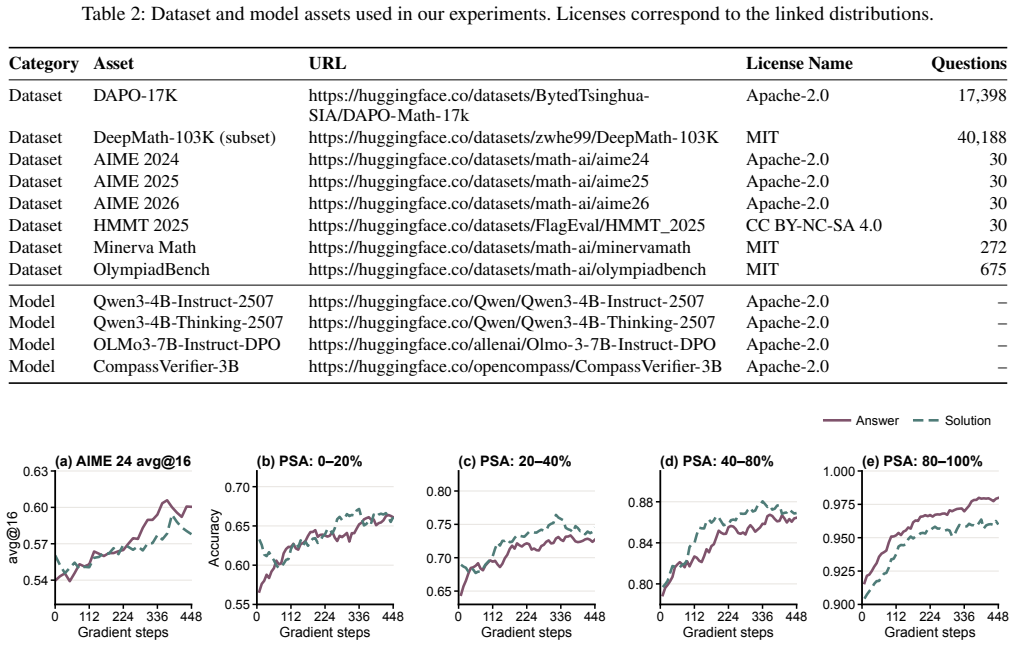
- [§4.1, Figure 3; §4.4, Figure 7] The higher explained variance and path-selection accuracy of the reference-guided critic relative to the standard critic are not independent evidence of better credit assignment, because the reference-guided critic is conditioned on the answer that defines the return. These metrics are partly forced by construction and should be presented as descriptive properties of the two critics, not as causal evidence that ReDiPPO improves credit assignment. The direct evidence for the method remains the downstream task accuracy, which makes the statistical concerns in the first two comments particularly important.
minor comments (4)
- [Abstract and Introduction] The text says ReDiPPO 'consistently outperforms' strong baselines, but Table 1 contains an exception (Qwen3-4B-Thinking on AIME 2025: DAPO 76.88 vs ReDiPPO 76.77). Please qualify the claim to 'on average' or report the number of benchmarks on which ReDiPPO leads.
- [Table 1] Some cells appear to run together in the submitted text (e.g., the Qwen3-4B-Thinking DAPO row appears as '79.6976.8878.18'). Please ensure all numbers are separated for readability.
- [Appendix D.1] The answer-vs-solution ablation is based on a single run and one generated-solution pipeline. The paper acknowledges this limitation; the associated claim could be phrased even more cautiously, since the 1.13-point difference is within the noise level discussed in the main results.
- [§4.1, Evaluation] The definition of value explained variance uses an epsilon in the denominator but not in the numerator; this is fine. However, the reported EV values for the standard critic are sometimes negative in Figure 7 (e.g., early positions), which should be explained in the caption or text.
Circularity Check
No significant circularity: the central policy-improvement claim rests on direct benchmark measurements rather than on the paper's own constructions.
full rationale
ReDiPPO's central claim is that the full method improves average benchmark accuracy over vanilla PPO by 1.19–2.37 percentage points. That claim is supported by direct benchmark measurements in Table 1 and by component ablations in Figure 4; none of these numbers is obtained by plugging the target result back into the method's equations. The discrepancy weight w_{i,t} (Eqs. 9–12) is a designed heuristic, and the paper explicitly notes that it 'does not directly measure the true critic error' (Section 3.4), so the reweighting is not presented as a derived equivalence. The reference-guided critic's higher EV/PSA is expected by construction because the critic is conditioned on the reference answer z_i that also defines the terminal reward G_i = R(x,y,z), but the paper uses those metrics as descriptive evidence of critic behavior rather than as the proof of the final policy gains. The related-work self-citation (Wu et al. 2026) is not load-bearing. The absence of error bars and the selection of [w_min,w_max] on AIME 2024 avg@16 are statistical and test-contamination concerns, not construction-level circularity, and do not change the circularity verdict.
Assumptions & free parameters
free parameters (1)
- Discrepancy weight clipping bounds w_min, w_max =
0.5, 2.0
assumptions (4)
- domain assumption Verifier reward G is a deterministic binary function of whether the extracted final answer matches the reference integer.
- domain assumption The reference answer can be given to the critic during training without leaking into the policy, because the policy is prompt-only.
- ad hoc to paper Reference-standard discrepancy e=|v_ref - v_std| is a valid proxy for token-level credit-assignment unreliability.
- standard math With terminal-only rewards and gamma=lambda=1, GAE reduces to A=G-V, and subtracting a reference-conditioned baseline leaves the expected policy gradient unbiased.
Cite this review
Pith. "Pith review of ReDiPPO: Reference-Guided Value Calibration and Discrepancy-Aware Token Reweighting for Mathematical Reasoning." pith.science (2026). https://pith.science/paper/CHN327LE
@misc{pith2026260727631,
  author       = {Pith},
  title        = {Pith review of: ReDiPPO: Reference-Guided Value Calibration and Discrepancy-Aware Token Reweighting for Mathematical Reasoning},
  year         = {2026},
  howpublished = {\url{https://pith.science/paper/CHN327LE}},
  note         = {Machine review of arXiv:2607.27631}
}
read the original abstract
Reinforcement learning has emerged as an effective paradigm for enhancing the mathematical reasoning capabilities of large language models. Among existing policy optimization methods, Proximal Policy Optimization (PPO) remains particularly appealing because its learned critic can, in principle, provide token-level credit assignment. However, in mathematical reasoning tasks characterized by long reasoning horizons and sparse outcome rewards, reliable token-level credit assignment remains challenging. The standard critic often fails to accurately evaluate intermediate reasoning states, resulting in noisy advantage estimates and suboptimal policy updates. In this paper, we propose ReDiPPO, a Reference-guided and Discrepancy-aware PPO framework for mathematical reasoning. ReDiPPO introduces a reference-guided critic that uses reference answers as training-time privileged signals to provide more accurate value estimation. Meanwhile, it retains a standard critic and quantifies the token-level reference-standard discrepancy between the standard value estimate and the reference-guided value estimate. This discrepancy serves as an indicator of difficult reasoning states and is used to reweight the corresponding token-level advantages during PPO optimization. Extensive experiments on diverse mathematical reasoning benchmarks demonstrate that ReDiPPO improves value-estimation accuracy and consistently outperforms strong policy optimization baselines, including PPO, DAPO, and GSPO, in final reasoning performance. Our code is available on https://github.com/cii030/ReDiPPO.
Figures


Figures from the paper (4 more)



Reference graph
Works this paper leans on
-
[1]
arXiv preprint arXiv:1707.06347 , year=
Proximal Policy Optimization Algorithms , author=. arXiv preprint arXiv:1707.06347 , year=
-
[2]
International Conference on Learning Representations , year=
High-Dimensional Continuous Control Using Generalized Advantage Estimation , author=. International Conference on Learning Representations , year=
-
[3]
Shao, Zhihong and Wang, Peiyi and Zhu, Qihao and Xu, Runxin and Song, Junxiao and Bi, Xiao and Zhang, Haowei and Zhang, Mingchuan and Li, Y. K. and Wu, Y. and Guo, Daya , journal=
-
[4]
Guo, Daya and Yang, Dejian and Zhang, Haowei and Song, Junxiao and Wang, Peiyi and Zhu, Qihao and Xu, Runxin and Zhang, Ruoyu and Ma, Shirong and Bi, Xiao and others , journal=
-
[5]
Sheng, Guangming and Zhang, Chi and Ye, Zilingfeng and Wu, Xibin and Zhang, Wang and Zhang, Ru and Peng, Yanghua and Lin, Haibin and Wu, Chuan , booktitle=
-
[6]
arXiv preprint arXiv:2512.13961 , year=
-
[7]
Yang, An and Li, Anfeng and Yang, Baosong and Zhang, Beichen and Hui, Binyuan and Zheng, Bo and Yu, Bowen and Gao, Chang and Huang, Chengen and Lv, Chenxu and others , journal=
-
[8]
Yu, Qiying and Zhang, Zheng and Zhu, Ruofei and Yuan, Yufeng and Zuo, Xiaochen and Yue, Yu and Dai, Weinan and Fan, Tiantian and Liu, Gaohong and Liu, Juncai and others , booktitle=
Show all 27 references
-
[9]
He, Zhiwei and Liang, Tian and Xu, Jiahao and Liu, Qiuzhi and Chen, Xingyu and Wang, Yue and Song, Linfeng and Yu, Dian and Liang, Zhenwen and Wang, Wenxuan and Zhang, Zhuosheng and Wang, Rui and Tu, Zhaopeng and Mi, Haitao and Yu, Dong , booktitle=
-
[10]
American Invitational Mathematics Examination (
Zhang, Yifan and. American Invitational Mathematics Examination (
-
[11]
Beyond Benchmarks:
Dekoninck, Jasper and Jovanovi. Beyond Benchmarks:. The 3rd AI for Math Workshop at the 43rd International Conference on Machine Learning , year=
-
[12]
Advances in Neural Information Processing Systems , volume=
Solving Quantitative Reasoning Problems with Language Models , author=. Advances in Neural Information Processing Systems , volume=
-
[13]
He, Chaoqun and Luo, Renjie and Bai, Yuzhuo and Hu, Shengding and Thai, Zhen and Shen, Junhao and Hu, Jinyi and Han, Xu and Huang, Yujie and Zhang, Yuxiang and Liu, Jie and Qi, Lei and Liu, Zhiyuan and Sun, Maosong , booktitle=
-
[14]
arXiv preprint arXiv:2507.18071 , year=
Group Sequence Policy Optimization , author=. arXiv preprint arXiv:2507.18071 , year=
-
[15]
What's Behind
Yuan, Yufeng and Yue, Yu and Zhu, Ruofei and Fan, Tiantian and Yan, Lin , journal=. What's Behind
-
[16]
Yue, Yu and Yuan, Yufeng and Yu, Qiying and Zuo, Xiaochen and Zhu, Ruofei and Xu, Wenyuan and Chen, Jiaze and Wang, Chengyi and Fan, TianTian and Du, Zhengyin and others , journal=
-
[17]
Hu, Jingcheng and Zhang, Yinmin and Han, Qi and Jiang, Daxin and Zhang, Xiangyu and Shum, Heung-Yeung , booktitle=
-
[18]
Understanding
Liu, Zichen and Chen, Changyu and Li, Wenjun and Qi, Penghui and Pang, Tianyu and Du, Chao and Lee, Wee Sun and Lin, Min , booktitle=. Understanding
-
[19]
2025 , organization=
Kazemnejad, Amirhossein and Aghajohari, Milad and Portelance, Eva and Sordoni, Alessandro and Reddy, Siva and Courville, Aaron and Le Roux, Nicolas , booktitle=. 2025 , organization=
2025
-
[20]
International Conference on Learning Representations , year=
Let's Verify Step by Step , author=. International Conference on Learning Representations , year=
-
[21]
Wang, Peiyi and Li, Lei and Shao, Zhihong and Xu, Runxin and Dai, Damai and Li, Yifei and Chen, Deli and Wu, Yu and Sui, Zhifang , booktitle=
-
[22]
Transactions on Machine Learning Research , year=
Process Reinforcement through Implicit Rewards , author=. Transactions on Machine Learning Research , year=
-
[23]
Sun, Wei and Yang, Wen and Jian, Pu and Du, Qianlong and Cui, Fuwei and Ren, Shuo and Zhang, Jiajun , journal=
-
[24]
Findings of the
Step Potential Advantage Estimation: Harnessing Intermediate Confidence and Correctness for Efficient Mathematical Reasoning , author=. Findings of the
-
[25]
arXiv preprint arXiv:2605.13217 , year=
GAGPO: Generalized Advantage Grouped Policy Optimization , author=. arXiv preprint arXiv:2605.13217 , year=
-
[26]
Asymmetric Proximal Policy Optimization: mini-critics boost
Liu, Jiashun and Obando-Ceron, Johan and Lu, Han and He, Yancheng and Wang, Weixun and Su, Wenbo and Zheng, Bo and Castro, Pablo Samuel and Courville, Aaron and Pan, Ling , booktitle=. Asymmetric Proximal Policy Optimization: mini-critics boost
-
[27]
Bringing Value Models Back: Generative Critics for Value Modeling in
Shan, Zikang and Zhong, Han and Wang, Liwei and Zhao, Li , journal=. Bringing Value Models Back: Generative Critics for Value Modeling in
Reviewed August 1, 2026 · model on record in the stance chip above.
Discussion (0). Sign in to comment.