REVIEW 3 major objections 6 minor 46 references
A frozen diffusion model can remove shadows without training by transferring light from lit regions and selectively keeping only the content features that shadows barely change.
Reviewed by Pith at T0; open to challenge. T0 means a machine referee read the full paper against a public rubric. the ladder, T0–T4 →
A frozen Stable Diffusion model can remove shadows at test time by reweighting self-attention for illumination transfer and selectively reinjecting shadow-insensitive structure and high-frequency detail.
T0 review reviewed 2026-07-30 challenge →
load-bearing objection Solid training-free shadow remover with real OOD numbers; the SI layer picks are a mild soft spot, not a collapse of the claim. the 3 major comments →
FreeShadow: Training-Free Shadow Removal via Illumination Transfer and Selective Content Preservation in Diffusion Models
The pith
A machine-rendered reading of the paper's core claim, the machinery that carries it, and where it could break.
The reading
Core claim
A completely training-free pipeline on frozen Stable Diffusion—illumination-transfer attention plus selective reinjection of the least shadow-sensitive self-attention maps and latent high-frequency components, followed by local texture-preserving relighting—restores illumination while preserving structure and fine detail, and yields stronger cross-dataset generalization than supervised, unsupervised, and zero-shot baselines trained on ISTD+.
What carries the argument
Illumination Transfer Attention (ITA): a mask-guided re-weighting of self-attention that amplifies attention from shadow queries to non-shadow keys, so lighting cues flow into shadowed regions; paired with Selective Attention Map and High-Frequency Injection that keep only the decoder layers and wavelet bands least altered by shadows.
Load-bearing premise
Non-shadow areas supply usable lighting references, the particular attention layers and high-frequency bands judged least shadow-sensitive stay the right content carriers on new images, and a usable shadow mask (plus its boundary band) is available at test time.
What would settle it
Run the identical frozen pipeline, without any hyper-parameter change, on a large held-out collection of hard cast and self-shadows whose masks are either noisy or replaced by loose bounding boxes; if residual shadows, boundary artifacts, or large drops in MAE/SSIM appear relative to the reported UIUC+/SRD/PSM numbers, the claim fails.
If this is right
- Shadow removal no longer requires collecting paired shadow/shadow-free training sets for every new domain.
- The same selective-injection recipe can be dropped onto other frozen diffusion backbones (e.g., SDXL) with only mask and layer choices adjusted.
- Cross-dataset scores on UIUC+, SRD and the portrait set PSM become the practical benchmark for generalization rather than in-distribution ISTD+ numbers.
- Runtime can be traded for quality simply by reducing DDIM steps (e.g., 20 steps already competitive) without retraining.
Where Pith is reading between the lines
- The same SI analysis that selects illumination-invariant attention maps could guide training-free removal of other spatially localized degradations such as specular highlights or localized haze.
- Because the method already works from coarse bounding-box masks when SHFI and LTPR are disabled, it could be paired with an off-the-shelf shadow detector for fully automatic pipelines.
- Self-shadows remain harder precisely because geometry and appearance are entangled; an explicit surface-normal or depth cue injected into the same attention path is a natural next test.
Editorial analysis
A structured set of objections, weighed in public.
Referee Report
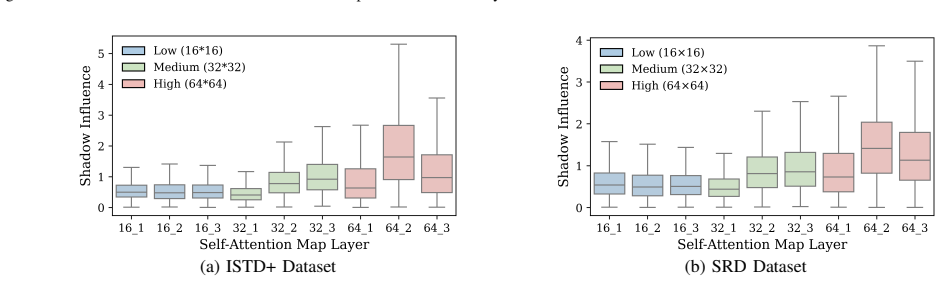
Summary. FreeShadow proposes a fully training-free shadow removal pipeline on frozen Stable Diffusion 2.1. After DDIM inversion of a masked shadow image, sampling is steered by (i) illumination transfer attention (ITA), which re-weights self-attention so shadow queries attend more to non-shadow keys (Eqs. 1–2), (ii) selective reinjection of decoder self-attention maps and latent high-frequency bands judged least shadow-sensitive (SAMI/SHFI; SI metric Eq. 4; Figs. 3–5), (iii) local texture-preserving relighting (LTPR) that transfers local mean/variance from the SD output onto the input texture (Eqs. 8–9), and (iv) shadow-removal redirect guidance (SRRG, Eq. 10). Non-shadow latents are locked to the inversion trajectory (Eq. 3). On ISTD+, UIUC+, SRD, and PSM, with supervised/unsupervised baselines trained only on ISTD+, the method reports competitive or superior MAE/SSIM/PSNR, especially under cross-dataset and portrait evaluation (Tables I–II), with component ablations (Tables IV–V) and qualitative comparisons.
Significance. If the empirical claims hold, the work is a clear contribution to training-free image restoration with large diffusion priors. It shows that a frozen T2I backbone, with carefully designed attention re-weighting and selective feature reinjection rather than fine-tuning or test-time optimization, can outperform both dataset-trained shadow removers under distribution shift and existing zero-shot methods that are slow or artifact-prone. Strengths include a consistent cross-dataset protocol, multi-component ablations, fixed hyperparameters across four datasets, mask-robustness checks (Fig. 13), guidance-scale and α sweeps, and an explicit failure-mode discussion (self-shadows). The SI analysis and selective-injection design are concrete and falsifiable engineering contributions, not only prompt engineering.
major comments (3)
- [§III.C–D, Eq. (4), Figs. 4–5; Tables I–II] §III.C–D, Eq. (4), Figs. 4–5: The SAMI layer policy (all three 16×16 maps plus the first map at 32×32 and 64×64) and the SHFI boundary-only keep-out are justified by SI boxplots and HF error maps computed on ISTD+ and SRD, then applied unchanged to UIUC+ and PSM (Tables I–II). The central OOD-generalization claim therefore partly rests on the premise that these illumination-invariant carriers transfer. Please either (a) report SI / HF-discrepancy statistics on UIUC+ and PSM under the same protocol, or (b) ablate alternative fixed layer sets on the held-out sets and show that the reported margins are not driven by this ISTD+/SRD-informed choice. Without that, the “pure prior / training-free” framing overstates independence from shadow-data statistics.
- [Tables I–II; Table III] Tables I–II and implementation: All quantitative scores are single-run point estimates with no error bars, multi-seed variation, or sensitivity to DDIM stochasticity / mask jitter beyond the qualitative bounding-box check in Fig. 13. Given that margins over strong SL baselines on UIUC+/SRD/PSM are a primary claim, at least seed- or step-schedule variation (or bootstrap over images) on one OOD set is needed to establish that the ranking is stable. Table III already varies T; extending that discipline to the main metrics would substantially strengthen the result.
- [§III.B–E; Fig. 13] Eqs. (1)–(3), (5)–(9) and Fig. 13: The pipeline assumes a usable shadow mask and a morphology-derived boundary band (kernel 19). Fig. 13 shows that coarse boxes still work if SHFI/LTPR are dropped, but the full model can produce boundary artifacts under mask error, and no automatic masker is evaluated end-to-end. For a method positioned as practical and training-free, please quantify full-pipeline performance with an off-the-shelf shadow detector (or report degraded-mask MAE on ISTD+/SRD) and state clearly in the abstract/intro that a mask is required, with the ITA+SAMI-only fallback as the recommended operating mode under unreliable masks.
minor comments (6)
- [Table I] Table I header colors supervised/unsupervised/zero-shot winners, but FreeShadow is listed under ZS-style comparison without a distinct TF highlight; a fourth category or explicit “training-free” row group would avoid implying it is optimized like Self-SGAN.
- [Eq. (4)] Eq. (4): SI normalizes by the global mean of the PCA map; a brief note on stability under sign flips of PCA components (or use of absolute PCA loadings) would help reproducibility.
- [Fig. 5; §III.D] Fig. 5 shows HF error maps at t=T, 0.5T, 0 but does not state whether the same interior-vs-boundary split holds across timesteps used in sampling; one sentence would clarify why a single boundary mask is applied at every t.
- [§II.B] Related work: BCDiff and StableShadow are discussed; a short contrast with other training-free diffusion editing controls (e.g., PnP / FreeControl-style attention injection) would situate ITA/SAMI more clearly for the diffusion-editing audience.
- [throughout] Typos/notation: “V AE” spacing is inconsistent (VAE); “timestept” missing space in §III.B; arXiv IDs in references for concurrent editing models are fine but venue years should be double-checked before camera-ready.
- [Fig. 12] Fig. 12 guidance-scale curve: y-axis metric is not labeled in the caption; state whether it is MAE on ISTD+.
Circularity Check
No significant circularity: external GT benchmarks and design choices that do not algebraically force the reported metrics.
full rationale
FreeShadow’s load-bearing claims are empirical shadow-removal quality (MAE/SSIM/PSNR) against held-out paired ground-truth images on ISTD+, UIUC+, SRD, and PSM, plus cross-dataset generalization when SL/UL baselines are trained only on ISTD+. The method is a fixed, training-free recipe on frozen SD 2.1: ITA re-weights attention (Eqs. 1–3), SAMI/SHFI selectively reinject decoder self-attention maps and non-boundary latent high-frequency bands (Eqs. 4–7, Figs. 3–5), LTPR matches local mean/variance (Eqs. 8–9), and SRRG steers sampling (Eq. 10). Layer/band selection is justified by an SI statistic and error maps computed on ISTD+/SRD attention and latents; that is ordinary empirical design/ablation (Tables IV–V), not a fitted parameter renamed as a prediction of a quantity that equals the fit by construction. Reported scores are not algebraically identical to SI, α, s, or the mask. No self-citation uniqueness theorem, no ansatz smuggled in as external fact, and no renaming of a known closed-form result. Mild dependence of design on related data is a generalization/robustness concern, not circularity. Score 0.
Axiom & Free-Parameter Ledger
free parameters (6)
- ITA re-weighting coefficient α =
1.5
- Shadow removal guidance scale s (SRRG) =
7
- DDIM steps T =
50 (main)
- Shadow-boundary morphology kernel =
19
- LTPR window size k and stride d =
k=7, d=1
- SAMI layer-selection policy =
16×16:{1,2,3}; 32×16 first; 64×64 first
axioms (7)
- domain assumption Large-scale pretrained T2I diffusion models encode natural-image priors sufficient to synthesize plausible shadow-free appearance when sampling is suitably steered.
- domain assumption Non-shadow regions of the same image provide valid illumination references for shadow regions via self-attention reweighting.
- domain assumption A binary (or coarse) shadow mask Ms is available at test time and can be downsampled by max-pooling to latent resolution.
- ad hoc to paper Lower-resolution decoder self-attention and first-layer medium/high-resolution maps are sufficiently illumination-invariant to safely reinject for structure preservation.
- ad hoc to paper High-frequency latent discrepancy between shadow and shadow-free images concentrates on shadow boundaries, so interior HF from the inversion is trustworthy.
- domain assumption DDIM inversion is approximately reversible enough that the unguided sampling direction reconstructs the shadow input, so steering away from it yields deshadowing.
- standard math Standard linear algebra / softmax attention and DWT/IDWT identities hold as used in Eqs. 2 and 5–7.
invented entities (3)
-
Shadow influence (SI) metric on PCA-reduced self-attention maps
no independent evidence
-
Illumination transfer attention (ITA)
no independent evidence
-
Local texture-preserving relighting (LTPR)
no independent evidence
Cite this review
Pith. "Pith review of FreeShadow: Training-Free Shadow Removal via Illumination Transfer and Selective Content Preservation in Diffusion Models." pith.science (2026). https://pith.science/paper/CHS4PVKD
@misc{pith2026260726715,
  author       = {Pith},
  title        = {Pith review of: FreeShadow: Training-Free Shadow Removal via Illumination Transfer and Selective Content Preservation in Diffusion Models},
  year         = {2026},
  howpublished = {\url{https://pith.science/paper/CHS4PVKD}},
  note         = {Machine review of arXiv:2607.26715}
}
read the original abstract
Existing supervised and unsupervised shadow removal methods often suffer from limited generalization due to the insufficient diversity of available training datasets, while zero-shot methods tend to produce artifacts and require time-consuming test-time optimization. To address these issues, we propose FreeShadow, a training-free shadow removal method built upon pretrained diffusion models, which exploits diffusion priors for shadow removal without any training or optimization. For illumination recovery, we propose an illumination transfer attention (ITA), which re-weights the self-attention maps in diffusion model to transfer illumination cues from non-shadow to shadow regions. For content preservation, we analyze the effects of illumination variations on self-attention maps and latent high-frequency features in diffusion model, and selectively preserve illumination-invariant components to maintain content fidelity while suppressing residual shadows. We further propose local texture-preserving relighting (LTPR) to mitigate local texture misalignment caused by VAE compression. Extensive experiments demonstrate that our method achieves strong generalization and produces realistic shadow-free images.
Figures




Reference graph
Works this paper leans on
-
[1]
Generative portrait shadow removal,
J. S. Yoon, Z. Shu, M. Ren, C. Zhang, Y . Hold-Geoffroy, K. K. Singh, and H. Zhang, “Generative portrait shadow removal,”ACM TOG, vol. 43, no. 6, pp. 1–13, 2024
2024
-
[2]
Shadows can be dangerous: Stealthy and effective physical-world adversarial attack by natural phenomenon,
Y . Zhong, X. Liu, D. Zhai, J. Jiang, and X. Ji, “Shadows can be dangerous: Stealthy and effective physical-world adversarial attack by natural phenomenon,” inCVPR, 2022, pp. 15 345–15 354
2022
-
[3]
Unsupervised moving object detection in complex scenes using adversarial regularizations,
M. Sultana, A. Mahmood, and S. K. Jung, “Unsupervised moving object detection in complex scenes using adversarial regularizations,”IEEE TMM, vol. 23, pp. 2005–2018, 2020
2005
-
[4]
Hyper rpca: joint maximum correntropy criterion and laplacian scale mixture modeling on-the-fly for moving object detection,
Z. Shao, Y . Pu, J. Zhou, B. Wen, and Y . Zhang, “Hyper rpca: joint maximum correntropy criterion and laplacian scale mixture modeling on-the-fly for moving object detection,”IEEE TMM, vol. 25, pp. 112– 125, 2021
2021
-
[5]
Decoupled spatial neural attention for weakly supervised semantic segmentation,
T. Zhang, G. Lin, J. Cai, T. Shen, C. Shen, and A. C. Kot, “Decoupled spatial neural attention for weakly supervised semantic segmentation,” IEEE TMM, vol. 21, no. 11, pp. 2930–2941, 2019
2019
-
[6]
Consistency preservation and feature entropy regularization for gan based face editing,
W. Xie, W. Lu, Z. Peng, and L. Shen, “Consistency preservation and feature entropy regularization for gan based face editing,”IEEE TMM, vol. 25, pp. 8892–8905, 2023
2023
-
[7]
A boundary-aware network for shadow removal,
K. Niu, Y . Liu, E. Wu, and G. Xing, “A boundary-aware network for shadow removal,”IEEE TMM, vol. 25, pp. 6782–6793, 2022
2022
-
[8]
A decoupled multi- task network for shadow removal,
J. Liu, Q. Wang, H. Fan, W. Li, L. Qu, and Y . Tang, “A decoupled multi- task network for shadow removal,”IEEE TMM, vol. 25, pp. 9449–9463, 2023
2023
-
[9]
Shadowformer: Global context helps shadow removal,
L. Guo, S. Huang, D. Liu, H. Cheng, and B. Wen, “Shadowformer: Global context helps shadow removal,”AAAI, vol. 37, no. 1, pp. 710– 718, 2023
2023
-
[10]
Recasting regional lighting for shadow removal,
Y . Liu, Z. Ke, K. Xu, F. Liu, Z. Wang, and R. W. Lau, “Recasting regional lighting for shadow removal,” inAAAI, vol. 38, no. 4, 2024, pp. 3810–3818
2024
-
[11]
Omnisr: Shadow removal under direct and indirect lighting,
J. Xu, Z. Li, Y . Zheng, C. Huang, R. Gu, W. Xu, and G. Xu, “Omnisr: Shadow removal under direct and indirect lighting,” inAAAI, vol. 39, no. 8, 2025, pp. 8887–8895
2025
-
[12]
Shadow removal via shadow image decompo- sition,
H. Le and D. Samaras, “Shadow removal via shadow image decompo- sition,” inICCV, 2019, pp. 8578–8587
2019
-
[13]
Deshadownet: A multi- context embedding deep network for shadow removal,
L. Qu, J. Tian, S. He, Y . Tang, and R. W. Lau, “Deshadownet: A multi- context embedding deep network for shadow removal,” inCVPR, 2017, pp. 4067–4075
2017
-
[14]
Mask-shadowgan: Learning to remove shadows from unpaired data,
X. Hu, Y . Jiang, C.-W. Fu, and P.-A. Heng, “Mask-shadowgan: Learning to remove shadows from unpaired data,” inICCV, 2019, pp. 2472–2481
2019
-
[15]
Learning to remove shadows from a single image,
H. Jiang, Q. Zhang, Y . Nie, L. Zhu, and W.-S. Zheng, “Learning to remove shadows from a single image,”IJCV, vol. 131, no. 9, pp. 2471– 2488, 2023
2023
-
[16]
From shadow generation to shadow removal,
Z. Liu, H. Yin, X. Wu, Z. Wu, Y . Mi, and S. Wang, “From shadow generation to shadow removal,” inCVPR, 2021, pp. 4927–4936
2021
-
[17]
When shadow removal meets intrinsic image decomposition: A joint learning framework using unpaired data,
R. Zheng, Q. Zhang, Y . Nie, and W.-S. Zheng, “When shadow removal meets intrinsic image decomposition: A joint learning framework using unpaired data,” inAAAI, vol. 39, no. 10, 2025, pp. 10 599–10 607
2025
-
[18]
Dc-shadownet: Single-image hard and soft shadow removal using unsupervised domain-classifier guided network,
Y . Jin, A. Sharma, and R. T. Tan, “Dc-shadownet: Single-image hard and soft shadow removal using unsupervised domain-classifier guided network,” inICCV, 2021, pp. 5027–5036
2021
-
[19]
From shadow segmentation to shadow removal,
H. Le and D. Samaras, “From shadow segmentation to shadow removal,” inECCV. Springer, 2020, pp. 264–281
2020
-
[20]
Shadowdiffusion: When degradation prior meets diffusion model for shadow removal,
L. Guo, C. Wang, W. Yang, S. Huang, Y . Wang, H. Pfister, and B. Wen, “Shadowdiffusion: When degradation prior meets diffusion model for shadow removal,” inCVPR, 2023, pp. 14 049–14 058
2023
-
[21]
Detail- preserving latent diffusion for stable shadow removal,
J. Xu, Y . Zheng, Z. Li, C. Wang, R. Gu, W. Xu, and G. Xu, “Detail- preserving latent diffusion for stable shadow removal,” inCVPR, 2025, pp. 7592–7602
2025
-
[22]
Denoising diffusion probabilistic models,
J. Ho, A. Jain, and P. Abbeel, “Denoising diffusion probabilistic models,” NeurIPS, vol. 33, pp. 6840–6851, 2020
2020
-
[23]
High- resolution image synthesis with latent diffusion models,
R. Rombach, A. Blattmann, D. Lorenz, P. Esser, and B. Ommer, “High- resolution image synthesis with latent diffusion models,” inCVPR, 2022, pp. 10 684–10 695
2022
-
[24]
Exploiting diffusion prior for real-world image super-resolution,
J. Wang, Z. Yue, S. Zhou, K. C. Chan, and C. C. Loy, “Exploiting diffusion prior for real-world image super-resolution,”IJCV, vol. 132, no. 12, pp. 5929–5949, 2024
2024
-
[25]
Zero-shot low- light image enhancement via latent diffusion models,
Y . Huang, X. Liao, J. Liang, Y . Quan, B. Shi, and Y . Xu, “Zero-shot low- light image enhancement via latent diffusion models,” inAAAI, vol. 39, no. 4, 2025, pp. 3815–3823
2025
-
[26]
Boundary-aware divide and conquer: A diffusion-based solution for unsupervised shadow removal,
L. Guo, C. Wang, W. Yang, Y . Wang, and B. Wen, “Boundary-aware divide and conquer: A diffusion-based solution for unsupervised shadow removal,” inICCV, 2023, pp. 13 045–13 054
2023
-
[27]
Homoformer: Homogenized transformer for image shadow removal,
J. Xiao, X. Fu, Y . Zhu, D. Li, J. Huang, K. Zhu, and Z.-J. Zha, “Homoformer: Homogenized transformer for image shadow removal,” inCVPR, 2024, pp. 25 617–25 626
2024
-
[28]
Icdsr: Integrated conditional diffusion model for single image super-resolution,
C. Hu, X.-Z. Wei, and X.-J. Wu, “Icdsr: Integrated conditional diffusion model for single image super-resolution,”IEEE TMM, vol. 28, pp. 1302– 1313, 2026
2026
-
[29]
Deblurring via stochastic refinement,
J. Whang, M. Delbracio, H. Talebi, C. Saharia, A. G. Dimakis, and P. Milanfar, “Deblurring via stochastic refinement,” inCVPR, 2022, pp. 16 293–16 303
2022
-
[30]
Mmginpainting: Multi- modality guided image inpainting based on diffusion models,
C. Zhang, W. Yang, X. Li, and H. Han, “Mmginpainting: Multi- modality guided image inpainting based on diffusion models,”IEEE TMM, vol. 26, pp. 8811–8823, 2024
2024
-
[31]
Latent feature-guided diffusion models for shadow removal,
K. Mei, L. Figueroa, Z. Lin, Z. Ding, S. Cohen, and V . M. Patel, “Latent feature-guided diffusion models for shadow removal,” inWACV, 2024, pp. 4313–4322
2024
-
[32]
Des3: Adaptive attention-driven self and soft shadow removal using vit similarity,
Y . Jin, W. Ye, W. Yang, Y . Yuan, and R. T. Tan, “Des3: Adaptive attention-driven self and soft shadow removal using vit similarity,” in AAAI, vol. 38, no. 3, 2024, pp. 2634–2642
2024
-
[33]
Diff-shadow: Global-guided diffusion model for shadow removal,
J. Luo, R. Li, C. Jiang, X. Zhang, M. Han, T. Jiang, H. Fan, and S. Liu, “Diff-shadow: Global-guided diffusion model for shadow removal,” in AAAI, vol. 39, no. 6, 2025, pp. 5856–5864
2025
-
[34]
Zero-shot text-to-image generation,
A. Ramesh, M. Pavlov, G. Goh, S. Gray, C. V oss, A. Radford, M. Chen, and I. Sutskever, “Zero-shot text-to-image generation,” inICML. Pmlr, 2021, pp. 8821–8831
2021
-
[35]
Denoising diffusion implicit models,
J. Song, C. Meng, and S. Ermon, “Denoising diffusion implicit models,” inICLR, 2021
2021
-
[36]
Plug-and-play diffusion features for text-driven image-to-image translation,
N. Tumanyan, M. Geyer, S. Bagon, and T. Dekel, “Plug-and-play diffusion features for text-driven image-to-image translation,” inCVPR, 2023, pp. 1921–1930
2023
-
[37]
Training-free style and content transfer by leveraging u-net skip connections in stable diffusion 2
L. Schaerf, A. Alfarano, F. Silvestri, and L. Impett, “Training-free style and content transfer by leveraging u-net skip connections in stable diffusion 2.”arXiv preprint arXiv:2501.14524, 2025
Pith/arXiv arXiv 2025
-
[38]
Stylessp: Sampling startpoint enhancement for training-free diffusion-based method for style transfer,
R. Xu, W. Xi, X. Wang, Y . Mao, and Z. Cheng, “Stylessp: Sampling startpoint enhancement for training-free diffusion-based method for style transfer,” inCVPR, 2025, pp. 18 260–18 269
2025
-
[39]
Sdxl: Improving latent diffusion models for high-resolution image synthesis,
D. Podell, Z. English, K. Lacey, A. Blattmann, T. Dockhorn, J. M ¨uller, J. Penna, and R. Rombach, “Sdxl: Improving latent diffusion models for high-resolution image synthesis,”arXiv preprint arXiv:2307.01952, 2023
Pith/arXiv arXiv 2023
-
[40]
Paired regions for shadow detection and removal,
R. Guo, Q. Dai, and D. Hoiem, “Paired regions for shadow detection and removal,”IEEE TPAMI, vol. 35, no. 12, pp. 2956–2967, 2012
2012
-
[41]
Portrait shadow manipulation,
X. Zhang, J. T. Barron, Y .-T. Tsai, R. Pandey, X. Zhang, R. Ng, and D. E. Jacobs, “Portrait shadow manipulation,”ACM TOG, vol. 39, no. 4, pp. 78–1, 2020
2020
-
[42]
Single-image shadow removal using deep learning: A comprehensive survey,
L. Guo, C. Wang, Y . Wang, Y . Yu, S. Huang, W. Yang, A. C. Kot, and B. Wen, “Single-image shadow removal using deep learning: A comprehensive survey,”arXiv preprint arXiv:2407.08865, 2024
Pith/arXiv arXiv 2024
-
[43]
Image shadow removal via multi-scale deep retinex decomposition,
Y . Huang, X. Lu, Y . Quan, Y . Xu, and H. Ji, “Image shadow removal via multi-scale deep retinex decomposition,”PR, vol. 159, p. 111126, 2025
2025
-
[44]
Shadow removal using bilateral filtering,
Q. Yang, K.-H. Tan, and N. Ahuja, “Shadow removal using bilateral filtering,”IEEE TIP, vol. 21, no. 10, pp. 4361–4368, 2012
2012
-
[45]
Flux. 1 kontext: Flow matching for in-context image generation and editing in latent space,
B. F. Labs, S. Batifol, A. Blattmann, F. Boesel, S. Consul, C. Diagne, T. Dockhorn, J. English, Z. English, P. Esseret al., “Flux. 1 kontext: Flow matching for in-context image generation and editing in latent space,”arXiv preprint arXiv:2506.15742, 2025
Pith/arXiv arXiv 2025
-
[46]
C. Wu, J. Li, J. Zhou, J. Lin, K. Gao, K. Yan, S.-m. Yin, S. Bai, X. Xu, Y . Chenet al., “Qwen-image technical report,”arXiv preprint arXiv:2508.02324, 2025
Pith/arXiv arXiv 2025
This paper was first reviewed by grok-4.5 on July 30, 2026.
discussion (0)
Sign in with ORCID, Apple, or X to comment. Anyone can read and Pith papers without signing in.