DAStatFormer: A Hybrid Multibranch Transformer with Statistical Feature Integration for DAS-Based Pattern Recognitions
Pith reviewed 2026-06-30 15:30 UTC · model grok-4.3
The pith
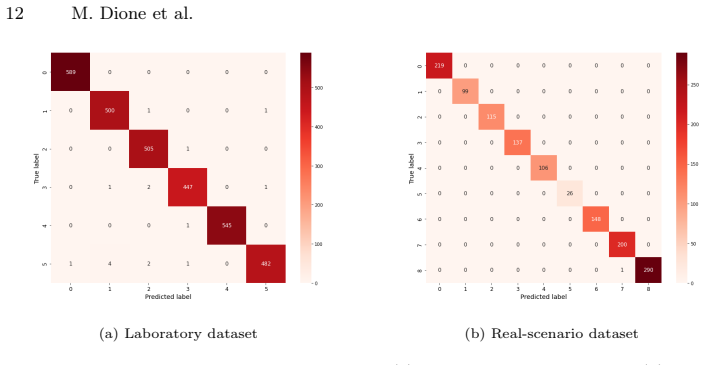
DAStatFormer classifies DAS events at up to 99.4 percent accuracy by feeding 24 statistical features into a gated multibranch Transformer instead of raw signals.
A machine-rendered reading of the paper's core claim, the machinery that carries it, and where it could break.
Core claim
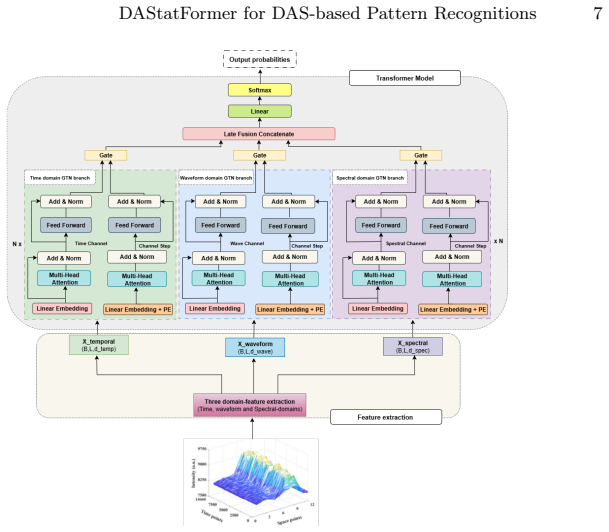
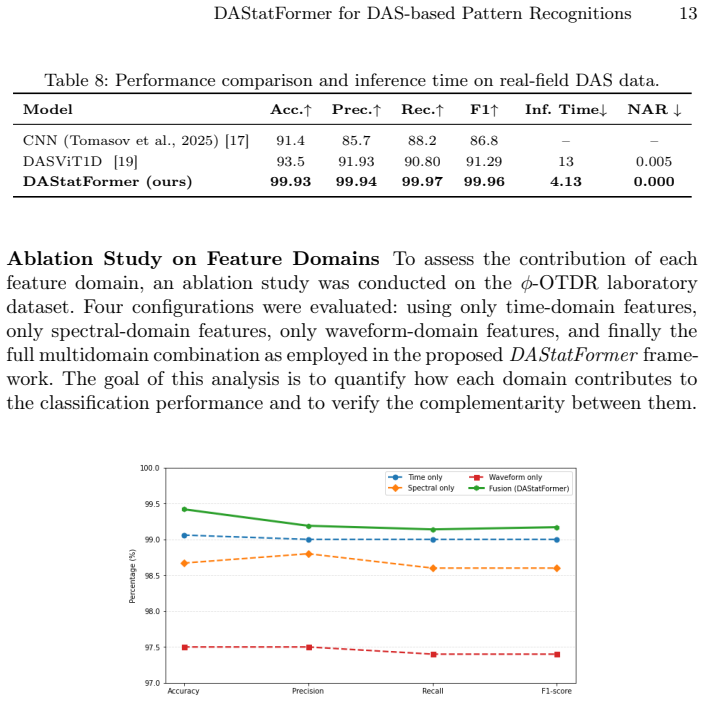
DAStatFormer is a hybrid multibranch Transformer that integrates compact multidomain statistical features with Gated Transformer Networks. Instead of processing raw DAS matrices, it extracts 24 ANOVA-selected attributes per channel from the temporal, waveform, and spectral domains. Dedicated step-wise and channel-wise attention branches process each domain before an adaptive gating mechanism fuses them. On the Φ-OTDR benchmark and a real-scenario DAS dataset, it reaches 99.4 percent accuracy with significantly fewer parameters and lower inference cost than prior models such as DASFormer and DeepViT.
What carries the argument
The adaptive gating mechanism that fuses outputs from domain-specific step-wise and channel-wise attention branches after statistical feature extraction.
If this is right
- Classification becomes feasible on resource-constrained devices because data size drops by orders of magnitude and parameter count is reduced.
- Real-time DAS monitoring can scale to larger fiber networks without proportional compute growth.
- Near-perfect performance holds on real-world datasets beyond the controlled benchmark.
- The gated fusion allows the model to emphasize informative domains without manual weighting.
Where Pith is reading between the lines
- The same statistical preprocessing step could be tested on other high-dimensional time-series sensing modalities such as seismic arrays or radar to check whether the compression benefit generalizes.
- Deployment on edge hardware becomes plausible for continuous DAS monitoring because inference cost is lowered without reported loss of accuracy.
- If the gating learns to down-weight noisy domains dynamically, the architecture may prove more robust to varying environmental conditions than static fusion approaches.
- Extending the ANOVA selection to include cross-domain interaction terms might further reduce the required attribute count while maintaining performance.
Load-bearing premise
The 24 ANOVA-selected statistical attributes per channel from the temporal, waveform, and spectral domains preserve the discriminative information needed for accurate classification across different scenarios and datasets.
What would settle it
A new DAS dataset in which models limited to these 24 statistical features achieve substantially lower accuracy than models given raw signals or additional features would falsify the preservation claim.
Figures
read the original abstract
Distributed Acoustic Sensing (DAS) enables large-scale monitoring through optical fibers, but its high dimensionality and complex spatio-temporal patterns make event classification demanding. Existing deep learning approaches-CNNs, recurrent models, and Transformer variants-either fail to capture long-range dependencies or require processing raw DAS matrices at prohibitive cost. We propose DAStatFormer, a hybrid multibranch Transformer that combines compact multidomain statistical features with Gated Transformer Networks. Instead of raw signals, we extract 24 ANOVA-selected attributes per channel from the temporal, waveform, and spectral domains, reducing data size by orders of magnitude while preserving discriminative information. Each domain is processed via dedicated step-wise and channel-wise attention branches, fused by an adaptive gating mechanism. Experiments on the open $\Phi$-OTDR benchmark and a real-scenario DAS dataset show that DAS-tatFormer achieves up to 99.4% accuracy and near-perfect real-world performance, while using significantly fewer parameters and lower inference cost than models such as DASFormer and DeepViT. These results demonstrate its suitability for scalable, real-time DAS-based monitoring. We release our code at https://github.com/MichelD-git/DAStatFormer
Editorial analysis
A structured set of objections, weighed in public.
Referee Report
Summary. The paper introduces DAStatFormer, a hybrid multibranch Transformer for DAS event classification that replaces raw high-dimensional signals with 24 ANOVA-selected statistical features (temporal, waveform, spectral) per channel. These are fed into dedicated step-wise and channel-wise attention branches fused via adaptive gating. The authors report up to 99.4% accuracy on the open Φ-OTDR benchmark and near-perfect results on a real-scenario dataset, with substantially lower parameter count and inference cost than baselines such as DASFormer and DeepViT. Code is released publicly.
Significance. If the accuracy claims prove robust to proper train-only feature selection and statistical testing, the work would offer a practical route to scalable real-time DAS monitoring by achieving large dimensionality reduction without apparent loss of discriminative power. The public code release is a clear strength that supports reproducibility.
major comments (2)
- [Section 3.2] Section 3.2 (Feature Extraction and Selection): The description of the ANOVA procedure for selecting the 24 statistical attributes does not state whether ranking and selection were performed exclusively within training folds (e.g., via nested cross-validation) or on the full dataset. Because this step directly determines the model input and is invoked to justify both the 99.4% accuracy and the parameter savings, the absence of this detail makes the central claim of information-preserving reduction vulnerable to optimistic bias.
- [Section 4.1 and Table 1] Section 4.1 and Table 1 (Benchmark Results): The reported accuracies and efficiency gains versus DASFormer are presented as single-point estimates without standard deviations across multiple random seeds or statistical significance tests. Given that the weakest assumption is preservation of discriminative information by the 24 features, lack of variability measures weakens the claim that the gains survive proper evaluation.
minor comments (2)
- [Abstract] Abstract: 'DAS-tatFormer' is a typographical error and should read 'DAStatFormer'.
- [Section 2] Section 2 (Related Work): The positioning relative to prior statistical-feature work in DAS could be expanded with one or two additional citations to clarify novelty.
Simulated Author's Rebuttal
We thank the referee for the constructive comments that highlight important aspects of methodological transparency and result robustness. We address each point below and have revised the manuscript to strengthen these areas.
read point-by-point responses
-
Referee: [Section 3.2] Section 3.2 (Feature Extraction and Selection): The description of the ANOVA procedure for selecting the 24 statistical attributes does not state whether ranking and selection were performed exclusively within training folds (e.g., via nested cross-validation) or on the full dataset. Because this step directly determines the model input and is invoked to justify both the 99.4% accuracy and the parameter savings, the absence of this detail makes the central claim of information-preserving reduction vulnerable to optimistic bias.
Authors: We agree that explicit documentation of the feature selection protocol is essential. The ANOVA ranking and selection of the 24 features was performed exclusively inside each training fold via nested 5-fold cross-validation, ensuring no test-set information influenced the selected features. This detail was omitted from the original text. We have revised Section 3.2 to describe the nested CV procedure in full, thereby removing any ambiguity about potential optimistic bias. revision: yes
-
Referee: [Section 4.1 and Table 1] Section 4.1 and Table 1 (Benchmark Results): The reported accuracies and efficiency gains versus DASFormer are presented as single-point estimates without standard deviations across multiple random seeds or statistical significance tests. Given that the weakest assumption is preservation of discriminative information by the 24 features, lack of variability measures weakens the claim that the gains survive proper evaluation.
Authors: We acknowledge that single-point estimates limit the ability to assess stability. We have re-executed all experiments with five independent random seeds and will update Table 1 to report mean accuracy and standard deviation for each method. We will also include the results of paired t-tests (with p-values) against the strongest baselines to demonstrate that the observed improvements are statistically significant. These additions directly address the concern about evaluation rigor. revision: yes
Circularity Check
No circularity; external benchmarks and descriptive feature selection keep derivation self-contained
full rationale
The paper describes extracting 24 ANOVA-selected statistical attributes per channel from temporal/waveform/spectral domains to reduce input size while claiming preservation of discriminative information, then feeds them into a hybrid multibranch Transformer. Performance is reported on named external benchmarks (Φ-OTDR and a real-scenario DAS dataset) with comparisons to DASFormer and DeepViT. No equations, self-citations, or derivations are quoted that reduce the preservation claim or accuracy results to the selection step by construction. The approach is presented as an empirical engineering choice rather than a mathematical reduction to its own inputs, satisfying the self-contained criterion.
Axiom & Free-Parameter Ledger
free parameters (1)
- number of statistical features
axioms (1)
- domain assumption Statistical summaries from temporal, waveform, and spectral domains are sufficient to distinguish DAS events without loss of critical information.
Reference graph
Works this paper leans on
-
[1]
In:Optical Fiber Sensors, pp
Tomasov, A., Zaviska, P., Spurny, V., Dejdar, P., Munster, P., Horvath, T., Klicnik, O.: Enhancing perimeter protection usingϕ-OTDR and CNN for event classifica- tion. In:Optical Fiber Sensors, pp. W4–39. Optica Publishing Group (2023)
2023
-
[2]
Hibert, C., Provost, F., Malet, J.-P., Maggi, A., Stumpf, A., Ferrazzini, V.: Au- tomatic identification of rockfalls and volcano-tectonic earthquakes at the Piton de la Fournaise volcano using a Random Forest algorithm.Journal of Volcanology and Geothermal Research340, 130–142 (2017)
2017
-
[3]
IEEE Sensors Journal 19, 3683–3689 (2019)
Jia, H., Liang, S., Lou, S., Sheng, X.: A k-Nearest Neighbor Algorithm-Based Near Category Support Vector Machine Method for Event Identification ofϕ-OTDR. IEEE Sensors Journal 19, 3683–3689 (2019)
2019
-
[4]
Optical Fiber Technology87, 103911 (2024) DAStatFormer for DAS-based Pattern Recognitions 15
Ghazali, M.F., Mohamad, H., Nasir, M.Y.M., Hamzh, A., Abdullah: State-of-the- art application and challenges of optical fibre distributed acoustic sensing in civil engineering. Optical Fiber Technology87, 103911 (2024) DAStatFormer for DAS-based Pattern Recognitions 15
2024
-
[5]
Wu, H., Yang, M., Yang, S., Lu, H., Wang, C., Rao, Y.: A novel DAS signal recognitionmethodbasedonspatiotemporalinformationextractionwith1DCNNs- BiLSTM network.IEEE Access 8, 119448–119457 (2020)
2020
-
[6]
Tejedor, J., Macias-Guarasa, J., Martins, H.F., Pastor-Graells, J., Corredera, P., Martin-Lopez, S.: Machine learning methods for pipeline surveillance systems based on distributed acoustic sensing: A review.Applied Sciences7(8), 841 (2017)
2017
-
[7]
Bublin,M.:Eventdetectionfordistributedacousticsensing:Combiningknowledge- based, classical machine learning, and deep learning approaches.Sensors 21, 7527 (2021)
2021
-
[8]
Cao, X., Su, Y., Jin, Z., Yu, K.: An open dataset ofϕ-OTDR events with two classification models as baselines.Results in Optics10, 100372 (2023)
2023
-
[9]
In:Advances in Neural Information Processing Systems (NeurIPS), vol
Vaswani,A.,Shazeer,N.,Parmar,N.,Uszkoreit,J.,Jones,L.,Gomez,A.N.,Kaiser, Ł., Polosukhin, I.: Attention is all you need. In:Advances in Neural Information Processing Systems (NeurIPS), vol. 30 (2017)
2017
-
[10]
IEEE Sensors Journal(2025)
Li, Y., Qin, Y., Hu, L., Wu, H., Yu, K.: DASFormer: A long sensing sequence classification and recognition model for phase-sensitive optical time domain reflec- tometers. IEEE Sensors Journal(2025)
2025
-
[11]
In: International Conference on Optical Instruments and Technology: Advanced Optical Sensors and Applications, SPIE 10618, 15–21 (2018)
Jiang, F., Li, H., Zhang, Z., Zhang, X.: An event recognition method for fiber distributed acoustic sensing systems based on the combination of MFCC and CNN. In: International Conference on Optical Instruments and Technology: Advanced Optical Sensors and Applications, SPIE 10618, 15–21 (2018)
2018
- [12]
-
[13]
IEEE Sensors Journal 21(8), 9852–9859 (2020)
Meng, H., Wang, S., Gao, C., Liu, F.: Research on recognition method of railway perimeter intrusions based on ϕ-OTDR optical fiber sensing technology. IEEE Sensors Journal 21(8), 9852–9859 (2020)
2020
- [14]
-
[15]
Jestin, C., Hibert, C., Calbris, G., Lanticq, V.: Integration of machine learning on distributed acoustic sensing surveys.Copernicus Meetings Technical Report(2020)
2020
-
[16]
Xie, Y., Wang, M., Zhong, Y., Deng, L., Zhang, J.: Label-free anomaly detection using distributed optical fiber acoustic sensing.Sensors 23, 4094 (2023)
2023
-
[17]
Tomasov, A., Zaviska, P., Dejdar, P., Klicnik, O., Horvath, T., Munster, P.: Com- prehensive Dataset for Event Classification Using Distributed Acoustic Sensing (DAS) Systems.figshare (2025)
2025
-
[18]
Chen, X., Liu, W., Zhang, J., Song, Z.: A review of feature extraction and selection for vibration-based fault diagnosis of rotating machinery.Mechanical Systems and Signal Processing 160, 107894 (2021)
2021
-
[19]
In:Proceedings of the IEEE 15th International Conference on Pattern Recognition Systems(2025)
Dione, M., Lonlac, J., Lecoeuche, S., Fleury, A.: Intrusion Pattern Recognition in DAS Using Multi-Domain Features and a Transformer Network. In:Proceedings of the IEEE 15th International Conference on Pattern Recognition Systems(2025)
2025
-
[20]
PLOS ONE 20(1), e0312359 (2025)
Song, D., Liu, C.: A facial expression recognition network using hybrid feature extraction. PLOS ONE 20(1), e0312359 (2025)
2025
-
[21]
In:Proceedings of the 25th International Conference on Pattern Recognition (ICPR), pp
Guzhov, A., Raue, F., Hees, J., Dengel, A.: ESResNet: Environmental sound clas- sification based on visual domain models. In:Proceedings of the 25th International Conference on Pattern Recognition (ICPR), pp. 4933–4940 (2021)
2021
discussion (0)
Sign in with ORCID, Apple, or X to comment. Anyone can read and Pith papers without signing in.