Calibrating Urban Traffic Simulation from Sparse Road Observations via Genetic Optimization
Pith reviewed 2026-06-28 09:36 UTC · model grok-4.3
The pith
Genetic optimization of job distributions and gate-traffic parameters calibrates urban traffic simulations to match sparse road observations.
A machine-rendered reading of the paper's core claim, the machinery that carries it, and where it could break.
Core claim
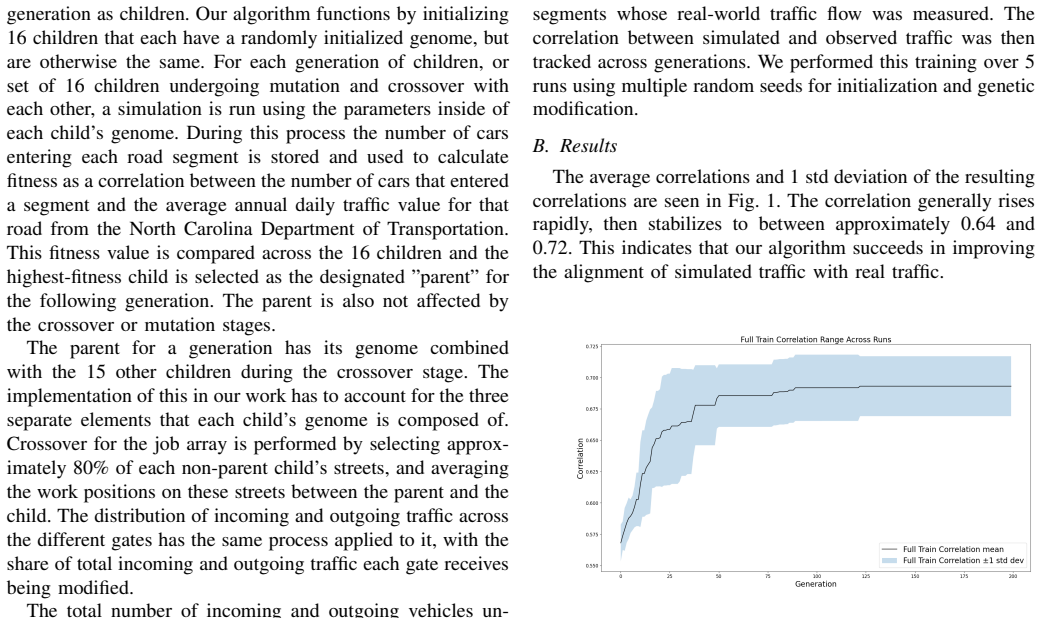
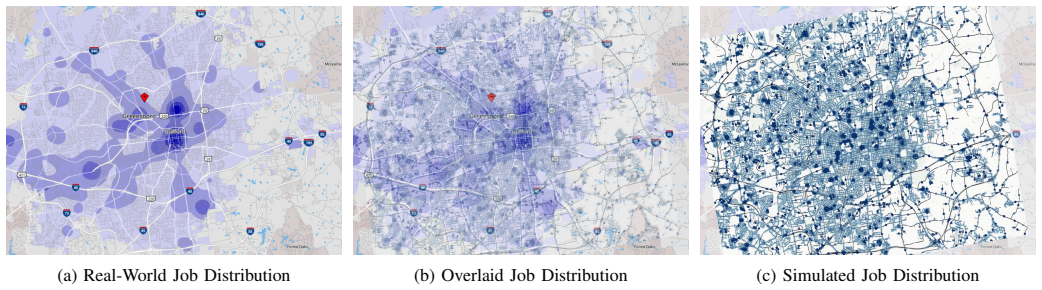
A genetic algorithm can optimize job distributions and gate-traffic parameters within the SUMO simulator so that simulated traffic volumes on a small sample of roads align with observed flow rates; the resulting model then produces city-wide traffic that correlates with real measurements, generalizes to roads withheld from the optimization, and yields job distributions that qualitatively agree with census employment data without ever having been trained on employment records.
What carries the argument
Genetic algorithm that searches over job distributions and gate-traffic parameters to minimize mismatch between simulated and observed traffic flows on selected roads.
If this is right
- Simulated traffic volumes correlate well with real-world measurements on the calibration roads.
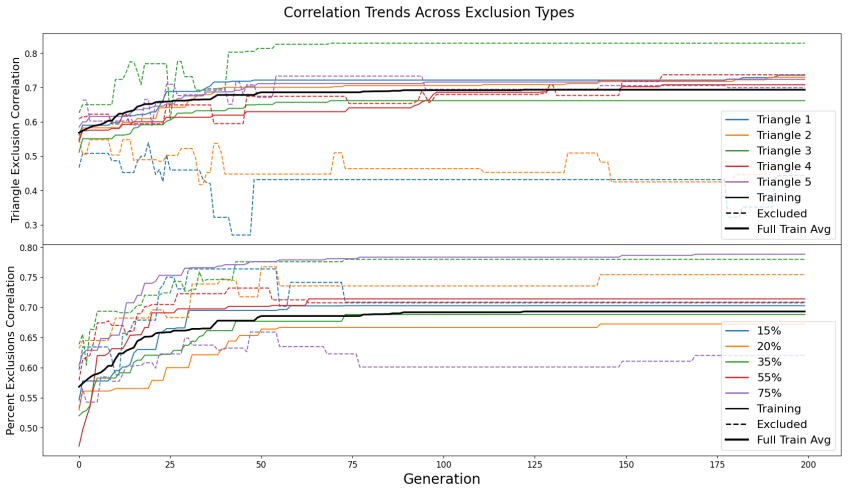
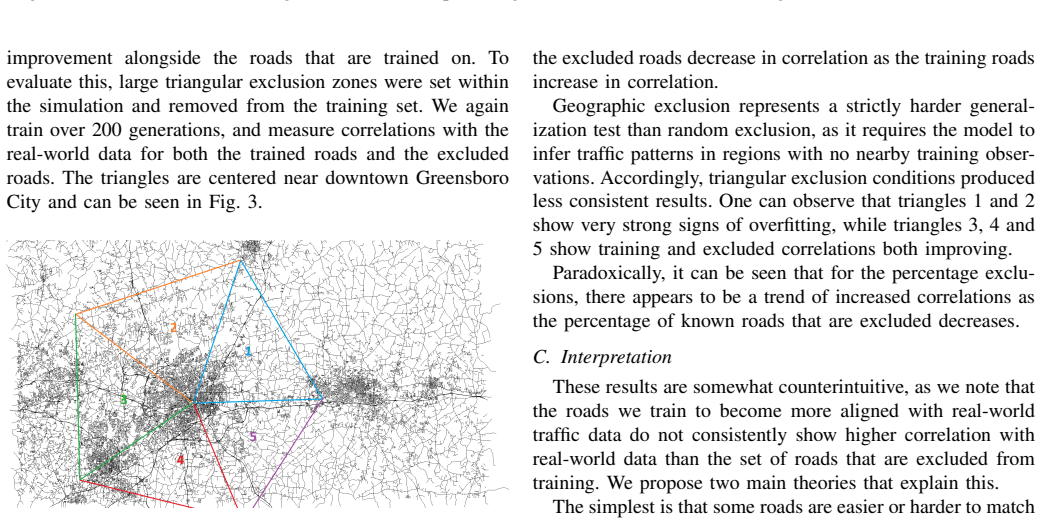
- The same parameters produce traffic estimates that remain accurate on road segments never seen during optimization.
- The inferred job distributions exhibit qualitative agreement with census employment data despite receiving no employment supervision.
- The calibration requires only a small number of road observations rather than city-wide detailed data.
Where Pith is reading between the lines
- The same sparse-observation approach could be applied to other cities or to different simulation platforms without new data-collection campaigns.
- Traffic flow data alone may be sufficient to recover plausible commuter origin-destination patterns at city scale.
- The method opens a route to rapid recalibration when road networks or demand patterns change.
Load-bearing premise
The underlying traffic model structure plus the two chosen parameter sets are flexible enough to reproduce observed city-wide patterns when fitted only to sparse road data.
What would settle it
Running the optimized parameters on a large held-out set of road segments and finding traffic volumes that show no correlation with measured flows, or job distributions that bear no resemblance to census employment maps.
Figures
read the original abstract
Urban traffic simulation is a critical tool for infrastructure planning, including the placement of electric vehicle charging stations. However, realistic traffic simulation across many cities is hindered by two fundamental data limitations: detailed real-world traffic measurements are available for only a small fraction of road segments in most cities, and employment distribution data critical for modeling commuter traffic is rarely available at the resolution needed for simulation. This paper presents a genetic algorithm-based framework that directly addresses both limitations, calibrating urban traffic simulations from sparse road observations without requiring detailed job location data. Using the SUMO traffic simulation platform for Greensboro, North Carolina, our approach optimizes job distributions and gate-traffic parameters to align simulated traffic with a small sample of roads with known traffic-flow rates. We demonstrate that this approach produces simulated traffic that correlates well with real-world measurements, generalizes to road segments withheld from training, and produces job distributions that show promising qualitative agreement with census employment data despite never directly training on that employment data. This work demonstrates that realistic urban traffic simulation can be achieved from minimal real-world observations, offering a scalable and data-light approach to simulation calibration that reduces the barrier to deploying traffic models across diverse cities.
Editorial analysis
A structured set of objections, weighed in public.
Referee Report
Summary. The paper presents a genetic algorithm framework for calibrating SUMO traffic simulations of Greensboro, NC, by optimizing job distributions (zonal parameters) and gate-traffic scalars to match traffic flow rates on a small set of observed roads. It claims the resulting simulations correlate well with real-world measurements, generalize to held-out road segments, and yield job distributions showing qualitative agreement with census employment data despite no direct training on employment figures.
Significance. If the quantitative support holds, the work offers a data-light calibration method that could enable realistic city-scale traffic models in data-scarce environments, directly supporting applications such as EV charging infrastructure planning. The use of external held-out measurements and the indirect census agreement are strengths that distinguish it from purely self-referential fitting.
major comments (3)
- [Abstract and §5] Abstract and §5 (Results): The claims that simulated traffic 'correlates well' and 'generalizes to road segments withheld from training' are presented without any reported correlation coefficients, RMSE values, error bars, or statistical tests, which are load-bearing for assessing whether the genetic optimization has produced a substantively useful calibration rather than a superficial match on sparse data.
- [§4 and §5] §4 (Methods) and §5: No ablation or sensitivity analysis is provided to test whether the chosen parameter classes (job distributions and gate-traffic parameters) are expressive enough to recover city-wide patterns, or whether uncalibrated elements such as signal timings or routing assumptions dominate the residual mismatch; this directly bears on the central sufficiency assumption invoked in the abstract.
- [§4.3] §4.3 (Data and Optimization): Details on the exact number of training vs. held-out roads, the rules for excluding observations, the precise fitness function, and convergence diagnostics for the genetic algorithm are absent, undermining evaluation of reproducibility and robustness of the reported generalization.
minor comments (2)
- [§3] Figure captions and §3 would benefit from explicit definitions of 'gate-traffic parameters' and the precise SUMO network elements they control.
- The manuscript should include a short table summarizing the genetic algorithm hyperparameters (population size, generations, mutation rate) for reproducibility.
Simulated Author's Rebuttal
We thank the referee for the constructive feedback, which highlights opportunities to strengthen the quantitative support and reproducibility of our calibration framework. We address each major comment below and commit to revisions that directly respond to the concerns raised.
read point-by-point responses
-
Referee: [Abstract and §5] Abstract and §5 (Results): The claims that simulated traffic 'correlates well' and 'generalizes to road segments withheld from training' are presented without any reported correlation coefficients, RMSE values, error bars, or statistical tests, which are load-bearing for assessing whether the genetic optimization has produced a substantively useful calibration rather than a superficial match on sparse data.
Authors: We agree that explicit quantitative metrics are necessary to substantiate the claims. The revised manuscript will report Pearson correlation coefficients, RMSE values with error bars, and p-values from statistical tests for both the training roads and the held-out segments to demonstrate the strength and significance of the matches. revision: yes
-
Referee: [§4 and §5] §4 (Methods) and §5: No ablation or sensitivity analysis is provided to test whether the chosen parameter classes (job distributions and gate-traffic parameters) are expressive enough to recover city-wide patterns, or whether uncalibrated elements such as signal timings or routing assumptions dominate the residual mismatch; this directly bears on the central sufficiency assumption invoked in the abstract.
Authors: The referee correctly identifies a gap in validating the sufficiency of the optimized parameters. While our choices are grounded in the data-scarce setting described in the introduction, we will add a sensitivity analysis in the revision that varies the number of job-distribution parameters and discusses the potential influence of fixed elements such as signal timings and routing assumptions on residual errors. revision: yes
-
Referee: [§4.3] §4.3 (Data and Optimization): Details on the exact number of training vs. held-out roads, the rules for excluding observations, the precise fitness function, and convergence diagnostics for the genetic algorithm are absent, undermining evaluation of reproducibility and robustness of the reported generalization.
Authors: We acknowledge that these implementation details are essential for reproducibility. The revised version will explicitly state the number of training and held-out roads, the exclusion criteria applied to observations, the exact mathematical form of the fitness function, and convergence diagnostics (e.g., fitness trajectories across generations) for the genetic algorithm. revision: yes
Circularity Check
No circularity: calibration is externally benchmarked against held-out observations and census data
full rationale
The paper's core procedure fits job-distribution and gate-traffic parameters via genetic optimization to minimize error on a sparse set of observed road counts. Reported performance is measured by correlation on road segments explicitly withheld from the loss, plus qualitative comparison to independent census employment statistics never used in training. No equation defines a target quantity in terms of itself, no fitted parameter is relabeled as a prediction, and no load-bearing premise rests on a self-citation whose content reduces to the present work. The derivation chain therefore remains externally falsifiable and does not collapse to its own inputs.
Axiom & Free-Parameter Ledger
free parameters (2)
- job distributions
- gate-traffic parameters
axioms (2)
- domain assumption The SUMO traffic simulation platform can represent real urban traffic dynamics once job and gate parameters are appropriately set.
- domain assumption Genetic algorithms can locate parameter values that produce traffic flows matching real observations without overfitting to the sparse training roads.
Reference graph
Works this paper leans on
-
[1]
Greenevt: Greensboro electric vehicle testbed,
G. Nilsson, A. D. O. Aquino, S. Coogan, and D. K. Molzahn, “Greenevt: Greensboro electric vehicle testbed,”IEEE Systems Journal, vol. 18, no. 1, pp. 600–611, 2024
2024
-
[2]
Luxembourg sumo traffic (lust) scenario: 24 hours of mobility for vehicular networking research,
L. Codeca, R. Frank, and T. Engel, “Luxembourg sumo traffic (lust) scenario: 24 hours of mobility for vehicular networking research,” in 2015 ieee vehicular networking conference (vnc). IEEE, 2015, pp. 1–8
2015
-
[3]
Tost: Tokyo sumo traffic scenario,
Y . Yamazaki, Y . Tamura, X. D ´efago, E. Javanmardi, and M. Tsukada, “Tost: Tokyo sumo traffic scenario,” in2023 IEEE 26th International Conference on Intelligent Transportation Systems (ITSC). IEEE, 2023, pp. 3597–3604
2023
-
[4]
Calibrating real-world city traffic simulation model using vehicle speed data,
S. Khaleghian, H. Neema, M. Sartipi, T. Tran, R. Sen, and A. Dubey, “Calibrating real-world city traffic simulation model using vehicle speed data,” in2023 IEEE international conference on smart computing (SMARTCOMP). IEEE, 2023, pp. 303–308
2023
-
[5]
Calibration and evaluation of car following models using real-world driving data,
M. Pourabdollah, E. Bj ¨arkvik, F. F¨urer, B. Lindenberg, and K. Burgdorf, “Calibration and evaluation of car following models using real-world driving data,” in2017 IEEE 20th International conference on intelligent transportation systems (ITSC). IEEE, 2017, pp. 1–6
2017
-
[6]
Calibration of microscopic traffic simulation models using metaheuristic algorithms,
M. Yu and W. D. Fan, “Calibration of microscopic traffic simulation models using metaheuristic algorithms,”International Journal of Trans- portation Science and Technology, vol. 6, no. 1, pp. 63–77, 2017
2017
-
[7]
Calibration of microsimulation models using nonparametric statistical techniques,
S.-J. Kim, W. Kim, and L. R. Rilett, “Calibration of microsimulation models using nonparametric statistical techniques,”Transportation Re- search Record, vol. 1935, no. 1, pp. 111–119, 2005
1935
-
[8]
A new method for microsimulation model calibration: A case study of i-710,
H. N. Esfahani and Z. Song, “A new method for microsimulation model calibration: A case study of i-710,” 2019
2019
-
[9]
An automatic calibration procedure of driving behaviour parameters in the presence of high bus volume,
N. Dadashzadeh, M. Ergun, S. Kesten, and M. ˇZura, “An automatic calibration procedure of driving behaviour parameters in the presence of high bus volume,”Promet-Traffic&Transportation, vol. 31, no. 5, pp. 491–502, 2019
2019
-
[10]
Cal- ibrating microscopic traffic simulation model using connected vehicle data and genetic algorithm,
A. Afshari, J. Lee, D. Besenski, B. Dimitrijevic, and L. Spasovic, “Cal- ibrating microscopic traffic simulation model using connected vehicle data and genetic algorithm,”Applied Sciences, vol. 15, no. 3, p. 1496, 2025
2025
-
[11]
Calibration of microsimulation with heuristic optimization methods,
J. Ma, H. Dong, and H. M. Zhang, “Calibration of microsimulation with heuristic optimization methods,”Transportation Research Record, vol. 1999, no. 1, pp. 208–217, 2007
1999
-
[12]
Development and evaluation of a procedure for the calibration of simulation models,
B. Park and H. Qi, “Development and evaluation of a procedure for the calibration of simulation models,”Transportation Research Record, vol. 1934, no. 1, pp. 208–217, 2005
1934
-
[13]
Development of a tool for an efficient calibration of corsim models,
A. Paz and V . Molano, “Development of a tool for an efficient calibration of corsim models,” 2014
2014
-
[14]
Genetic algorithm-based optimization approach and generic tool for calibrating traffic microscopic simulation parame- ters,
T. Ma and B. Abdulhai, “Genetic algorithm-based optimization approach and generic tool for calibrating traffic microscopic simulation parame- ters,”Transportation research record, vol. 1800, no. 1, pp. 6–15, 2002
2002
-
[15]
A multi-objective approach for traffic signal scheduling leveraging vehicle priority model and microscopic simulation,
M. Rahaman, A. M. S. Rumi, M. S. Islam, T. R. Toha, M. M. Mushfiq, M. S. Rahman, M. A. Nayeem, N. A. Al-Nabhan, and A. A. Al Islam, “A multi-objective approach for traffic signal scheduling leveraging vehicle priority model and microscopic simulation,”Traffic, vol. 4, p. 6
-
[16]
Iterative calibration of vissim simulator based on genetic algorithm,
T. Tettamanti, A. Csik ´os, I. Varga, and A. Ele˝od, “Iterative calibration of vissim simulator based on genetic algorithm,”Acta Technica Jaurinensis, vol. 8, no. 2, pp. 145–152, 2015
2015
-
[17]
Calibration of microscopic traffic simulation models: Methods and application,
R. Balakrishna, C. Antoniou, M. Ben-Akiva, H. N. Koutsopoulos, and Y . Wen, “Calibration of microscopic traffic simulation models: Methods and application,”Transportation Research Record, vol. 1999, no. 1, pp. 198–207, 2007
1999
-
[18]
2010 tiger/line shapefiles: Traffic analysis zones (taz),
U.S. Census Bureau, “2010 tiger/line shapefiles: Traffic analysis zones (taz),” https://www2.census.gov/geo/tiger/TIGER2010/TAZ/2010/, 2010
2010
discussion (0)
Sign in with ORCID, Apple, or X to comment. Anyone can read and Pith papers without signing in.