Machines Learn Number Fields, But How? The Case of Galois Groups
Pith reviewed 2026-05-21 23:48 UTC · model grok-4.3
The pith
Decision trees trained on Dedekind zeta coefficients yield new explicit criteria for classifying Galois groups of number fields.
A machine-rendered reading of the paper's core claim, the machinery that carries it, and where it could break.
Core claim
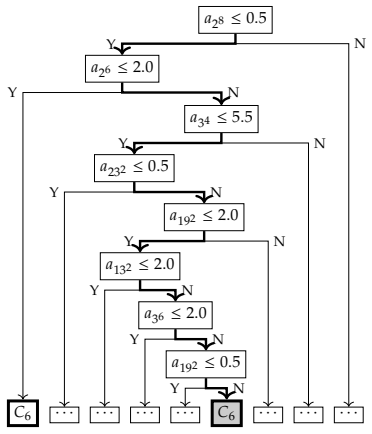
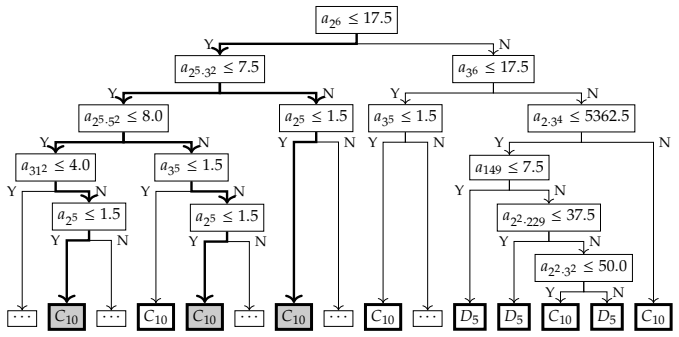
By applying interpretable machine learning methods such as decision trees, we study how simple models can classify the Galois groups of Galois extensions over Q of degrees 4, 6, 8, 9, and 10, using Dedekind zeta coefficients. Our interpretation of the machine learning results allows us to understand how the distribution of zeta coefficients depends on the Galois group, and to prove new criteria for classifying the Galois groups of these extensions.
What carries the argument
Decision trees whose successive splits on Dedekind zeta coefficients correspond to verifiable properties of their distributions and thereby furnish classification rules.
If this is right
- Explicit, checkable rules exist for determining the Galois group from the first several zeta coefficients in degrees up to 10.
- The distribution of zeta coefficients carries enough information to separate distinct Galois groups in these degrees.
- Machine learning outputs can be translated into self-contained arithmetic statements that do not depend on the original algorithms.
Where Pith is reading between the lines
- The same interpretive procedure could be applied to other arithmetic invariants or to extensions of higher degree once suitable training data become available.
- The derived criteria might reduce the computational cost of Galois group computation for small-degree fields by replacing full resolvent calculations with coefficient checks.
Load-bearing premise
The features and splits found by the decision trees reflect general, provable distinctions in the zeta coefficient distributions that hold independently of the training data and model architecture.
What would settle it
A single Galois extension in one of the listed degrees whose Dedekind zeta coefficients violate one of the derived criteria while possessing the Galois group the criterion claims to exclude.
Figures




read the original abstract
By applying interpretable machine learning methods such as decision trees, we study how simple models can classify the Galois groups of Galois extensions over $\mathbb{Q}$ of degrees 4, 6, 8, 9, and 10, using Dedekind zeta coefficients. Our interpretation of the machine learning results allows us to understand how the distribution of zeta coefficients depends on the Galois group, and to prove new criteria for classifying the Galois groups of these extensions. Combined with previous results, this work provides another example of a new paradigm in mathematical research driven by machine learning.
Editorial analysis
A structured set of objections, weighed in public.
Referee Report
Summary. The manuscript applies interpretable machine learning, specifically decision trees, to classify Galois groups of Galois extensions of Q in degrees 4, 6, 8, 9, and 10 using coefficients of the Dedekind zeta function. Interpretation of the learned decision rules is used to understand the dependence of zeta coefficient distributions on the Galois group and to derive and prove new classification criteria for these degrees. The work is presented as an instance of machine learning driving new mathematical results in number theory.
Significance. If the derived criteria are shown to be general, data-independent, and rigorously proven without post-hoc adjustment to the training distribution, the paper would illustrate a viable workflow from ML pattern discovery to provable statements in algebraic number theory. This could strengthen the case for ML-assisted exploration in the field, particularly when combined with the authors' prior results on related problems.
major comments (3)
- [§4.3] §4.3, decision tree for degree-8 fields: the reported split thresholds on the first few zeta coefficients (e.g., a_2 < 1.5) are presented as leading directly to a provable criterion, but the manuscript does not explicitly verify that these thresholds coincide with exact distinctions in the possible splitting types or Artin symbols that hold for all extensions of degree 8, independent of the finite training sample.
- [Theorem 6.2] Theorem 6.2 (degree-9 case): the proof invokes an additional case analysis on the possible cycle types that is not visibly entailed by the single decision-tree split shown in Figure 4; it is therefore unclear whether the final criterion is a direct formalization of the ML output or requires independent number-theoretic reasoning that could have been discovered without the tree.
- [§5.1] §5.1, general claim of 'parameter-free' criteria: the statement that the new rules are free of training-set dependence is not accompanied by a statement of the precise sample size, the range of discriminants used, or a cross-validation check showing that the same thresholds emerge on disjoint sets of fields.
minor comments (2)
- [Table 1] Table 1: the column headings for the Galois-group labels are not defined in the caption; readers must consult the text to learn that 'C4' denotes the cyclic group of order 4.
- [Figure 3] Figure 3: the x-axis label 'zeta coeff index' should specify whether the coefficients are normalized or raw, and the vertical lines marking the learned thresholds should be labeled with their numerical values.
Simulated Author's Rebuttal
We thank the referee for the careful reading and constructive comments. The points raised help clarify the relationship between the machine-learning outputs and the general mathematical criteria. We respond to each major comment below and indicate the planned revisions.
read point-by-point responses
-
Referee: [§4.3] §4.3, decision tree for degree-8 fields: the reported split thresholds on the first few zeta coefficients (e.g., a_2 < 1.5) are presented as leading directly to a provable criterion, but the manuscript does not explicitly verify that these thresholds coincide with exact distinctions in the possible splitting types or Artin symbols that hold for all extensions of degree 8, independent of the finite training sample.
Authors: We agree that the manuscript would benefit from an explicit statement that the thresholds are not artifacts of the training sample. In the revised version we will augment §4.3 with a short general argument showing that the inequalities on the initial zeta coefficients are equivalent to restrictions on the possible cycle types (or Artin symbols) in the Galois group of any degree-8 extension of Q. This argument relies only on the factorization of the Dedekind zeta function and the Chebotarev density theorem, making the criterion independent of any finite dataset. revision: yes
-
Referee: [Theorem 6.2] Theorem 6.2 (degree-9 case): the proof invokes an additional case analysis on the possible cycle types that is not visibly entailed by the single decision-tree split shown in Figure 4; it is therefore unclear whether the final criterion is a direct formalization of the ML output or requires independent number-theoretic reasoning that could have been discovered without the tree.
Authors: The single split identified by the decision tree isolates the coefficient whose distribution most sharply separates the Galois groups in the training data. The subsequent case analysis on cycle types is required to obtain a complete, exhaustive criterion. In the revision we will insert a brief explanatory paragraph immediately before Theorem 6.2 that (i) records the precise coefficient and threshold suggested by the tree and (ii) states that the remaining case distinctions follow from standard Galois-theoretic bookkeeping once that coefficient is fixed. This makes transparent both the ML-guided starting point and the additional number-theoretic work needed for a full proof. revision: partial
-
Referee: [§5.1] §5.1, general claim of 'parameter-free' criteria: the statement that the new rules are free of training-set dependence is not accompanied by a statement of the precise sample size, the range of discriminants used, or a cross-validation check showing that the same thresholds emerge on disjoint sets of fields.
Authors: We will expand §5.1 to report the exact number of fields generated for each degree, the range of absolute discriminants sampled, and the results of a 5-fold cross-validation experiment performed on disjoint random partitions of the data. In each fold the same thresholds were recovered (within the precision of the floating-point representation), providing empirical evidence that the criteria are stable across different training distributions. These details will be added without altering the theoretical proofs already given. revision: yes
Circularity Check
No significant circularity: ML discovery followed by independent proofs
full rationale
The paper trains decision trees on Dedekind zeta coefficients to classify Galois groups for degrees 4,6,8,9,10, then interprets the learned splits to derive mathematical criteria that are subsequently proven rigorously. This separates empirical pattern discovery from formal verification; the proofs do not reduce to the training data or model outputs by construction. No self-citations are load-bearing for the central claims, and no fitted parameters are relabeled as predictions. The derivation chain is self-contained against external number-theoretic benchmarks.
Axiom & Free-Parameter Ledger
axioms (1)
- domain assumption Coefficients of the Dedekind zeta function of a Galois extension encode information sufficient to distinguish Galois groups in low degrees
Forward citations
Cited by 3 Pith papers
-
How Twist Class Redundancy Drives the Prediction of Traces of Frobenius of Elliptic Curves
Redundancy within quadratic twist classes in elliptic curve datasets is sufficient to produce highly accurate machine learning predictions of Frobenius traces.
-
Computer vision and converse theorems
2D CNNs on image-encoded elliptic curve twists outperform 1D CNNs on Frobenius traces alone at separating conductor families from Sato-Tate random matrices and can predict analytic rank.
-
AI for Mathematics: Progress, Challenges, and Prospects
AI for math combines task-specific architectures and general foundation models to support research and advance AI reasoning capabilities.
Reference graph
Works this paper leans on
-
[1]
Amir, M., He, Y .-H., Lee, K.-H., Oliver, T., and Sultanow , E.Machine learning class numbers of real quadratic fields.International Journal of Data Science in the Mathematical Sciences 1, 02 (2023), 107–134
work page 2023
-
[2]
Awtrey , C., French, R., Jakes, P ., and Russell, A. Irreducible sextic polynomials and their absolute resolvents.Minnesota Journal of Undergraduate Mathematics 1, 1 (2015)
work page 2015
-
[3]
On the Galois group of a reciprocal even octic polynomial
Awtrey , C., and P atane, F. On the Galois group of a reciprocal even octic polynomial. Communications in Algebra 52, 7 (2024), 3018–3026
work page 2024
-
[4]
On small discriminants of number fields of degree 8 and 9.J
Battistoni, F. On small discriminants of number fields of degree 8 and 9.J. Théor. Nombres Bordeaux 32, 2 (2020), 489–501
work page 2020
-
[5]
Bosma, W., Cannon, J., and Playoust , C.The Magma algebra system. I. The user language.J. SymbolicComput.24 ,3-4(1997),235–265. Computationalalgebraandnumbertheory(London, 1993)
work page 1997
-
[6]
Enumeration of quartic fields of small discriminant
Buchmann, J., Ford, D., and Pohst , M. Enumeration of quartic fields of small discriminant. mathematics of computation 61, 204 (1993), 873–879
work page 1993
-
[7]
Carifio, J., Halverson, J., Krioukov , D., and Nelson, B. D. Machine learning in the string landscape. Journal of High Energy Physics 2017, 9 (2017), 157
work page 2017
-
[8]
Carrillo, B. Finding Galois splitting models to compute local invariants.Journal of Number Theory 261(2024), 241–251
work page 2024
-
[9]
Ca v allo, A.AnelementarycomputationoftheGaloisgroupsofsymmetricsextictrinomials. arXiv preprint arXiv:1902.00965(2019)
-
[10]
Chen, M. H. W., Chin, A. Y . M., and Tan, T. S.Galoisgroupsofcertainevenocticpolynomials. Journal of Algebra and its Applications 22, 12 (2023), 2350263
work page 2023
-
[11]
Elliptic curve ‘murmurations’ found with AI take flight.Qunata Magazine(2024)
Chiou, L. Elliptic curve ‘murmurations’ found with AI take flight.Qunata Magazine(2024)
work page 2024
-
[12]
Number theory: Volume II: Analytic and modern tools, vol
Cohen, H. Number theory: Volume II: Analytic and modern tools, vol. 240. Springer Science & Business Media, 2007
work page 2007
-
[13]
Advancing mathematics by guiding human intuition with AI.Nature 600, 7887 (2021), 70–74
Da vies, A., Veličković, P ., Buesing, L., Blackwell, S., Zheng, D., Tomašev , N., Tanburn, R., Battaglia, P ., Blundell, C., Juhász, A., et al. Advancing mathematics by guiding human intuition with AI.Nature 600, 7887 (2021), 70–74
work page 2021
-
[14]
Douglas, M. R., and Lee, K.-H. Mathematical data science. Advances in Theoretical and Mathematical Physics(2025). To appear. 42
work page 2025
-
[15]
Dummit , D. S., Foote, R. M., et al. Abstract algebra, vol. 3. Wiley Hoboken, 2004
work page 2004
-
[16]
LMSJournal of Computation and Mathematics 17, 1 (2014), 141–158
Fieker, C., and Klüners, J.ComputationofGaloisgroupsofrationalpolynomials. LMSJournal of Computation and Mathematics 17, 1 (2014), 141–158
work page 2014
-
[17]
Greenberg, M. An elementary proof of the kronecker-weber theorem.The American Mathe- matical Monthly 81, 6 (1974), 601–607
work page 1974
-
[18]
He, Y .-H.Machine-learning the string landscape.Physics Letters B 774(2017), 564–568
work page 2017
-
[19]
Mathematics,Computation and Geometry of Data 2, 1 (2022), 49–66
He, Y .-H., Lee, K.-H., and Oliver, T.Machine-learningnumberfields. Mathematics,Computation and Geometry of Data 2, 1 (2022), 49–66
work page 2022
-
[20]
Machine-learning the Sato-Tate conjecture.J
He, Y .-H., Lee, K.-H., and Oliver, T. Machine-learning the Sato-Tate conjecture.J. Symbolic Comput. 111(2022), 61–72
work page 2022
-
[21]
Machine learning invariants of arithmetic curves.J
He, Y .-H., Lee, K.-H., and Oliver, T. Machine learning invariants of arithmetic curves.J. Symbolic Comput. 115(2023), 478–491
work page 2023
-
[22]
Experi- mental Mathematics(2024), 1–13
He, Y .-H., Lee, K.-H., Oliver, T., and Pozdnyakov , A.Murmurationsofellipticcurves. Experi- mental Mathematics(2024), 1–13
work page 2024
-
[23]
Iwasawa, K.On Galois groups of local fields.Transactions of the American Mathematical Society 80, 2 (1955), 448–469
work page 1955
-
[24]
Jones, J. W., and Roberts, D. P .Nonic 3-adic fields. InInternational Algorithmic Number Theory Symposium(2004), Springer, pp. 293–308
work page 2004
-
[25]
Jones, J. W., and Roberts, D. P . A database of local fields.Journal of symbolic computation 41, 1 (2006), 80–97
work page 2006
-
[26]
Jones, J. W., and Roberts, D. P . Octic 2-adic fields. Journal of Number Theory 128, 6 (2008), 1410–1429
work page 2008
-
[27]
Jones, J. W., and Roberts, D. P . A database of number fields.LMS Journal of Computation and Mathematics 17, 1 (2014), 595–618
work page 2014
-
[28]
Klüners, J., and Malle, G. A database for field extensions of the rationals.LMS Journal of Computation and Mathematics 4(2001), 182–196
work page 2001
-
[29]
Machine learning of Calabi-Yau volumes.Physical Review D 96, 6 (2017), 066014
Krefl, D., and Seong, R.-K. Machine learning of Calabi-Yau volumes.Physical Review D 96, 6 (2017), 066014
work page 2017
-
[30]
Data-scientific study of Kronecker coefficients.Experimental Mathematics(2025)
Lee, K.-H. Data-scientific study of Kronecker coefficients.Experimental Mathematics(2025). 43
work page 2025
-
[31]
The L-functions and modular forms database
LMFDB Collaboration, T. The L-functions and modular forms database. https://www. lmfdb.org, 2025. [Online; accessed 19 July 2025]
work page 2025
-
[32]
Explicit local reciprocity for tame extensions
Newton, R. Explicit local reciprocity for tame extensions. InMathematical Proceedings of the Cambridge Philosophical Society(2012), vol. 152, Cambridge University Press, pp. 425–454
work page 2012
-
[33]
The computation of sextic fields with a cubic subfield and no quadratic subfield
Olivier, M. The computation of sextic fields with a cubic subfield and no quadratic subfield. Math. Comp. 58, 197 (1992), 419–432
work page 1992
-
[34]
Mathematics of Computation 70, 236 (2001), 1641–1659
P auli, S., and Roblot , X.-F.On the computation of all extensions of a𝑝-adic field of a given degree. Mathematics of Computation 70, 236 (2001), 1641–1659
work page 2001
-
[35]
Pedregosa, F., V aroquaux, G., Gramfort , A., Michel, V ., Thirion, B., Grisel, O., Blondel, M., Prettenhofer, P ., Weiss, R., Dubourg, V ., et al.Scikit-learn: Machine learning in Python.the Journal of machine Learning research 12(2011), 2825–2830
work page 2011
-
[36]
Evolving neural networks with genetic algorithms to study the string landscape
Ruehle, F. Evolving neural networks with genetic algorithms to study the string landscape. Journal of High Energy Physics 2017, 8 (2017), 1–20
work page 2017
-
[37]
Voight , J.Enumeration of totally real number fields of bounded root discriminant. InAlgo- rithmic Number Theory: 8th International Symposium, ANTS-VIII Banff, Canada, May 17-22, 2008 Proceedings 8(2008), Springer, pp. 268–281
work page 2008
-
[38]
W ang, S.A counter-example to Grunwald’s theorem.Ann. Math. 49, 4 (1948), 1008–1009
work page 1948
-
[39]
W ang, S.On Grunwald’s theorem.Ann. Math. 51, 2 (1950), 471–484. Department of Mathematics, University of Connecticut, Storrs, CT 06269, USA Korea Institute for Advanced Study, Seoul 02455, Republic of Korea khlee@math.uconn.edu Department of Mathematics, University of California—Berkeley, Berkeley, CA 94720, USA seewoo5@berkeley.edu 44
work page 1950
discussion (0)
Sign in with ORCID, Apple, or X to comment. Anyone can read and Pith papers without signing in.