REVIEW 5 major objections 8 minor 36 references
An agent can train its own screenwriting skills from human scripts, with no human annotation or reward model.
Reviewed by Pith at T0; open to challenge. T0 means a machine referee read the full paper against a public rubric. the ladder, T0–T4 →
T0 review · deepseek-v4-flash
2026-08-01 05:42 UTC pith:CIIF73JX
load-bearing objection A fresh self-supervised skill-acquisition mechanism with a fair OOD design, but the critic generating the training signal is never validated, there's no generic-memory control, and the headline table lacks error bars. the 5 major comments →
Training Skills Like Parameters via Self-Supervised Semantic Diffusion
The pith
A machine-rendered reading of the paper's core claim, the machinery that carries it, and where it could break.
Core claim
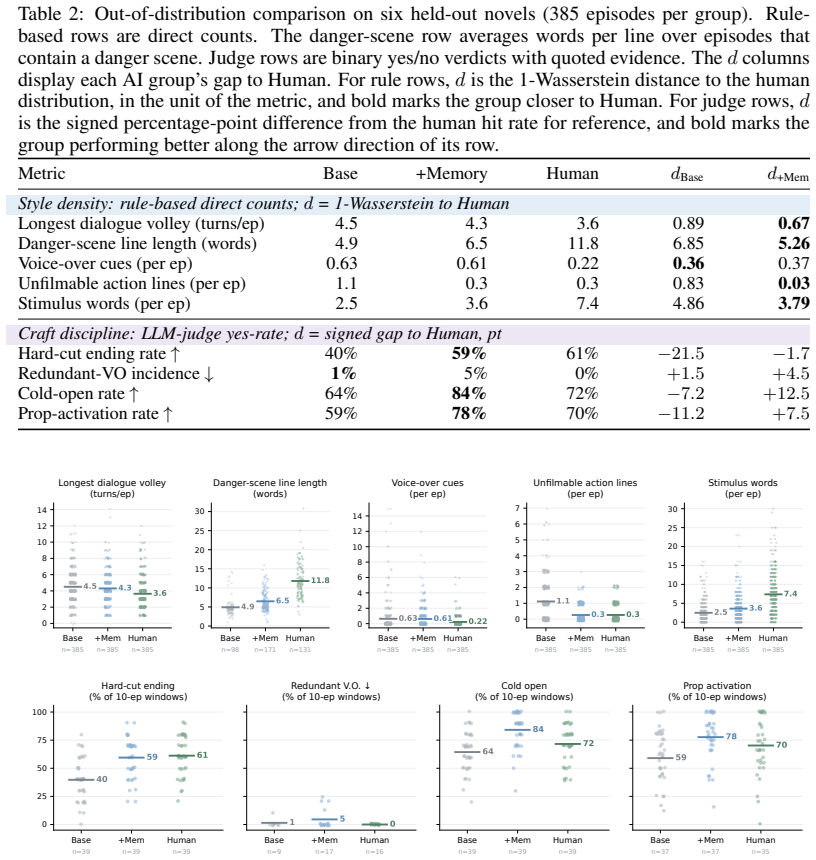
The central claim is that the familiar forward/loss/backward loop of neural network training can be reproduced entirely in text, with a library of skill cards playing the role of parameters. The forward pass generates a screenplay from an outline with the help of memory; the loss pass is a written critique contrasting the draft with the human original; the backward pass edits the skill cards to strengthen what worked, narrow what misled, and add missing rules. On held-out short-drama episodes, the memory-equipped agent outperformed the same agent with empty memory on seven of nine metrics, with the largest gains in eliminating unfilmable action lines and in structural discipline like hard-cu
What carries the argument
The load-bearing mechanism is the corruption-and-reconstruction pair: a 'corruption agent' compresses a human screenplay into a coarse story outline, and a 'script agent' must recover the full screenplay. The difference between what it produces and the human original is captured by a 'loss agent' as a dense natural-language report; a 'backward agent' then routes that report through a hierarchical reduction into micro-edits. The updated object is a compact, Mixture-of-Experts-style memory library in which each rule card is routed to one of three folders (general principles, craft techniques, genre conventions) and held to a hard token cap by a linter, which acts as regularization and prevents
Load-bearing premise
The whole training signal is the loss agent's written critique comparing the agent's draft to the human original; if that critique is biased, noisy, or misses real flaws, the memory updates are misdirected even though the forward loop runs correctly.
What would settle it
Train the identical loop but have the loss agent compare each reconstruction against a different human episode from the same corpus rather than its own original. If the learned memory still improves held-out metrics, then the specific contrast against the human artifact is not the active ingredient—and the method's claimed self-supervision would need a different explanation.
If this is right
- Closed-source, weight-inaccessible models can be specialized to an open-ended domain without any parameter updates, since training happens entirely in an external text memory.
- The learned skills are human-readable and auditable, in contrast to gradient updates; a misbehaving rule card can be identified and corrected directly.
- The same frozen memory pool transfers across different base models, converging the craft disciplines toward the same levels regardless of each model's starting temperament.
- The approach implies a data-parallel, serialized micro-step training scheme that avoids the orchestration overhead of earlier multi-agent designs, completing full runs in under an hour per step.
- Memory regularization is decisive: uncapped pools overfit (over-suppressing stimulus words and tripling inference cost), while token-capped pools improve both rule-level and judge-level metrics simultaneously.
Where Pith is reading between the lines
- If the loss agent is the sole learning signal, the ceiling of the whole method is the critic's ability to recognize craft; a weaker or more biased critic would degrade the memory even if every other component is unchanged.
- The framework should extend to any domain with abundant high-quality human artifacts and a reversible corruption process—code review comments, scientific abstracts, dialogue, legal drafting—wherever 'clean' and 'noised' versions can be constructed without supervision.
- Because the one metric that never improved (stimulus words) had no rule card in the final pool, a testable prediction is that explicitly adding a card for that dimension would move it, and the card would need to encode lexical intensity rather than structure.
- The retrieval bottleneck identified in the paper's own case study suggests that making card retrieval more reliable—rather than writing better cards—is the highest-leverage next step; a direct experiment would compare performance between episodes where the relevant card was read and episodes where it was missed.
Editorial analysis
A structured set of objections, weighed in public.
Referee Report
Summary. The paper introduces a self-supervised agentic learning framework that acquires screenwriting skills from human screenplays without external annotations. The method corrupts a professional screenplay into a condensed story outline, has a script agent reconstruct the full episode with the aid of an external textual memory library, and then uses a 'loss agent' to write a free-form natural-language critique comparing the reconstruction against the human original. A 'backward agent' subsequently edits the memory library—adding, narrowing, merging, or dropping rule cards—under token-length constraints enforced by a linter. The memory is organized into a Mixture-of-Experts-like structure. Experiments on short-drama screenwriting train on twenty production novels and evaluate on six held-out novels, comparing a Base agent (empty memory) with a +Memory agent on nine metrics. The paper reports that +Memory outperforms Base on seven of nine metrics, that the learned pool transfers across two model families, and that it improves an external production pipeline. The authors argue that this constitutes a scalable, unsupervised path for agents to internalize generalizable domain skills while keeping the learned knowledge human-auditable.
Significance. If the main claims hold, the paper addresses an important bottleneck in agent continual learning: acquiring expert skills without expensive human annotation and without model-weight access. The idea of turning existing human artifacts into self-supervised training pairs for an external textual memory is original and potentially generalizable beyond screenwriting. The paper also has notable strengths: an OOD held-out protocol, partially rule-based metrics with no LLM involvement, cross-model transfer experiments, an external-pipeline case study with verbatim read traces, and a planned open-source release. However, the central evidence is weakened by two load-bearing gaps: the sole training signal is an unvalidated LLM-generated critique from the same model family as the generator, and the headline comparison lacks both a generic-rule control and confidence intervals. The reported gains are therefore suggestive but not yet conclusive.
major comments (5)
- [§3.3, §4.1] The semantic loss reports are the sole training signal and are never validated. The paper asserts in §3.3 that anchoring on a concrete human artifact makes the signal 'far more reliable than free-form LLM scoring,' but no evidence is provided: there is no human agreement study, no correlation with the downstream metrics, no sensitivity analysis of the loss agent, and no comparison with a critic from a different model family. Since both the loss agent and the script agent are Claude Sonnet 4.6, the loop may be reinforcing the model family's stylistic preferences rather than moving toward human craft. The Gemini-based evaluation in §4.1 measures final outputs, not the loss reports that shaped the memory. This gap is load-bearing for the central claim of self-supervised learning from human artifacts.
- [Table 2, §4.1–§4.2] The headline OOD comparison lacks a control for a generic or inert rule library. In the +Memory condition the agent receives an additional set of textual instructions at inference time; a standard control would attach an untrained, random, or generic screenwriting-rule pool under identical retrieval conditions. Without this, the seven-of-nine improvement could reflect the benefit of any structured instruction set rather than the specific content learned from human artifacts. Additionally, Table 2 reports no confidence intervals or significance tests. The judge metrics are computed on n≈39 ten-episode windows and are clustered by novel; a hard-cut difference of 40% vs. 59% may be significant, but the paper should demonstrate this, especially because the redundant-VO metric moves in the wrong direction.
- [§4.2 vs. §4.3] There is an unresolved inconsistency between the training dynamics and the OOD results. Section 4.3 and Figure 4 report that stimulus words show no statistically significant change across training epochs and that no rule card targets this dimension, yet Table 2 shows a clear OOD improvement (Wasserstein distance 4.86→3.79). Conversely, voice-over cues improve during training (distance 0.19→0.12) but the OOD distance slightly worsens (0.36→0.37) and the redundant-VO judge rate degrades. The paper should reconcile these observations or temper the attribution of progress to the presence of specific rule cards.
- [Table 2, danger-scene row] The danger-scene line-length comparison is confounded by changing coverage. The average is computed over 98 Base episodes, 171 +Memory episodes, and 131 human episodes; the denominator itself changes because the pool encourages more episodes to contain danger scenes. The distance reduction (6.85→5.26) may therefore reflect a coverage effect as much as a line-length effect. A matched-episode comparison or a joint (coverage, length) analysis is needed to interpret this row.
- [§4.5] The regularization conclusions rest on an uncontrolled historical comparison ('natural-history comparison'), not a dedicated ablation. The uncapped, line-limited, and token-limited pools differ in training data, mechanism variants, and number of training novels. While the result is suggestive, the paper should either present a controlled ablation with identical training data and mechanism except for the linter/budget, or explicitly label this section as anecdotal rather than evidence for the regularization principle.
minor comments (8)
- [§4.1] Judge reproducibility is reported as 84% on a 16-episode subset. Given that four of the nine metrics rely on an LLM judge, the paper should report per-metric agreement and the full sample size.
- [General] No human evaluation is included. All quality signals are either rule-based proxies or LLM judgments. A small human preference study would substantially strengthen the claim that the learned memory improves 'quality.'
- [Abstract, §3.3] The term 'self-supervised' may be misleading: the loss is not directly computed from the human artifact but is a free-form LLM critique. Consider qualifying the term, e.g., 'LLM-mediated self-supervision.'
- [Figure 4] The text mentions episode-paired bootstrap 95% confidence intervals, but the figures do not show them. Adding error bars or intervals would make the significance claims verifiable.
- [§4.3] The in-distribution training curves reconstruct the same 1,127 outline chapters each epoch. Memorization of the outline set could inflate apparent improvement; the paper should acknowledge this possibility more explicitly.
- [§3.1] The corruption agent that compresses screenplays into outlines is not described in detail. If it is also Claude Sonnet 4.6, this should be stated and its reliability assessed, as it defines the training targets.
- [Text formatting] Several formatting artifacts appear in the text: 'V oice-over,' 'T oken-capped,' and an unrendered 'W' in §4.3. Also, references [3] and [4] are future-dated arXiv preprints; please verify citation details.
- [§4.6, Appendix A.2] The external-pipeline evaluation is a qualitative case study with five episodes and no blinding or statistical analysis. It is persuasive as an illustration but should not be presented as a quantitative validation.
Circularity Check
No significant circularity; training target is the external human artifact and evaluation is held-out with independent judge.
full rationale
The paper's central loop is a corruption-reconstruction optimization against an external target: human screenplays are corrupted into outlines (Section 3.1), the script agent reconstructs them (Section 3.2), and a loss agent writes a textual loss by directly comparing the reconstruction with the human original (Section 3.3). The backward agent then edits an external memory library (Section 3.4). No claimed prediction is a fitted input: the memory is trained on twenty novels and then evaluated on six held-out novels with empty vs. trained memory as the only variable (Section 4.1), so the OOD protocol breaks any fit-to-evaluation equivalence. The four LLM-judged metrics use Gemini 3.1 Pro, a different model family from the generator, and the five rule-based metrics are computed with a parser with no LLM. The only self-citation ([3]) is a contextual example of repository-specific software development in the introduction and is not load-bearing. The concerns that the loss agent is the same model family as the generator, or that its loss reports are never validated against human judgments, are validity/reliability risks about the quality of the learning signal, not a demonstration that a result reduces to its inputs by definition or construction. Therefore no circular step is exhibited.
Axiom & Free-Parameter Ledger
free parameters (6)
- card_body_token_cap =
1200 tokens
- card_description_token_cap =
200 tokens
- line_cap =
50 lines
- expert_folder_count =
3
- epoch_count =
3
- micro_step_batch =
not specified
axioms (7)
- domain assumption Corruption-and-reconstruction on discrete text yields useful self-supervised training signals.
- domain assumption Claude Sonnet 4.6 can reliably act as script generator, loss assessor, and memory editor within the loop.
- domain assumption Free-form LLM-written loss reports provide a low-noise gradient-like signal for memory edits.
- domain assumption The read trace faithfully reflects which memory cards influenced generation.
- domain assumption Human screenplays used as targets are high-quality and their craft can be captured in short textual rules.
- domain assumption Prompt-based constraints during reconstruction force the agent to extract generalizable patterns rather than memorize specific texts.
- domain assumption The evaluation metrics capture meaningful quality dimensions of short drama.
invented entities (1)
-
Textual skill library (rule cards)
no independent evidence
read the original abstract
While Large Language Models (LLMs) demonstrate remarkable general instruction-following capabilities, they often fall short of human experts in highly specialized, open-ended domains such as creative screenwriting. Prior approaches typically adopt post-training, yet both supervised fine-tuning and reinforcement learning require weight access that closed-source frontier models do not offer, and demand heavy compute. Moreover, what is learned is tied to a single checkpoint and cannot be inspected by humans. Recent advancements in agentic continual learning instead attempt to bridge this gap by accumulating external textual skills. However, these methods heavily rely on costly human expert annotations or unreliable LLM-as-a-judge feedback for reflection. To overcome this bottleneck, we propose a novel, unsupervised self-evolving agent framework inspired by the corruption-and-reconstruction paradigm of diffusion models. Instead of relying on explicit external scoring, we leverage existing high-quality human artifacts to construct self-supervised signals. Training then follows the familiar loop of neural network training, forward, loss, and backward, with the loss coming from contrasting the agent's reconstruction against the human original. What is updated is not model weights but an external library of textual skills. We evaluate our framework on the challenging task of short drama screenwriting. Experimental results demonstrate that our method enables the agent to autonomously extract and internalize highly generalizable skills, significantly enhancing its domain-specific generation capabilities. Furthermore, this self-contrastive reflection paradigm offers a scalable pathway for agents to teach themselves the production of complex, high-quality human artifacts, without requiring external supervision.
Figures




Reference graph
Works this paper leans on
-
[1]
Long Ouyang, Jeff Wu, Xu Jiang, Diogo Almeida, Carroll L. Wainwright, Pamela Mishkin, Chong Zhang, Sandhini Agarwal, Katarina Slama, Alex Ray, John Schulman, Jacob Hilton, Fraser Kelton, Luke Miller, Maddie Simens, Amanda Askell, Peter Welinder, Paul Christiano, Jan Leike, and Ryan Lowe. Training language models to follow instructions with human feedback,...
Pith/arXiv arXiv 2022
-
[2]
Tom B. Brown, Benjamin Mann, Nick Ryder, Melanie Subbiah, Jared Kaplan, Prafulla Dhari- wal, Arvind Neelakantan, Pranav Shyam, Girish Sastry, Amanda Askell, Sandhini Agar- wal, Ariel Herbert-V oss, Gretchen Krueger, Tom Henighan, Rewon Child, Aditya Ramesh, Daniel M. Ziegler, Jeffrey Wu, Clemens Winter, Christopher Hesse, Mark Chen, Eric Sigler, Mateusz L...
Pith/arXiv arXiv 2020
-
[3]
Mo Li, L. H. Xu, Qitai Tan, Ting Cao, and Yunxin Liu. Learning to commit: Generating organic pull requests via online repository memory, 2026. URLhttps://arxiv.org/abs/ 2603.26664
arXiv 2026
-
[4]
One sentence, one drama: Personalized short-form drama generation via multi-agent systems, 2026
Yufei Shi, Weilong Yan, Naixuan Huang, Yucheng Chen, Chenyu Zhang, Tao He, Si Yong Yeo, and Ming Li. One sentence, one drama: Personalized short-form drama generation via multi-agent systems, 2026. URLhttps://arxiv.org/abs/2605.22144
Pith/arXiv arXiv 2026
-
[5]
Lima: Less is more for alignment, 2023
Chunting Zhou, Pengfei Liu, Puxin Xu, Srini Iyer, Jiao Sun, Yuning Mao, Xuezhe Ma, Avia Efrat, Ping Yu, Lili Yu, Susan Zhang, Gargi Ghosh, Mike Lewis, Luke Zettlemoyer, and Omer Levy. Lima: Less is more for alignment, 2023. URLhttps://arxiv.org/abs/2305. 11206
2023
-
[6]
The unlocking spell on base llms: Rethinking alignment via in-context learning, 2023
Bill Yuchen Lin, Abhilasha Ravichander, Ximing Lu, Nouha Dziri, Melanie Sclar, Khyathi Chandu, Chandra Bhagavatula, and Yejin Choi. The unlocking spell on base llms: Rethinking alignment via in-context learning, 2023. URLhttps://arxiv.org/abs/2312.01552. 11
Pith/arXiv arXiv 2023
-
[7]
Scaling laws for reward model overoptimization,
Leo Gao, John Schulman, and Jacob Hilton. Scaling laws for reward model overoptimization,
-
[8]
Guan, Aleksander Madry, Wojciech Zaremba, Jakub Pachocki, and David Farhi
Bowen Baker, Joost Huizinga, Leo Gao, Zehao Dou, Melody Y . Guan, Aleksander Madry, Wojciech Zaremba, Jakub Pachocki, and David Farhi. Monitoring reasoning models for mis- behavior and the risks of promoting obfuscation, 2025. URLhttps://arxiv.org/abs/ 2503.11926
Pith/arXiv arXiv 2025
-
[9]
V oyager: An open-ended embodied agent with large language models, 2023
Guanzhi Wang, Yuqi Xie, Yunfan Jiang, Ajay Mandlekar, Chaowei Xiao, Yuke Zhu, Linxi Fan, and Anima Anandkumar. V oyager: An open-ended embodied agent with large language models, 2023. URLhttps://arxiv.org/abs/2305.16291
Pith/arXiv arXiv 2023
-
[10]
Expel: Llm agents are experiential learners, 2024
Andrew Zhao, Daniel Huang, Quentin Xu, Matthieu Lin, Yong-Jin Liu, and Gao Huang. Expel: Llm agents are experiential learners, 2024. URLhttps://arxiv.org/abs/2308.10144
Pith/arXiv arXiv 2024
-
[11]
Weiss, Niru Maheswaranathan, and Surya Ganguli
Jascha Sohl-Dickstein, Eric A. Weiss, Niru Maheswaranathan, and Surya Ganguli. Deep unsu- pervised learning using nonequilibrium thermodynamics, 2015. URLhttps://arxiv.org/ abs/1503.03585
Pith/arXiv arXiv 2015
-
[12]
Denoising diffusion probabilistic models, 2020
Jonathan Ho, Ajay Jain, and Pieter Abbeel. Denoising diffusion probabilistic models, 2020. URLhttps://arxiv.org/abs/2006.11239
Pith/arXiv arXiv 2020
-
[13]
Mike Lewis, Yinhan Liu, Naman Goyal, Marjan Ghazvininejad, Abdelrahman Mohamed, Omer Levy, Ves Stoyanov, and Luke Zettlemoyer. Bart: Denoising sequence-to-sequence pre-training for natural language generation, translation, and comprehension, 2019. URL https://arxiv.org/abs/1910.13461
Pith/arXiv arXiv 2019
-
[14]
Representation learning with contrastive predictive coding, 2019
Aaron van den Oord, Yazhe Li, and Oriol Vinyals. Representation learning with contrastive predictive coding, 2019. URLhttps://arxiv.org/abs/1807.03748
Pith/arXiv arXiv 2019
-
[15]
Mert Yuksekgonul, Federico Bianchi, Joseph Boen, Sheng Liu, Zhi Huang, Carlos Guestrin, and James Zou. Textgrad: Automatic "differentiation" via text, 2024. URLhttps://arxiv. org/abs/2406.07496
Pith/arXiv arXiv 2024
-
[16]
Reid Pryzant, Dan Iter, Jerry Li, Yin Lee, Chenguang Zhu, and Michael Zeng. Automatic prompt optimization with “gradient descent” and beam search. In Houda Bouamor, Juan Pino, and Kalika Bali, editors,Proceedings of the 2023 Conference on Empirical Meth- ods in Natural Language Processing, pages 7957–7968, Singapore, December 2023. As- sociation for Compu...
-
[17]
Justin Chih-Yao Chen, Sukwon Yun, Elias Stengel-Eskin, Tianlong Chen, and Mohit Bansal. Skill-based mixture-of-experts: Adaptive routing for heterogeneous reasoning via inferred skills, 2026. URLhttps://arxiv.org/abs/2503.05641
Pith/arXiv arXiv 2026
-
[18]
Hudson, Ehsan Adeli, Russ Altman, Simran Arora, Sydney von Arx, Michael S
Rishi Bommasani, Drew A. Hudson, Ehsan Adeli, Russ Altman, Simran Arora, Sydney von Arx, Michael S. Bernstein, Jeannette Bohg, Antoine Bosselut, Emma Brunskill, Erik Brynjolf- sson, Shyamal Buch, Dallas Card, Rodrigo Castellon, Niladri Chatterji, Annie Chen, Kathleen Creel, Jared Quincy Davis, Dora Demszky, Chris Donahue, Moussa Doumbouya, Esin Dur- mus, ...
Pith/arXiv arXiv 2022
-
[19]
Hu, Yelong Shen, Phillip Wallis, Zeyuan Allen-Zhu, Yuanzhi Li, Shean Wang, Lu Wang, and Weizhu Chen
Edward J. Hu, Yelong Shen, Phillip Wallis, Zeyuan Allen-Zhu, Yuanzhi Li, Shean Wang, Lu Wang, and Weizhu Chen. Lora: Low-rank adaptation of large language models, 2021. URLhttps://arxiv.org/abs/2106.09685
Pith/arXiv arXiv 2021
-
[20]
Yun Luo, Zhen Yang, Fandong Meng, Yafu Li, Jie Zhou, and Yue Zhang. An empirical study of catastrophic forgetting in large language models during continual fine-tuning, 2025. URL https://arxiv.org/abs/2308.08747
Pith/arXiv arXiv 2025
-
[21]
Sumers, Shunyu Yao, Karthik Narasimhan, and Thomas L
Theodore R. Sumers, Shunyu Yao, Karthik Narasimhan, and Thomas L. Griffiths. Cognitive architectures for language agents, 2024. URLhttps://arxiv.org/abs/2309.02427
Pith/arXiv arXiv 2024
-
[22]
Memento: Fine-tuning llm agents without fine-tuning llms, 2025
Huichi Zhou, Yihang Chen, Siyuan Guo, Xue Yan, Kin Hei Lee, Zihan Wang, Ka Yiu Lee, Guchun Zhang, Kun Shao, Linyi Yang, and Jun Wang. Memento: Fine-tuning llm agents without fine-tuning llms, 2025. URLhttps://arxiv.org/abs/2508.16153
Pith/arXiv arXiv 2025
-
[23]
Siru Ouyang, Jun Yan, I-Hung Hsu, Yanfei Chen, Ke Jiang, Zifeng Wang, Rujun Han, Long T. Le, Samira Daruki, Xiangru Tang, Vishy Tirumalashetty, George Lee, Mahsan Rofouei, Hangfei Lin, Jiawei Han, Chen-Yu Lee, and Tomas Pfister. Reasoningbank: Scaling agent self-evolving with reasoning memory, 2026. URLhttps://arxiv.org/abs/2509.25140
Pith/arXiv arXiv 2026
-
[24]
Large language models cannot self-correct reasoning yet, 2024
Jie Huang, Xinyun Chen, Swaroop Mishra, Huaixiu Steven Zheng, Adams Wei Yu, Xinying Song, and Denny Zhou. Large language models cannot self-correct reasoning yet, 2024. URL https://arxiv.org/abs/2310.01798
Pith/arXiv arXiv 2024
-
[25]
Skillopt: Executive strategy for self-evolving agent skills, 2026
Yifan Yang, Ziyang Gong, Weiquan Huang, Qihao Yang, Ziwei Zhou, Zisu Huang, Yan Li, Xuemei Gao, Qi Dai, Bei Liu, Kai Qiu, Yuqing Yang, Dongdong Chen, Xue Yang, and Chong Luo. Skillopt: Executive strategy for self-evolving agent skills, 2026. URLhttps://arxiv. org/abs/2605.23904
Pith/arXiv arXiv 2026
-
[26]
Skillopt-lite: Better and faster agent self-evolution via one line of vibe, 2026
Yifei Shen, Bo Li, and Xinjie Zhang. Skillopt-lite: Better and faster agent self-evolution via one line of vibe, 2026. URLhttps://arxiv.org/abs/2607.03451
Pith/arXiv arXiv 2026
-
[27]
Mathewson, Jaylen Pittman, and Richard Evans
Piotr Mirowski, Kory W. Mathewson, Jaylen Pittman, and Richard Evans. Co-writing screen- plays and theatre scripts with language models: An evaluation by industry professionals, 2022. URLhttps://arxiv.org/abs/2209.14958
Pith/arXiv arXiv 2022
-
[28]
Wenda Xie, Chao Guo, Yanqing Jing, Junle Wang, Yisheng Lv, and Fei-Yue Wang. Plug-and- play dramaturge: A divide-and-conquer approach for iterative narrative script refinement via collaborative llm agents, 2026. URLhttps://arxiv.org/abs/2510.05188
Pith/arXiv arXiv 2026
-
[29]
Lianmin Zheng, Wei-Lin Chiang, Ying Sheng, Siyuan Zhuang, Zhanghao Wu, Yonghao Zhuang, Zi Lin, Zhuohan Li, Dacheng Li, Eric P. Xing, Hao Zhang, Joseph E. Gonza- lez, and Ion Stoica. Judging llm-as-a-judge with mt-bench and chatbot arena, 2023. URL https://arxiv.org/abs/2306.05685
Pith/arXiv arXiv 2023
-
[30]
Openmeva: A benchmark for evaluating open-ended story generation metrics, 2021
Jian Guan, Zhexin Zhang, Zhuoer Feng, Zitao Liu, Wenbiao Ding, Xiaoxi Mao, Changjie Fan, and Minlie Huang. Openmeva: A benchmark for evaluating open-ended story generation metrics, 2021. URLhttps://arxiv.org/abs/2105.08920
Pith/arXiv arXiv 2021
-
[31]
Joon Sung Park, Joseph C. O’Brien, Carrie J. Cai, Meredith Ringel Morris, Percy Liang, and Michael S. Bernstein. Generative agents: Interactive simulacra of human behavior, 2023. URL https://arxiv.org/abs/2304.03442
Pith/arXiv arXiv 2023
-
[32]
Reflexion: Language agents with verbal reinforcement learning, 2023
Noah Shinn, Federico Cassano, Edward Berman, Ashwin Gopinath, Karthik Narasimhan, and Shunyu Yao. Reflexion: Language agents with verbal reinforcement learning, 2023. URL https://arxiv.org/abs/2303.11366
Pith/arXiv arXiv 2023
-
[33]
Skillgrad: Optimizing agent skills like gradient descent, 2026
Hanyu Wang, Yifan Lan, Bochuan Cao, Lu Lin, and Jinghui Chen. Skillgrad: Optimizing agent skills like gradient descent, 2026. URLhttps://arxiv.org/abs/2605.27760. 13
Pith/arXiv arXiv 2026
-
[34]
The Old Harlan Place — Greenhouse For Sale
Mingzhe Zheng, Dingjie Song, Guanyu Zhou, Jun You, Jiahao Zhan, Xuran Ma, Xinyuan Song, Ser-Nam Lim, Qifeng Chen, and Harry Yang. Cml-bench: A framework for evaluating and enhancing llm-powered movie scripts generation, 2025. URLhttps://arxiv.org/abs/ 2510.06231. 14 A Appendix A.1 Implementation Details The overall execution pipeline and token limits are ...
arXiv 2025
-
[36]
This is the only episode where that card was missed
For Episode 5 it read only three cards, it read them only after a first draft was already written, and the ending rule card was not among them. This is the only episode where that card was missed. With no ending rule in scope, the episode slid into the habits the memory is written against: voice-over climbed to 17 of its 21 lines, more than the control gr...
-
[2022]
URLhttps://arxiv.org/abs/2210.10760
discussion (0)
Sign in with ORCID, Apple, or X to comment. Anyone can read and Pith papers without signing in.