REVIEW 3 major objections 6 minor 56 references
Quantum trails and memory effects in the phase space of chaotic quantum systems
T0 review · 3 major / 6 minor · reviewed 2026-08-11 · deepseek-v4-flash
Pith's one-line read Chaotic eigenstates carry elongated 'quantum trails' along any weakly dispersing classical path, periodic or not.
desk verdict A clean and genuinely new observation about eigenstate correlations in chaotic billiards, but the central wavepacket-fidelity premise is asserted rather than measured. read the letter →
The pith
A machine-rendered reading of the paper's core claim, the machinery that carries it, and where it could break.
The reading
What carries the argument
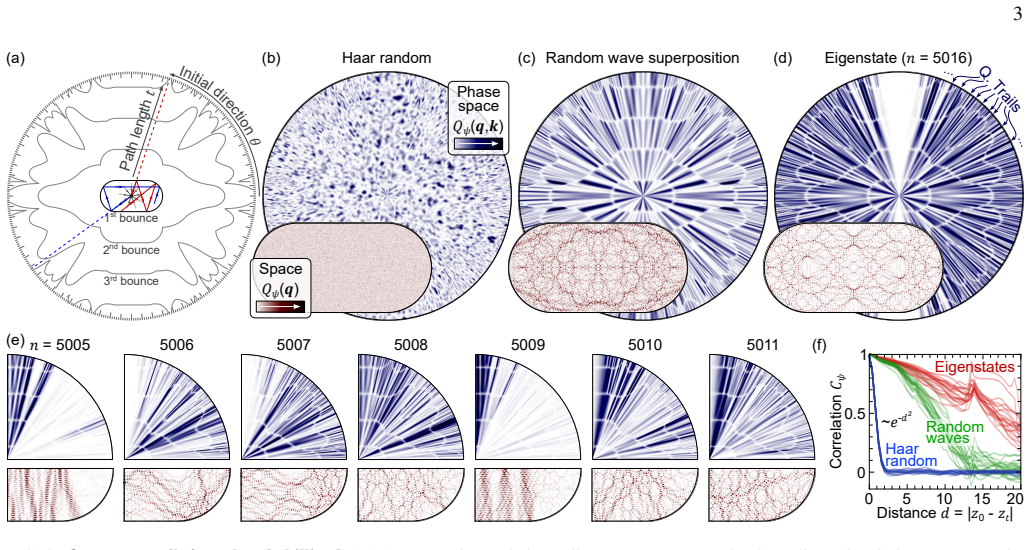
The load-bearing object is the quantum trail: an elongated speckle, of width $\sim h$ and length larger than $h$, in the phase-space projection $Q_E(z)$ of an eigenstate, aligned along a classical trajectory $z_t$. The trail exists precisely where the pointer-state fidelity $|\langle z_t|e^{-i\hat H t}|z_0\rangle|^2$ remains close to one; that condition transfers the eigenstate projection at $z_0$ to $z_t$ via the phase $e^{-iEt}$, creating correlations on scales far exceeding $h$. The numerical analysis relies on an unwarping of the three-dimensional phase space onto the page: a fan of trajectories launched from one point is parameterized by polar coordinates $(t,\theta)$, so trails become radial streaks and their length can be read off directly. The contrast of the memory effect is then estimated by binning energies and assuming the normalized phase-space projections follow a Porter-Thomas distribution, yielding the factor $1+|\langle z_t|e^{-i\hat H t}|z_0\rangle|^2$.
What would settle it
Compute the fidelity $|\langle z_t|e^{-i\hat H t}|z_0\rangle|^2$ directly for a Gaussian wave packet in the stadium billiard at $k\approx 94.7$ launched from the center at $\theta_0=20^\circ$, over times up to $3/\lambda$ with $\lambda\approx 0.86 k$; if it drops far below one before the radial extent of the trails seen in Fig. 2, the stated identity cannot explain the correlations. A complementary test: repeat the correlation analysis in a billiard where wave packets disperse rapidly, such as a mushroom billiard, and check that the phase-space correlation length shrinks back to $\sim h$.
Extended reading notes
Core claim
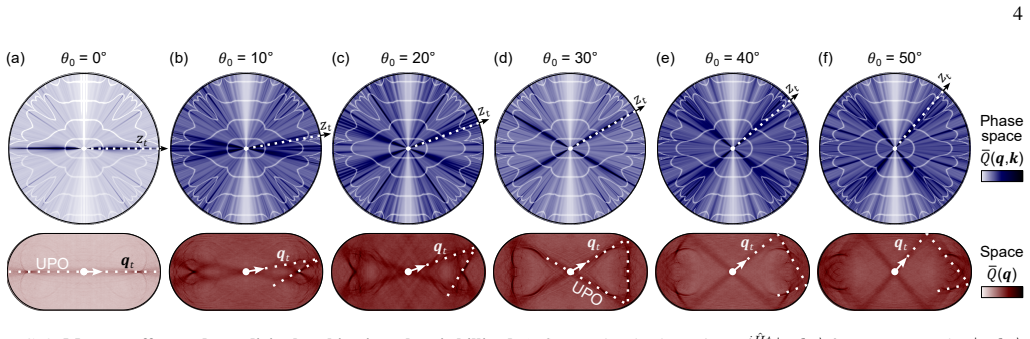
The paper's central claim is captured by a single identity: if a pointer state $|z_t\rangle$ attached to a classical trajectory $z_t$ tracks the real dynamics, $e^{-i\hat H t}|z_0\rangle \approx |z_t\rangle$, then $\langle E|z_t\rangle \approx e^{-iEt}\langle E|z_0\rangle$ and therefore $Q_E(z_t) \approx Q_E(z_0)$ even when the phase-space distance $|z_t-z_0|$ is much larger than the localization length $h$. Numerically, eigenstates of the stadium billiard show such extended correlations along short-time trajectories, persisting across collisions with the boundary, whereas random wave superpositions show trails that break at each collision. Because these trails correlate $Q_E(z_0)$ with $Q_E(z_t)$, the time-averaged projection $\bar Q(z|z_0)$ is enhanced along the trajectory by a factor approximately $1+|\langle z_t|e^{-i\hat H t}|z_0\rangle|^2$, producing visible caustics in real space and a persistent memory of the initial condition. Since the classical stadium billiard is ergodic, the enhancement is a genuine quantum ergodicity breaking: it narrows as $k\to\infty$ but does not lose contrast.
Load-bearing premise
The load-bearing premise is that a Gaussian wave packet in the stadium billiard stays close to its classical trajectory—$|\langle z_t|e^{-i\hat H t}|z_0\rangle|^2 \approx 1$—for a finite time, including across collisions; the paper infers this fidelity from the observed trails and their length rather than measuring it directly, so if packets disperse faster than assumed the trails and the memory effect would have a different origin.
Editorial extensions
If this is right
- Quantum scars become a special case: trails appear along every weakly dispersing trajectory, periodic or not, so enhancement of eigenstates is generic rather than confined to unstable periodic orbits.
- A system initialized in a localized wave packet keeps an enhanced probability of being found along that same short-time trajectory at arbitrarily long times, a weak ergodicity breaking that also shows up as caustics in real space.
- Going deeper into the semiclassical limit narrows the trails without reducing their contrast, so ergodicity is restored only asymptotically as $k\to\infty$.
- The same mechanism transfers to many-body systems if $z$ parametrizes a variational family and $z_t$ follows the time-dependent variational principle, suggesting trails and memory effects should be looked for beyond single-particle billiards.
Reading between the lines
- The contrast formula $\bar Q(z_t|z_0)/\bar Q(z_g|z_0) \approx 1 + |\langle z_t|e^{-i\hat H t}|z_0\rangle|^2$ suggests that a measurement of the late-time enhancement along a known trajectory could serve as a direct experimental probe of the wave packet's fidelity, effectively a quantum-classical correspondence meter.
- A natural test of the mechanism's scope is to compare trail length with the Lyapunov time across billiards with different horizon or curvature; the paper does not report such a sweep.
- Because the mechanism needs only correlations and not localization, it may be relevant to transport and thermalization in disordered or quasiperiodic systems, where trail-like phase-space correlations could slow relaxation without many-body localization.
Signed reviews
Editorial analysis
A structured set of objections, weighed in public.
Referee Report
Summary. The paper introduces the notion of 'quantum trails': in a chaotic system, if a localized wave packet follows a classical trajectory with little dispersion, then energy eigenstates have phase-space projections Q_E(z) that are correlated along that short-time nonperiodic trajectory. This correlation is claimed to produce a 'memory effect' in the time-averaged phase-space projection, leading to weak ergodicity breaking. The author derives the expansion of the time-averaged projection in the energy basis (Eq. (2)), gives a heuristic derivation of the contrast formula (Eq. (3), detailed in Appendix A), and presents numerical evidence from the stadium billiard: phase-space unwarping visualizations of eigenstates, Pearson correlation curves in Fig. 2(f), and time-averaged distributions in Fig. 3. The Supplemental Material compares quantum with classical time-averaged distributions and defines a timescale t* for the onset of ergodicity breaking.
Significance. If the central premise is verified, the work is conceptually significant: it extends the notion of quantum scarring beyond unstable periodic orbits to generic nonperiodic trajectories and identifies a mechanism for weak ergodicity breaking that does not require eigenstate localization. The algebraic identity in Eq. (2) is exact, and the numerical comparison against Haar-random and random-wave states is a sensible control. The unwarping visualization is effective and the inclusion of a direct classical-versus-quantum comparison in the Supplemental Material is a strength. However, the paper's central claim is conditional on the wave-packet fidelity |<z_t|e^{-iHt}|z0>|^2 being close to 1 over the trail length, and this quantity is never directly computed or bounded. The significance is therefore real but currently rests on an unverified premise.
major comments (3)
- [General intuition / Fig. 2(f) / SM Sec. I] The load-bearing condition of the paper, alpha = |<zt|e^{-iHt}|z0>|^2 ≈ 1 over the 'short-time trajectory', is asserted but never directly measured. The trail length is defined by t < 3/lambda, and for the parameters of Fig. 2 (k ≈ 94.68, sigma ≈ 0.103, lambda ≈ 0.86k) this gives t up to about 0.037 in the billiard units, corresponding to a path length of about 3.5 and hence several collisions with the boundary, with a Lyapunov stretching factor e^3 ≈ 20. A direct computation of F(t) = |<zt|e^{-iHt}|z0>|^2, including intervals across collisions, is required to support the claim that weakly dispersing wave packets are the cause of the trails. Without it, the correlations seen in Fig. 2(f) demonstrate the existence of trail-like correlations but do not establish that they originate from the proposed wave-packet mechanism rather than from other sources such as boundary-induced caustics or conventional scarring.
- [Eqs. (3) and (11) / Appendix A] The contrast formula in Eq. (11) is essentially a restatement of the trail condition: the predicted enhancement is 1 + alpha, where alpha is exactly the overlap that defines the trail. Since alpha is not independently measured, the numerical enhancement in Fig. 3 is a necessary consequence of the eigenstate correlations through Eq. (2) but does not serve as an independent test of the mechanism. The paper should either report F(t) explicitly or clearly present Eq. (11) as a conditional relation rather than as a validated prediction.
- [Appendix A] The derivation of Eq. (11) relies on two uncontrolled assumptions: the Porter-Thomas-type distribution of normalized projections (used to replace the variance by 1) and the statistical independence of <E|z0> and <E|rt> in Eq. (8). The first assumption is standard for chaotic eigenstates but is known to fail for visibly scarred states, several of which appear in Fig. 2(e) (e.g., n = 5005 and 5009). The second is plausible but not verified. Given that the central numerical contrast is not directly compared with Eq. (11), the author should at least check the covariance structure against the numerically available eigenstates to show that the assumptions are consistent with the stadium data.
minor comments (6)
- [Page 4] The phrase 'In the bottom of Fig. (3)' should be 'In the bottom panels of Fig. 3'.
- [Page 5] The phrase 'does not loose contrast' should be 'does not lose contrast'.
- [SM Sec. III] The text says 'As discussed in the main test' but should say 'main text'.
- [Fig. 2(e)] The caption says 'consecutive eigenstates' but the row shows n = 5005–5011 while panel (d) shows n = 5016; please clarify the indexing or adjust the wording.
- [Fig. 2(f)] The cutoff t < 3/lambda is introduced in the quantitative analysis without a sensitivity study; since the length of the trails and the correlation curves depend on this cutoff, a sentence on how the results change with the chosen cutoff would strengthen the presentation.
- [Note added] The note added acknowledges the closely related work of Ref. [56] on 'birthmarks' but does not discuss the relation or difference between that work and the quantum trails presented here; a brief comparative sentence would help situate the contribution.
Circularity Check
No significant circularity: the trail–memory relation is a transparent conditional derivation, and the numerical results are computed independently of the formula’s inputs.
full rationale
The paper’s central claim is explicitly conditional: if the coherent-state pointer |z_t> tracks the true propagated wavepacket, then the eigenstate projections Q_E(z_t) and Q_E(z_0) are correlated along the trajectory. The derivation in the main text and Appendix A is a transparent algebraic identity: writing |z_t> = sqrt(alpha) e^{-iHt}|z_0> + sqrt(1-alpha)|r_t> with alpha = |<z_t|e^{-iHt}|z_0>|^2, the estimate for the time-averaged contrast reduces to 1 + alpha (Eqs. (8)–(11)). This is a theorem under stated statistical assumptions, not a fitted parameter: alpha is never extracted from the eigenstate data or from the observed time-averaged projections, and the enhancement formula is not used to construct any numerical plot. The empirical content is independent: Fig. 2 computes eigenstate phase-space correlations directly from boundary-integral eigenstates, and Fig. 3 computes time-averaged projections from the propagated wavepacket; neither is generated from Eq. (11). The reviewer’s concern that the fidelity condition |<z_t|e^{-iHt}|z_0>|^2 ~ 1 is never directly measured is a verification/correctness gap rather than a circular reduction — the paper does not set alpha from the data it then claims to predict. Self-citations appear only in the introductory discussion of many-body scars and are not load-bearing, and the closely related “birthmarks” work is explicitly acknowledged in the note added. No circular step can therefore be exhibited from the paper’s own equations.
Assumptions & free parameters
free parameters (4)
- wavepacket width sigma =
sigma = 1/sqrt(k)
- short-time cutoff =
t < 3/lambda, lambda ≈ 0.86k
- eigenstate sample window =
n = 5009 to 5028 (k ≈ 94.6-94.7)
- billiard geometry =
height 2R=2, width 2R+L=4
assumptions (5)
- domain assumption The eigenstate Husimi-like projections Q_E(z) for chaotic systems follow a Porter-Thomas (exponential) distribution in each energy bin.
- domain assumption The residual state |r_t>, the part of the time-evolved wavepacket orthogonal to |z_t>, is statistically independent of |z0> in the energy basis.
- ad hoc to paper The time-evolved wavepacket remains well approximated by the classical trajectory |z_t> for a finite time window, including across collisions with the billiard boundary.
- domain assumption The stadium billiard is classically ergodic.
- domain assumption The energy spectrum is non-degenerate.
Cite this review
Pith. "Pith review of Quantum trails and memory effects in the phase space of chaotic quantum systems." pith.science (2026). https://pith.science/paper/CJZSOTI2
@misc{pith2026241204310,
  author       = {Pith},
  title        = {Pith review of: Quantum trails and memory effects in the phase space of chaotic quantum systems},
  year         = {2026},
  howpublished = {\url{https://pith.science/paper/CJZSOTI2}},
  note         = {Machine review of arXiv:2412.04310}
}
read the original abstract
The eigenstates of a chaotic system can be enhanced along underlying unstable periodic orbits in so-called quantum scars, making it more likely for a particle launched along one such orbits to be found still there at long times. Unstable periodic orbits are, however, a negligible part of the phase space, and a question arises regarding the structure of the wave function elsewhere. Here, we address this question and show that a weakly-dispersing dynamics of a localized wave packet in phase space leaves a "quantum trail" on the eigenstates, that is, makes them vary slowly when moving along trajectories in phase space, even if not periodic. The quantum trails underpin a remarkable dynamical effect: for a system initialized in a localized wave packet, the long-time phase-space distribution is enhanced along the short-time trajectory, which can result in ergodicity breaking. We provide the general intuition for these effects and prove them in the stadium billiard, for which an unwarping procedure allows us to visualize the phase space on the two-dimensional space of the page.
Figures

Reference graph
Works this paper leans on
-
[1]
E. N. Lorenz, Deterministic nonperiodic flow, Journal of atmo- spheric sciences 20, 130 (1963)
work page 1963
-
[2]
S. H. Strogatz, Nonlinear dynamics and chaos: with appli- cations to physics, biology, chemistry, and engineering (CRC press, 2018)
2018
-
[3]
Wimberger, Nonlinear dynamics and quantum chaos, V ol
S. Wimberger, Nonlinear dynamics and quantum chaos, V ol. 10 (Springer, 2014)
work page 2014
-
[4]
Berry, Quantum chaology, not quantum chaos, Physica Scripta 40, 335 (1989)
M. Berry, Quantum chaology, not quantum chaos, Physica Scripta 40, 335 (1989)
1989
-
[5]
R. V . Jensen, Quantum chaos, Nature355, 311 (1992)
work page 1992
-
[6]
D. Delande and A. Buchleitner, Classical and quantum chaos in atomic systems, in Advances in atomic, molecular , and optical physics, V ol. 34 (Elsevier, 1994) pp. 85–123
work page 1994
-
[7]
Bohigas, M.-J
O. Bohigas, M.-J. Giannoni, and C. Schmit, Characterization of chaotic quantum spectra and universality of level fluctuation laws, Physical review letters 52, 1 (1984)
1984
-
[8]
M. V . Berry, Quantum chaology (the bakerian lecture), in A Half-Century of Physical Asymptotics and Other Diversions: Selected Works by Michael Berry (World Scientific, 1987) pp. 307–322
work page 1987
Show all 56 references
-
[9]
Y . Y . Atas, E. Bogomolny, O. Giraud, and G. Roux, Distribu- tion of the ratio of consecutive level spacings in random matrix ensembles, Physical review letters 110, 084101 (2013)
2013
-
[10]
P. Kos, M. Ljubotina, and T. Prosen, Many-body quantum chaos: Analytic connection to random matrix theory, Physical Review X 8, 021062 (2018)
2018
-
[11]
M. V . Berry, Regular and irregular semiclassical wavefunc- tions, Journal of Physics A: Mathematical and General10, 2083 (1977)
1977
-
[12]
Hortikar and M
S. Hortikar and M. Srednicki, Correlations in chaotic eigen- functions at large separation, Physical review letters 80, 1646 (1998)
1998
-
[13]
Rigol, V
M. Rigol, V . Dunjko, and M. Olshanii, Thermalization and its mechanism for generic isolated quantum systems, Nature 452, 854 (2008)
2008
-
[14]
E. J. Heller, Bound-state eigenfunctions of classically chaotic hamiltonian systems: scars of periodic orbits, Physical Review Letters 53, 1515 (1984)
1984
-
[15]
Kaplan and E
L. Kaplan and E. Heller, Linear and nonlinear theory of eigen- function scars, Annals of Physics 264, 171 (1998)
1998
-
[16]
C. J. Turner, A. A. Michailidis, D. A. Abanin, M. Serbyn, and Z. Papi´c, Weak ergodicity breaking from quantum many-body scars, Nature Physics 14, 745 (2018)
2018
-
[17]
Serbyn, D
M. Serbyn, D. A. Abanin, and Z. Papi ´c, Quantum many-body scars and weak breaking of ergodicity, Nature Physics 17, 675 (2021)
2021
-
[18]
Pilatowsky-Cameo, D
S. Pilatowsky-Cameo, D. Villase ˜nor, M. A. Bastarrachea- Magnani, S. Lerma-Hern ´andez, L. F. Santos, and J. G. Hirsch, Ubiquitous quantum scarring does not prevent ergodicity, Na- ture communications 12, 852 (2021)
2021
-
[19]
Hummel, K
Q. Hummel, K. Richter, and P. Schlagheck, Genuine many- body quantum scars along unstable modes in bose-hubbard sys- tems, Physical review letters 130, 250402 (2023)
2023
-
[20]
Ermakov, O
I. Ermakov, O. Lychkovskiy, and B. V . Fine, Periodic classi- cal trajectories and quantum scars in many-spin systems, arXiv preprint arXiv:2409.00258 (2024)
2024
-
[21]
Pizzi, B
A. Pizzi, B. Evrard, C. B. Dag, and J. Knolle, Quantum scars in many-body systems, arXiv preprint arXiv:2408.10301 (2024)
2024 arXiv
-
[22]
Evrard, A
B. Evrard, A. Pizzi, S. I. Mistakidis, and C. B. Dag, Quantum many-body scars from unstable periodic orbits, Physical Re- view B 110, 144302 (2024)
2024
-
[23]
Evrard, A
B. Evrard, A. Pizzi, S. I. Mistakidis, and C. B. Dag, Quantum scars and regular eigenstates in a chaotic spinor condensate, Physical Review Letters 132, 020401 (2024)
2024
-
[24]
Gross and I
C. Gross and I. Bloch, Quantum simulations with ultracold atoms in optical lattices, Science 357, 995 (2017)
2017
-
[25]
Bernien, S
H. Bernien, S. Schwartz, A. Keesling, H. Levine, A. Omran, H. Pichler, S. Choi, A. S. Zibrov, M. Endres, M. Greiner,et al., Probing many-body dynamics on a 51-atom quantum simulator, Nature 551, 579 (2017)
2017
-
[26]
Z. Li, S. Colombo, C. Shu, G. Velez, S. Pilatowsky-Cameo, R. Schmied, S. Choi, M. Lukin, E. Pedrozo-Pe ˜nafiel, and V . Vuleti´c, Improving metrology with quantum scrambling, Sci- ence 380, 1381 (2023)
2023
-
[27]
C. E. Porter and R. G. Thomas, Fluctuations of nuclear reaction widths, Physical Review 104, 483 (1956)
1956
-
[28]
Boixo, S
S. Boixo, S. V . Isakov, V . N. Smelyanskiy, R. Babbush, N. Ding, Z. Jiang, M. J. Bremner, J. M. Martinis, and H. Neven, Char- acterizing quantum supremacy in near-term devices, Nature Physics 14, 595 (2018)
2018
-
[29]
K. S. J. Nordholm and S. A. Rice, Quantum ergodicity and vibrational relaxation in isolated molecules, The Journal of Chemical Physics 61, 203 (1974)
1974
-
[30]
E. J. Heller, Quantum localization and the rate of exploration of phase space, Physical Review A 35, 1360 (1987)
1987
-
[31]
E. J. Heller, Quantum intramolecular dynamics: Criteria for stochastic and nonstochastic flow, The Journal of Chemical Physics 72, 1337 (1980)
1980
-
[32]
Kaplan and E
L. Kaplan and E. Heller, Short-time effects on eigenstate struc- ture in sinai billiards and related systems, Physical Review E 62, 409 (2000)
2000
-
[33]
E. J. Heller, The semiclassical way to dynamics and spec- troscopy (Princeton University Press, 2018)
2018
-
[34]
Haegeman, J
J. Haegeman, J. I. Cirac, T. J. Osborne, I. Pi ˇzorn, H. Ver- schelde, and F. Verstraete, Time-dependent variational princi- ple for quantum lattices, Physical review letters 107, 070601 (2011)
2011
-
[35]
Haegeman, C
J. Haegeman, C. Lubich, I. Oseledets, B. Vandereycken, and 6 F. Verstraete, Unifying time evolution and optimization with matrix product states, Physical Review B 94, 165116 (2016)
2016
-
[36]
W. W. Ho, S. Choi, H. Pichler, and M. D. Lukin, Periodic orbits, entanglement, and quantum many-body scars in constrained models: Matrix product state approach, Physical review letters 122, 040603 (2019)
2019
-
[37]
Michailidis, C
A. Michailidis, C. Turner, Z. Papi ´c, D. Abanin, and M. Serbyn, Slow quantum thermalization and many-body revivals from mixed phase space, Physical Review X 10, 011055 (2020)
2020
-
[38]
L. A. Bunimovich, On ergodic properties of certain billiards, Functional Analysis and Its Applications 8, 254 (1974)
1974
-
[39]
L. A. Bunimovich, On the ergodic properties of nowhere dis- persing billiards, Communications in Mathematical Physics65, 295 (1979)
1979
-
[40]
B ¨acker, Numerical aspects of eigenvalue and eigenfunction computations for chaotic quantum systems, in The mathemati- cal aspects of quantum maps (Springer, 2003) pp
A. B ¨acker, Numerical aspects of eigenvalue and eigenfunction computations for chaotic quantum systems, in The mathemati- cal aspects of quantum maps (Springer, 2003) pp. 91–144
2003
-
[41]
See Supplemental Material
-
[42]
Bohigas, S
O. Bohigas, S. Tomsovic, and D. Ullmo, Manifestations of clas- sical phase space structures in quantum mechanics, Physics Re- ports 223, 43 (1993)
1993
-
[43]
J. J. Sakurai and J. Napolitano, Modern quantum mechanics (Cambridge University Press, 2020)
2020
-
[44]
Crespi, G
B. Crespi, G. Perez, and S.-J. Chang, Quantum poincar ´e sec- tions for two-dimensional billiards, Physical Review E 47, 986 (1993)
1993
-
[45]
Tualle and A
J.-M. Tualle and A. V oros, Normal modes of billiards portrayed in the stellar (or nodal) representation, Chaos, Solitons & Frac- tals 5, 1085 (1995)
1995
-
[46]
F. P. Simonotti, E. Vergini, and M. Saraceno, Quantitative study of scars in the boundary section of the stadium billiard, Physical Review E 56, 3859 (1997)
1997
-
[47]
N. R. Cerruti, A. Lakshminarayan, J. H. Lefebvre, and S. Tomsovic, Exploring phase space localization of chaotic eigenstates via parametric variation, Physical Review E 63, 016208 (2000)
2000
-
[48]
B ¨acker, S
A. B ¨acker, S. F ¨urstberger, and R. Schubert, Poincar ´e husimi representation of eigenstates in quantum billiards, Physical Re- view E—Statistical, Nonlinear, and Soft Matter Physics 70, 036204 (2004)
2004
-
[49]
Schanz, Phase-space correlations of chaotic eigenstates, Physical review letters 94, 134101 (2005)
H. Schanz, Phase-space correlations of chaotic eigenstates, Physical review letters 94, 134101 (2005)
2005
-
[50]
Harayama and S
T. Harayama and S. Shinohara, Ray-wave correspondence in chaotic dielectric billiards, Physical Review E 92, 042916 (2015)
2015
-
[51]
This definition depends on the space discretization step, but the projection Qψ(qk) shown in Fig
Haar random states are obtained in the space-basis upon draw- ing ⟨qn|ψHaar⟩ = A(αn + iβn), with αn and βn normally distributed random numbers, A a normalization constant, and qn the discretized space points. This definition depends on the space discretization step, but the pr...
-
[52]
In position basis we consider a sum PN n=1 eiq·kn+ϕn of waves with momentum kn = k(cos θn, sin θn), and θn and phase ϕn uniform random numbers in [0, 2π]
More precisely, we obtain the random wave superpositions as follows. In position basis we consider a sum PN n=1 eiq·kn+ϕn of waves with momentum kn = k(cos θn, sin θn), and θn and phase ϕn uniform random numbers in [0, 2π]. In an ef- fort to make the random wave superposition ...
-
[53]
P. W. Anderson, Absence of diffusion in certain random lattices, Physical review 109, 1492 (1958)
1958
-
[54]
Pal and D
A. Pal and D. A. Huse, Many-body localization phase tran- sition, Physical Review B—Condensed Matter and Materials Physics 82, 174411 (2010)
2010
-
[55]
D. A. Abanin, E. Altman, I. Bloch, and M. Serbyn, Colloquium: Many-body localization, thermalization, and entanglement, Re- views of Modern Physics 91, 021001 (2019)
2019
-
[56]
Quantum trails and memory effects in the phase space of chaotic quantum systems
A. M. Graf, J. Keski-Rahkonen, M. Xiao, S. Atwood, Z. Lu, S. Chen, and E. J. Heller, Birthmarks: Ergodicity breaking be- yond quantum scars, arXiv preprint arXiv:2412.02982 (2024). Appendix A In this Appendix we estimate the contrast of the memory effect in the time-averaged p...
2024
Reviewed August 11, 2026 · model on record in the stance chip above.
Discussion (0). Continue with ORCID to comment.