REVIEW 4 major objections 6 minor 26 references
GPI-Net: Gestalt-Guided Parallel Interaction Network via Orthogonal Geometric Consistency for Robust Point Cloud Registration
T0 review · 4 major / 6 minor · reviewed 2026-08-06 · deepseek-v4-flash
Pith's one-line read This paper argues that explicitly pruning redundant local-global feature overlap through orthogonal integration makes point cloud registration outlier removal both more accurate and more robust.
desk verdict A clean, incremental architecture for point cloud outlier removal, but the gains over the authors' own PG-Net are marginal and the ablation has a suspicious duplicate row; deserves review but needs code and error bars. read the letter →
The pith
A machine-rendered reading of the paper's core claim, the machinery that carries it, and where it could break.
The reading
What carries the argument
The load-bearing mechanism is the Orthogonal Integration (OI) step: the network computes a weighted global average feature $F_g^\tau$, projects each correspondence feature $F$ onto that direction, and keeps the residual $f = F - F_{\text{projection}}$, where $F_{\text{projection}} = (F \cdot F_g^\tau / \|F_g^\tau\|^2)\, F_g^\tau$. The residual is orthogonal to the global direction, and the network concatenates it with the global feature before a 1x1 convolution, claiming the result is a compact representation without duplicated information. Around this step the Gestalt Feature Attention block alternates self-attention and cross-attention, and the Dual-path Multi-Granularity block mixes coarse-to-fine and fine-to-coarse pathways; together they carry the argument that multi-granularity interaction is what turns the orthogonal residual into reliable inlier classification.
What would settle it
A direct ablation would settle the question: replace the residual feature $f$ in Equation (6) with the original feature $F$ (no orthogonal subtraction) and re-run the 3DMatch-FPFH evaluation; if registration recall does not fall below the reported 83.25%, the OI subtraction is not the operative mechanism.
Extended reading notes
Core claim
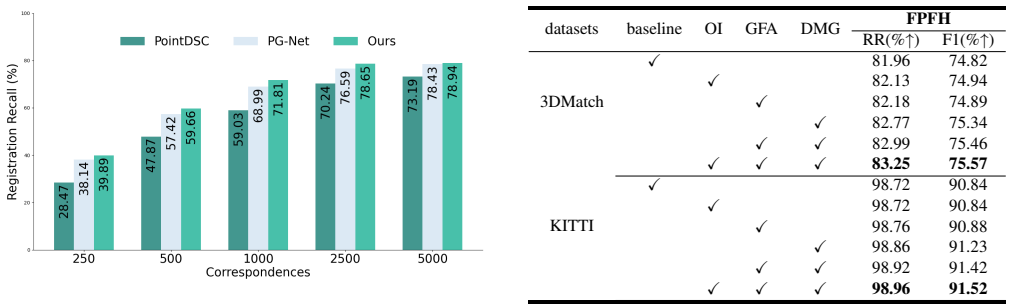
The central claim is that a correspondence-classification network achieves better outlier removal when it (i) subtracts from each feature vector its projection onto a learned global feature direction, leaving an orthogonal residual that carries local detail, (ii) refines the combined representation with paired self-attention and cross-attention, and (iii) mixes coarse and fine granularities in both directions. The paper reports that this architecture, called GPI-Net, reaches 83.25% registration recall on 3DMatch with FPFH and 93.15% with FCGF, compared with 81.96% and 92.98% for the PG-Net baseline, and 98.96% and 98.21% on KITTI. The ablation attributes the gains to all three components, with the orthogonal integration contributing roughly 1.5% registration recall on 3DMatch in the paper's accounting.
Load-bearing premise
The approach depends on the assumption that subtracting each correspondence's projection onto one learned global feature direction removes only redundant information and not useful signal that distinguishes inliers from outliers.
Editorial extensions
If this is right
- Feature-based registration can improve simply by restructuring feature fusion; the paper's gains are achieved without changing the FPFH or FCGF descriptors themselves.
- The network remains effective when only 250 to 1,000 initial correspondences are available, suggesting practical use in sparse or computationally constrained settings.
- Since the components each add a positive increment in the ablation, the paper's design choices are complementary rather than interchangeable.
- The same architecture transfers from indoor scenes (3DMatch) to outdoor LiDAR scenes (KITTI), so the redundancy-reduction strategy is not tied to one data modality.
Reading between the lines
- Editorial inference: the orthogonal projection in Eq. (4) is a single-direction decorrelation; extending it to multiple global directions, or to a learned orthogonal basis, is a natural test of whether the redundancy-removal idea generalizes.
- Editorial inference: the larger gains on FPFH than on FCGF suggest the OI helps most when the descriptors are noisier; this could be tested directly by injecting controlled noise into FCGF features and measuring whether GPI-Net degrades more gracefully than PG-Net.
- Editorial inference: the Gestalt language is architectural rather than mathematical; swapping the GFA block for a standard transformer block without changing parameters would reveal whether the attention pairing or the overall residual design is the active ingredient.
Editorial analysis
A structured set of objections, weighed in public.
Referee Report
Summary. The paper proposes GPI-Net, a correspondence outlier-rejection network for feature-based point cloud registration. It builds on the authors' earlier PG-Net and adds an Orthogonal Integration (OI) module (Eqs. 3-6), a Gestalt Feature Attention (GFA) block (Eqs. 7-8), and a Dual-path Multi-Granularity (DMG) aggregation block (Eqs. 9-11). Experiments on 3DMatch and KITTI with FPFH and FCGF descriptors report improved registration recall and F1 over PG-Net, with an ablation study in Table 3.
Significance. The architecture is clearly specified and the experimental protocol follows standard benchmarks; if the reported gains are reproducible, GPI-Net would provide a modest, practically useful improvement for outlier rejection in registration. The use of standard datasets, two descriptors, and an ablation of each component are strengths. However, the improvements over the PG-Net baseline are small, the paper provides no error bars or repeated-seed analysis, the OI-only ablation row on KITTI is identical to baseline, and code is not yet available. These issues leave the magnitude of the claimed contribution unverified; the paper's significance is therefore incremental rather than transformative.
major comments (4)
- [§4.4, Table 3] In Table 3, the KITTI row with only the OI module reports RR=98.72 and F1=90.84, exactly matching the PG-Net baseline, and the text states 'all block combinations outperform the baseline' and later attributes roughly 1.5% to the OI. This is a load-bearing contradiction because the OI is one of the three contributions; please correct the table or explain why the OI-only configuration has no effect on KITTI.
- [Tables 1 and 2] The reported improvements over PG-Net are small, e.g., 3DMatch-FCGF RR 93.15 vs 92.98, KITTI-FCGF RR 98.21 vs 97.95, and KITTI-FPFH F1 91.52 vs 90.84. No error bars, number of repeated runs, or paired significance tests are reported. Given normal run-to-run variability in learned outlier-removal networks, the central claim that GPI-Net outperforms PG-Net is not statistically established. The authors should report multiple-seed results and paired evaluation on the same test pairs.
- [§3.3, Eqs. (4)-(5)] The orthogonal integration subtracts the projection of the feature matrix onto a single learned global vector and assumes the residual preserves crucial local detail. This is a heuristic Gram-Schmidt-like operation, and no analysis or experiment justifies the term 'optimal' used in the Abstract and §3.3. Please either temper the optimality claim or provide a formal justification plus an ablation of this design choice.
- [§3.5, Eq. (11)] The top-down mixing is stated for t ∈ {1,...,T}, but for t=T the term G_{t+1} is undefined because the multi-granularity set is defined as {g_0,...,g_T}. The index range or boundary conditions need to be corrected, otherwise the DMG block as written is not computable.
minor comments (6)
- [Eq. (6)] The notation F_g^T appears to mean F_g^τ from Eq. (3); please unify the superscripts.
- [§3.5] The value of T is never stated; the dimension 15d/8 in Eq. (9) implies T=3, but this should be explicit in the text.
- [Table 2] Several rows contain missing column separators, e.g., '97.950.307.23' and '97.960.3321.29'; please fix the formatting.
- [Abstract and §1] The paper promises code at a GitHub URL, but no code or checkpoints are available for the review; please clarify the reproducibility status.
- [§1 and §3.4] The Gestalt-principle motivation is qualitative; the mapping from specific principles (closure, whole-before-parts) to specific operations (cross-attention, multi-granularity mixing) would benefit from a more concrete explanation or a small motivating experiment.
- [§4.2, Figure 4] The claim that GPI-Net surpasses PG-Net by over 2% at several correspondence counts is based on Figure 4, which has no error bars or numeric labels; please provide the underlying numbers.
Circularity Check
No significant circularity: the claimed improvements are empirical, benchmarked against external baselines, and the inherited PG-Net modules are used as transparent building blocks rather than as evidence for the new modules' gains.
full rationale
The paper's central claim is that the OI, GFA, and DMG blocks improve correspondence classification and pose estimation over PG-Net and other methods. This is supported by comparisons on 3DMatch and KITTI against external baselines (SM, FGR, TEASER, RANSAC, DGR, DHVR, PointDSC) in Tables 1-2, so the main result is not equivalent to an input by construction. The paper does reuse components from the authors' earlier PG-Net: 'The contextual embedding module [Wang et al., 2023] maps the initial correspondences into a high-dimensional feature space' and 'Following the Two-Stage NSM [Wang et al., 2023], each consensus set produces a transformation matrix.' Since Lifang Wei, Changcai Yang, and Riqing Chen are also PG-Net authors, this is a self-citation, but it is transparent and non-load-bearing: PG-Net supplies a backbone and inference routine, while the paper's contribution is the new modules and their ablation. No 'prediction' is a refit of the same data, no parameter is fitted and then reported as a forecast, and no uniqueness or ansatz is smuggled in via self-citation. The suspicious ablation row (KITTI with OI alone identical to baseline, RR 98.72/F1 90.84) and the absence of error bars or released checkpoints are reproducibility/correctness concerns, not circularity. The Gestalt discussion is rhetorical framing rather than a mathematical input used to derive the reported numbers.
Assumptions & free parameters
free parameters (3)
- T (number of granularities in DMG) =
not specified in the paper; consistent with T=3 based on channel arithmetic (15d/8)
- d (feature dimension) =
not specified
- delta (inlier threshold in Eq. 2) =
not specified
assumptions (5)
- ad hoc to paper The residual of a feature after subtracting its projection onto the global feature direction retains the crucial local detail information (Eq. 5).
- domain assumption Self-attention and cross-attention capture geometric features and dependencies among correspondences (Section 3.4).
- domain assumption Gestalt principles provide a valid conceptual guide for designing the local-global fusion modules (Sections 1 and 3).
- domain assumption The Two-Stage NSM module from PG-Net (Wang et al., 2023) functions correctly when embedded in GPI-Net (Section 3.2).
- domain assumption The standard evaluation protocols for 3DMatch and KITTI are followed and baseline numbers are fairly reproduced (Section 4).
Cite this review
Pith. "Pith review of GPI-Net: Gestalt-Guided Parallel Interaction Network via Orthogonal Geometric Consistency for Robust Point Cloud Registration." pith.science (2026). https://pith.science/paper/CK5UGEDO
@misc{pith2026250714452,
  author       = {Pith},
  title        = {Pith review of: GPI-Net: Gestalt-Guided Parallel Interaction Network via Orthogonal Geometric Consistency for Robust Point Cloud Registration},
  year         = {2026},
  howpublished = {\url{https://pith.science/paper/CK5UGEDO}},
  note         = {Machine review of arXiv:2507.14452}
}
read the original abstract
The accurate identification of high-quality correspondences is a prerequisite task in feature-based point cloud registration. However, it is extremely challenging to handle the fusion of local and global features due to feature redundancy and complex spatial relationships. Given that Gestalt principles provide key advantages in analyzing local and global relationships, we propose a novel Gestalt-guided Parallel Interaction Network via orthogonal geometric consistency (GPI-Net) in this paper. It utilizes Gestalt principles to facilitate complementary communication between local and global information. Specifically, we introduce an orthogonal integration strategy to optimally reduce redundant information and generate a more compact global structure for high-quality correspondences. To capture geometric features in correspondences, we leverage a Gestalt Feature Attention (GFA) block through a hybrid utilization of self-attention and cross-attention mechanisms. Furthermore, to facilitate the integration of local detail information into the global structure, we design an innovative Dual-path Multi-Granularity parallel interaction aggregation (DMG) block to promote information exchange across different granularities. Extensive experiments on various challenging tasks demonstrate the superior performance of our proposed GPI-Net in comparison to existing methods. The code will be released at https://github.com/gwk429/GPI-Net.
Figures


Figures from the paper (1 more)
Reference graph
Works this paper leans on
-
[1]
PointDSC: Robust point cloud registration us- ing deep spatial consistency
[Bai et al., 2021] Xuyang Bai, Zixin Luo, Lei Zhou, Hongkai Chen, Lei Li, Zeyu Hu, Hongbo Fu, and Chiew- Lan Tai. PointDSC: Robust point cloud registration us- ing deep spatial consistency. In Proc. 2021 IEEE/CVF Conference on Computer Vision and Pattern Recognition (CVPR), pages 15854–15864. IEEE, jun
work page 2021
-
[10]
[Kuang et al., 2023] Haopeng Kuang, Dingkang Yang, Shunli Wang, Xiaoying Wang, and Lihua Zhang. To- wards Simultaneous Segmentation Of Liver Tumors And Intrahepatic Vessels Via Cross-Attention Mechanism. In ICASSP 2023 - 2023 IEEE International Conference on Acoustics, Speech and Signal Processing (ICASSP) , pages 1–5, June
work page 2023
-
[12]
[Leordeanu and Hebert, 2005] M. Leordeanu and M. Hebert. A spectral technique for correspondence problems using pairwise constraints. In Proc. Tenth IEEE International Conference on Computer Vision (ICCV’05) V olume 1, vol- ume 2, pages 1482–1489 V ol. 2, October
work page 2005
-
[15]
Qi, Li Yi, Hao Su, and Leonidas J
[Qi et al., 2017] Charles R. Qi, Li Yi, Hao Su, and Leonidas J. Guibas. PointNet++: Deep Hierarchical Fea- ture Learning on Point Sets in a Metric Space, June
work page 2017
-
[16]
[Quan and Yang, 2020] Siwen Quan and Jiaqi Yang
arXiv:1706.02413 [cs]. [Quan and Yang, 2020] Siwen Quan and Jiaqi Yang. Compatibility-Guided Sampling Consensus for 3-D Point Cloud Registration. IEEE Transactions on Geoscience and Remote Sensing, 58(10):7380–7392, October
arXiv 2020
-
[17]
Fast Point Feature Histograms (FPFH) for 3D registration
[Rusu et al., 2009] Radu Bogdan Rusu, Nico Blodow, and Michael Beetz. Fast Point Feature Histograms (FPFH) for 3D registration. In Proc. 2009 IEEE International Con- ference on Robotics and Automation , pages 3212–3217. IEEE, May
work page 2009
-
[19]
[Xu et al., 2018] Yusheng Xu, Wei Yao, Sebastian Tuttas, Ludwig Hoegner, and Uwe Stilla. Unsupervised Segmen- tation of Point Clouds From Buildings Using Hierarchi- cal Clustering Based on Gestalt Principles. IEEE Journal of Selected Topics in Applied Earth Observations and Re- mote Sensing, 11(11):4270–4286, November
work page 2018
-
[20]
Stereo Visual Inertial SLAM Algorithm Fusing Point and Line Features
[Xue and Lv, 2022] Xiujie Xue and Xiafu Lv. Stereo Visual Inertial SLAM Algorithm Fusing Point and Line Features. In Proc. 2022 China Automation Congress (CAC) , pages 1687–1692, November
work page 2022
Show all 26 references
-
[23]
3DMatch: Learning Local Geometric De- scriptors from RGB-D Reconstructions
[Zeng et al., 2017] Andy Zeng, Shuran Song, Matthias Niessner, Matthew Fisher, Jianxiong Xiao, and Thomas Funkhouser. 3DMatch: Learning Local Geometric De- scriptors from RGB-D Reconstructions. In Proc. 2017 IEEE Conference on Computer Vision and Pattern Recog- nition (CVPR), ...
2017
-
[24]
LIF-Seg: LiDAR and Camera Image Fusion for 3D LiDAR Semantic Seg- mentation
[Zhao et al., 2024] Lin Zhao, Hui Zhou, Xinge Zhu, Xiao Song, Hongsheng Li, and Wenbing Tao. LIF-Seg: LiDAR and Camera Image Fusion for 3D LiDAR Semantic Seg- mentation. IEEE Transactions on Multimedia , 26:1158– 1168,
2024
-
[26]
Loop Closure Detection Using Local 3D Deep Descriptors
[Zhou et al., 2022] Youjie Zhou, Yiming Wang, Fabio Poiesi, Qi Qin, and Yi Wan. Loop Closure Detection Using Local 3D Deep Descriptors. IEEE Robotics and Automa- tion Letters, 7(3):6335–6342, July 2022
2022
-
[1981]
Vision meets robotics: The KITTI dataset
[Geiger et al., 2013] A Geiger, P Lenz, C Stiller, and R Ur- tasun. Vision meets robotics: The KITTI dataset. The International Journal of Robotics Research, 32(11):1231– 1237, September
2013
-
[1992]
[Charles et al., 2017] R
Conference Name: IEEE Transac- tions on Pattern Analysis and Machine Intelligence. [Charles et al., 2017] R. Qi Charles, Hao Su, Mo Kaichun, and Leonidas J. Guibas. PointNet: Deep Learning on Point Sets for 3D Classification and Segmentation. In2017 IEEE Conference on Computer...
2017
-
[2003]
Fischler and Robert C
[Fischler and Bolles, 1981] Martin A. Fischler and Robert C. Bolles. Random sample consensus: a paradigm for model fitting with applications to image analysis and automated cartography. Communications of the ACM , 24(6):381– 395, June
1981
-
[2005]
Autonomous Driving System based on Deep Q Learnig
[Okuyama et al., 2018] Takafumi Okuyama, Tad Gonsalves, and Jaychand Upadhay. Autonomous Driving System based on Deep Q Learnig. In Proc. 2018 International Conference on Intelligent Autonomous Systems (ICoIAS) , pages 201–205, March
2018
-
[2009]
PG-Net: Progressive Guidance Network via Robust Con- textual Embedding for Efficient Point Cloud Registration
[Wang et al., 2023] Jingtao Wang, Xin Liu, Luanyuan Dai, Jiayi Ma, Lifang Wei, Changcai Yang, and Riqing Chen. PG-Net: Progressive Guidance Network via Robust Con- textual Embedding for Efficient Point Cloud Registration. IEEE Transactions on Geoscience and Remote Sensing , 61:1–12,
2023
-
[2013]
Salient Object Detection Based on Self- attention Mechanism
[Gu et al., 2021] Zongyun Gu, Qing Wang, Fangfang Li, and Junling Kan. Salient Object Detection Based on Self- attention Mechanism. In Proc. 2021 IEEE 5th Information Technology,Networking,Electronic and Automation Con- trol Conference (ITNEC) , volume 5, pages 969–975, Oc- tober
2021
-
[2016]
[Yang et al., 2021] Heng Yang, Jingnan Shi, and Luca Car- lone
ISSN: 2157-362X. [Yang et al., 2021] Heng Yang, Jingnan Shi, and Luca Car- lone. TEASER: Fast and Certifiable Point Cloud Regis- tration. IEEE Transactions on Robotics , 37(2):314–333, April
2021
-
[2017]
[Choy et al., 2019] Christopher Choy, Jaesik Park, and Vladlen Koltun
ISSN: 1063-6919. [Choy et al., 2019] Christopher Choy, Jaesik Park, and Vladlen Koltun. Fully Convolutional Geometric Features. In Proc. 2019 IEEE/CVF International Conference on Computer Vision (ICCV), pages 8957–8965, Seoul, Korea (South), October
2019
-
[2018]
Dias Pais, Srikumar Ramalingam, Venu Madhav Govindu, Jacinto C
[Pais et al., 2020] G. Dias Pais, Srikumar Ramalingam, Venu Madhav Govindu, Jacinto C. Nascimento, Rama Chellappa, and Pedro Miraldo. 3DRegNet: A Deep Neu- ral Network for 3D Point Registration. In Proc. 2020 IEEE/CVF Conference on Computer Vision and Pattern Recognition (CVPR...
2020
-
[2019]
[Choy et al., 2020] Christopher Choy, Wei Dong, and Vladlen Koltun
IEEE. [Choy et al., 2020] Christopher Choy, Wei Dong, and Vladlen Koltun. Deep Global Registration. In Proc. 2020 IEEE/CVF Conference on Computer Vision and Pattern Recognition (CVPR), pages 2511–2520, June
2020
-
[2020]
Locally Optimized RANSAC
[Chum et al., 2003] Ondˇrej Chum, Jiˇr´ı Matas, and Josef Kit- tler. Locally Optimized RANSAC. InProc. Pattern Recog- nition, volume 2781, pages 236–243. Springer Berlin Hei- delberg, Berlin, Heidelberg,
2003
-
[2021]
Besl and Neil D
[Besl and McKay, 1992] P.J. Besl and Neil D. McKay. A method for registration of 3-D shapes. IEEE Transactions on Pattern Analysis and Machine Intelligence , 14(2):239– 256, February
1992
-
[2022]
[Yang et al., 2016] K. C. Yang, C. H. Huang, and C. F. Le. Applying microsoft kinect for windows to develop a Stroke Rehabilitation System. In 2016 IEEE International Conference on Industrial Engineering and Engineering Management (IEEM), pages 1923–1927, December
2016
-
[2023]
[Lee et al., 2021] Junha Lee, Seungwook Kim, Minsu Cho, and Jaesik Park
ISSN: 2379-190X. [Lee et al., 2021] Junha Lee, Seungwook Kim, Minsu Cho, and Jaesik Park. Deep Hough V oting for Robust Global Registration. In Proc. 2021 IEEE/CVF International Con- ference on Computer Vision (ICCV) , pages 15974–15983, October
2021
-
[2024]
[Zhou et al., 2016] Qian-Yi Zhou, Jaesik Park, and Vladlen Koltun
Conference Name: IEEE Transactions on Multimedia. [Zhou et al., 2016] Qian-Yi Zhou, Jaesik Park, and Vladlen Koltun. Fast Global Registration. In proc. Computer Vi- sion – ECCV 2016, volume 9906, pages 766–782. Springer International Publishing, Cham,
2016
Reviewed August 6, 2026 · model on record in the stance chip above.
Discussion (0). Continue with ORCID to comment.