REVIEW 3 major objections 5 minor 51 references
Causal Multi-fidelity Surrogate Forward and Inverse Models for ICF Implosions
T0 review · 3 major / 5 minor · reviewed 2026-08-05 · deepseek-v4-flash
Pith's one-line read This paper builds a causal multi-fidelity surrogate that maps a radiation-temperature drive to the deuterium-tritium interface radius and velocity, then inverts it to recover the drive from observed interface dynamics.
desk verdict A well-engineered causal multi-fidelity surrogate for ICF DT-interface dynamics, with honest inverse-crime avoidance, but its accuracy claims are scoped to one 1D perturbed-spline drive family. read the letter →
The pith
A machine-rendered reading of the paper's core claim, the machinery that carries it, and where it could break.
The reading
What carries the argument
The load-bearing object is the controlled incompressible-shell ODE (Equation 2): Rdot_i = V_i, Vdot_i = -W/(4πρ̄ R_i^4)[3+2R_i/R_o+(R_i/R_o)^2] + P V_i/(2W), with R_o = (R_c^3+R_i^3)^{1/3} and W = W0 + ∫ P ds. The power source P(t), piecewise-constant on 121 uniform knots, is the learned parameter: the low-fidelity network predicts it, the high-fidelity network corrects it, and integrating the ODE with it yields the trajectory. Causality is built in both architecturally (causal 1D convolution, recurrent states that only see the past) and in training-data generation, where each knot is solved successively by an adjoint gradient method on its own interval. The same ODE bridges the inverse mode
What would settle it
Take drives that are not generated by the paper's perturbed-35-knot-spline family (for example, drives with a foot pulse, different shock timing, or non-smooth structure), run fresh 67-group radiation-hydrodynamics simulations, and compare surrogate-predicted interface radius and velocity against them; if the median relative radius error moves substantially above 0.1% or the median drive-reconstruction L-infinity error above about 8 eV, the ODE embedding is not a sufficient statistic of the interface dynamics.
Extended reading notes
Core claim
Central claim: a reduced-order map F_MF = F_HF ∘ F_LF takes radiation temperature Tr(t) to DT interface radius/velocity. Training data become piecewise-constant power coefficients p(t) of an incompressible-shell ODE, found by optimal control per simulation. A causal network predicts low-fidelity coefficients from the drive; a second LSTM predicts the residual to high-fidelity coefficients using only 300 high-fidelity runs; integrating the corrected ODE gives the trajectory. Reported held-out errors: median relative L1 0.1% (radius), 2.7% (velocity). Inverse models reconstruct the drive's four principal components from full or four-snapshot trajectories with median L-infinity errors 4.5-8.2 e
Load-bearing premise
The load-bearing premise is that the DT interface's motion is simple enough that a single ODE with 121 adjustable power steps can describe it fully, so the learned power steps carry all the information needed to predict the implosion and recover the drive.
Editorial extensions
If this is right
- A few hundred high-fidelity simulations (300) suffice to correct a surrogate trained on thousands of cheap low-fidelity runs (4000), shifting the main data bottleneck away from expensive 67-group radiation-hydrodynamics calculations.
- Drive estimates from four optimally chosen snapshots differ from those using the full trajectory by only about 0.8 eV median error, so sparse experimental diagnostics need not cripple drive inference.
- The forward and inverse models are cycle-consistent: reconstructed drives, when passed back through the surrogate, reproduce interface dynamics no worse than the surrogate itself, indicating the inverse problem is relatively flat and the learned mapping is not oscillating between inconsistent inputs and outputs.
- The learned sparse sampling times are non-uniform and sample-dependent; including velocity information spreads the four selected times across distinct phases and removes the redundant time selection seen with radius alone.
- Because the representation is causal, the surrogate output at time t depends only on the drive up to t, making the learned controller coefficients an interpretable reduced state rather than a black-box fit.
Reading between the lines
- Beyond the paper: the same controlled-ODE embedding could be attached to other Lagrangian observables, such as hotspot edge or ablator thickness, giving each observable a cheap pinned ODE and its own forward/inverse pair.
- Beyond the paper: the learned sparse-time schedules amount to a data-driven prediction of when radiograph-like observations carry drive information; experimental shots could test this by varying snapshot timing and checking whether inferred drives agree with full-trajectory inversions.
- Beyond the paper: because drive reconstruction lives in a 4-dimensional PCA space, real ignition-relevant drives with richer temporal structure (foot pulses, multiple shocks, varied rise times) may require more principal components or a different embedding, and the framework's accuracy outside the perturbed-spline drive family is untested.
- Beyond the paper: the residual-learning split between low- and high-fidelity networks suggests a general recipe for multi-fidelity surrogate construction: learn the bulk dynamics from many cheap runs, then learn only the correction from few expensive runs, provided the cheap model already captures the right qualitative physics.
Editorial analysis
A structured set of objections, weighed in public.
Referee Report
Summary. The paper presents a causal multi-fidelity surrogate for the radiation-temperature-drive-to-DT-interface mapping in 1D ICF capsule implosions, built on an ODE embedding of the interface as an incompressible shell with a learned piecewise-constant power controller. A low-fidelity network (trained on 4000 3-group xRAGE runs) maps the drive to controller coefficients; a high-fidelity residual network (trained on 300 67-group runs) corrects those coefficients. The composed surrogate is validated on held-out LF and HF simulations, reporting median relative L1 errors of 0.1% (radius) and 2.7% (velocity) for the HF surrogate. The paper then trains inverse models (dense-time LSTM and sparse-time soft-selection networks) to recover a 4-dimensional PCA representation of the drive from surrogate-generated trajectories, with test errors evaluated against true HF trajectories to avoid inverse crime. The central methodological claims—held-out forward accuracy and inverse-crime-free inverse validation—are, as far as the manuscript demonstrates, internally sound.
Significance. If the reported accuracies hold, the framework is a useful demonstration of how physical inductive bias, causality, and multi-fidelity data can be combined for ICF surrogate modeling and drive estimation. The paper's strengths are its disciplined evaluation: forward models are tested on held-out simulations, inverse models are trained on surrogate data and tested on true HF trajectories, and cycle-consistency diagnostics are provided. The sparse-time sampling framework is also a practical contribution for diagnostic design. The main limitation is the narrowness of the empirical validation, which is restricted to one 1D drive-perturbation family; this affects how broadly the abstract and conclusions can be read.
major comments (3)
- [§2 and §6, Eq. (2)] The empirical claims are established only for a single 1D drive family: the baseline NIF-like FDS drive with every-other knot of a 35-knot spline perturbed by at most ±10% (Section 2). The controlled incompressible-shell ODE (Eq. 2) is assumed to be a sufficient embedding of the DT interface dynamics, but this is validated only on that family (Figure 2). Real NIF drives include different pulse shapes, picket/main-pulse structures, multi-layer compressibility, and 2D/3D asymmetries. Since the inverse models are trained on FMF-generated trajectories, any embedding bias transfers to the drive estimates. The abstract's unrestricted claim that the surrogate 'maps from a time-dependent radiation temperature drive' and the conclusion's 'unified approach' are therefore broader than the evidence. Please either explicitly scope all claims to the perturbed-spline 1D family or add validation on a se
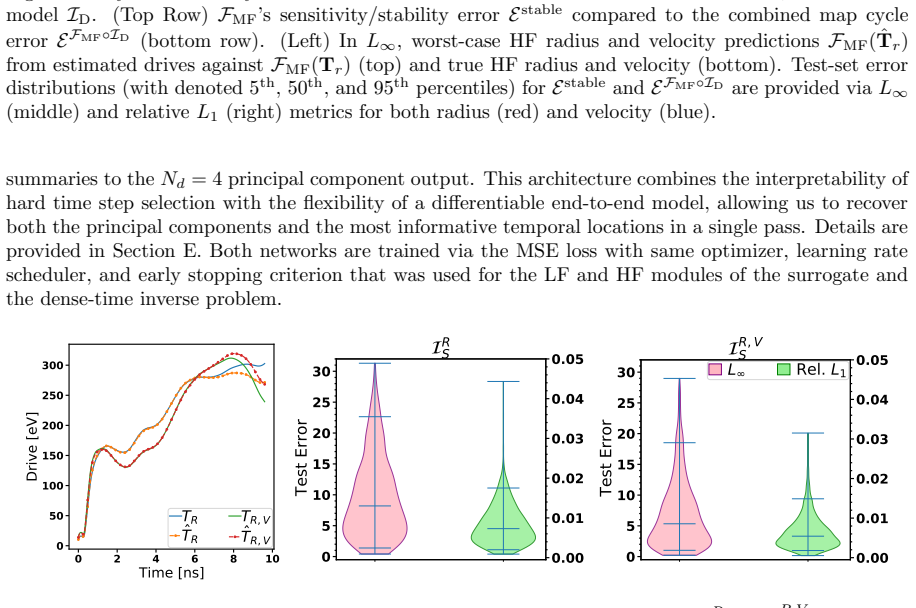
- [§5, Figures 5–7] All inverse models are trained and evaluated on noiseless simulated trajectories, yet the motivating application is experimental observation, where diagnostics have noise and systematic errors. The paper states that sparse snapshots are 'typically available in experimental settings' but does not test robustness to observation noise. A simple and load-bearing test would be to add Gaussian (or realistic) noise to the test-set inputs and report drive-estimation error as a function of noise amplitude. Without this, the practical utility of the inverse framework for real shots is unquantified, and the claim that the framework 'mimics the real-world scenario' (Section 5) is not supported.
- [§5.1 and §5.2, PCA dimensionality] The drive is reduced to N_d = 4 principal components before inverse estimation, and all reported drive errors are after inverse PCA. The paper states that 99.9% of variance is explained by four PCs for the training family, but no PCA reconstruction error or sensitivity to N_d is reported. If the experimental drive family has higher-dimensional variation, the fixed 4D bottleneck will introduce irreducible bias. Please report the PCA reconstruction error on the test family and an experiment varying N_d (e.g., 4 vs. 8) to show that the inverse error is not dominated by the PCA truncation.
minor comments (5)
- [§5.2, Figure 7] The text states that including velocity 'makes a statistically significant improvement' in drive estimation, but no hypothesis test, confidence interval, or repeated-seed variation is provided. Please either add statistical support or soften the wording to 'a modest improvement in the point estimates.'
- [§4, Figures 3–4] The term 'variance-weighted R²' is used without a definition. Since R² is usually unweighted, the weighting scheme should be specified (e.g., inverse variance weights over time or samples).
- [§6] Typo in 'extend': written as 'e xtend' in the first sentence of the Future Work paragraph.
- [§5.2, Remark 2] The comparison between dynamic and global time selection reports only R² values (0.96 vs. 0.95 and 0.972 vs. 0.958). It would be useful to report the same L∞ and relative L1 error metrics used elsewhere to assess whether the global times are a practical alternative.
- [§3.4] The HF training set size is 300, validation 1000, and test 1000. This implies a total of 2300 HF simulations, but the total number of HF simulations is not stated explicitly in Section 2. Please state the total dataset sizes for both LF and HF.
Circularity Check
No significant circularity: forward and inverse accuracy claims are validated on held-out high-fidelity simulations; self-citations are motivational only.
full rationale
The paper's derivation chain is not circular. The controlled ODE embedding (Eq. 2) is fixed a priori from a physical incompressible-shell model; the per-simulation controller coefficients are obtained by solving the trajectory-tracking optimal control problem (Eq. 3) and serve only as training targets for the LF/HF networks. The forward surrogate F_MF is evaluated on held-out high-fidelity drives (D_For,test_HF) by integrating Eq. (2) with NN-predicted coefficients and comparing to true xRAGE trajectories (Section 4, Figures 3–4). The inverse models are trained on surrogate-generated trajectories, but test errors are computed on true high-fidelity trajectories from an independent dataset (D_Inv,test_HF), explicitly avoiding the 'inverse crime' (Section 5). The ODE embedding itself is a modeling assumption whose fidelity is checked empirically (Figure 2), not an output that is definitionally equal to the measured trajectories; the controller fit is in-sample tracking, while the surrogate predictions are out-of-sample. The only self-citations ([37,5], which include two co-authors) appear as motivation for using robust features and are not load-bearing for the surrogate construction or validation. The residual-learning and PCA steps are standard supervised fits with independent test sets. The main risk—transferability to drive families outside the perturbed-spline, 1D dataset—is a scoping/correctness concern, not circularity.
Assumptions & free parameters
free parameters (4)
- epsilon (threshold for early-time controller start) =
1e-3 (µm/ns velocity)
- Number of control knots N_k =
121
- Base ODE constants (rho_bar, W0, R_c) =
fixed per NIF-like capsule (W0 ≈ 9.56e-8)
- PCA drive dimensionality N_d =
4
assumptions (5)
- domain assumption DT interface dynamics during the implosion phase admit an embedding as the solution of a parameterized ODE of the form (1) (existence of operator Pi : U -> P)
- domain assumption The shell can be modeled as an incompressible, uniform-density spherical shell (Book-Bodner model) augmented with an external power source P(t)
- domain assumption The 3-group (low-fidelity) and 67-group (high-fidelity) radiation models bracket the relevant physics; residual LF-to-HF corrections are smooth and learnable
- domain assumption The drive family generated by perturbing spline knots in [-0.1, 0.1] and re-smoothing is representative of the relevant ICF drive space
- standard math Standard ODE well-posedness (Lipschitz continuity of h in x, Caratheodory integrability of P) holds for the base ODE
Cite this review
Pith. "Pith review of Causal Multi-fidelity Surrogate Forward and Inverse Models for ICF Implosions." pith.science (2026). https://pith.science/paper/CL4IWRX6
@misc{pith2026250905510,
  author       = {Pith},
  title        = {Pith review of: Causal Multi-fidelity Surrogate Forward and Inverse Models for ICF Implosions},
  year         = {2026},
  howpublished = {\url{https://pith.science/paper/CL4IWRX6}},
  note         = {Machine review of arXiv:2509.05510}
}
read the original abstract
Continued progress in inertial confinement fusion (ICF) requires solving inverse problems relating experimental observations to simulation input parameters, followed by design optimization. However, such high-dimensional dynamic PDE-constrained optimization problems are extremely challenging or even intractable. It has been recently shown that inverse problems can be solved by only considering certain robust features. Here we consider the ICF capsule's deuterium-tritium (DT) interface, and construct a causal, dynamic, multifidelity reduced-order surrogate that maps from a time-dependent radiation temperature drive to the interface's radius and velocity dynamics. The surrogate targets an ODE embedding of DT interface dynamics, and is constructed by learning a controller for a base analytical model using low- and high-fidelity simulation training data with respect to radiation energy group structure. After demonstrating excellent accuracy of the surrogate interface model, we use machine learning (ML) models with surrogate-generated data to solve inverse problems optimizing radiation temperature drive to reproduce observed interface dynamics. For sparse snapshots in time, the ML model further characterizes the most informative times at which to sample dynamics. Altogether we demonstrate how operator learning, causal architectures, and physical inductive bias can be integrated to accelerate discovery, design, and diagnostics in high-energy-density systems.
Figures


Figures from the paper (7 more)




Reference graph
Works this paper leans on
-
[1]
Tops: A multigroup opacity code
J Abdallah Jr and R EH Clark. Tops: A multigroup opacity code. Technical report, Los Alamos National Lab., NM (USA), 1985
work page 1985
-
[2]
Rushil Anirudh, Jayaraman J Thiagarajan, Peer-Timo Bremer, and Brian K Spears. Improved surrogates in inertial confinement fusion with manifold and cycle consistencies.Proceedings of the National Academy of Sciences, 117(18):9741–9746, 2020
work page 2020
-
[3]
Jimmy Lei Ba, Jamie Ryan Kiros, and Geoffrey E. Hinton. Layer normalization. InAdvances in Neural Information Processing Systems Deep Learning Symposium, 2016
work page 2016
-
[4]
Neural machine translation by jointly learning to align and translate
Dzmitry Bahdanau, Kyunghyun Cho, and Yoshua Bengio. Neural machine translation by jointly learning to align and translate. InProceedings of the International Conference on Learning Repre- sentations (ICLR), 2015
work page 2015
-
[5]
Learning robust parameter inference and density reconstruction in flyer plate impact experiments
Evan Bell, Daniel A Serino, Ben S Southworth, Trevor Wilcox, and Marc L Klasky. Learning robust parameter inference and density reconstruction in flyer plate impact experiments.arXiv preprint arXiv:2506.23914, 2025
work page Pith review arXiv 2025
-
[6]
Christopher M. Bishop. Training with noise is equivalent to tikhonov regularization.Neural Comput., 7(1):108–116, 1995
work page 1995
-
[7]
David L. Book and Stephen E. Bodner. Variation in the amplitude of perturbations on the inner surface of an imploding shell during the coasting phase.Phys. Fluids., 30(2):367–376, February 1987
work page 1987
-
[8]
Yang Cao, Shengtai Li, Linda Petzold, and Radu Serban. Adjoint sensitivity analysis for differential- algebraic equations: The adjoint dae system and its numerical solution.J. Sci. Comput., 24(3):1076–1089, January 2003
work page 2003
Show all 51 references
-
[9]
Recurrent neural networks for multivariate time series with missing values.Sci
Zhengping Che, Sanjay Purushotham, Kyunghyun Cho, David Sontag, and Yan Liu. Recurrent neural networks for multivariate time series with missing values.Sci. Rep., 8(1), April 2018
2018
-
[10]
A new generation of los alamos opacity tables.The Astrophysical Journal, 817(2):116, 2016
James Colgan, David Parker Kilcrease, NH Magee, Manolo Edgar Sherrill, J Abdallah Jr, Peter Hakel, Christopher John Fontes, Joyce Ann Guzik, and KA Mussack. A new generation of los alamos opacity tables.The Astrophysical Journal, 817(2):116, 2016
2016
-
[11]
Multi-fidelity optimization via sur- rogate modelling.Proc
Alexander I.J Forrester, Andr´ as S´ obester, and Andy J Keane. Multi-fidelity optimization via sur- rogate modelling.Proc. R. Soc. A, 463(2088):3251–3269, October 2007
-
[12]
Thermodynamic modeling of uncertainties in nif icf implosions due to underlying microphysics models
Jim Gaffney, Paul Springer, and Gilbert Collins. Thermodynamic modeling of uncertainties in nif icf implosions due to underlying microphysics models. InAPS Division of Plasma Physics Meeting Abstracts, volume 2014, pages PO5–011, 2014
2014
-
[13]
The rage radiation-hydrodynamic code.Computational Science & Discovery, 1(1):015005, nov 2008
Michael Gittings, Robert Weaver, Michael Clover, Thomas Betlach, Nelson Byrne, Robert Coker, Edward Dendy, Robert Hueckstaedt, Kim New, W Rob Oakes, Dale Ranta, and Ryan Stefan. The rage radiation-hydrodynamic code.Computational Science & Discovery, 1(1):015005, nov 2008
2008
-
[14]
MIT Press, 2016
Ian Goodfellow, Yoshua Bengio, and Aaron Courville.Deep Learning. MIT Press, 2016
2016
-
[15]
Haines, C
Brian M. Haines, C. H. Aldrich, J. M. Campbell, R. M. Rauenzahn, and C. A. Wingate. High- resolution modeling of indirectly driven high-convergence layered inertial confinement fusion capsule implosions.Physics of Plasmas, 24(5):052701, 04 2017
2017
-
[16]
On upstream differencing and godunov-type schemes for hyperbolic conservation laws.SIAM review, 25(1):35–61, 1983
Amiram Harten, Peter D Lax, and Bram van Leer. On upstream differencing and godunov-type schemes for hyperbolic conservation laws.SIAM review, 25(1):35–61, 1983
1983
-
[17]
The blind implosion-maker: Automated inertial confinement fusion experiment design.Physics of Plasmas, 26(6), 2019
PW Hatfield, SJ Rose, and RHH Scott. The blind implosion-maker: Automated inertial confinement fusion experiment design.Physics of Plasmas, 26(6), 2019
2019
-
[18]
Deep residual learning for image recog- nition
Kaiming He, Xiangyu Zhang, Shaoqing Ren, and Jian Sun. Deep residual learning for image recog- nition. In2016 IEEE Conference on Computer Vision and Pattern Recognition (CVPR), pages 770–778, 2016. 15
2016
-
[19]
Deep neural network initialization with decision trees.IEEE transactions on neural networks and learning systems, 30(5):1286–1295, 2018
Kelli D Humbird, J Luc Peterson, and Ryan G McClarren. Deep neural network initialization with decision trees.IEEE transactions on neural networks and learning systems, 30(5):1286–1295, 2018
2018
-
[20]
Predicting the time-evolution of multi- physics systems with sequence-to-sequence models.arXiv preprint arXiv:1811.05852, 2018
Kelli D Humbird, J Luc Peterson, and Ryan G McClarren. Predicting the time-evolution of multi- physics systems with sequence-to-sequence models.arXiv preprint arXiv:1811.05852, 2018
2018 arXiv
-
[21]
Transfer learning to model inertial confinement fusion experiments.IEEE Transactions on Plasma Science, 48(1):61–70, 2019
Kelli D Humbird, Jayson Luc Peterson, BK Spears, and Ryan G McClarren. Transfer learning to model inertial confinement fusion experiments.IEEE Transactions on Plasma Science, 48(1):61–70, 2019
2019
-
[22]
A convolutional neural network for modelling sentences
Nal Kalchbrenner, Edward Grefenstette, and Phil Blunsom. A convolutional neural network for modelling sentences. InProceedings of the 52nd Annual Meeting of the Association for Computa- tional Linguistics (ACL), pages 655–665. ACL, 2014
2014
-
[23]
M. Kennedy. Predicting the output from a complex computer code when fast approximations are available.Biometrika, 87(1):1–13, March 2000
2000
-
[24]
LeCun, L´ eon Bottou, Genevieve B
Yann A. LeCun, L´ eon Bottou, Genevieve B. Orr, and Klaus-Robert M¨ uller. Efficient backprop. In Gr´ egoire Montavon, Genevi` eve B. Orr, and Klaus-Robert M¨ uller, editors,Neural Networks: Tricks of the Trade: Second Edition, pages 9–48. Springer Berlin Heidelberg, Berlin, H...
2012
-
[25]
An electron conductivity model for dense plasmas.The Physics of fluids, 27(5):1273–1286, 1984
Yim T Lee and RM More. An electron conductivity model for dense plasmas.The Physics of fluids, 27(5):1273–1286, 1984
1984
-
[26]
Kovachki, Kamyar Azizzadenesheli, Burigede Liu, Kaushik Bhattacharya, Andrew M
Zongyi Li, Nikola B. Kovachki, Kamyar Azizzadenesheli, Burigede Liu, Kaushik Bhattacharya, Andrew M. Stuart, and Anima Anandkumar. Neural operator: Graph kernel network for partial differential equations.CoRR, abs/2003.03485, 2020
2003 arXiv
-
[27]
Stuart, and Anima Anandkumar
Zongyi Li, Nikola Borislavov Kovachki, Kamyar Azizzadenesheli, Burigede Liu, Kaushik Bhat- tacharya, Andrew M. Stuart, and Anima Anandkumar. Fourier neural operator for parametric partial differential equations. In9th International Conference on Learning Representations, ICLR
-
[28]
The control parameterization method for nonlinear optimal control: A survey.J
Qun Lin, Ryan Loxton, and Kok Lay Teo. The control parameterization method for nonlinear optimal control: A survey.J. Ind. Manage. Optim., 10(1):275–309, 2014
2014
-
[29]
A structured self-attentive sentence embedding
Zhouhan Lin, Minwei Feng, Cicero Nogueira dos Santos, Mo Yu, Bing Xiang, Bowen Zhou, and Yoshua Bengio. A structured self-attentive sentence embedding. InProceedings of the 5th Interna- tional Conference on Learning Representations (ICLR), 2017
2017
-
[30]
Learning nonlinear operators via deeponet based on the universal approximation theorem of operators.Nat
Lu Lu, Pengzhan Jin, Guofei Pang, Zhongqiang Zhang, and George Em Karniadakis. Learning nonlinear operators via deeponet based on the universal approximation theorem of operators.Nat. Mach. Intell., 3(3):218–229, March 2021
2021
-
[31]
Johnson, and Giuseppe Romano
Lu Lu, Rapha¨ el Pestourie, Steven G. Johnson, and Giuseppe Romano. Multifidelity deep neural operators for efficient learning of partial differential equations with application to fast inverse design of nanoscale heat transport.Phys. Rev. Res., 4(2), June 2022
2022
-
[32]
Sesame: the los alamos national laboratory equation of state database.LANL report, 1978
Stanford P Lyon. Sesame: the los alamos national laboratory equation of state database.LANL report, 1978
1978
-
[33]
Electron thermal conduction in lasnex
DA VID Munro and STEPHEN Weber. Electron thermal conduction in lasnex. Technical report, Lawrence Livermore National Lab.(LLNL), Livermore, CA (United States), 1994
1994
-
[34]
En- semble simulations of inertial confinement fusion implosions.Statistical Analysis and Data Mining: The ASA Data Science Journal, 10(4):230–237, 2017
Ryan Nora, Jayson Luc Peterson, Brian Keith Spears, John Everett Field, and Scott Brandon. En- semble simulations of inertial confinement fusion implosions.Statistical Analysis and Data Mining: The ASA Data Science Journal, 10(4):230–237, 2017
2017
-
[35]
Pytorch: An imperative style, high- performance deep learning library
Adam Paszke, Sam Gross, and Francisco Massa et al. Pytorch: An imperative style, high- performance deep learning library. In H. Wallach, H. Larochelle, A. Beygelzimer, F. d'Alch´ e-Buc, E. Fox, and R. Garnett, editors,Advances in Neural Information Processing Systems, volume 3...
2019
-
[36]
Zonal flow generation in inertial confinement fusion implosions
Jayson L Peterson, Kelli D Humbird, John E Field, Scott T Brandon, Steve H Langer, Ryan C Nora, Brian K Spears, and PT Springer. Zonal flow generation in inertial confinement fusion implosions. Physics of Plasmas, 24(3), 2017
2017
-
[37]
Physics consistent machine learning framework for inverse modeling with applications to icf capsule implosions.Scientific Reports, 15(1):25915, 2025
Daniel A Serino, Evan Bell, Marc Klasky, Ben S Southworth, Balasubramanya Nadiga, Trevor Wilcox, and Oleg Korobkin. Physics consistent machine learning framework for inverse modeling with applications to icf capsule implosions.Scientific Reports, 15(1):25915, 2025
2025
-
[38]
Implosion and burn of fast ignition capsules—calculations with hydra.Physics of Plasmas, 19(9), 2012
HD Shay, P Amendt, D Clark, D Ho, M Key, J Koning, M Marinak, D Strozzi, and M Tabak. Implosion and burn of fast ignition capsules—calculations with hydra.Physics of Plasmas, 19(9), 2012
2012
-
[39]
Dropout: A simple way to prevent neural networks from overfitting.J
Nitish Srivastava, Geoffrey Hinton, Alex Krizhevsky, Ilya Sutskever, and Ruslan Salakhutdinov. Dropout: A simple way to prevent neural networks from overfitting.J. Mach. Learn. Res., 15(56):1929–1958, 2014
1929
-
[40]
American Mathematical Society, 2012
Gerald Teschl.Ordinary Differential Equations and Dynamical Systems. American Mathematical Society, 2012
2012
-
[41]
Coupling 1d xrage sim- ulations with machine learning for graded inner shell design optimization in double shell capsules
Nomita Nirmal Vazirani, Michael John Grosskopf, David James Stark, Paul Andrew Bradley, Brian Michael Haines, E Loomis, Scott L England, and Wayne A Scales. Coupling 1d xrage sim- ulations with machine learning for graded inner shell design optimization in double shell capsule...
2021
-
[42]
Virtanen, R
P. Virtanen, R. Gommers, and T.E. Oliphant et al. Scipy 1.0: fundamental algorithms for scientific computing in python.Nat. Methods, 17(3):261–272, February 2020
2020
-
[43]
A multifidelity bayesian optimization method for inertial confinement fusion design.Physics of Plasmas, 31(3), 2024
Jingyi Wang, N Chiang, Andrew Gillette, and J Luc Peterson. A multifidelity bayesian optimization method for inertial confinement fusion design.Physics of Plasmas, 31(3), 2024
2024
-
[44]
Improved architectures and training algorithms for deep operator networks.J
Sifan Wang, Hanwen Wang, and Paris Perdikaris. Improved architectures and training algorithms for deep operator networks.J. Sci. Comput., 92(2), June 2022
2022
-
[45]
Multifrequency-gray method for radiation diffusion with compton scattering
Alan M Winslow. Multifrequency-gray method for radiation diffusion with compton scattering. Journal of Computational Physics, 117(2):262–273, 1995
1995
-
[46]
Hierarchical attention networks for document classification
Zichao Yang, Diyi Yang, Chris Dyer, Xiaodong He, Alexander Smola, and Eduard Hovy. Hierarchical attention networks for document classification. InProceedings of the 2016 Conference of the North American Chapter of the Association for Computational Linguistics: Human Language T...
2016
-
[47]
Nonlocal kernel network (nkn): A stable and resolution-independent deep neural network.J
Huaiqian You, Yue Yu, Marta D’Elia, Tian Gao, and Stewart Silling. Nonlocal kernel network (nkn): A stable and resolution-independent deep neural network.J. Comput. Phys., 469:111536, November 2022. A ODE Derivation of Imploding Incompressible Shell We derive a first-order ODE...
2022
-
[49]
Integrate ¯h(x, ˙x,u, t) = 0 forxovert∈(t 0, tf ] with initial conditiong(x(t 0),u) = 0
-
[50]
Integrate (26) forλovert∈(t f , t0] with terminal conditionλ(t f ) = 0
-
[51]
Set DuJ= Z tf t0 h fu +λ ⊤∂u ¯h i dt+λ ⊤∂ ˙x ¯h|t0 g−1 x(t0)gu.(27) In the special case that the ODE constraint is in explicit form, i.e., ¯h:= ˙x−h(x,u, t), we can further simplify. The adjoint equation (26) becomes ˙λ ⊤ +λ ⊤∂xh−∂ xf= 0,λ(t f ) = 0,(28) and the gradient (27) ...
-
[2021]
OpenReview.net, 2021
2021
Reviewed August 5, 2026 · model on record in the stance chip above.
Discussion (0). Sign in to comment.