REVIEW 3 major objections 4 minor 43 references
Nested Bloch waves in elastic structures with configurational forces
T0 review · 3 major / 4 minor · reviewed 2026-08-14 · deepseek-v4-flash
Pith's one-line read This paper claims that small flexural vibrations in a periodic beam-and-sleeve structure generate longitudinal vibrations at twice the flexural frequency, allowing axial waves inside the axial band gap and triggering axial resonance when…
desk verdict A clever, parameter-free analysis of how small flexural vibrations can force axial motion at twice the frequency through Eshelby-like forces, with a real open question about whether the quasi-static force law carries over to dynamics. read the letter →
The pith
A machine-rendered reading of the paper's core claim, the machinery that carries it, and where it could break.
The reading
What carries the argument
The nested Bloch-Floquet ansatz: axial fields are quasi-periodic with phase $\varphi$ per cell while flexural fields carry phase $\varphi/2$, so that the quadratic configurational force, proportional to the square of the bending curvature at each sleeve end, can transfer energy from transverse to axial motion. The coupling appears as jumps in axial force at the sleeve ends, Eq. (17), and time-independence of those jumps forces the frequency relation $\omega = 2\Omega$. Solving the resulting $12 \times 12$ linear system for axial amplitudes, with the transverse amplitudes prescribed, gives the resonance condition $\det M = 0$, Eq. (44), which is exactly the dispersion relation for purely axial Bloch waves in the same two-material cell.
What would settle it
Drive a small flexural mode at frequency $\Omega$ in a beam with a sliding sleeve and measure axial displacement. The paper predicts an axial component at $2\Omega$ whose amplitude grows like the square of the flexural amplitude, appears inside the axial band gap only when flexure is present, and becomes very large when $2\Omega$ crosses the pure-axial dispersion curve. Failing to see any $2\Omega$ axial component, or seeing a different frequency ratio or no resonant amplification when $2\Omega$ crosses the dispersion curve, would falsify the central claim.
Extended reading notes
Core claim
The central discovery is that a small flexural oscillation of a periodic two-material beam constrained by sliding sleeves produces a longitudinal oscillation at exactly twice its frequency, through configurational forces concentrated at the sleeve ends. This breaks the band-gap structure of the purely axial problem: axial Bloch waves can exist inside frequency gaps provided a transverse companion wave is present. Moreover, when the doubled frequency coincides with the axial dispersion relation, the linear system for the axial amplitudes becomes singular and longitudinal displacement grows without bound for infinitesimal transverse input. The paper names these compatible motions 'nested Bloch waves' and characterizes them through the determinant condition $\det M = 0$, which is equivalent to the classical one-dimensional bi-material axial dispersion relation.
Load-bearing premise
The argument rests on treating the force at each sliding sleeve end as the static configurational force, proportional to the square of the bending curvature, even during vibration, with no inertial, rate-dependent, or friction contributions; if that force law changes in dynamics, the exact $\omega=2\Omega$ nesting and the predicted resonance need not occur.
Editorial extensions
If this is right
- Inside the axial band gap of the same structure without flexure, a small transverse vibration makes axial propagation possible; the gap is no longer forbidden.
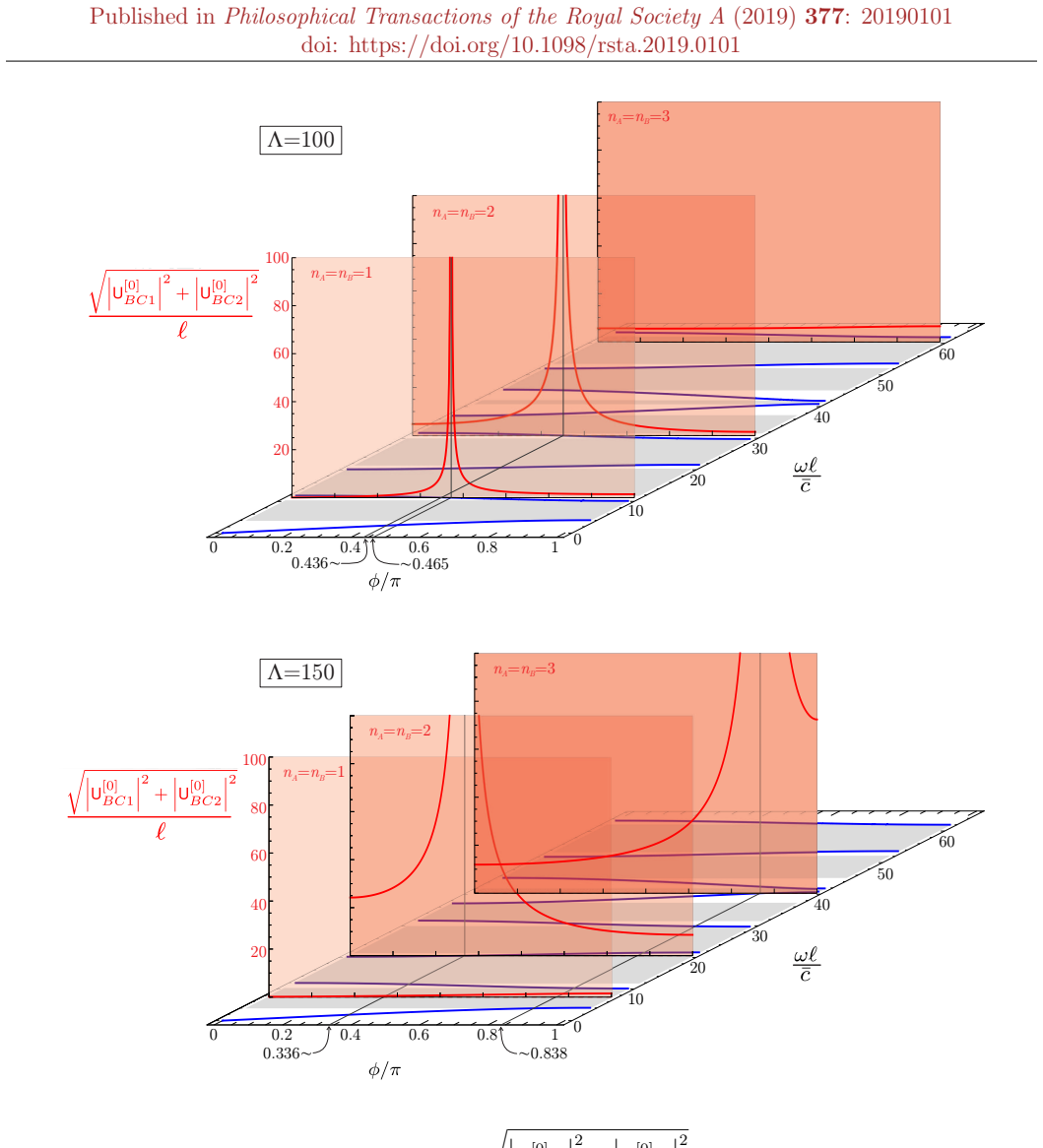
- When $2\Omega$ lies on the axial dispersion curve, longitudinal displacement is predicted to become unbounded in the undamped model, so flexural vibration acts as a resonant pump for axial motion.
- For small oscillations the axial amplitude is proportional to the square of the transverse amplitude, giving a directly observable nonlinear signature at twice the drive frequency.
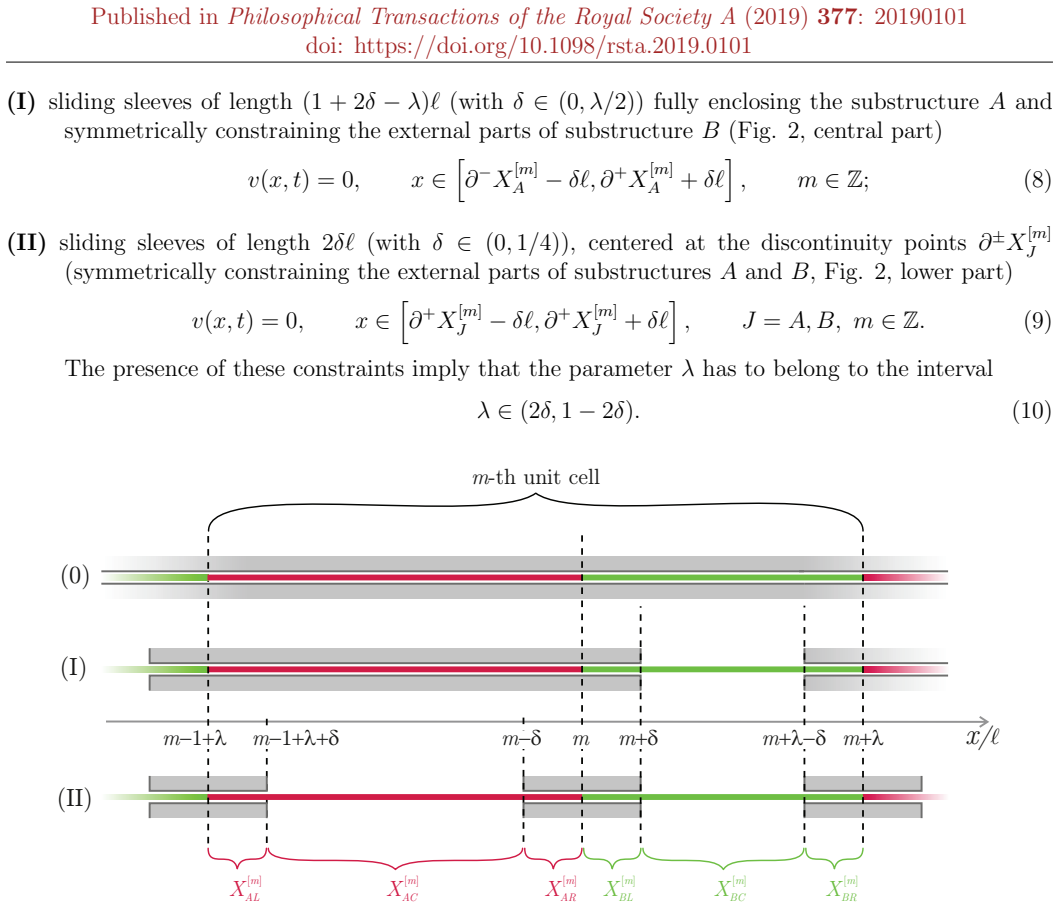
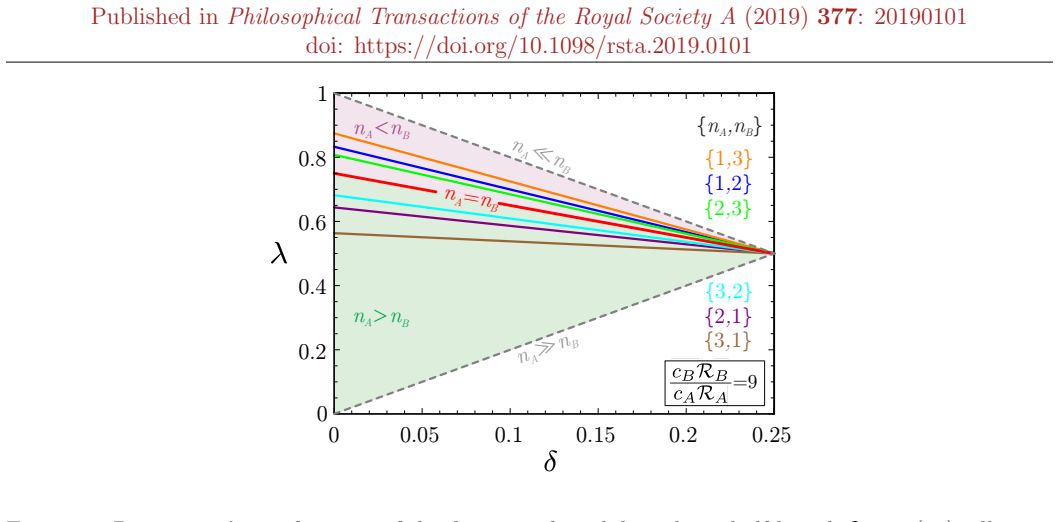
- System (II) requires the geometric relation Eq. (31) linking the cell length fraction $\lambda$ to the sleeve half-length $\delta$; only certain flexural mode pairs permit simultaneous transverse oscillations of both substructures.
- The resonance condition is independent of the sliding sleeve length parameter $\delta$, so the axial resonance frequencies are inherited from the classical axial Bloch problem.
- For a finite damped structure, the same mechanism predicts large, frequency-selective amplification of axial motion when the doubled flexural frequency approaches the axial pass band, rather than true unbounded growth.
Reading between the lines
- If the $2:1$ nesting survives in finite structures, a compact device could convert low-amplitude bending vibration into axial force or displacement, for example for actuation or energy harvesting; the paper itself only suggests sensors.
- The coupling is one-way, flexural drives axial, so a cascade of cells driven by the same transverse wave could add axial contributions and effectively rectify vibration into net axial motion.
- A direct dynamical test of the assumed force law would check whether axial response appears at $2\Omega$ and whether its amplitude scales as the square of the flexural amplitude; if rate-dependent sleeve friction dominates, the quadratic law and the resonance peak would be obscured.
- The same nested-phase idea may apply to other constraints that generate configurational forces, such as moving supports or injected rods, so frequency-doubling band-gap breaking is not obviously limited to this geometry.
Signed reviews
Editorial analysis
A structured set of objections, weighed in public.
Referee Report
Summary. The paper presents an analytical study of a periodic elastic beam structure constrained by sliding sleeves. The authors propose a 'nested Bloch-Floquet' method in which a small-amplitude flexural oscillation at frequency Ω generates, through Eshelby-like configurational forces at the sleeve ends, an axial oscillation at frequency 2Ω. The axial response is analyzed through a 12x12 linear system; its determinant yields the classical axial dispersion relation. Two main claims are advanced: (i) the presence of flexural motion can break the axial band-gap structure, allowing axial waves at frequencies forbidden in the purely axial problem, and (ii) when the flexural frequency intersects the axial dispersion curve, a resonance occurs in which the longitudinal amplitude becomes unbounded. The results are illustrated for two structural systems with different sleeve arrangements.
Significance. The paper introduces a conceptually interesting mechanism by which a small transverse vibration can produce longitudinal motion at a different frequency in a periodic structure, with potential applications to actuation and metamaterials. The analytical treatment is largely self-contained, the linear system and determinant formula are clearly laid out, and the axial dispersion relation is benchmarked against the known result from the literature. The frequency-doubling condition ω=2Ω follows naturally from the quadratic nature of the configurational force. If the underlying dynamic force law is accepted, the derivation of the band-gap breaking and the resonance condition is sound. The main weakness is the unvalidated extension of the quasi-static Eshelby force law to the dynamic oscillating-sleeve setting.
major comments (3)
- [§2.2 and §3.2, Eqs. (17), (19)-(20)] The boundary condition (17) is imposed 'for every time t', but the right-hand side contains the square of the flexural curvature, so for a harmonic flexural mode Ψ(t) ~ cos(Ωt) it includes a time-independent term proportional to cos²(Ωt) = (1+cos(2Ωt))/2. The assumed axial displacement (19) with Φ(t) at frequency ω = 2Ω cannot represent the static component of the jump condition. The constant part is silently dropped in the derivation of the frequency-locking condition (35). The authors should either include a static axial field (which would be a separate solution of the linear equations) or explicitly state that the static component is neglected because it does not affect the harmonic response. As it stands, the statement that the jump conditions hold 'at every time t' is not satisfied by the single-frequency ansatz.
- [§2.2, Eq. (17)] The central physical ingredient is the configurational-force jump law, which is taken from the static theory of rods with sliding sleeves (reference [8]). The paper does not derive a dynamic balance of material forces for an oscillating sleeve, nor does it discuss the range of validity of this quasi-static law in the presence of time-dependent motion. Since the entire nested Bloch wave mechanism, the relation ω = 2Ω, and the resonance condition (44) depend on this law, the authors need to justify its dynamic applicability, for example by deriving it from a Lagrangian with moving boundaries or by estimating the neglected inertial terms and showing they are small under the stated assumptions. Without this, a central premise of the paper is unsupported.
- [§4.3, Fig. 5] The resonance predictions are presented as intersections of the flexural eigenfrequency (56) with the axial dispersion curve, but no direct validation of these resonances is given. A time-domain simulation of the full system with the boundary conditions (15)-(18), or a comparison with a discrete model, would significantly strengthen the claim that the predicted unbounded longitudinal response is a genuine feature of the proposed dynamic configurational-force model rather than an artifact of the quasi-static assumption.
minor comments (4)
- [Eq. (23)] Equation (23) contains an extra closing parenthesis at the end of the expression for V^{(m)}_{JC}(x).
- [Eq. (42)] In Eq. (42), the first line of ΓJ2 has a misplaced bracket: it reads 'cosh[(Ξ(nJ)]' instead of 'cosh[Ξ(nJ)]'.
- [§4.2] Under the assumptions (49), (50), and (55) in §4.2, Eq. (55) has not yet been introduced; it should refer to the specific parameter relation used in that section.
- [Eq. (37)] The quasi-periodicity condition (37) assigns the phase φ to the axial displacement and φ/2 to the flexural displacement. This is consistent with frequency doubling, but the physical interpretation is not discussed; a short explanation would help the reader.
Circularity Check
No significant circularity: the nested 2Ω resonance and band-gap response follow from the assumed configurational-force jump conditions, with no fitted parameters and the axial dispersion benchmark independently derived.
full rationale
The derivation chain is self-contained rather than circular. The central frequency relation ω = 2Ω, Eq. (35), follows from substituting the separated single-frequency ansatz into the configurational-force jump conditions, Eq. (17): the quadratic term (v'')² carries time dependence cos²(Ωt), whose oscillatory part is at 2Ω, and the paper matches that to the axial time-dependence. This is a consequence of the model, not a parameter fit or a renamed input. The axial amplitudes are then obtained from the linear system (39), whose forcing terms are explicitly proportional to the square of the prescribed transverse amplitudes; no amplitude is fitted to a target resonance. The resonance condition, Eq. (44), is derived from the determinant (43) of the same matrix M, and the paper only notes afterwards that this determinant coincides with a known dispersion relation from Ref. [35]; the citation is illustrative, not load-bearing. The self-citations that do appear — Ref. [8] for the Eshelby-like force law used in Eq. (17), and Ref. [1] for a dynamic configurational-force problem — are prior theoretical/experimental results with independent content; they do not merely restate the present paper's conclusions. The physical validity of using the quasi-static instantaneous force law of Eq. (17) in a dynamic oscillating-sleeve setting, and the neglect of the time-independent part of cos²(Ωt), are modeling/approximation questions, not circularity: they concern whether the assumed law is correct, not whether the derived results reduce to the assumptions by construction.
Assumptions & free parameters
assumptions (5)
- standard math Bloch-Floquet theorem applies: solutions are quasi-periodic with phase phi for u and phi/2 for v
- domain assumption Euler-Bernoulli beam theory with uncoupled axial and flexural equations and neglected rotational inertia
- domain assumption The configurational force at a sliding sleeve end is E S R^2 (v'')^2 / 2 at every instant, including in dynamics
- domain assumption Sliding sleeves impose v = v' = 0 within and at sleeve ends and allow free axial sliding with no friction
- ad hoc to paper Single-frequency time-harmonic ansatz with u at frequency 2 Omega and v at Omega, discarding the static component of the quadratic Eshelby term
Cite this review
Pith. "Pith review of Nested Bloch waves in elastic structures with configurational forces." pith.science (2026). https://pith.science/paper/CLAPTVE3
@misc{pith2026190803061,
  author       = {Pith},
  title        = {Pith review of: Nested Bloch waves in elastic structures with configurational forces},
  year         = {2026},
  howpublished = {\url{https://pith.science/paper/CLAPTVE3}},
  note         = {Machine review of arXiv:1908.03061}
}
read the original abstract
Small axial and flexural oscillations are analyzed for a periodic and infinite structure, constrained by sliding sleeves and composed of elastic beams. A nested Bloch-Floquet technique is introduced to treat the non-linear coupling between longitudinal and transverse displacements induced by the configurational forces generated at the sliding sleeve ends. The action of configurational forces is shown to play an important role from two perspectives. First, the band gap structure for purely longitudinal vibration is broken so that axial propagation may occur at frequencies that are forbidden in the absence of a transverse oscillation and, second, a flexural oscillation may induce axial resonance, a situation in which the longitudinal vibrations tend to become unbounded. The presented results disclose the possibility of exploiting configurational forces in the design of mechanical devices towards longitudinal actuation from flexural vibrations of small amplitude at given frequency.
Figures

Figures from the paper (2 more)

Reference graph
Works this paper leans on
-
[1]
Configurational forces and nonlinear struc- tural dynamics
Armanini A, Dal Corso F, Misseroni D, Bigoni D 2019. Configurational forces and nonlinear struc- tural dynamics. J. Mech. Phys. Sol. 130, 82–100
work page 2019
-
[8]
Eshelby-like forces acting on elastic structures: theoretical and experimental proof
Bigoni D, Dal Corso F, Bosi F, Misseroni D 2015. Eshelby-like forces acting on elastic structures: theoretical and experimental proof. Mech. Mater., 80, 368–374
2015
-
[2]
Bacigalupo A, Gambarotta L 2017. Wave propagation in non-centrosymmetric beam-lattices with lumped masses: Discrete and micropolar modeling. Int. J. Sol. Struct. 118–119, 128–145
work page 2017
-
[3]
Acoustic wave polarization and energy flow in periodic beam lattice materials
Bacigalupo A, Lepidi M 2018. Acoustic wave polarization and energy flow in periodic beam lattice materials. Int. J. Sol. Struct. 147, 183–203
work page 2018
-
[4]
On work done by reaction forces of moving supports
Balabukh LI, Vulfson MN, Mukoseev BV Panovko YaG 1970. On work done by reaction forces of moving supports. Research on Theory of Constructions , 18, 190–200
work page 1970
-
[5]
A Newtonian interpretation of configurational forces on dis- locations and cracks
Ballarini R, Royer-Carfagni G 2016. A Newtonian interpretation of configurational forces on dis- locations and cracks. J. Mech. Phys. Sol. 95, 602– 620
work page 2016
-
[6]
Bigoni D, Dal Corso F, Misseroni D, Bosi F 2014. Torsional locomotion Proc. R. Soc. A , 470.2171, 20140599
work page 2014
-
[7]
Instability of a penetrating blade J
Bigoni D, Bosi F, Dal Corso F, Misseroni D 2014. Instability of a penetrating blade J. Mech. Phys. Sol. 64, 411–425
work page 2014
Show all 43 references
-
[10]
Bosi F, Misseroni D, Dal Corso F, Bigoni D. 2014. An elastica arm scale. Proc. R. Soc. A 470:20160870
2014
-
[11]
Self-encapsulation, or the ‘dripping’ of an elastic rod
Bosi F, Misseroni D, Dal Corso F, Bigoni D 2015. Self-encapsulation, or the ‘dripping’ of an elastic rod. Proc. R. Soc. A , 471: 20150195
2015
-
[12]
Development of configurational forces during the injection of an elastic rod
Bosi F, Misseroni D, Dal Corso F, Bigoni D 2015. Development of configurational forces during the injection of an elastic rod. Ext. Mech. Lett. , 471 83–88
2015
-
[13]
Asymptotic self-restabilization of a continuous elastic structure
Bosi F, Misseroni D, Dal Corso F, Neukirch S, Bigoni D 2016. Asymptotic self-restabilization of a continuous elastic structure. Phys. Rev. E , 94 (6): 063005
2016
-
[14]
Transition wave in a supported heavy beam
Brun M, Movchan AB, Slepyan LI 2013. Transition wave in a supported heavy beam. J. Mech. Phys. Sol. 61(10), 2067–2085
2013
-
[15]
Bloch-Floquet waves in flexural systems with continuous and discrete element
Carta G, Brun M 2015. Bloch-Floquet waves in flexural systems with continuous and discrete element. Mech. Mat. 87, 11–26
2015
-
[16]
Gyro-elastic beams for the vibra- tion reduction of long flexural systems
Carta G, Jones IS, Movchan NV, Movchan AB, Nieves MJ 2017. Gyro-elastic beams for the vibra- tion reduction of long flexural systems. Proc. R. Soc. A 473, 20170136
2017
-
[17]
Elastic chiral waveguides with gyro-hinges, Quart
Carta G, Nieves MJ, Jones IS, Movchan NV, Movchan AB 2018. Elastic chiral waveguides with gyro-hinges, Quart. J. Mech. Appl. Math. 71, 157–185
2018
-
[18]
Wave propagation in beams with periodic arrays of airfoil- shapedresonating units, J
Casadei F, Bertoldi K 2014. Wave propagation in beams with periodic arrays of airfoil- shapedresonating units, J. Sound Vibr. 333 (24), 6532–6547
2014
-
[19]
Serpentine locomotion through elastic energy release
Dal Corso F, Misseroni D, Pugno NM, Movchan AB, Movchan NV, Bigoni D 2017. Serpentine locomotion through elastic energy release. J. R. Soc. Interface , 14: 20170055
2017
-
[20]
Metamaterials with amplitude gaps for elastic solitons Nature Comm., 9, 3410
Deng B, Wang P, He Q, Tournat V, Bertoldi K 2018. Metamaterials with amplitude gaps for elastic solitons Nature Comm., 9, 3410
2018
-
[21]
The force on an elastic singularity
Eshelby JD 1951. The force on an elastic singularity. Phil. Trans. R. Soc. A , 244–877, 87–112
1951
-
[22]
The continuum theory of lattice defects
Eshelby JD 1956. The continuum theory of lattice defects. Solid State Phys. , 3.C, 79–144
1956
-
[23]
Energy relations and the energy-momentum tensor in continuum mechanics
Eshelby JD 1970. Energy relations and the energy-momentum tensor in continuum mechanics. Inelastic Behaviour of Solids , 17–115
1970
-
[24]
Mechanical modeling of innovative metamaterials alternating pentamode lattices and confinement plates
Fraternali F, Amendola A 2017. Mechanical modeling of innovative metamaterials alternating pentamode lattices and confinement plates. J. Mech. Phys. Sol. 99, 259–271
2017
-
[25]
Interfacial waveforms in chiral lattices with gyroscopic spinners
Garau M, Carta G, Nieves MJ, Jones IS, Movchan NV, Movchan AB 2018. Interfacial waveforms in chiral lattices with gyroscopic spinners. Proc. R. Soc. A 474: 20180132
2018
-
[26]
Partial Constraint Singularities in Elastic Rods
Hanna JA, Singh H, Virga EG 2018. Partial Constraint Singularities in Elastic Rods. J. Elas. 133(1), 105–118
2018
-
[28]
Application of optimal control method in buckling analysis of constrained elastica problems
Liakou A 2018. Application of optimal control method in buckling analysis of constrained elastica problems. Int. J. Sol. Struct. 141-142, 158–172
2018
-
[29]
Constrained buckling of variable length elastica: Solution by geo- metrical segmentation
Liakou A, Detournay E 2018. Constrained buckling of variable length elastica: Solution by geo- metrical segmentation. Int. J. Non-Linear Mech. 99, 204–217
2018
-
[30]
Low-frequency wave propagation in post-buckled structures
Maurin FPR, Spadoni A 2014. Low-frequency wave propagation in post-buckled structures. Wave Motion 51, 323–334
2014
-
[31]
Wave dispersion in post-buckled structures
Maurin FPR, Spadoni A 2014. Wave dispersion in post-buckled structures. J. Sound Vibr. , 333, 4562–4578
2014
-
[32]
Wave propagation in periodic buckled beams
Maurin FPR, Spadoni A 2016. Wave propagation in periodic buckled beams. Part I: Analytical models and numerical simulations, Wave Motion 66, 190–209
2016
-
[33]
Wave propagation in periodic buckled beams
Maurin FPR, Spadoni A 2016. Wave propagation in periodic buckled beams. Part II: Experiments. Wave Motion 66, 210–219
2016
-
[34]
Waves in one-dimensional quasicrystalline structures: dynamical trace mapping, scaling and self-similarity of the spectrum
Morini L, Gei M 2018. Waves in one-dimensional quasicrystalline structures: dynamical trace mapping, scaling and self-similarity of the spectrum. J. Mech. Phys. Sol. 119, 83–103
2018
-
[35]
Asymptotic models of fields in dilute and densely packed composites
Movchan AB, Movchan NV, Poulton CG 2002. Asymptotic models of fields in dilute and densely packed composites. World Scientific Publ
2002
-
[36]
Dynamics of periodic mechanical structures containing bistable elastic elements: From elastic to solitary wave propagation Phys
Nadkarni N, Daraio C, Kochmann DM 2014. Dynamics of periodic mechanical structures containing bistable elastic elements: From elastic to solitary wave propagation Phys. Rev. E 90, 023204
2014
-
[37]
Unidirectional transition waves in bistable lattices
Nadkarni N, Arrieta AF, Chong C, Kochmann DM, Daraio C 2016. Unidirectional transition waves in bistable lattices. Phys. Rev. Lett. , 116, 244501
2016
-
[38]
Transient wave in a transformable periodic flexural structure
Nieves MJ, Mishuris GS, Slepyan LI 2017. Transient wave in a transformable periodic flexural structure. Int. J. Sol. Struct. 112, 185–208
2017
-
[39]
Vibrations and elastic waves in chiral multi-structures
Nieves MJ, Carta G, Jones IS, Movchan AB, Movchan NV 2018. Vibrations and elastic waves in chiral multi-structures. J. Mech. Phys. Solids 121, 387–408
2018
-
[40]
Some perspectives on Eshelby-like forces in the elastica arm scale
O’Reilly OM 2015. Some perspectives on Eshelby-like forces in the elastica arm scale. Proc. R. Soc. A 471(2174),20140785
2015
-
[41]
Modeling Nonlinear Problems in the Mechanics of Strings and Rods: The Role of the Balance Laws
O’Reilly, OM 2017. Modeling Nonlinear Problems in the Mechanics of Strings and Rods: The Role of the Balance Laws . Springer
2017
-
[42]
On the Planar Elastica, Stress, and Material Stress
Singh H, Hanna JA 2019. On the Planar Elastica, Stress, and Material Stress. J. Elas. https://doi.org/10.1007/s10659-018-9690-5
2019 doi
-
[43]
Tilted resonators in a triangular elastic lattice: chirality, Bloch waves and negative refraction
Tallarico D, Movchan NV, Movchan AB, Colquitt DJ 2017. Tilted resonators in a triangular elastic lattice: chirality, Bloch waves and negative refraction. J. Mech. Phys. Sol. , 103, 236–256
2017
-
[44]
Edge waves and localization in lattices containing tilted resonators
Tallarico D, Trevisan A, Movchan NV, Movchan AB 2017. Edge waves and localization in lattices containing tilted resonators. Front. Mat., 4, 16 19 Published in Philosophical Transactions of the Royal Society A (2019) 377: 20190101 doi: https://doi.org/10.1098/rsta.2019.0101
2019
-
[45]
Propagation and filtering of elastic and electromagnetic waves in piezoelectric composite structures, Math
Tallarico D, Movchan NV, Movchan AB, Camposaragna M 2017. Propagation and filtering of elastic and electromagnetic waves in piezoelectric composite structures, Math. Meth. Appl. Sci. , 40 (9), 3202–3220 20
2017
Reviewed August 14, 2026 · model on record in the stance chip above.
Discussion (0). Continue with ORCID to comment.