REVIEW 2 major objections 5 minor 4 cited by
Multicentered black hole saddles for supersymmetric indices
T0 review · 2 major / 5 minor · reviewed 2026-08-06 · deepseek-v4-flash
Pith's one-line read The paper constructs finite-temperature multicentered black hole saddles for the supersymmetric index and shows that wall-crossing happens because the entire moduli space of such saddles ceases to exist.
desk verdict A solid, genuinely new construction of finite-temperature multicentered index saddles, but the wall-crossing mechanism rests on an unproven reality assumption for pole positions that the authors themselves flag. read the letter →
The pith
A machine-rendered reading of the paper's core claim, the machinery that carries it, and where it could break.
The reading
What carries the argument
The central object is the finite-temperature multicentered Bates--Denef saddle, obtained by splitting each double pole of the extremal harmonic function into a north pole with charge $\gamma_i=\Gamma_i/2+i\delta_i$ and a south pole with charge $\bar\gamma_i=\Gamma_i/2-i\delta_i$. Smoothness of the Euclidean geometry imposes the regularity conditions $i\langle\gamma_i,H(x_i)\rangle=\beta/4\pi$ and $i\langle\bar\gamma_i,H(\bar{x}_i)\rangle=-\beta/4\pi$, which replace the zero-temperature integrability conditions and, together with the Cayley--Menger condition ensuring that the six pole distances can be embedded in $\mathbb{R}^3$, define the moduli space. The on-shell action is computed by rewriting the electromagnetic boundary term as a bulk term, which yields the factorized action (3.43) and is what makes the semiclassical answer consistent with a graded trace.
What would settle it
Solve the regularity conditions (4.1)--(4.4) for complex pole positions and check whether a continuous branch of solutions connects the two sides of the wall $\langle\Gamma_1,h\rangle=0$; if such a branch exists, the real-position restriction, not the disappearance of saddles, would be what produces the jump.
Extended reading notes
Core claim
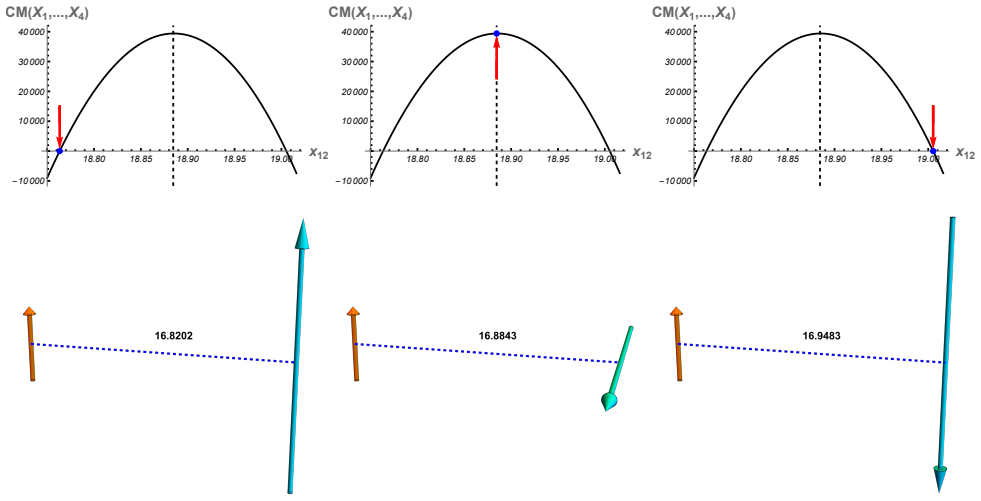
The paper establishes that multicentered black hole bound states contribute to the gravitational supersymmetric index through new finite-temperature saddles whose on-shell action is $-S_{\rm total} = -\beta|Z(\Gamma;\Omega_\infty)| + \sum_i \pi i\langle\gamma_i,\bar\gamma_i\rangle = -\beta M_{\rm BPS} + \sum_i S_{{\rm ext},i}$. The temperature-dependent term is only the Boltzmann weight, and the temperature-independent term factorizes into the extremal entropies of the individual centers. Wall-crossing happens because the regularity conditions (4.1)--(4.4), imposed for real pole positions $x_i,\bar{x}_i\in\mathbb{R}^3$, can no longer be solved once $\langle\Gamma_1,h\rangle$ changes sign; the finite-temperature moduli space is carried around by the zero-temperature Bates--Denef distance and disappears at the wall. For two black holes the moduli space is $S^3\times S^1$, in contrast to the $S^2$ of the extremal limit, and for $N>2$ charges lying in a two-dimensional sublattice the same $\beta$-independent wall condition is reproduced, matching the chamber analysis of [39].
Load-bearing premise
The load-bearing premise is that the pole positions defining each saddle can be taken real, $x_i,\bar{x}_i\in\mathbb{R}^3$; if complex positions are admissible, bound-state saddles might persist across the wall and the claimed wall-crossing mechanism would be an artifact of that contour choice.
Editorial extensions
If this is right
- The semiclassical gravitational index receives multicentered contributions whose action is $-\beta M_{\rm BPS}+\sum_i S_{{\rm ext},i}$, so each constituent's extremal entropy appears additively rather than through a single horizon area.
- Wall-crossing in the index is reproduced as the loss of the full moduli space of finite-temperature saddles, with a $\beta$-independent wall position that agrees with Lorentzian extremal solutions.
- The two-black-hole bound state saddle has moduli space $S^3\times S^1$ at finite temperature, reducing to the $S^2$ rotation moduli space only in the $\beta\to\infty$ limit.
- For $N>2$ charges in a two-dimensional sublattice, the saddle equations admit solutions only in the chamber $c_-$, matching the known wall-crossing result of [39].
- Because the on-shell action is independent of pole positions, computing the index requires integrating over the moduli space; the paper supplies a symplectic form and a large-$\beta$ volume for the two-black-hole case.
Reading between the lines
- If the real-position restriction is relaxed and complex pole positions are allowed, bound-state saddles might continue across the wall; a direct search for complex solutions of (4.1)--(4.4) would show whether the claimed mechanism is an artifact of the contour choice.
- The factorization of the on-shell action into $-\beta M_{\rm BPS}$ plus a sum of extremal entropies suggests that the index factorizes over constituent quantum mechanical systems; checking temperature independence of one-loop determinants would test whether the gravitational index is a true Witten index.
- The $S^3\times S^1$ moduli space and its symplectic volume give a target for a finite-temperature generalization of quiver quantum mechanics, whose zero-temperature measure is known to produce the extremal wall-crossing formula.
- The same pole-splitting construction could plausibly lift to five dimensions, where it would produce black ring, black lens, and multicentered saddles for the five-dimensional index.
Editorial analysis
A structured set of objections, weighed in public.
Referee Report
Summary. The paper constructs finite-temperature Euclidean saddles of four-dimensional N=2 supergravity, with periodic fermions, that represent multicenter black holes and contribute to the supersymmetric gravitational index. The on-shell action is computed from first principles in Sections 2 and 3 and shown to be -beta |Z(Γ;Ω∞)| + Σ_i S_ext,i. The paper then analyzes the moduli space of these saddles, finding a richer structure than at zero temperature (for two centers, S1 x S3 or S1 x SO(3)), and argues that the moduli space disappears at walls of marginal stability, thereby explaining wall-crossing at the level of the gravitational path integral. The wall location is argued to agree with the zero-temperature Bates-Denef condition.
Significance. If the construction is correct, this is an important step: it gives the first gravitational path-integral understanding of wall-crossing in the index and shows that the finite-temperature saddles carry the extremal entropy sum. The on-shell action computation is a strong point: it is done explicitly with careful boundary terms, and the factorization (3.43) is a nontrivial consistency check. The identification of the new moduli space and its topology is a valuable technical contribution. However, the central wall-crossing mechanism rests on the unproven assumption that pole positions can be restricted to real R^3; until that assumption is justified or removed, the headline claim is conditional.
major comments (2)
- [Section 4, first paragraph] The reality assumption xi, exi in R^3 is explicitly flagged by the authors as 'entirely not obvious', yet the wall-crossing conclusion of Section 4.5 depends on it. The regularity conditions (4.1)-(4.4) are complex equations once complex positions are allowed; the paper gives no argument that no finite-distance complex solutions persist in the c+ chamber. The analogy with the Kerr-Newman Wick rotation does not constitute a contour-deformation proof for multi-center configurations. This is load-bearing: the claim that the gravitational path integral explains wall-crossing requires ruling out complex saddles that would survive the wall.
- [Section 4.1, equations (4.40)-(4.42)] The S1 topology of the two-center moduli space and the resulting 'loss of the full moduli space' at the wall are based on a conjecture about which roots of an eighth-order polynomial give the interval endpoints. For finite beta, only one numerical example is provided. The wall-crossing argument in Section 4.5 uses the large-beta expansions (4.41)-(4.42) to conclude that the interval passes through infinity; this conclusion is only as solid as the conjecture. The central mechanism would be more robust if the endpoint behavior were proven for all beta or if the argument were reformulated to not depend on the interval structure.
minor comments (5)
- [Section 2.3] The counting of the IWP two-black-hole moduli space is inconsistent: after fixing rotations and translations the space is three-dimensional, yet the text calls it six-dimensional and then reintroduces Euler angles. The counting should be stated in one consistent frame.
- [Section 4.1] The final moduli space is S1 x SO(3) (since SO(3) is three-dimensional and topologically RP^3), not literally S1 x S3; if the S3 refers to the spin double-cover, this should be stated explicitly.
- [Section 4.4] The argument for dim M = 2N is only a local tangent-space count; a proof that the linearized equations (4.62) have the asserted rank would be needed for rigor.
- [Equation (2.31)] The rewriting of the electromagnetic boundary term as a bulk term assumes that the internal patch boundaries do not contribute; a sentence justifying this against Dirac-Misner string contributions would be helpful.
- [Notation, Section 4.1] The notation for the distances (x_{1bar1}, x_{bar1bar2}, etc.) is introduced only shortly before use; a table or a short glossary would improve readability.
Circularity Check
No significant circularity: the on-shell action is computed directly and the wall-crossing location is benchmarked against, not fitted to, the known Bates-Denef/zero-temperature conditions.
full rationale
The paper's central derivation is self-contained. The multicentered on-shell action (3.43) is obtained by an explicit evaluation of the bulk, Gibbons-Hawking, and electromagnetic boundary terms (eqs. (3.24)-(3.41)), with the pole values of the potentials fixed by the cited single-center attractor analysis [14]; because [14] is a single-center result whose assumptions do not include the multicentered factorization claim, citing it is independent support rather than circularity. The wall-crossing analysis in Sec. 4.5 does not fit the wall location from the finite-temperature data: the value ⟨Γ1,h⟩=0 is imported from the zero-temperature Bates-Denef integrability condition and from [39], and the paper then verifies that the explicit finite-temperature regularity equations (4.1)-(4.4) lose real solutions there. The finite-temperature moduli space S1×S3 and the concentration of the allowed interval around x* are derived (numerically and in perturbation theory) rather than assumed. The paper explicitly flags the real-slice restriction xi, exi ∈ R3 ('It is entirely not obvious that one should impose such a restriction...') as an assumption; this is a robustness caveat about complex saddles, not a circular step. Section 5 likewise flags the unsettled criterion for which complex saddles contribute, another non-circular caveat. The heavy use of Ref. [14] is a normal dependence on prior single-center results and does not make the multicentered prediction equivalent to its inputs.
Assumptions & free parameters
assumptions (6)
- domain assumption The new attractor procedure of Ref. [14] applies to multiple centers: splitting each extremal double pole into north/south poles with γ_i = Γ_i/2 + i δ_i and imposing regularity (3.21) gives the finite-temperature index saddles.
- ad hoc to paper Pole positions can be taken real: xi, exi ∈ R³ after deforming the integration contour of the complex gravitational saddle.
- domain assumption The Gibbons-Hawking prescription computes the index by summing over these saddles; the index is a helicity supertrace, with fermion zero modes absorbed.
- standard math Cayley-Menger determinants (4.15) with signed volumes correctly characterize embeddability of the six distances in R³.
- domain assumption The wall of marginal stability is located at ⟨Γ1,h⟩=0, the same condition as for extremal Lorentzian Bates-Denef solutions.
- domain assumption The symplectic form ω_β in (A.5) is the correct measure on the moduli space, with J_z as moment map.
Cite this review
Pith. "Pith review of Multicentered black hole saddles for supersymmetric indices." pith.science (2026). https://pith.science/paper/CLJPD6X6
@misc{pith2026250707166,
  author       = {Pith},
  title        = {Pith review of: Multicentered black hole saddles for supersymmetric indices},
  year         = {2026},
  howpublished = {\url{https://pith.science/paper/CLJPD6X6}},
  note         = {Machine review of arXiv:2507.07166}
}
abstract
The supersymmetric index in string theory can sometimes have a discontinuous integer-valued jump at co-dimension one surfaces in moduli space called walls of marginal stability. When the index counts black hole microstates, crossing such walls of marginal stability amounts to the appearance or disappearance of a large number of such states. While wall-crossing has been understood in string theory and through the disappearance of extremal Lorentzian supergravity solutions as the moduli are varied, there has been no understanding about how the discontinuous changes in the index occur at the level of the gravitational path integral. In this paper, we find the finite-temperature saddles in $4d$ flatspace supergravity in which fermionic fields are periodic when going around the thermal circle that correspond to the multi-center black hole contributions to the index. By analyzing these saddles, we can explain how wall-crossing occurs: as the scalar moduli in supergravity are varied at the asymptotic boundary, for a given split of the charges, the saddle point equations can no longer be solved and, consequently, the corresponding multi-center saddle no longer contributes to the index. While the values of the scalars and the jump in the index when a wall is crossed all agree with the prediction from previously found Lorentzian supergravity solutions, the saddles in the index exhibit a much richer moduli space, which we analyze in detail.
Figures


Figures from the paper (1 more)

Forward citations
Cited by 4 Pith papers
-
On conformal symmetry in large-$N$ quiver mechanics
At large rank N, the fixed-point formula for the quiver superconformal index equals the Ω_uneq contribution to the microscopic scaling BPS index of Beaujard–Mondal–Pioline, a piece previously invisible on the Coulomb branch.
-
Index saddle for the D1-D5-P black string and its decoupling limit
Constructs index saddle for D1-D5-P black string via BPS limit and uplift, with decoupling to BTZ x S^3 computing CFT index.
-
Index saddle for supersymmetric F1-P black ring
A complex supergravity solution is identified as the index saddle of the F1–P small black ring; its higher-derivative corrections reproduce the microscopic index √(nw−JQ) up to an unfixed constant, in a restricted thi...
-
Gravitational index of the D1-D5-P black string
Complex, supersymmetric, non-extremal Euclidean saddles for the D1-D5-P black string realize the gravitational index and match the Cardy formula of the dual elliptic genus.
Reference graph
Works this paper leans on
-
[1]
Microscopic origin of the Bekenstein-Hawking entropy,
A. Strominger and C. Vafa, “Microscopic origin of the Bekenstein-Hawking entropy,” Phys. Lett. B 379 (1996) 99–104, arXiv:hep-th/9601029
arXiv 1996
-
[2]
Action Integrals and Partition Functions in Quantum Gravity,
G. W. Gibbons and S. W. Hawking, “Action Integrals and Partition Functions in Quantum Gravity,” Phys. Rev. D15 (1977) 2752–2756
work page 1977
-
[3]
Microscopic origin of the Bekenstein-Hawking entropy of supersymmetric AdS 5 black holes,
A. Cabo-Bizet, D. Cassani, D. Martelli, and S. Murthy, “Microscopic origin of the Bekenstein-Hawking entropy of supersymmetric AdS 5 black holes,” JHEP 10 (2019) 062, arXiv:1810.11442 [hep-th]
arXiv 2019
-
[4]
The BPS limit of rotating AdS black hole thermodynamics,
D. Cassani and L. Papini, “The BPS limit of rotating AdS black hole thermodynamics,” JHEP 09 (2019) 079, arXiv:1906.10148 [hep-th]
arXiv 2019
-
[5]
Universal spinning black holes and theories of class R,
N. Bobev and P. M. Crichigno, “Universal spinning black holes and theories of class R,” JHEP 12 (2019) 054, arXiv:1909.05873 [hep-th]
arXiv 2019
-
[6]
Euclidean black saddles and AdS 4 black holes,
N. Bobev, A. M. Charles, and V. S. Min, “Euclidean black saddles and AdS 4 black holes,” JHEP 10 (2020) 073, arXiv:2006.01148 [hep-th]
arXiv 2020
-
[7]
Microscopic entropy of AdS 3 black holes revisited,
F. Larsen and S. Lee, “Microscopic entropy of AdS 3 black holes revisited,” JHEP 07 (2021) 038, arXiv:2101.08497 [hep-th]
arXiv 2021
-
[8]
4d N = 2 supergravity observables from Nekrasov-like partition functions,
K. Hristov, “4d N = 2 supergravity observables from Nekrasov-like partition functions,” JHEP 02 (2022) 079, arXiv:2111.06903 [hep-th]
arXiv 2022
Show all 67 references
-
[9]
The dark (BPS) side of thermodynamics in Minkowski 4,
K. Hristov, “The dark (BPS) side of thermodynamics in Minkowski 4,” JHEP 09 (2022) 204, arXiv:2207.12437 [hep-th]
2022 arXiv
-
[10]
Supersymmetric phases of AdS 4/CFT3,
P. Benetti Genolini, A. Cabo-Bizet, and S. Murthy, “Supersymmetric phases of AdS 4/CFT3,” JHEP 06 (2023) 125, arXiv:2301.00763 [hep-th]
2023 arXiv
-
[11]
Supersymmetric indices factorize,
L. V. Iliesiu, M. Kologlu, and G. J. Turiaci, “Supersymmetric indices factorize,” arXiv:2107.09062 [hep-th]. 41
-
[12]
Logarithmic Correction to BPS Black Hole Entropy from Supersymmetric Index at Finite Temperature,
A. A. H., P. V. Athira, C. Chowdhury, and A. Sen, “Logarithmic Correction to BPS Black Hole Entropy from Supersymmetric Index at Finite Temperature,” arXiv:2306.07322 [hep-th]
-
[13]
Revisiting Logarithmic Correction to Five Dimensional BPS Black Hole Entropy,
A. H. Anupam, C. Chowdhury, and A. Sen, “Revisiting Logarithmic Correction to Five Dimensional BPS Black Hole Entropy,” arXiv:2308.00038 [hep-th]
-
[14]
New forms of attraction: Attractor saddles for the black hole index,
J. Boruch, L. V. Iliesiu, S. Murthy, and G. J. Turiaci, “New forms of attraction: Attractor saddles for the black hole index,” arXiv:2310.07763 [hep-th]
-
[15]
Killing spinors for finite temperature Euclidean solutions at the BPS bound,
S. Hegde and A. Virmani, “Killing spinors for finite temperature Euclidean solutions at the BPS bound,” JHEP 02 (2024) 203, arXiv:2311.09427 [hep-th]
2024 arXiv
-
[16]
Supersymmetric index for small black holes,
C. Chowdhury, A. Sen, P. Shanmugapriya, and A. Virmani, “Supersymmetric index for small black holes,” JHEP 04 (2024) 136, arXiv:2401.13730 [hep-th]
2024 arXiv
-
[17]
Gravitational index of the heterotic string,
Y. Chen, S. Murthy, and G. J. Turiaci, “Gravitational index of the heterotic string,” JHEP 09 (2024) 041, arXiv:2402.03297 [hep-th]
2024 arXiv
-
[18]
Localization of the 5D supergravity action and Euclidean saddles for the black hole index,
D. Cassani, A. Ruip´ erez, and E. Turetta, “Localization of the 5D supergravity action and Euclidean saddles for the black hole index,” arXiv:2409.01332 [hep-th]
-
[19]
Supersymmetric Index for Half BPS Black Holes in N=2 Supergravity with Higher Curvature Corrections,
S. Hegde, A. Sen, P. Shanmugapriya, and A. Virmani, “Supersymmetric Index for Half BPS Black Holes in N=2 Supergravity with Higher Curvature Corrections,” arXiv:2411.08260 [hep-th]
-
[20]
Attractor saddle for 5D black hole index,
S. Adhikari, P. Dharanipragada, K. Goswami, and A. Virmani, “Attractor saddle for 5D black hole index,” arXiv:2411.12413 [hep-th]
-
[21]
Mixed ’t Hooft Anomalies and the Witten Effect for AdS Black Holes,
M. Heydeman and C. Toldo, “Mixed ’t Hooft Anomalies and the Witten Effect for AdS Black Holes,” arXiv:2412.03695 [hep-th]
-
[22]
The gravitational index of 5d black holes and black strings,
J. Boruch, R. Emparan, L. V. Iliesiu, and S. Murthy, “The gravitational index of 5d black holes and black strings,” arXiv:2501.17909 [hep-th]
-
[23]
Cassani and S
D. Cassani and S. Murthy, Quantum black holes: supersymmetry and exact results. 2, 2025. arXiv:2502.15360 [hep-th]
2025 arXiv
-
[24]
The gravitational index and allowable complex metrics,
P. Benetti Genolini and S. Murthy, “The gravitational index and allowable complex metrics,” J. Phys. A 58 no. 21, (2025) 215401, arXiv:2503.20866 [hep-th]
2025
-
[25]
The gravitational index of a small black ring,
S. Bandyopadhyay, G. S. Punia, Y. K. Srivastava, and A. Virmani, “The gravitational index of a small black ring,” arXiv:2504.09982 [hep-th]
-
[26]
Quantum Entropy Function from AdS(2)/CFT(1) Correspondence,
A. Sen, “Quantum Entropy Function from AdS(2)/CFT(1) Correspondence,” Int. J. Mod. Phys. A24 (2009) 4225–4244, arXiv:0809.3304 [hep-th]
2009 arXiv
-
[27]
Supersymmetric Index from Black Hole Entropy,
A. Dabholkar, J. Gomes, S. Murthy, and A. Sen, “Supersymmetric Index from Black Hole Entropy,” JHEP 04 (2011) 034, arXiv:1009.3226 [hep-th]
2011 arXiv
-
[28]
Quantum black holes, localization and the topological string,
A. Dabholkar, J. Gomes, and S. Murthy, “Quantum black holes, localization and the topological string,” JHEP 06 (2011) 019, arXiv:1012.0265 [hep-th]
2011 arXiv
-
[29]
Black hole microstate counting from the gravitational path integral,
L. V. Iliesiu, S. Murthy, and G. J. Turiaci, “Black hole microstate counting from the gravitational path integral,” arXiv:2209.13602 [hep-th]. 42
-
[30]
The Gravitational Path Integral for N = 4 BPS Black Holes from Black Hole Microstate Counting,
G. Lopes Cardoso, A. Kidambi, S. Nampuri, V. Reys, and M. Rossell´ o, “The Gravitational Path Integral for N = 4 BPS Black Holes from Black Hole Microstate Counting,” Annales Henri Poincare 24 no. 10, (2023) 3305–3346, arXiv:2211.06873 [hep-th]
2023 arXiv
-
[31]
Counting BPS black holes in toroidal Type II string theory,
J. M. Maldacena, G. W. Moore, and A. Strominger, “Counting BPS black holes in toroidal Type II string theory,” arXiv:hep-th/9903163
-
[32]
New connections between 4-D and 5-D black holes,
D. Gaiotto, A. Strominger, and X. Yin, “New connections between 4-D and 5-D black holes,” JHEP 02 (2006) 024, arXiv:hep-th/0503217
2006 arXiv
-
[33]
BPS black hole degeneracies and minimal automorphic representations,
B. Pioline, “BPS black hole degeneracies and minimal automorphic representations,” JHEP 08 (2005) 071, arXiv:hep-th/0506228
2005 arXiv
-
[34]
Counting dyons in N=8 string theory,
D. Shih, A. Strominger, and X. Yin, “Counting dyons in N=8 string theory,” JHEP 06 (2006) 037, arXiv:hep-th/0506151
2006 arXiv
-
[35]
CHL Dyons and Statistical Entropy Function from D1-D5 System,
J. R. David and A. Sen, “CHL Dyons and Statistical Entropy Function from D1-D5 System,” JHEP 11 (2006) 072, arXiv:hep-th/0605210
2006 arXiv
-
[36]
Supergravity flows and D-brane stability,
F. Denef, “Supergravity flows and D-brane stability,” JHEP 08 (2000) 050, arXiv:hep-th/0005049
2000 arXiv
-
[37]
Exact solutions for supersymmetric stationary black hole composites,
B. Bates and F. Denef, “Exact solutions for supersymmetric stationary black hole composites,” JHEP 11 (2011) 127, arXiv:hep-th/0304094
2011 arXiv
-
[38]
Split states, entropy enigmas, holes and halos,
F. Denef and G. W. Moore, “Split states, entropy enigmas, holes and halos,” JHEP 11 (2011) 129, arXiv:hep-th/0702146
2011 arXiv
-
[39]
Wall Crossing from Boltzmann Black Hole Halos,
J. Manschot, B. Pioline, and A. Sen, “Wall Crossing from Boltzmann Black Hole Halos,” JHEP 07 (2011) 059, arXiv:1011.1258 [hep-th]
2011 arXiv
-
[40]
Event horizons in static vacuum space-times,
W. Israel, “Event horizons in static vacuum space-times,” Phys. Rev.164 (1967) 1776–1779
1967
-
[41]
Solutions of the Einstein-Maxwell equations with many black holes,
J. B. Hartle and S. W. Hawking, “Solutions of the Einstein-Maxwell equations with many black holes,” Commun. Math. Phys.26 (1972) 87–101
1972
-
[42]
On Israel-Wilson-Perjes black holes,
P. T. Chrusciel, H. S. Reall, and P. Tod, “On Israel-Wilson-Perjes black holes,” Class. Quant. Grav. 23 (2006) 2519–2540, arXiv:gr-qc/0512116
2006 arXiv
-
[43]
ISRAEL-WILSON METRICS,
B. Whitt, “ISRAEL-WILSON METRICS,” Annals Phys. 161 (1985) 241
1985
-
[44]
Israel-wilson Metrics in the Euclidean Regime,
A. L. Yuille, “Israel-wilson Metrics in the Euclidean Regime,” Class. Quant. Grav.4 (1987) 1409–1426
1987
-
[45]
Einstein-Maxwell gravitational instantons and five dimensional solitonic strings,
M. Dunajski and S. A. Hartnoll, “Einstein-Maxwell gravitational instantons and five dimensional solitonic strings,” Class. Quant. Grav.24 (2007) 1841–1862, arXiv:hep-th/0610261
2007 arXiv
-
[46]
All Metrics Admitting Supercovariantly Constant Spinors,
K. p. Tod, “All Metrics Admitting Supercovariantly Constant Spinors,” Phys. Lett.121B (1983) 241–244
1983
-
[47]
Black hole entropy is the Noether charge,
R. M. Wald, “Black hole entropy is the Noether charge,” Phys. Rev. D48 no. 8, (1993) 3427–3431, arXiv:gr-qc/9307038
1993 arXiv
-
[48]
Duality between electric and magnetic black holes,
S. W. Hawking and S. F. Ross, “Duality between electric and magnetic black holes,” Phys. Rev. D52 (1995) 5865–5876, arXiv:hep-th/9504019 [hep-th]. 43
1995 arXiv
-
[49]
L. M. Blumenthal, Theory and Applications of Distance Geometry. Chelsea Publishing Company, New York, 1970. First published in 1953 by the Clarendon Press
1970
-
[50]
Distance geometry — Wikipedia, The Free Encyclopedia,
Wikipedia contributors, “Distance geometry — Wikipedia, The Free Encyclopedia,” 2025. https://en.wikipedia.org/wiki/Distance_geometry. [Online; accessed 2-January-2025]
2025
-
[51]
Black hole entropy, special geometry and strings,
T. Mohaupt, “Black hole entropy, special geometry and strings,” Fortsch. Phys.49 (2001) 3–161, arXiv:hep-th/0007195
2001 arXiv
-
[52]
Calabi-Yau black holes,
M. Shmakova, “Calabi-Yau black holes,” Phys. Rev. D56 (1997) 540–544, arXiv:hep-th/9612076
1997 arXiv
-
[53]
Stability structures, motivic Donaldson-Thomas invariants and cluster transformations,
M. Kontsevich and Y. Soibelman, “Stability structures, motivic Donaldson-Thomas invariants and cluster transformations,” arXiv:0811.2435 [math.AG]
-
[54]
Wall-crossing, Hitchin systems, and the WKB approximation,
D. Gaiotto, G. W. Moore, and A. Neitzke, “Wall-crossing, Hitchin systems, and the WKB approximation,” Adv. Math.234 (2013) 239–403, arXiv:0907.3987 [hep-th]
2013 arXiv
-
[55]
Framed BPS States,
D. Gaiotto, G. W. Moore, and A. Neitzke, “Framed BPS States,” Adv. Theor. Math. Phys.17 no. 2, (2013) 241–397, arXiv:1006.0146 [hep-th]
2013 arXiv
-
[56]
Four-dimensional wall-crossing via three-dimensional field theory,
D. Gaiotto, G. W. Moore, and A. Neitzke, “Four-dimensional wall-crossing via three-dimensional field theory,” Commun. Math. Phys.299 (2010) 163–224, arXiv:0807.4723 [hep-th]
2010 arXiv
-
[57]
Quantum Black Holes, Wall Crossing, and Mock Modular Forms,
A. Dabholkar, S. Murthy, and D. Zagier, “Quantum Black Holes, Wall Crossing, and Mock Modular Forms,” arXiv:1208.4074 [hep-th]
-
[58]
Witten Index and Wall Crossing,
K. Hori, H. Kim, and P. Yi, “Witten Index and Wall Crossing,” JHEP 01 (2015) 124, arXiv:1407.2567 [hep-th]
2015 arXiv
-
[59]
Quantum quivers and Hall / hole halos,
F. Denef, “Quantum quivers and Hall / hole halos,” JHEP 10 (2002) 023, arXiv:hep-th/0206072
2002 arXiv
-
[60]
Quantizing N=2 Multicenter Solutions,
J. de Boer, S. El-Showk, I. Messamah, and D. Van den Bleeken, “Quantizing N=2 Multicenter Solutions,” JHEP 05 (2009) 002, arXiv:0807.4556 [hep-th]
2009 arXiv
-
[61]
A Fixed point formula for the index of multi-centered N=2 black holes,
J. Manschot, B. Pioline, and A. Sen, “A Fixed point formula for the index of multi-centered N=2 black holes,” JHEP 05 (2011) 057, arXiv:1103.1887 [hep-th]
2011 arXiv
-
[62]
Corfu lectures on wall-crossing, multi-centered black holes, and quiver invariants,
B. Pioline, “Corfu lectures on wall-crossing, multi-centered black holes, and quiver invariants,” PoS Corfu2012 (2013) 085, arXiv:1304.7159 [hep-th]
2013 arXiv
-
[63]
Wick Rotation and the Positivity of Energy in Quantum Field Theory,
M. Kontsevich and G. Segal, “Wick Rotation and the Positivity of Energy in Quantum Field Theory,” Quart. J. Math. Oxford Ser.72 no. 1-2, (2021) 673–699, arXiv:2105.10161 [hep-th]
2021 arXiv
-
[64]
A Note On Complex Spacetime Metrics,
E. Witten, “A Note On Complex Spacetime Metrics,” arXiv:2111.06514 [hep-th]
-
[65]
Estimating global charge violating amplitudes from wormholes,
I. Bah, Y. Chen, and J. Maldacena, “Estimating global charge violating amplitudes from wormholes,” JHEP 04 (2023) 061, arXiv:2212.08668 [hep-th]
2023 arXiv
-
[66]
Comments on the double cone wormhole,
Y. Chen, V. Ivo, and J. Maldacena, “Comments on the double cone wormhole,” JHEP 04 (2024) 124, arXiv:2310.11617 [hep-th]
2024 arXiv
-
[67]
To appear,
J. Boruch, R. Emparan, L. V. Iliesiu, S. Murthy, and G. J. Turiaci, “To appear,”. 44
Reviewed August 6, 2026 · model on record in the stance chip above.
Discussion (0). Sign in to comment.