REVIEW 2 major objections 5 minor 64 references
Characteristic Sensitivity Ensembles for Inference of Hidden Dynamics from Marginal Observations
T0 review · 2 major / 5 minor · reviewed 2026-08-07 · deepseek-v4-flash
Pith's one-line read This paper argues that the parameters of a deterministic ODE with hidden variables can be recovered from observed marginal probability densities of the visible coordinates alone, using a grid-free, characteristic-based stochastic gradient…
desk verdict Solid method for deterministic ODE inference from marginal densities, with an overpromising abstract about diffusion that should be cut; worth serious review but needs scope tightening and reproducibility fixes. read the letter →
The pith
A machine-rendered reading of the paper's core claim, the machinery that carries it, and where it could break.
The reading
What carries the argument
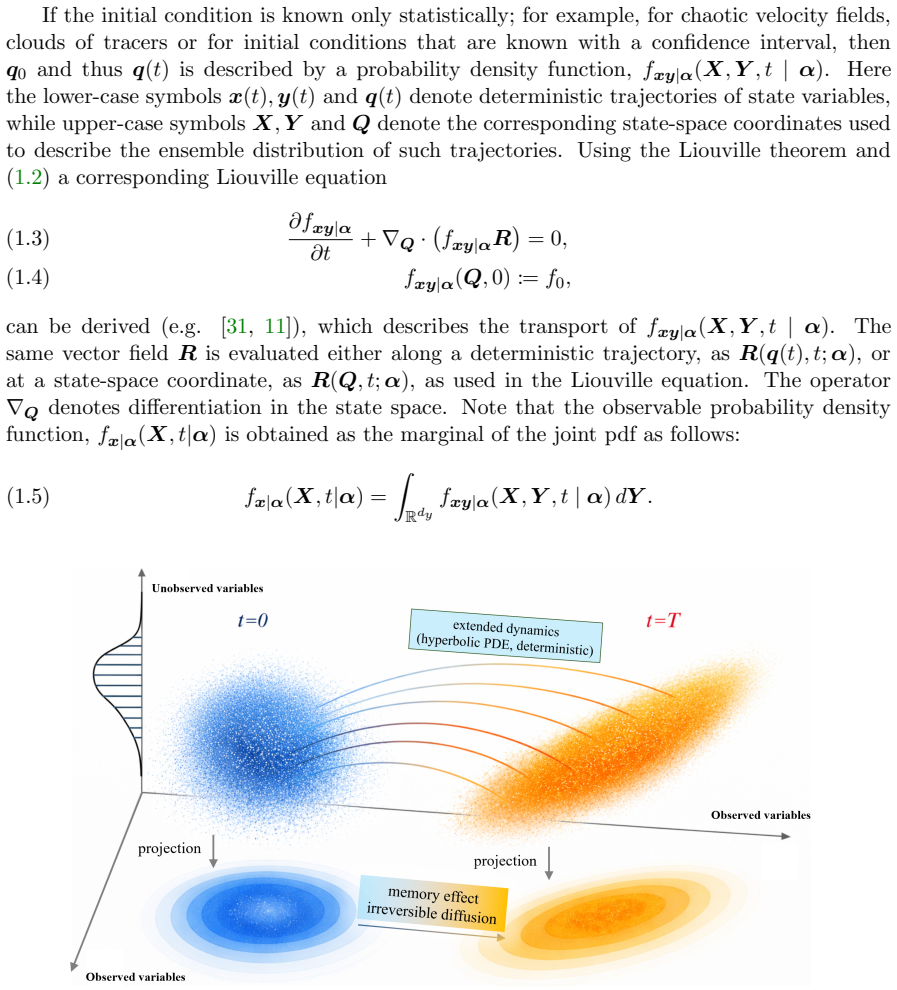
The load-bearing object is the characteristic representation of the Liouville equation for the joint density: rather than solving $\partial_t f + \nabla_Q \cdot (f R) = 0$ on a grid in $\mathbb{R}^d$, the solution is carried by particle trajectories $q(t) = \Phi_t(q_0;\alpha)$ with density weight $f_0(q_0)\exp(-\int_0^t h_\alpha\,ds)$ (Lemma 2.1). Three mechanisms sit on top of it. First, the Eulerian sensitivity formula (Theorem 3.4) computes $\partial_\alpha \log f$ at a fixed terminal point by backward integration of the variational equation plus the accumulated divergence, so the flow map never needs direct differentiation and one forward-mode automatic-differentiation pass returns the whole sensitivity vector. Second, the crossed U-statistic (Proposition 3.6) evaluates the moment misfit and the differentiated moment on disjoint particle pairs, which is what makes the product-of-expectations gradient exactly unbiased rather than biased at order $1/N$. Third, the finite-sample variance bound (Theorem 4.2) quantifies how gradient noise scales as $O(1/N)$ and grows through $e^{L_R T}$ with the horizon, which is why a Shampoo-style full-matrix preconditioner and an inverse-time step schedule are part of the algorithm. Identifiability and convergence rates are both governed by the projected sensitivity Gramian $I_T = S^\top S$: local identifiability holds exactly when $I_T \succ 0$, and the parameter recovery rate is set by its conditioning.
What would settle it
Generate marginal data from a genuinely stochastic process with the same visible coordinates, for example a white-noise-driven oscillator observed through one coordinate, and run the method with a guessed latent dimension: the central assumption fails observably if no fixed $d_y$ keeps the weak loss small across a long horizon, if the inferred parameters drift as the observation window lengthens, or if the recovered deterministic flow cannot reproduce marginals beyond the trained times. A second check on the closed-form linear experiment of Section 5.1 would measure the crossed-estimator standard deviation against $N$ and the horizon $T$ and test the predicted $e^{L_R T} N^{-1/2}$ growth; a different dependence would disprove the variance law of Theorem 4.2.
Extended reading notes
Core claim
The paper's central claim is that the inverse problem of recovering the parameter vector $\alpha$ of a deterministic augmented ODE $\dot{q} = R(q,t;\alpha)$, $q = (x,y)$, from marginal densities of the observed block $x$ is solvable by a stochastic gradient method that never discretizes the joint density. The key step is Eulerian: holding the terminal state-space point $Q_T$ fixed, the log-density sensitivity decomposes as $G(Q_T,T;\alpha) = S_\alpha(0)^\top \nabla \log f_0(q(0)) + r(T)$, where $r(T) = -\int_0^T [\partial_\alpha h_\alpha + (\nabla_q h_\alpha)^\top S_\alpha(t)]\,dt$ is the parametric sensitivity of the accumulated divergence along the backward characteristic and $S_\alpha$ solves the variational equation with terminal condition $S_\alpha(T)=0$ (Theorem 3.4). Combined with moments of bounded test functions this yields a weak loss whose gradient is a sum of products of expectations; the paper proves the crossed U-statistic estimator over $N$ independent characteristics is exactly unbiased (Proposition 3.6), has finite-sample standard deviation $O(N^{-1/2})$ with constants growing like $e^{L_R T}$ (Theorem 4.2), and drives the nonconvex iteration to $\min_\ell E\|\partial_\alpha J(\alpha_\ell)\|^2 = O(1/\log L)$ (Remark 7). In the locally identifiable regime, where the projected sensitivity Gramian $I_T = S^\top S$ is positive definite, parameter error decays as $\ell^{-1/2}$ in iteration and $N^{-1/2}$ in ensemble size; without identifiability the weak loss still converges, so accuracy and parameter stability decouple. Four experiments validate the claims: a three-mode linear chain observed through one mode, a nonlinear Gompertz model with a hidden mode, a bistable system whose hidden mode turns a unimodal marginal bimodal, and Stokes–Oseen drag recovery from particle positions alone.
Load-bearing premise
The data are assumed to be the projection of a single deterministic finite-dimensional ODE whose initial joint density and latent dimension are known, so every bit of randomness in the observed marginal must come from random initial conditions; if the true process has its own stochastic forcing, the advertised recasting of diffusion as a deterministic reversible flow is asserted but not constructed, and the forward model would be misspecified.
Editorial extensions
If this is right
- Marginal-density inference for latent ODEs becomes possible without solving a density PDE: each iterate needs only $N$ characteristic trajectories plus one backward sensitivity sweep, so cost scales with trajectory count rather than grid resolution.
- Because the crossed gradient is exactly unbiased with $O(1/N)$ variance, it can serve as a drop-in stochastic optimizer for parametrized vector fields trained against marginal data; the paper demonstrates this with neural-network right-hand sides in the bistable experiment.
- Accuracy and identifiability decouple: when the projected sensitivity Gramian is positive definite the parameter error decays as $\ell^{-1/2}$ in iteration and the weak loss as $\ell^{-1}$, and when the map is rank-deficient the loss still converges to a stationary point even though parameter recovery is meaningless.
- The time horizon is the practical ceiling: gradient noise and signal amplify at the same exponential rate $e^{L_R T}$, so on chaotic dynamics the usable horizon is bounded unless windowing or variance reduction is added, which the authors state as the main limitation.
- Hidden variables leave identifiable signatures in the observed marginal, a latent mode can turn a unimodal marginal bimodal, and the experiments recover latent parameters such as the hidden decay rate from the visible coordinates alone.
Reading between the lines
- Editorial inference: the abstract's claim that diffusion and other irreversible processes can be recast as deterministic reversible flows in an augmented state space is never actually constructed in the paper; a natural test is to apply the method to Langevin-style data and check whether the inferred deterministic flow extrapolates, which would settle whether the recasting is more than a promise.
- Editorial inference: the crossed U-statistic is the general remedy for losses that are products of expectations, so the same estimator could transfer to other marginal-matching and moment-matching inverse problems beyond ODE inference, including partially observed control and density-matching generative models.
- Editorial inference: because identifiability is characterized by the projected sensitivity Gramian, the method yields a free diagnostic: monitoring the empirical Gramian's smallest singular value during training reveals which parameters the observed marginals actually pin down, a testable extension of the paper's local analysis.
- Editorial inference: to combat the $e^{L_R T}$ noise growth the paper only gestures at windowing; a concrete extension would divide the observation interval into overlapping windows, run the backward scans per window, and fuse the gradients, which could be benchmarked against the closed-form linear experiment where the variance law is exactly measurable.
Editorial analysis
A structured set of objections, weighed in public.
Referee Report
Summary. The paper proposes a method for inferring parameters α of a deterministic ODE ˙q=R(q,t;α) from observations of the marginal density of a subset of coordinates x at discrete times. The forward model uses the Liouville equation for the joint density f_{xy|α}; the algorithm samples initial conditions q0~f0, propagates characteristics, computes Eulerian log-density sensitivities by backward integration (Theorem 3.4), and forms an unbiased gradient of a weak moment-matching loss via a crossed U-statistic (Proposition 3.6). A variance bound O(1/N) (Theorem 4.2) and a nonconvex SGD stationarity bound O(1/log L) (Remark 7) are proved. Four numerical experiments (linear hidden modes, Gompertz, bistable latent, particle-in-flow drag) validate the method on tractable models. The abstract claims that diffusion and other irreversible processes can be recast into this deterministic framework, but no such construction is given.
Significance. If the deterministic-ODE version of the claim is taken as the contribution, the paper is a useful and clean addition: it avoids density-PDE grids, gives an unbiased stochastic gradient with explicit finite-sample variance, proves stationarity convergence, and demonstrates parameter recovery on several nonlinear problems including position-only observations of a 5D particle-flow system. The theoretical development is careful: Lemma 2.1, Theorem 3.4, Proposition 3.6, and Theorem 4.2 follow from stated assumptions, and the experiments use exact closed-form moments where available. The advertised broader scope (diffusion via hyperbolic lifting) is not supported, and the claimed parameter-error rate rests on condition (4.8), which is not verified in the experiments; these issues should be addressed before publication.
major comments (2)
- [Abstract and §1, Assumption 1; §6 Conclusion] The abstract states that 'Diffusion and other irreversible processes... can be recast as deterministic, reversible flows in a sufficiently augmented state space,' and the introduction gestures at this via Sz.-Nagy dilation and Mori–Zwanzig. However, the entire development (Eqs. (1.1)–(1.4), Assumption 1, Lemmas and Theorems) concerns a fixed deterministic vector field R(q,t;α) with randomness only in q0~f0; no finite-dimensional augmented ODE reproducing a parabolic Fokker–Planck marginal is constructed. The conclusion itself lists 'adaptation to stochastic dynamics governed by the Fokker–Planck equation' as future work. This is load-bearing because the advertised generality is part of the paper's stated contribution. Please either provide the lifting construction, identify precisely the class of diffusions for which it exists, or restrict the abstract and introduction to the deterministic-ODE setting.
- [§4.2, Eq. (4.8); §5.1.3, Fig. 4] The parameter-error rate E||α_ℓ−α*||^2 = O(1/(N ℓ)) is stated conditionally on a λ_min(P I_T) > 1/2 (Eq. (4.8)). In Experiment 1, the reported singular values of S are {1.300,0.837,0.523}, so for the unpreconditioned iteration P=I and the step schedule η_ℓ=0.5/(ℓ+50) (so a=0.5), one has a λ_min(I_T) ≈ 0.137 < 1/2, meaning condition (4.8) fails. The authors use a Shampoo preconditioner, but they never report λ_min(P I_T) or any verification that the required inequality holds. Consequently, the empirical ℓ^{-1/2} fit in Figures 4 and 5 does not by itself establish the claimed rate; either compute the effective a λ_min(P I_T) for the actual preconditioner or weaken the claim to a heuristic observation.
minor comments (5)
- [§3, Definition 3.2] The sentence 'determined by the ℓ2 norm of the difference between the weak loss (3.6) and the weak forward model moment (3.7)' is garbled; it should say 'the ℓ2 norm of the difference between the observed moments (3.5) and the forward model moments (3.7).'
- [§4.2, Eq. (4.8)] The line 'And the local quadratic model gives...' begins with an uppercase 'And' after an equation; rephrase for readability.
- [References [11] and [12]] References [11] and [12] appear to be the same work (Domínguez-Vázquez, Jacobs, and Tartakovsky, Physics of Fluids 36, 063303, 2024); merge or differentiate them.
- [Algorithm 3.1, step 8] The phrase 'backward-integrate the sensitivity (3.14) on [T,0]' is awkward; specify integration from T down to 0 to match Eq. (3.14).
- [§5.4.2] In the list of six position-only test functions, the punctuation is inconsistent; use semicolons between the six entries for clarity.
Circularity Check
No circularity: every derived quantity follows from the stated ODE/Liouville model, and the inverse loss is evaluated against externally computed reference moments, not against fitted values.
full rationale
The paper's derivation chain is self-contained. Assumption 1 defines the admissible deterministic ODE class; Lemma 2.1 is the standard characteristic solution of the Liouville equation; Theorem 3.4 computes the Eulerian log-density sensitivity by differentiating the backward characteristic system; Lemma 3.5 and Proposition 3.6 construct the weak-loss gradient and its unbiased crossed U-statistic estimator from independence of the sampled characteristics; Theorem 4.2 and Remark 7 bound the estimator variance and give a nonconvex SGD convergence statement. None of these steps substitutes an input for a conclusion: the gradient identity uses only the definition of G as the log-density derivative plus the flow-map change of variables, and the unbiasedness of the crossed estimator follows from i.i.d. sampling, not from any fitted parameter. The numerical experiments validate against closed-form moments or large fixed reference ensembles, so the loss values are independent of the recovered parameters rather than forced by construction. Self-citations to prior Liouville work by the same group appear as background support, but the central sensitivity, gradient, variance, and convergence results are derived from first principles in the present paper and do not depend on those citations. The abstract's assertion that diffusion and irreversible processes can be recast as deterministic reversible flows is not constructed in the paper, and the conclusion lists adaptation to Fokker-Planck dynamics as future work; this is a scope or correctness limitation, not a circular step, because no equation or fitted value reduces to an input. Accordingly, no significant circularity is present.
Assumptions & free parameters
assumptions (5)
- domain assumption Assumption 1: local regularity of R, globally Lipschitz vector field, f0 C^1 strictly positive on interior with finite log-density gradient second moment
- domain assumption The observed marginal is generated by a deterministic finite-dimensional ODE (1.1) with latent variables, so all randomness entering the observed process comes from the initial condition f0
- domain assumption The initial joint density f0 is known to the observer
- domain assumption The feature moments and observation times are sufficient for identifiability, meaning the sensitivity Gramian I_T is positive definite
- standard math Standard results from ODE theory and stochastic approximation (Picard-Lindelof, Gronwall, Fabian asymptotics, Robbins-Monro)
Cite this review
Pith. "Pith review of Characteristic Sensitivity Ensembles for Inference of Hidden Dynamics from Marginal Observations." pith.science (2026). https://pith.science/paper/CLOFXODT
@misc{pith2026260806190,
  author       = {Pith},
  title        = {Pith review of: Characteristic Sensitivity Ensembles for Inference of Hidden Dynamics from Marginal Observations},
  year         = {2026},
  howpublished = {\url{https://pith.science/paper/CLOFXODT}},
  note         = {Machine review of arXiv:2608.06190}
}
read the original abstract
A framework is developed for the inference of dynamics described by a generalized system of ordinary differential equations. A stochastic gradient method is coined that infers dynamics from observed marginal probability density functions using the joint probability density function of the observable and latent variables. Diffusion and other irreversible processes observed in a low-dimensional state can be recast as deterministic, reversible flows in a sufficiently augmented state space, where the joint density satisfies the hyperbolic Liouville equation. The marginal distribution observed is the projection of these hyperbolic dynamics onto the observed coordinates, with the latent components carrying the randomness and memory. This reframing allows inference for irreversible or stochastic dynamics into the recovery of a deterministic Ordinary Differential Equation (ODE) from marginal observations. Instead of solving the high-dimensional Liouville equation for the joint density, the algorithm exploits its characteristic representation. Particles sampled from the initial distribution are transported along characteristic lines. The Eulerian sensitivity with respect to parameters is obtained by sensitivity propagation along the characteristic lines, with a crossed U-statistic producing an unbiased gradient estimator, which enables stochastic gradient descent. Four experiments validate the method: recovery of a three-mode linear system observed through the marginal of a single mode; a nonlinear Gompertz growth model with a hidden mode; a bistable system whose hidden mode turns a unimodal marginal bimodal; and Stokes--Oseen drag law recovery for particles in a cellular flow. Convergence behavior is analyzed across these settings.
Figures


Figures from the paper (9 more)


Reference graph
Works this paper leans on
- [1]
-
[2]
Computer Methods in Applied Mechanics and Engineering , volume=
A high-order semi-Lagrangian method for the consistent Monte-Carlo solution of stochastic Lagrangian drift--diffusion models coupled with Eulerian discontinuous spectral element method , author=. Computer Methods in Applied Mechanics and Engineering , volume=. 2021 , publisher=
work page 2021
-
[3]
Journal of Computational Physics , volume=
High-order Lagrangian algorithms for Liouville models of particle-laden flows , author=. Journal of Computational Physics , volume=. 2024 , publisher=
work page 2024
-
[4]
The Fokker-Planck equation: methods of solution and applications , pages =
Fokker-planck equation , author =. The Fokker-Planck equation: methods of solution and applications , pages =. 1989 , publisher =
work page 1989
-
[5]
Journal of statistical physics , volume =
Solutions of the Fokker-Planck equation for a double-well potential in terms of matrix continued fractions , author =. Journal of statistical physics , volume =. 1985 , publisher =
work page 1985
-
[6]
The annals of mathematical statistics , pages =
A stochastic approximation method , author =. The annals of mathematical statistics , pages =. 1951 , publisher =
work page 1951
-
[7]
Stochastic approximation and recursive algorithms and applications , author =. 2003 , publisher =
work page 2003
-
[8]
Optimal control of systems governed by partial differential equations , author =. Springer , year =
Show all 64 references
-
[9]
Data Assimilation: The Ensemble Kalman Filter , author =
-
[10]
The Fokker--Planck Equation: Methods of Solution and Applications , author =
-
[11]
Physica D , volume =
Moment closure approximations in stochastic dynamics , author =. Physica D , volume =
-
[12]
Advances in neural information processing systems , volume=
Latent ordinary differential equations for irregularly-sampled time series , author=. Advances in neural information processing systems , volume=
-
[13]
Advances in neural information processing systems , volume=
Neural ordinary differential equations , author=. Advances in neural information processing systems , volume=
-
[14]
Advances in Neural Information Processing Systems , volume =
Neural Controlled Differential Equations for Irregular Time Series , author =. Advances in Neural Information Processing Systems , volume =
-
[15]
Stochastic Processes and their Applications , volume=
Reverse-time diffusion equation models , author=. Stochastic Processes and their Applications , volume=. 1982 , publisher=
1982
-
[16]
IEEE transactions on pattern analysis and machine intelligence , volume=
Normalizing flows: An introduction and review of current methods , author=. IEEE transactions on pattern analysis and machine intelligence , volume=. 2020 , publisher=
2020
-
[17]
Journal of Machine Learning Research , volume=
Normalizing flows for probabilistic modeling and inference , author=. Journal of Machine Learning Research , volume=
-
[18]
Proceedings of the IEEE/CVF conference on computer vision and pattern recognition , pages=
High-resolution image synthesis with latent diffusion models , author=. Proceedings of the IEEE/CVF conference on computer vision and pattern recognition , pages=
-
[19]
Journal of Computational Physics , volume =
Physics-informed neural networks: A deep learning framework for solving forward and inverse problems involving nonlinear partial differential equations , author =. Journal of Computational Physics , volume =
-
[20]
Nature Machine Intelligence , volume =
Learning nonlinear operators via DeepONet based on the universal approximation theorem of operators , author =. Nature Machine Intelligence , volume =
-
[21]
arXiv preprint arXiv:2010.08895 , year =
Fourier Neural Operator for Parametric Partial Differential Equations , author =. arXiv preprint arXiv:2010.08895 , year =
2010 arXiv
-
[22]
International Conference on Machine Learning , year =
Variational Inference with Normalizing Flows , author =. International Conference on Machine Learning , year =
-
[23]
International Conference on Learning Representations , year =
Density estimation using Real NVP , author =. International Conference on Learning Representations , year =
-
[24]
Advances in Neural Information Processing Systems , volume =
Glow: Generative Flow with Invertible 1x1 Convolutions , author =. Advances in Neural Information Processing Systems , volume =
-
[25]
Grathwohl, Will and Chen, Ricky T. Q. and Bettencourt, Jesse and Sutskever, Ilya and Duvenaud, David , journal =
-
[26]
International Conference on Learning Representations , year =
Scalable Reversible Generative Models with Free-form Continuous Dynamics , author =. International Conference on Learning Representations , year =
-
[27]
Statistics and Computing , volume =
Approximate Bayesian computational methods , author =. Statistics and Computing , volume =
-
[28]
arXiv preprint arXiv:2102.06559 , year =
Simulation-based inference for sequential decision making , author =. arXiv preprint arXiv:2102.06559 , year =
-
[29]
International Conference on Learning Representations , year =
Score-based generative modeling through stochastic differential equations , author =. International Conference on Learning Representations , year =
-
[30]
Advances in Neural Information Processing Systems , volume =
Generative modeling by estimating gradients of the data distribution , author =. Advances in Neural Information Processing Systems , volume =
-
[31]
Monthly Weather Review , volume =
Theoretical skill of Monte Carlo forecasts , author =. Monthly Weather Review , volume =
-
[32]
Harmonic Analysis of Operators on
Sz.-Nagy, B\'ela and Foia. Harmonic Analysis of Operators on
-
[33]
The Theory of Open Quantum Systems , author =
-
[34]
Transport, Collective Motion, and
Mori, Hazime , journal =. Transport, Collective Motion, and
-
[35]
Physical Review , volume =
Memory Effects in Irreversible Thermodynamics , author =. Physical Review , volume =
-
[36]
, journal =
Rabiner, Lawrence R. , journal =. A tutorial on hidden
-
[37]
2009 , publisher=
Optimal transport: old and new , author=. 2009 , publisher=
2009
-
[38]
Biometrika , volume=
Unbiased approximations of products of expectations , author=. Biometrika , volume=. 2019 , publisher=
2019
-
[39]
Point Processes and Queues: Martingale Dynamics , author =
-
[40]
SIAM Review , volume =
Optimization methods for large-scale machine learning , author =. SIAM Review , volume =
-
[41]
2008 , publisher=
Stochastic approximation: a dynamical systems viewpoint , author=. 2008 , publisher=
2008
-
[42]
The Annals of Mathematical Statistics , pages=
On asymptotic normality in stochastic approximation , author=. The Annals of Mathematical Statistics , pages=. 1968 , publisher=
1968
-
[43]
arXiv preprint arXiv:2502.12984 , year=
On Erlang mixture approximations for differential equations with distributed time delays , author=. arXiv preprint arXiv:2502.12984 , year=
-
[44]
The condition number of real
Beckermann, Bernhard , journal =. The condition number of real
-
[45]
2013 , publisher=
Existence theorems for ordinary differential equations , author=. 2013 , publisher=
2013
-
[46]
International Conference on Machine Learning , year =
Shampoo: Preconditioned Stochastic Tensor Optimization , author =. International Conference on Machine Learning , year =
-
[47]
International Conference on Learning Representations , year =
Adam: A Method for Stochastic Optimization , author =. International Conference on Learning Representations , year =
-
[48]
and Tartakovsky, Daniel M
Domínguez-Vázquez, Daniel and Jacobs, Gustaaf B. and Tartakovsky, Daniel M. , title =. Physics of Fluids , volume =. 2024 , month =. doi:10.1063/5.0207403 , url =
2024 doi
-
[49]
Texts in applied mathematics , volume=
Stochastic processes and applications , author=. Texts in applied mathematics , volume=. 2014 , publisher=
2014
-
[50]
Neural Schrödinger Bridge With Sinkhorn Losses: Application to Data-Driven Minimum Effort Control of Colloidal Self-Assembly , year=
Nodozi, Iman and Yan, Charlie and Khare, Mira and Halder, Abhishek and Mesbah, Ali , journal=. Neural Schrödinger Bridge With Sinkhorn Losses: Application to Data-Driven Minimum Effort Control of Colloidal Self-Assembly , year=
-
[51]
Localization of sources in weakly nonlinear fluid systems using linear and quadratic sensitivity analysis , author =. Phys. Rev. Fluids , pages =. 2026 , month =. doi:10.1103/kgb6-k3zm , url =
2026 doi
-
[52]
Ai , volume=
Understanding physics-informed neural networks: Techniques, applications, trends, and challenges , author=. Ai , volume=. 2024 , publisher=
2024
-
[53]
Numerische Mathematik , volume=
A computational fluid mechanics solution to the Monge-Kantorovich mass transfer problem , author=. Numerische Mathematik , volume=. 2000 , publisher=
2000
-
[54]
Wang, Qi and Wang, Mengze and Zaki, Tamer A. , year=. What is observable from wall data in turbulent channel flow? , volume=. doi:10.1017/jfm.2022.295 , journal=
2022 doi
-
[55]
Wang, Qi and Zaki, Tamer A. , year=. Domain of dependence for wall-pressure measurements in high-speed boundary layers , volume=. doi:10.1017/jfm.2025.224 , journal=
2025 doi
-
[56]
, title =
Domínguez-Vázquez, Daniel and Escobar-Castaneda, Nicolas and Wang, Qi and Jacobs, Gustaaf B. , title =. Physics of Fluids , volume =. 2025 , month =
2025
-
[57]
International Conference on Learning Representations (ICLR) , year =
Flow Matching for Generative Modeling , author =. International Conference on Learning Representations (ICLR) , year =
-
[58]
Advances in Neural Information Processing Systems (NeurIPS) , year =
Random Features for Large-Scale Kernel Machines , author =. Advances in Neural Information Processing Systems (NeurIPS) , year =
-
[59]
International Conference on Learning Representations (ICLR) , year =
Denoising Diffusion Implicit Models , author =. International Conference on Learning Representations (ICLR) , year =
-
[60]
and Tartakovsky, Daniel M
Domínguez-Vázquez, Daniel and Jacobs, Gustaaf B. and Tartakovsky, Daniel M. , title =. Physics of Fluids , volume =. 2024 , month =
2024
-
[61]
Stein Variational Gradient Descent: A General Purpose
Liu, Qiang and Wang, Dilin , booktitle =. Stein Variational Gradient Descent: A General Purpose
-
[62]
Proceedings of the National Academy of Sciences , volume=
The frontier of simulation-based inference , author=. Proceedings of the National Academy of Sciences , volume=. 2020 , publisher=
2020
-
[63]
2004 , publisher=
Plasma Physics via Computer Simulation , author=. 2004 , publisher=
2004
-
[64]
The Annals of Mathematical Statistics , volume=
A class of statistics with asymptotically normal distribution , author=. The Annals of Mathematical Statistics , volume=. 1948 , publisher=
1948
Reviewed August 7, 2026 · model on record in the stance chip above.
Discussion (0). Continue with ORCID to comment.