REVIEW 4 major objections 5 minor 24 references
Holography and charmonium structure in a finite density plasma
T0 review · 4 major / 5 minor · reviewed 2026-08-16 · deepseek-v4-flash
Pith's one-line read Charmonium's quark-antiquark interaction, carried by a string in a five-dimensional holographic background, also controls dissociation in a finite-density plasma and produces a first-order critical curve in the…
desk verdict A plausible new finite-density dissociation curve for charmonium in a bottom-up holographic model, but the (T, mu) dictionary is inherited from the phi=0 AdS-RN background and is not self-consistent with the metric actually used. read the letter →
The pith
A machine-rendered reading of the paper's core claim, the machinery that carries it, and where it could break.
The reading
What carries the argument
The central object is the effective string-tension function $V(T,\mu,z) = \frac{1}{2\pi\alpha'}\frac{R^2}{z^2} e^{-2\phi(z)}\sqrt{f(z)}$, built from the Nambu-Goto string in the AdS5-Reissner-Nordström background with the tangent-model dilaton $\phi(z)=-\kappa^2 z^2 - Mz + \tanh(1/(Mz-\kappa/\sqrt{\Gamma}))$. At low temperature and chemical potential this function has a nonzero local minimum at $z_{\min}$, and that minimum value is the string tension $\sigma(T,\mu)$; as $T$ or $\mu$ increases, the minimum flattens into an inflection point where the first and second $z$-derivatives of $V$ vanish. Solving the inflection-point condition for each $\bar\mu$ generates the dissociation curve, and once the nonzero minimum disappears the only allowed string configuration is two straight lines reaching the horizon, representing free quarks.
What would settle it
One direct numerical check: for a fixed $\bar\mu$, evaluate $V(T,\bar\mu,z)$ from Eq. (18) together with its first two $z$-derivatives along the claimed critical curve, and verify that the local minimum becomes an inflection point at exactly the temperatures shown in Fig. 5a; if for any $\bar\mu$ the minimum turns into a maximum or disappears before the horizon, the dissociation curve as defined in Sec. IV is not what the metric produces.
Extended reading notes
Core claim
The paper's central claim is that, at finite chemical potential, the dissociation of charmonium is still governed by the same string in the five-dimensional background that reproduces the Cornell potential in vacuum. Using the AdS5-Reissner-Nordström metric together with the tangent-model dilaton, the effective function $V(T,\mu,z)$ develops a local minimum at $z_{\min}$; the temperature at which that minimum becomes an inflection point is the dissociation temperature $\bar T$ for a given chemical potential $\bar\mu$. The result is a critical curve in the $(T,\mu)$ plane that separates confined from deconfined quarks, and the string tension $\sigma(T,\mu)=V(T,\mu,z_{\min})$ jumps from a finite value to zero on that curve, marking a first-order transition. At zero temperature and finite density the model gives $\mu_0 = 1.7661$ GeV, the ratio $\mu_0/T_0 \approx 5.585$ is close to the light-meson value $5.475$, and the finite-density results are claimed to be consistent with earlier spectral-function calculations.
Load-bearing premise
The load-bearing premise is that the vacuum dilaton function, with parameters fixed at zero temperature and chemical potential, remains valid at every temperature and density, even though the AdS5-Reissner-Nordström metric solves the Einstein-Maxwell equations only when that dilaton is switched off; if the dilaton runs with temperature or chemical potential, the inflection-point condition that defines the dissociation curve loses its basis.
Editorial extensions
If this is right
- At a fixed nonzero chemical potential, charmonium dissociates at a lower temperature than at $\mu=0$, so baryon density weakens quarkonium binding before the thermal bath alone would melt it.
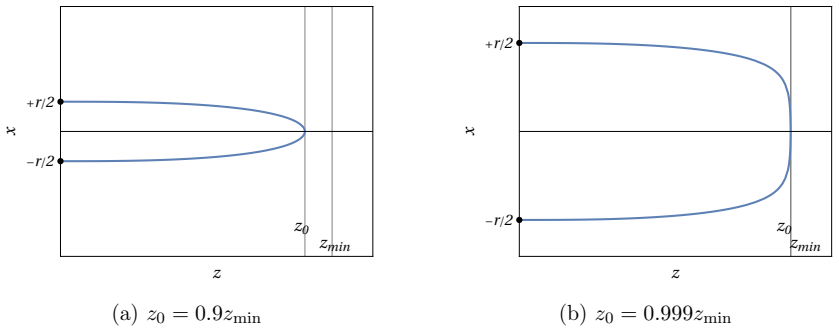
- Above the dissociation curve the only string configuration is two straight lines reaching the horizon, so the quark-antiquark pair becomes free with constant energy once the separation exceeds a maximum distance $r(T,\mu,z_0^*)$.
- The discontinuous jump of the string tension at the critical curve is an order-parameter signature of a first-order confinement-deconfinement transition, corresponding to a singular point in the grand potential at $\{\bar T,\bar\mu\}$.
- The model predicts a critical chemical potential $\mu_0 = 1.7661$ GeV at $T=0$ and a ratio $\mu_0/T_0 \approx 5.585$, close to the value $5.475$ obtained for light mesons.
- Below the critical curve the grand potential as a function of quark separation keeps a Cornell-like confining shape, with the string tension decreasing gently as $T$ or $\mu$ rises.
Reading between the lines
- The same string construction should apply to bottomonium by rescaling the dilaton parameters, producing its own dissociation curve at higher temperatures and chemical potentials; binning heavy-ion collision data by collision energy would test that prediction.
- Because the transition is first-order in the string tension, charmonium suppression in a dense plasma should appear as a sharp step in survival probability as a function of temperature or baryon chemical potential, rather than a smooth monotonic decrease.
- The approximation that the vacuum dilaton remains unchanged inside the charged black-hole metric is the most exposed step; solving the back-reacted dilaton-Einstein-Maxwell system and recomputing the curve would show whether the inflection-point criterion survives.
- If the identification of the holographic coordinate with internal quark structure is this robust, the same string construction could be adapted to compute in-medium decay constants or electromagnetic form factors at finite density, not only dissociation temperatures.
Signed reviews
Editorial analysis
A structured set of objections, weighed in public.
Referee Report
Summary. This paper extends the string interpretation of the holographic coordinate proposed in Ref. [12] to a finite-density plasma. After reviewing the vacuum dilaton of Eq. (3) and the string-energy construction of Sec. III, the authors replace the thermal metric by the AdS5-Reissner-Nordstrom solution with the dilaton inserted in Eq. (14), define the tension function V(T,μ,z) in Eq. (18), and identify dissociation with the temperature and chemical potential at which the local minimum of V becomes an inflection point. This yields a dissociation curve in the (T,μ) plane (Fig. 5a) and a first-order jump in the string tension at the critical line (Fig. 5b). The paper also computes the string energy/grand potential as a function of quark separation (Fig. 7) and concludes that the holographic-coordinate interpretation of the quark-antiquark interaction holds at finite chemical potential.
Significance. If the construction is correct, the model gives a simple, falsifiable prediction for how the charmonium dissociation temperature changes with baryon chemical potential, and it does so without fitting new parameters to the finite-density curve; the string tension σ=0.17 GeV² at zero density agrees with known values, and the numerical procedure is transparent. The paper also ships explicit plots and a concrete criterion for dissociation, which is a strength. However, the novelty lies entirely in the finite-density extension, and at that point the calculation rests on the unverified premise that the φ=0 AdS-RN dictionary for T and μ remains valid in the dilaton-deformed metric used in Eq. (14). The validation against spectral functions is asserted in the abstract but not presented in the body, and the only quantitative benchmark is a ratio compared with a light-meson model. With the dictionary question resolved, the qualitative result that higher μ lowers the dissociation temperature would be an interesting bottom-up contribution, but in its current form the central quantitative claim is not yet grounded.
major comments (4)
- [Sec. IV, Eqs. (14)-(17)] The chemical-potential dictionary of Eq. (17) is not consistent with the metric actually used. The Maxwell equation derived from the action in the background (14) is d/dz[(R/z) e^{-φ(z)} A_t'(z)] = 0, so A_t'(z) is proportional to z e^{φ(z)}; the linear profile A_t = μ + k q z² used before Eq. (17) is a solution only for φ=0. Solving the Maxwell equation with the boundary condition A_t(z_h)=0 gives μ = 2 k q ∫_0^{z_h} z e^{φ(z)} dz, which differs from k q z_h² for the dilaton in Eq. (3). Since the inflection-point condition of Sec. IV is mapped to physical (T,μ) through Eqs. (16)-(17), the dissociation curve in Fig. 5a and the jump in Fig. 5b are conditional on this untested assumption. The authors should either solve the A_t equation in the dilaton background and recompute the dissociation curve, or explicitly define Eq. (17) as an independent phenomenological dictionary and assess the robustness of Fig. 5 under this choice.
- [Sec. IV, text after Eq. (15)] The paper acknowledges that the metric (14) solves the Einstein-Maxwell equations only for φ=0, yet it uses the φ=0 Hawking temperature (16) and the φ=0 charge-μ relation (17) as the physical mapping. This is not automatically fatal for a bottom-up holographic model, but the dilaton is not a small perturbation: φ(0)=1 and φ(z) grows quadratically negative, so the finite-density calculation is not quantitatively grounded unless the authors either justify the neglect of backreaction or show that the corrected dictionary leaves the dissociation curve unchanged. The central claim about the μ-dependence of the dissociation temperature depends on this point.
- [Sec. IV A, around Eq. (19)] The regulator ϵ(T,μ) is introduced in Eq. (19) and then chosen at each point of the critical set to make the grand potential a continuous function of the separation distance r. This is a free function, not fixed by the model, and it enters the construction of the deconfined-phase potential. The statement in Sec. IV that the jump in the string tension produces a singular point in the free energy relies on this construction, so that part of the analysis is not yet a model prediction. Please state explicitly how the results depend on ϵ(T,μ) or show that the discontinuity and the first-order character are independent of its choice.
- [Abstract and Sec. V] The abstract states that the results are consistent with those derived previously using spectral functions, but the body of the paper does not show such a comparison. The only quantitative benchmark in Sec. IV is μ0/T0 ≈ 5.585 versus 5.475 from a light-meson model [24]; no finite-density spectral-function dissociation curve is displayed or referenced. Please add the comparison with Refs. [6-11] or soften the claim so that the validation statement matches what is actually demonstrated.
minor comments (5)
- [Abstract] The first line contains the typo 'charmoniun'; it should read 'charmonium'.
- [Table I] The fit quality is not discussed: the 1S mass is fitted as 2399 MeV versus the experimental 3096.9 MeV, and the 1S decay constant as 298 MeV versus 416 MeV, deviations around 20-30%. The 4S decay constant deviates by about 40%. Since the string parameters of Eq. (3) are fixed by these fits, the large deviations deserve a comment.
- [Fig. 4] The four panels show curves for different temperatures but no legend or labels identifying individual temperatures; adding explicit labels or a legend would make the approach to the inflection point much easier to follow.
- [Sec. IV, Eq. (18)] Because φ(0)=1, the boundary value of the metric factor is e^{-2}, and the normalization of the gauge field A_t and hence the definition of μ is implicit. Please state the boundary normalization explicitly, since the charge-μ dictionary is a central part of the construction.
- [Throughout] There are several grammatical and typographical errors, including 'the the', 'fiting', and 'show' in Sec. V; a careful proofreading pass is needed.
Circularity Check
No circularity: the finite-density dissociation curve is computed from the stated model inputs rather than fitted or renamed.
full rationale
The paper's central finite-density result, the dissociation curve in Fig. 5a and the string-tension jump in Fig. 5b, is not obtained by fitting or renaming any input. The dilaton and its parameters are fixed in earlier work from vacuum charmonium masses and decay constants and from the mu=0 dissociation temperature; this paper then feeds those fixed inputs through the Nambu-Goto action with the AdS5-Reissner-Nordstrom metric and reads off V(T,mu,z). The inflection-point criterion used in Sec. IV is an algebraic condition applied to that V, so the (T,mu) boundary is a computed consequence of the stated model rather than a restatement of an input. The abstract's claim of consistency with spectral-function results is a post-hoc comparison with the same group's earlier calculations using the same metric, dilaton, and fitted parameters; it does not enter the derivation, so it is at most a minor self-citation and is not load-bearing. The paper explicitly acknowledges after Eq. (15) that the metric and gauge field solve the Einstein-Maxwell equations only for phi=0, meaning the T-mu dictionary of Eqs. (16)-(17) is inherited from the phi=0 RN solution. That is a consistency and modeling concern, not circularity, because the finite-density behavior is contingent on that dictionary rather than equivalent to it. No step of the derivation reduces, by construction, to its own input.
Assumptions & free parameters
free parameters (5)
- kappa =
1.1 GeV
- M =
0.11 GeV
- sqrt(Gamma) =
0.26 GeV
- R^2/alpha' =
not given (set by fitting charmonium masses in Ref. [12])
- epsilon(T,mu) =
chosen per point on the critical curve
assumptions (7)
- domain assumption The AdS5-Reissner-Nordstrom metric with the dilaton factor e^{-2 phi(z)} (Eq. 14) describes the finite-temperature, finite-density plasma even though Einstein-Maxwell equations are only solved for phi=0.
- domain assumption The Hawking temperature (Eq. 16) and the chemical potential relation (Eq. 17), derived from the phi=0 RN solution, remain valid for the modified metric.
- domain assumption The dilaton phi(z) and its parameters fitted at T=0, mu=0 are unchanged for all T and mu.
- domain assumption The dissociation boundary is the set where the local minimum of V(T,mu,z) becomes an inflection point (V'=V''=0).
- domain assumption The string tension sigma(T,mu)=V(T,mu,z_min) is a valid order parameter for the confined/deconfined transition, and the transition is first-order because sigma jumps.
- domain assumption The spectral-function calculations of Refs. [6-11] constitute a valid independent benchmark for the dissociation curve.
- standard math The Nambu-Goto string action and the r(z0), E(z0) relations (Eqs. 7-9) describe the quark-antiquark interaction in the holographic background.
Cite this review
Pith. "Pith review of Holography and charmonium structure in a finite density plasma." pith.science (2026). https://pith.science/paper/CLPODDKX
@misc{pith2026250502956,
  author       = {Pith},
  title        = {Pith review of: Holography and charmonium structure in a finite density plasma},
  year         = {2026},
  howpublished = {\url{https://pith.science/paper/CLPODDKX}},
  note         = {Machine review of arXiv:2505.02956}
}
read the original abstract
It has recently been proposed that the extra dimension in holographic models for charmoniun is related to its internal structure. Representing the interaction between the quark anti-quark pair by a string inside the background used in these models, the linear term of the Cornell potential was obtained. More than that, the dissociation in the thermal medium is also described in a consistent way. Here we extend this study to the case of a plasma with finite density. The combined effects of density and temperature are analyzed from the point of view of quark anti-quark interaction and the results obtained are consistent with the ones derived previously using spectral functions.
Figures


Figures from the paper (4 more)


Reference graph
Works this paper leans on
-
[12]
N. R. F. Braga, Y. F. Ferreira, and W. S. Cunha (2024), arXiv:2410.09091 [hep-ph]
work page Pith review arXiv 2024
-
[24]
O. DeWolfe, S. S. Gubser, and C. Rosen, Phys. Rev. D83, 086005 (2011), arXiv:1012.1864 [hep-th]. 16
arXiv 2011
-
[1]
E. Shuryak, Prog. Part. Nucl. Phys.62, 48 101 (2009), arXiv:0807.3033 [hep-ph]
arXiv 2009
-
[2]
J. Casalderrey-Solana, H. Liu, D. Mateos, K. Rajagopal, and U. A. Wiedemann, Gauge/String Duality, Hot QCD and Heavy Ion Collisions (Cambridge University Press, 2014) arXiv:1101.0618 [hep-th]
arXiv 2014
-
[3]
Matsui and H
T. Matsui and H. Satz, Phys. Lett. B178, 416 (1986)
1986
-
[4]
H. Satz, J. Phys. G32, R25 (2006), arXiv:hep-ph/0512217
arXiv 2006
-
[5]
N. R. F. Braga, L. F. Ferreira, and A. Vega, Phys. Lett. B 774, 476 481 (2017), arXiv:1709.05326 [hep-ph]
arXiv 2017
-
[6]
N. R. F. Braga and L. F. Ferreira, Phys. Lett. B 773, 313 319 (2017), arXiv:1704.05038 [hep-ph]
arXiv 2017
Show all 24 references
-
[7]
N. R. F. Braga and L. F. Ferreira, Phys. Lett. B 783, 186 192 (2018), arXiv:1802.02084 [hep-ph]
2018 arXiv
-
[8]
N. R. F. Braga and L. F. Ferreira, JHEP01, 082, arXiv:1810.11872 [hep-ph]
-
[9]
N. R. F. Braga and L. F. Ferreira, Phys. Lett. B 795, 462 468 (2019), arXiv:1905.11309 [hep-ph]
2019 arXiv
-
[10]
N. R. F. Braga and R. da Mata, Phys. Lett. B811, 135918 (2020), arXiv:2008.10457 [hep-th]
2020 arXiv
-
[11]
N.R.F.BragaandY.F.Ferreira,Phys.Rev.D 108,094017(2023),arXiv:2309.11643[hep-ph]
2023 arXiv
-
[13]
Andreev and V
O. Andreev and V. I. Zakharov, Phys. Rev. D74, 025023 (2006), arXiv:hep-ph/0604204
2006 arXiv
-
[14]
Colangelo, F
P. Colangelo, F. Giannuzzi, and S. Nicotri, Phys. Rev. D83, 035015 (2011), arXiv:1008.3116 [hep-ph]
2011 arXiv
-
[15]
J. M. Maldacena, Phys. Rev. Lett.80, 4859 (1998), arXiv:hep-th/9803002
1998 arXiv
-
[16]
Kinar, E
Y. Kinar, E. Schreiber, and J. Sonnenschein, Nucl. Phys. B 566, 103 (2000), arXiv:hep- th/9811192
2000
-
[17]
Ebert, R
D. Ebert, R. N. Faustov, and V. O. Galkin, Eur. Phys. J. C71, 1825 (2011), arXiv:1111.0454 [hep-ph]
2011 arXiv
-
[18]
N. R. Soni, B. R. Joshi, R. P. Shah, H. R. Chauhan, and J. N. Pandya, Eur. Phys. J. C78, 592 (2018), arXiv:1707.07144 [hep-ph]
2018 arXiv
-
[19]
Mateu, P
V. Mateu, P. G. Ortega, D. R. Entem, and F. Fernández, Eur. Phys. J. C79, 323 (2019), arXiv:1811.01982 [hep-ph]
2019 arXiv
-
[20]
Colangelo, F
P. Colangelo, F. Giannuzzi, and S. Nicotri, JHEP05, 076, arXiv:1201.1564 [hep-ph]
-
[21]
Colangelo, F
P. Colangelo, F. Giannuzzi, S. Nicotri, and V. Tangorra, Eur. Phys. J. C72, 2096 (2012), arXiv:1112.4402 [hep-ph]
2012 arXiv
-
[22]
B.-H. Lee, C. Park, and S.-J. Sin, JHEP07, 087, arXiv:0905.2800 [hep-th]
-
[23]
Veschgini, E
K. Veschgini, E. Megias, and H. J. Pirner, Phys. Lett. B696, 495 (2011), arXiv:1009.4639 15 [hep-th]
2011 arXiv
Reviewed August 16, 2026 · model on record in the stance chip above.
Discussion (0). Continue with ORCID to comment.