REVIEW 1 major objections 4 minor 22 references
Electron escape probability in high-efficiency photocathodes measured by reverse-injection photovoltage
T0 review · 1 major / 4 minor · reviewed 2026-08-01 · deepseek-v4-flash
Pith's one-line read Electron escape probability in photocathodes can be read directly from reverse-injection photovoltage, without needing absorption or transport data.
desk verdict A clean new technique for extracting the electron escape probability from reverse-injection SPV, with one central assumption—that returned electrons recombine at the surface—that is plausible but not directly verified. read the letter →
The pith
A machine-rendered reading of the paper's core claim, the machinery that carries it, and where it could break.
The reading
What carries the argument
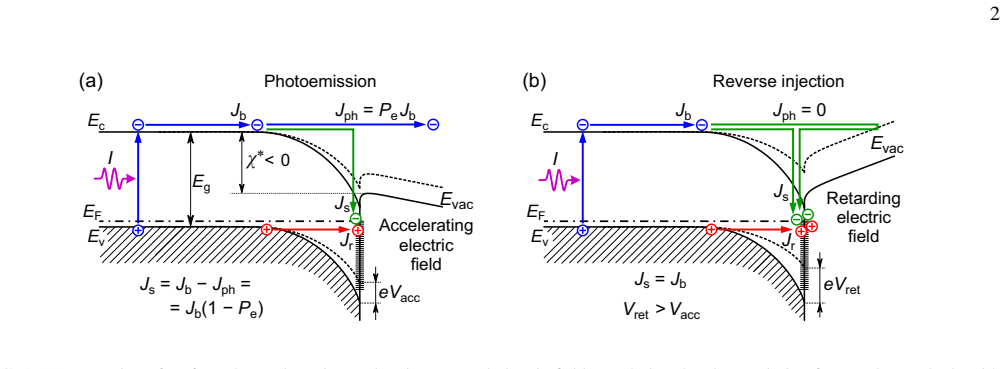
Surface photovoltage (SPV) in a p-type NEA photocathode: under illumination, electrons that do not escape recombine at the surface with a current Js, balanced by a restoring hole current Jr(V) ≈ J0[exp(V/E0) − 1]. Reversing the field sends the emitted electrons back, raising Js to Jb and the photovoltage to Vret; the escape probability is the fraction that changes the balance between the two field directions. The measured quantity is the quantum-efficiency drop ΔQEri, linked to ΔVri by the proportionality QE ≈ QE0 − A V, so that the product AE0, obtained from the QE-vs-ln(I) slope, converts the drop into Pe.
What would settle it
Measure Pe on the same p-GaN(Cs,O) cathode by an independent method—for example, from the spectral dependence of QE with independently known absorption coefficient and diffusion length—and compare with the reverse-injection value. A systematic discrepancy under varying retarding-field strength or illumination intensity would indicate the injected electrons do not simply join the surface recombination current. Alternatively, check whether ΔQEri is independent of the energy of the returned electrons by changing the retarding voltage within the saturated range.
Extended reading notes
Core claim
On its own terms, the paper establishes that the escape probability can be obtained from the difference between the surface photovoltage in accelerating and retarding fields. Because reverse-injected electrons add to the surface recombination current, the retarding-field photovoltage is Vret = E0 ln(1 + Jb/J0), while the accelerating-field value is Vacc = E0 ln(1 + (1 − Pe)Jb/J0). In the high-power limit the two differ by ΔVri, and since quantum efficiency drops linearly with photovoltage, Pe ≈ 1 − exp[ΔQEri/(AE0)]. The authors verify that the measured QE decrease tracks the reverse-injected current and saturates when all electrons return to the illuminated spot, then report Pe values for p-
Load-bearing premise
The central premise is that electrons injected back into the photocathode contribute to the surface recombination current exactly as photoelectrons that fail to escape; if they instead pass into the bulk, excite secondary carriers, or modify the surface charge, the photovoltage change would not equal E0 ln(Jb/J0) and Pe would be biased.
Editorial extensions
If this is right
- A direct measurement of Pe without absorption or transport data, removing the main source of uncertainty in three-step photoemission models.
- The method can be implemented in a sealed vacuum photodiode or larger vacuum system using only photocurrent kinetics and a QE-versus-power calibration.
- For p-GaN(Cs,O), measured Pe values of 30–60% set a quantitative target for optimizing the (Cs,O) activation layer and surface preparation.
- The low-power formula Pe ≈ 1 − Vacc/Vret gives a check at low intensity, while Eq. 11 covers the practical high-power regime.
- If the proportionality between QE and photovoltage holds, the same procedure applies to other NEA photocathodes such as GaAs and InGaAs.
Reading between the lines
- The method implicitly assumes the injected electrons relax to the same surface state distribution as photoelectrons; a direct test would be to compare Pe from this technique with an independent measurement, such as fitting QE spectra with known absorption and diffusion length.
- Because the measurement is fast and non-destructive, it could be used in situ during activation to monitor how Pe evolves as Cs and O2 are deposited.
- The same photovoltage-balance argument may extend to secondary-electron emitters or cold-electron sources, where escape probability across a surface barrier is also limiting.
- The observed range 30–60% across similar cathodes suggests surface morphology or activation stoichiometry, not bulk properties, controls Pe; this could be tested by correlating Pe with atomic-force microscopy or XPS on the same cathodes.
Signed reviews
Editorial analysis
A structured set of objections, weighed in public.
Referee Report
Summary. The paper proposes a direct method for measuring the electron escape probability Pe in NEA photocathodes by exploiting the surface photovoltage change induced by reverse injection of emitted electrons under a retarding field. From a three-step photoemission model and a diode-like surface recombination current, the authors derive expressions for Pe in terms of photovoltages (Eqs. 6 and 8) and, using a linear QE–SPV relation, in terms of the reverse-injection-induced QE decrease (Eq. 11). The method is demonstrated on p-GaN(Cs,O) photocathodes, yielding Pe(I*) = (27 ± 3)% and Pe,0 = (32 ± 3)% for one device and 30–60% across devices, consistent with literature.
Significance. If correct, the method provides a simple, direct route to Pe without requiring separate knowledge of absorption and transport parameters, which would be valuable for photocathode optimization. The derivation is internally consistent, signs are correct, and the experimental data include error bars and consistency checks: the QE decrease saturates with retarding field and follows the reverse-injected current (Fig. 3). The main strength is that Pe is not a fitted parameter; E0 and AE0 are calibrated from the same sample in the accelerating regime without using Pe. However, the method relies on an untested microscopic assumption about the fate of reverse-injected electrons, and this limits the certainty of the quantitative results.
major comments (1)
- [Eqs. (4)–(5) and Fig. 3] The derivation of Vret assumes Js = Jb in the retarding field, i.e., every reverse-injected photoelectron is captured at the surface and recombines there exactly like a photoelectron that failed to escape. The paper verifies that the QE decrease saturates with the retarding field and tracks Jri (Fig. 3), which demonstrates that the effect is caused by returning electrons, but it does not establish that these electrons recombine at the surface rather than entering the quasi-neutral bulk or exciting secondary carriers. If a non-negligible fraction enters the bulk, the photovoltage is not described by Eq. (5), and Eq. (11) gives a biased Pe. This is the central load-bearing assumption of the method and should be justified by an energy/length-scale argument or tested directly (e.g., by comparing the retarding-field photovoltage Vret with E0 ln(1+Jb/J0) from independent measurements).
minor comments (4)
- [Fig. 2(c)] The axis labels 'const − ln(AE0 I)' and 'const − ln(E0 I)' are ambiguous. They should read 'const − AE0 ln I' and 'const − E0 ln I' (or equivalent) to show the slope correctly.
- [Fig. 2(d) description] Please specify how ΔQEri is obtained from the kinetics—whether it is the initial photocurrent immediately after switching to the accelerating field, extrapolated to zero time, or an average over a short interval. This is important for reproducibility.
- [Paragraph after Eq. (11)] The conversion Pe,0 = Pe × QE0/QE(I*) assumes that Pab and Ptr are independent of surface photovoltage. This should be stated explicitly, since Ptr could in principle depend on band bending.
- [General] The paper would benefit from a brief discussion of the validity of Eq. (9) (linear QE–SPV relation) over the relevant voltage range, as deviations could affect the exponential in Eq. (11).
Circularity Check
No significant circularity: Pe is derived from an independently measured AE0 slope and a separate ΔQEri transient; the residual assumption about electron fate under reverse injection is a physical validity concern, not a circular one.
full rationale
The central formula Pe ≈ 1 − exp[∆QEri/(AE0)] (Eq. 11) follows algebraically from the SPV balance equations (Eqs. 2–5), the QE-SPV proportionality (Eq. 9), and the high-power limit. The calibration constants are measured directly: AE0 = (0.32 ± 0.03)% is the slope of QE versus ln I and E0 = (0.055 ± 0.005) V is the slope of UCPD versus ln I, both obtained in the accelerating-field regime. These fits do not involve Pe, and ΔQEri is measured as a separate transient after field reversal. Thus Pe is not a fitted parameter renamed as a prediction; it is extracted from data via a derived relation. The self-citations (Refs. 13, 19, 22) provide sample preparation, UCPD determination, and prior methodology but do not supply the target escape-probability result. The paper’s main vulnerability is physical rather than circular: Eq. 5 assumes every reverse-injected electron recombines at the surface exactly like a non-escaping photoelectron, so that Js rises to Jb. The paper verifies that the injected electrons return to the illuminated region (saturation of ΔQEri with retarding field, Fig. 3) but does not prove they do not enter the bulk or excite secondary carriers. This is an assumption about the microscopic equivalence of the recombination channels; it is not a definitional reduction of the output to the input, so it does not constitute circularity.
Assumptions & free parameters
free parameters (2)
- E0 =
0.055 ± 0.005 V
- AE0 =
0.32 ± 0.03 %
assumptions (6)
- domain assumption Three-step photoemission model: QE = Pab Ptr Pe (Eq. 1)
- domain assumption Surface recombination current equals exponential restoring hole current: Js = Jr(V) ≈ J0[exp(V/E0) − 1] (Eq. 3)
- domain assumption Electrons reaching the band-bending region either escape or recombine at the surface; return to the bulk is unlikely (Refs. 16,17)
- domain assumption QE is linearly proportional to SPV: QE ≈ QE0 − A V (Eq. 9)
- domain assumption High optical power limit Jb >> J0 for Eqs. 8 and 11
- domain assumption All emitted electrons are reverse-injected into the illuminated region in the retarding field
Cite this review
Pith. "Pith review of Electron escape probability in high-efficiency photocathodes measured by reverse-injection photovoltage." pith.science (2026). https://pith.science/paper/CN2XTFQH
@misc{pith2026260718420,
  author       = {Pith},
  title        = {Pith review of: Electron escape probability in high-efficiency photocathodes measured by reverse-injection photovoltage},
  year         = {2026},
  howpublished = {\url{https://pith.science/paper/CN2XTFQH}},
  note         = {Machine review of arXiv:2607.18420}
}
read the original abstract
The characterization of electron transfer through the emitting surface is of crucial importance for optimizing existing and developing new photocathodes. Here we propose and develop a method for the direct determination of the electron escape probability in high-efficiency semiconductor photocathodes. The proposed method is based on the variations in the surface photovoltage upon the injection of emitted photoelectrons back into a photocathode (``reverse injection"), which is induced by the polarity reversal of the external electric field. We demonstrate the method on \textit{p}-GaN(Cs,O) photocathodes with negative effective electron affinity by measuring the evolution of photoemission quantum efficiency upon the reverse injection of emitted electrons.
Figures


Reference graph
Works this paper leans on
-
[1]
author author R. L. \ Bell ,\ @noop title Negative Electron Affinity Devices \ ( publisher Clarendon Press, Oxford ,\ year 1973 ) NoStop
1973
-
[2]
author author O. H. W. \ Siegmund , author A. S. \ Tremsin , \ and\ author J. V. \ Vallerga ,\ 10.1016/S0168-9002(03)01696-6 journal journal Nucl. Instr. and Meth. A \ volume 510 ,\ pages 185 ( year 2003 ) NoStop
-
[3]
author author S. Li , author Y. Zhang , author S. Tang , author L. Yang , author X. Ma , author J. Gao , author Z. Tong , author Y. Qian , author F. Shi , \ and\ author X. Guo ,\ 10.1364/OE.571590 journal journal Opt. Express \ volume 33 ,\ pages 38543 ( year 2025 ) NoStop
-
[4]
author author Y. A. \ Mamaev , author L. G. \ Gerchikov , author Y. P. \ Yashin , author D. A. \ Vasiliev , author V. V. \ Kuzmichev , author V. M. \ Ustinov , author A. E. \ Zhukov , author V. S. \ Mikhrin , \ and\ author A. P. \ Vasiliev ,\ 10.1063/1.2976437 journal journal Appl. Phys. Lett. \ volume 93 ,\ pages 081114 ( year 2008 ) NoStop
-
[5]
author author V. N. \ Litvinenko , author N. Bachhawat , author J. C. \ Brutus , author L. Cultrera , author K. Decker , author M. Gaowei , author P. Inacker , author Y. Jing , author J. Ma , author K. P. \ Mondal , author G. Narayan , author I. Pinayev , author F. Severino , author K. Shih , author J. Skaritka , author L. Smart , author Y. Than , author ...
-
[6]
Novotn\' y , author P
author author O. Novotn\' y , author P. Wilhelm , author D. Paul , author \' A bel K\' a losi , author S. Saurabh , author A. Becker , author K. Blaum , author S. George , author J. Göck , author M. Grieser , author F. Grussie , author R. von Hahn , author C. Krantz , author H. Kreckel , author C. Meyer , author P. M. \ Mishra , author D. Muell , author F...
2019
-
[7]
author author S. A. \ Rozhkov , author V. V. \ Bakin , author H. E. \ Scheibler , author V. S. \ Rusetsky , author D. V. \ Gorshkov , author D. A. \ Kustov , author V. A. \ Golyashov , author V. L. \ Alperovich , \ and\ author O. E. \ Tereshchenko ,\ 10.1103/j7rl-8xcc journal journal Phys. Rev. Lett. \ volume 136 ,\ pages 127001 ( year 2026 ) NoStop
-
[8]
author author S. Uchiyama , author Y. Takagi , author M. Niigaki , author H. Kan , \ and\ author H. Kondoh ,\ 10.1063/1.1883707 journal journal Appl. Phys. Lett. \ volume 86 ,\ pages 103511 ( year 2005 ) NoStop
Show all 22 references
-
[9]
Vergara , author L
author author G. Vergara , author L. J. \ G\' o mez , author J. Presa , \ and\ author M. T. \ Montojo ,\ 10.1116/1.576479 journal journal J. Vac. Sci. Technol. A \ volume 8 ,\ pages 3676 ( year 1990 ) NoStop
1990 doi
-
[10]
Liu , author P
author author W. Liu , author P. Xie , author L. Zhang , author C. Luo , author J. Ouyang , author X. Peng , author J. Zou , author W. Deng , \ and\ author L. Jiang ,\ 10.1016/j.mssp.2026.110605 journal journal Mater. Sci. Semicond. Process. \ volume 209 ,\ pages 110605 ( year...
2026
-
[11]
Liu , author M
author author W. Liu , author M. Poelker , author X. Peng , author S. Zhang , \ and\ author M. Stutzman ,\ 10.1063/1.4994306 journal journal J. Appl. Phys. \ volume 122 ,\ pages 035703 ( year 2017 ) NoStop
2017 doi
-
[12]
author author S. J. \ Levenson , author M. B. \ Andorf , author B. D. \ Dickensheets , author I. V. \ Bazarov , author A. Galdi , author J. Encomendero , author V. V. \ Protasenko , author D. Jena , author H. G. \ Xing , \ and\ author J. M. \ Maxson ,\ 10.1063/5.0215746 journa...
2024 doi
-
[13]
author author S. A. \ Rozhkov , author V. V. \ Bakin , author V. S. \ Rusetsky , author D. A. \ Kustov , author V. A. \ Golyashov , author A. Y. \ Demin , author H. E. \ Scheibler , author V. L. \ Alperovich , \ and\ author O. E. \ Tereshchenko ,\ 10.1103/PhysRevApplied.22.024...
2024 doi
-
[14]
Kronik \ and\ author Y
author author L. Kronik \ and\ author Y. Shapira ,\ 10.1016/S0167-5729(99)00002-3 journal journal Surface Science Reports \ volume 37 ,\ pages 1 ( year 1999 ) NoStop
1999 doi
-
[15]
Mulhollan , author A
author author G. Mulhollan , author A. Subashiev , author J. Clendenin , author E. Garwin , author R. Kirby , author T. Maruyama , \ and\ author R. Prepost ,\ https://doi.org/10.1016/S0375-9601(01)00202-X journal journal Physics Letters A \ volume 282 ,\ pages 309 ( year 2001 ) NoStop
2001 doi
-
[16]
Liu , author F
author author Z. Liu , author F. Machuca , author P. Pianetta , author W. E. \ Spicer , \ and\ author R. F. W. \ Pease ,\ 10.1063/1.1785865 journal journal Appl. Phys. Lett. \ volume 85 ,\ pages 1541 ( year 2004 ) NoStop
2004 doi
-
[17]
author author A. A. \ Pakhnevich , author V. V. \ Bakin , author A. V. \ Yaz’kov , author H. E. \ Scheibler , author S. V. \ Shevelev , author O. E. \ Tereshchenko , author A. S. \ Yaroshevich , \ and\ author A. S. \ Terekhov ,\ 10.1134/1.1780556 journal journal JETP Lett. \ v...
2004 doi
-
[18]
Rhoderick ,\ @noop title Metal-semiconductor Contacts ,\ Monographs in electrical and electronic engineering\ ( publisher Clarendon Press ,\ year 1978 ) NoStop
author author E. Rhoderick ,\ @noop title Metal-semiconductor Contacts ,\ Monographs in electrical and electronic engineering\ ( publisher Clarendon Press ,\ year 1978 ) NoStop
1978
-
[19]
author author S. A. \ Rozhkov , author V. V. \ Bakin , author D. V. \ Gorshkov , author S. N. \ Kosolobov , \ and\ author H. E. \ Scheibler ,\ 10.1088/1742-6596/1199/1/012031 journal journal J. Phys.: Conf. Ser. \ volume 1199 ,\ pages 012031 ( year 2018 ) NoStop
2018 doi
-
[20]
Sumiya , author Y
author author M. Sumiya , author Y. Kamo , author N. Ohashi , author M. Takeguchi , author Y.-U. \ Heo , author H. Yoshikawa , author S. Ueda , author K. Kobayashi , author T. Nihashi , author M. Hagino , author T. Nakano , \ and\ author S. Fuke ,\ 10.1016/j.apsusc.2010.01.038...
2010 doi
-
[21]
Sauty , author C
author author M. Sauty , author C. W. \ Johnson , author T. Tak , author W. Y. \ Ho , author Y. C. \ Chow , author J. S. \ Speck , author A. K. \ Schmid , author C. Weisbuch , \ and\ author J. Peretti ,\ 10.1103/PhysRevApplied.22.034005 journal journal Phys. Rev. Appl. \ volum...
2024 doi
-
[22]
author author O. E. \ Tereshchenko , author H. E. \ Scheibler , author A. S. \ Jaroshevich , author S. V. \ Shevelev , author A. S. \ Terekhov , author V. V. \ Lundin , author E. E. \ Zavarin , \ and\ author A. I. \ Besyul’kin ,\ 10.1134/1.1809437 journal journal Phys. Solid S...
1949 doi
Reviewed August 1, 2026 · model on record in the stance chip above.
Discussion (0). Continue with ORCID to comment.