REVIEW 3 major objections 6 minor 34 references
Catalyst: a Novel Regularizer for Structured Pruning with Auxiliary Extension of Parameter Space
T0 review · 3 major / 6 minor · reviewed 2026-08-06 · deepseek-v4-flash
Pith's one-line read A catalyst regularizer is claimed to make structured pruning lossless, magnitude-unbiased, and robust.
desk verdict A genuinely new regularizer with correct algebraic lemmas, but the 'provably zero bias' claim is asserted, not proved, and the actual training dynamics are not analyzed. read the letter →
The pith
A machine-rendered reading of the paper's core claim, the machinery that carries it, and where it could break.
The reading
What carries the argument
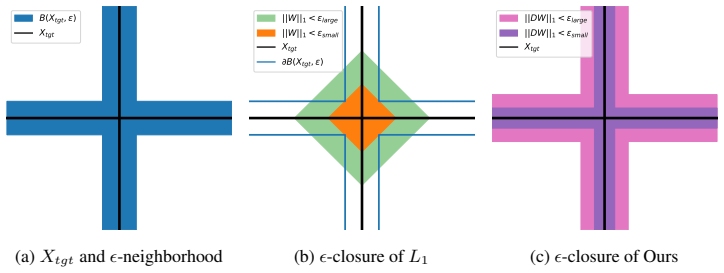
The load-bearing object is the product $\|DW\|_{2,1} = \sum_i \|D_{ii}F_i\|_2$ over a diagonal matrix of auxiliary 'catalyst' variables $D$ inserted into a learnable activation $\psi_{D,\bar D}(x)=Dx-\bar D x+\sigma(x)$. The diagonal $D$ encodes the pruning-invariant set: $DW=0$ with $D\neq 0$ forces each zeroed filter to be exactly zero, so minimizing this term is a tractable proxy for reaching $X_{\mathrm{tgt}}$. The initialization $D_{ii}=\|F_i\|_2$ sets the ratio $c_i=D_{ii}/\|F_i\|_2$ to 1, and the bifurcation dynamics of Theorem 3.4 — driven by the recurrence $c_{t+1}=f(c_t,\lambda_t)c_t$ with $f$ defined by gradient descent with weight decay — push $c_i$ exponentially toward $0$ or very large values. The pruning rule $P=\{i: D_{ii}>\|F_i\|_2\}$ then selects filters whose ratio crossed above 1, and the extend–train–contract scheme removes $D$ and $\bar D$ in two stages.
What would settle it
Take a layer, multiply each filter's initial norm by a known constant, run Catalyst from the same $c=1$ initialization, and compare which filters are pruned: if pruning probability varies with the scaling, the zero-bias claim is false. In parallel, measure the output difference between the pruned and unpruned network at the stopping epsilon; any nonzero activation error shows that pruning at approximate $DW\approx 0$ is not truly lossless.
Extended reading notes
Core claim
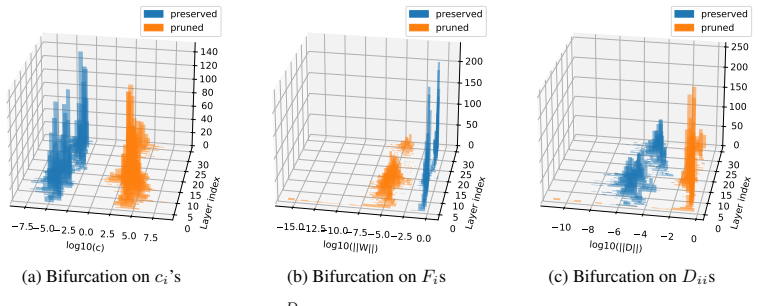
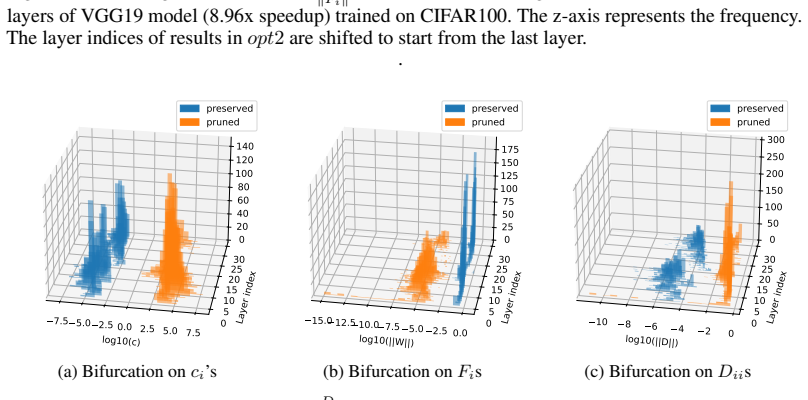
The paper's central claim is that structured pruning can be made lossless and magnitude-fair by regularizing in an extended parameter space. It first defines the pruning-invariant set $X_{\mathrm{tgt}}$ as the union of subspaces in which at least one filter $F_i$ is zero, and proves that this set is exactly the projection of $\{(W,D): DW=0,\ D\neq 0\}$ for a diagonal auxiliary matrix $D$. Minimizing $\|DW\|_{2,1}$ therefore drives $W$ toward the pruning-invariant set, and the paper shows that the regularizer's global minima are nontrivial and all its critical points are global minima. Initializing $D_{ii}=\|F_i\|_2$ places every filter on the decision boundary $c_i=1$, and Theorem 3.4 shows that under the pure regularizer the ratio $c_i=D_{ii}/\|F_i\|_2$ exponentially bifurcates away from 1, so a filter is pruned when $c_i>1$ and preserved when $c_i<1$. Because the escape from $c_i=1$ is attributed to the performance loss $L$, the paper concludes that all channels get an equal chance to be pruned, with wide-margin separation between pruned and preserved filters, and reports empirically that pruning at $\|DW\|_{2,1}<\epsilon$ is lossless and beats state-of-the-art baselines.
Load-bearing premise
The whole fairness argument rests on the unproven assumption that the performance-loss gradient pushes each filter across the decision boundary $c=1$ without systematic preference for filter magnitude, and that stopping at a tiny nonzero $\|DW\|_{2,1}$ behaves like the exact lossless condition $DW=0$.
Editorial extensions
If this is right
- If the zero-bias claim holds, pruning decisions track a filter's contribution to the loss instead of its magnitude, so small-norm but functionally important filters are no longer preferentially removed.
- The exponential bifurcation of $c_i$ gives a wide margin between preserved and pruned filters, so small perturbations in filter weights will not flip a pruning decision.
- Because $DW=0$ is both the lossless-pruning condition and the contraction constraint, the prune operation itself causes negligible accuracy drop, and the training loss curve stays smooth across the pruning steps.
- The regularizer applies to different structured targets — batch-normalization scaling factors or grouped channels — and across architectures, as confirmed on ResNet-56, VGG-19, and ResNet-50.
- At comparable speedups the method matches or exceeds state-of-the-art filter-pruning accuracy, for instance gaining +0.47 on ResNet-56/CIFAR-10 at 2.06x speedup and +0.36 on ResNet-50/ImageNet at 1.49x.
Reading between the lines
- A testable consequence the paper leaves implicit: the set of pruned filters should be nearly invariant under a global rescaling of a layer's filter norms, since the decision variable is the ratio $c_i$ rather than the norm itself.
- If the escape from $c_i=1$ is not in fact magnitude-unbiased under the full objective $L+\gamma_t\|DW\|_{2,1}$, the method would degrade toward the very bias it claims to remove; measuring the correlation between final pruning status and initial filter norm across many seeds would settle this.
- The same algebraic encoding $DW=0$ could be applied to other structured units — heads in attention layers, channels in grouped convolutions, or blocks of layers — by choosing a coarser diagonal structure for $D$, which suggests a generalization to transformer pruning.
- Because the hyperparameter $c$ at initialization determines the sign of the initial ratio offset from 1, it effectively sets a continuous sparsity target before training; a controlled sweep of $c$ would test whether pruning ratio and accuracy trade off predictably.
Editorial analysis
A structured set of objections, weighed in public.
Referee Report
Summary. The paper introduces Catalyst, a regularizer for structured pruning defined in an extended parameter space via auxiliary diagonal matrices D and D-bar. The main theoretical claim is that minimizing ||DW||_{2,1} with the initialization Dinit = diag(||F_i||_2) drives the ratio c_i = D_ii/||F_i||_2 to bifurcate exponentially away from 1, so that filters with c_i > 1 are pruned and filters with c_i < 1 are preserved, yielding a wide decision margin. The paper further claims that this process gives each filter a provably equal chance of being pruned, independent of filter magnitude, and that pruning under the condition DW=0 is lossless. An algorithm, Catalyst Pruning, is proposed based on a bypass-style extension and contraction pipeline, and experiments are reported on ResNet-56/CIFAR-10, VGG-19/CIFAR-100, and ResNet-50/ImageNet, with comparisons to several structured pruning baselines.
Significance. If the advertised guarantees were valid, the work would be significant: a regularizer whose pruning decisions are provably decoupled from filter magnitude, and which provably produces a wide bifurcation, would address well-known limitations of L1/group-Lasso-based pruning. The algebraic characterization of the pruning-invariant set (Theorem 3.3) and the explicit bypass-style construction are interesting and appear self-contained. The empirical study covers multiple standard benchmarks and reports competitive accuracies, and the loss curves shown are smooth. However, the central advertised properties—provably zero magnitude bias and provably lossless pruning under the actual algorithm—are not established by the theorems given. Theorem 3.4 analyzes only the pure regularizer, and Theorem A.5 requires exact equality conditions that the algorithm does not enforce. The significance of the paper therefore hinges on unsupported claims, which substantially reduces its contribution as a theoretical pruning method.
major comments (3)
- [Section 3.4 and Section 4.1; Eq. (12) and Algorithm 1 line 4] The central advertised guarantee of 'provably equal chance' / 'provably zero bias' is not supported by any theorem. Theorem 3.4 analyzes gradient descent on the pure regularizer ||dM||_2 (Appendix E, Eqs. E1–E6), and its part (1) states that when c0=1, ct=1 for all t; hence the Catalyst dynamics alone never selects a filter. The paper's text asserts that 'due to performance loss L' the pair (D_ii, F_i) escapes this decision boundary almost surely and that this makes all channels equally likely to be pruned, but the actual training objective L + gamma_t ||DW||_{2,1} is never analyzed. In particular, no probability space, symmetry condition, or bound on the gradient of L is provided to justify that the side of the boundary reached by a filter is independent of its magnitude. Since the initialization places every filter exactly on the boundary, the pruning decision is entirely delegated to this unmodeled escape mechanism, so the fairness claim is an assertion rather than a proven property.
- [Section 3.3 / Theorem A.5 vs. Algorithm 1, lines 6 and 13] There is a mismatch between the lossless-pruning theorem and the algorithm's actual pruning step. Theorem A.5 guarantees that prune(P) is function-preserving only when DW=0 exactly and P={i: D_ii != 0} = {i: W_i=0}. Algorithm 1 stops when ||DW||_{2,1} < epsilon and sets P={i: D_ii > ||F_i||_2}. At that point, the rows F_i for i in P are not required to be zero, so the equality condition of Theorem A.5 is not satisfied. Table 2 reports small measured accuracy changes after pruning, which is good empirical evidence, but the paper does not provide any bound on the error introduced by pruning at epsilon>0. Consequently the claim of 'lossless pruning' as a theoretical property is not established for the implemented algorithm.
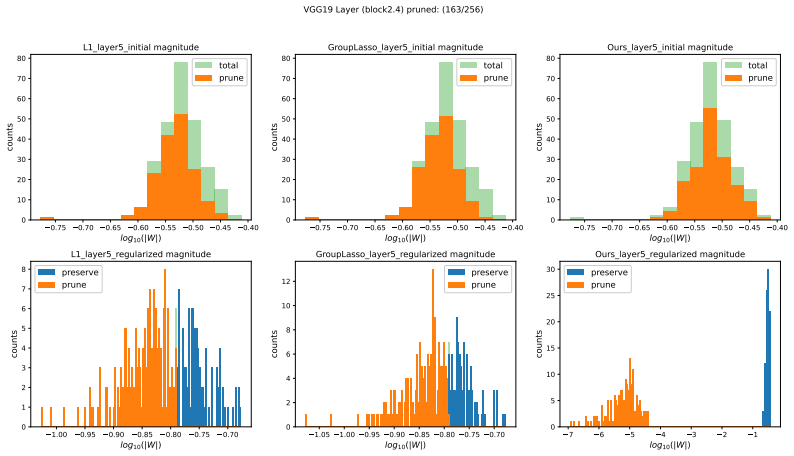
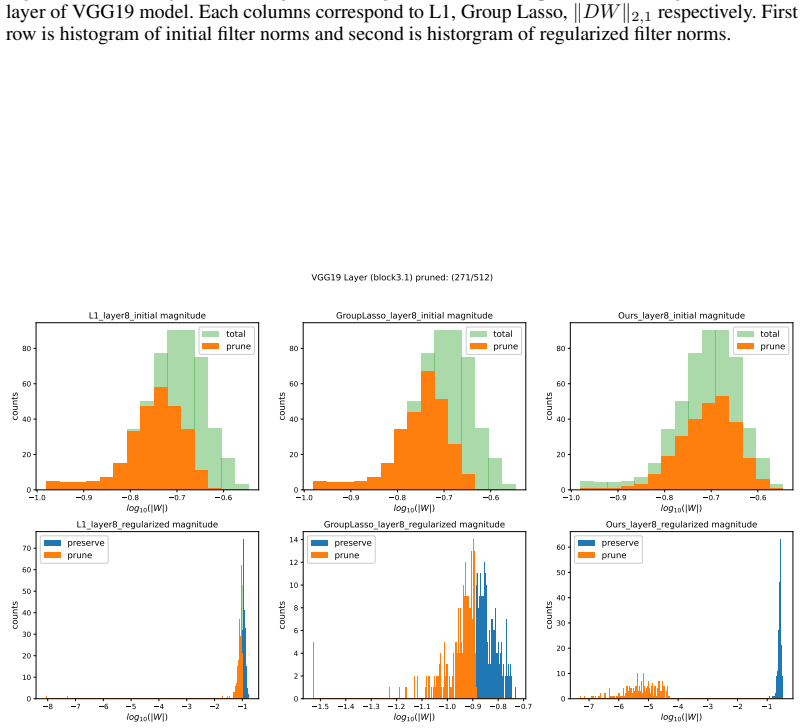
- [Section 4.4 and Appendix I] The empirical support for 'fair pruning chance' is qualitative and does not test the claimed property. Appendix I shows histograms of initial filter magnitudes for pruned and preserved filters under L1, Group Lasso, and Catalyst regularization. The figures suggest that Catalyst's pruned filters span a wider range of initial magnitudes, but no statistical test is performed (e.g., a two-sample test of the initial-magnitude distributions, or a correlation coefficient between initial magnitude and pruning outcome). The paper claims a provable property, which experiments alone cannot establish; without a quantitative comparison, the evidence remains suggestive rather than conclusive.
minor comments (6)
- [Section 3.4] The text says 'Dinit_ii = c||F_i||_2 with the hyperparameter c=1 where N is the number of parameters in Fi'; the role of N is unclear, and Dinit_ii is a scalar norm, not scaled by N. Please clarify or remove the reference to N.
- [Notation, Section 3.3 and Algorithm 1] The two auxiliary matrices D and D-bar are both rendered as 'D' in parts of the text and in Algorithm 1 (e.g., line 2 initializes theta, D, D-bar, and later 'D=0' appears). Please distinguish the two clearly throughout, as the current notation is confusing amid the pruning steps.
- [Theorem 3.4] The proof of Theorem 3.4 relies on the assumption that the signs of the entries of M and d remain unchanged along the trajectory (Appendix E, first paragraph), but this condition is not stated in the theorem. Please include it explicitly in the statement.
- [Figure 2] The caption says 'Simulation on ||DW||_{2,1} minimization' but the subfigures show (d,F) dynamics, ct, and ||Wt||; please clarify what the red arrows in subfigure (a) represent and ensure axis labels are readable.
- [Section 4.4] The sentence 'The ratio of c between pruned filters and preserved filters are extremely large, around 10^8' should be rephrased, since the ratio is derived from log-scale plots and the actual ratios may be much larger or the statement refers to the log-ratio; please state the quantity precisely.
- [Appendix F] The hyperparameter table appears to have garbled entries in the 'LR decay epoch' row, with repeated or misplaced values across columns. Please reformat the table for clarity.
Circularity Check
The algebraic core is self-contained, but the headline 'provably zero bias' fairness claim reduces to the c=1 initialization plus an unproved assumption about the loss-gradient escape.
-
other
[Section 3.4; Algorithm 1 lines 2 and 7]
"During training, due to performance loss L (red arrows in Fig. 2a), the (Dii, Fi) escapes this decision boundary almost surely ... Since the pruning decision of ith filter is made by the position of (Dii, Fi) induced by performance loss L, all channels get provably equal chance to be pruned."
The zero-bias claim is presented as a theorem-backed prediction, but the only proved dynamics, Theorem 3.4(1), has c0=1 as a fixed point, so the Catalyst regularizer alone never moves any filter off the boundary. The escape is attributed to the unmodeled gradient of L, and the paper asserts, without any equation or test, that this escape is independent of filter magnitude. That assertion is exactly the fairness property being claimed ('filters with smaller initial magnitudes are not any more preferred'); it is an assumption about ∇L, not a derived consequence. The observed c-bifurcation then merely illustrates the decision rule P={i|Dii>||F_i||} that defines the pruned and preserved classes.
full rationale
Theorem 3.3 (pruning-invariant set as projection of DW=0), Theorem A.5 (function-preserving prune under DW=0), and the convergence/bifurcation analysis of the pure regularizer in Theorem 3.4 are derived from the paper's own definitions and are not circular. The self-citation of the authors' Bypass pipeline [21] is not load-bearing because the lossless contraction used here is re-proved in Theorem A.5. The circular reduction is confined to the advertised fairness guarantee: every filter is initialized at c0=1 by construction, and the proof that all channels have equal pruning chance is replaced by the statement that the pruning decision is 'induced by performance loss L,' with no analysis of whether ∇L's boundary crossing is magnitude-independent. Since Theorem 3.4's c0=1 branch is a fixed point, the fairness prediction does not follow from the stated theory and is effectively an assumption about the unmodeled loss gradient rather than a theorem. The empirical sections show qualitative histograms but do not quantify this escape bias. Score 4 reflects that the pruning mechanism and algebra have independent content, while the paper's strongest theoretical claim is not derived.
Assumptions & free parameters
free parameters (5)
- c (Catalyst scale) =
1
- gamma_t regularization schedule =
0.007(1+0.25t) (R56); 3e-4(1+0.25t) (R50); [2e-3,9e-3,12e-3](1+0.25t) (VGG19)
- epsilon stopping threshold =
1e-6 to 3e-6 depending on dataset and phase
- kappa bifurcation threshold =
1 (ImageNet), infinity (CIFAR)
- weight decay pair (alpha_theta, alpha_D) =
(5e-4,5e-5) R56; (5e-4,0) VGG19; (1e-4,0) R50
assumptions (4)
- domain assumption Sign of d_t and entries of M_t remain unchanged during the relevant training interval
- ad hoc to paper The loss gradient causes (D_ii, F_i) to escape the decision boundary unbiasedly
- domain assumption Weight decay term alpha is identical for d and M in Theorem 3.4
- domain assumption Comparison baselines in Table 1 are directly comparable despite different pretrained baselines
invented entities (1)
-
Auxiliary diagonal catalyst matrices D and D-bar (rendered identically as D in the text)
Cite this review
Pith. "Pith review of Catalyst: a Novel Regularizer for Structured Pruning with Auxiliary Extension of Parameter Space." pith.science (2026). https://pith.science/paper/CNU4VUF3
@misc{pith2026250714170,
  author       = {Pith},
  title        = {Pith review of: Catalyst: a Novel Regularizer for Structured Pruning with Auxiliary Extension of Parameter Space},
  year         = {2026},
  howpublished = {\url{https://pith.science/paper/CNU4VUF3}},
  note         = {Machine review of arXiv:2507.14170}
}
read the original abstract
Structured pruning aims to reduce the size and computational cost of deep neural networks by removing entire filters or channels. The traditional regularizers such as L1 or Group Lasso and its variants lead to magnitude-biased pruning decisions, such that the filters with small magnitudes are likely to be pruned. Also, they often entail pruning results with almost zero margin around pruning decision boundary, such that tiny perturbation in a filter magnitude can flip the pruning decision. In this paper, we identify the precise algebraic condition under which pruning operations preserve model performance, and use the condition to construct a novel regularizer defined in an extended parameter space via auxiliary catalyst variables. The proposed Catalyst regularization ensures fair pruning chance for each filters with theoretically provable zero bias to their magnitude and robust pruning behavior achieved by wide-margin bifurcation of magnitudes between the preserved and the pruned filters. The theoretical properties naturally lead to real-world effectiveness, as shown by empirical validations of Catalyst Pruning algorithm. Pruning results on various datasets and models are superior to state-of-the-art filter pruning methods, and at the same time confirm the predicted robust and fair pruning characteristics of Catalyst pruning.
Figures


Figures from the paper (25 more)








Reference graph
Works this paper leans on
-
[1]
Structured pruning for deep convolutional neural networks: A survey
Yang He and Lingao Xiao. Structured pruning for deep convolutional neural networks: A survey. IEEE Transactions on Pattern Analysis and Machine Intelligence, pages 1–20, 2023
work page 2023
-
[2]
Model selection and estimation in regression with grouped variables
Ming Yuan and Yi Lin. Model selection and estimation in regression with grouped variables. Journal of the Royal Statistical Society Series B: Statistical Methodology, 68(1):49–67, 2006
2006
-
[3]
Learning structured sparsity in deep neural networks
Wei Wen, Chunpeng Wu, Yandan Wang, Yiran Chen, and Hai Li. Learning structured sparsity in deep neural networks. Advances in neural information processing systems, 29, 2016
2016
-
[4]
Filter pruning via geometric median for deep convolutional neural networks acceleration
Yang He, Ping Liu, Ziwei Wang, Zhilan Hu, and Yi Yang. Filter pruning via geometric median for deep convolutional neural networks acceleration. In Proceedings of the IEEE/CVF Conference on Computer Vision and Pattern Recognition (CVPR), June 2019
work page 2019
-
[5]
Pruning-aware sparse regularization for network pruning
Nan-Fei Jiang, Xu Zhao, Chao-Yang Zhao, Yong-Qi An, Ming Tang, and Jin-Qiao Wang. Pruning-aware sparse regularization for network pruning. Machine Intelligence Research, 20(1):109–120, 2023
work page 2023
-
[6]
Structured pruning for efficient convnets via incremental regularization
Huan Wang, Qiming Zhang, Yuehai Wang, Lu Yu, and Haoji Hu. Structured pruning for efficient convnets via incremental regularization. In 2019 International Joint Conference on Neural Networks (IJCNN), pages 1–8. IEEE, 2019
work page 2019
-
[7]
Neuron-level structured pruning using polarization regularizer
Tao Zhuang, Zhixuan Zhang, Yuheng Huang, Xiaoyi Zeng, Kai Shuang, and Xiang Li. Neuron-level structured pruning using polarization regularizer. Advances in neural information processing systems , 33:9865–9877, 2020
work page 2020
-
[8]
Gdp: Stabilized neural network pruning via gates with differentiable polarization
Yi Guo, Huan Yuan, Jianchao Tan, Zhangyang Wang, Sen Yang, and Ji Liu. Gdp: Stabilized neural network pruning via gates with differentiable polarization. In Proceedings of the IEEE/CVF International Conference on Computer Vision, pages 5239–5250, 2021
work page 2021
Show all 34 references
-
[9]
Differentiable network pruning via polarization of probabilistic channelwise soft masks
Ming Ma, Jiapeng Wang, Zhenhua Yu, et al. Differentiable network pruning via polarization of probabilistic channelwise soft masks. Computational Intelligence and Neuroscience, 2022, 2022
2022
-
[10]
Learning efficient convolutional networks through network slimming
Zhuang Liu, Jianguo Li, Zhiqiang Shen, Gao Huang, Shoumeng Yan, and Changshui Zhang. Learning efficient convolutional networks through network slimming. In Proceedings of the IEEE international conference on computer vision, pages 2736–2744, 2017
2017
-
[11]
Operation-aware soft channel pruning using differentiable masks
Minsoo Kang and Bohyung Han. Operation-aware soft channel pruning using differentiable masks. In International conference on machine learning, pages 5122–5131. PMLR, 2020
2020
-
[12]
Neural pruning via growing regularization.arXiv preprint arXiv:2012.09243, 2020
Huan Wang, Can Qin, Yulun Zhang, and Yun Fu. Neural pruning via growing regularization.arXiv preprint arXiv:2012.09243, 2020
2012 arXiv
-
[13]
Auto-train-once: Controller network guided automatic network pruning from scratch
Xidong Wu, Shangqian Gao, Zeyu Zhang, Zhenzhen Li, Runxue Bao, Yanfu Zhang, Xiaoqian Wang, and Heng Huang. Auto-train-once: Controller network guided automatic network pruning from scratch. In Proceedings of the IEEE/CVF Conference on Computer Vision and Pattern Recognition, p...
2024
-
[14]
Resrep: Lossless cnn pruning via decoupling remembering and forgetting
Xiaohan Ding, Tianxiang Hao, Jianchao Tan, Ji Liu, Jungong Han, Yuchen Guo, and Guiguang Ding. Resrep: Lossless cnn pruning via decoupling remembering and forgetting. InProceedings of the IEEE/CVF International Conference on Computer Vision, pages 4510–4520, 2021
2021
-
[15]
Depgraph: Towards any structural pruning
Gongfan Fang, Xinyin Ma, Mingli Song, Michael Bi Mi, and Xinchao Wang. Depgraph: Towards any structural pruning. In Proceedings of the IEEE/CVF Conference on Computer Vision and Pattern Recognition, pages 16091–16101, 2023
2023
-
[16]
Pruning via sparsity-indexed ode: a continuous sparsity viewpoint
Zhanfeng Mo, Haosen Shi, and Sinno Jialin Pan. Pruning via sparsity-indexed ode: a continuous sparsity viewpoint. In International Conference on Machine Learning, pages 25018–25036. PMLR, 2023
2023
-
[17]
Repvgg: Making vgg-style convnets great again
Xiaohan Ding, Xiangyu Zhang, Ningning Ma, Jungong Han, Guiguang Ding, and Jian Sun. Repvgg: Making vgg-style convnets great again. In Proceedings of the IEEE/CVF conference on computer vision and pattern recognition, pages 13733–13742, 2021
2021
-
[18]
Online convolutional re-parameterization
Mu Hu, Junyi Feng, Jiashen Hua, Baisheng Lai, Jianqiang Huang, Xiansheng Hua, and Xiaojin Gong. Online convolutional re-parameterization. In CVPR, 2022
2022
-
[19]
Repnas: Searching for efficient re-parameterizing blocks
Mingyang Zhang, Xinyi Yu, Jingtao Rong, and Linlin Ou. Repnas: Searching for efficient re-parameterizing blocks. In 2023 IEEE International Conference on Multimedia and Expo (ICME), pages 270–275. IEEE, 2023. 10
2023
-
[20]
Repan: Enhanced annealing through re-parameterization
Xiang Fei, Xiawu Zheng, Yan Wang, Fei Chao, Chenglin Wu, and Liujuan Cao. Repan: Enhanced annealing through re-parameterization. In Proceedings of the IEEE/CVF Conference on Computer Vision and Pattern Recognition, pages 5798–5808, 2024
2024
-
[21]
Bypassing stationary points in training deep learning models
Jaeheun Jung and Donghun Lee. Bypassing stationary points in training deep learning models. IEEE Transactions on Neural Networks and Learning Systems, pages 1–13, 2024
2024
-
[22]
Eigendamage: Structured pruning in the kronecker-factored eigenbasis
Chaoqi Wang, Roger Grosse, Sanja Fidler, and Guodong Zhang. Eigendamage: Structured pruning in the kronecker-factored eigenbasis. In International conference on machine learning, pages 6566–6575. PMLR, 2019
2019
-
[23]
Provable filter pruning for efficient neural networks
Lucas Liebenwein, Cenk Baykal, Harry Lang, Dan Feldman, and Daniela Rus. Provable filter pruning for efficient neural networks. In International Conference on Learning Representations, 2020
2020
-
[24]
Thinet: A filter level pruning method for deep neural network compression
Jian-Hao Luo, Jianxin Wu, and Weiyao Lin. Thinet: A filter level pruning method for deep neural network compression. In Proceedings of the IEEE international conference on computer vision, pages 5058–5066, 2017
2017
-
[25]
Carrying out cnn channel pruning in a white box
Yuxin Zhang, Mingbao Lin, Chia-Wen Lin, Jie Chen, Yongjian Wu, Yonghong Tian, and Rongrong Ji. Carrying out cnn channel pruning in a white box. IEEE Transactions on Neural Networks and Learning Systems, 34(10):7946–7955, 2023
2023
-
[26]
Oicsr: Out-in-channel sparsity regularization for compact deep neural networks
Jiashi Li, Qi Qi, Jingyu Wang, Ce Ge, Yujian Li, Zhangzhang Yue, and Haifeng Sun. Oicsr: Out-in-channel sparsity regularization for compact deep neural networks. In Proceedings of the IEEE/CVF conference on computer vision and pattern recognition, pages 7046–7055, 2019
2019
-
[27]
Aggregated residual transforma- tions for deep neural networks
Saining Xie, Ross Girshick, Piotr Dollár, Zhuowen Tu, and Kaiming He. Aggregated residual transforma- tions for deep neural networks. In Proceedings of the IEEE conference on computer vision and pattern recognition, pages 1492–1500, 2017
2017
-
[28]
Learning multiple layers of features from tiny images
Alex Krizhevsky et al. Learning multiple layers of features from tiny images. 2009
2009
-
[29]
Very deep convolutional networks for large-scale image recogni- tion
Karen Simonyan and Andrew Zisserman. Very deep convolutional networks for large-scale image recogni- tion. arXiv preprint arXiv:1409.1556, 2014
2014 arXiv
-
[30]
Berg, and Li Fei-Fei
Olga Russakovsky, Jia Deng, Hao Su, Jonathan Krause, Sanjeev Satheesh, Sean Ma, Zhiheng Huang, Andrej Karpathy, Aditya Khosla, Michael Bernstein, Alexander C. Berg, and Li Fei-Fei. ImageNet Large Scale Visual Recognition Challenge. International Journal of Computer Vision (IJC...
2015
-
[31]
Torchvision: Pytorch’s computer vision library
TorchVision maintainers and contributors. Torchvision: Pytorch’s computer vision library. https: //github.com/pytorch/vision, 2016. 11 A Components of Section 3.3 In this section, we provide detailed explanations on each components of Bypassing, focusing on the modifications f...
2016
-
[32]
We first define learnable activation ψD,D with additional parameter D and D: ψD,D : x 7→ Dx − Dx + σ(x) (A2)
-
[33]
We define φ2 by φ2(θ, D,D) = φ2(W, bW , A, bA, D,D) = N N(W, bW , A, bA, ψD,D) (A3)
-
[34]
A.2 The embed function Now we set the embed map as follows: Definition A.2
The φ2(θ, D,D) is defined by replacing φ1(θ) to φ2(θ, D,D) from original model φ1(θ). A.2 The embed function Now we set the embed map as follows: Definition A.2. Given Dinit, we define embed(Dinit) as function-preserving operator on extended parameter space, as follows: embed(...
Reviewed August 6, 2026 · model on record in the stance chip above.
Discussion (0). Continue with ORCID to comment.