REVIEW 3 major objections 5 minor 37 references
Provably-Safe Neural Network Training Using Hybrid Zonotope Reachability Analysis
T0 review · 3 major / 5 minor · reviewed 2026-08-10 · deepseek-v4-flash
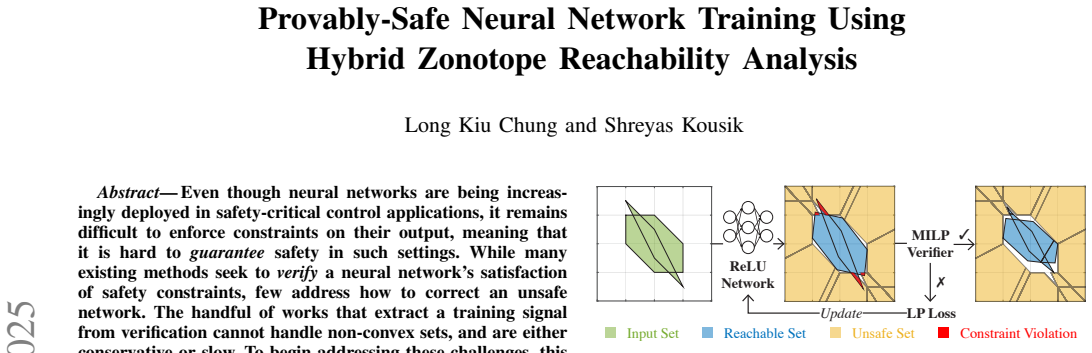
Pith's one-line read A training loss derived from hybrid-zonotope reachability drives the exact image of a ReLU network out of collision with a non-convex unsafe region, with an independent MILP check certifying safety.
desk verdict A genuinely useful method for non-convex safety certification that currently ships without a certificate for its hypercube bound. read the letter →
The pith
A machine-rendered reading of the paper's core claim, the machinery that carries it, and where it could break.
The reading
What carries the argument
Scaled hybrid zonotope: a hybrid zonotope whose first $n_r$ continuous-generator coefficients are constrained by $\|(z_c)_{1:n_r}\|_\infty \le r$ instead of $\|z_c\|_\infty \le 1$, so $r$ parameterizes a nested family of polytopic sets ($r<1$ shrinks, $r>1$ grows). The paper proves that the operations used to propagate a set through a ReLU network—Cartesian products, intersections with hyperplanes, affine maps, and intersections—commute with this scaling, so the exact graph and image of the scaled input set are obtained from the same matrices as the unscaled image. The emptiness-check MILP optimizes $r$, and an LP relaxation makes the optimum differentiable through KKT conditions, which is how the safety signal reaches the network weights.
What would settle it
For any network the method reports as safe, compute the exact range of pre-activation values over the input set; if any value exceeds the chosen bound $a$, the exact-image formula is invalid and an independent MILP on the true image could reveal a collision, settling whether the certificate is real.
Extended reading notes
Core claim
The paper's central claim is Theorem 6: for a collision set $Q$ formed by intersecting the exact image of an input set with an unsafe region, $Q$ is empty if and only if the optimal scaling factor $r^*$ of the MILP (15) is strictly greater than 1. Consequently the scalar $\ell = 1 - r^*$ is a certificate of safety whenever it is negative. Because an MILP optimum is not differentiable, the paper replaces $r^*$ with the optimum of an LP relaxation with log-barrier regularization; for a small barrier parameter the relaxed value is no larger than $r^*$, so a negative surrogate loss is a sufficient condition for $Q$ to be empty. The paper thereby converts a verification problem into a loss function that can be minimized by backpropagation while retaining an independent mixed-integer feasibility check as the final safety certificate.
Load-bearing premise
The reachable set is guaranteed exact only if the hypercube bound used to encode each ReLU is large enough to contain every pre-activation value the network produces, and the paper does not certify that its hand-picked values (50, 1000, and 40) are sufficient for the experiments.
Editorial extensions
If this is right
- If the surrogate loss drops below zero, the exact image of the input set is guaranteed to be disjoint from the unsafe region, with the guarantee checked by an independent MILP rather than by sampling.
- Non-convex input sets and non-convex unsafe regions can be handled exactly, removing a restriction of earlier verification-based training methods that only treated convex sets.
- The reachable-set representation grows linearly in the number of neurons, so training remains practical for networks of a few hundred neurons and for long time horizons that would make time-stepped methods expensive.
- The same loss can produce forward-invariant controllers for non-convex safe sets and safe reach-avoid policies for black-box dynamical systems, because the loss integrates with standard optimizers and additional objective terms.
Reading between the lines
- The parameterized scaling idea transfers to any exact set-based layer representation whose constraints are linear in bounded continuous coefficients, so the same $r$-based loss could be built for activation functions beyond ReLU once such representations exist.
- In the black-box reach-avoid application, the formal guarantee applies to the learned trajectory model plus a sampled error bound; the physical robot's safety is only as strong as that error estimate, which is not itself certified.
- The optimal $r^*$ can be read as a safety margin: how much the input set would need to shrink before its image touches the unsafe set. Used online, it could serve as a safety-distance estimate for re-planning or for ranking candidate controllers, not just as a training loss.
Editorial analysis
A structured set of objections, weighed in public.
Referee Report
Summary. The paper proposes a training method for ReLU networks that drives the image of a non-convex input set out of collision with a non-convex unsafe region. The key construction is a scaled hybrid zonotope (SHZ), which scales a user-selected subset of continuous generator bounds by a factor r. Theorem 6 states that the collision set Q is empty if and only if the optimal scaling r* in MILP (15) is greater than 1, giving a loss l = 1 - r*. To make the loss differentiable, the paper solves an LP relaxation (16) with a log-barrier term and uses KKT differentiation. Training alternates with an independent MILP check (14) that certifies Q is empty. Experiments benchmark scalability up to 240 neurons against the authors' prior work [15], and two applications are presented: training a forward-invariant controller for a double integrator with a non-convex safe set, and a reach-avoid plan for a black-box drifting vehicle.
Significance. If the exactness assumptions are certified, the paper makes a meaningful contribution: it is, to my knowledge, the first training method that uses exact hybrid-zonotope reachability for non-convex input and unsafe sets, with representation complexity linear in the number of neurons and a final safety certificate from an independent MILP rather than from the training loss itself. The SHZ scaling idea is elegant, and the theoretical core (Corollary 3, Proposition 5, Theorem 6) is simple and correct under its stated assumptions. The numerical comparison with [15] is appropriate, and the two control demonstrations show practical potential. The main caveat is that the advertised 'exact' and 'provably-safe' claims rest on an unverified hypercube radius a, so the guarantee as presented is not yet fully demonstrated.
major comments (3)
- [Section II-B, Eq. (5); Sections V-A, VI-A, VI-B] The exact-image construction (3) is valid only when the hypercube radius a is large enough to contain every pre-activation value of the network. The paper states this without proof and fixes a=50, a=1000, and a=40 by hand, with no check before or after training. Because the weights are updated during training, an initially sufficient a can cease to be sufficient. If any pre-activation leaves [-a,a], the computed Q in (3) is a strict subset of the true collision set, and the verification MILP (14) can certify emptiness of an under-approximation, yielding a false safety certificate. Please add a certified bound on all pre-activations for the final network (and ideally during training), or otherwise demonstrate that the selected a values are sufficient in each experiment.
- [Theorem 6, Eq. (15)] The equivalence 'Q is empty if and only if r* > 1' presumes that the MILP (15) has an optimal solution. If Q is empty and no finite r makes Q_r = SHZ(Q,r,nr) nonempty, then (15) is infeasible and r* is undefined, so the theorem as stated is not universally valid. The paper should either prove feasibility for the constructed Q (for example, from the structure of ReLU reachable sets) or explicitly handle the infeasible case, which would itself certify safety. This matters because the proposed loss function requires r* to be computable.
- [Section IV-C, Eq. (16)] The paper states that for a small enough mu, the condition l~ < 0 is sufficient for Q to be empty. This is an asymptotic statement in the limit mu -> 0, but the experiments use mu = 0.1 and no quantitative bound is given for that value. Since the final certificate is obtained from the independent MILP (14), this does not invalidate the reported safety results, but the paper should be explicit that the sufficiency is asymptotic and not certified at the implemented mu.
minor comments (5)
- [Eq. (16)] The objective contains the expression '1ln(' which should presumably be '1^T ln('; please clarify the notation.
- [Problem 1 and Conclusion] There are two typos: 'to to tackle' in Problem 1 and 'belive' in the Conclusion.
- [Table I] Each experiment was run only once, so the reported training times should be presented as indicative rather than as statistically robust measurements; adding repetitions or error bars would strengthen the comparison.
- [Section VI-A] The discussion of why nr = 5 is preferred over nr = 9 is useful, but a short explanation of how nr was selected would improve reproducibility, given the observed sensitivity to this hyperparameter.
- [Eq. (18)] The hybrid zonotope defining the safe set Xt is displayed with large matrices that are difficult to parse; consider reformatting or referring the reader to a figure with a clearer visualization.
Circularity Check
No load-bearing circularity: the safety loss is tied to an independent MILP feasibility check, and self-citations are only baselines; the main caveat is an uncertified hypercube-radius assumption.
full rationale
I walked the derivation chain from the exact image construction (3) through Theorem 6 and the surrogate LP loss (16). The exact image is imported from external prior work [6] with the explicit condition that the hypercube radius a in (5) be large enough; the paper chooses a=50, a=1000, and a=40 by hand without certifying them. That is a soundness assumption about the reachability machinery, not a circular reuse of the target conclusion: the terminal verification is the feasibility MILP (14), which checks Q=P_d∩U directly and is not fitted to any training data. Theorem 6's equivalence Q=∅ iff r*>1 follows from the definition of scaled hybrid zonotopes (7) and the construction of Q_r; it is a designed loss/verification identity rather than a fitted parameter being renamed as a prediction. The relaxation argument around (16) is also structurally independent: ℓ̃<0 is claimed as a sufficient condition for Q=∅ relative to the relaxed optimum, and the paper separately solves (14) to stop training. Self-citations appear as baselines and context: [15] is the authors' prior work used only for runtime comparison, and [34]/[35] provide the black-box reach-avoid demo problem, not the safety theorem. These citations are not load-bearing. The Limitations section itself flags sensitivity to hyperparameters and lack of solvability certificates, which corroborates that the central claim is not made circular by a hidden fit. I found no circular step requiring a quote-level reduction.
Assumptions & free parameters
free parameters (4)
- ReLU graph bound a =
50, 1000, 40 per experiment
- Log-barrier multiplier μ =
0.1
- Scaling index n_r =
2, 5, 2 per experiment
- Unsafe-set shrink ε =
small positive (not quantified)
assumptions (4)
- domain assumption Hybrid zonotopes exactly represent the image of a ReLU network and are closed under intersection, Cartesian product, affine map, union, and hyperplane intersection.
- domain assumption The hypercube bound a can be chosen large enough that (3) holds exactly.
- domain assumption The LP relaxation (16) with log-barrier from IntOpt [29] and KKT differentiation from [28] provides valid, informative gradients for the MILP optimum.
- domain assumption The sampled modeling error e in (21) is an upper bound for the black-box model error.
invented entities (1)
-
Scaled hybrid zonotope (SHZ)
Cite this review
Pith. "Pith review of Provably-Safe Neural Network Training Using Hybrid Zonotope Reachability Analysis." pith.science (2026). https://pith.science/paper/COK5XJEJ
@misc{pith2026250113023,
  author       = {Pith},
  title        = {Pith review of: Provably-Safe Neural Network Training Using Hybrid Zonotope Reachability Analysis},
  year         = {2026},
  howpublished = {\url{https://pith.science/paper/COK5XJEJ}},
  note         = {Machine review of arXiv:2501.13023}
}
read the original abstract
Even though neural networks are being increasingly deployed in safety-critical control applications, it remains difficult to enforce constraints on their output, meaning that it is hard to guarantee safety in such settings. While many existing methods seek to verify a neural network's satisfaction of safety constraints, few address how to correct an unsafe network. The handful of works that extract a training signal from verification cannot handle non-convex sets, and are either conservative or slow. To begin addressing these challenges, this work proposes a neural network training method that can encourage the exact image of a non-convex input set for a neural network with rectified linear unit (ReLU) nonlinearities to avoid a non-convex unsafe region. This is accomplished by reachability analysis with scaled hybrid zonotopes, a modification of the existing hybrid zonotope set representation that enables parameterized scaling of non-convex polytopic sets with a differentiable collision check via mixed-integer linear programs (MILPs). The proposed method was shown to be effective and fast for networks with up to 240 neurons, with the computational complexity dominated by inverse operations on matrices that scale linearly in size with the number of neurons and complexity of input and unsafe sets. We demonstrate the practicality of our method by training a forward-invariant neural network controller for an affine dynamical system with a non-convex input set, as well as generating safe reach-avoid plans for a black-box dynamical system.
Figures


Reference graph
Works this paper leans on
-
[15]
Constrained feedforward neural network training via reachability analysis,
L. K. Chung, A. Dai, D. Knowles, S. Kousik, and G. X. Gao, “Constrained feedforward neural network training via reachability analysis,” arXiv preprint arXiv:2107.07696 , 2021
arXiv 2021
-
[1]
Challenges of real-world reinforcement learning: definitions, benchmarks and analysis,
G. Dulac-Arnold, N. Levine, D. J. Mankowitz, et al., “Challenges of real-world reinforcement learning: definitions, benchmarks and analysis,” Machine Learning, vol. 110, no. 9, pp. 2419–2468, 2021
work page 2021
-
[2]
Robust physical-world attacks on deep learning visual classification,
K. Eykholt, I. Evtimov, E. Fernandes, et al., “Robust physical-world attacks on deep learning visual classification,” in Proceedings of the IEEE conference on computer vision and pattern recognition , 2018, pp. 1625–1634
work page 2018
-
[3]
A review of safe reinforce- ment learning: Methods, theory and applications,
S. Gu, L. Yang, Y . Du, et al. , “A review of safe reinforce- ment learning: Methods, theory and applications,” arXiv preprint arXiv:2205.10330, 2022
arXiv 2022
-
[4]
Constrained decision transformer for offline safe reinforcement learning,
Z. Liu, Z. Guo, Y . Yao, et al. , “Constrained decision transformer for offline safe reinforcement learning,” in International Conference on Machine Learning , PMLR, 2023, pp. 21 611–21 630
work page 2023
-
[5]
POLICE: Provably optimal linear constraint enforcement for deep neural networks,
R. Balestriero and Y . LeCun, “POLICE: Provably optimal linear constraint enforcement for deep neural networks,” in ICASSP 2023- 2023 IEEE International Conference on Acoustics, Speech and Signal Processing (ICASSP) , IEEE, 2023, pp. 1–5
work page 2023
-
[6]
Hybrid zonotopes exactly represent ReLU neural networks,
J. Ortiz, A. Vellucci, J. Koeln, and J. Ruths, “Hybrid zonotopes exactly represent ReLU neural networks,” in 2023 62nd IEEE Conference on Decision and Control (CDC), IEEE, 2023, pp. 5351– 5357
work page 2023
-
[7]
Open- and closed-loop neural network verification using polynomial zono- topes,
N. Kochdumper, C. Schilling, M. Althoff, and S. Bak, “Open- and closed-loop neural network verification using polynomial zono- topes,” in NASA Formal Methods Symposium , Springer, 2023, pp. 16–36
work page 2023
Show all 37 references
-
[8]
Verification of deep convolutional neural networks using imagestars,
H.-D. Tran, S. Bak, W. Xiang, and T. T. Johnson, “Verification of deep convolutional neural networks using imagestars,” in Interna- tional conference on computer aided verification , Springer, 2020, pp. 18–42
2020
-
[9]
Verification of recurrent neural networks with star reachability,
H. D. Tran, S. W. Choi, X. Yang, T. Yamaguchi, B. Hoxha, and D. Prokhorov, “Verification of recurrent neural networks with star reachability,” in Proceedings of the 26th ACM International Conference on Hybrid Systems: Computation and Control , 2023, pp. 1–13
2023
-
[10]
Lyapunov- stable neural-network control,
H. Dai, B. Landry, L. Yang, M. Pavone, and R. Tedrake, “Lyapunov- stable neural-network control,” arXiv preprint arXiv:2109.14152 , 2021
2021 arXiv
-
[11]
Certified Robust Invariant Polytope Training in Neural Controlled ODEs,
A. Harapanahalli and S. Coogan, “Certified Robust Invariant Polytope Training in Neural Controlled ODEs,” arXiv preprint arXiv:2408.01273, 2024
2024 arXiv
-
[12]
Differentiable abstract interpretation for provably robust neural networks,
M. Mirman, T. Gehr, and M. Vechev, “Differentiable abstract interpretation for provably robust neural networks,” in International Conference on Machine Learning , PMLR, 2018, pp. 3578–3586
2018
-
[13]
X. Lin, H. Zhu, R. Samanta, and S. Jagannathan, ART: abstraction refinement-guided training for provably correct neural networks. In 2020 Formal Methods in Computer Aided Design (FMCAD) , 2020
2020
-
[14]
Provable defenses against adversarial ex- amples via the convex outer adversarial polytope,
E. Wong and Z. Kolter, “Provable defenses against adversarial ex- amples via the convex outer adversarial polytope,” in International conference on machine learning , PMLR, 2018, pp. 5286–5295
2018
-
[16]
Neural network repair with reachability analysis,
X. Yang, T. Yamaguchi, H.-D. Tran, B. Hoxha, T. T. Johnson, and D. Prokhorov, “Neural network repair with reachability analysis,” in International Conference on Formal Modeling and Analysis of Timed Systems, Springer, 2022, pp. 221–236
2022
-
[17]
Hybrid zonotopes: A new set representation for reachability analysis of mixed logical dynamical systems,
T. J. Bird, H. C. Pangborn, N. Jain, and J. P. Koeln, “Hybrid zonotopes: A new set representation for reachability analysis of mixed logical dynamical systems,” Automatica, vol. 154, p. 111 107, 2023
2023
-
[18]
Unions and complements of hybrid zonotopes,
T. J. Bird and N. Jain, “Unions and complements of hybrid zonotopes,” IEEE Control Systems Letters , vol. 6, pp. 1778–1783, 2021
2021
-
[19]
zonoLAB: A MATLAB toolbox for set-based control systems anal- ysis using hybrid zonotopes,
J. Koeln, T. J. Bird, J. Siefert, J. Ruths, H. C. Pangborn, and N. Jain, “zonoLAB: A MATLAB toolbox for set-based control systems anal- ysis using hybrid zonotopes,” in 2024 American Control Conference (ACC), IEEE, 2024, pp. 2513–2520
2024
-
[20]
Backward reachability analysis of neural feedback systems using hybrid zonotopes,
Y . Zhang, H. Zhang, and X. Xu, “Backward reachability analysis of neural feedback systems using hybrid zonotopes,” IEEE Control Systems Letters, vol. 7, pp. 2779–2784, 2023
2023
-
[21]
A set-based approach for robust control co-design,
T. J. Bird, J. A. Siefert, H. C. Pangborn, and N. Jain, “A set-based approach for robust control co-design,” in 2024 American Control Conference (ACC), IEEE, 2024, pp. 2564–2571
2024
-
[22]
Hybrid Zonotope-Based Backward Reachability Analysis for Neural Feedback Systems With Nonlinear Plant Models,
H. Zhang, Y . Zhang, and X. Xu, “Hybrid Zonotope-Based Backward Reachability Analysis for Neural Feedback Systems With Nonlinear Plant Models,” in 2024 American Control Conference (ACC), IEEE, 2024, pp. 4155–4161
2024
-
[23]
Reachability analysis and safety verification of neural feedback systems via hybrid zonotopes,
Y . Zhang and X. Xu, “Reachability analysis and safety verification of neural feedback systems via hybrid zonotopes,” in2023 American Control Conference (ACC), IEEE, 2023, pp. 1915–1921
2023
-
[24]
Scalable zonotopic under-approximation of backward reachable sets for uncertain linear systems,
L. Yang and N. Ozay, “Scalable zonotopic under-approximation of backward reachable sets for uncertain linear systems,” IEEE Control Systems Letters, vol. 6, pp. 1555–1560, 2021
2021
-
[25]
Presolve reductions in mixed integer programming,
T. Achterberg, R. E. Bixby, Z. Gu, E. Rothberg, and D. Weninger, “Presolve reductions in mixed integer programming,” INFORMS Journal on Computing , vol. 32, no. 2, pp. 473–506, 2020
2020
-
[26]
Constrained zonotopes: A new tool for set-based estimation and fault detection,
J. K. Scott, D. M. Raimondo, G. R. Marseglia, and R. D. Braatz, “Constrained zonotopes: A new tool for set-based estimation and fault detection,” Automatica, vol. 69, pp. 126–136, 2016
2016
-
[27]
Pytorch: An imperative style, high-performance deep learning library,
A. Paszke, S. Gross, F. Massa, et al. , “Pytorch: An imperative style, high-performance deep learning library,” Advances in neural information processing systems , vol. 32, 2019
2019
-
[28]
Two-Stage Predict+ Optimize for MILPs with Unknown Parameters in Constraints,
X. Hu, J. Lee, and J. Lee, “Two-Stage Predict+ Optimize for MILPs with Unknown Parameters in Constraints,” Advances in Neural Information Processing Systems , vol. 36, 2024
2024
-
[29]
Interior point solving for lp-based pre- diction+ optimisation,
J. Mandi and T. Guns, “Interior point solving for lp-based pre- diction+ optimisation,” Advances in Neural Information Processing Systems, vol. 33, pp. 7272–7282, 2020
2020
-
[30]
Adam: A method for stochastic optimiza- tion,
D. P. Kingma and J. Ba, “Adam: A method for stochastic optimiza- tion,” arXiv preprint arXiv:1412.6980 , 2014
2014 arXiv
-
[31]
Gurobi Optimization, Gurobi optimizer reference manual , 2021
L. Gurobi Optimization, Gurobi optimizer reference manual , 2021
2021
-
[32]
S. J. Wright, Primal-dual interior-point methods . SIAM, 1997
1997
-
[33]
Reachability analysis of nonlinear systems with uncertain parameters using conservative linearization,
M. Althoff, O. Stursberg, and M. Buss, “Reachability analysis of nonlinear systems with uncertain parameters using conservative linearization,” in 2008 47th IEEE Conference on Decision and Control, IEEE, 2008, pp. 4042–4048
2008
-
[34]
Guaranteed Reach- Avoid for Black-Box Systems through Narrow Gaps via Neural Network Reachability,
L. K. Chung, W. Jung, S. Pullabhotla, et al. , “Guaranteed Reach- Avoid for Black-Box Systems through Narrow Gaps via Neural Network Reachability,” arXiv preprint arXiv:2409.13195 , 2024
2024 arXiv
-
[35]
Goal-reaching trajectory design near danger with piecewise affine reach-avoid computation,
L. K. Chung, W. Jung, C. Kong, and S. Kousik, “Goal-reaching trajectory design near danger with piecewise affine reach-avoid computation,” arXiv preprint arXiv:2402.15604 , 2024
2024 arXiv
-
[36]
Feurer and F
M. Feurer and F. Hutter, Hyperparameter optimization . Springer International Publishing, 2019
2019
-
[37]
Lyapunov-stable neural control for state and output feedback: A novel formulation,
L. Yang, H. Dai, Z. Shi, C.-J. Hsieh, R. Tedrake, and H. Zhang, “Lyapunov-stable neural control for state and output feedback: A novel formulation,” arXiv preprint arXiv:2404.07956 , 2024
2024 arXiv
Reviewed August 10, 2026 · model on record in the stance chip above.
Discussion (0). Continue with ORCID to comment.