REVIEW 3 major objections 6 minor 131 references
Deconstructing Depression Stigma: Integrating AI-driven Data Collection and Analysis with Causal Knowledge Graphs
T0 review · 3 major / 6 minor · reviewed 2026-08-08 · deepseek-v4-flash
Pith's one-line read An AI pipeline of chatbot interviews, LLM coding, and causal knowledge graphs can deconstruct depression stigma at scale.
desk verdict Solid methods paper with an overhyped abstract: trust the coding comparison, treat the causal graph as hypothesis generation. read the letter →
The pith
A machine-rendered reading of the paper's core claim, the machinery that carries it, and where it could break.
The reading
What carries the argument
The load-bearing object is the causal knowledge graph: a network whose edges are cause-effect relations expressed as entity-relationship-entity triples, generated by a fine-tuned LLM and then mapped to psychological constructs. The machinery also includes the chatbot interview protocol adapted from the Attribution Questionnaire, prompt-based LLM coding with majority voting over five outputs, and entity resolution that merges semantically similar entities using multiple embedding methods and LLM matching. The knowledge graph is what converts free-form interview text into an analyzable causal structure, and the final conceptual model is built by keeping only the most frequent edges between constructs.
What would settle it
Take the graph's novel edges, such as situation directly shaping behavioral intention or past experience shaping both cognitive judgment and emotional response, and test them in a preregistered vignette experiment or longitudinal survey; if manipulating or measuring those predictors does not move stigma-related behavioral intentions in the predicted direction, the claim that the CKG captures real causal mechanisms is undercut.
Extended reading notes
Core claim
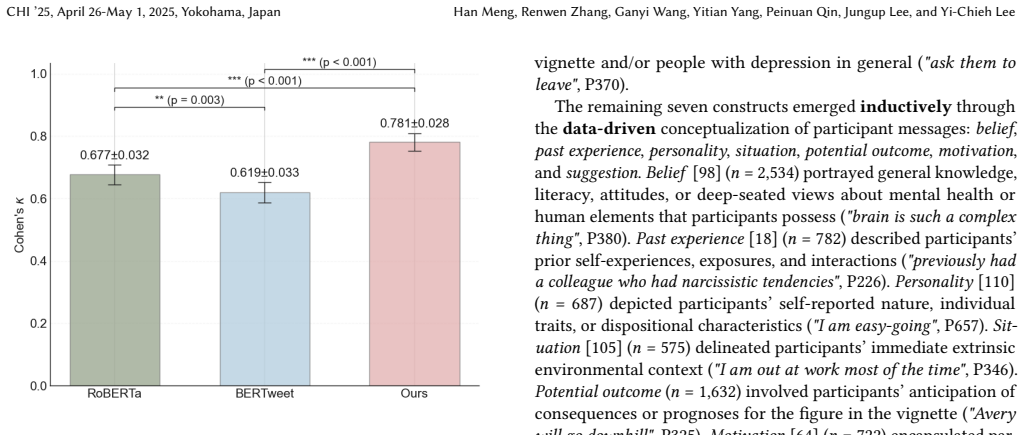
The central claim is that an integrated AI-assisted pipeline can elicit, code, and deconstruct mental-illness stigma at a scale previously impossible for interview-based research. On the data-collection side, the chatbot interview drew out detailed responses: participants wrote messages averaging roughly 40 words, reported high satisfaction (4.37 out of 5), and often disclosed personal experiences and ambivalent attitudes. On the coding side, AI-assisted coding matched human-expert coding with overall Cohen's kappa of 0.69 and outperformed two transformer baselines on a held-out test set. On the modeling side, the causal knowledge graph, built from triples such as (stigma, because, no pity), was organized into 11 psychological constructs and used to derive a conceptual model that both confirms the main pathways of attribution theory and proposes new ones, including the direct influence of situation on behavioral intention and the dual influence of past experience on cognition and emotion.
Load-bearing premise
The pipeline assumes that causal triples extracted by the LLM, such as (stigma, because, no pity), correspond to genuine psychological mechanisms rather than linguistic patterns learned from the small fine-tuning set or from the model's priors.
Editorial extensions
If this is right
- Depression stigma can be measured from open-ended interview data at scale, so qualitative studies of psychological constructs need not be limited to a few dozen hand-coded transcripts.
- The causal knowledge graph provides a structured, queryable representation of how stigma-related beliefs, emotions, and behavioral intentions connect, enabling theory testing and hypothesis generation from existing data.
- Individual-level subgraphs allow real-time identification of a person's stigma pattern, which the paper argues could support personalized micro-interventions rather than one-size-fits-all anti-stigma campaigns.
- Because the pipeline is language-based and modular, it can be adapted to other psychological constructs and to cross-cultural studies by changing the vignette, the codebook, and the interview prompts.
Reading between the lines
- Inference: the paper's causal edges are treated as psychological mechanisms, but a skeptical reading is that they are linguistic regularities; the strongest test would be to validate the novel pathways with an independent experiment or longitudinal data.
- Inference: the per-attribute variation in human-AI agreement (from kappa 0.46 for pity to 0.76 for social distance) suggests that AI disagreements can be mined to expose contested or ambiguous constructs, not just treated as coding errors.
- Inference: because chatbot interviews are cheap to repeat, the pipeline could be extended to measure how stigma changes within the same people over time, something the present cross-sectional design does not test.
Editorial analysis
A structured set of objections, weighed in public.
Referee Report
Summary. The paper presents an integrated pipeline for studying depression stigma: a chatbot ('Nova') interviews 1,002 participants about a depression vignette; two human coders develop a codebook and code 4,200 messages from 600 participants; GPT-4-Turbo is then used for AI-assisted coding with majority voting; and a causal knowledge graph (CKG) is built by fine-tuning GPT-3.5 to extract 'because' triples, mapping entities to 11 psychological constructs, resolving entities, and distilling a conceptual model with theory-aligned and novel pathways. The paper reports that the chatbot elicits rich self-disclosure, that AI-assisted coding is highly consistent with human coding and outperforms RoBERTa-base and BERTweet-base, and that the CKG reveals both known and new interrelationships among stigma-related constructs, including novel pathways from situation, personality, and past experience to behavioral intentions and emotional responses.
Significance. If the empirical claims hold, this is a useful methodological contribution to HCI and computational social science: it demonstrates a scalable way to collect and code qualitative interview data on a sensitive construct. The study's strengths include the large sample (1,002 participants, 7,014 messages), the use of human expert coding to build a codebook, the inclusion of two baseline models for comparison, the detailed reporting of the technical pipeline, and the explicit acknowledgement in Section 5.2 that the paper does not aim to establish robust social-science models. The participant-level case studies are also a valuable illustration of how graph structures can be used to inspect individual reasoning. However, the significance is conditional on two issues: the abstract's characterization of coding agreement is stronger than the reported kappa values support, and the causal validity of the knowledge graph is asserted rather than demonstrated. The paper's contribution would be more persuasive if framed as an exploratory hypothesis-generation pipeline, with the causal language correspondingly tempered.
major comments (3)
- [Section 3.2.1 and Section 4.2.1] The causal validity of the CKG is not established. The triple-extraction accuracy of 0.93 reported in Section 3.2.1 measures whether the fine-tuned GPT-3.5 reproduces the authors' curated triples on 70 unseen messages; it does not validate that an extracted 'because' edge corresponds to the participant's genuine causal belief. Because the chatbot explicitly prompts participants for reasons ('Is there any reason that...'), extracted 'because I...' clauses may be conversational justifications rather than stable attributions. The CKG quality metrics in Section 4.2.1 (entity coverage 61.04%, relationship counts, the presence of only eight cycles, and connectivity) are descriptive properties of the graph, not evidence that the edges are causally meaningful. The Section 5.2 caveat that the paper is not establishing robust social-science models partly addresses this, but the abstract and RQ2 still present the graph as revealing interrelationships and novel causal pathways. Please either reframe the CKG contribution as exploratory hypothesis generation or add validation of the causal edges (e.g., human judgments of causal status on a sample of edges, agreement with theory-derived predictions, or stability of edges across extraction models and prompts).
- [Abstract and Section 4.1.2] The abstract's claim that AI-assisted coding was 'strongly consistent' with human-expert coding overstates the evidence. The overall Cohen's kappa is 0.69, which is in the moderate range on the scale cited by the paper (McHugh 2012), and per-code kappas range from 0.46 for pity to 0.76 for social distance. In addition, there is a numerical inconsistency: Section 3.1.2 reports Cohen's kappa of 0.71 across all 4,200 messages, while Section 4.1.2 reports an overall kappa of 0.69 across 4,153 human-coded messages. Please reconcile these numbers and temper the abstract and summary statements accordingly. The separate validation on 200 previously uncoded messages (kappa = 0.87) is encouraging, but it is based on a balanced sample of 25 messages per code, which does not reflect the natural code distribution (e.g., pity appears in only 1.01% of messages), so it should be interpreted with caution.
- [Section 3.2.4 and Figure 8] The three 'novel' pathways in Figure 8 are the output of several author-imposed analytic choices, and no sensitivity analysis is reported. The conceptual-model construction in Section 3.2.4 uses a per-construct mean outgoing-edge weight threshold, consolidates potential outcome, cognitive judgment, and belief, merges motivation and personality, excludes suggestion, and imposes explicit direction restrictions (e.g., behavioral intention cannot lead to other constructs). Any of these choices could change which pathways survive, so the dashed edges (situation to behavioral intention, personality to emotional response, and past experience to cognitive and emotional responses) may be artifacts of the specific thresholds and rules rather than robust patterns in the data. Please report sensitivity analyses (e.g., varying the edge-weight threshold, testing alternative consolidation rules, or removing the direction restrictions) or explicitly label the novel pathways as illustrative hypotheses that require confirmation in future work.
minor comments (6)
- [Section 3.2.1] The sentence reporting fine-tuning progress says accuracy improved 'from 0.47 to 0.66, 0.86, 0.90, and 0.931' and mentions six iterations, but the listed values appear to cover five points; please clarify the iteration count and the final accuracy (0.93 or 0.931).
- [Section 3.1.1] The vignette text renders the character's name as 'A very' in several places (e.g., 'A very is employed by a company'); this appears to be a spacing artifact and should be corrected to 'Avery' throughout.
- [Figure 6 caption] The caption states 'p≥ 0.05 (ns)' but the conventional notation is 'p > 0.05 (ns)'; please correct the typo.
- [Section 4.2.1] The entity-resolution step reports an average of 6.74 potential matches per entity with a standard deviation of 33.08, indicating a highly skewed distribution; a median or a note about the skew would help readers interpret the merging process.
- [Section 1 and Abstract] The phrase 'strongly consistent' also appears in the abstract and in Section 4.1.2's summary bullet; as noted in the major comments, this should be revised to match the reported kappa values.
- [General] The manuscript contains several ACM-format auxiliary lines (e.g., 'Please use nonacm option or ACM Engage class to enable CC licenses') that should be removed before final submission; they are presumably artifacts of the template.
Circularity Check
No significant circularity: the pipeline is benchmarked against external human codes, and the conceptual-model pathways are explicitly hypothesis-generating summaries rather than predictions.
full rationale
The paper's derivation chain is anchored to external checks rather than to its own outputs. The AI-assisted coding is validated against human expert codes (Section 4.1.2), including a held-out set of 200 previously uncoded messages (kappa = 0.87), and against two non-author baselines (RoBERTa-base, BERTweet-base). The CKG triple extraction is fine-tuned on human-curated triples but evaluated on 70 unseen messages (accuracy 0.93); ontologization and entity resolution are checked against human judgments (kappa = 0.77 and 0.90). These are independent benchmarks, not same-data fits. The pre-specified '(stigma, because, no pity)' triples in Section 3.2.1 are representational scaffolding for the graph, not confirmatory evidence, and the paper does not use them to validate the conceptual model. The 'novel' conceptual-model pathways in Section 3.2.4 are produced by transparent thresholding and author-specified direction rules, and Section 5.2 explicitly states that 'this paper is not to establish robust social-science models' and calls for future work 'to validate causal pathways that LLMs/CKGs unveil from qualitative data.' The pathways are therefore presented as hypothesis generation, not as predictions that reduce to their inputs. The self-citations to the authors' earlier chatbot work (Lee et al. 2020, 2023; Liu et al. 2024) appear only in design details such as interview-question adaptation and coherence scoring, and are not load-bearing for the central claim. Concerns about whether 'because' triples capture genuine psychological causality, threshold sensitivity, or the strength of the kappa = 0.69 agreement are validity and correctness risks, not circularity.
Assumptions & free parameters
free parameters (5)
- edge-retention threshold =
average weight of outgoing edges per construct
- entity-resolution candidate set size =
10
- triple-extraction fine-tuning data size =
420 curated messages (~5% of dataset)
- minimum-length threshold for follow-up probes =
not reported
- majority-vote count for AI coding =
5
assumptions (5)
- domain assumption Attribution model (Corrigan et al., 2003) is an appropriate framework for depression stigma in this population.
- domain assumption Chatbot-interview responses are authentic enough to serve as qualitative data on stigma.
- domain assumption Linguistic causal connectives in participant text correspond to psychological causal mechanisms.
- domain assumption A model fine-tuned on 5% of curated messages generalizes to the full message set.
- standard math Cohen's kappa thresholds for satisfactory agreement (e.g., 0.69) are appropriate for evaluating AI coding in this context.
Cite this review
Pith. "Pith review of Deconstructing Depression Stigma: Integrating AI-driven Data Collection and Analysis with Causal Knowledge Graphs." pith.science (2026). https://pith.science/paper/COPLKHSW
@misc{pith2026250206075,
  author       = {Pith},
  title        = {Pith review of: Deconstructing Depression Stigma: Integrating AI-driven Data Collection and Analysis with Causal Knowledge Graphs},
  year         = {2026},
  howpublished = {\url{https://pith.science/paper/COPLKHSW}},
  note         = {Machine review of arXiv:2502.06075}
}
read the original abstract
Mental-illness stigma is a persistent social problem, hampering both treatment-seeking and recovery. Accordingly, there is a pressing need to understand it more clearly, but analyzing the relevant data is highly labor-intensive. Therefore, we designed a chatbot to engage participants in conversations; coded those conversations qualitatively with AI assistance; and, based on those coding results, built causal knowledge graphs to decode stigma. The results we obtained from 1,002 participants demonstrate that conversation with our chatbot can elicit rich information about people's attitudes toward depression, while our AI-assisted coding was strongly consistent with human-expert coding. Our novel approach combining large language models (LLMs) and causal knowledge graphs uncovered patterns in individual responses and illustrated the interrelationships of psychological constructs in the dataset as a whole. The paper also discusses these findings' implications for HCI researchers in developing digital interventions, decomposing human psychological constructs, and fostering inclusive attitudes.
Figures


Figures from the paper (5 more)




Reference graph
Works this paper leans on
-
[1]
Josh Achiam, Steven Adler, Sandhini Agarwal, Lama Ahmad, Ilge Akkaya, Floren- cia Leoni Aleman, Diogo Almeida, Janko Altenschmidt, Sam Altman, Shyamal Anadkat, et al. 2023. Gpt-4 technical report. arXiv preprint arXiv:2303.08774 (2023)
arXiv 2023
-
[2]
Atalay Alem, Lars Jacobsson, Mesfin Araya, D Kebede, and Gunnar Kullgren
-
[3]
Amin, Erik Cambria, and Björn W
Mostafa M. Amin, Erik Cambria, and Björn W. Schuller. 2023. Will Affective Computing Emerge From Foundation Models and General Artificial Intelligence? A First Evaluation of ChatGPT. IEEE Intelligent Systems 38, 2 (2023), 15–23. https://doi.org/10.1109/MIS.2023.3254179
arXiv 2023
-
[4]
More than just a game, it’s an app that builds awareness around Mental Health
Soraya S Anvari, Jessica Hammer, and Rina R Wehbe. 2024. " More than just a game, it’s an app that builds awareness around Mental Health": Mental Health Stigma Reduction Using Games for Change. Proceedings of the ACM on Human- Computer Interaction 8, CHI PLAY (2024), 1–30
2024
-
[5]
2023.Using Large Language Models for Qualitative Analysis can Introduce Serious Bias
Julian Ashwin, Aditya Chhabra, and Vijayendra Rao. 2023.Using Large Language Models for Qualitative Analysis can Introduce Serious Bias . Policy Research Working Paper Series 10597. The World Bank. https://ideas.repec.org/p/wbk/ wbrwps/10597.html
2023
-
[6]
American Psychiatric Association. 2013. Diagnostic and Statistical Manual of Mental Disorders, Fifth Edition . Washington, D.C. https://doi.org/10.1176/appi. books.9780890425596
-
[7]
Christopher A Bail, Taylor W Brown, and Marcus Mann. 2017. Channeling hearts and minds: Advocacy organizations, cognitive-emotional currents, and public conversation. American Sociological Review 82, 6 (2017), 1188–1213
2017
-
[8]
Banathy and Patrick M
Bela H. Banathy and Patrick M. Jenlink. 2005. Dialogue as a means of collective communication. Springer
2005
Show all 131 references
-
[9]
Albert Bandura. 2001. Social cognitive theory: An agentic perspective. Annual review of psychology 52, 1 (2001), 1–26
2001
-
[10]
Amit Baumel, Theresa Fleming, and Stephen M Schueller. 2020. Digital micro interventions for behavioral and mental health gains: core components and conceptualization of digital micro intervention care. Journal of medical Internet research 22, 10 (2020), e20631
2020
-
[11]
Just sit down so we can talk:
Leandra A Bedini et al. 2000. "Just sit down so we can talk:" perceived stigma and community recreation pursuits of people with disabilities. Therapeutic Recreation Journal 34, 1 (2000), 55–68
2000
-
[12]
David Bohm and Robert A Weinberg. 2004. On dialogue. Routledge
2004
-
[13]
Denny Borsboom, Marie K Deserno, Mijke Rhemtulla, Sacha Epskamp, Eiko I Fried, Richard J McNally, Donald J Robinaugh, Marco Perugini, Jonas Dalege, Giulio Costantini, et al. 2021. Network analysis of multivariate data in psycho- logical science. Nature Reviews Methods Primers ...
2021
-
[14]
Danah Boyd and Kate Crawford. 2012. Critical questions for big data: Provo- cations for a cultural, technological, and scholarly phenomenon. Information, communication & society 15, 5 (2012), 662–679
2012
-
[15]
Ryan L Boyd and H Andrew Schwartz. 2021. Natural language analysis and the psychology of verbal behavior: The past, present, and future states of the field. Journal of Language and Social Psychology 40, 1 (2021), 21–41
2021
-
[16]
Salvatore Carta, Alessandro Giuliani, Leonardo Piano, Alessandro Sebastian Podda, Livio Pompianu, and Sandro Gabriele Tiddia. 2023. Iterative zero-shot llm prompting for knowledge graph construction. arXiv preprint arXiv:2307.01128 (2023)
2023 arXiv
-
[17]
Lauren T Catalano, Clayton H Brown, Alicia Lucksted, Samantha M Hack, and Amy L Drapalski. 2021. Support for the social-cognitive model of internalized stigma in serious mental illness. Journal of psychiatric research 137 (2021), 41–47
2021
-
[18]
Anita Chandra and Cynthia S Minkovitz. 2007. Factors that influence mental health stigma among 8th grade adolescents. Journal of Youth and Adolescence 36 (2007), 763–774
2007
-
[19]
Jiawei Chen, Hongyu Lin, Xianpei Han, and Le Sun. 2024. Benchmarking large language models in retrieval-augmented generation. In Proceedings of the AAAI Conference on Artificial Intelligence, Vol. 38. 17754–17762
2024
-
[20]
Sarah Clement, Oliver Schauman, Tanya Graham, Francesca Maggioni, Sara Evans-Lacko, Nikita Bezborodovs, Craig Morgan, Nicolas Rüsch, June SL Brown, and Graham Thornicroft. 2015. What is the impact of mental health-related stigma on help-seeking? A systematic review of quantita...
2015
-
[21]
Corrigan
Patrick W. Corrigan. 2000. Mental health stigma as social attribution: Implica- tions for research methods and attitude change. Clinical psychology: science and Deconstructing Depression Stigma: Integrating AI-driven Data Collection and Analysis with Causal Knowledge Graphs CH...
2000
-
[22]
Corrigan
Patrick W. Corrigan. 2012. A toolkit for evaluating programs meant to erase the stigma of mental illness. Illinois Institute of Technology 10 (2012)
2012
-
[23]
Corrigan, Fred E
Patrick W. Corrigan, Fred E. Markowitz, Amy Watson, David Rowan, and Mary Ann Kubiak. 2003. An Attribution Model of Public Discrimination To- wards Persons with Mental Illness. Journal of Health and Social Behavior 44, 2 (2003), 162–179. http://www.jstor.org/stable/1519806
2003
-
[24]
Corrigan and David L
Patrick W. Corrigan and David L. Penn. 1999. Lessons from social psychology on discrediting psychiatric stigma. American psychologist 54, 9 (1999), 765
1999
-
[25]
Corrigan, L
Patrick W. Corrigan, L. Philip River, Robert K. Lundin, David L. Penn, Kyle Uphoff-Wasowski, John Campion, James Mathisen, Christine Gagnon, Maria Bergman, Hillel Goldstein, et al. 2001. Three strategies for changing attributions about severe mental illness. Schizophrenia bull...
2001
-
[26]
Corrigan and Jenessa R
Patrick W. Corrigan and Jenessa R. Shapiro. 2010. Measuring the impact of programs that challenge the public stigma of mental illness. Clinical Psychology Review 30, 8 (2010), 907–922. https://doi.org/10.1016/j.cpr.2010.06.004
2010 doi
-
[27]
Corrigan and Amy C
Patrick W. Corrigan and Amy C. Watson. 2002. Understanding the impact of stigma on people with mental illness. World psychiatry : official journal of the World Psychiatric Association 11 (2002), 16–20. https://www.ncbi.nlm.nih.gov/ pmc/articles/PMC1489832/
2002
-
[28]
Patrick W Corrigan and Amy C Watson. 2002. Understanding the impact of stigma on people with mental illness. World psychiatry 1, 1 (2002), 16
2002
-
[29]
Loes Crielaard, Jeroen F Uleman, Bas DL Châtel, Sacha Epskamp, Peter Sloot, and Rick Quax. 2022. Refining the causal loop diagram: A tutorial for maximizing the contribution of domain expertise in computational system dynamics modeling. Psychological methods (2022)
2022
-
[30]
Yeager, Christopher J
Dorottya Demszky, Diyi Yang, David S. Yeager, Christopher J. Bryan, Mar- garett Clapper, Susannah Chandhok, Johannes C. Eichstaedt, Cameron Hecht, Jeremy Jamieson, Meghann Johnson, Danielle Krettek-Cobb, Leslie Lai, Nirel JonesMitchell, Desmond C. Ong, Carol S. Dweck, James J....
2023 doi
-
[31]
Magdalena A Denham and Anthony John Onwuegbuzie. 2013. Beyond words: Using nonverbal communication data in research to enhance thick description and interpretation. International Journal of Qualitative Methods 12, 1 (2013), 670–696
2013
-
[32]
Dunn, Evelyn J
Mary Amanda Dew, Leslie O. Dunn, Evelyn J. Bromet, and Herbert C. Schulberg
-
[33]
Myths and facts
Keith S Dobson and Savannah Rose. 2022. “Myths and facts” campaigns are at best ineffective and may increase mental illness stigma. Stigma and Health 7, 1 (2022), 27
2022
- [34]
-
[35]
Anna Fang and Haiyi Zhu. 2023. Measuring the stigmatizing effects of a highly publicized event on online mental health discourse. In Proceedings of the 2023 CHI Conference on Human Factors in Computing Systems . 1–18
2023
-
[36]
Jennifer Fereday and Eimear Muir-Cochrane. 2006. Demonstrating rigor using thematic analysis: A hybrid approach of inductive and deductive coding and theme development. International journal of qualitative methods 5, 1 (2006), 80–92
2006
-
[37]
Jessica L Feuston. 2019. Algorithms, oppression, and mental illness on social media. In Extended Abstracts of the 2019 CHI Conference on Human Factors in Computing Systems. 1–5
2019
-
[38]
Jessica L Feuston and Jed R Brubaker. 2021. Putting tools in their place: The role of time and perspective in human-AI collaboration for qualitative analysis. Proceedings of the ACM on Human-Computer Interaction 5, CSCW2 (2021), 1–25
2021
-
[39]
Robert J. Fisher. 1993. Social Desirability Bias and the Validity of Indirect Questioning. Journal of Consumer Research 20, 2 (09 1993), 303–315. https: //doi.org/10.1086/209351
1993 doi
-
[40]
David M Frost and Diego Castro. 2024. An integrated understanding of the mech- anisms linking social stigma to mental health among marginalized populations. Nature Mental Health 2, 6 (2024), 645–654
2024
-
[41]
Adrian Furnham. 1986. Response bias, social desirability and dissimulation. Personality and Individual Differences 7, 3 (1986), 385–400. https://doi.org/10. 1016/0191-8869(86)90014-0
1986
-
[43]
Erving Goffman. 1964. Stigma: Notes on the Management of Spoiled Identity. Social Forces 43, 1 (10 1964), 127–128. https://doi.org/10.1093/sf/43.1.127
1964 doi
-
[44]
Davidoff, Kevin L
Lauren Gonzales, Kristin C. Davidoff, Kevin L. Nadal, and Philip T. Yanos. 2015. Microaggressions experienced by persons with mental illnesses: An exploratory study. Psychiatric Rehabilitation Journal 38, 3 (2015), 234–241. https://doi.org/ 10.1037/prj0000096
2015 doi
-
[45]
Herbert P Grice. 1975. Logic and conversation. In Speech acts. Brill, 41–58
1975
-
[46]
Maarten Grootendorst. 2022. BERTopic: Neural topic modeling with a class- based TF-IDF procedure. arXiv preprint arXiv:2203.05794 (2022)
2022 arXiv
-
[47]
Turner, and Tom Yeh
Xu Han, Michelle Zhou, Matthew J. Turner, and Tom Yeh. 2021. Designing Ef- fective Interview Chatbots: Automatic Chatbot Profiling and Design Suggestion Generation for Chatbot Debugging. In Proceedings of the 2021 CHI Conference on Human Factors in Computing Systems (Yokohama,...
2021
-
[48]
Benjamin David Hoffman, Michelle Leanne Oppert, and Mikaela Owen. 2024. Understanding young adults’ attitudes towards using AI chatbots for psychother- apy: The role of self-stigma. Computers in Human Behavior: Artificial Humans 2, 2 (2024), 100086
2024
-
[49]
Md Naimul Hoque, Ayman A Mahfuz, Mayukha Sridhatri Kindi, and Naeemul Hassan. 2024. Towards Designing a Question-Answering Chatbot for Online News: Understanding Questions and Perspectives. In Proceedings of the CHI Conference on Human Factors in Computing Systems (Honolulu, H...
2024
-
[50]
Esther Howe, Jina Suh, Mehrab Bin Morshed, Daniel McDuff, Kael Rowan, Javier Hernandez, Marah Ihab Abdin, Gonzalo Ramos, Tracy Tran, and Mary P Czerwinski. 2022. Design of digital workplace stress-reduction intervention systems: Effects of intervention type and timing. In Proc...
2022
-
[51]
Rizwan Iqbal, Masrah Azrifah Azmi Murad, Aida Mustapha, Nurfadhlina Mohd Sharef, et al . 2013. An analysis of ontology engineering methodologies: A literature review. Research journal of applied sciences, engineering and technology 6, 16 (2013), 2993–3000
2013
-
[52]
Utkarshani Jaimini and Amit Sheth. 2022. CausalKG: Causal Knowledge Graph Explainability using interventional and counterfactual reasoning. IEEE Internet Computing 26, 1 (2022), 43–50
2022
-
[53]
Sooah Jang, Jae-Jin Kim, Soo-Jeong Kim, Jieun Hong, Suji Kim, and Eunjoo Kim. 2021. Mobile app-based chatbot to deliver cognitive behavioral therapy and psychoeducation for adults with attention deficit: A development and feasibility/usability study. International journal of m...
2021
-
[54]
Jenlink and Bela H
Patrick M. Jenlink and Bela H. Banathy. 2005. Dialogue. Springer US, Boston, MA, 3–14. https://doi.org/10.1007/0-306-48690-3_1
2005 doi
-
[55]
Sagar Jilka, Clarissa Mary Odoi, Janet van Bilsen, Daniel Morris, Sinan Erturk, Nicholas Cummins, Matteo Cella, and Til Wykes. 2022. Identifying schizophrenia stigma on Twitter: a proof of principle model using service user supervised machine learning. Schizophrenia 8, 1 (2022), 1
2022
-
[56]
Eunkyung Jo, Daniel A Epstein, Hyunhoon Jung, and Young-Ho Kim. 2023. Understanding the benefits and challenges of deploying conversational AI lever- aging large language models for public health intervention. In Proceedings of the 2023 CHI Conference on Human Factors in Compu...
2023
-
[57]
Kessler, Patricia Berglund, Olga Demler, Robert Jin, Doreen Koretz, Kathleen R
Ronald C. Kessler, Patricia Berglund, Olga Demler, Robert Jin, Doreen Koretz, Kathleen R. Merikangas, A. John Rush, Ellen E. Walters, and Philip S. Wang
-
[58]
Emre Kiciman, Robert Ness, Amit Sharma, and Chenhao Tan. 2024. Causal Reasoning and Large Language Models: Opening a New Frontier for Causality. Transactions on Machine Learning Research (2024). https://openreview.net/ forum?id=mqoxLkX210 Featured Certification
2024
-
[59]
Soomin Kim, Joonhwan Lee, and Gahgene Gweon. 2019. Comparing Data from Chatbot and Web Surveys: Effects of Platform and Conversational Style on Survey Response Quality. In Proceedings of the 2019 CHI Conference on Human Factors in Computing Systems (Glasgow, Scotland Uk) (CHI ...
2019
-
[60]
Taewan Kim, Mintra Ruensuk, and Hwajung Hong. 2020. In Helping a Vulnera- ble Bot, You Help Yourself: Designing a Social Bot as a Care-Receiver to Promote Mental Health and Reduce Stigma. In Proceedings of the 2020 CHI Conference on Human Factors in Computing Systems (Honolulu...
2020
-
[61]
Elisavet Koutsiana, Johanna Walker, Michelle Nwachukwu, Albert Meroño- Peñuela, and Elena Simperl. 2024. Knowledge Prompting: How Knowledge Engineers Use Large Language Models. arXiv preprint arXiv:2408.08878 (2024)
2024
-
[62]
Anne C Krendl and Bernice A Pescosolido. 2020. Countries and cultural differ- ences in the stigma of mental illness: the east–west divide. Journal of Cross- Cultural Psychology 51, 2 (2020), 149–167
2020
- [63]
-
[64]
Erlend P Kvaale and Nick Haslam. 2016. Motivational orientations and psy- chiatric stigma: Social motives influence how causal explanations relate to stigmatizing attitudes. Personality and Individual Differences 89 (2016), 111–116
2016
-
[65]
Steinar Kvale. 2009. Interviews: Learning the craft of qualitative research inter- viewing. Sage
2009
-
[66]
Min Hyung Lee and Richard Kyung. 2022. Mental Health Stigma and Natural Language Processing: Two Enigmas Through the Lens of a Limited Corpus. In 2022 IEEE World AI IoT Congress (AIIoT). IEEE, 688–691
2022
-
[67]
Yi-Chieh Lee, Yichao Cui, Jack Jamieson, Wayne Fu, and Naomi Yamashita
-
[68]
I Hear You, I Feel You
Yi-Chieh Lee, Naomi Yamashita, Yun Huang, and Wai Fu. 2020. "I Hear You, I Feel You": Encouraging Deep Self-Disclosure through a Chatbot. In Proceedings of the 2020 CHI Conference on Human Factors in Computing Systems (Honolulu, HI, USA) (CHI ’20). 1–12. https://doi.org/10.114...
2020
-
[69]
William Leeson, Adam Resnick, Daniel Alexander, and John Rovers. 2019. Natural Language Processing (NLP) in Qualitative Public Health Research: A Proof of Concept Study. International Journal of Qualitative Methods 18 (2019), 1609406919887021. https://doi.org/10.1177/1609406919887021
2019 doi
-
[70]
Ang Li, Dongdong Jiao, and Tingshao Zhu. 2018. Detecting depression stigma on social media: A linguistic analysis. Journal of affective disorders 232 (2018), 358–362
2018
-
[71]
Han Li, Renwen Zhang, Yi-Chieh Lee, Robert E Kraut, and David C Mohr. 2023. Systematic review and meta-analysis of AI-based conversational agents for promoting mental health and well-being. NPJ Digital Medicine 6, 1 (2023), 236
2023
-
[72]
Jackie Liggins and Simon Hatcher. 2005. Stigma toward the mentally ill in the general hospital: a qualitative study. General Hospital Psychiatry 27, 5 (2005), 359–364. https://doi.org/10.1016/j.genhosppsych.2005.05.006
2005 doi
-
[73]
Link, Francis T
Bruce G. Link, Francis T. Cullen, James Frank, and John F. Wozniak. 1987. The Social Rejection of Former Mental Patients: Understanding Why Labels Matter. Amer. J. Sociology 92, 6 (1987), 1461–1500. https://doi.org/10.1086/228672
1987 doi
-
[74]
Link, Lawrence H
Bruce G. Link, Lawrence H. Yang, Jo C. Phelan, and Pamela Y. Collins. 2004. Measuring Mental Illness Stigma. Schizophrenia Bulletin 30, 3 (01 2004), 511–541. https://doi.org/10.1093/oxfordjournals.schbul.a007098
2004 doi
-
[75]
Yinhan Liu, Myle Ott, Naman Goyal, Jingfei Du, Mandar Joshi, Danqi Chen, Omer Levy, Mike Lewis, Luke Zettlemoyer, and Veselin Stoyanov. 2019. Roberta: A robustly optimized bert pretraining approach. arXiv preprint arXiv:1907.11692 (2019)
2019 arXiv
-
[76]
Zihan Liu, Han Li, Anfan Chen, Renwen Zhang, and Yi-Chieh Lee. 2024. Under- standing Public Perceptions of AI Conversational Agents: A Cross-Cultural Anal- ysis. In Proceedings of the CHI Conference on Human Factors in Computing Systems (Honolulu, HI, USA) (CHI ’24). Associati...
2024
-
[77]
Gale M Lucas, Jonathan Gratch, Aisha King, and Louis-Philippe Morency. 2014. It’s only a computer: Virtual humans increase willingness to disclose.Computers in Human Behavior 37 (2014), 94–100
2014
-
[78]
Michael Lyons and Jenny Ziviani. 1995. Stereotypes, Stigma, and Mental Illness: Learning From Fieldwork Experiences. The American Journal of Occupational Therapy 49, 10 (11 1995), 1002–1008. https://doi.org/10.5014/ajot.49.10.1002
1995 doi
-
[79]
Zilin Ma, Yiyang Mei, Yinru Long, Zhaoyuan Su, and Krzysztof Z Gajos. 2024. Evaluating the Experience of LGBTQ+ People Using Large Language Model Based Chatbots for Mental Health Support. In Proceedings of the CHI Conference on Human Factors in Computing Systems . 1–15
2024
-
[80]
Zilin Ma, Yiyang Mei, and Zhaoyuan Su. 2023. Understanding the benefits and challenges of using large language model-based conversational agents for mental well-being support. In AMIA Annual Symposium Proceedings , Vol. 2023. American Medical Informatics Association, 1105
2023
-
[81]
Julia Martínez-Gonzálvez, María-Jesús Lirola, José Gallego, and Adolfo J Cangas Díaz. 2024. Virtu-act: a virtual reality program for mental health stigma.Current Psychology 43, 35 (2024), 28306–28315
2024
-
[82]
Mary L McHugh. 2012. Interrater reliability: the kappa statistic. Biochemia medica 22, 3 (2012), 276–282
2012
-
[83]
Joanne Meredith. 2019. Conversation analysis and online interaction. Research on Language and Social Interaction 52, 3 (2019), 241–256
2019
-
[84]
Michaels and Patrick W
Patrick J. Michaels and Patrick W. Corrigan. 2013. Measuring mental illness stigma with diminished social desirability effects. Journal of Mental Health 22, 3 (2013), 218–226. https://doi.org/10.3109/09638237.2012.734652
2013
-
[85]
Shravika Mittal and Munmun De Choudhury. 2023. Moral framing of mental health discourse and its relationship to stigma: a comparison of social media and news. In Proceedings of the 2023 CHI Conference on Human Factors in Computing Systems. 1–19
2023
-
[86]
social priming
Daniel C Molden. 2014. Understanding priming effects in social psychology: What is “social priming” and how does it occur? Social cognition 32, Supplement (2014), 1–11
2014
-
[87]
Mesfin Samuel Mulatu and Carmi Schooler. 2002. Health: reciprocal effects and mediating mechanisms. J Health Soc Behav 43, 1 (2002)
2002
-
[88]
Michael Muller, Shion Guha, Eric PS Baumer, David Mimno, and N Sadat Shami
-
[89]
Dat Quoc Nguyen, Thanh Vu, and Anh Tuan Nguyen. 2020. BERTweet: A pre- trained language model for English Tweets. InProceedings of the 2020 Conference on Empirical Methods in Natural Language Processing: System Demonstrations . 9–14
2020
-
[90]
Richard E Nisbett, Kaiping Peng, Incheol Choi, and Ara Norenzayan. 2001. Culture and systems of thought: holistic versus analytic cognition.Psychological review 108, 2 (2001), 291
2001
-
[91]
Rita Obeid, Nidal Daou, Danielle DeNigris, Christina Shane-Simpson, Patricia J Brooks, and Kristen Gillespie-Lynch. 2015. A cross-cultural comparison of knowledge and stigma associated with autism spectrum disorder among college students in Lebanon and the United States. Journ...
2015
-
[92]
Margareta Östman and Lars Kjellin. 2002. Stigma by association: psychological factors in relatives of people with mental illness.The British Journal of Psychiatry 181, 6 (2002), 494–498
2002
-
[93]
Henna Paakki, Heidi Vepsäläinen, Antti Salovaara, and Bushra Zafar. 2024. Detecting covert disruptive behavior in online interaction by analyzing conver- sational features and norm violations. ACM Transactions on Computer-Human Interaction 31, 2 (2024), 1–43
2024
-
[94]
Shirui Pan, Linhao Luo, Yufei Wang, Chen Chen, Jiapu Wang, and Xindong Wu
-
[95]
Alina Pavlova and Pauwke Berkers. 2020. Mental health discourse and social media: Which mechanisms of cultural power drive discourse on Twitter. Social Science & Medicine 263 (2020), 113250
2020
-
[96]
Ralph Peeters and Christian Bizer. 2023. Using chatgpt for entity matching. In European Conference on Advances in Databases and Information Systems. Springer, 221–230
2023
-
[97]
Sachin R Pendse, Daniel Nkemelu, Nicola J Bidwell, Sushrut Jadhav, Soumitra Pathare, Munmun De Choudhury, and Neha Kumar. 2022. From Treatment to Healing:Envisioning a Decolonial Digital Mental Health. In Proceedings of the 2022 CHI Conference on Human Factors in Computing Sys...
2022
-
[98]
Lina-Jolien Peter, Stephanie Schindler, Christian Sander, Silke Schmidt, Holger Muehlan, Thomas McLaren, Samuel Tomczyk, Sven Speerforck, and Georg Schomerus. 2021. Continuum beliefs and mental illness stigma: a systematic review and meta-analysis of correlation and interventi...
2021
-
[99]
Judith J Prochaska, Erin A Vogel, Amy Chieng, Matthew Kendra, Michael Baioc- chi, Sarah Pajarito, and Athena Robinson. 2021. A therapeutic relational agent for reducing problematic substance use (Woebot): development and usability study. Journal of medical Internet research 23...
2021
- [100]
-
[101]
Tim Rietz, Peyman Toreini, and Alexander Maedche. 2020. Cody: An interactive machine learning system for qualitative coding. In Adjunct Proceedings of the 33rd Annual ACM Symposium on User Interface Software and Technology . 90–92
2020
-
[102]
Laura Weiss Roberts. 2002. Ethics and Mental Illness Research. Psychiatric Clinics of North America 25, 3 (2002), A525–A545
2002
-
[103]
Patrick Robinson, Daniel Turk, Sagar Jilka, and Matteo Cella. 2019. Measuring attitudes towards mental health using social media: investigating stigma and trivialisation. Social psychiatry and psychiatric epidemiology 54 (2019), 51–58
2019
-
[104]
David Roesler, Shana Johnny, Mike Conway, and Annie T Chen. 2024. A theory- informed deep learning approach to extracting and characterizing substance use-related stigma in social media. BMC Digital Health 2, 1 (2024), 60
2024
-
[105]
Nicolas Rüsch, Patrick W Corrigan, Abigail Wassel, Patrick Michaels, Manfred Olschewski, Sandra Wilkniss, and Karen Batia. 2009. A stress-coping model of mental illness stigma: I. Predictors of cognitive stress appraisal. Schizophrenia research 110, 1-3 (2009), 59–64
2009
-
[106]
Derek Ruths and Jürgen Pfeffer. 2014. Social media for large studies of behavior. Science 346, 6213 (2014), 1063–1064
2014
-
[107]
Johnny Saldana. 2016. The Coding Manual for Qualitative Researchers (3rd ed.). Sage Publications, Inc, London
2016
-
[108]
Joel Sebastian and Deborah Richards. 2017. Changing stigmatizing attitudes to mental health via education and contact with embodied conversational agents. Computers in Human Behavior 73 (2017), 479–488. https://doi.org/10.1016/j.chb. 2017.03.071
2017 doi
-
[109]
Jenny Secker, Clare Armstrong, and Malcolm Hill. 1999. Young people’s under- standing of mental illness. Health Education Research 14, 6 (1999), 729–739. Deconstructing Depression Stigma: Integrating AI-driven Data Collection and Analysis with Causal Knowledge Graphs CHI ’25, ...
1999
-
[110]
Sahar Steiger, Julia F Sowislo, Julian Moeller, Roselind Lieb, Undine E Lang, and Christian G Huber. 2022. Personality, self-esteem, familiarity, and mental health stigmatization: a cross-sectional vignette-based study. Scientific Reports 12, 1 (2022), 10347
2022
-
[111]
Nathaniel Swinger, Maria De-Arteaga, Neil Thomas Heffernan IV, Mark DM Leiserson, and Adam Tauman Kalai. 2019. What are the biases in my word embedding?. In Proceedings of the 2019 AAAI/ACM Conference on AI, Ethics, and Society. 305–311
2019
-
[112]
Hamed Taherdoost. 2022. What are different research approaches? Compre- hensive Review of Qualitative, quantitative, and mixed method research, their applications, types, and limitations. Journal of Management Science & Engineer- ing Research 5, 1 (2022), 53–63
2022
-
[113]
Robert H Tai, Lillian R Bentley, Xin Xia, Jason M Sitt, Sarah C Fankhauser, Ana M Chicas-Mosier, and Barnas G Monteith. 2024. An Examination of the Use of Large Language Models to Aid Analysis of Textual Data. International Journal of Qualitative Methods 23 (2024), 16094069241231168
2024
-
[114]
Song Tong, Kai Mao, Zhen Huang, Yukun Zhao, and Kaiping Peng. 2024. Au- tomating psychological hypothesis generation with AI: when large language models meet causal graph. Humanities and Social Sciences Communications 11, 1 (2024), 896. https://doi.org/10.1057/s41599-024-03407-5
2024 doi
-
[115]
Jeroen F Uleman, René JF Melis, Rick Quax, Eddy A van der Zee, Dick Thijssen, Martin Dresler, Ondine van de Rest, Isabelle F van der Velpen, Hieab HH Adams, Ben Schmand, et al. 2021. Mapping the multicausality of Alzheimer’s disease through group model building. Geroscience 43...
2021
-
[116]
Kevin-Marc Valery and Antoinette Prouteau. 2020. Schizophrenia stigma in men- tal health professionals and associated factors: A systematic review. Psychiatry research 290 (2020), 113068
2020
-
[117]
Thea F van de Mortel. 2008. Faking It: Social Desirability Response Bias in Self-report Research. The Australian Journal of Advanced Nursing 25, 4 (2008), 40–48. https://search.informit.org/doi/10.3316/informit.210155003844269
2008 doi
-
[118]
Renata Vezzoli, Luigina Archiati, Chiara Buizza, Patrizio Pasqualetti, Giuseppe Rossi, and Rosaria Pioli. 2001. Attitude towards psychiatric patients: a pilot study in a northern Italian town. European psychiatry 16, 8 (2001), 451–458
2001
-
[119]
Neil D Weinstein. 1989. Effects of personal experience on self-protective behav- ior. Psychological bulletin 105, 1 (1989), 31
1989
-
[120]
World Health Organization. 2023. Depression. https://www.who.int/news- room/fact-sheets/detail/depression. Accessed: 2024-06-20
2023
-
[121]
Vera Liao, Rania Abdelghani, and Pierre-Yves Oudeyer
Ziang Xiao, Xingdi Yuan, Q. Vera Liao, Rania Abdelghani, and Pierre-Yves Oudeyer. 2023. Supporting Qualitative Analysis with Large Language Models: Combining Codebook with GPT-3 for Deductive Coding. InCompanion Proceed- ings of the 28th International Conference on Intelligent...
2023
-
[122]
Ziang Xiao, Michelle X Zhou, Q Vera Liao, Gloria Mark, Changyan Chi, Wenxi Chen, and Huahai Yang. 2020. Tell me about yourself: Using an AI-powered chatbot to conduct conversational surveys with open-ended questions. ACM Transactions on Computer-Human Interaction (TOCHI) 27, 3...
2020
- [123]
- [124]
-
[125]
Caleb Ziems, William Held, Omar Shaikh, Jiaao Chen, Zhehao Zhang, and Diyi Yang. 2024. Can Large Language Models Transform Computational Social Science? Computational Linguistics (03 2024), 1–55. https://doi.org/10.1162/ coli_a_00502
2024
-
[126]
Érica de Toledo Piza Peluso and Sérgio Luís Blay. 2009. Public stigma in relation to individuals with depression. Journal of Affective Disorders 115, 1 (2009), 201–206. https://doi.org/10.1016/j.jad.2008.08.013
2009 doi
-
[1988]
Journal of Affective Disorders 14, 3 (1988), 223–234
Factors affecting help-seeking during depression in a community sample. Journal of Affective Disorders 14, 3 (1988), 223–234. https://doi.org/10.1016/0165- 0327(88)90038-9
1988 doi
-
[1999]
Acta Psychiatrica Scandinavica 100 (1999), 40–47
How are mental disorders seen and where is help sought in a rural Ethiopian community? A key informant study in Butajira, Ethiopia. Acta Psychiatrica Scandinavica 100 (1999), 40–47
1999
-
[2003]
JAMA 289, 23 (06 2003), 3095–3105
The Epidemiology of Major Depressive DisorderResults From the National Comorbidity Survey Replication (NCS-R). JAMA 289, 23 (06 2003), 3095–3105. https://doi.org/10.1001/jama.289.23.3095
2003 doi
-
[2016]
In Proceedings of the 2016 ACM International Conference on Supporting Group Work
Machine learning and grounded theory method: convergence, divergence, and combination. In Proceedings of the 2016 ACM International Conference on Supporting Group Work. 3–8
2016
-
[2023]
In Proceedings of the 2023 CHI Conference on Human Factors in Computing Systems (Hamburg, Germany) (CHI ’23)
Exploring Effects of Chatbot-based Social Contact on Reducing Mental Illness Stigma. In Proceedings of the 2023 CHI Conference on Human Factors in Computing Systems (Hamburg, Germany) (CHI ’23). Association for Computing Machinery, New York, NY, USA, Article 488, 16 pages. htt...
2023
-
[2024]
IEEE Transactions on Knowledge and Data Engineering (2024)
Unifying large language models and knowledge graphs: A roadmap. IEEE Transactions on Knowledge and Data Engineering (2024)
2024
Reviewed August 8, 2026 · model on record in the stance chip above.
Discussion (0). Continue with ORCID to comment.