REVIEW 4 major objections 5 minor 1 cited by
diffSPH: Differentiable Smoothed Particle Hydrodynamics for Adjoint Optimization and Machine Learning
T0 review · 4 major / 5 minor · reviewed 2026-08-06 · deepseek-v4-flash
Pith's one-line read diffSPH makes particle-fluid simulation end-to-end differentiable, so gradients can drive inverse design and learned corrections.
desk verdict diffSPH is a genuinely useful differentiable SPH framework with solid forward validation, but the headline particle-shifting application is currently an initial-condition optimizer and the code/reproducibility details are missing. read the letter →
The pith
A machine-rendered reading of the paper's core claim, the machinery that carries it, and where it could break.
The reading
What carries the argument
The load-bearing mechanism is the differentiable SPH operator stack: kernels, gradient/divergence/curl/Laplacian operators, density summations, equations of state, boundary extrapolation, and timesteppers are all composed from differentiable tensor operations, with kernel values and spatial derivatives precomputed per particle pair to shorten the backward graph. To keep memory bounded, the framework uses gradient checkpointing and recomputes intermediates on the fly rather than storing all pair interactions for all timesteps. The neighbor list itself is deliberately treated as non-differentiable, since particle adjacency is a binary choice; gradient information flows only through interactions that exist in the forward pass, and the coordinate-list storage of pairs makes that flow bidirectional. Analytical higher-order kernel derivatives, including a regularized Hessian at zero separation, are defined so that backpropagation through kernel evaluations stays finite.
What would settle it
Run a small inverse problem in which the target trajectory requires particles to cross into or out of each other's support radius, and compare the diffSPH gradient with a finite-difference or fully differentiable-adjacency reference gradient over the same rollout; if the gradients diverge and the optimizer stalls or converges to a visibly wrong optimum, the non-differentiable neighbor list is the cause.
Extended reading notes
Core claim
The paper's core discovery is that a Lagrangian SPH solver can be made end-to-end differentiable without storing every pairwise intermediate, by building each SPH operator as a differentiable module and recomputing intermediate values during the backward pass. The authors establish this by differentiating through hundreds of timesteps in five application demonstrations, including recovering noise-free initial conditions and the adiabatic exponent from Sod shock-tube trajectories, maximizing wave intensity at a target point by moving a wave source, training a graph-network corrector that turns explicit Euler into RK4-like integration, and generating optimized particle distributions by minimizing SPH interpolation and gradient errors rather than by heuristic rules. The common thread is that inverse problems in CFD reduce to gradient descent on a loss defined in terms of the solver's own state, and diffSPH provides that gradient path directly.
Load-bearing premise
The load-bearing assumption is that the neighbor list can be treated as non-differentiable without losing the gradient information needed for optimization, because gradient flow only passes through particle pairs that exist in the forward pass; if gradients through particle-pair creation or removal are essential, the inverse, shape, and particle-shifting results could fail.
Editorial extensions
If this is right
- Inverse problems in SPH, such as recovering initial conditions or physical parameters from a target trajectory, can be set up in a few lines of code by marking inputs as differentiable and running an off-the-shelf optimizer.
- Hybrid solver-in-the-loop models can be trained with temporal unrolling, because the solver itself is differentiable; the paper shows unrolling yields substantially more stable learned correctors than training on single steps.
- Particle shifting can be reformulated as an optimization problem: minimizing physical losses and regularization terms over particle positions produces initial distributions that match or beat inverse-CDF sampling, including at sharp density interfaces.
- The same differentiable core supports compressible, weakly compressible, and incompressible SPH schemes, so gradient-based design and learning are available across these regimes rather than only in one specialized solver.
- Because the neighbor search is non-differentiable but memory-bounded, the framework scales to millions of particles and supports backpropagation through hundreds of steps, making long-horizon optimization tasks practical.
Reading between the lines
- Editorial inference: the non-differentiable-neighbor-list choice is most vulnerable when an optimum requires particles to enter or leave each other's support; if such adjacency changes carry essential gradient information, inverse problems near contact or phase boundaries could converge to biased optima.
- Editorial inference: the target-oriented particle-shifting scheme could be extended to a learned shifting rule, where a small network predicts a regularization strength or a per-particle shift that minimizes the same physical losses, since the framework already provides the gradient path for such a loss.
- Editorial inference: the wave-equation example suggests the framework is not limited to fluids; any particle-based PDE discretization expressible with SPH operators could inherit the same adjoint optimization and solver-in-the-loop capabilities.
- Editorial inference: a direct test of gradient quality would be to compare diffSPH gradients against finite differences or an adjoint implementation on a problem with strong particle reordering; the paper does not report such a comparison.
Editorial analysis
A structured set of objections, weighed in public.
Referee Report
Summary. The paper introduces diffSPH, a PyTorch-based differentiable Smoothed Particle Hydrodynamics framework that supports compressible, weakly compressible, and incompressible SPH schemes, as well as a wave-equation variant. It describes the software architecture, including differentiable neighborhood search, custom SPH operators, gradient checkpointing, and C++/CUDA extensions, and validates the forward solvers against a series of standard benchmarks in Appendix E. The authors demonstrate the differentiable capabilities on four application classes: inverse problems for shock tubes, shape optimization for wave propagation, solver-in-the-loop neural network corrections, and an optimization-based approach to initial particle distributions that they label 'particle shifting.' The central advertised contribution is a general-purpose differentiable SPH platform with gradient propagation over hundreds of simulation steps.
Significance. If the central claims hold, diffSPH would be a valuable open-source platform that lowers the barrier for adjoint optimization and hybrid machine-learning research with SPH. The forward validation in Appendix E is a genuine strength: the linear wave convergence test, Sod shock tube, Rayleigh-Taylor instability, Taylor-Green vortex, lid-driven cavity, and oscillating droplet all match established results, giving confidence that the differentiable core wraps a physically correct solver. The demonstrations of backpropagation through 500 to 832 timesteps and of temporal unrolling in the solver-in-the-loop setup are concrete and useful. However, the particle-shifting claim, which appears in the abstract and Section 4.5 as a headline capability, is not supported by the experiments as presented, because the method optimizes static initial configurations rather than correcting evolving particle disorder. This is a load-bearing mismatch between the paper's stated contribution and its actual demonstration, though it is fixable by rewording or by adding an in-simulation shifting experiment.
major comments (4)
- [4.5 / Abstract] The abstract and Section 4.5 present 'addressing particle shifting via a novel, target-oriented approach' as a headline contribution, but the experiments in Sections 4.5.1-4.5.3 optimize static initial particle distributions, not the time-evolving particle disorder that 'particle shifting' refers to in the SPH literature (e.g., Sun et al. [41], Rastelli et al. [42]). Section 4.5.2 explicitly frames the task as 'find optimal initial conditions' and Figures 13-15 show one-shot optimization of initial positions; no mechanism applies the target-oriented loss repeatedly during the forward simulation to correct developing particle anisotropy. The authors should either add an in-loop shifting demonstration or revise the terminology throughout the abstract, Section 1, and Section 4.5 to describe optimization-based initial-condition generation rather than particle shifting.
- [4.5.2, Eq. (24), Figs. 14-16] The regularization term is essential to the 2D and 3D results: without it, Figure 13b shows pairing instability, while with it Figures 14b, 15, and 16 achieve near-uniform distributions. However, the paper never gives the explicit form or weight of this regularizer; it only states that it adds 'a penalty term if particles are closer than a fraction of the initial particle spacing Δx' and that the results use 'an additional regularizer.' This omission prevents reproduction and quantitative comparison of the claimed improvements. The exact penalty formula and its coefficient should be stated, or provided in an appendix.
- [4.3, Eq. (19)] Equation (19) defines the loss as the squared deviation from an arbitrarily chosen target amplitude of 5, and the text describes the objective as 'maximize the magnitude' of the wave field at the target point. For a scalar field u, minimizing (5-u)^2 and maximizing |u| are not equivalent for u<5, and the reported improvement from -0.18 to 0.43 is a signed value, not a magnitude. This ambiguity affects the interpretation of the shape-optimization result; the authors should clarify whether the goal is to drive u to +5 or to maximize |u|, and if the latter, use a loss on |u| or report unsigned magnitudes.
- [3.3 / Appendix D] The paper validates the forward solvers extensively in Appendix E, but it does not report any direct verification of the computed gradients, such as a finite-difference or analytical gradient check. This is particularly relevant because the framework relies on manually defined higher-order kernel derivatives (e.g., Eq. (16)), custom backward passes for C++/CUDA functions, and a Hessian regularization at zero separation. Since the central claim of the paper is exact differentiability, a gradient check for representative SPH operators and for one full timestep would substantiate that claim and would help users trust the framework for adjoint optimization.
minor comments (5)
- [1 / Abstract] The paper describes diffSPH as 'open-source' but does not provide a repository URL, version number, or DOI anywhere in the text; this should be included for reproducibility.
- [A.6, Eq. (46)] Reference [86] (J. Liu, 'Fuzzy modularity and fuzzy community structure in networks') does not appear related to the boundary extrapolation linear system in Eq. (46); this citation should be corrected or replaced with the appropriate boundary-condition reference.
- [Throughout] There are several typographical and stylistic inconsistencies: 'Dirchlet' should be 'Dirichlet' (Sec. 3.4), 'Maronne' in the references should be 'Marrone', 'compSPH' and 'CompSPH' are used interchangeably, and 'velocity verlet' should be capitalized consistently.
- [4.5.3] The text claims the optimized 3D sampling has a density variation of 'less than ±0.00005' but does not specify the density scale or the initial variation; stating these quantities would make the improvement quantitative and comparable.
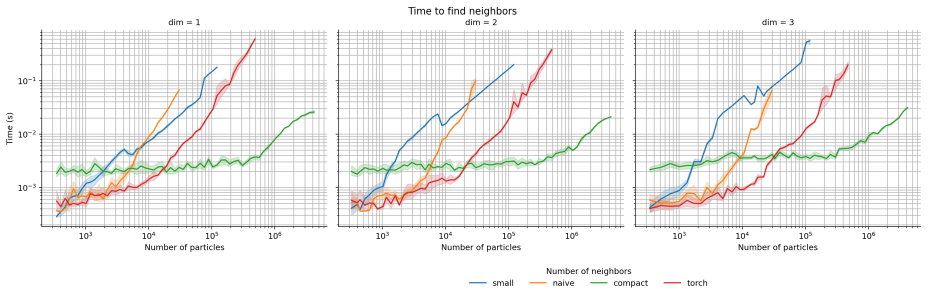
- [4.1 / Figure 2] The text reports O(n) scaling for the solver and O(n log n) for the neighborhood search due to the sort operation, but Figure 2 presents the overall solver scaling as linear. The sentence should clarify that the neighborhood search cost is negligible in the tested regime, otherwise the apparent contradiction is confusing.
Circularity Check
No significant circularity: diffSPH's differentiable-SPH claims are supported by independent forward validation and explicit loss-based demonstrations, not by self-referential reductions.
full rationale
The paper's forward solver is validated in Appendix E against external references (e.g., Frontiere et al. for the linear-wave and Sod-shock cases, Sun et al. for the oscillating droplet, and Bender & Koschier for DFSPH), so the physical correctness of the differentiable core does not rest on the authors' own prior outputs. The inverse-problem demonstrations in Sec. 4.2 generate reference states with the same forward solver, but this is a standard gradient-correctness and adjoint check rather than a fitted prediction: the optimized quantities (initial mass noise, adiabatic constant gamma) are not closed-form functions of the loss, and the loss is evaluated through full unrolled trajectories of hundreds of steps. Sec. 4.3 optimizes a geometric source position against a target-point amplitude, and Sec. 4.4 trains a GNN corrector against an RK4 trajectory and evaluates on an unseen rollout; both have independent target data. Sec. 4.5 minimizes well-defined SPH-operator losses (Eqs. 21, 23, 24) with respect to particle positions; the resulting distributions are minima of those explicit losses, so they are definitional demonstrations of gradient-based optimization rather than disguised predictions. The self-citations that appear (e.g., [38], [62], [68]) support implementation details such as neighbor search, boundary handling, and memory structures; they are not load-bearing for the central differentiability claim. The mismatch between the abstract's 'particle shifting' wording and Sec. 4.5's initial-condition optimization is a scope and claims issue, not circularity, and the omitted regularization weight in Sec. 4.5.2 is a reproducibility gap rather than evidence of a circular derivation.
Assumptions & free parameters
free parameters (3)
- Particle shifting regularization coefficient and distance fraction =
not reported
- Loss weights for density, gradient, and regularization terms =
not reported
- Wave optimization target amplitude (value 5) =
5
assumptions (4)
- domain assumption SPH discretizations of the Navier-Stokes equations using compact kernels converge to the PDE solutions for the tested regimes
- standard math Kernel functions follow the Dehnen-Aly form and possess a well-defined Hessian extension at zero separation
- domain assumption Reference benchmark results from Frontiere et al. [44] and Sun et al. [41,88] are correct and accurately represent the expected physics
- ad hoc to paper Reverse-mode automatic differentiation with checkpointing and recomputation computes exact gradients of the discretized forward pass
Cite this review
Pith. "Pith review of diffSPH: Differentiable Smoothed Particle Hydrodynamics for Adjoint Optimization and Machine Learning." pith.science (2026). https://pith.science/paper/CPHLIEWJ
@misc{pith2026250721684,
  author       = {Pith},
  title        = {Pith review of: diffSPH: Differentiable Smoothed Particle Hydrodynamics for Adjoint Optimization and Machine Learning},
  year         = {2026},
  howpublished = {\url{https://pith.science/paper/CPHLIEWJ}},
  note         = {Machine review of arXiv:2507.21684}
}
read the original abstract
We present diffSPH, a novel open-source differentiable Smoothed Particle Hydrodynamics (SPH) framework developed entirely in PyTorch with GPU acceleration. diffSPH is designed centrally around differentiation to facilitate optimization and machine learning (ML) applications in Computational Fluid Dynamics~(CFD), including training neural networks and the development of hybrid models. Its differentiable SPH core, and schemes for compressible (with shock capturing and multi-phase flows), weakly compressible (with boundary handling and free-surface flows), and incompressible physics, enable a broad range of application areas. We demonstrate the framework's unique capabilities through several applications, including addressing particle shifting via a novel, target-oriented approach by minimizing physical and regularization loss terms, a task often intractable in traditional solvers. Further examples include optimizing initial conditions and physical parameters to match target trajectories, shape optimization, implementing a solver-in-the-loop setup to emulate higher-order integration, and demonstrating gradient propagation through hundreds of full simulation steps. Prioritizing readability, usability, and extensibility, this work offers a foundational platform for the CFD community to develop and deploy novel neural networks and adjoint optimization applications.
Figures


Figures from the paper (22 more)


Forward citations
Cited by 1 Pith paper
-
Neural Particle Automata: Learning Self-Organizing Particle Dynamics
NPA trains a shared neural rule on dynamic particles using SPH-based local perception, extending Neural Cellular Automata off the grid.
Reference graph
Works this paper leans on
-
[41]
A consistent approach to particle shifting in the δ-plus-sph model
PengNan Sun, Andrea Colagrossi, Salvatore Marrone, M Antuono, and A-M Zhang. A consistent approach to particle shifting in the δ-plus-sph model. Computer Methods in Applied Mechanics and Engineering, 348:912–934, 2019
work page 2019
-
[42]
Implicit iterative particle shifting for meshless numerical schemes using kernel basis functions
P Rastelli, R Vacondio, JC Marongiu, G Fourtakas, and Benedict D Rogers. Implicit iterative particle shifting for meshless numerical schemes using kernel basis functions. Computer Methods in Applied Mechanics and Engineering , 393:114716, 2022
work page 2022
-
[1]
Smoothed particle hydrodynamics: theory and application to non-spherical stars
Robert A Gingold and Joseph J Monaghan. Smoothed particle hydrodynamics: theory and application to non-spherical stars. Monthly notices of the royal astronomical society , 181(3):375–389, 1977
1977
-
[2]
Smoothed particle hydrodynamics in astrophysics
Volker Springel. Smoothed particle hydrodynamics in astrophysics. Annual Review of Astronomy and Astrophysics, 48(1):391–430, 2010
2010
-
[3]
Smoothed particle hydrodynamics (sph) for complex fluid flows: Recent developments in methodology and applications
Ting Ye, Dingyi Pan, Can Huang, and Moubin Liu. Smoothed particle hydrodynamics (sph) for complex fluid flows: Recent developments in methodology and applications. Physics of Fluids , 31(1), 2019
2019
-
[4]
A survey on sph methods in computer graphics
Dan Koschier, Jan Bender, Barbara Solenthaler, and Matthias Teschner. A survey on sph methods in computer graphics. In Computer graphics forum , volume 41, pages 737–760, 2022
2022
-
[5]
Rogers, and Antonio Souto-Iglesias
Renato Vacondio, Corrado Altomare, Matthieu De Leffe, Xiangyu Hu, David Le Touz´ e, Steven Lind, Jean-Christophe Marongiu, Salvatore Marrone, Benedict D. Rogers, and Antonio Souto-Iglesias. Grand challenges for Smoothed Particle Hydrodynamics numerical schemes. Computational Particle Mechan- ics, 8(3):575–588, May 2021
2021
-
[6]
Imagenet: A large-scale hierarchical image database
Jia Deng, Wei Dong, Richard Socher, Li-Jia Li, Kai Li, and Li Fei-Fei. Imagenet: A large-scale hierarchical image database. In 2009 IEEE conference on computer vision and pattern recognition , pages 248–255. Ieee, 2009
2009
Show all 88 references
-
[7]
Improving language under- standing by generative pre-training
Alec Radford, Karthik Narasimhan, Tim Salimans, Ilya Sutskever, et al. Improving language under- standing by generative pre-training. Technical report, OpenAI, 2018
2018
-
[8]
Mastering the game of go without human knowledge
David Silver, Julian Schrittwieser, Karen Simonyan, Ioannis Antonoglou, Aja Huang, Arthur Guez, Thomas Hubert, Lucas Baker, Matthew Lai, Adrian Bolton, et al. Mastering the game of go without human knowledge. nature, 550(7676):354–359, 2017
2017
-
[9]
Deep learning, volume 1
Ian Goodfellow, Yoshua Bengio, Aaron Courville, and Yoshua Bengio. Deep learning, volume 1. MIT Press, 2016
2016
-
[10]
Highly accurate protein structure prediction with alphafold
John Jumper, Richard Evans, Alexander Pritzel, Tim Green, Michael Figurnov, Olaf Ronneberger, Kathryn Tunyasuvunakool, Russ Bates, Augustin ˇZ ´ ıdek, Anna Potapenko, et al. Highly accurate protein structure prediction with alphafold. nature, 596(7873):583–589, 2021
2021
-
[11]
phiflow: A differentiable pde solving framework for deep learning via physical simulations
Philipp Holl, Vladlen Koltun, Kiwon Um, and Nils Thuerey. phiflow: A differentiable pde solving framework for deep learning via physical simulations. In NeurIPS workshop , volume 2, 2020
2020
-
[12]
Difftaichi: Differentiable programming for physical simulation
Yuanming Hu, Luke Anderson, Tzu-Mao Li, Qi Sun, Nathan Carr, Jonathan Ragan-Kelley, and Fr´ edo Durand. Difftaichi: Differentiable programming for physical simulation. arXiv preprint arXiv:1910.00935, 2019. 46
1910 arXiv
-
[13]
Apebench: A benchmark for autoregressive neural emulators of pdes
Felix Koehler, Simon Niedermayr, Nils Thuerey, et al. Apebench: A benchmark for autoregressive neural emulators of pdes. Advances in Neural Information Processing Systems , 37:120252–120310, 2024
2024
-
[14]
Pytorch: An imperative style, high-performance deep learning library, 2019
Adam Paszke, Sam Gross, Francisco Massa, Adam Lerer, James Bradbury, Gregory Chanan, Trevor Killeen, Zeming Lin, Natalia Gimelshein, Luca Antiga, Alban Desmaison, Andreas Kopf, Edward Yang, Zachary DeVito, Martin Raison, Alykhan Tejani, Sasank Chilamkurthy, Benoit Steiner, Lu ...
2019
-
[15]
JAX: composable transformations of Python+NumPy programs, 2018
James Bradbury, Roy Frostig, Peter Hawkins, Matthew James Johnson, Chris Leary, Dougal Maclaurin, George Necula, Adam Paszke, Jake VanderPlas, Skye Wanderman-Milne, and Qiao Zhang. JAX: composable transformations of Python+NumPy programs, 2018
2018
-
[16]
Universal physics transformers
Benedikt Alkin, Andreas F¨ urst, Simon Schmid, Lukas Gruber, Markus Holzleitner, and Johannes Brand- stetter. Universal physics transformers. NeurIPS, 2024
2024
-
[17]
Symmetric basis convolutions for learning lagrangian fluid me- chanics
Rene Winchenbach and Nils Thuerey. Symmetric basis convolutions for learning lagrangian fluid me- chanics. In 12th International Conference on Learning Representations, ICLR , 2024
2024
-
[18]
Physics- informed neural networks (pinns) for fluid mechanics: A review, 2021
Shengze Cai, Zhiping Mao, Zhicheng Wang, Minglang Yin, and George Em Karniadakis. Physics- informed neural networks (pinns) for fluid mechanics: A review, 2021
2021
-
[19]
Solver-in-the-loop: Learning from differentiable physics to interact with iterative pde-solvers
Kiwon Um, Robert Brand, Yun Fei, Philipp Holl, and Nils Thuerey. Solver-in-the-loop: Learning from differentiable physics to interact with iterative pde-solvers. In Advances in Neural Information Processing Systems 33, 2020
2020
-
[20]
Adjoint sys- tem method in shape optimization of some typical fluid flow patterns
Alexis Courtais, Fran¸ cois Lesage, Yannick Privat, Pascal Frey, and Abder-Razak Latifi. Adjoint sys- tem method in shape optimization of some typical fluid flow patterns. In Computer Aided Chemical Engineering, volume 46, pages 871–876. Elsevier, 2019
2019
-
[21]
Deep learning methods for reynolds-averaged navier–stokes simulations of airfoil flows
Nils Thuerey, Konstantin Weißenow, Lukas Prantl, and Xiangyu Hu. Deep learning methods for reynolds-averaged navier–stokes simulations of airfoil flows. AIAA journal , 58(1):25–36, 2020
2020
-
[22]
Simulating cosmic structure formation with the gadget-4 code
Volker Springel, R¨ udiger Pakmor, Oliver Zier, and Martin Reinecke. Simulating cosmic structure formation with the gadget-4 code. Monthly Notices of the Royal Astronomical Society , 506(2):2871– 2949, 2021
2021
-
[23]
A new class of accurate, mesh-free hydrodynamic simulation methods
Philip F Hopkins. A new class of accurate, mesh-free hydrodynamic simulation methods. Monthly Notices of the Royal Astronomical Society , 450(1):53–110, 2015
2015
-
[24]
Swift: Sph with inter-dependent fine-grained tasking.Astrophysics source code library, pages ascl–1805, 2018
Matthieu Schaller, Pedro Gonnet, Peter W Draper, Aidan BG Chalk, Richard G Bower, James Willis, and Lo ¨ ıc Hausammann. Swift: Sph with inter-dependent fine-grained tasking.Astrophysics source code library, pages ascl–1805, 2018
2018
-
[25]
A smoothed particle hydrodynamics mini-app for exascale
Aur´ elien Cavelan, Rub´ en M Cabez´ on, Michal Grabarczyk, and Florina M Ciorba. A smoothed particle hydrodynamics mini-app for exascale. In Proceedings of the Platform for Advanced Scientific Computing Conference, pages 1–11, 2020. 47
2020
-
[26]
Dualsphysics: from fluid dynamics to multiphysics problems
Jose M Dom ´ ınguez, Georgios Fourtakas, Corrado Altomare, Ricardo B Canelas, Angelo Tafuni, Or- lando Garc ´ ıa-Feal, Ivan Mart ´ ınez-Est´ evez, Athanasios Mokos, Renato Vacondio, Alejandro JC Crespo, et al. Dualsphysics: from fluid dynamics to multiphysics problems. Computa...
2022
-
[27]
Sphinxsys: An open-source multi-physics and multi-resolution library based on smoothed particle hydrodynamics
Chi Zhang, Massoud Rezavand, Yujie Zhu, Yongchuan Yu, Dong Wu, Wenbin Zhang, Jianhang Wang, and Xiangyu Hu. Sphinxsys: An open-source multi-physics and multi-resolution library based on smoothed particle hydrodynamics. Computer Physics Communications , 267:108066, 2021
2021
-
[28]
Dinesh, Dileep Menon, Rahul Govind, Suraj Sanka, Amal S
Prabhu Ramachandran, Aditya Bhosale, Kunal Puri, Pawan Negi, Abhinav Muta, A. Dinesh, Dileep Menon, Rahul Govind, Suraj Sanka, Amal S. Sebastian, Ananyo Sen, Rohan Kaushik, Anshuman Kumar, Vikas Kurapati, Mrinalgouda Patil, Deep Tavker, Pankaj Pandey, Chandrashekhar Kaushik, A...
2021
-
[29]
SPlisHSPlasH Library
Jan Bender et al. SPlisHSPlasH Library
-
[30]
Jax-sph: A differentiable smoothed particle hydrodynamics framework
Artur P Toshev, Harish Ramachandran, Jonas A Erbesdobler, Gianluca Galletti, Johannes Brandstet- ter, and Nikolaus A Adams. Jax-sph: A differentiable smoothed particle hydrodynamics framework. arXiv preprint arXiv:2403.04750 , 2024
2024 arXiv
-
[31]
Difffr: Differentiable sph-based fluid-rigid coupling for rigid body control
Zhehao Li, Qingyu Xu, Xiaohan Ye, Bo Ren, and Ligang Liu. Difffr: Differentiable sph-based fluid-rigid coupling for rigid body control. ACM Trans. Graph., 42(6), December 2023
2023
-
[32]
Warp: A high-performance python framework for gpu simulation and graphics
Miles Macklin. Warp: A high-performance python framework for gpu simulation and graphics. https: //github.com/nvidia/warp, March 2022. NVIDIA GPU Technology Conference (GTC)
2022
-
[33]
Lagrangebench: A lagrangian fluid mechanics benchmarking suite
Artur Toshev, Gianluca Galletti, Fabian Fritz, Stefan Adami, and Nikolaus Adams. Lagrangebench: A lagrangian fluid mechanics benchmarking suite. Advances in Neural Information Processing Systems , 36:64857–64884, 2023
2023
-
[34]
Smoothed particle hydrodynamics and magnetohydrodynamics
Daniel J Price. Smoothed particle hydrodynamics and magnetohydrodynamics. Journal of Computa- tional Physics , 231(3):759–794, 2012
2012
-
[35]
Smoothed particle hydrodynamics
Joe J Monaghan. Smoothed particle hydrodynamics. Reports on progress in physics , 68(8):1703, 2005
2005
-
[36]
Improving convergence in smoothed particle hydrodynamics simula- tions without pairing instability
Walter Dehnen and Hossam Aly. Improving convergence in smoothed particle hydrodynamics simula- tions without pairing instability. Monthly Notices of the Royal Astronomical Society , 425(2):1068–1082, 2012
2012
-
[37]
Implicit incompressible sph
Markus Ihmsen, Jens Cornelis, Barbara Solenthaler, Christopher Horvath, and Matthias Teschner. Implicit incompressible sph. IEEE transactions on visualization and computer graphics , 20(3):426–435, 2013
2013
-
[38]
Multi-level memory structures for simulating and rendering smoothed particle hydrodynamics
Rene Winchenbach and Andreas Kolb. Multi-level memory structures for simulating and rendering smoothed particle hydrodynamics. Comput. Graph. Forum, 39(6):527–541, 2020
2020
-
[39]
Asph modeling of material damage and failure
Michael Owen. Asph modeling of material damage and failure. Technical report, Lawrence Livermore National Lab.(LLNL), Livermore, CA (United States), 2010. 48
2010
-
[40]
A method of calculating radiative heat diffusion in particle simulations
Leigh Brookshaw. A method of calculating radiative heat diffusion in particle simulations. Publications of the Astronomical Society of Australia , 6(2):207–210, 1985
1985
-
[43]
δ-sph model for simulating violent impact flows
Salvatore Marrone, MAGD Antuono, A Colagrossi, G Colicchio, D Le Touz´ e, and G Graziani. δ-sph model for simulating violent impact flows. Computer Methods in Applied Mechanics and Engineering , 200(13-16), 2011
2011
-
[44]
Crksph–a conservative reproducing kernel smoothed particle hydrodynamics scheme
Nicholas Frontiere, Cody D Raskin, and J Michael Owen. Crksph–a conservative reproducing kernel smoothed particle hydrodynamics scheme. Journal of Computational Physics , 332:160–209, 2017
2017
-
[45]
Learning to control pdes with differentiable physics
Philipp Holl, Vladlen Koltun, and Nils Thuerey. Learning to control pdes with differentiable physics. International Conference on Learning Representation (ICLR) , 2020
2020
-
[46]
Numerical investigation of minimum drag profiles in laminar flow using deep learning surrogates
Li-Wei Chen, Berkay A Cakal, Xiangyu Hu, and Nils Thuerey. Numerical investigation of minimum drag profiles in laminar flow using deep learning surrogates. Journal of Fluid Mechanics, 919:A34, 2021
2021
-
[47]
Adjoint sensitivity analysis for differential- algebraic equations: The adjoint dae system and its numerical solution
Yang Cao, Shengtai Li, Linda Petzold, and Radu Serban. Adjoint sensitivity analysis for differential- algebraic equations: The adjoint dae system and its numerical solution. SIAM journal on scientific computing, 24(3):1076–1089, 2003
2003
-
[48]
A unifying mathematical definition of particle methods
Johannes Pahlke and Ivo F Sbalzarini. A unifying mathematical definition of particle methods. IEEE Open Journal of the Computer Society , 4:97–108, 2023
2023
-
[49]
Thuerey, B
N. Thuerey, B. Holzschuh, P. Holl, G. Kohl, M. Lino, Q. Liu, P. Schnell, and F. Trost. Physics-based Deep Learning. WWW, 2021
2021
-
[50]
The δ-ale-sph model: An arbitrary lagrangian- eulerian framework for the δ-sph model with particle shifting technique
M Antuono, PN Sun, S Marrone, and A Colagrossi. The δ-ale-sph model: An arbitrary lagrangian- eulerian framework for the δ-sph model with particle shifting technique. Computers & Fluids , 216:104806, 2021
2021
-
[51]
Numerical diffusive terms in weakly- compressible sph schemes
Matteo Antuono, Andrea Colagrossi, and Salvatore Marrone. Numerical diffusive terms in weakly- compressible sph schemes. Computer Physics Communications , 183(12):2570–2580, 2012
2012
-
[52]
Divergence-free smoothed particle hydrodynamics
Jan Bender and Dan Koschier. Divergence-free smoothed particle hydrodynamics. In Proceedings of the 14th ACM SIGGRAPH/Eurographics symposium on computer animation , pages 147–155, 2015
2015
-
[53]
Incompressible sph method for simulating newtonian and non- newtonian flows with a free surface
Songdong Shao and Edmond YM Lo. Incompressible sph method for simulating newtonian and non- newtonian flows with a free surface. Advances in water resources, 26(7):787–800, 2003
2003
-
[54]
An optimized source term formulation for incompressible sph
Jens Cornelis, Jan Bender, Christoph Gissler, Markus Ihmsen, and Matthias Teschner. An optimized source term formulation for incompressible sph. The Visual Computer , 35(4):579–590, 2019. 49
2019
-
[55]
A compatibly differenced total energy conserving form of sph
J Michael Owen. A compatibly differenced total energy conserving form of sph. International Journal for Numerical Methods in Fluids , 75(11):749–774, 2014
2014
-
[56]
Cosmological smoothed particle hydrodynamics simulations: the entropy equation
Volker Springel and Lars Hernquist. Cosmological smoothed particle hydrodynamics simulations: the entropy equation. Monthly Notices of the Royal Astronomical Society , 333(3):649–664, 2002
2002
-
[57]
Conduction modelling using smoothed particle hydrodynamics
Paul W Cleary and Joseph J Monaghan. Conduction modelling using smoothed particle hydrodynamics. Journal of Computational Physics , 148(1):227–264, 1999
1999
-
[58]
Sph compressible turbulence
Joseph J Monaghan. Sph compressible turbulence. Monthly Notices of the Royal Astronomical Society , 335(3):843–852, 2002
2002
-
[59]
Von neumann stability analysis of smoothed particle hydrodynamics—suggestions for optimal algorithms
Dinshaw S Balsara. Von neumann stability analysis of smoothed particle hydrodynamics—suggestions for optimal algorithms. Journal of Computational Physics , 121(2):357–372, 1995
1995
-
[60]
Inviscid smoothed particle hydrodynamics
Lee Cullen and Walter Dehnen. Inviscid smoothed particle hydrodynamics. Monthly Notices of the Royal Astronomical Society, 408(2):669–683, 2010
2010
-
[61]
A general class of lagrangian smoothed particle hydrodynamics methods and implica- tions for fluid mixing problems
Philip F Hopkins. A general class of lagrangian smoothed particle hydrodynamics methods and implica- tions for fluid mixing problems. Monthly Notices of the Royal Astronomical Society , 428(4):2840–2856, 2013
2013
-
[62]
Semi-analytic boundary handling below particle resolution for smoothed particle hydrodynamics
Rene Winchenbach, Rustam Akhunov, and Andreas Kolb. Semi-analytic boundary handling below particle resolution for smoothed particle hydrodynamics. ACM Trans. Graph., 39(6), 2020
2020
-
[63]
Modified dynamic boundary conditions (mdbc) for general-purpose smoothed particle hydrodynamics (sph): Application to tank sloshing, dam break and fish pass problems
Aaron English, JM Dom ´ ınguez, Renato Vacondio, AJC Crespo, PK Stansby, SJ Lind, Luca Chiapponi, and M G´ omez-Gesteira. Modified dynamic boundary conditions (mdbc) for general-purpose smoothed particle hydrodynamics (sph): Application to tank sloshing, dam break and fish pas...
2022
-
[64]
Particle-based fluid simulation for interactive applications
Matthias M¨ uller, David Charypar, and Markus Gross. Particle-based fluid simulation for interactive applications. In Proceedings of the 2003 ACM SIGGRAPH/Eurographics symposium on Computer animation, pages 154–159, 2003
2003
-
[65]
Eulerian incompressible smoothed particle hydrodynamics on multiple gpus.Computer Physics Communications, 273:108263, 2022
Joseph O’connor, Jos´ e M Dom ´ ınguez, Benedict D Rogers, Steven J Lind, and Peter K Stansby. Eulerian incompressible smoothed particle hydrodynamics on multiple gpus.Computer Physics Communications, 273:108263, 2022
2022
-
[66]
Mls pressure boundaries for divergence-free and viscous sph fluids
Stefan Band, Christoph Gissler, Andreas Peer, and Matthias Teschner. Mls pressure boundaries for divergence-free and viscous sph fluids. Computers & Graphics , 76:37–46, 2018
2018
-
[67]
An improved non-reflecting outlet boundary condition for weakly-compressible sph
Pawan Negi, Prabhu Ramachandran, and Asmelash Haftu. An improved non-reflecting outlet boundary condition for weakly-compressible sph. Computer Methods in Applied Mechanics and Engineering , 367:113119, 2020
2020
-
[68]
Multi-level-memory structures for adaptive SPH simulations
Rene Winchenbach and Andreas Kolb. Multi-level-memory structures for adaptive SPH simulations. In 24th International Symposium on Vision, Modeling, and Visualization, VMV 2019 , pages 99–107. Eurographics Association, 2019. 50
2019
-
[69]
A hybrid framework for fluid flow simulations: Combining sph with machine learning
Rene Winchenbach and Nils Thuerey. A hybrid framework for fluid flow simulations: Combining sph with machine learning. In SPHERIC 2023 , 2023
2023
-
[70]
Splinecnn: Fast geometric deep learning with continuous b-spline kernels
Matthias Fey, Jan Eric Lenssen, Frank Weichert, and Heinrich M¨ uller. Splinecnn: Fast geometric deep learning with continuous b-spline kernels. In Proceedings of the IEEE conference on computer vision and pattern recognition, pages 869–877, 2018
2018
-
[71]
Efficient coding of the minimum image convention
Ulrich K Deiters. Efficient coding of the minimum image convention. Zeitschrift f¨ ur Physikalische Chemie, 227(2-3):345–352, 2013
2013
-
[72]
Constrained neighbor lists for sph-based fluid simulations
Rene Winchenbach, Hendrik Hochstetter, and Andreas Kolb. Constrained neighbor lists for sph-based fluid simulations. In Barbara Solenthaler, Matthias Teschner, Ladislav Kavan, and Chris Wojtan, edi- tors, Proceedings of the ACM SIGGRAPH/Eurographics Symposium on Computer Anima...
2016
-
[73]
Lawrence Livermore National Laboratory. Spheral. https://github.com/LLNL/spheral, 2024. Ac- cessed: May 22, 2025
2024
-
[74]
The complexity of partial derivatives
Walter Baur and Volker Strassen. The complexity of partial derivatives. Theoretical Computer Science, 22(3):317–330, 1983
1983
-
[75]
Kingma and Jimmy Ba
Diederik P. Kingma and Jimmy Ba. Adam: A method for stochastic optimization. In Yoshua Bengio and Yann LeCun, editors, 3rd International Conference on Learning Representations, ICLR , 2015
2015
-
[76]
Learnable fourier features for multi- dimensional spatial positional encoding
Yang Li, Si Si, Gang Li, Cho-Jui Hsieh, and Samy Bengio. Learnable fourier features for multi- dimensional spatial positional encoding. Advances in Neural Information Processing Systems, 34:15816– 15829, 2021
2021
-
[77]
Smith, Ayya Alieva, Qing Wang, Michael P
Dmitrii Kochkov, Jamie A. Smith, Ayya Alieva, Qing Wang, Michael P. Brenner, and Stephan Hoyer. Machine learning–accelerated computational fluid dynamics. Proceedings of the National Academy of Sciences, 118(21):e2101784118, 2021
2021
-
[78]
Worrall, and Max Welling
Johannes Brandstetter, Daniel E. Worrall, and Max Welling. Message passing neural PDE solvers. In The Tenth International Conference on Learning Representations, ICLR . OpenReview.net, 2022
2022
-
[79]
Fourier features let networks learn high frequency functions in low dimensional domains
Matthew Tancik, Pratul Srinivasan, Ben Mildenhall, Sara Fridovich-Keil, Nithin Raghavan, Utkarsh Singhal, Ravi Ramamoorthi, Jonathan Barron, and Ren Ng. Fourier features let networks learn high frequency functions in low dimensional domains. Advances in neural information proc...
2020
-
[80]
Differentiability in unrolled training of neural physics simulators on transient dynamics
Bjoern List, Li-Wei Chen, Kartik Bali, and Nils Thuerey. Differentiability in unrolled training of neural physics simulators on transient dynamics. Computer Methods in Applied Mechanics and Engineering , 433:117441, 2025
2025
-
[81]
Diehl, G
S. Diehl, G. Rockefeller, C. L. Fryer, D. Riethmiller, and T. S. Statler. Generating optimal initial conditions for smoothed particle hydrodynamics simulations. Publications of the Astronomical Society of Australia, 32:e048, 2015. 51
2015
-
[82]
Infinite continuous adaptivity for incom- pressible SPH
Rene Winchenbach, Hendrik Hochstetter, and Andreas Kolb. Infinite continuous adaptivity for incom- pressible SPH. ACM Trans. Graph., 36(4):102:1–102:10, 2017
2017
-
[83]
Fast and accurate sph modelling of 3d complex wall boundaries in viscous and non viscous flows
Laurent Chiron, Matthieu De Leffe, Guillaume Oger, and David Le Touz´ e. Fast and accurate sph modelling of 3d complex wall boundaries in viscous and non viscous flows. Computer Physics Commu- nications, 234:93–111, 2019
2019
-
[84]
Versatile rigid-fluid coupling for incompressible sph
Nadir Akinci, Markus Ihmsen, Gizem Akinci, Barbara Solenthaler, and Matthias Teschner. Versatile rigid-fluid coupling for incompressible sph. ACM Transactions on Graphics (TOG) , 31(4):1–8, 2012
2012
-
[85]
Unified semi-analytical wall boundary conditions applied to 2-d incompressible sph
Agn` es Leroy, Damien Violeau, Martin Ferrand, and Christophe Kassiotis. Unified semi-analytical wall boundary conditions applied to 2-d incompressible sph. Journal of Computational Physics, 261:106–129, 2014
2014
-
[86]
J. Liu. Fuzzy modularity and fuzzy community structure in networks. Eur. Phys. J. B. , 77:547–557, 2010
2010
-
[87]
Simulating free surface flows with sph
Joe J Monaghan. Simulating free surface flows with sph. Journal of computational physics , 110(2), 1994
1994
-
[88]
P.N. Sun, A. Colagrossi, S. Marrone, and A.M. Zhang. The δplus-sph model: Simple procedures for a further improvement of the sph scheme. Computer Methods in Applied Mechanics and Engineering , 315:25–49, 2017. 52
2017
Reviewed August 6, 2026 · model on record in the stance chip above.
Discussion (0). Sign in to comment.