REVIEW 4 major objections 6 minor 56 references
IAP: Invisible Adversarial Patch Attack through Perceptibility-Aware Localization and Perturbation Optimization
T0 review · 4 major / 6 minor · reviewed 2026-08-06 · deepseek-v4-flash
Pith's one-line read IAP shows that targeted adversarial patch attacks can be both highly successful and nearly invisible to humans by placing patches via a perceptibility-aware localization score and optimizing them with color-constancy updates.
desk verdict A well-engineered patch attack with impressive objective stealth, but the human-invisibility claim needs a proper user study before I'd trust it. read the letter →
The pith
A machine-rendered reading of the paper's core claim, the machinery that carries it, and where it could break.
The reading
What carries the argument
The load-bearing object is the perturbation priority index $G(x;i,j)$ (Eq. 3), which combines a Grad-CAM class localization map $J_y(x)$ and a human-visual sensitivity map $\mathrm{Sens}(x) = 1/(\sigma_{ij}+\lambda)$, where $\sigma_{ij}$ is the square root of the minimum of horizontal and vertical standard deviations at that pixel (Eq. 6). The index selects where to put the patch: high $J_y$ makes the model easy to fool there, and low $\mathrm{Sens}$ (i.e., high local variance) means humans can tolerate bigger changes. The optimization then uses a sensitivity-weighted perceptual distance $D$ (Eq. 7) as a regularizer in the loss (Eq. 8), and a gradient update (Eq. 9) that averages the gradient over color channels and divides by $\mathrm{Sens}$, which preserves each pixel's base color while letting perturbations accumulate in textured areas.
What would settle it
A human study in which at least 100 non-expert participants view single full-resolution images (no clean/adversarial pairs) at a fixed duration, with patches placed in textured regions chosen by IAP, would settle the invisibility claim if detection rates substantially exceed the 4.2% reported in the paper's paired, ML-expert study.
Extended reading notes
Core claim
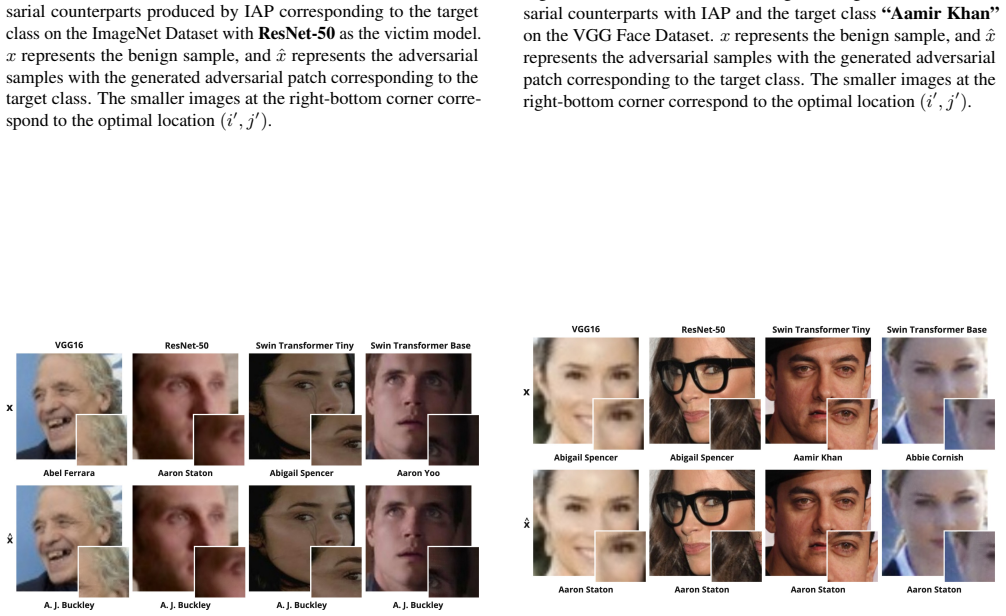
The central discovery is that targeted adversarial patch attacks need not sacrifice imperceptibility: a patch covering 14% of the image can reliably mislead the model while being effectively invisible. The method, IAP, first computes a perturbation priority index $G(x;i,j)$ for every candidate patch location, defined as the sum over the patch window of the ratio between a Grad-CAM class localization map $J_y$ and a sensitivity map $\mathrm{Sens}$ based on local variance (Eq. 3–6). It then optimizes the patch by minimizing a targeted cross-entropy loss balanced against a ground-truth loss and a perceptibility distance $D$ (Eq. 7–8), using an update rule that divides the gradient by the sensitivity map and averages across color channels so the base color of each pixel is preserved (Eq. 9). The result is a patch whose perturbations are concentrated in high-texture regions and whose channel-averaged updates keep it contextually coherent, achieving targeted attack success rates above 98% across four architectures on ImageNet and VGG Face while attaining the lowest LPIPS and highest SSIM among compared attacks.
Load-bearing premise
The assumption that the sensitivity map—based on local variance and channel-averaged updates—fully captures human imperceptibility is the load-bearing premise, and the paper's own Section 7 admits individual pixels can become unnaturally bright or dark, leaving the 28-participant, 10-image user study as the only direct evidence that this does not matter in practice.
Editorial extensions
If this is right
- Targeted patch attacks no longer require visibly artificial patches; a 14% patch can be nearly indistinguishable from the host image while forcing the target class with more than 98% success across CNN and Transformer architectures.
- Saliency-based defenses that search for the patch's attention peak will often fail: Grad-CAM attention does not overlap the patch for about 70% of IAP samples, and post-defense attack success stays above 78% against all six tested defenses.
- The method extrapolates beyond ImageNet: on VGG Face, targeted attack success stays above 94% with local LPIPS at or below 0.28, indicating that the invisibility is not dataset-specific.
- Patch shape and physical-world settings are compatible: a circular patch at 11% area reaches 99.2% attack success with LPIPS 0.085, and printed patches achieve 70% average success in physical tests.
- Because larger patches improve imperceptibility, patch size is no longer a reliable proxy for detectability, so defenses must look for subtler statistical anomalies rather than raw saliency.
Reading between the lines
- If the invisibility claim rests on local variance and base-color preservation, a natural next test is whether patches remain invisible when the surrounding region has unusual texture statistics or repeated patterns; the sensitivity map may underestimate human sensitivity to global texture coherence.
- The same localization-optimization split could be transferred to other explanation maps (e.g., integrated gradients) or to patch shapes tuned by the optimization, potentially improving black-box transferability beyond the reported NES-based variant.
- The color-constancy update rule suggests a general recipe for any perturbation method: restrict updates to brightness and saturation changes while keeping hue, which may reduce detectability of other attacks like watermarking or attribute editing.
- The paper's own Section 7 concedes that individual pixels can become unnaturally bright or dark; a frequency-domain analysis of the patch region may reveal high-frequency spikes that a rival defense could exploit even when local LPIPS is low.
Editorial analysis
A structured set of objections, weighed in public.
Referee Report
Summary. The paper proposes IAP, a targeted adversarial patch attack that jointly optimizes patch placement and perturbation content for imperceptibility. Placement is determined by maximizing a perturbation priority index built from a Grad-CAM class localization map and a local-variance-based sensitivity map; content is optimized with a cross-entropy-based loss augmented by a perceptibility distance term and a color-preserving multiplicative update rule. Experiments on ImageNet and VGG Face across four architectures report high targeted ASR (94--100%) and substantially lower local LPIPS/SSIM distortion than existing baselines, and the attack is reported to evade six patch defenses with post-defense ASR between 78.6% and 100%. A user study with 28 participants reports a 4.2% detection rate for IAP. The code is released.
Significance. If the claims hold, IAP is a notable advance: it demonstrates that targeted adversarial patch attacks can achieve both high success and low perceptual distortion. The method is precisely specified (Eqs. 3--9, Algorithm 1), the code is available, and the empirical comparison covers a wide range of settings (two datasets, four architectures, six defenses). The defense-avoidance results, particularly the 100% ASR against SAC, are striking. The black-box and physical-world extensions broaden the applicability. The main weakness is the evidence for human imperceptibility: the user study is small and underspecified, and the paper's own limitation section concedes a visible-artifact failure mode. Reproducibility is also hampered by missing hyperparameter values.
major comments (4)
- [§5.3] The human perceptibility study is underspecified and its results are implausibly low. The paper reports a 4.2% detection rate for IAP in a four-option forced-choice task, which is far below the 25% chance level, yet it provides no explanation for this below-chance performance (e.g., a response bias toward the 'Both clean' option). The study does not state how the 10 IAP images were selected, which victim model and target class produced them, whether the clean/adversarial order was randomized and counterbalanced, whether viewing was time-limited, or the exact instructions. Additionally, all 28 participants had an ML background and 82% were familiar with adversarial examples, making them a high-vigilance population. Since the invisibility claim is a central contribution, this evidence is insufficient; the study should be redesigned with a larger, more diverse sample, more images, and full methodological detail.
- [§7] The conclusion's limitation statement concedes that 'individual pixels can become unnaturally bright or dark relative to their neighbors, reducing imperceptibility.' This is in direct tension with the abstract's blanket claim of 'highly invisible' patches. If such failure cases occur, a 4.2% detection rate from 10 selected study images may not generalize. Please either qualify the invisibility claim to exclude these cases or provide evidence, for example, a human evaluation that includes the worst-case images, about the frequency of this failure mode.
- [§5.1 / §4] The values of the key hyperparameters are never reported. The loss weights w1, w2, w3 in Eq. (8), the smoothing constant λ in Eq. (6), the learning rate η and stop threshold s in Algorithm 1, and the stride of the sliding window used in patch localization are all absent from the main text and Appendix A. Without these values, the experiments cannot be reproduced from the paper alone; please provide them in a dedicated table.
- [§6.2 / Table 24] The ablation on the regularization coefficient w3 shows only marginal changes in imperceptibility: local LPIPS ranges from 0.111 to 0.108 as w3 varies from 0 to 13, a difference likely within noise. The paper states that 'our proposed regularized loss and update rule contributes significantly' to imperceptibility, but the ablation indicates that the contribution is dominated by the update rule (Table 25, where Adam gives LPIPS 0.662 versus IAP's 0.070). Please either report a statistically meaningful effect of w3 on a larger set of images or revise the claim to reflect the ablation.
minor comments (6)
- [§5.4] The defense evaluation includes DiffPAD [10], which is co-authored by the second author. Please disclose this relationship in the experimental section for transparency.
- [Algorithm 1, line 6] The line 'Initialize δ0 ← x' is confusing because δ is described as a patch; clarify that the optimization variable is a full-image tensor whose masked region forms the patch.
- [Eq. (6)] Please define what 'standard deviation of the pixel across the color channels' means; it appears to be computed from a local neighborhood, but the neighborhood size is not specified.
- [Figure 4 caption] The caption reads 'Human perceptability study' but should be 'Human perceptibility study.'
- [§5.1 / §5.2] The paper states that optimization stops when the target confidence reaches 0.9, but Section 5.2 reports an average target confidence of 0.84 ± 0.03 on ImageNet. Please clarify how the average can be below the stopping threshold, for example, by including failed attacks in the average.
- [Table 23] In the patch-size ablation, the entry for a 6% patch reports local LPIPS of 0.024, which is lower than the values for 8% and 10% patches (0.183 and 0.152). This appears to be a typo or an anomaly that should be checked.
Circularity Check
No significant circularity: IAP's success and imperceptibility are evaluated on held-out data with external metrics, and no derivation step reduces to a fitted value or self-citation.
full rationale
The claimed chain is: (i) choose patch location by maximizing G = sum Jy/Sens (Eq. 3), where Jy is Grad-CAM (Eq. 5) and Sens is the reciprocal local standard deviation (Eq. 6); (ii) optimize patch pixels by minimizing a target/ground-truth cross-entropy loss plus a sensitivity-weighted L1 distance D (Eqs. 7-8); (iii) update with channel-averaged gradients scaled by delta/Sens (Eq. 9). These are construction equations, not predictions. The evaluation quantities reported in support of the headline claims are external: ASR is measured directly on the victim model (Eq. 10), LPIPS/SSIM are independent perceptual metrics, and the invisibility claim is checked by a 28-participant human study (Section 5.3). No constant is fitted to the test set and no reported number is algebraically identical to an optimized objective; the sensitivity map is an engineering proxy, not a definition of the reported outcome metrics. The paper's own Section 7 limitation (pixels can become unnaturally bright/dark) further confirms the proxy is approximate rather than circular. The only self-citation is DiffPAD [10], co-authored by the second author, used as one of six evaluated defenses; it is a benchmark, not a load-bearing premise, and the other five defenses are external. This is a transparency note, not circularity.
Assumptions & free parameters
free parameters (6)
- Loss weights w1, w2 (Eq. 8) =
not disclosed
- Regularization weight w3 (Eq. 8) =
not disclosed; ablated over 0 to 13
- Smoothing constant lambda (Eq. 6) =
"small value", not disclosed
- Step size eta and reinitialization schedule =
not disclosed; up to 3 reinitializations
- Attack stop threshold s =
0.9
- Patch size w x h =
84 x 84 pixels (14% of image)
assumptions (6)
- domain assumption The attacker has full access to victim model parameters and gradients (Section 3.1, Algorithm 1).
- domain assumption The Grad-CAM class localization map Jy (Eq. 5) identifies image regions where the model is most vulnerable to perturbation.
- domain assumption Human visual sensitivity is adequately modeled by the reciprocal of the minimum of horizontal and vertical local standard deviations (Eq. 6).
- domain assumption Preserving per-pixel base color (channel ratios) while changing brightness and saturation is sufficient for human imperceptibility.
- domain assumption The perceptual distance D(x, x-hat) (Eq. 7), a sensitivity-weighted L1 difference, is a valid regularizer for human invisibility.
- domain assumption Grad-CAM (Eqs. 4-5) is applicable without modification to Swin Transformer models, despite being designed for CNNs.
Cite this review
Pith. "Pith review of IAP: Invisible Adversarial Patch Attack through Perceptibility-Aware Localization and Perturbation Optimization." pith.science (2026). https://pith.science/paper/CQDHIQ2B
@misc{pith2026250706856,
  author       = {Pith},
  title        = {Pith review of: IAP: Invisible Adversarial Patch Attack through Perceptibility-Aware Localization and Perturbation Optimization},
  year         = {2026},
  howpublished = {\url{https://pith.science/paper/CQDHIQ2B}},
  note         = {Machine review of arXiv:2507.06856}
}
read the original abstract
Despite modifying only a small localized input region, adversarial patches can drastically change the prediction of computer vision models. However, prior methods either cannot perform satisfactorily under targeted attack scenarios or fail to produce contextually coherent adversarial patches, causing them to be easily noticeable by human examiners and insufficiently stealthy against automatic patch defenses. In this paper, we introduce IAP, a novel attack framework that generates highly invisible adversarial patches based on perceptibility-aware localization and perturbation optimization schemes. Specifically, IAP first searches for a proper location to place the patch by leveraging classwise localization and sensitivity maps, balancing the susceptibility of patch location to both victim model prediction and human visual system, then employs a perceptibility-regularized adversarial loss and a gradient update rule that prioritizes color constancy for optimizing invisible perturbations. Comprehensive experiments across various image benchmarks and model architectures demonstrate that IAP consistently achieves competitive attack success rates in targeted settings with significantly improved patch invisibility compared to existing baselines. In addition to being highly imperceptible to humans, IAP is shown to be stealthy enough to render several state-of-the-art patch defenses ineffective.
Figures


Figures from the paper (11 more)




Reference graph
Works this paper leans on
-
[1]
Inconspicuous adversarial patches for fooling image-recognition systems on mobile devices
Tao Bai, Jinqi Luo, and Jun Zhao. Inconspicuous adversarial patches for fooling image-recognition systems on mobile devices. IEEE Internet of Things Journal, 9(12):9515–9524,
-
[2]
Tom B Brown, Dandelion Man´e, Aurko Roy, Mart´ın Abadi, and Justin Gilmer. Adversarial patch. arXiv preprint arXiv:1712.09665, 2017. 1, 2, 3, 5, 7, 11
arXiv 2017
-
[3]
Chunshui Cao, Xianming Liu, Yi Yang, Yinan Yu, Jiang Wang, Zilei Wang, Yongzhen Huang, Liang Wang, Chang Huang, Wei Xu, et al. Look and think twice: Capturing top-down visual attention with feedback convolutional neural networks. In Proceedings of the IEEE international confer- ence on computer vision, pages 2956–2964, 2015. 3
work page 2015
-
[4]
Towards evaluating the robustness of neural networks
Nicholas Carlini and David Wagner. Towards evaluating the robustness of neural networks. In 2017 ieee symposium on security and privacy (sp), pages 39–57. Ieee, 2017. 1
work page 2017
-
[5]
Jujutsu: A two-stage defense against adversarial patch attacks on deep neural networks, 2022
Zitao Chen, Pritam Dash, and Karthik Pattabiraman. Jujutsu: A two-stage defense against adversarial patch attacks on deep neural networks, 2022. 1, 2, 3, 5, 7, 11
work page 2022
-
[6]
Sparse and imperceiv- able adversarial attacks
Francesco Croce and Matthias Hein. Sparse and imperceiv- able adversarial attacks. In Proceedings of the IEEE/CVF international conference on computer vision , pages 4724– 4732, 2019. 2, 3, 4, 5
work page 2019
-
[7]
Diffusion models beat gans on image synthesis
Prafulla Dhariwal and Alexander Nichol. Diffusion models beat gans on image synthesis. Advances in neural information processing systems, 34:8780–8794, 2021. 2
work page 2021
-
[8]
Perceptual quality metrics applied to still image compression
Michael P Eckert and Andrew P Bradley. Perceptual quality metrics applied to still image compression. Signal processing, 70(3):177–200, 1998. 2
work page 1998
Show all 56 references
-
[9]
Robust physical-world attacks on deep learning visual classification
Kevin Eykholt, Ivan Evtimov, Earlence Fernandes, Bo Li, Amir Rahmati, Chaowei Xiao, Atul Prakash, Tadayoshi Kohno, and Dawn Song. Robust physical-world attacks on deep learning visual classification. In Proceedings of the IEEE conference on computer vision and pattern recognit...
2018
-
[10]
Diffpad: Denoising diffusion- based adversarial patch decontamination
Jia Fu, Xiao Zhang, Sepideh Pashami, Fatemeh Rahimian, and Anders Holst. Diffpad: Denoising diffusion- based adversarial patch decontamination. arXiv preprint arXiv:2410.24006, 2024. 1, 3, 5, 7, 11
2024 arXiv
-
[11]
Wichmann, and Wieland Brendel
Robert Geirhos, Patricia Rubisch, Claudio Michaelis, Matthias Bethge, Felix A. Wichmann, and Wieland Brendel. Imagenet-trained cnns are biased towards texture; increasing shape bias improves accuracy and robustness, 2022. 8
2022
-
[12]
Explaining and harnessing adversarial examples
Ian J Goodfellow, Jonathon Shlens, and Christian Szegedy. Explaining and harnessing adversarial examples. arXiv preprint arXiv:1412.6572, 2014. 1, 2
2014 arXiv
-
[13]
Unravelling robustness of deep learning based face recognition against adversarial attacks,
Gaurav Goswami, Nalini Ratha, Akshay Agarwal, Richa Singh, and Mayank Vatsa. Unravelling robustness of deep learning based face recognition against adversarial attacks,
-
[14]
On visible adversarial perturbations & digital watermarking
Jamie Hayes. On visible adversarial perturbations & digital watermarking. In Proceedings of the IEEE Conference on Computer Vision and Pattern Recognition Workshops, pages 1597–1604, 2018. 2, 3, 5, 7, 11
2018
-
[15]
Deep residual learning for image recognition
Kaiming He, Xiangyu Zhang, Shaoqing Ren, and Jian Sun. Deep residual learning for image recognition. In Proceedings of the IEEE Conference on Computer Vision and Pattern Recognition (CVPR), pages 770–778, 2016. 5, 11
2016
-
[16]
Clipscore: A reference-free evaluation metric for image captioning
Jack Hessel, Ari Holtzman, Maxwell Forbes, Ronan Le Bras, and Yejin Choi. Clipscore: A reference-free evaluation metric for image captioning. arXiv preprint arXiv:2104.08718, 2021. 6, 11
2021 arXiv
-
[17]
Denoising diffu- sion probabilistic models
Jonathan Ho, Ajay Jain, and Pieter Abbeel. Denoising diffu- sion probabilistic models. Advances in neural information processing systems, 33:6840–6851, 2020. 2
2020
-
[18]
Human imperceptible attacks and applications to improve fairness, 2021
Xinru Hua, Huanzhong Xu, Jose Blanchet, and Viet Nguyen. Human imperceptible attacks and applications to improve fairness, 2021. 8
2021
-
[19]
Black-box adversarial attacks with limited queries and information, 2018
Andrew Ilyas, Logan Engstrom, Anish Athalye, and Jessy Lin. Black-box adversarial attacks with limited queries and information, 2018. 8
2018
-
[20]
Diffender: Diffusion-based adversarial defense against patch attacks
Caixin Kang, Yinpeng Dong, Zhengyi Wang, Shouwei Ruan, Yubo Chen, Hang Su, and Xingxing Wei. Diffender: Diffusion-based adversarial defense against patch attacks. In European Conference on Computer Vision, pages 130–147. Springer, 2024. 1, 3, 5, 7, 11
2024
-
[21]
Lavan: Localized and visible adversarial noise
Danny Karmon, Daniel Zoran, and Yoav Goldberg. Lavan: Localized and visible adversarial noise. In International Conference on Machine Learning, pages 2507–2515. PMLR,
-
[22]
Advhat: Real- world adversarial attack on arcface face id system
Stepan Komkov and Aleksandr Petiushko. Advhat: Real- world adversarial attack on arcface face id system. In 2020 25th International Conference on Pattern Recognition (ICPR), page 819–826. IEEE, 2021. 2
2020
-
[23]
Super-resolution of sentinel-2 images: Learning a globally applicable deep neu- ral network
Charis Lanaras, Jos ´e Bioucas-Dias, Silvano Galliani, Em- manuel Baltsavias, and Konrad Schindler. Super-resolution of sentinel-2 images: Learning a globally applicable deep neu- ral network. ISPRS Journal of Photogrammetry and Remote Sensing, 146:305–319, 2018. 6, 11
2018
-
[24]
Generative dynamic patch attack
Xiang Li and Shihao Ji. Generative dynamic patch attack. arXiv preprint arXiv:2111.04266, 2021. 2, 3, 5, 11
2021 arXiv
-
[25]
Anmin Liu, Weisi Lin, Manoranjan Paul, Chenwei Deng, and Fan Zhang. Just noticeable difference for images with decom- position model for separating edge and textured regions.IEEE Transactions on Circuits and Systems for Video Technology, 20(11):1648–1652, 2010. 2, 3
2010
-
[26]
Perceptual-sensitive gan for generating adversarial patches
Aishan Liu, Xianglong Liu, Jiaxin Fan, Yuqing Ma, Anlan Zhang, Huiyuan Xie, and Dacheng Tao. Perceptual-sensitive gan for generating adversarial patches. In Proceedings of the AAAI conference on artificial intelligence, pages 1028–1035,
-
[27]
Segment and complete: Defending object detectors against adversarial patch attacks with robust patch detection
Jiang Liu, Alexander Levine, Chun Pong Lau, Rama Chel- lappa, and Soheil Feizi. Segment and complete: Defending object detectors against adversarial patch attacks with robust patch detection. In Proceedings of the IEEE/CVF Confer- ence on Computer Vision and Pattern Recognitio...
2022
-
[28]
Swin transformer: Hierarchical vision transformer using shifted windows
Ze Liu, Yutong Lin, Yue Cao, Han Hu, Yixuan Wei, Zheng Zhang, Stephen Lin, and Baining Guo. Swin transformer: Hierarchical vision transformer using shifted windows. In Proceedings of the IEEE/CVF International Conference on Computer Vision (ICCV), pages 10012–10022, 2021. 5, 11
2021
-
[29]
Towards imperceptible and robust adversarial example attacks against 9 neural networks
Bo Luo, Yannan Liu, Lingxiao Wei, and Qiang Xu. Towards imperceptible and robust adversarial example attacks against 9 neural networks. In Proceedings of the AAAI Conference on Artificial Intelligence, 2018. 2, 3, 4
2018
-
[30]
Towards deep learn- ing models resistant to adversarial attacks
Aleksander Madry, Aleksandar Makelov, Ludwig Schmidt, Dimitris Tsipras, and Adrian Vladu. Towards deep learn- ing models resistant to adversarial attacks. arXiv preprint arXiv:1706.06083, 2017. 1, 2, 5, 11
2017 arXiv
-
[31]
Deepfool: a simple and accurate method to fool deep neural networks
Seyed-Mohsen Moosavi-Dezfooli, Alhussein Fawzi, and Pas- cal Frossard. Deepfool: a simple and accurate method to fool deep neural networks. In Proceedings of the IEEE con- ference on computer vision and pattern recognition , pages 2574–2582, 2016. 1, 2
2016
-
[32]
Face recognition as a method of authentication in a web-based system
Ben Wycliff Mugalu, Rodrick Calvin Wamala, Jonathan Seru- gunda, and Andrew Katumba. Face recognition as a method of authentication in a web-based system. arXiv preprint arXiv:2103.15144, 2021. 3
2021 arXiv
-
[33]
Diffusion models for adver- sarial purification, 2022
Weili Nie, Brandon Guo, Yujia Huang, Chaowei Xiao, Arash Vahdat, and Anima Anandkumar. Diffusion models for adver- sarial purification, 2022. 3
2022
-
[34]
Parkhi, Andrea Vedaldi, and Andrew Zisserman
Omkar M. Parkhi, Andrea Vedaldi, and Andrew Zisserman. Deep face recognition. In British Machine Vision Conference,
-
[35]
Visually imper- ceptible adversarial patch attacks on digital images
Yaguan Qian, Jiamin Wang, Bin Wang, Shaoning Zeng, Zhao- quan Gu, Shouling Ji, and Wassim Swaileh. Visually imper- ceptible adversarial patch attacks on digital images. arXiv preprint arXiv:2012.00909, 2020. 2, 3
2012 arXiv
-
[36]
Berg, and Li Fei-Fei
Olga Russakovsky, Jia Deng, Hao Su, Jonathan Krause, San- jeev Satheesh, Sean Ma, Zhiheng Huang, Andrej Karpathy, Aditya Khosla, Michael Bernstein, Alexander C. Berg, and Li Fei-Fei. Imagenet large scale visual recognition challenge,
-
[37]
Defense-gan: Protecting classifiers against adversarial attacks using generative models, 2018
Pouya Samangouei, Maya Kabkab, and Rama Chellappa. Defense-gan: Protecting classifiers against adversarial attacks using generative models, 2018. 2
2018
-
[38]
Grad- cam: Visual explanations from deep networks via gradient- based localization
Ramprasaath R Selvaraju, Michael Cogswell, Abhishek Das, Ramakrishna Vedantam, Devi Parikh, and Dhruv Batra. Grad- cam: Visual explanations from deep networks via gradient- based localization. In Proceedings of the IEEE international conference on computer vision, pages 618–62...
2017
-
[39]
Accessorize to a crime: Real and stealthy attacks on state-of-the-art face recognition
Mahmood Sharif, Sruti Bhagavatula, Lujo Bauer, and Michael K Reiter. Accessorize to a crime: Real and stealthy attacks on state-of-the-art face recognition. In Proceedings of the 2016 acm sigsac conference on computer and communi- cations security, pages 1528–1540, 2016. 2
2016
-
[40]
A general framework for adversarial ex- amples with objectives
Mahmood Sharif, Sruti Bhagavatula, Lujo Bauer, and Michael K Reiter. A general framework for adversarial ex- amples with objectives. ACM Transactions on Privacy and Security (TOPS), 22(3):1–30, 2019. 1
2019
-
[41]
Very deep convo- lutional networks for large-scale image recognition
Karen Simonyan and Andrew Zisserman. Very deep convo- lutional networks for large-scale image recognition. arXiv preprint arXiv:1409.1556, 2014. 5, 11
2014 arXiv
-
[42]
Intriguing properties of neural networks
Christian Szegedy, Wojciech Zaremba, Ilya Sutskever, Joan Bruna, Dumitru Erhan, Ian Goodfellow, and Rob Fergus. Intriguing properties of neural networks. arXiv preprint arXiv:1312.6199, 2013. 1, 2
2013 arXiv
-
[43]
Jedi: entropy-based localization and removal of adversarial patches
Bilel Tarchoun, Anouar Ben Khalifa, Mohamed Ali Mahjoub, Nael Abu-Ghazaleh, and Ihsen Alouani. Jedi: entropy-based localization and removal of adversarial patches. In Proceed- ings of the IEEE/CVF Conference on Computer Vision and Pattern Recognition, pages 4087–4095, 2023. 1,...
2023
-
[44]
Guided diffusion model for adversarial purification.arXiv preprint arXiv:2205.14969, 2022
Jinyi Wang, Zhaoyang Lyu, Dahua Lin, Bo Dai, and Hongfei Fu. Guided diffusion model for adversarial purification.arXiv preprint arXiv:2205.14969, 2022. 3
2022 arXiv
-
[45]
Generating visually realistic adversarial patch
Xiaosen Wang and Kunyu Wang. Generating visually realistic adversarial patch. arXiv preprint arXiv:2312.03030, 2023. 1, 2, 3
2023 arXiv
-
[46]
A universal image quality index
Zhou Wang and Alan C Bovik. A universal image quality index. IEEE signal processing letters, 9(3):81–84, 2002. 6, 11
2002
-
[47]
Image quality assessment: from error visibility to structural similarity
Zhou Wang, Alan C Bovik, Hamid R Sheikh, and Eero P Simoncelli. Image quality assessment: from error visibility to structural similarity. IEEE transactions on image processing, 13(4):600–612, 2004. 6, 11
2004
-
[48]
Privacy-preserving adversarial facial features
Zhibo Wang, He Wang, Shuaifan Jin, Wenwen Zhang, Jiahui Hu, Yan Wang, Peng Sun, Wei Yuan, Kaixin Liu, and Kui Ren. Privacy-preserving adversarial facial features. In Proceedings of the IEEE/CVF Conference on Computer Vision and Pattern Recognition, pages 8212–8221, 2023. 3
2023
-
[49]
Patchguard++: Efficient provable attack detection against adversarial patches, 2021
Chong Xiang and Prateek Mittal. Patchguard++: Efficient provable attack detection against adversarial patches, 2021. 7
2021
-
[50]
Densepure: Understanding diffusion models for adversarial robustness
Chaowei Xiao, Zhongzhu Chen, Kun Jin, Jiongxiao Wang, Weili Nie, Mingyan Liu, Anima Anandkumar, Bo Li, and Dawn Song. Densepure: Understanding diffusion models for adversarial robustness. In The Eleventh International Conference on Learning Representations, 2023. 3
2023
-
[51]
Patchzero: Defending against adversarial patch at- tacks by detecting and zeroing the patch
Ke Xu, Yao Xiao, Zhaoheng Zheng, Kaijie Cai, and Ram Nevatia. Patchzero: Defending against adversarial patch at- tacks by detecting and zeroing the patch. In Proceedings of the IEEE/CVF Winter Conference on Applications of Com- puter Vision, pages 4632–4641, 2023. 1, 2
2023
-
[52]
Visualizing and un- derstanding convolutional networks
Matthew D Zeiler and Rob Fergus. Visualizing and un- derstanding convolutional networks. In Computer Vision– ECCV 2014: 13th European Conference, Zurich, Switzerland, September 6-12, 2014, Proceedings, Part I 13, pages 818–833. Springer, 2014. 3
2014
-
[53]
The unreasonable effectiveness of deep features as a perceptual metric
Richard Zhang, Phillip Isola, Alexei A Efros, Eli Shechtman, and Oliver Wang. The unreasonable effectiveness of deep features as a perceptual metric. In Proceedings of the IEEE conference on computer vision and pattern recognition, pages 586–595, 2018. 6, 11
2018
-
[54]
The translucent patch: A physical and universal attack on object detectors
Alon Zolfi, Moshe Kravchik, Yuval Elovici, and Asaf Shabtai. The translucent patch: A physical and universal attack on object detectors. In Proceedings of the IEEE/CVF conference on computer vision and pattern recognition , pages 15232– 15241, 2021. 2, 3
2021
-
[55]
Toaster” class to include “Baseball
Alon Zolfi, Shai Avidan, Yuval Elovici, and Asaf Shabtai. Adversarial mask: Real-world universal adversarial attack on face recognition model, 2022. 2 10 A. Detailed Experimental Settings In this section, we give more details on the setup of our experiments. We evaluate the pe...
2022
-
[56]
A. J. Buckley
The results indicate that transferability is influenced by the architectural similarity between the substitute and target models, as well as their relative model sizes. C.4. Black-box Adaptation While IAP is initially designed as a white-box method, it can be successfully adap...
Reviewed August 6, 2026 · model on record in the stance chip above.
Discussion (0). Continue with ORCID to comment.