REVIEW 4 major objections 4 minor 55 references
Physics Augmented Machine Learning Discovery of Composition-Dependent Constitutive Laws for 3D Printed Digital Materials
T0 review · 4 major / 4 minor · reviewed 2026-08-06 · deepseek-v4-flash
Pith's one-line read A physics-augmented neural network learns composition-dependent stress and torque laws for 3D printed blends, predicting a held-out mixture accurately but not blends beyond the trained composition range
desk verdict Composition-aware pICNN+QLV model with a real held-out interpolation test; the main caveats are the overclaimed polyconvexity guarantee and the unverified large-strain incompressibility assumption. read the letter →
The pith
A machine-rendered reading of the paper's core claim, the machinery that carries it, and where it could break.
The reading
What carries the argument
The load-bearing mechanism is the partially input convex neural network (pICNN) coupled to a quasi-linear viscoelastic (QLV) model. The pICNN enforces polyconvexity of the strain-energy function with respect to strain invariants while allowing arbitrary non-convex dependence on composition, ensuring thermodynamic admissibility; the QLV layer with relaxation time $\tau = 10$ s fixed and composition-dependent coefficient $\gamma$ (output by an MLP) captures rate dependence; $L_0$ sparsification prunes the trained network to 17+4+11 active parameters, yielding the closed-form strain energy of Eq. 26 and $\gamma(c)$ of Eq. 27.
What would settle it
Measure volume change directly during uniaxial tension to large stretch ($\lambda > 1.2$) and during torsion on a printed DM-50 specimen; if the material dilates or compresses by more than a few percent, the incompressibility assumption ($J=1$) that defines all strain invariants and stresses in Sections 3.3 and 3.4 fails, and the learned energy function does not describe the true material.
Extended reading notes
Core claim
The central claim is that a partially input convex neural network (pICNN) coupled to a quasi-linear viscoelastic (QLV) kernel can serve as a unified, composition-aware constitutive law for Agilus/Digital-ABS digital materials. Strain invariants $\bar{I}_1$ and $\bar{I}_2$ enter the convex branch, the resin mixing ratio $c$ enters the non-convex branch, and a separate multilayer perceptron maps $c$ to the QLV relaxation coefficient $\gamma$; the resulting model is trained jointly on uniaxial tension at three stretch rates and torsion at 360 deg/min. After $L_0$ sparsification the network shrinks from 1,357+75 weights to 17+4+11 active parameters and yields closed-form expressions for the strain energy (Eq. 26) and $\gamma(c)$ (Eq. 27). The paper establishes that this model achieves high accuracy on training compositions ($R^2 > 0.98$ in 21 of 24 datasets), interpolates well to the held-out DM-40 composition ($R^2 \geq 0.964$ in tension, $R^2 = 0.990$ in torsion), and degrades sharply when extrapolating to the stiffer held-out DM-70 ($R^2$ as low as 0.251 in tension, negative in torsion).
Load-bearing premise
The printed digital materials are assumed to be isotropic and perfectly incompressible ($J=1$) over the full deformation range, based on a Poisson's ratio of about 0.47 measured only at small stretches ($\lambda < 1.05$).
Editorial extensions
If this is right
- A single trained model replaces per-composition constitutive fitting: once trained on a handful of blends, it supplies stress and torque predictions for any intermediate composition in the training range.
- The $L_0$-sparsified result is a closed-form strain-energy function and $\gamma(c)$ mapping with only 17 convex, 4 non-convex, and 11 connection parameters, so the discovered law can be written down, inspected, and embedded in simulations.
- The framework covers both uniaxial tension and torsion within one model, so multiaxial behavior of an interpolated composition can be predicted without new experiments.
- Extrapolation in composition is not reliable: for held-out DM-70 the model's $R^2$ drops to 0.251 at the slowest tension rate and becomes negative in torsion, so the model's valid range is bounded by the trained composition interval.
Reading between the lines
- A practical consequence the authors leave implicit: to apply this method to a new material family, the training set should bracket the intended composition range with endpoint formulations, because interpolation is reliable but extrapolation is not.
- Because the torsion tests in this study stayed in the quasi-static regime, the relaxation coefficient $\gamma$ is constrained mainly by tension data; adding higher-rate or cyclic torsion would likely produce a different $\gamma$ and sharpen the viscoelastic branch.
- The near-linearity of torque vs twist angle alongside strongly nonlinear tension suggests the second strain invariant $\bar{I}_2$ of the learned energy is weakly identified by the current experiments; biaxial or shear tests would pin down the $\bar{I}_2$ dependence.
- The architecture is not specific to resin jetting; the same pICNN-QLV combination should transfer to any continuously tunable material family, provided the composition input is encoded monotonically with the property of interest.
Editorial analysis
A structured set of objections, weighed in public.
Referee Report
Summary. The paper combines an experimental campaign on five PolyJet digital materials (A, DM-40, DM-50, DM-60, DM-70) under uniaxial tension and torsion at several rates with a physics-augmented neural network model. The model uses a partially input convex neural network (pICNN) to represent a composition-dependent hyperelastic strain energy and a quasi-linear viscoelastic (QLV) formulation with a composition-dependent relaxation coefficient to capture rate dependence. Training is performed on A, DM-50, and DM-60, with DM-40 held out for interpolation and DM-70 for extrapolation. The authors report high R^2 and low sMAPE on training data and on the interpolated DM-40, and they honestly document the failure to extrapolate to DM-70. L0 sparsification reduces the model to closed-form expressions for the energy and relaxation parameter.
Significance. If the physical assumptions behind the kinematic reductions are valid, this is a useful contribution: it demonstrates a scalable, composition-aware framework for constitutive model discovery, provides experimental data for an under-characterized class of printed materials, and includes a rare, clearly reported extrapolation failure that delimits the method's validity. The sparse closed-form expressions in Eqs. (26) and (27) are a concrete interpretability outcome, and the staged training and honest reporting of held-out performance are methodological strengths. The main reservations concern the strength of the 'polyconvexity' guarantee and the kinematic assumptions used to convert raw force/torque measurements into the invariants and stresses that define the training targets.
major comments (4)
- [§3.1–3.1.2] The paper states that convexity of the learned strain energy with respect to (I1, I2) 'ensures the polyconvexity conditions required for hyperelastic constitutive modeling.' This is not sufficient. Polyconvexity of an isotropic incompressible energy requires additional structure beyond convexity in the two invariants, typically monotonicity conditions on the derivatives ∂Ψ/∂I1 and ∂Ψ/∂I2 (or an explicit representation in terms of F and cof F), and convexity in (I1, I2) alone does not imply rank-one convexity or ellipticity. Since the paper does not verify ellipticity, monotonicity, or a suitable invariant-based polyconvexity theorem, the guarantee is overstated. Please either prove the required conditions for the specific architecture or soften the claim to 'convex in I1 and I2' and discuss what stability property this actually provides.
- [§3.3–3.4, §2.1.1] The incompressibility and kinematic reductions are load-bearing because every training target is computed from them. Eq. (17) imposes transverse stretch λ^{-1/2} for the entire tensile deformation range up to rupture, justified only by ν ≥ 0.47 measured at λ < 1.05. The video extensometer recorded transverse strain; please report large-strain transverse stretch data, either to confirm J ≈ 1 over the training range or to use measured transverse stretches in training. Similarly, Eq. (19) assumes pure simple torsion with no radial expansion and no axial stretch. For an incompressible isotropic cylinder with a free lateral surface, this deformation is not generally an equilibrium solution at the twists used here; Poynting-type normal stresses and radial deformation can be significant at shear strains of order 0.5. If the actual deformation in the torsion tests was not verified, the invariants and shear stresses in Eqs. (20)–(21) may be systematically wrong, and the high reported R^2 values would be fits to a mis-specified kinematic target.
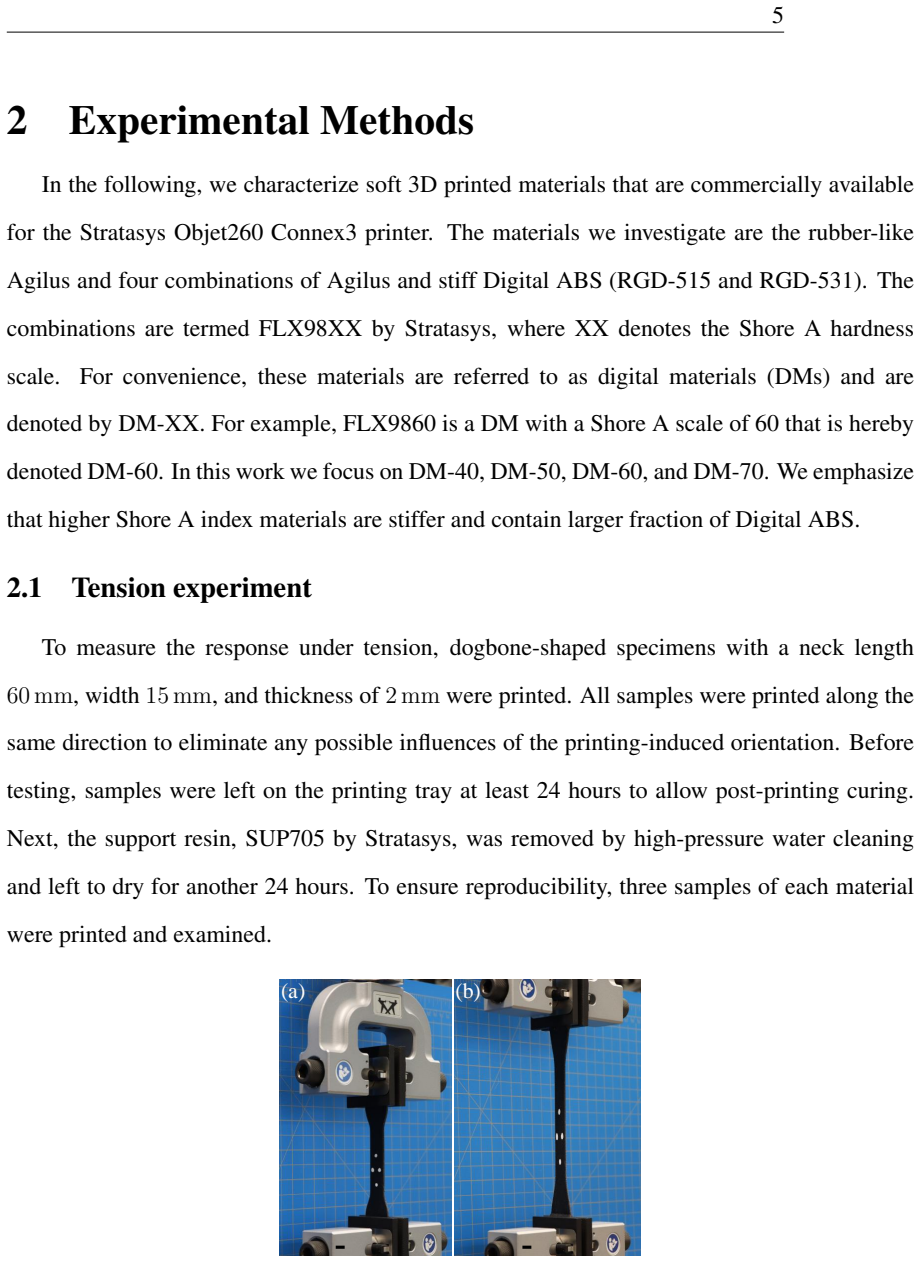
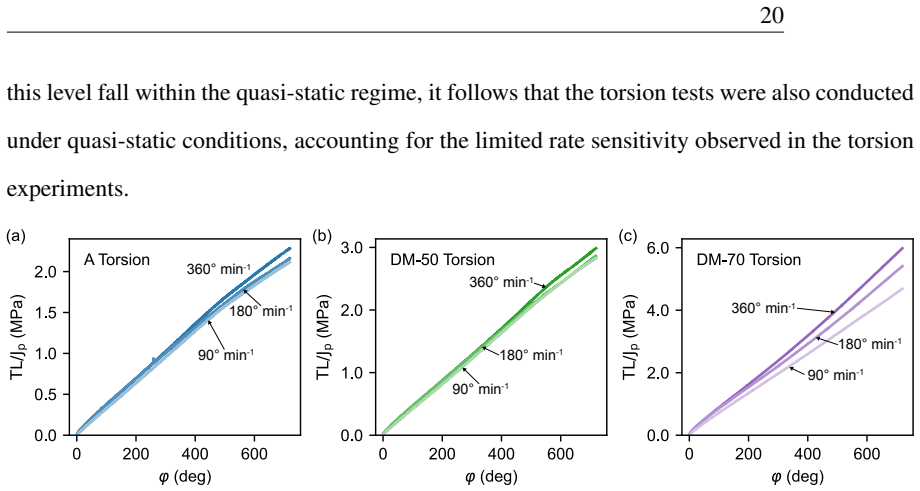
- [§2.2 vs §4.1/Fig. 6] The torsion data range is internally inconsistent. Section 2.2 states that torsion results are shown for φ ≤ 360° because at higher angles micro-cracks evolve and the rod buckles and deforms out-of-plane, but Section 4.1 and Figure 6 plot T L/Jp up to φ ≤ 720°, and Figure 2 shows a specimen at φ = 720°. Please clarify which angular range is used for training and how post-buckling or damaged data are excluded. This matters because the apparently linear torque response at large angles may include structural instability rather than intrinsic material response.
- [Eq. (14)] The QLV convolution is written as σ(t) = σe(t) + ∫_0^t D′(t−s) σe(t) ds, with σe(t) inside the integral. As written this is not a history-dependent convolution: σe(t) is constant with respect to the integration variable, so the integral reduces to a time-dependent scalar factor multiplying the current stress. The standard QLV form should have σe(s) under the integral. If the implementation uses the correct form, please correct the equation; if not, the model is not the QLV model claimed in the text. This is a central equation and needs to be fixed.
minor comments (4)
- [Table 3 and §5] The sentence 'Out of 24 training and test datasets for these compositions, 21 have an R2 above 0.98, and 22 have a sMAPE below 8%' is not supported by the rounded values in Table 3. For example, DM-60 has rows with R2 of 0.977, 0.956, and 0.925, DM-50 has rows of 0.980, and several sMAPE values exceed 8%. Please recompute these counts from unrounded metrics or adjust the sentence.
- [§2.1.1 and §4.1] It is unclear whether Poisson's ratio was measured in the present study or taken from reference [28]. Section 2.1.1 describes a calculation from the uniaxial tests, while Section 4.1 attributes the values to Levin and Cohen [28]. Please state this explicitly and report the measured ν values for each composition if they are new data.
- [Table 2] The mapping from % Digital ABS to the composition parameter c is not a simple linear scaling of the digital ABS percentages (e.g., 25.2% maps to 0.1755 while 27.2% maps to 1.0). Please provide the exact scaling formula or clarify how c is defined, since Eq. (26) and Eq. (27) depend on this input definition.
- [Eq. (11)] The first line of Eq. (11), 's = s(ζ − γ) + γ1', appears to contain a typo or undefined notation. Please correct or define the intermediate variable s̄ (or similar) used in the hard-sigmoid approximation.
Circularity Check
No significant circularity: the held-out DM-40 interpolation and the failed DM-70 extrapolation show the evaluation is a genuine benchmark, not a refit.
full rationale
The derivation chain is data-driven and independently benchmarked. The pICNN strain energy is trained on tension and torsion experiments for compositions A, DM-50, and DM-60, while DM-40 (c=0.1755) is held out entirely and DM-70 (c=2.0895) is held out as an extrapolation test; the reported DM-40 R2 and sMAPE values are predictions, not fitted constants, and the poor DM-70 results (R2 as low as 0.251 in tension, -0.118 in torsion) are the opposite of a forced outcome. The incompressibility and isotropy assumptions, including Eq. 17 and Eq. 19, define a kinematic modeling choice rather than a circular reduction: the training targets (axial stress and torque) come from independent force/displacement measurements, and no target is reinserted as an input or as a fitted prediction. The Poisson-ratio justification cites prior same-author work (Levin and Cohen [28]), but that is an independent experimental measurement, not a fitted parameter or a restatement of the learned energy, so it does not raise the circularity score. Self-citations to PANN methodology ([40], [41], [52]) are ordinary method references and are not load-bearing uniqueness claims; the central claim is validated against external held-out data.
Assumptions & free parameters
free parameters (5)
- Fixed QLV relaxation time τ =
10 s
- pICNN sparsified weight coefficients (Eq. 26) =
a1=6.84602, a2=6.86996, a3=6.88268, a4=6.93876, b1=2.37126, b2=2.1961, b3=2.56167, b4=1.9888, and other coefficients…
- MLP weight coefficients for γ (Eq. 27) =
Exponents and coefficients in Eq. 27 (e.g., 0.423, 0.446, 0.552, 0.492, 0.054, 0.147, 0.254, 0.264; 1.381, 1.018…
- Composition scaling mapping =
c = 0, 0.1755, 0.4669, 1.0, 2.0895 for A, DM-40, DM-50, DM-60, DM-70
- L0 regularization coefficients =
α_fc=5e-4, α_nc=1e-6, α_ncfc=1e-6
assumptions (5)
- domain assumption Convexity of the strain energy with respect to I1 and I2 is sufficient to guarantee polyconvexity of the hyperelastic model.
- domain assumption Agilus/Digital ABS digital materials are isotropic and nearly incompressible (ν≥0.47) throughout the testing range.
- domain assumption A single-exponential QLV kernel with fixed τ=10 s captures the time-dependent response over two decades of strain rate.
- standard math The ICNN construction of Amos et al. [51] and the pICNN variant guarantee convexity with respect to the strain invariants in the passthrough architecture.
- domain assumption The torsion test is equivalent to simple torsion of an incompressible rod, with no end effects or buckling over the data range used.
Cite this review
Pith. "Pith review of Physics Augmented Machine Learning Discovery of Composition-Dependent Constitutive Laws for 3D Printed Digital Materials." pith.science (2026). https://pith.science/paper/CQJM23U7
@misc{pith2026250702991,
  author       = {Pith},
  title        = {Pith review of: Physics Augmented Machine Learning Discovery of Composition-Dependent Constitutive Laws for 3D Printed Digital Materials},
  year         = {2026},
  howpublished = {\url{https://pith.science/paper/CQJM23U7}},
  note         = {Machine review of arXiv:2507.02991}
}
abstract
Multi-material 3D printing, particularly through polymer jetting, enables the fabrication of digital materials by mixing distinct photopolymers at the micron scale within a single build to create a composite with tunable mechanical properties. This work presents an integrated experimental and computational investigation into the composition-dependent mechanical behavior of 3D printed digital materials. We experimentally characterize five formulations, combining soft and rigid UV-cured polymers under uniaxial tension and torsion across three strain and twist rates. The results reveal nonlinear and rate-dependent responses that strongly depend on composition. To model this behavior, we develop a physics-augmented neural network (PANN) that combines a partially input convex neural network (pICNN) for learning the composition-dependent hyperelastic strain energy function with a quasi-linear viscoelastic (QLV) formulation for time-dependent response. The pICNN ensures convexity with respect to strain invariants while allowing non-convex dependence on composition. To enhance interpretability, we apply $L_0$ sparsification. For the time-dependent response, we introduce a multilayer perceptron (MLP) to predict viscoelastic relaxation parameters from composition. The proposed model accurately captures the nonlinear, rate-dependent behavior of 3D printed digital materials in both uniaxial tension and torsion, achieving high predictive accuracy for interpolated material compositions. This approach provides a scalable framework for automated, composition-aware constitutive model discovery for multi-material 3D printing.
Figures


Figures from the paper (9 more)




Reference graph
Works this paper leans on
-
[1]
Sharma, S., and Goel, S. A. (2019) 3D printing and its future in medical world.Journal of Medical Research and Innovation 3, e000141–e000141
work page 2019
-
[2]
E.3D printing in Orthopaedic surgery; Elsevier, 2019; pp 1–15
Jakus, A. E.3D printing in Orthopaedic surgery; Elsevier, 2019; pp 1–15
work page 2019
-
[3]
Gokhare, V . G., Raut, D., and Shinde, D. (2017) A review paper on 3D-printing aspects and various processes used in the 3D-printing.Int. J. Eng. Res. Technol 6, 953–958
work page 2017
-
[4]
W., Pohl, R., Sun, C., Romer, G.-W., Huis int Veld, B., and Lohse, D
Visser, C. W., Pohl, R., Sun, C., Romer, G.-W., Huis int Veld, B., and Lohse, D. (2015) Toward 3D printing of pure metals by laser-induced forward transfer.Advanced materials 27, 4087–4092
work page 2015
-
[5]
Gibson, M. A., Mykulowycz, N. M., Shim, J., Fontana, R., Schmitt, P., Roberts, A., Ketkaew, J., Shao, L., Chen, W., Bordeenithikasem, P., and others (2018) 3D printing metals like thermoplastics: Fused filament fabrication of metallic glasses.Materials Today 21, 697–702
work page 2018
-
[6]
(1998) 3D printing with metals.Computing and Control Engineering Journal 9, 31–38
Ribeiro, F. (1998) 3D printing with metals.Computing and Control Engineering Journal 9, 31–38
work page 1998
-
[7]
(2019) 3D printing of ceramics: A review.Journal of the European Ceramic Society 39, 661–687
Chen, Z., Li, Z., Li, J., Liu, C., Lao, C., Fu, Y ., Liu, C., Li, Y ., Wang, P., and He, Y . (2019) 3D printing of ceramics: A review.Journal of the European Ceramic Society 39, 661–687
work page 2019
-
[8]
Hwa, L. C., Rajoo, S., Noor, A. M., Ahmad, N., and Uday, M. (2017) Recent advances in 3D printing of porous ceramics: A review.Current Opinion in Solid State and Materials Science 21, 323–347
work page 2017
Show all 55 references
-
[9]
(2017) 3D printing of polymer matrix composites: A review and prospective.Composites Part B: Engineering 110, 442–458
Wang, X., Jiang, M., Zhou, Z., Gou, J., and Hui, D. (2017) 3D printing of polymer matrix composites: A review and prospective.Composites Part B: Engineering 110, 442–458. 34
2017
-
[10]
G., and Lewis, J
Compton, B. G., and Lewis, J. A. (2014) 3D-printing of lightweight cellular composites. Advanced materials 26, 5930–5935
2014
-
[11]
(2018) A review of 3D printing technology for medical applications.Engineering 4, 729–742
Yan, Q., Dong, H., Su, J., Han, J., Song, B., Wei, Q., and Shi, Y . (2018) A review of 3D printing technology for medical applications.Engineering 4, 729–742
2018
-
[12]
A., Finne-Wistrand, A., and Gasser, T
Liu, H., Ahlinder, A., Yassin, M. A., Finne-Wistrand, A., and Gasser, T. C. (2020) Computational and experimental characterization of 3D-printed PCL structures toward the design of soft biological tissue scaffolds.Materials & Design 188, 108488
2020
-
[13]
L., Peng, C., Pille, P., Leary, M., and Tran, P
Tee, Y . L., Peng, C., Pille, P., Leary, M., and Tran, P. (2020) PolyJet 3D printing of composite materials: experimental and modelling approach.Jom 72, 1105–1117
2020
-
[14]
Materials Horizons 6, 394–404
Lei, D., Yang, Y ., Liu, Z., Chen, S., Song, B., Shen, A., Yang, B., Li, S., Yuan, Z., Qi, Q., and others (2019) A general strategy of 3D printing thermosets for diverse applications. Materials Horizons 6, 394–404
2019
-
[15]
(2020) 3D printing technologies: techniques, materials, and post- processing.Current Opinion in Chemical Engineering 28, 134–143
Karakurt, I., and Lin, L. (2020) 3D printing technologies: techniques, materials, and post- processing.Current Opinion in Chemical Engineering 28, 134–143
2020
-
[16]
Patpatiya, P., Chaudhary, K., Shastri, A., and Sharma, S. (2022) A review on polyjet 3D printing of polymers and multi-material structures.Proceedings of the Institution of Mechanical Engineers, Part C: Journal of Mechanical Engineering Science 236, 7899– 7926
2022
-
[17]
(2024) Design principles for 3D-printed thermally activated shape-morphing structures.International Journal of Mechanical Sciences 262, 108716
Hanuhov, T., and Cohen, N. (2024) Design principles for 3D-printed thermally activated shape-morphing structures.International Journal of Mechanical Sciences 262, 108716
2024
-
[18]
J., and O’Sullivan, L
Shannon, A., O’Connell, A., O’Sullivan, A., Byrne, M., Clifford, S., O’Sullivan, K. J., and O’Sullivan, L. (2020) A radiopaque nanoparticle-based ink using PolyJet 3D printing for medical applications.3D Printing and Additive Manufacturing 7, 259–268
2020
-
[19]
(2017) Reconstruction of complex 35 mandibular defects using integrated dental custom-made titanium implants.British Journal of Oral and Maxillofacial Surgery 55, 425–427
Rachmiel, A., Shilo, D., Blanc, O., and Emodi, O. (2017) Reconstruction of complex 35 mandibular defects using integrated dental custom-made titanium implants.British Journal of Oral and Maxillofacial Surgery 55, 425–427
2017
-
[20]
Barone, S., Casinelli, M., Frascaria, M., Paoli, A., and Razionale, A. V . (2016) Interactive design of dental implant placements through CAD-CAM technologies: from 3D imaging to additive manufacturing.International Journal on Interactive Design and Manufacturing 10, 105–117
2016
-
[21]
(2023) Personalized 3D printed eye gear for microscopic surgeons amidst and beyond COVID-19.Bioengineering 10, 1129
Singh, R., Singh, R., and Suri, A. (2023) Personalized 3D printed eye gear for microscopic surgeons amidst and beyond COVID-19.Bioengineering 10, 1129
2023
-
[22]
J., Wu, J., Hamel, C
Kuang, X., Roach, D. J., Wu, J., Hamel, C. M., Ding, Z., Wang, T., Dunn, M. L., and Qi, H. J. (2019) Advances in 4D printing: materials and applications.Advanced Functional Materials 29, 1805290
2019
-
[23]
(2018) 4D printing: history and recent progress.Chinese Journal of Polymer Science 36, 563–575
Wu, J.-J., Huang, L.-M., Zhao, Q., and Xie, T. (2018) 4D printing: history and recent progress.Chinese Journal of Polymer Science 36, 563–575
2018
-
[24]
Raviv, D., Zhao, W., McKnelly, C., Papadopoulou, A., Kadambi, A., Shi, B., Hirsch, S., Dikovsky, D., Zyracki, M., Olguin, C., and others (2014) Active printed materials for complex self-evolving deformations.Scientific reports 4, 1–8
2014
-
[25]
I., Vladimirsky, D., Klein, G., and Rudykh, S
Slesarenko, V ., Engelkemier, S., Galich, P. I., Vladimirsky, D., Klein, G., and Rudykh, S. (2018) Strategies to control performance of 3d-printed, cable-driven soft polymer actuators: From simple architectures to gripper prototype.Polymers 10, 846
2018
-
[26]
G., Preti, M
Shi, G., Palombi, A., Lim, Z., Astolfi, A., Burani, A., Campagnini, S., Loizzo, F. G., Preti, M. L., Vargas, A. M., Peperoni, E., and others (2020) Fluidic haptic interface for mechano-tactile feedback.IEEE transactions on haptics 13, 204–210
2020
-
[27]
(2019) Fast-response, stiffness-tunable soft actuator by hybrid multimaterial 3D printing.Advanced Functional Materials 29, 1806698
Zhang, Y .-F., Zhang, N., Hingorani, H., Ding, N., Wang, D., Yuan, C., Zhang, B., Gu, G., and Ge, Q. (2019) Fast-response, stiffness-tunable soft actuator by hybrid multimaterial 3D printing.Advanced Functional Materials 29, 1806698. 36
2019
-
[28]
(2023) Swelling under Constraints: Exploiting 3D-Printing to Optimize the Performance of Gel-Based Devices.Advanced Materials Technologies 8, 2202136
Levin, M., and Cohen, N. (2023) Swelling under Constraints: Exploiting 3D-Printing to Optimize the Performance of Gel-Based Devices.Advanced Materials Technologies 8, 2202136
2023
-
[29]
F., and Ghajari, M
Abayazid, F. F., and Ghajari, M. (2020) Material characterisation of additively manufactured elastomers at different strain rates and build orientations.Additive Manufacturing 33, 101160
2020
-
[30]
(2018) Towards mechanical characterization of soft digital materials for multimaterial 3D-printing.International Journal of Engineering Science 123, 62–72
Slesarenko, V ., and Rudykh, S. (2018) Towards mechanical characterization of soft digital materials for multimaterial 3D-printing.International Journal of Engineering Science 123, 62–72
2018
-
[31]
M., and Costa, C
V olpato, N., Solis, D. M., and Costa, C. A. (2016) An analysis of Digital ABS as a rapid tooling material for polymer injection moulding.International Journal of Materials and Product Technology 52, 3–16
2016
-
[32]
(2009) Nonlinear Viscoelastic Solids - A Review.Mathematics and Mechanics of Solids 14, 300–366
Wineman, A. (2009) Nonlinear Viscoelastic Solids - A Review.Mathematics and Mechanics of Solids 14, 300–366
2009
-
[33]
Aziz, S., and Spinks, G. M. (2020) Torsional artificial muscles.Materials Horizons 7, 667–693
2020
-
[34]
(2017) Effect of intrinsic twist and orthotropy on extension–twist–inflation coupling in compressible circular tubes.Journal of Elasticity 128, 175–201
Singh, R., Kumar, S., and Kumar, A. (2017) Effect of intrinsic twist and orthotropy on extension–twist–inflation coupling in compressible circular tubes.Journal of Elasticity 128, 175–201
2017
-
[35]
(2021) Inversion and perversion in twist incompatible isotropic tubes.Extreme Mechanics Letters 46, 101303
Emuna, N., and Cohen, N. (2021) Inversion and perversion in twist incompatible isotropic tubes.Extreme Mechanics Letters 46, 101303
2021
-
[36]
(2021) A new type of soft pneumatic torsional actuator with helical chambers for flexible machines.Journal of Mechanisms and Robotics 13
Xiao, W., Hu, D., Chen, W., Yang, G., and Han, X. (2021) A new type of soft pneumatic torsional actuator with helical chambers for flexible machines.Journal of Mechanisms and Robotics 13. 37
2021
-
[37]
(2021) Inflation-induced twist in geometrically incompatible isotropic tubes.Journal of Applied Mechanics 88
Emuna, N., and Cohen, N. (2021) Inflation-induced twist in geometrically incompatible isotropic tubes.Journal of Applied Mechanics 88
2021
-
[38]
(2022) Electrically-induced twist in geometrically incompatible dielectric elastomer tubes.International Journal of Solids and Structures111707
Bazaev, K., and Cohen, N. (2022) Electrically-induced twist in geometrically incompatible dielectric elastomer tubes.International Journal of Solids and Structures111707
2022
-
[39]
Kolesnikov, A. M. (2022) Finite deformations of a nonlinearly elastic electrosensitive tube reinforced by two fiber families.Continuum Mechanics and Thermodynamics 34, 1237– 1255
2022
-
[40]
N., Jones, R
Fuhg, J. N., Jones, R. E., and Bouklas, N. (2024) Extreme sparsification of physics- augmented neural networks for interpretable model discovery in mechanics.Computer Methods in Applied Mechanics and Engineering 426, 116973
2024
-
[41]
A., Safta, C., Bouklas, N., and Jones, R
Padmanabha, G. A., Safta, C., Bouklas, N., and Jones, R. E. (2024) Condensed Stein Variational Gradient Descent for Uncertainty Quantification of Neural Networks.arXiv preprint arXiv:2412.16462
2024 arXiv
-
[42]
K., Roth, F
Klein, D. K., Roth, F. J., Valizadeh, I., and Weeger, O. (2023) Parametrized polyconvex hyperelasticity with physics-augmented neural networks.Data-Centric Engineering 4, Publisher: Cambridge University Press (CUP)
2023
-
[43]
Tac, V ., Sahli Costabal, F., and Tepole, A. B. (2022) Data-driven tissue mechanics with polyconvex neural ordinary differential equations.Computer Methods in Applied Mechanics and Engineering 398, 115248, Publisher: Elsevier BV
2022
-
[44]
(2024) A Physics-Guided Machine Learning Model for Predicting Viscoelasticity of Solids at Large Deformation.Polymers 16, 3222, Publisher: MDPI AG
Qin, B., and Zhong, Z. (2024) A Physics-Guided Machine Learning Model for Predicting Viscoelasticity of Solids at Large Deformation.Polymers 16, 3222, Publisher: MDPI AG
2024
-
[45]
A., Brummund, J., Sun, W., and KÃ Cstner, M
Rosenkranz, M., Kalina, K. A., Brummund, J., Sun, W., and KÃ Cstner, M. (2024) Viscoelasticty with physics-augmented neural networks: model formulation and training methods without prescribed internal variables.Computational Mechanics 74, 1279–1301, Publisher: Springer Science...
2024
-
[47]
N., Van Wees, L., Obstalecki, M., Shade, P., Bouklas, N., and Kasemer, M
Fuhg, J. N., Van Wees, L., Obstalecki, M., Shade, P., Bouklas, N., and Kasemer, M. (2022) Machine-learning convex and texture-dependent macroscopic yield from crystal plasticity simulations.Materialia 23, 101446, Publisher: Elsevier BV
2022
-
[48]
Jailin, C., Benady, A., Legroux, R., and Baranger, E. (2024) Experimental Learning of a Hyperelastic Behavior with a Physics-Augmented Neural Network.Experimental Mechanics 64, 1465–1481, Publisher: Springer Science and Business Media LLC
2024
-
[49]
A., Gebhart, P., Brummund, J., Linden, L., Sun, W., and KÃ Cstner, M
Kalina, K. A., Gebhart, P., Brummund, J., Linden, L., Sun, W., and KÃ Cstner, M. (2024) Neural network-based multiscale modeling of finite strain magneto-elasticity with relaxed convexity criteria.Computer Methods in Applied Mechanics and Engineering 421, 116739, Publisher: El...
2024
-
[50]
Louizos, C., Welling, M., and Kingma, D. P. (2017) Learning sparse neural networks throughL_0regularization.arXiv preprint arXiv:1712.01312
2017 arXiv
-
[51]
Amos, B., Xu, L., and Kolter, J. Z. Input convex neural networks. International Conference on Machine Learning. 2017; pp 146–155
2017
-
[52]
A., Kalina, K
Jadoon, A. A., Kalina, K. A., Rausch, M. K., Jones, R., and Fuhg, J. N. (2024) Inverse design of anisotropic microstructures using physics-augmented neural networks.arXiv preprint arXiv:2412.13370
2024 arXiv
-
[53]
K., Kalina, K
Linden, L., Klein, D. K., Kalina, K. A., Brummund, J., Weeger, O., and Kästner, M. (2023) Neural networks meet hyperelasticity: A guide to enforcing physics.Journal of the Mechanics and Physics of Solids 179, 105363
2023
-
[54]
D., and Parnell, W
De Pascalis, R., Abrahams, I. D., and Parnell, W. J. (2014) On nonlinear viscoelastic 39 deformations: a reappraisal of Fung’s quasi-linear viscoelastic model.Proceedings of the Royal Society A: Mathematical, Physical and Engineering Sciences 470, 20140058
2014
-
[55]
O., and Saccomandi, G
Horgan, C. O., and Saccomandi, G. (1999) Simple torsion of isotropic, hyperelastic, incompressible materials with limiting chain extensibility.Journal of elasticity 56, 159– 170
1999
-
[56]
P., and Ba, J
Kingma, D. P., and Ba, J. (2014) Adam: A method for stochastic optimization.arXiv preprint arXiv:1412.6980
2014 arXiv
Reviewed August 6, 2026 · model on record in the stance chip above.
Discussion (0). Continue with ORCID to comment.