RS-Gen: A Multi-Stage Agentic Framework for Reasoning and Search-Augmented Image Generation
Pith reviewed 2026-06-26 08:57 UTC · model grok-4.3
The pith
A plug-and-play training-free agentic framework augments image models with a closed-loop Questioning-and-Solving mechanism to detect and resolve logical and knowledge gaps.
A machine-rendered reading of the paper's core claim, the machinery that carries it, and where it could break.
Core claim
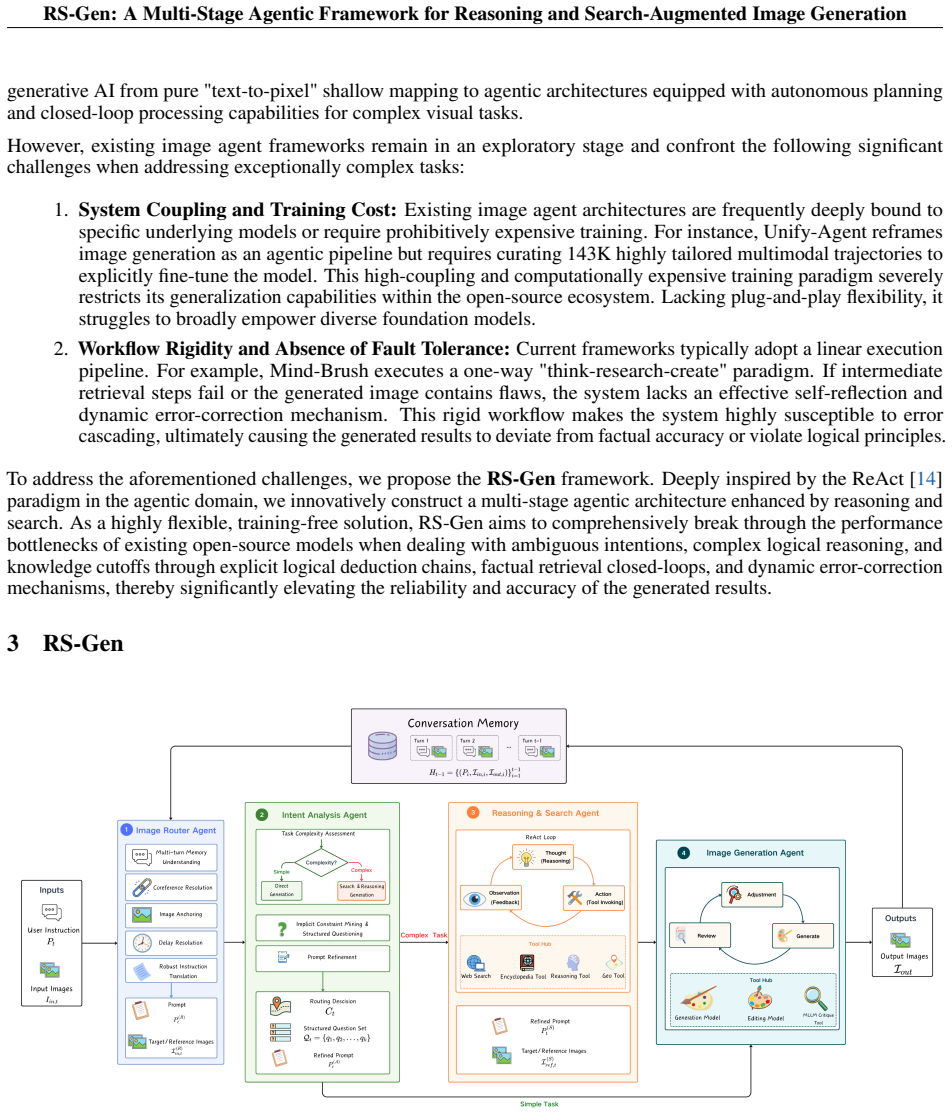
RS-Gen is a plug-and-play, training-free, multi-stage image agentic framework that introduces a Questioning-and-Solving closed-loop mechanism. This loop accurately identifies logical issues and knowledge gaps, autonomously plans actions to bridge information deficits, and executes deep logical reasoning augmented by search. When applied to base models such as Qwen-Image and Qwen-Image-Edit-2511, it produces absolute performance gains of 0.313 and 19.70 respectively on the WISE Verified and RISEBench benchmarks, elevating both to state-of-the-art level among open-source models.
What carries the argument
The Questioning-and-Solving closed-loop mechanism that identifies logical issues and knowledge gaps then plans and executes bridging actions.
If this is right
- Base image generation and editing models can handle ambiguous and out-of-distribution prompts more effectively without retraining.
- The same wrapper can be applied across different foundation models to produce measurable benchmark gains.
- Search augmentation combined with internal reasoning steps expands model capability boundaries on tasks requiring real-time or external information.
- Training-free deployment allows immediate use of the framework on current open-source models.
Where Pith is reading between the lines
- The same closed-loop pattern could be tested on other generative tasks such as video or 3D synthesis.
- Agentic wrappers of this type may allow smaller models to match larger ones on reasoning-heavy prompts.
- Integration with live search sources could further improve timeliness of generated content in rapidly changing domains.
Load-bearing premise
The closed-loop mechanism can reliably detect logical issues and knowledge gaps and then successfully bridge them for any base image model without training.
What would settle it
Running RS-Gen on a base model and measuring no performance improvement or outright degradation on the WISE Verified or RISEBench benchmarks.
Figures
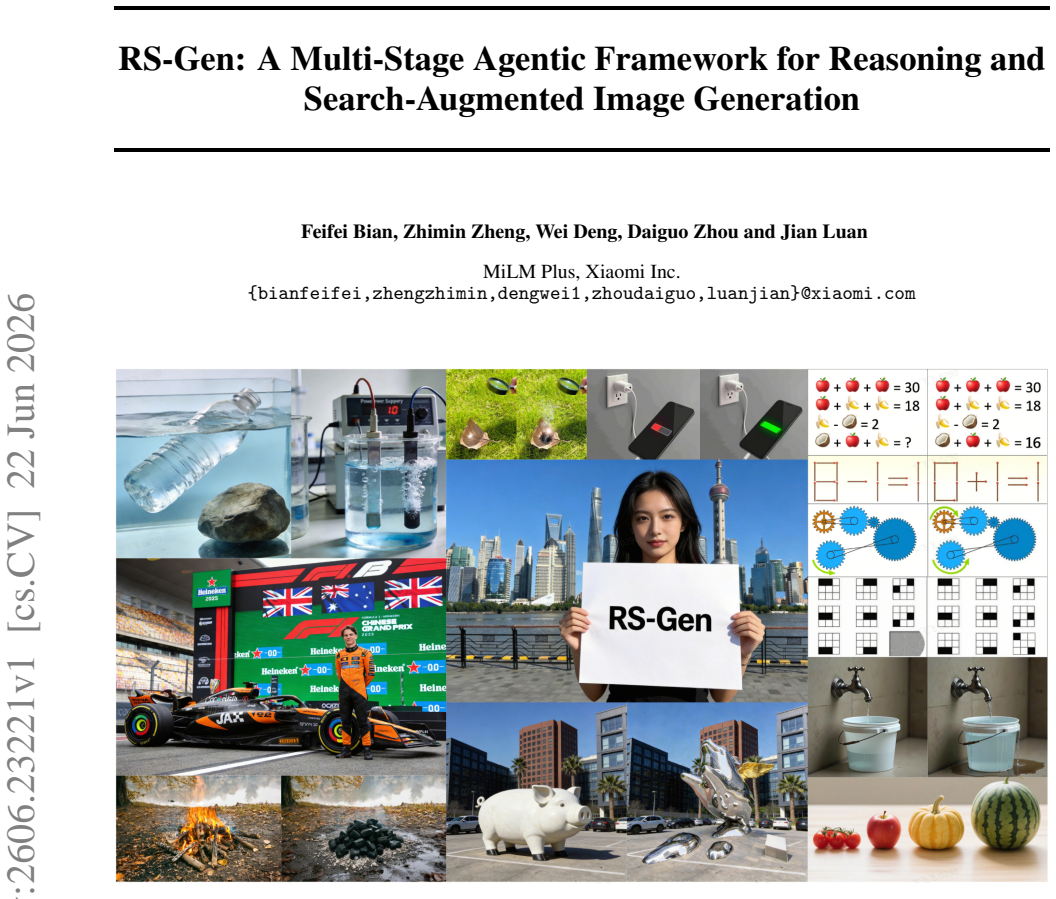
read the original abstract
Recent years have witnessed remarkable progress in image generation and editing, particularly regarding instruction following and visual fidelity. However, when handling ambiguous intentions, logical reasoning, and Out-of-Distribution (OOD) knowledge, existing image models often yield sub-optimal results due to a lack of deep reasoning capabilities and real-time external information. Although emerging unified understanding-and-generation models attempt to bridge this gap, they remain constrained by their intrinsic parameter scales and static knowledge gaps. Inspired by agentic paradigms, we propose RS-Gen: a plug-and-play, training-free, multi-stage image agentic framework. RS-Gen innovatively introduces a "Questioning-and-Solving" closed-loop mechanism to accurately identify logical issues and knowledge gaps, autonomously planning actions to bridge information deficits and execute deep logical reasoning. Extensive experiments demonstrate that RS-Gen significantly expands the capability boundaries of foundational image generation and editing models. Specifically, on the WISE Verified and RISEBench benchmarks, RS-Gen yields substantial absolute performance gains of 0.313 for Qwen-Image and 19.70 for Qwen-Image-Edit-2511, respectively, successfully elevating both to the state-of-the-art (SOTA) level among open-source models.
Editorial analysis
A structured set of objections, weighed in public.
Referee Report
Summary. The paper proposes RS-Gen, a plug-and-play, training-free multi-stage agentic framework for image generation and editing. It introduces a Questioning-and-Solving closed-loop mechanism to identify logical issues and knowledge gaps in prompts, autonomously plan search and reasoning actions to bridge them, and improve output quality for ambiguous, reasoning-heavy, or OOD cases. The central empirical claim is that wrapping base models (e.g., Qwen-Image) with RS-Gen yields absolute gains of 0.313 on WISE Verified and 19.70 on RISEBench, elevating them to open-source SOTA.
Significance. If the reported gains are reproducible and the framework generalizes as described, the work would be significant for the field: it offers a general, training-free method to augment existing image models with external knowledge and logical reasoning, addressing a recognized limitation without requiring new model training or architectural changes.
major comments (2)
- [Abstract and §4] Abstract and §4 (Experiments): the central claim of SOTA-level gains (0.313 on WISE Verified for Qwen-Image; 19.70 on RISEBench for Qwen-Image-Edit-2511) is presented without any description of evaluation protocol, exact metrics, number of test cases, baseline scores for the unwrapped models, statistical significance, or error analysis; this absence makes the support for the performance claims impossible to evaluate.
- [§3] §3 (Framework): the plug-and-play claim that the closed-loop mechanism accurately identifies gaps and successfully augments any base image model rests on an untested assumption; no ablation or cross-model verification is described to show that the agentic stages transfer without model-specific tuning or failure modes on certain generators.
minor comments (2)
- Define all benchmark acronyms and model version numbers at first use and ensure consistent citation to the original benchmark papers.
- [§3] Clarify the exact interface between the agentic stages and the underlying image generator (e.g., prompt rewriting vs. latent editing) so readers can reproduce the wrapper.
Simulated Author's Rebuttal
We thank the referee for the constructive comments. We address each major point below and commit to revisions that strengthen the manuscript's clarity and empirical support.
read point-by-point responses
-
Referee: [Abstract and §4] Abstract and §4 (Experiments): the central claim of SOTA-level gains (0.313 on WISE Verified for Qwen-Image; 19.70 on RISEBench for Qwen-Image-Edit-2511) is presented without any description of evaluation protocol, exact metrics, number of test cases, baseline scores for the unwrapped models, statistical significance, or error analysis; this absence makes the support for the performance claims impossible to evaluate.
Authors: We agree that the current manuscript does not provide sufficient detail on the evaluation protocol, metrics, test case counts, baseline scores, statistical significance, or error analysis. This omission limits the evaluability of the claims. In the revised version we will expand the abstract and §4 with a dedicated evaluation protocol subsection that explicitly reports these elements, including baseline scores for the unwrapped models, the precise metrics on each benchmark, the number of test cases, any significance testing performed, and an error analysis of failure modes. revision: yes
-
Referee: [§3] §3 (Framework): the plug-and-play claim that the closed-loop mechanism accurately identifies gaps and successfully augments any base image model rests on an untested assumption; no ablation or cross-model verification is described to show that the agentic stages transfer without model-specific tuning or failure modes on certain generators.
Authors: The experiments apply RS-Gen to two distinct base models and report gains in both cases. However, we acknowledge that explicit stage-wise ablations and verification across a wider range of generators are not presented, leaving the generality claim under-supported. In the revision we will add ablation studies isolating each component of the closed-loop mechanism and extend testing to at least one additional base model to demonstrate transfer without model-specific tuning. revision: yes
Circularity Check
No significant circularity; empirical framework with independent benchmark results
full rationale
The paper presents RS-Gen as a plug-and-play, training-free multi-stage agentic framework added externally to base image models. Performance gains (0.313 on WISE Verified, 19.70 on RISEBench) are reported as direct experimental outcomes on external benchmarks, with no derivation chain, equations, or self-citations that reduce the central claim to its own inputs by construction. The description of the closed-loop mechanism and action planning is independent of the reported results, making the work self-contained against external evaluations.
Axiom & Free-Parameter Ledger
Reference graph
Works this paper leans on
-
[1]
Flux.https://github.com/black-forest-labs/flux, 2024
Black Forest Labs. Flux.https://github.com/black-forest-labs/flux, 2024
2024
-
[2]
Qwen-Image technical report, 2025
Chenfei Wu, Jiahao Li, Jingren Zhou, Junyang Lin, Kaiyuan Gao, Kun Yan, Sheng ming Yin, Shuai Bai, Xiao Xu, Yilei Chen, Yuxiang Chen, Zecheng Tang, Zekai Zhang, Zhengyi Wang, An Yang, Bowen Yu, Chen Cheng, Dayiheng Liu, Deqing Li, Hang Zhang, Hao Meng, Hu Wei, Jingyuan Ni, Kai Chen, Kuan Cao, Liang Peng, Lin Qu, Minggang Wu, Peng Wang, Shuting Yu, Tingkun...
Pith/arXiv arXiv 2025
-
[3]
Z-image: An efficient image generation foundation model with single-stream diffusion transformer
Z-Image Team. Z-image: An efficient image generation foundation model with single-stream diffusion transformer. arXiv preprint arXiv:2511.22699, 2025
Pith/arXiv arXiv 2025
-
[4]
Longcat-image technical report.arXiv preprint arXiv:2512.07584, 2025
Meituan LongCat Team, Hanghang Ma, Haoxian Tan, Jiale Huang, Junqiang Wu, Jun-Yan He, Lishuai Gao, Songlin Xiao, Xiaoming Wei, Xiaoqi Ma, Xunliang Cai, Yayong Guan, and Jie Hu. Longcat-image technical report.arXiv preprint arXiv:2512.07584, 2025. 15 RS-Gen: A Multi-Stage Agentic Framework for Reasoning and Search-Augmented Image Generation
Pith/arXiv arXiv 2025
-
[5]
Chunting Zhou, Lili Yu, Arun Babu, Kushal Tirumala, Michihiro Yasunaga, Leonid Shamis, Jacob Kahn, Xuezhe Ma, Luke Zettlemoyer, and Omer Levy. Transfusion: Predict the next token and diffuse images with one multi-modal model.arXiv preprint arXiv:2408.11039, 2024
Pith/arXiv arXiv 2024
-
[6]
Janusflow: Harmonizing autoregression and rectified flow for unified multimodal understanding and generation, 2024
Yiyang Ma, Xingchao Liu, Xiaokang Chen, Wen Liu, Chengyue Wu, Zhiyu Wu, Zizheng Pan, Zhenda Xie, Haowei Zhang, Xingkai yu, Liang Zhao, Yisong Wang, Jiaying Liu, and Chong Ruan. Janusflow: Harmonizing autoregression and rectified flow for unified multimodal understanding and generation, 2024
2024
-
[7]
Emerging properties in unified multimodal pretraining.arXiv preprint arXiv:2505.14683, 2025
Chaorui Deng, Deyao Zhu, Kunchang Li, Chenhui Gou, Feng Li, Zeyu Wang, Shu Zhong, Weihao Yu, Xiaonan Nie, Ziang Song, Guang Shi, and Haoqi Fan. Emerging properties in unified multimodal pretraining.arXiv preprint arXiv:2505.14683, 2025
Pith/arXiv arXiv 2025
-
[8]
Seedream Team, Yunpeng Chen, Yu Gao, Lixue Gong, Meng Guo, Qiushan Guo, Zhiyao Guo, Xiaoxia Hou, Weilin Huang, Yixuan Huang, et al. Seedream 4.0: Toward next-generation multimodal image generation.arXiv preprint arXiv:2509.20427, 2025
Pith/arXiv arXiv 2025
-
[9]
Gemini Image Pro: High-quality image generation
Google DeepMind. Gemini Image Pro: High-quality image generation. https://deepmind.google/models/ gemini-image/pro/, 2025a. Accessed: 2026-01-26
2026
-
[10]
Flux.2 max.https://bfl.ai/models/flux-2-max, 2026a
Black Forest Labs. Flux.2 max.https://bfl.ai/models/flux-2-max, 2026a. Accessed: 2026-05-06
2026
-
[11]
Jun He, Junyan Ye, Zilong Huang, Dongzhi Jiang, Chenjue Zhang, Leqi Zhu, Renrui Zhang, Xiang Zhang, and Weijia Li. Mind-brush: Integrating agentic cognitive search and reasoning into image generation.arXiv preprint arXiv:2602.01756, 2026
arXiv 2026
-
[12]
Shuang Chen, Quanxin Shou, Hangting Chen, Yucheng Zhou, Kaituo Feng, Wenbo Hu, Yi-Fan Zhang, Yunlong Lin, Wenxuan Huang, Mingyang Song, et al. Unify-agent: A unified multimodal agent for world-grounded image synthesis.arXiv preprint arXiv:2603.29620, 2026
arXiv 2026
-
[13]
Openclaw: Personal ai assistant
OpenClaw Team. Openclaw: Personal ai assistant. https://github.com/openclaw/openclaw, 2026. Official website:https://openclaw.ai/, Accessed: 2026-05-06
2026
-
[14]
React: Synergizing reasoning and acting in language models.arXiv preprint arXiv:2210.03629, 2022
Shunyu Yao, Jeffrey Zhao, Dian Yu, Nan Du, Izhak Shafran, Karthik Narasimhan, and Yuan Cao. React: Synergizing reasoning and acting in language models.arXiv preprint arXiv:2210.03629, 2022
Pith/arXiv arXiv 2022
-
[15]
High-resolution image synthesis with latent diffusion models, 2021
Robin Rombach, Andreas Blattmann, Dominik Lorenz, Patrick Esser, and Björn Ommer. High-resolution image synthesis with latent diffusion models, 2021
2021
-
[16]
Scaling rectified flow transformers for high-resolution image synthesis
Patrick Esser, Sumith Kulal, Andreas Blattmann, Rahim Entezari, Jonas Müller, Harry Saini, Yam Levi, Dominik Lorenz, Axel Sauer, Frederic Boesel, et al. Scaling rectified flow transformers for high-resolution image synthesis. InForty-first international conference on machine learning, 2024
2024
-
[17]
Flow matching for generative modeling.arXiv preprint arXiv:2210.02747, 2022
Yaron Lipman, Ricky TQ Chen, Heli Ben-Hamu, Maximilian Nickel, and Matt Le. Flow matching for generative modeling.arXiv preprint arXiv:2210.02747, 2022
Pith/arXiv arXiv 2022
-
[18]
Attention is all you need.Advances in neural information processing systems, 30, 2017
Ashish Vaswani, Noam Shazeer, Niki Parmar, Jakob Uszkoreit, Llion Jones, Aidan N Gomez, Łukasz Kaiser, and Illia Polosukhin. Attention is all you need.Advances in neural information processing systems, 30, 2017
2017
-
[19]
Learning transferable visual models from natural language supervision
Alec Radford, Jong Wook Kim, Chris Hallacy, Aditya Ramesh, Gabriel Goh, Sandhini Agarwal, Girish Sastry, Amanda Askell, Pamela Mishkin, Jack Clark, et al. Learning transferable visual models from natural language supervision. InInternational conference on machine learning, pages 8748–8763. PmLR, 2021
2021
-
[20]
Exploring the limits of transfer learning with a unified text-to-text transformer.Journal of machine learning research, 21(140):1–67, 2020
Colin Raffel, Noam Shazeer, Adam Roberts, Katherine Lee, Sharan Narang, Michael Matena, Yanqi Zhou, Wei Li, and Peter J Liu. Exploring the limits of transfer learning with a unified text-to-text transformer.Journal of machine learning research, 21(140):1–67, 2020
2020
-
[21]
InstructPix2Pix: Learning to follow image editing instructions.arXiv preprint arXiv:2211.09800, 2022
Tim Brooks, Aleksander Holynski, and Alexei A Efros. InstructPix2Pix: Learning to follow image editing instructions.arXiv preprint arXiv:2211.09800, 2022
arXiv 2022
-
[22]
Magicbrush: A manually annotated dataset for instruction-guided image editing
Kai Zhang, Lingbo Mo, Wenhu Chen, Huan Sun, and Yu Su. Magicbrush: A manually annotated dataset for instruction-guided image editing. InAdvances in Neural Information Processing Systems, 2023
2023
-
[23]
Mude Hui, Siwei Yang, Bingchen Zhao, Yichun Shi, Heng Wang, Peng Wang, Yuyin Zhou, and Cihang Xie. Hq-edit: A high-quality dataset for instruction-based image editing.arXiv preprint arXiv:2404.09990, 2024
arXiv 2024
-
[24]
Emu edit: Precise image editing via recognition and generation tasks
Shelly Sheynin, Adam Polyak, Uriel Singer, Yuval Kirstain, Amit Zohar, Oron Ashual, Devi Parikh, and Yaniv Taigman. Emu edit: Precise image editing via recognition and generation tasks. InProceedings of the IEEE/CVF Conference on Computer Vision and Pattern Recognition, pages 8871–8879, 2024
2024
-
[25]
Omnigen2: Exploration to advanced multimodal generation.arXiv preprint arXiv:2506.18871, 2025
Chenyuan Wu, Pengfei Zheng, Ruiran Yan, Shitao Xiao, Xin Luo, Yueze Wang, Wanli Li, Xiyan Jiang, Yexin Liu, Junjie Zhou, Ze Liu, Ziyi Xia, Chaofan Li, Haoge Deng, Jiahao Wang, Kun Luo, Bo Zhang, Defu Lian, Xinlong Wang, Zhongyuan Wang, Tiejun Huang, and Zheng Liu. Omnigen2: Exploration to advanced multimodal generation.arXiv preprint arXiv:2506.18871, 202...
Pith/arXiv arXiv 2025
-
[26]
Step1x-edit: A practical framework for general image editing.arXiv preprint arXiv:2504.17761, 2025
Shiyu Liu, Yucheng Han, Peng Xing, Fukun Yin, Rui Wang, Wei Cheng, Jiaqi Liao, Yingming Wang, Honghao Fu, Chunrui Han, Guopeng Li, Yuang Peng, Quan Sun, Jingwei Wu, Yan Cai, Zheng Ge, Ranchen Ming, Lei Xia, Xianfang Zeng, Yibo Zhu, Binxing Jiao, Xiangyu Zhang, Gang Yu, and Daxin Jiang. Step1x-edit: A practical framework for general image editing.arXiv pre...
Pith/arXiv arXiv 2025
-
[27]
Chameleon: Mixed-modal early-fusion foundation models.arXiv preprint arXiv:2405.09818,
Chameleon Team. Chameleon: Mixed-modal early-fusion foundation models.arXiv preprint arXiv:2405.09818,
-
[28]
Chameleon: Mixed-Modal Early-Fusion Foundation Models
doi:10.48550/arXiv.2405.09818. URLhttps://github.com/facebookresearch/chameleon
work page internal anchor Pith review Pith/arXiv arXiv doi:10.48550/arxiv.2405.09818
-
[29]
Jinheng Xie, Weijia Mao, Zechen Bai, David Junhao Zhang, Weihao Wang, Kevin Qinghong Lin, Yuchao Gu, Zhijie Chen, Zhenheng Yang, and Mike Zheng Shou. Show-o: One single transformer to unify multimodal understanding and generation.arXiv preprint arXiv:2408.12528, 2024
Pith/arXiv arXiv 2024
-
[30]
Chengyue Wu, Xiaokang Chen, Zhiyu Wu, Yiyang Ma, Xingchao Liu, Zizheng Pan, Wen Liu, Zhenda Xie, Xingkai Yu, Chong Ruan, et al. Janus: Decoupling visual encoding for unified multimodal understanding and generation.arXiv preprint arXiv:2410.13848, 2024
Pith/arXiv arXiv 2024
-
[31]
Gen-searcher: Reinforcing agentic search for image generation.arXiv preprint arXiv:2603.28767, 2026
Kaituo Feng, Manyuan Zhang, Shuang Chen, Yunlong Lin, Kaixuan Fan, Yilei Jiang, Hongyu Li, Dian Zheng, Chenyang Wang, and Xiangyu Yue. Gen-searcher: Reinforcing agentic search for image generation.arXiv preprint arXiv:2603.28767, 2026
Pith/arXiv arXiv 2026
-
[32]
Wise: A world knowledge-informed semantic evaluation for text-to-image generation
Yuwei Niu, Munan Ning, Mengren Zheng, Weiyang Jin, Bin Lin, Peng Jin, Jiaqi Liao, Kunpeng Ning, Chaoran Feng, Bin Zhu, and Li Yuan. Wise: A world knowledge-informed semantic evaluation for text-to-image generation. arXiv preprint arXiv:2503.07265, 2025
Pith/arXiv arXiv 2025
-
[33]
Qwen3.5: Towards native multimodal agents, February 2026
Qwen Team. Qwen3.5: Towards native multimodal agents, February 2026. URL https://qwen.ai/blog?id= qwen3.5
2026
-
[34]
Envisioning beyond the pixels: Benchmarking reasoning-informed visual editing
Xiangyu Zhao, Peiyuan Zhang, Kexian Tang, Hao Li, Zicheng Zhang, Guangtao Zhai, Junchi Yan, Hua Yang, Xue Yang, and Haodong Duan. Envisioning beyond the pixels: Benchmarking reasoning-informed visual editing. Advances in neural information processing systems, 2025
2025
-
[35]
Seed, Team. Seed2.0. https://seed.bytedance.com/zh/blog/seed-2-0-official-launch , 2026. Offi- cial announcement blog
2026
-
[36]
Introducing gpt-5.4: Openai’s most most capable and efficient frontier model for professional work, with state-of-the-art coding, computer use, tool search, and 1m-token context
OpenAI. Introducing gpt-5.4: Openai’s most most capable and efficient frontier model for professional work, with state-of-the-art coding, computer use, tool search, and 1m-token context. https://openai.com/index/ introducing-gpt-5-4/, 2026. Official announcement blog
2026
-
[37]
Gpt-image-1.5: Enhanced visual reasoning and creative generation
OpenAI. Gpt-image-1.5: Enhanced visual reasoning and creative generation. https://platform.openai. com/docs/models/gpt-image-1.5, 2025. Accessed: 2026-01-29
2025
-
[38]
GPT-image-2: State-of-the-Art Image Generation Model
OpenAI. GPT-image-2: State-of-the-Art Image Generation Model. https://developers.openai.com/api/ docs/models/gpt-image-2, 2026. Official API Documentation, Accessed: 2026-05-07
2026
-
[39]
Mimo-V2-Omni Model Official Homepage
Xiaomi Inc. Mimo-V2-Omni Model Official Homepage. https://mimo.xiaomi.com/mimo-v2-omni, 2026. Official model homepage, Accessed: 2026-05-25
2026
-
[40]
Introducing 4o image generation
OpenAI. Introducing 4o image generation. OpenAI Blog, 2025. URL https://openai.com/index/ introducing-4o-image-generation/. Accessed: 2026-05-20
2025
-
[41]
Sixiang Chen, Zhaohu Xing, Tian Ye, Xinyu Geng, Yunlong Lin, Jianyu Lai, Xuanhua He, Fuxiang Zhai, Jialin Gao, and Lei Zhu. Genevolve: Self-evolving image generation agents via tool-orchestrated visual experience distillation, 2026. URLhttps://arxiv.org/abs/2605.21605. 17 RS-Gen: A Multi-Stage Agentic Framework for Reasoning and Search-Augmented Image Gen...
Pith/arXiv arXiv 2026
discussion (0)
Sign in with ORCID, Apple, or X to comment. Anyone can read and Pith papers without signing in.