REVIEW 2 major objections 3 minor 44 references
Full-dimensional (12D) variational vibrational states of CH$_4\cdot$F$^-$: interplay of anharmonicity and tunneling
T0 review · 2 major / 3 minor · reviewed 2026-08-14 · deepseek-v4-flash
Pith's one-line read A full-dimensional 12D variational computation determines the vibrational states of CH4·F−, showing that tunneling splittings stay tiny below 730 cm⁻¹ and grow near the 1104 cm⁻¹ barrier.
desk verdict Serious 12D variational study with a plausible core result, but the abstract overstates the tunneling-splitting smallness and the excited-state splitting convergence rests on an unverified error-cancellation argument. read the letter →
The pith
A machine-rendered reading of the paper's core claim, the machinery that carries it, and where it could break.
The reading
What carries the argument
The load-bearing machinery is the GENIUSH–Smolyak algorithm, a combination of the numerical kinetic energy operator (KEO) approach with a Smolyak (non-product) quadrature grid, which makes the 12D variational computation tractable. Methane's nine internal modes are described with normal coordinates and a harmonic-oscillator basis pruned by the condition $\sum_{i=1}^{9} n_{q_i} \le b$, while the three intermolecular coordinates ($R$, $\cos\theta$, $\phi$) keep a full direct-product basis; the $\cos\theta$ degree is treated with a sin-cot discrete variable representation (DVR) to avoid singular KEO terms. Convergence is established by increasing the pruning parameter $b$ (2, 3, 4) and the angular grid size, giving the claimed 1 cm$^{-1}$/0.05 cm$^{-1}$ accuracy. The symmetry analysis uses the $T_d(M)$ molecular symmetry group with the local $C_{3v}$ irreps lifted as $\Gamma(A_1^{C_{3v}}) = A_1 \oplus F_2$, $\Gamma(A_2^{C_{3v}}) = A_2 \oplus F_1$, and $\Gamma(E^{C_{3v}}) = E \oplus F_1 \oplus F_2$, which converts computed eigenvalues into assigned tunneling manifolds.
What would settle it
An infrared spectrum of CH4·F− resolving the region up to 730 cm$^{-1}$ above the zero-point level: any tunneling splitting larger than 0.05 cm$^{-1}$ in that range would contradict the central numerical claim. Alternatively, a 12D variational calculation on an independently fitted potential surface that differs from these band origins by more than about 2 cm$^{-1}$ would show the results are artifacts of the CBB08 surface.
Extended reading notes
Core claim
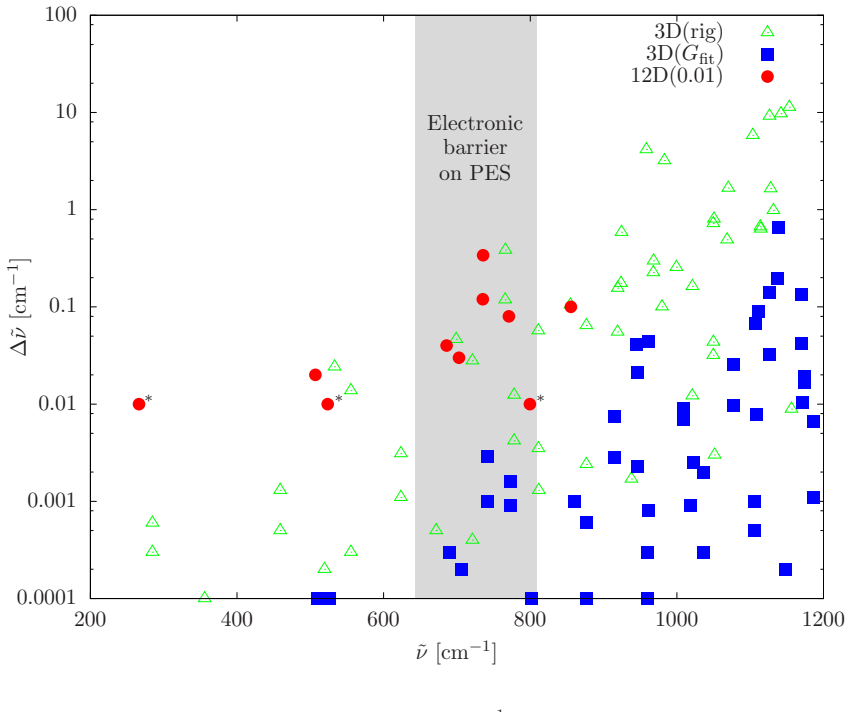
The central claim is that a genuinely full-dimensional, multi-well variational treatment is both necessary and sufficient to describe the low-energy vibrational states of CH4·F− on the CBB08 surface. The 12D GENIUSH–Smolyak computation yields benchmark-quality band origins, converged to within 1 cm$^{-1}$, and tunneling splittings converged to within 0.05 cm$^{-1}$ (excited-state splittings within 0.02 cm$^{-1}$), for all states up to about 730 cm$^{-1}$ above the zero-point vibrational energy. Up to that energy the computed splittings are smaller than 0.02 cm$^{-1}$, so the four equivalent wells are not resolved as spectral splittings; nevertheless, a single-well normal-coordinate computation disagrees with the multi-well band origins by about 20 cm$^{-1}$ (rmsd), showing that the wavefunctions feel the multi-well anharmonicity even when the tunneling splitting is tiny. In the higher-energy range, the splittings increase with vibrational excitation and reach values larger than 0.1 cm$^{-1}$ near the lowest electronic barrier (1104 cm$^{-1}$), which the authors interpret as non-negligible tunneling of the heavy (methane–fluoride) relative motion. These results reconcile the earlier 3D and 12D studies: the 3D model that reproduces the band origins fails to reproduce the splittings by orders of magnitude, while the rigid-monomer 3D model gives reasonable splittings but poor band origins, so only the full-dimensional treatment captures both.
Load-bearing premise
The single fitted potential energy surface (CBB08), with a reported 42 cm$^{-1}$ root-mean-square fitting error, accurately represents the true CH4·F− interaction over the coordinate regions sampled by the vibrational states.
Editorial extensions
If this is right
- The computed band origins up to 730 cm$^{-1}$ provide a benchmark that future approximate quantum-dynamics treatments of this complex can be tested against.
- Infrared spectra below 730 cm$^{-1}$ should show unsplit (or nearly unsplit) vibrational bands, while spectra excited near or above the barrier should develop resolvable tunneling multiplets.
- Single-well normal-coordinate calculations, despite giving reasonable zero-point energies, are not reliable for vibrational excitation energies of this complex.
- No fixed-monomer 3D reduction can simultaneously reproduce both band origins and tunneling splittings; accurate results require explicit coupling of methane's vibrations to the hindered rotation of the ion.
- Near the 1104 cm$^{-1}$ barrier, tunneling splittings of order 0.1 cm$^{-1}$ appear, which is the signature of heavy-atom tunneling in the relative methane–fluoride motion.
Reading between the lines
- If the CBB08 surface is accurate, the predicted onset of sizeable splittings around 680–730 cm$^{-1}$ above the zero-point level is a sharp, observable prediction for action-spectroscopy experiments on CH4·F−.
- The same pruned-basis Smolyak strategy could be applied to other four-well complexes such as CH4·Cl−, where the pattern of 3D-versus-12D disagreement would likely be similar.
- The 1104 cm$^{-1}$ barrier height is the key control parameter; recomputing the splittings on a surface with a deliberately modified barrier (e.g., ±50 cm$^{-1}$) would quantify how sensitively the near-threshold splittings respond, which the paper does not report.
- One could also compute the tunneling path non-perturbatively from the 12D wavefunctions (for example, the nodal surfaces of the relative-orientation coordinates) to verify the 'heavy-atom tunneling' interpretation; the paper assigns splittings but does not map the path.
Signed reviews
Editorial analysis
A structured set of objections, weighed in public.
Referee Report
Summary. This paper reports full-dimensional (12D) variational vibrational computations for the CH4·F− complex on the CBB08 potential energy surface, using the GENIUSH program with Smolyak quadrature. The authors compute vibrational band origins up to about 730 cm−1 above the zero-point energy and tunneling splittings up to about 856 cm−1, with stated convergence of 1 cm−1 for band origins and 0.05 cm−1 (or better) for splittings. They compare their results with earlier MCTDH, MULTIMODE, and reduced-dimensionality GENIUSH calculations, and conclude that tunneling splittings are very small for low-lying states, that a multi-well full-dimensional treatment is necessary despite the small splittings, and that the splittings increase with vibrational excitation, leading to non-negligible 'heavy-atom' tunneling near the barrier.
Significance. If the reported calculations are correct, this work provides a valuable benchmark for a challenging 12D, four-well vibrational problem with large-amplitude motion. Its strengths are the systematic basis-pruning and grid-convergence studies (b=2,3,4; Nc=23 and 25; and a larger BT angular basis), the honest reporting of artificial splittings, the explicit labeling of the fitted 3D(Gfit) model rather than disguising its adjustable parameters, and the detailed comparison with previous methods. The results should be useful as numerical benchmarks on the CBB08 PES, with the important caveat that this surface itself has an rmsd of 42 cm−1 to the underlying CCSD(T) energies, so the numbers are benchmarks for the surface rather than direct experimental predictions.
major comments (2)
- [Section V (Excited-state tunneling manifolds)] The central new conclusion that tunneling splittings become significant above about 680 cm−1 rests on the BT 12D calculation, which uses b=2 pruning of the methane basis. The paper states that although the band origins have 3–4 cm−1 uncertainty, the splittings are converged to better than 0.02 cm−1 because the methane-basis error cancels in the near-degenerate tunneling manifold. This error-cancellation assumption is plausible but is not demonstrated. Table I provides b=2, b=3, and b=4 comparisons only with a small angular basis (23 or 25 sin-cot functions), and that table shows artificial splittings of 0.2–0.3 cm−1 for some higher states at b=2 and b=3; the larger angular basis in BT tests angular convergence but not the assumed cancellation of the methane-basis truncation. Because the claims that 'tunneling splittings increase upon vibrational excitation' and that 'heavy-atom tunneling' appears are carried by the BT splittings, the paper should provide a direct comparison of b=2 and b=3 (or b=4) splittings at a fixed large angular basis, at least for representative states above 680 cm−1.
- [Abstract and Section V/Figure 1] The abstract states as a confirmed result that 'the tunneling splittings are smaller than 0.02 cm−1.' This unqualified statement is contradicted by the body of the paper: Section V reports that several splittings larger than 0.02 cm−1 appear above about 680 cm−1, Figure 1 highlights these states in red, and Section VI summarizes 'sizeable tunneling splittings, >0.1 cm−1' near the barrier. The abstract should be qualified (for example, by limiting the statement to states below about 680 cm−1 or to the low-energy manifold), and the convergence threshold should be reconciled consistently between the abstract, Section V, Figure 1, and the summary.
minor comments (3)
- [Table I and Section IV] In Table I, the ZPVE row for the two 3D models (461.0 and 378.8 cm−1) is not on the same absolute energy scale as the 12D ZPVE values, because the 3D models exclude methane internal zero-point energy; a footnote explaining this difference would prevent confusion.
- [Section V] The sentence stating that the barrier is '1104 cm−1 from the PES minimum and ca. 700 cm−1 measured from the intermolecular ZPVE' is potentially confusing because Figure 1 plots energies measured from the full 12D zero-point vibration; please clarify which model's ZPVE the 700 cm−1 value refers to.
- [Section V and Supplementary Material] The main text does not contain a numerical table of the BT excited-state tunneling splittings, even though those splittings drive the main conclusions; including the BT energies and splittings for the states above 680 cm−1 in the main text (or at least a clear pointer to the specific supplementary table) would strengthen the presentation.
Circularity Check
No significant circularity: direct variational computation on the external CBB08 PES; the only fitted model is explicitly labeled and is not used to produce the main predictions.
full rationale
The central results are obtained by a direct 12D GENIUSH-Smolyak variational solution of the vibrational Hamiltonian using the externally published CBB08 PES. Neither the band origins nor the tunneling splittings are defined in terms of the target quantities; they come from solving the Hamiltonian with increasingly large basis sets and grids, with explicit convergence checks reported in Table I (BA/BB/BC) and Section V. The only fitted model, 3D(Gfit), is explicitly labeled as 'merely a fitted model' designed to reproduce the 12D band origins, and its splittings are not presented as first-principles predictions; they are used to illustrate that matching band origins does not automatically reproduce splittings. The self-citations to Refs. [18] and [34] provide the GENIUSH-Smolyak method and the Td(M) symmetry analysis, but these are methodological or mathematical inputs, not the paper's physical results, and the load-bearing energies and splittings are computed in the present work rather than imported from those citations. The abstract/body discrepancy about the 0.02 cm^-1 threshold is a presentation or convergence-criterion inconsistency, not a circular reduction. No quoted step exhibits a fitted parameter renamed as a prediction, a result equivalent to its input by construction, or a load-bearing self-citation chain. The derivation is therefore self-contained with respect to circularity, and the appropriate score is 0.
Assumptions & free parameters
free parameters (3)
- rPES(C-H) in 3D(Gfit) model =
2.143624 bohr
- rKEO(C-H) in 3D(Gfit) model =
2.518620 bohr
- Morse basis parameters for R (D0, alpha, gamma) =
D0=1975.27 cm^-1, alpha=0.9, gamma=18
assumptions (5)
- domain assumption The CBB08 PES accurately represents the true CH4·F- potential energy surface in the sampled region.
- standard math Born-Oppenheimer separation of electronic and nuclear motion.
- domain assumption Four equivalent wells connected by surmountable barriers justify the Td(M) molecular symmetry analysis.
- ad hoc to paper The 12D states are assigned by transferring 3D wavefunction labels in energy order.
- ad hoc to paper In the BT 12D computation, the small methane basis (b=2) shifts both symmetry components of a tunneling manifold equally, so the splittings are converged even though the band origins are not.
Cite this review
Pith. "Pith review of Full-dimensional (12D) variational vibrational states of CH$_4\cdot$F$^-$: interplay of anharmonicity and tunneling." pith.science (2026). https://pith.science/paper/CQOTOBAX
@misc{pith2026190800809,
  author       = {Pith},
  title        = {Pith review of: Full-dimensional (12D) variational vibrational states of CH$_4\cdot$F$^-$: interplay of anharmonicity and tunneling},
  year         = {2026},
  howpublished = {\url{https://pith.science/paper/CQOTOBAX}},
  note         = {Machine review of arXiv:1908.00809}
}
abstract
The complex of a methane molecule and a fluoride anion represents a 12-dimensional (12D), four-well vibrational problem with multiple large-amplitude motions, which has challenged the quantum dynamics community for years. The present work reports vibrational band origins and tunneling splittings obtained in a full-dimensional variational vibrational computation using the GENIUSH program and the Smolyak quadrature scheme. The converged 12D vibrational band origins and tunneling splittings confirm complementary aspects of the earlier full- and reduced-dimensionality studies: (1) the tunneling splittings are smaller than 0.02 cm$^{-1}$; (2) a single-well treatment is not sufficient (except perhaps the zero-point vibration) due to a significant anharmonicity over the wells; and thus, (3) a full-dimensional treatment appears to be necessary. The present computations extend to a higher energy range than earlier work, show that the tunneling splittings increase upon vibrational excitation of the complex, and indicate non-negligible `heavy-atom' tunneling.
Figures

Reference graph
Works this paper leans on
-
[1]
112 ˚ A, for the H which binds (b) to the F −, while for the other three hydrogens, rint eq (C–H) =
-
[2]
The corresponding distorted tetrahedral structure is chara cterized by the α (H– C–Hb) = 110
095 ˚ A. The corresponding distorted tetrahedral structure is chara cterized by the α (H– C–Hb) = 110 . 46o angle. In the CH 4+F− channel, the practically isolated (isol) methane molecule is a regular tetrahedron with a C–H equilibrium distance, risol eq (C–H) = 1 . 090 ˚ A. In the forthcoming sections, we briefly summarize the quantum dyn amics methodolog...
-
[3]
Z. M. Loh, L. Wilson, D. A. Wild, J. Bieske, J. M. Lisy, B. Nj egic, and M. S. Gordon, J. Phys. Chem. A 110, 13736 (2006)
work page 2006
-
[4]
05 cm −1 upon the increase of the basis set, which is reported in column BC of the table (25 sin-cot-DVR basis functions and b = 4 basis-pruning parameter). Finally, we mention that we were able to put together a ‘fitted’ 3D mod el which re- produced the 12D GENIUSH–Smolyak vibrational band origins with an rmsd of 1.9 cm −1 (‘Gfit ’ in the Table I). ‘ Gfit’ ...
-
[5]
05 cm −1, Sec. IV). The question arises whether the energy splitting due to tunneling of the heavy fragments (heavier than the hydrogen atom) becomes more significant upon the vibrational excitation of the complex. The symmetry species in the t unneling manifold are specified in Eq. (5), but of course, the symmetry analysis by itself d oes not provide any i...
-
[6]
01) Electronic barrier on PES ∗ ∗ ∗ FIG
1 1 10 100 200 400 600 800 1000 1200 ∆˜ν [cm−1] ˜ν [cm−1] 3D(rig) 3D(Gfit ) 12D(0. 01) Electronic barrier on PES ∗ ∗ ∗ FIG. 2: Logarithm of the energy splitting, ∆˜ ν in cm −1, among the different symmetry species of the tunneling manifold, Eq. (5), shown with respect to the ˜ν energy of the vibrational state measured from the zero-point vibrational energy ...
work page 2019
-
[7]
D. A. Wild, Z. M. Loh, and E. Bieske, Int. J. Mass. Spectrom . 220, 273 (2002)
work page 2002
-
[8]
Z. M. Loh, R. L. Wilson, D. A. Wild, E. J. Bieske, and M. S. Go rdon, Aust. J. Chem. 57, 1157 (2004)
work page 2004
Show all 44 references
-
[9]
Wodraszka, J
R. Wodraszka, J. Palma, and U. Manthe, J. Phys. Chem. A 116, 11249 (2012)
2012
-
[10]
D. M. Neumark, J. Phys. Chem. A 112, 13287 (2008)
2008
-
[11]
T. I. Yacovitch, E. Garand, J. B. Kim, C. Hock, T. Theis, an d D. M. Neumark, Faraday Discuss. 157, 399 (2012)
2012
-
[12]
Cheng, Y
M. Cheng, Y. Feng, Y. Du, Q. Zhu, W. Zheng, G. Czak´ o, and J. M. Bowman, J. Chem. Phys. 134, 191102 (2011)
2011
-
[13]
Westermann, J
T. Westermann, J. B. Kim, M. L. Weichman, C. Hock, T. I. Yac ovitch, J. Palma, D. M. Neumark, and U. Manthe, Angew. Chem. Int. Ed.. 53, 1122 (2014)
2014
-
[14]
Czak´ o, B
G. Czak´ o, B. J. Braams, and J. M. Bowman, J. Phys. Chem. A 112, 7466 (2008)
2008
-
[15]
F´ abri, E
C. F´ abri, E. M´ atyus, and A. G. Cs´ asz´ ar, J. Chem. Phys. 134, 074105 (2011)
2011
-
[16]
F´ abri, A
C. F´ abri, A. G. Cs´ asz´ ar, and G. Czak´ o, J. Phys. Chem.A 117, 6975 (2013)
2013
-
[17]
J. M. Bowman, S. Carter, and X. Huang, International Rev iews in Physical Chemistry 22, 533 (2003)
2003
-
[18]
Meyer, F
H.-D. Meyer, F. Gatti, and G. A. Worth, MCTDH for Density Operator (Wiley-Blackwell, 2009), chap. 7, pp. 57–62, ISBN 9783527627400
2009
-
[19]
M. Beck, A. Jackle, G. Worth, and H.-D. Meyer, Physics Re ports 324, 1 (2000), ISSN 19 0370-1573
2000
-
[20]
M´ atyus, G
E. M´ atyus, G. Czak´ o, and A. G. Cs´ asz´ ar, J. Chem. Phys. 130, 134112 (2009)
2009
-
[21]
Avila and J
G. Avila and J. T. Carrington, J. Chem. Phys. 134, 064101 (2011)
2011
-
[22]
Quack and M
M. Quack and M. A. Suhm, J. Chem. Phys. 95, 28 (1991)
1991
-
[23]
Mizukami, S
W. Mizukami, S. Habershon, and D. P. Tew, J. Chem. Phys. 141, 144310 (2014)
2014
-
[24]
Avila and E
G. Avila and E. M´ atyus, J. Chem. Phys. 150, 174107 (2019)
2019
-
[25]
Avila and J
G. Avila and J. T. Carrington, J. Chem. Phys. 131, 174103 (2009)
2009
-
[26]
Avila and J
G. Avila and J. T. Carrington, J. Chem. Phys. 134, 054126 (2011)
2011
-
[27]
Sarka, A
J. Sarka, A. G. Cs´ asz´ ar, S. C. Althorpe, D. J. Wales, an d E. M´ atyus, Phys. Chem. Chem. Phys. 18, 22816 (2016)
2016
-
[28]
Lauvergnat and A
D. Lauvergnat and A. Nauts, 119, 18 (2014), ISSN 1386-1425
2014
-
[29]
Nauts and D
A. Nauts and D. Lauvergnat, Mol. Phys. 116, 3701 (2018)
2018
-
[30]
F´ abri, E
C. F´ abri, E. M´ atyus, and A. G. Cs´ asz´ ar, Spectrochim. Acta 119, 84 (2014)
2014
-
[31]
F´ abri, J
C. F´ abri, J. Sarka, and A. G. Cs´ asz´ ar, J. Chem. Phys.140, 051101 (2014)
2014
-
[32]
Sarka and A
J. Sarka and A. G. Cs´ asz´ ar, J. Chem. Phys. 144, 154309 (2016)
2016
-
[33]
R. J. Whitehead and N. C. Handy, J. Mol. Spectrosc. 55, 356 (1975)
1975
-
[34]
Sarka, A
J. Sarka, A. G. Cs´ asz´ ar, and E. M´ atyus, Phys. Chem. Chem. Phys. 19, 15335 (2017)
2017
-
[35]
F´ abri, M
C. F´ abri, M. Quack, and A. G. Cs´ asz´ ar, J. Chem. Phys.147, 134101 (2017)
2017
-
[36]
Simk´ o, T
I. Simk´ o, T. Szidarovszky, and A. G. Cs´ asz´ ar, J. Chem. Theory Comput. 15, 4156 (2019)
2019
-
[37]
Schiffel and U
G. Schiffel and U. Manthe, Chem. Phys. 374, 118 (2010), ISSN 0301-0104
2010
-
[38]
J. C. Light and T. Carrington Jr., Discrete-Variable Representations and their Utilization (John Wiley & Sons, Ltd, 2007), pp. 263–310
2007
-
[40]
Ferenc and E
D. Ferenc and E. M´ atyus, Mol. Phys. 117, 1694 (2019)
2019
-
[41]
J. S. Coursey, D. J. Schwab, J. J. Tsai, and R. A. Dragoset , Atomic Weights and Isotopic Compositions (version 4.1): http://physics.nist.gov/Comp [last accessed on 12 May 2018]. National Institute of Standards and Technology, Gaithersb urg, MD. (2015)
2015
-
[42]
Wei and T
H. Wei and T. Carrington, Jr., J. Chem. Phys. 97, 3029 (1992)
1992
-
[43]
Echave and D
J. Echave and D. C. Clary, Chem. Phys. Lett. 190, 225 (1992)
1992
-
[44]
Szalay, G
V. Szalay, G. Czak´ o, A. Nagy, T. Furtenbacher, and A. G. Cs´ asz´ ar, J. Chem. Phys.119, 10512 (2003). 20
2003
-
[1975]
9, and γ = 18 parameter values which correspond to the 1D cut of the current PES (all other coordinates fixed at their equilibrium valu e)
27 cm −1, α = 0 . 9, and γ = 18 parameter values which correspond to the 1D cut of the current PES (all other coordinates fixed at their equilibrium valu e). The cos θ degree of freedom was described with sin-cot-DVR basis functions and quadr ature points [31], while we used Fo...
Reviewed August 14, 2026 · model on record in the stance chip above.
Discussion (0). Continue with ORCID to comment.