REVIEW 35 references
Large Language Model-Driven Distributed Integrated Multimodal Sensing and Semantic Communications
T0 review · reviewed 2026-08-07 · deepseek-v4-flash
Pith's one-line read LLM-DiSAC fuses RF and visual features from multiple devices with an LLM-based semantic communication link and reports up to 191% relative classification improvement over a unimodal single-device baseline on a synthetic dataset.
The pith
A machine-rendered reading of the paper's core claim, the machinery that carries it, and where it could break.
The reading
Extended reading notes
Core claim
The central claim is that LLM-DiSAC achieves a 191.0% relative improvement in classification accuracy, reduces RMSE by an average of 31.5%, lowers NMSE by 55.6% compared to the unimodal single-device baseline, and reduces data transmission cost by 92.6% relative to conventional approaches. If true, the framework would demonstrate that combining multimodal sensing, multi-device collaboration, and LLM-based semantic communication yields large gains in sensing accuracy and communication efficiency.
Load-bearing premise
The weakest load-bearing assumption is that the synthetic dataset generated by Genesis, together with the idealized radar echo model in Eq. (1), is representative of real-world RF-visual conditions. The paper's experiments and all headline numbers rely on this synthetic data, and the authors themselves state in the conclusion that the current study is based on synthetic data and that a practical platform is needed for real-world validation. If the simulated RF signals, visual scenes, and channel conditions differ materially from physical reality, the reported improvements may not hold.
Editorial analysis
A structured set of objections, weighed in public.
Assumptions & free parameters
free parameters (2)
- Loss weight for regression tasks =
l1 = l2 = l3 = l4 = 50
- RCS values for car, robotic dog, drone =
100, 10, 1
assumptions (3)
- domain assumption The radar echo model in Eq. (1) with a point-target RCS is an accurate representation of real RF sensing signals.
- domain assumption The Genesis simulation engine produces visual scenes representative of real-world camera observations in urban or non-line-of-sight scenarios.
- ad hoc to paper Concatenating a pretrained language model token embedding with non-textual feature vectors allows LLaMA-3 to perform effective semantic decoding of sensing features.
Cite this review
Pith. "Pith review of Large Language Model-Driven Distributed Integrated Multimodal Sensing and Semantic Communications." pith.science (2026). https://pith.science/paper/CQXQRZ45
@misc{pith2026250518194,
  author       = {Pith},
  title        = {Pith review of: Large Language Model-Driven Distributed Integrated Multimodal Sensing and Semantic Communications},
  year         = {2026},
  howpublished = {\url{https://pith.science/paper/CQXQRZ45}},
  note         = {Machine review of arXiv:2505.18194}
}
read the original abstract
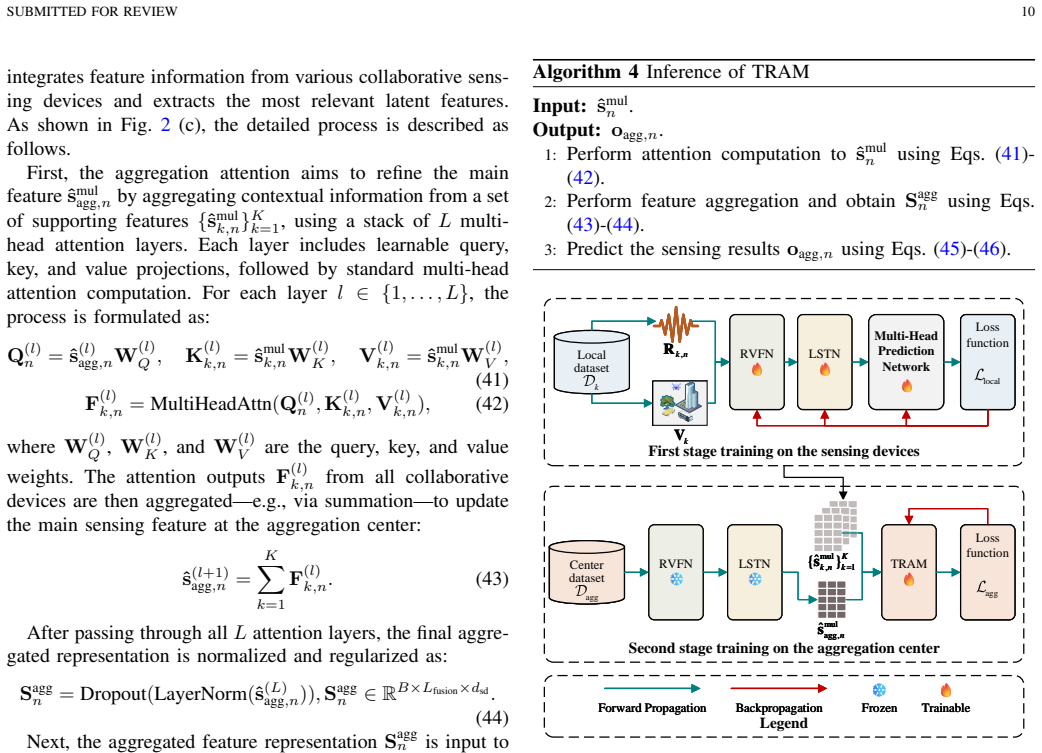
Traditional single-modal sensing systems-based solely on either radio frequency (RF) or visual data-struggle to cope with the demands of complex and dynamic environments. Furthermore, single-device systems are constrained by limited perspectives and insufficient spatial coverage, which impairs their effectiveness in urban or non-line-of-sight scenarios. To overcome these challenges, we propose a novel large language model (LLM)-driven distributed integrated multimodal sensing and semantic communication (LLM-DiSAC) framework. Specifically, our system consists of multiple collaborative sensing devices equipped with RF and camera modules, working together with an aggregation center to enhance sensing accuracy. First, on sensing devices, LLM-DiSAC develops an RF-vision fusion network (RVFN), which employs specialized feature extractors for RF and visual data, followed by a cross-attention module for effective multimodal integration. Second, a LLM-based semantic transmission network (LSTN) is proposed to enhance communication efficiency, where the LLM-based decoder leverages known channel parameters, such as transceiver distance and signal-to-noise ratio (SNR), to mitigate semantic distortion. Third, at the aggregation center, a transformer-based aggregation model (TRAM) with an adaptive aggregation attention mechanism is developed to fuse distributed features and enhance sensing accuracy. To preserve data privacy, a two-stage distributed learning strategy is introduced, allowing local model training at the device level and centralized aggregation model training using intermediate features. Finally, evaluations on a synthetic multi-view RF-visual dataset generated by the Genesis simulation engine show that LLM-DiSAC achieves a good performance.
Figures


Figures from the paper (7 more)


Reference graph
Works this paper leans on
-
[1]
Role of sensing and computer vision in 6G wireless communications,
S. Kim, J. Moon, J. Kim, Y . Ahn, D. Kim, S. Kim, K. Shim, and B. Shim, “Role of sensing and computer vision in 6G wireless communications,” IEEE Wireless Communications, vol. 31, no. 5, pp. 264–271, 2024
work page 2024
-
[2]
D. Zhang, X. Zhang, Z. Yin, Y . Xie, H. Wei, Z. Chang, W. Li, and D. Zhang, “mmrotation: Unlocking versatility of a single mmwave radar via horizontal mobility and azimuthal rotation,”IEEE Transactions on Mobile Computing, pp. 1–16, 2025
work page 2025
-
[3]
Simac: A semantic-driven integrated multimodal sensing and communication framework,
Y . Peng, L. Xiang, K. Yang, F. Jiang, K. Wang, and D. O. Wu, “Simac: A semantic-driven integrated multimodal sensing and communication framework,”arXiv preprint arXiv:2503.08726, 2025
arXiv 2025
-
[4]
Security challenges in internet of vehicles (IoV) for its: A survey,
E. Khezri, H. Hassanzadeh, R. O. Yahya, and M. Mir, “Security challenges in internet of vehicles (IoV) for its: A survey,”Tsinghua Science and Technology, vol. 30, no. 4, pp. 1700–1723, 2025
work page 2025
-
[5]
Fusegrasp: Radar-camera fusion for robotic grasping of transparent objects,
H. Deng, T. Xue, and H. Chen, “Fusegrasp: Radar-camera fusion for robotic grasping of transparent objects,”IEEE Transactions on Mobile Computing, no. 99, pp. 1–14, 2025. SUBMITTED FOR REVIEW 16
work page 2025
-
[6]
Line-of-sight probability and holding distance in non- terrestrial networks,
A. Al-Hourani, “Line-of-sight probability and holding distance in non- terrestrial networks,”IEEE Communications Letters, vol. 28, no. 3, pp. 622–626, 2024
work page 2024
-
[7]
Non-line-of-sight identification and mitigation using received signal strength,
Z. Xiao, H. Wen, A. Markham, N. Trigoni, P. Blunsom, and J. Frolik, “Non-line-of-sight identification and mitigation using received signal strength,”IEEE Transactions on Wireless Communications, vol. 14, no. 3, pp. 1689–1702, 2015
work page 2015
-
[8]
Sensing-communication-computing integrated resource allocation for AI-empowered trustworthy iot,
B. Huang, J. Feng, and X. Jin, “Sensing-communication-computing integrated resource allocation for AI-empowered trustworthy iot,”IEEE Transactions on Consumer Electronics, pp. 1–1, 2025
work page 2025
Show all 35 references
-
[9]
Collaborative sensing in internet of things: A comprehensive survey,
S. He, K. Shi, C. Liu, B. Guo, J. Chen, and Z. Shi, “Collaborative sensing in internet of things: A comprehensive survey,”IEEE Communications Surveys & Tutorials, vol. 24, no. 3, pp. 1435–1474, 2022
2022
-
[10]
Large AI model-based semantic communications,
F. Jiang, Y . Peng, L. Dong, K. Wang, K. Yang, C. Pan, and X. You, “Large AI model-based semantic communications,”IEEE Wireless Com- munications, vol. 31, no. 3, pp. 68–75, 2024
2024
-
[11]
Large language model enhanced multi-agent systems for 6G communications,
F. Jiang, Y . Peng, L. Dong, K. Wang, K. Yang, C. Pan, D. Niyato, and O. A. Dobre, “Large language model enhanced multi-agent systems for 6G communications,”IEEE Wireless Communications, vol. 31, no. 6, pp. 48–55, 2024
2024
-
[12]
Semantic communications: Overview, open issues, and future research directions,
X. Luo, H.-H. Chen, and Q. Guo, “Semantic communications: Overview, open issues, and future research directions,”IEEE Wireless Communi- cations, vol. 29, no. 1, pp. 210–219, 2022
2022
-
[13]
Semantic communication systems for speech transmission,
Z. Weng and Z. Qin, “Semantic communication systems for speech transmission,”IEEE Journal on Selected Areas in Communications, vol. 39, no. 8, pp. 2434–2444, 2021
2021
-
[14]
Large AI model empowered multimodal semantic communications,
F. Jiang, L. Dong, Y . Peng, K. Wang, K. Yang, C. Pan, and X. You, “Large AI model empowered multimodal semantic communications,” IEEE Communications Magazine, vol. 63, no. 1, pp. 76–82, 2025
2025
-
[15]
Semantic communication with memory,
H. Xie, Z. Qin, and G. Y . Li, “Semantic communication with memory,” IEEE Journal on Selected Areas in Communications, vol. 41, no. 8, pp. 2658–2669, 2023
2023
-
[16]
Chatgpt is not enough: Enhancing large language models with knowledge graphs for fact-aware language modeling,
L. Yang, H. Chen, Z. Li, X. Ding, and X. Wu, “Chatgpt is not enough: Enhancing large language models with knowledge graphs for fact-aware language modeling,”arXiv preprint arXiv:2306.11489, 2023
2023 arXiv
-
[17]
Llama 2: Open foundation and fine-tuned chat models,
H. Touvron, L. Martin, K. Stone, P. Albert, A. Almahairi, Y . Babaei, N. Bashlykov, S. Batra, P. Bhargava, S. Bhosaleet al., “Llama 2: Open foundation and fine-tuned chat models,”arXiv preprint arXiv:2307.09288, 2023
2023 arXiv
-
[18]
When large language model agents meet 6G networks: Perception, grounding, and alignment,
M. Xu, D. Niyato, J. Kang, Z. Xiong, S. Mao, Z. Han, D. I. Kim, and K. B. Letaief, “When large language model agents meet 6G networks: Perception, grounding, and alignment,”IEEE Wireless Communications, vol. 31, no. 6, pp. 63–71, 2024
2024
-
[19]
Genesis: A universal and generative physics engine for robotics and beyond,
G. Authors, “Genesis: A universal and generative physics engine for robotics and beyond,” December 2024. [Online]. Available: https://github.com/Genesis-Embodied-AI/Genesis
2024
-
[20]
Metasens- ing: Intelligent metasurface assisted rf 3d sensing by deep reinforcement learning,
J. Hu, H. Zhang, K. Bian, M. D. Renzo, Z. Han, and L. Song, “Metasens- ing: Intelligent metasurface assisted rf 3d sensing by deep reinforcement learning,”IEEE Journal on Selected Areas in Communications, vol. 39, no. 7, pp. 2182–2197, 2021
2021
-
[21]
Real- time rf sensing for the early identification and management of respiratory health,
M. M. Arslan, X. Yang, S. U. Rahman, A. A. Shah, and M. Ullah, “Real- time rf sensing for the early identification and management of respiratory health,” in2024 IEEE 12th Asia-Pacific Conference on Antennas and Propagation (APCAP), 2024, pp. 1–2
2024
-
[22]
Semantic com- munications with computer vision sensing for edge video transmission,
Y . Peng, L. Xiang, K. Yang, K. Wang, and M. Debbah, “Semantic com- munications with computer vision sensing for edge video transmission,” arXiv preprint arXiv:2503.07252, 2025
2025
-
[23]
Computer vision- based bridge inspection and monitoring: A review,
K. Luo, X. Kong, J. Zhang, J. Hu, J. Li, and H. Tang, “Computer vision- based bridge inspection and monitoring: A review,”Sensors, vol. 23, no. 18, p. 7863, 2023
2023
-
[24]
Real-time volumetric perception for unmanned surface vehicles through fusion of radar and camera,
H. Xu, X. Zhang, J. He, Y . Yu, and Y . Cheng, “Real-time volumetric perception for unmanned surface vehicles through fusion of radar and camera,”IEEE Transactions on Instrumentation and Measurement, vol. 73, pp. 1–12, 2024
2024
-
[25]
Deep multimodal learning: Merging sensory data for massive mimo channel prediction,
Y . Yang, F. Gao, C. Xing, J. An, and A. Alkhateeb, “Deep multimodal learning: Merging sensory data for massive mimo channel prediction,” IEEE Journal on Selected Areas in Communications, vol. 39, no. 7, pp. 1885–1898, 2021
2021
-
[26]
Millimeter-wave radar and vision fusion-based semantic simultaneous localization and mapping,
Y . Wang, Y . Wu, D. Li, and W. Yu, “Millimeter-wave radar and vision fusion-based semantic simultaneous localization and mapping,”IEEE Antennas and Wireless Propagation Letters, vol. 23, no. 11, pp. 3977– 3981, 2024
2024
-
[27]
Edge collaborative com- pressed sensing in wireless sensor networks for mechanical vibration monitoring,
C. Zhao, B. Tang, Y . Huang, and L. Deng, “Edge collaborative com- pressed sensing in wireless sensor networks for mechanical vibration monitoring,”IEEE Transactions on Industrial Informatics, vol. 19, no. 8, pp. 8852–8864, 2023
2023
-
[28]
Cloud-edge–terminal collaboration-enabled device-free sensing under class-imbalance condi- tions,
Q. Zhou, S. Wu, C. Jiang, R. Zhang, and X. Jing, “Cloud-edge–terminal collaboration-enabled device-free sensing under class-imbalance condi- tions,”IEEE Internet of Things Journal, vol. 11, no. 4, pp. 5980–5992, 2024
2024
-
[29]
Federated sensing: Edge-cloud elastic collaborative learning for intelligent sensing,
Y . Gao, L. Liu, X. Zheng, C. Zhang, and H. Ma, “Federated sensing: Edge-cloud elastic collaborative learning for intelligent sensing,”IEEE Internet of Things Journal, vol. 8, no. 14, pp. 11 100–11 111, 2021
2021
-
[30]
Edge- assisted collaborative perception against jamming and interference in vehicular networks,
Z. Lin, L. Xiao, H. Chen, Z. Lv, Y . Zhu, Y . Zhang, and Y .-J. Liu, “Edge- assisted collaborative perception against jamming and interference in vehicular networks,”IEEE Transactions on Wireless Communications, vol. 24, no. 1, pp. 860–874, 2025
2025
-
[31]
Large generative model assisted 3D semantic communication,
F. Jiang, Y . Peng, L. Dong, K. Wang, K. Yang, C. Pan, and X. You, “Large generative model assisted 3D semantic communication,”arXiv preprint arXiv:2403.05783, 2024
2024 arXiv
-
[32]
A convnet for the 2020s,
Z. Liu, H. Mao, C.-Y . Wu, C. Feichtenhofer, T. Darrell, and S. Xie, “A convnet for the 2020s,” inProceedings of the IEEE/CVF Conference on Computer Vision and Pattern Recognition (CVPR), June 2022, pp. 11 976–11 986
2022
-
[33]
Bidirectional lstm with attention mechanism and convolutional layer for text classification,
G. Liu and J. Guo, “Bidirectional lstm with attention mechanism and convolutional layer for text classification,”Neurocomputing, vol. 337, pp. 325–338, 2019
2019
-
[34]
The llama 3 herd of models,
A. Grattafiori, A. Dubey, A. Jauhri, A. Pandey, A. Kadian, A. Al-Dahle, A. Letman, A. Mathur, A. Schelten, A. Vaughanet al., “The llama 3 herd of models,”arXiv preprint arXiv:2407.21783, 2024
2024 arXiv
-
[35]
Lora: Low-rank adaptation of large language models
E. J. Hu, Y . Shen, P. Wallis, Z. Allen-Zhu, Y . Li, S. Wang, L. Wang, W. Chenet al., “Lora: Low-rank adaptation of large language models.” ICLR, vol. 1, no. 2, p. 3, 2022
2022
Reviewed August 7, 2026 · model on record in the stance chip above.
Discussion (0). Continue with ORCID to comment.