Guided Image Generation with Conditional Invertible Neural Networks
Pith reviewed 2026-05-25 09:29 UTC · model grok-4.3
The pith
Conditional invertible neural networks generate diverse sharp images from conditioning inputs by construction.
A machine-rendered reading of the paper's core claim, the machinery that carries it, and where it could break.
Core claim
The cINN combines an invertible neural network for generation with an unconstrained feed-forward network that preprocesses the conditioning input; all parameters are optimized jointly by stable maximum likelihood training. By this construction the model produces diverse samples without mode collapse and sharp images without any reconstruction loss.
What carries the argument
The conditional invertible neural network (cINN), which merges a generative invertible network with a preprocessing feed-forward network for the conditioning signal.
If this is right
- Samples remain diverse because the invertible structure prevents mode collapse.
- Images stay sharp because training never relies on a reconstruction term.
- The bidirectional flow permits direct manipulation of latent properties such as style.
- The same training procedure applies to both digit synthesis and colorization.
Where Pith is reading between the lines
- The separation of conditioning preprocessing from the invertible generator might transfer to conditional tasks outside images.
- Stable maximum-likelihood training could reduce the need for adversarial objectives in other hybrid generative models.
- Latent-space edits shown in the paper suggest a route to controllable generation that does not require additional supervision.
Load-bearing premise
Joint maximum-likelihood optimization of the invertible network and the feed-forward preprocessor produces the claimed diversity and sharpness on the tested tasks.
What would settle it
Demonstrating mode collapse or visibly blurry outputs on the MNIST or colorization tasks would show that the construction does not deliver the stated properties.
Figures
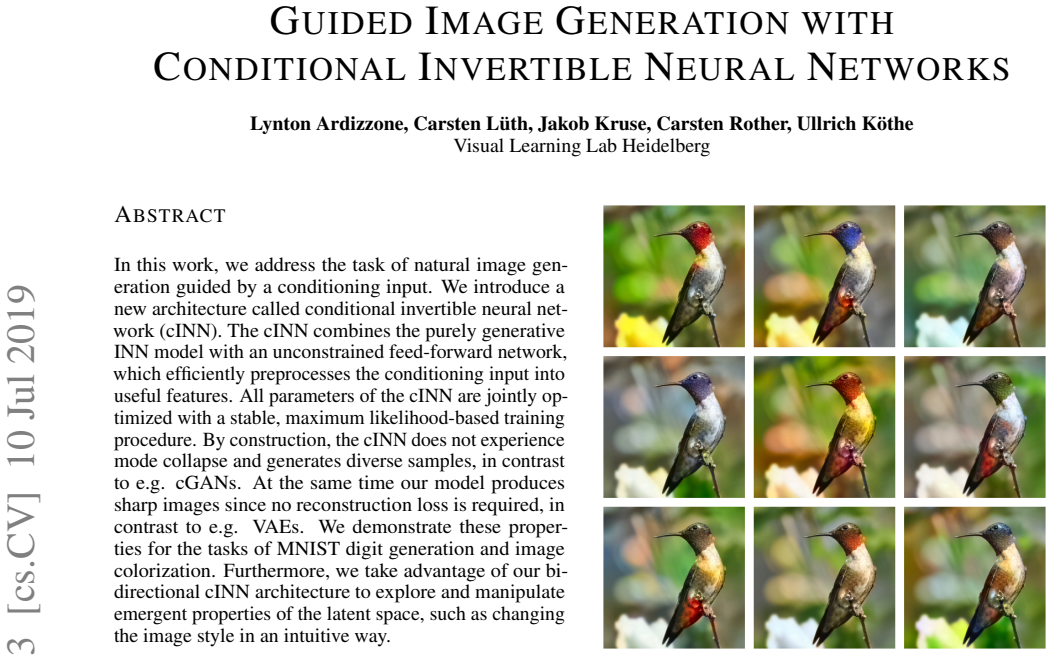


read the original abstract
In this work, we address the task of natural image generation guided by a conditioning input. We introduce a new architecture called conditional invertible neural network (cINN). The cINN combines the purely generative INN model with an unconstrained feed-forward network, which efficiently preprocesses the conditioning input into useful features. All parameters of the cINN are jointly optimized with a stable, maximum likelihood-based training procedure. By construction, the cINN does not experience mode collapse and generates diverse samples, in contrast to e.g. cGANs. At the same time our model produces sharp images since no reconstruction loss is required, in contrast to e.g. VAEs. We demonstrate these properties for the tasks of MNIST digit generation and image colorization. Furthermore, we take advantage of our bi-directional cINN architecture to explore and manipulate emergent properties of the latent space, such as changing the image style in an intuitive way.
Editorial analysis
A structured set of objections, weighed in public.
Referee Report
Summary. The manuscript introduces conditional invertible neural networks (cINNs) for conditional natural image generation. The architecture augments a standard INN with an unconstrained feed-forward network that preprocesses the conditioning input; all parameters are optimized jointly via maximum-likelihood training using the change-of-variables formula. The central claims are that bijectivity precludes mode collapse and guarantees sample diversity (unlike cGANs) while the absence of any pixel-wise reconstruction term permits sharp outputs (unlike VAEs). Experiments are presented on MNIST digit generation conditioned on class labels and on image colorization; the bidirectional architecture is further used to explore and manipulate emergent latent-space properties such as style.
Significance. If the joint optimization remains stable and the claimed properties hold under the reported training procedure, the work supplies a theoretically grounded alternative to adversarial and variational conditional generators. Exact likelihood training together with invertibility directly enforces the diversity and sharpness properties without auxiliary losses or sampling heuristics. The latent-space manipulation experiments illustrate an additional practical benefit of the bijective mapping. These strengths are explicitly grounded in the architectural axioms rather than in post-hoc empirical tuning.
minor comments (3)
- [Methods] The description of the feed-forward conditioning network (architecture, depth, and how its output is injected into the cINN coupling layers) should be expanded with a diagram or explicit equations to allow exact reproduction.
- [Experiments] Quantitative metrics (e.g., FID, negative log-likelihood on held-out data) are mentioned only qualitatively; adding numerical tables comparing against cGAN and VAE baselines on both tasks would strengthen the experimental section.
- [Preliminaries] Notation for the base distribution and the Jacobian determinant computation is introduced without a dedicated preliminary section; a short recap of the standard INN change-of-variables formula would improve readability for readers unfamiliar with the prior INN literature.
Simulated Author's Rebuttal
We thank the referee for the positive assessment of our work and the recommendation to accept. The provided summary accurately reflects the contributions of the cINN architecture.
Circularity Check
No significant circularity
full rationale
The paper's central claims follow directly from the stated architecture (bijective cINN layers plus change-of-variables likelihood) and training objective (joint NLL without pixel reconstruction term). These properties are presented as consequences of the design choices rather than derived quantities that reduce to fitted parameters or self-referential citations. No load-bearing step equates a prediction to its own input by construction, and external benchmarks or independent verification of invertibility are not required for the internal logic to hold.
Axiom & Free-Parameter Ledger
axioms (2)
- domain assumption Invertible neural networks support stable maximum-likelihood training for generative modeling of images
- ad hoc to paper Joint optimization of the invertible network and the feed-forward preprocessor is stable and yields the claimed generative properties
Forward citations
Cited by 7 Pith papers
-
Non-Parametric Rehearsal Learning via Conditional Mean Embeddings
A non-parametric rehearsal learning framework using conditional mean embeddings and a Probit surrogate for avoiding undesired outcomes, with consistency guarantees.
-
Order-based Rehearsal Learning
Order-based rehearsal learning learns sufficient order structures from observational data to make decisions avoiding undesired events, outperforming graph-based methods and matching oracle graph baselines in experiments.
-
Extending Evidence Accumulation Models to Bounded Continuous Self-report Data
Two new diffusion-based models (HCDM and BDDM) are developed and validated for bounded continuous response and reaction-time data using amortized Bayesian methods.
-
Diffusion Posterior Sampling for General Noisy Inverse Problems
Diffusion models solve noisy (non)linear inverse problems via approximated posterior sampling that blends diffusion steps with manifold gradients without strict consistency projection.
-
A flow-matching generative model for event-by-event jet-induced hydro response in high-energy heavy-ion collisions
A flow-matching generative model trained on CoLBT-hydro data conditionally generates marginal final-state hadron spectra from jet-induced hydro responses in 0-10% Pb+Pb collisions at 5.02 TeV, matching training data s...
-
Extending Evidence Accumulation Models to Bounded Continuous Self-report Data
Introduces HCDM and BDDM as extensions of evidence accumulation models for bounded continuous responses and demonstrates their parameter recovery and model comparison via amortized Bayesian methods on real data.
-
Generative Design of a Gas Turbine Combustor Using Invertible Neural Networks
Invertible Neural Networks are used to generate gas turbine combustor designs that meet specified performance criteria from a training database of parameterized designs and simulations.
Reference graph
Works this paper leans on
-
[1]
L. Ardizzone, J. Kruse, C. Rother, and U. Köthe. Analyz- ing inverse problems with invertible neural networks. In Intl. Conf. on Learning Representations, 2019. 1, 3
work page 2019
-
[2]
J. Behrmann, D. Duvenaud, and J.-H. Jacobsen. Invertible residual networks. arXiv:1811.00995, 2018. 3
work page internal anchor Pith review Pith/arXiv arXiv 2018
- [3]
-
[4]
Y . Cao, Z. Zhou, W. Zhang, and Y . Yu. Unsupervised diverse colorization via generative adversarial networks. In Joint Europ. Conf. on Machine Learning and Knowledge Discovery in Databases, pages 151–166. Springer, 2017. 3, 6
work page 2017
-
[5]
Comparison of Maximum Likelihood and GAN-based training of Real NVPs
I. Danihelka, B. Lakshminarayanan, B. Uria, D. Wierstra, and P. Dayan. Comparison of maximum likelihood and GAN-based training of RealNVPs. arXiv:1705.05263,
work page internal anchor Pith review Pith/arXiv arXiv
-
[6]
A. Deshpande, J. Lu, M.-C. Yeh, M. Jin Chong, and D. Forsyth. Learning diverse image colorization. In Conf. on Computer Vision and Pattern Recognition (CVPR) , pages 6837–6845, 2017. 3, 8
work page 2017
-
[7]
L. Dinh, D. Krueger, and Y . Bengio. NICE: Non-linear independent components estimation. arXiv:1410.8516,
work page internal anchor Pith review Pith/arXiv arXiv
-
[8]
L. Dinh, J. Sohl-Dickstein, and S. Bengio. Density esti- mation using Real NVP. arXiv:1605.08803, 2016. 1, 2, 3
work page internal anchor Pith review Pith/arXiv arXiv 2016
-
[9]
V . Dumoulin, J. Shlens, and M. Kudlur. A learned rep- resentation for artistic style. In Intl. Conf. on Learning Representations, 2017. 2
work page 2017
-
[10]
X. Glorot and Y . Bengio. Understanding the difficulty of training deep feedforward neural networks. In Proc
-
[11]
Intl. Conf. Artificial Intelligence and Statistics, pages 249–256, 2010. 4
work page 2010
- [12]
-
[13]
PixColor: Pixel Recursive Colorization
S. Guadarrama, R. Dahl, D. Bieber, M. Norouzi, J. Shlens, and K. Murphy. Pixcolor: Pixel recursive colorization. arXiv:1705.07208, 2017. 3
work page internal anchor Pith review Pith/arXiv arXiv 2017
-
[14]
A. Haar. Zur Theorie der orthogonalen Funktionensysteme. Mathematische Annalen, 69(3):331–371, 1910. 4
work page 1910
- [15]
-
[16]
X. Huang and S. Belongie. Arbitrary style transfer in real- time with adaptive instance normalization. In ICCV’17, pages 1501–1510, 2017. 2
work page 2017
- [17]
-
[18]
P. Isola, J.-Y . Zhu, T. Zhou, and A. A. Efros. Image-to- image translation with conditional adversarial networks. In CVPR’17, pages 1125–1134, 2017. 1, 2, 3, 6, 8
work page 2017
-
[19]
J.-H. Jacobsen, J. Behrmann, R. Zemel, and M. Bethge. Ex- cessive invariance causes adversarial vulnerability. arXiv preprint arXiv:1811.00401, 2018. 4
-
[20]
J.-H. Jacobsen, A. W. Smeulders, and E. Oyallon. i- RevNet: deep invertible networks. In International Con- ference on Learning Representations, 2018. 2
work page 2018
-
[21]
Bidirectional Conditional Generative Adversarial Networks
A. Jaiswal, W. AbdAlmageed, Y . Wu, and P. Natarajan. Bidirectional conditional generative adversarial networks. arXiv:1711.07461, 2017. 2
work page internal anchor Pith review Pith/arXiv arXiv 2017
-
[22]
Progressive Growing of GANs for Improved Quality, Stability, and Variation
T. Karras, T. Aila, S. Laine, and J. Lehtinen. Progres- sive growing of GANs for improved quality, stability, and variation. arXiv:1710.10196, 2017. 1
work page internal anchor Pith review Pith/arXiv arXiv 2017
-
[23]
D. P. Kingma and P. Dhariwal. Glow: Generative flow with invertible 1x1 convolutions. arXiv:1807.03039, 2018. 1, 2, 3, 4, 7
work page internal anchor Pith review Pith/arXiv arXiv 2018
-
[24]
D. P. Kingma, T. Salimans, R. Jozefowicz, X. Chen, I. Sutskever, and M. Welling. Improved variational in- ference with inverse autoregressive flow. In Advances in Neural Information Processing Systems, pages 4743–4751,
-
[25]
D. P. Kingma and M. Welling. Auto-encoding variational Bayes. arXiv:1312.6114, 2013. 2
work page internal anchor Pith review Pith/arXiv arXiv 2013
-
[26]
CausalGAN: Learning Causal Implicit Generative Models with Adversarial Training
M. Kocaoglu, C. Snyder, A. G. Dimakis, and S. Vish- wanath. CausalGAN: Learning causal implicit generative models with adversarial training. arXiv:1709.02023, 2017. 2
work page internal anchor Pith review Pith/arXiv arXiv 2017
-
[27]
J. Kopf, M. F. Cohen, D. Lischinski, and M. Uyttendaele. Joint bilateral upsampling. InACM Transactions on Graph- ics (ToG), volume 26, page 96. ACM, 2007. 6
work page 2007
- [28]
-
[29]
G. Larsson, M. Maire, and G. Shakhnarovich. Learning representations for automatic colorization. In Europ. Conf. on Computer Vision, pages 577–593. Springer, 2016. 3
work page 2016
-
[30]
C. Ledig, L. Theis, F. Huszár, J. Caballero, A. Cunning- ham, A. Acosta, A. Aitken, A. Tejani, J. Totz, Z. Wang, et al. Photo-realistic single image super-resolution using a generative adversarial network. In Intl. Conf. on Computer Vision and Pattern Recognition, pages 4681–4690, 2017. 1
work page 2017
-
[31]
Z. Lin, A. Khetan, G. Fanti, and S. Oh. PacGAN: The power of two samples in generative adversarial networks. In Advances in Neural Information Processing Systems , pages 1498–1507, 2018. 2
work page 2018
-
[32]
Conditional Generative Adversarial Nets
M. Mirza and S. Osindero. Conditional generative adver- sarial nets. arXiv:1411.1784, 2014. 2
work page internal anchor Pith review Pith/arXiv arXiv 2014
-
[33]
T. Miyato and M. Koyama. cGANs with projection dis- criminator. In International Conference on Learning Rep- resentations, 2018. 1
work page 2018
-
[34]
T. Park, M.-Y . Liu, T.-C. Wang, and J.-Y . Zhu. Seman- tic image synthesis with spatially-adaptive normalization. arXiv:1903.07291, 2019. 1, 2
- [35]
-
[36]
O. Russakovsky, J. Deng, H. Su, J. Krause, S. Satheesh, S. Ma, Z. Huang, A. Karpathy, A. Khosla, M. Bernstein, A. C. Berg, and L. Fei-Fei. ImageNet large scale visual recognition challenge. International Journal of Computer Vision (IJCV), 115(3):211–252, 2015. 5
work page 2015
-
[37]
R. T. Schirrmeister, P. Chrabaszcz, F. Hutter, and T. Ball. Training generative reversible networks. arXiv:1806.01610, 2018. 2
work page internal anchor Pith review Pith/arXiv arXiv 2018
-
[38]
Very Deep Convolutional Networks for Large-Scale Image Recognition
K. Simonyan and A. Zisserman. Very deep convolu- tional networks for large-scale image recognition. CoRR, abs/1409.1556, 2014. 6 10
work page internal anchor Pith review Pith/arXiv arXiv 2014
-
[39]
K. Sohn, H. Lee, and X. Yan. Learning structured output representation using deep conditional generative models. In C. Cortes, N. D. Lawrence, D. D. Lee, M. Sugiyama, and R. Garnett, editors, Advances in Neural Information Processing Systems 28, pages 3483–3491. 2015. 2
work page 2015
-
[40]
D. Ulyanov, A. Vedaldi, and V . Lempitsky. It takes (only) two: Adversarial generator-encoder networks. In Thirty- Second AAAI Conference on Artificial Intelligence, 2018. 2, 3
work page 2018
-
[41]
T.-C. Wang, M.-Y . Liu, J.-Y . Zhu, A. Tao, J. Kautz, and B. Catanzaro. High-resolution image synthesis and seman- tic manipulation with conditional gans. In Proceedings of the IEEE Conference on Computer Vision and Pattern Recognition, pages 8798–8807, 2018. 2
work page 2018
-
[42]
F. Yu, A. Seff, Y . Zhang, S. Song, T. Funkhouser, and J. Xiao. Lsun: Construction of a large-scale image dataset using deep learning with humans in the loop. arXiv preprint arXiv:1506.03365, 2015. 6
work page internal anchor Pith review Pith/arXiv arXiv 2015
- [43]
-
[44]
J.-Y . Zhu, T. Park, P. Isola, and A. A. Efros. Unpaired image-to-image translation using cycle-consistent adver- sarial networks. In ICCV’17, pages 2223–2232, 2017. 2
work page 2017
-
[45]
J.-Y . Zhu, R. Zhang, D. Pathak, T. Darrell, A. A. Efros, O. Wang, and E. Shechtman. Toward multimodal image- to-image translation. In Advances in Neural Information Processing Systems, pages 465–476, 2017. 1 11
work page 2017
discussion (0)
Sign in with ORCID, Apple, or X to comment. Anyone can read and Pith papers without signing in.