REVIEW 3 major objections 7 minor 228 references
A deployed hybrid retrieval system for accelerator operations knowledge lifts answer quality over plain keyword search, and the reranker—not the fancy agent loop—carries most of the gain.
Reviewed by Pith at T0; open to challenge. T0 means a machine referee read the full paper against a public rubric. the ladder, T0–T4 →
T0 review · grok-4.5
2026-07-31 08:31 UTC pith:CRBJGYKK
load-bearing objection Honest multi-source ops RAG with a real benchmark and one solid ablation (reranker); agentic/graph gains are underpowered and the abstract oversells deltas measured on a retrievability-filtered n=50. the 3 major comments →
A corrective agentic hybrid RAG and an operations-grounded evaluation for a scientific facility
The pith
A machine-rendered reading of the paper's core claim, the machinery that carries it, and where it could break.
Core claim
On an operations-grounded 50-question benchmark with auditable gold nuggets, every hybrid retrieval-augmented variant improves strict vital-nugget recall over naive BM25 (63.8% to 65.5–70.3%), with full corrective Agentic GraphRAG at 70.3%. The only component contribution that survives multiplicity correction is the cross-encoder reranker: replacing it with LLM relevance scoring drops strict vital recall by 32.8 points. Graph retrieval and the corrective loop add directional but statistically marginal gains, mainly on faithfulness and causal or troubleshooting queries.
What carries the argument
Query-type-adaptive three-channel retrieval (dense vectors + BM25 + knowledge graph) fused by reciprocal-rank fusion, followed by cross-encoder reranking and a bounded corrective agentic loop that re-retrieves when a draft fails a relevance/grounding/completeness score.
Load-bearing premise
The benchmark questions, auto-built from the same corpus they test, are close enough to real staff questions that the measured gains will transfer to day-to-day operations.
What would settle it
Run the same six-layer harness on a held-out set of verbatim staff questions (not corpus-echoed synthetic items) and check whether the full system still beats BM25 on strict vital recall and whether removing the reranker still causes a large drop.
If this is right
- Facilities building ops knowledge assistants should invest first in a working cross-encoder reranker before adding agent loops or knowledge graphs.
- Inexpensive self-critique gates are worth keeping mainly as faithfulness guards, even when they do not raise recall.
- Knowledge-graph fault chains are best treated as a conditional tool for multi-hop troubleshooting, not a default boost to ranking.
- Open-weight generators can approach frontier recall, but hallucination rate—not parameter count—should drive which model is allowed to answer safety-relevant ops questions.
- The released APS-Bench construction method and six-layer harness give other instruments a reusable way to score institutional-knowledge RAG with claim-level faithfulness.
Where Pith is reading between the lines
- If the corpus-echo bias is large, production wins may shrink to the reranker alone, which would simplify deployment at smaller facilities.
- The same parent-child indexing plus adaptive fusion pattern should transfer to any multi-database ops setting (reactors, telescopes, manufacturing plants) where identifiers must match exactly and causes span systems.
- A pre-registered, larger per-query-type study is the natural next measurement to settle when graph retrieval actually pays for its ranking dilution.
- Coupling the live archiver tools into the primary metrics, not only the chat demo, would test whether mixed document-plus-telemetry answers stay faithful under the same nugget standard.
Editorial analysis
A structured set of objections, weighed in public.
Referee Report
Summary. The manuscript presents APS-RAG, a deployed retrieval-augmented-generation platform at the Advanced Photon Source that fuses dense, sparse (BM25), and knowledge-graph retrieval channels via query-type-adaptive reciprocal-rank fusion, adds a cross-encoder reranker, a corrective agentic loop with a self-critique gate, and a ReAct executor over an MCP tooling layer. To evaluate it, the authors construct APS-Bench, a 50-question corpus-derived QA benchmark with LLM-extracted nugget-annotated gold answers and per-item provenance, and run a five-system ablation ladder under a six-layer evaluation with cross-family LLM judging (GPT-family generation, Claude primary judge, Gemini verification at κ≈0.8) and paired bootstrap/McNemar statistics with Holm/Bonferroni/BH correction. Headline results: all retrieval-augmented variants numerically exceed naive BM25 on strict vital recall (63.8% → 65.5–70.3%) but no pairwise comparison survives (or even reaches) significance at n=50; the only statistically reliable component effect is the cross-encoder reranker, whose replacement by a legacy LLM scorer drops strict vital recall by 32.8 points on a 19-question hard-biased subset. The authors are unusually candid about these caveats in the body; the main concerns are that the abstract and conclusion do not carry the same qualifiers, and that the gold construction shares the generator's model family.
Significance. If the results hold, the paper's value is twofold. First, it demonstrates that a corrective agentic GraphRAG stack can be operated against a live accelerator facility's heterogeneous record — nine sources, daily diff-and-upsert indexing, an MCP tooling layer, ~8 queries/day in service — and documents the reliability engineering that deployment actually requires (Sec. S3), which is rarely reported. Second, and more important for the field, it ships an evaluation methodology that is meaningfully reproducible: a frozen corpus snapshot, an InPars-style benchmark with per-item provenance (prompt hashes, document IDs, package-level SHA-256), hand-set fusion weights and corrective coefficients fixed before scoring, cross-family judging with a third-family judge swap (κ≈0.8), paired-bootstrap CIs with Holm/Bonferroni/BH correction, and released code, harness, benchmark, and the /aps-rag skill. The honest negative results — graph channel and corrective loop not reliably separable at n=50; corrective loop's value concentrated in faithfulness rather than recall; domain-pretrained embeddings underperforming general-purpose ones (Table S5) — are falsifiable, transferable findings for other DOE/
major comments (3)
- [Abstract; Sec. V; Sec. S8 Stage 4; Table II/Table S4] Abstract and Conclusion vs. Sec. V/Table II and Sec. S8 Stage 4: the abstract's lead sentence — 'Every retrieval-augmented variant numerically improves strict vital-nugget recall over a naive BM25 baseline (63.8%→65.5–70.3%)' — and the Conclusion's 'clear improvements' omit two qualifiers the body itself establishes. (i) Table II shows none of the ten pairwise V_strict comparisons is significant even nominally (min Holm p=0.92 on McNemar), which Sec. V states correctly as absence of detection. (ii) The Stage-4 construction filter (Sec. S8d) retains a candidate question only if its source passage is recoverable from the full index by an independent retriever (mean gold-doc min-rank 0.41, Table S4), so the BM25 baseline is evaluated only on pre-selected retrievable items; this mechanically raises the baseline toward ceiling and compresses the achievable deltas into the 1.7–6.4 pt range whe
- [Abstract; Sec. V D; Table IV; Sec. S2; Tables S6–S7] The abstract's reranker sentence — 'removing it and allowing the LLM to score the relevance drastically reduces strict vital recall by 32.8% (95% CI [−47.4,−19.1]; p<10⁻⁴)' — omits the two qualifiers that Sec. V D and Sec. S2 correctly attach to the result: it is measured on the 19-question hard-biased ablation subset where the full system scores 64.5% (not the 70.3% full-benchmark figure that immediately precedes it in the abstract), and the ablation arm is a degraded legacy LLM scorer that produces NDCG@10 < 0.02 (no usable ranking) for 63% of subset questions, not a peer reranker. Tables S6–S7/Fig. S6 show that swapping among competent cross-encoders moves MRR@10 only ~3–4 points, so the abstract as written invites readers to over-read the marginal value of the specific Jina v3 component. Since this is the paper's only statistically significant component result, the abstract should st
- [Sec. IV C; Sec. S8 Stage 2/5; Sec. V H] Gold answers, nugget extraction, and the Stage-2 question generation all use a GPT-family model (gpt54, Secs. S8b/S8e), the same family as the evaluated answer generator (GPT-5.4). The cross-family judging protocol (Claude primary judge; Gemini swap with κ≈0.8, Sec. IV C) guards the judging step, but it does not guard the gold itself: if GPT-family phrasing preferences are embedded in the gold nuggets, GPT-family system answers may receive systematically easier nugget-presence decisions from any judge. The Stage-5 multi-retriever 'anti-circular' reconstruction addresses independence from the evaluated systems' outputs, not from the shared generator family. This is a correctness-risk on the headline metric rather than a fatal flaw, and there is a concrete test the authors can run without new infrastructure: re-annotate the vital nuggets for a stratified calibration sample using a non-GPT-
minor comments (7)
- [Sec. V B] Internal numerical inconsistency: the hard band's strict vital recall is given as 72.6% ('remains similar for the hard band (72.6%)') and two paragraphs later as 62.6% ('The hard band performs better than its designation implies (62.6%)'). One of these is wrong; please reconcile. Relatedly, the stratum counts here (easy 15 / medium 24 / hard 10) disagree with Table S4 (15/25/10), and Sec. IV A's '49 answerable, one abstention' disagrees with Table S4's 'Answerable / abstention 50 / 0'.
- [Sec. V E; Sec. S7; Sec. S8g] Supplementary figure cross-references are off: Sec. V E cites 'Figure S1' for the per-question faithfulness breakdown by query type, but Fig. S1 is the corpus-record JSON schema; Fig. S3 appears to be the intended target. Sec. S7 references 'Fig. ??' for the BELY schema and Sec. S8g references 'Sec. ??' — unresolved LaTeX cross-references.
- [Sec. S2] The five-batch reranker A/B paragraph ('A five-batch reranker A/B evaluation compared the Jina v3 cross-encoder...') is duplicated verbatim twice in this section.
- [Data Availability] The Data Availability statement reads 'available on GitHub ()' with an empty URL; please fill in the repository link (or state the release timeline if the link is not yet live).
- [Sec. IV A; Table S4] 'Mean gold-document minimum rank 0.41' (also Table S4): a minimum rank below 1 is undefined under ordinary integer ranking; please define the quantity (presumably a fractional or averaged rank) so readers can interpret the retrievability claim.
- [Sec. III E (after Eq. (2)); Table S4] 'they were fixed before either benchmark was scored' implies two benchmarks, and Table S4's caption also mentions 'two benchmarks (n=50 each), reported side by side', yet only one (APS-Bench) is described in the main text and only one column appears in Table S4. Please clarify whether a second benchmark exists and was omitted.
- [Sec. II; Sec. S5; Sec. III E] Typographical: 'recent lterature' in Sec. II; garbled model-name strings in Sec. S5 ('claudeopus46', 'Anthropic̸=generatorgpt54', 'gpt54via ARGO'); 'BELY' rendered as 'BELY ' with a trailing space throughout; Eq. (2) states coefficients were 'manually tuned... rather than learned or tuned', which is self-contradictory — presumably 'rather than learned' is intended.
Circularity Check
No load-bearing circularity: empirical RAG ablations on a frozen, independently re-golded benchmark; residual InPars ease is a validity bound, not a by-construction win.
specific steps
-
other
[Sec. S8 Stage 4; Table S4; Limitations / Sec. S8 known biases]
"The primary filtering criterion is retrievability: a candidate is retained only if its source passage can be recovered from the full index by an independent retriever. ... APS-Bench’s gold remains highly BM25-retrievable (mean gold-document minimum rank 0.41). ... corpus-derived questions echo the vocabulary of their source passages, which makes them intrinsically easier to retrieve than verbatim operator questions; absolute scores should therefore be read as an upper bound on staff-question performance."
Mild residual coupling only: the benchmark is conditioned on first-stage recoverability, so absolute BM25 is near a soft ceiling and deltas are small. This biases difficulty and transfer claims; it does not make Hybrid/Agentic/GraphRAG scores equal their inputs by definition, nor does it force the reranker result. Classed as validity/selection bias the paper already flags, not a self-definitional or fitted-as-prediction loop.
full rationale
APS-RAG is an engineering/systems paper, not a first-principles derivation. Its central claims are empirical point estimates and one multiplicity-corrected ablation on APS-Bench. The evaluation chain is deliberately anti-circular: (i) fusion weights and corrective coefficients were hand-set from operational experience and fixed before scoring; (ii) Stage-5 gold answers are reconstructed via an independent multi-retriever protocol, not taken from the InPars draft; (iii) generation and judging are cross-family with a third-family Gemini check (κ≈0.8); (iv) difficulty is structure-assigned, not performance-assigned. Self-citations (e.g., CALMS coauthors in related work) are positional, not uniqueness theorems that force the result. The Stage-4 retrievability filter and corpus-echo of InPars questions inflate absolute scores and compress deltas—this is a known upper-bound/validity limitation the paper states, not a reduction of the claimed ordering to its inputs by construction. Systems still differ on the same frozen items; pairwise V_strict tests are mostly non-significant, which is the opposite of a forced win. Score 1 only for minor residual coupling of synthetic questions to source vocabulary, which does not make the headline deltas tautological.
Axiom & Free-Parameter Ledger
free parameters (4)
- Query-type-adaptive RRF channel weights (W_V, W_K, W_G per 8 intents) =
e.g. troubleshooting 0.3/0.2/0.5; factual 0.2/0.5/0.3; k=60
- Corrective score coefficients and threshold τ =
0.4, 0.3, 0.3, −0.05; τ=0.4; max corrective rounds=2
- Retrieval/rerank cutoffs (top-k, reranker_top_k, N_q) =
per-channel top-k=100; reranker_top_k=50; N_q=5
- Chunking sizes and 200-character overlap =
two-stage recursive split + 200-char overlap (sizes referenced to Sec. III D)
axioms (6)
- domain assumption Strict vital-nugget recall and claim-level faithfulness under cross-family LLM judges are adequate primary metrics of operational answer quality.
- domain assumption Corpus-derived InPars-style questions with retrievability filtering form a valid frozen benchmark for comparing RAG variants.
- standard math Reciprocal rank fusion with fixed k=60 and hand weights is a sufficient multi-channel merge (standard IR practice).
- domain assumption e5-large-v2 embeddings and Jina v3 cross-encoder are competent off-the-shelf retrieval/rerank models for terse accelerator text.
- domain assumption Separating generator and judge model families removes self-enhancement bias enough for headline comparisons.
- ad hoc to paper Knowledge-graph fault chains (CAUSED_BY, RESOLVED_BY, etc.) usefully encode troubleshooting structure beyond vector similarity.
invented entities (3)
-
APS-Bench (50-question nugget-annotated operations QA benchmark)
no independent evidence
-
APS operations knowledge graph (96,517 nodes / 84,222 edges, 14 types)
no independent evidence
-
/aps-rag retrieval agent skill (BM25 gateway + MCP tools)
no independent evidence
read the original abstract
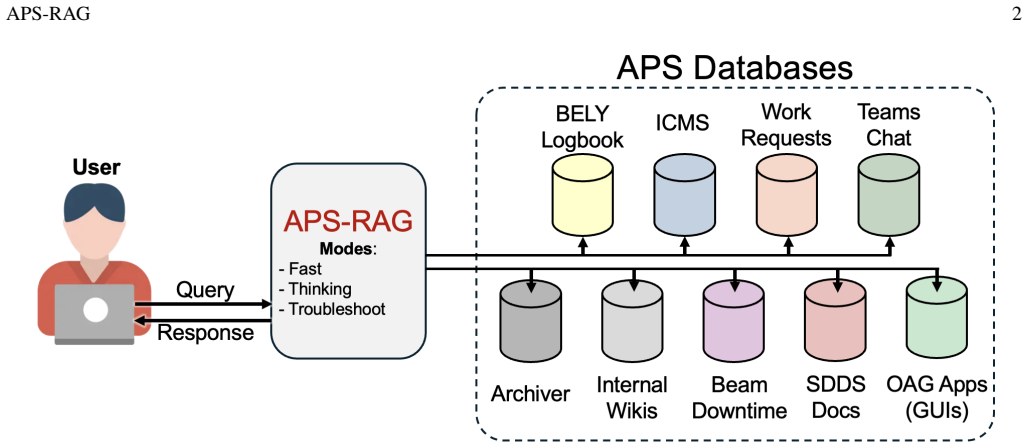
Scientific user facilities accumulate decades of operational knowledge that no single search index covers: electronic logbooks, technical documents, internal wikis, operations chat messages, maintenance records, and live control-system data. We present APS-RAG, Advanced Photon Source Retrieval Augmented Generation, a deployed platform that makes the institutional knowledge at the Advanced Photon Source (APS) accessible to staff through natural-language queries, along with an operations-grounded evaluation. The retrieval engine fuses dense, sparse, and knowledge-graph (KG) channels with query-type-adaptive reciprocal-rank fusion, adds a corrective agentic loop, and runs a native-tool ReAct executor over a Model Context Protocol (MCP) tooling layer. We construct APS-Bench, a 50-question, question-answering (QA) dataset with auditable gold answers. Every retrieval-augmented variant numerically improves strict vital-nugget recall over a naive BM25 baseline (63.8%), with the full corrective Agentic GraphRAG scoring (70.3%). The cross-encoder reranker contributes significantly to answer quality: removing it and allowing the LLM to score relevance drastically reduces strict vital recall by 32.8%. The graph channel and corrective loop contribute positively as expected, but the performance gains are marginal. Additionally, we also compare the performance of open-source and closed-source LLMs in final answer synthesis. We release the APS-Bench construction methodology, the six-layer evaluation harness, and the underlying codebase, along with the '/aps-rag' retrieval agent skill framework, to support reproduction and adoption at other facilities. Together, the deployed platform and its operations-grounded evaluation present a promising workflow for trustworthy, statistically grounded AI assistance in facility operations, transferable to other large scientific instruments.
Figures


Reference graph
Works this paper leans on
-
[1]
2023 , note =
Zhao, Firstname , title =. 2023 , note =
2023
-
[2]
J. N. Galayda , title =. Proc. PAC'95 , pages =
-
[3]
M. Borland and others , title =. Proc. IPAC'18 , pages =. doi:10.18429/JACoW-IPAC2018-THXGBD1 , url =
-
[4]
arXiv preprint arXiv:2212.03533 , author =
Text. arXiv preprint arXiv:2212.03533 , author =
-
[5]
Robertson, Stephen and Zaragoza, Hugo , month = apr, year =. The. Found. Trends Inf. Retr. , publisher =. doi:10.1561/1500000019 , abstract =
-
[6]
Wang, Liang and Yang, Nan and Huang, Xiaolong and Jiao, Binxing and Yang, Linjun and Jiang, Daxin and Majumder, Rangan and Wei, Furu , month = feb, year =. Text. doi:10.48550/arXiv.2212.03533 , abstract =
-
[7]
Borland, M. , month = jul, year =. User`s guide for. doi:10.2172/179270 , number =
-
[8]
Jiang, Ruobing and Fu, Dawei and Jiang, Cheng and Yang, Tianyi and Wang, Zijian and Wu, Youpeng and Ban, Yong and Mao, Yajun and Li, Qiang , month = jun, year =. Agentic. doi:10.48550/arXiv.2606.10381 , abstract =
-
[9]
Dai, Qing and Ischebeck, Rasmus and Sapinski, Maruisz and Grycner, Adam , month = sep, year =. Application. doi:10.48550/arXiv.2509.02227 , abstract =
work page internal anchor Pith review Pith/arXiv arXiv doi:10.48550/arxiv.2509.02227
-
[10]
Liu, Yung-Hui and Chung, Yen-Ching and Kuan, Chien-Kuang and Tsai, Zong-Da , year =. The
-
[11]
doi:10.48550/arXiv.2605.23904 , abstract =
Yang, Yifan and Gong, Ziyang and Huang, Weiquan and Yang, Qihao and Zhou, Ziwei and Huang, Zisu and Li, Yan and Gao, Xuemei and Dai, Qi and Liu, Bei and Qiu, Kai and Yang, Yuqing and Chen, Dongdong and Yang, Xue and Luo, Chong , month = may, year =. doi:10.48550/arXiv.2605.23904 , abstract =
-
[12]
Feng, Yifan and Hu, Hao and Hou, Xingliang and Liu, Shiquan and Ying, Shihui and Du, Shaoyi and Hu, Han and Gao, Yue , month = mar, year =. Hyper-. doi:10.48550/arXiv.2504.08758 , abstract =
-
[13]
and Cox, Sam and Schilter, Oliver and Baldassari, Carlo and White, Andrew D
Bran, Andres M. and Cox, Sam and Schilter, Oliver and Baldassari, Carlo and White, Andrew D. and Schwaller, Philippe , month = oct, year =. doi:10.48550/arXiv.2304.05376 , abstract =
-
[14]
Mao, Kelong and Liu, Zheng and Qian, Hongjin and Mo, Fengran and Deng, Chenlong and Dou, Zhicheng , year =. Findings of the. doi:10.18653/v1/2024.findings-emnlp.41 , abstract =
-
[15]
npj Computational Materials , author =
Operating advanced scientific instruments with. npj Computational Materials , author =. 2026 , pages =. doi:10.1038/s41524-026-02005-0 , abstract =
-
[16]
Li, Zhuofeng and Zhang, Haoxiang and Wei, Cong and Lu, Pan and Nie, Ping and Lu, Yi and Bai, Yuyang and Feng, Shangbin and Zhu, Hangxiao and Zhong, Ming and Zhang, Yuyu and Xie, Jianwen and Choi, Yejin and Zou, James and Han, Jiawei and Chen, Wenhu and Lin, Jimmy and Jiang, Dongfu and Zhang, Yu , month = may, year =. Beyond. doi:10.48550/arXiv.2605.05242 ...
-
[17]
ACM Transactions on Information Systems , author =
An. ACM Transactions on Information Systems , author =. 2024 , note =. doi:10.1145/3596512 , abstract =
doi:10.1145/3596512 2024
-
[18]
Jeong, Soyeong and Baek, Jinheon and Cho, Sukmin and Hwang, Sung Ju and Park, Jong , year =. Adaptive-. Proceedings of the 2024. doi:10.18653/v1/2024.naacl-long.389 , abstract =
-
[19]
Zhang, Qinggang and Chen, Shengyuan and Bei, Yuanchen and Yuan, Zheng and Zhou, Huachi and Hong, Zijin and Chen, Hao and Xiao, Yilin and Zhou, Chuang and Dong, Junnan and Chang, Yi and Huang, Xiao , month = sep, year =. A. doi:10.48550/arXiv.2501.13958 , abstract =
-
[20]
Xiang, Zhishang and Wu, Chuanjie and Zhang, Qinggang and Chen, Shengyuan and Hong, Zijin and Huang, Xiao and Su, Jinsong , month = feb, year =. When to use. doi:10.48550/arXiv.2506.05690 , abstract =
-
[21]
Fan, Dongzhe and Xue, Zheyi and Liu, Siyuan and Tan, Qiaoyu , month = apr, year =. Do. doi:10.48550/arXiv.2604.09666 , abstract =
work page internal anchor Pith review Pith/arXiv arXiv doi:10.48550/arxiv.2604.09666
-
[22]
Yao, Shunyu and Zhao, Jeffrey and Yu, Dian and Du, Nan and Shafran, Izhak and Narasimhan, Karthik and Cao, Yuan , year =
-
[23]
Application of low-cost sensors and deep autoencoders for monitoring water pumps in particle accelerators , abstract =
-
[24]
Reducing the. Science , author =. 2006 , pages =. doi:10.1126/science.1127647 , abstract =
-
[25]
Jarosz, D and Chandler, E and Shen, G and Xiao, L and Arnold, N and Veseli, S , pages =. Logging a new era at the. doi:10.18429/JACoW-ICALEPCS2025-THMG007 , abstract =
-
[26]
Randall, R. B. , year =. Vibration-based condition monitoring: industrial, automotive and aerospace applications. , isbn =. doi:10.1002/9780470977668 , publisher =
-
[27]
Nuclear Engineering and Technology , author =
Research on unsupervised condition monitoring method of pump-type machinery in nuclear power plant , volume =. Nuclear Engineering and Technology , author =. 2024 , pages =. doi:10.1016/j.net.2024.01.031 , abstract =
-
[28]
Feature. Proceedings of the Institution of Mechanical Engineers, Part O: Journal of Risk and Reliability , author =. 2020 , note =. doi:10.1177/1748006X19868335 , abstract =
-
[29]
Edelen, Jonathan P. and Cook, Nathan M. , month = mar, year =. Anomaly. doi:10.26024/p6mv-en77 , abstract =
-
[30]
Sun, Yipeng , editor =. Anomaly. Proceedings of the 12th International Particle Accelerator Conference , publisher =. 2021 , note =. doi:10.18429/JACOW-IPAC2021-TUPAB061 , abstract =
-
[31]
Physical Review Accelerators and Beams , author =
Uncertainty aware anomaly detection to predict errant beam pulses in the. Physical Review Accelerators and Beams , author =. 2022 , pages =. doi:10.1103/PhysRevAccelBeams.25.122802 , number =
-
[32]
Digital Signal Processing , author =
Time series anomaly detection in power electronics signals with recurrent and. Digital Signal Processing , author =. 2022 , pages =. doi:10.1016/j.dsp.2022.103704 , urldate =
arXiv 2022
-
[33]
doi:10.48550/arXiv.2405.01359 , abstract =
Mayet, Frank , month = may, year =. doi:10.48550/arXiv.2405.01359 , abstract =
-
[34]
Sulc, Antonin and Bien, Alex and Eichler, Annika and Ratner, Daniel and Rehm, Florian and Mayet, Frank and Hartmann, Gregor and Hoschouer, Hayden and Tuennermann, Henrik and Kaiser, Jan and John, Jason St and Maldonado, Jennefer and Hazelwood, Kyle and Kammering, Raimund and Hellert, Thorsten and Wilksen, Tim and Kain, Verena and Hu, Wan-Lin , month = may...
-
[35]
Towards a RAG-based Summarization Agent for the Electron-Ion Collider
Suresh, Karthik and Kackar, Neeltje and Schleck, Luke and Fanelli, Cristiano , month = jun, year =. Towards a. doi:10.48550/arXiv.2403.15729 , abstract =
work page internal anchor Pith review Pith/arXiv arXiv doi:10.48550/arxiv.2403.15729
-
[36]
Sulc, Antonin and Hellert, Thorsten and Kammering, Raimund and Hoschouer, Hayden and John, Jason St , month = sep, year =. Towards. doi:10.48550/arXiv.2409.06336 , abstract =
-
[37]
Physical Review Research , author =
Agentic artificial intelligence for multistage physics experiments at a large-scale user facility particle accelerator , volume =. Physical Review Research , author =. 2026 , pages =. doi:10.1103/jtqy-9jz1 , abstract =
-
[38]
Large language models for human-machine collaborative particle accelerator tuning through natural language , volume =. Science Advances , author =. 2025 , pages =. doi:10.1126/sciadv.adr4173 , abstract =
-
[39]
Gao, Yunfan and Xiong, Yun and Gao, Xinyu and Jia, Kangxiang and Pan, Jinliu and Bi, Yuxi and Dai, Yi and Sun, Jiawei and Wang, Meng and Wang, Haofen , month = mar, year =. Retrieval-. doi:10.48550/arXiv.2312.10997 , abstract =
-
[40]
and Clarke, Charles L A and Buettcher, Stefan , month = jul, year =
Cormack, Gordon V. and Clarke, Charles L A and Buettcher, Stefan , month = jul, year =. Reciprocal rank fusion outperforms condorcet and individual rank learning methods , isbn =. Proceedings of the 32nd international. doi:10.1145/1571941.1572114 , abstract =
-
[41]
Nogueira, Rodrigo and Cho, Kyunghyun , month = apr, year =. Passage. doi:10.48550/arXiv.1901.04085 , abstract =
-
[42]
Bonifacio, Luiz and Abonizio, Hugo and Fadaee, Marzieh and Nogueira, Rodrigo , month = jul, year =. Proceedings of the 45th. doi:10.1145/3477495.3531863 , abstract =
-
[43]
IEEE Transactions on Knowledge and Data Engineering , author =
Unifying. IEEE Transactions on Knowledge and Data Engineering , author =. 2024 , note =. doi:10.1109/TKDE.2024.3352100 , abstract =
arXiv 2024
-
[44]
Zhang, Yanzhao and Li, Mingxin and Long, Dingkun and Zhang, Xin and Lin, Huan and Yang, Baosong and Xie, Pengjun and Yang, An and Liu, Dayiheng and Lin, Junyang and Huang, Fei and Zhou, Jingren , month = jun, year =. Qwen3. doi:10.48550/arXiv.2506.05176 , abstract =
-
[45]
Kim, Yubin and Gu, Ken and Park, Chanwoo and Park, Chunjong and Schmidgall, Samuel and Heydari, A. Ali and Yan, Yao and Zhang, Zhihan and Zhuang, Yuchen and Liu, Yun and Malhotra, Mark and Liang, Paul Pu and Park, Hae Won and Yang, Yuzhe and Xu, Xuhai and Du, Yilun and Patel, Shwetak and Althoff, Tim and McDuff, Daniel and Liu, Xin , month = apr, year =. ...
-
[46]
Tian, Chris Xing and Xie, Weihao and Chen, Zhen and Yi, Zhengyuan and Liu, Hui and Li, Haoliang and Wang, Shiqi and Ma, Siwei , month = apr, year =. Domain-. doi:10.48550/arXiv.2510.11217 , abstract =
work page internal anchor Pith review Pith/arXiv arXiv doi:10.48550/arxiv.2510.11217
-
[47]
Lee, Yoonho and Nair, Roshen and Zhang, Qizheng and Lee, Kangwook and Khattab, Omar and Finn, Chelsea , month = mar, year =. Meta-. doi:10.48550/arXiv.2603.28052 , abstract =
-
[48]
Training language models to follow instructions with human feedback , abstract =
-
[49]
ACS Catalysis , author =. 2025 , pages =. doi:10.1021/acscatal.5c02824 , abstract =
-
[50]
In-situ. Acta Materialia , author =. 2024 , pages =. doi:10.1016/j.actamat.2024.120282 , abstract =
arXiv 2024
-
[51]
Materials Characterization , author =
Direct observation of tungsten oxidation studied by in situ environmental. Materials Characterization , author =. 2021 , pages =. doi:10.1016/j.matchar.2021.111016 , abstract =
arXiv 2021
-
[54]
Scientific Reports , author =. 2022 , pages =. doi:10.1038/s41598-022-19697-1 , abstract =
-
[55]
Deep. Scientific Reports , author =. 2019 , pages =. doi:10.1038/s41598-019-49105-0 , abstract =
-
[56]
Edwards, D. A. and Syphers, M. J. , month = jan, year =. An. doi:10.1002/9783527617272 , urldate =
-
[57]
Options, futures, and other derivatives , isbn =
Hull, John , year =. Options, futures, and other derivatives , isbn =
-
[58]
Retrieval-
Lewis, Patrick and Perez, Ethan and Piktus, Aleksandra and Petroni, Fabio and Karpukhin, Vladimir and Goyal, Naman and Küttler, Heinrich and Lewis, Mike and Yih, Wen-tau and Rocktäschel, Tim and Riedel, Sebastian and Kiela, Douwe , editor =. Retrieval-. Advances in. 2020 , pages =
2020
-
[59]
Minaee, Shervin and Mikolov, Tomas and Nikzad, Narjes and Chenaghlu, Meysam and Socher, Richard and Amatriain, Xavier and Gao, Jianfeng , month = mar, year =. Large. doi:10.48550/arXiv.2402.06196 , abstract =
-
[60]
and Zhu, Yuanyuan , month = jul, year =
Sainju, Rajat and Li, Tianyu and Nielsen, Monia R. and Zhu, Yuanyuan , month = jul, year =. Operando. Nano Letters , publisher =. doi:10.1021/acs.nanolett.5c02133 , number =
-
[61]
Hellert, Thorsten and Montenegro, João and Sulc, Antonin , month = aug, year =. Alpha. doi:10.48550/arXiv.2508.15066 , abstract =
-
[62]
and Sulc, Antonin and Venturini, Marco , month = sep, year =
Hellert, Thorsten and Bertwistle, Drew and Leemann, Simon C. and Sulc, Antonin and Venturini, Marco , month = sep, year =. Agentic. doi:10.48550/arXiv.2509.17255 , abstract =
-
[63]
Swetin, E and Kirshenbaum, M and Putnam, C , year =. Cooling
-
[64]
Journal of Molecular and Engineering Materials , author =
A. Journal of Molecular and Engineering Materials , author =. 2024 , note =. doi:10.1142/S225123732430002X , abstract =
-
[65]
Journal of Open Source Software , author =. 2020 , pages =. doi:10.21105/joss.02120 , abstract =
-
[66]
Dortwegt, R. , year =. Low-conductivity water systems for accelerators , isbn =. Proceedings of the 2003. doi:10.1109/PAC.2003.1288995 , abstract =
Pith/arXiv arXiv 2003
-
[67]
Applied Sciences , author =. 2025 , pages =. doi:10.3390/app15095185 , abstract =
-
[68]
A. Future Internet , author =. 2025 , pages =. doi:10.3390/fi17040164 , abstract =
-
[69]
Wu, Neo and Green, Bradley and Ben, Xue and O'Banion, Shawn , month = jan, year =. Deep. doi:10.48550/arXiv.2001.08317 , abstract =
-
[70]
Discover Internet of Things , author =. 2025 , pages =. doi:10.1007/s43926-025-00142-4 , number =
-
[71]
Anomaly. Machines , author =. 2022 , pages =. doi:10.3390/machines10060459 , abstract =
-
[72]
Sainju, Rajat and Rathnayake, Dinithi and Tan, Haiyan and Bollas, George and Dongare, Avinash M. and Suib, Steven L. and Zhu, Yuanyuan , month = apr, year =. In. ACS Nano , publisher =. doi:10.1021/acsnano.2c00742 , number =
-
[73]
, editor =
Feynman, Richard P. , editor =. "
-
[74]
Muralidharan, Balaji and Beadles, Hayden and Marzban, Reza and Mupparaju, Kalyan Sashank , month = aug, year =. Knowledge. doi:10.48550/arXiv.2408.04651 , abstract =
work page internal anchor Pith review Pith/arXiv arXiv doi:10.48550/arxiv.2408.04651
-
[75]
Wang, Xin and Chen, Zirui and Wang, Haofen and U, Leong Hou and Li, Zhao and Guo, Wenbin , month = apr, year =. Large. doi:10.48550/arXiv.2407.00936 , abstract =
work page internal anchor Pith review Pith/arXiv arXiv doi:10.48550/arxiv.2407.00936
-
[76]
and Yang, Shuyi and Agrawal, Lakshya A
Cemri, Mert and Pan, Melissa Z. and Yang, Shuyi and Agrawal, Lakshya A. and Chopra, Bhavya and Tiwari, Rishabh and Keutzer, Kurt and Parameswaran, Aditya and Klein, Dan and Ramchandran, Kannan and Zaharia, Matei and Gonzalez, Joseph E. and Stoica, Ion , month = apr, year =. Why. doi:10.48550/arXiv.2503.13657 , abstract =
-
[77]
Cao, Shuxiang and Zhang, Zijian and Alghadeer, Mohammed and Fasciati, Simone D. and Piscitelli, Michele and Bakr, Mustafa and Leek, Peter and Aspuru-Guzik, Alán , month = dec, year =. Agents for self-driving laboratories applied to quantum computing , url =. doi:10.48550/arXiv.2412.07978 , abstract =
-
[78]
Hong, Sirui and Lin, Yizhang and Liu, Bang and Liu, Bangbang and Wu, Binhao and Zhang, Ceyao and Wei, Chenxing and Li, Danyang and Chen, Jiaqi and Zhang, Jiayi and Wang, Jinlin and Zhang, Li and Zhang, Lingyao and Yang, Min and Zhuge, Mingchen and Guo, Taicheng and Zhou, Tuo and Tao, Wei and Tang, Xiangru and Lu, Xiangtao and Zheng, Xiawu and Liang, Xinbi...
-
[79]
Agentic. IEEE Access , author =. 2025 , pages =. doi:10.1109/ACCESS.2025.3532853 , abstract =
arXiv 2025
-
[80]
Peters, Matthew E. and Neumann, Mark and Iyyer, Mohit and Gardner, Matt and Clark, Christopher and Lee, Kenton and Zettlemoyer, Luke , month = mar, year =. Deep contextualized word representations , url =. doi:10.48550/arXiv.1802.05365 , abstract =
-
[81]
doi:10.48550/arXiv.1810.04805 , abstract =
Devlin, Jacob and Chang, Ming-Wei and Lee, Kenton and Toutanova, Kristina , month = may, year =. doi:10.48550/arXiv.1810.04805 , abstract =
-
[82]
Brown, Tom B. and Mann, Benjamin and Ryder, Nick and Subbiah, Melanie and Kaplan, Jared and Dhariwal, Prafulla and Neelakantan, Arvind and Shyam, Pranav and Sastry, Girish and Askell, Amanda and Agarwal, Sandhini and Herbert-Voss, Ariel and Krueger, Gretchen and Henighan, Tom and Child, Rewon and Ramesh, Aditya and Ziegler, Daniel M. and Wu, Jeffrey and W...
discussion (0)
Sign in with ORCID, Apple, or X to comment. Anyone can read and Pith papers without signing in.