REVIEW 3 major objections 5 minor 65 references
Deep Inertial Pose: A deep learning approach for human pose estimation
T0 review · 3 major / 5 minor · reviewed 2026-08-07 · deepseek-v4-flash
Pith's one-line read Neural networks trained on raw inertial-magnetic data can estimate whole-body human pose with accuracy comparable to classical sensor-fusion filters.
desk verdict A useful empirical benchmark showing NN-based fusion can approach classical filters, but the headline number depends on a calibration caveat and the abstract contradicts Table 3. read the letter →
The pith
A machine-rendered reading of the paper's core claim, the machinery that carries it, and where it could break.
The reading
What carries the argument
The load-bearing object is the detached hybrid filter, named in the paper as Hybrid-CFF-NN. A classical Madgwick complementary filter first integrates the MARG data into a quaternion orientation; a recurrent network (LSTM or temporal graph convolutional network) then reads that quaternion together with the raw sensor streams and outputs a residual quaternion correction. The 'detached' part means the filter's internal state never receives the network's output, so the classical estimate stays clean and training stays stable; a feedback variant that re-injected the network's quaternion into the filter diverged during training. Training uses the quaternion angle distance loss, $2\arccos(|q_{\text{target}} \cdot q_{\text{pred}}|)$, which is also the evaluation metric.
What would settle it
Recompute the high-end comparison using an independent sensor-to-segment calibration obtained only from calibration and task trials, never touching test-trial ground truth; if the hybrid network's advantage over the no-prior filter shrinks or reverses, the reported parity is an artifact of calibration leakage. A second check would be re-splitting the dataset with more than two test subjects and reporting subject-level variance.
Extended reading notes
Core claim
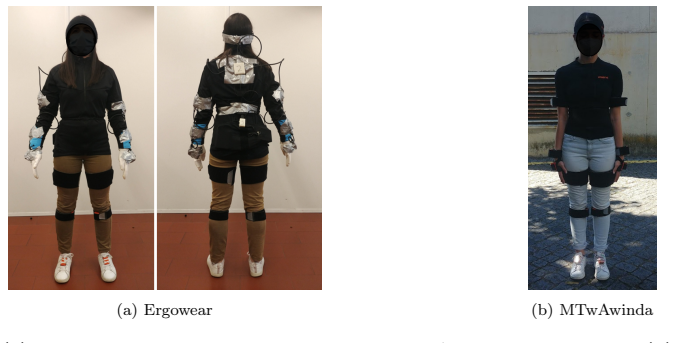
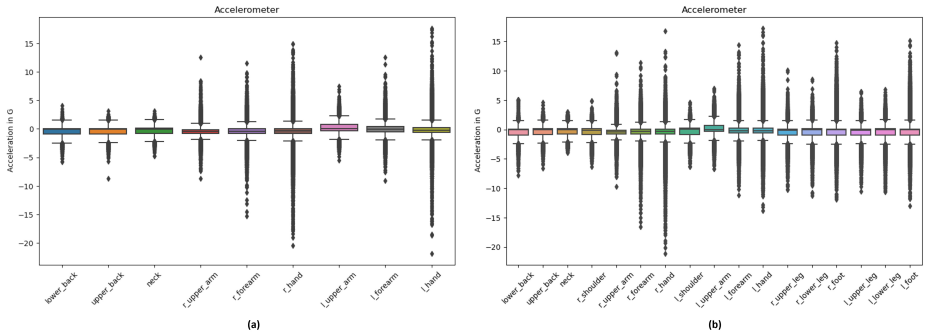
On its own terms, the paper's claim is that a neural network can act as the sensor-fusion and biomechanical-modeling layer of an inertial motion-capture pipeline, turning raw acceleration, angular velocity, and magnetic field readings directly into segment orientations. The evidence is a controlled benchmark on two datasets: a nine-sensor low-cost smart garment and a seventeen-sensor high-end full-body suit, both following the same movement protocol and using the same ground-truth reference. The hybrid that couples a Madgwick filter with a detached LSTM or TGCN correction reaches 7.96 degrees plus or minus 6.72 degrees mean QAD on the high-end data, essentially tied with the classical Madgwick filter with magnetic rejection at 7.76 degrees plus or minus 6.75 degrees. On the low-cost garment, the detached LSTM hybrid reaches 20.63 degrees plus or minus 16.45 degrees, slightly better than the best classical filter on that data, and the paper notes that the neural models also show lower variance. The conclusion the authors draw is modest: neural networks can be trained to estimate human pose with results comparable to state-of-the-art fusion filters, but the full pipeline, including sensor-to-segment calibration, still limits accuracy.
Load-bearing premise
The load-bearing premise is that the per-subject sensor-to-segment transform for the high-end dataset, chosen offline by optimizing against the ground-truth trajectories, stays valid for every test trial and does not smuggle information about those trajectories into the comparison.
Editorial extensions
If this is right
- If accurate, developers of wearable prototypes could replace licensed full-body tracking software with a trained model plus raw MARG data, cutting cost and setup complexity.
- Real-time use is plausible: all tested models run full-body inference in under 2 ms per sample on a desktop CPU, far below the 16 ms budget of 60 Hz sampling.
- Magnetometer data is necessary for low drift: removing it raises error by roughly 30 to 125 percent depending on dataset and model, matching the behavior of classical filters.
- The detached hybrid design separates the filter's recurrent state from the network, making training stable and window size less harmful, unlike feedback hybrids that diverged.
- Benchmarking must include sensor-to-segment calibration in the pipeline; the paper argues whole-body pose accuracy depends on calibration as much as on fusion itself.
Reading between the lines
- A direct test of generalizability would train on one set of subjects and test on subjects whose sensor-to-segment transforms were recomputed from held-out trials, quantifying how much of the 7.96 degree gap comes from the offline calibration optimization rather than from the fusion method itself.
- The results weakly support a cheap-hardware route: the same hybrid architecture could compensate for sensor sliding on garments by treating calibration offset as part of the input distribution, which the model-free results on the low-cost garment hint at.
- The 50-sample window improvement on the high-end data suggests that short-horizon training with bounded integration could exceed full-trajectory training, so a systematic window-length sweep with drift penalties is the natural next ablation.
- Because magnetometer-free networks lose heading reference, extending the comparison to long-duration trials of several minutes would test whether learned corrections prevent unbounded drift as well as the magnetic rejection heuristic does.
Editorial analysis
A structured set of objections, weighed in public.
Referee Report
Summary. This paper studies whether neural networks can replace classical analytical sensor-fusion pipelines for inertial human pose estimation. Using two self-collected datasets (Ergowear, 9 low-cost MPU9250 IMUs, and Movella MTw Awinda, 17 high-end IMUs) with MVN Analyze as ground truth, the authors compare classical filters (Mahony, Madgwick variants, EKF), model-free recurrent NNs, complementary hybrid NNs, and hybrid filter-NN architectures (feedback and detached). The main empirical claim is that the best detached hybrid models achieve accuracy comparable to the best classical filters—e.g., TGCN-MG-detach at 7.96° QAD versus Madgwick with magnetic rejection at 7.76° on MTwAwinda—and slightly outperform them on the low-cost Ergowear data. A broad ablation study covers data augmentation, output representation, magnetometer usage, window size, and loss function.
Significance. If the central comparison survives scrutiny, the paper is a useful benchmark for the inertial-pose community: it is one of the few studies to evaluate NN-based fusion end-to-end against classical filters on both low-cost and high-end hardware, with a public dataset and code. The hybrid detached architecture is a sensible and practical design, and the thorough ablations (Tables 5–6) provide actionable guidance. The result that NN-based fusion approaches the tuned classical baseline to within roughly 0.2° is a meaningful, falsifiable claim, but the current evidence is not yet conclusive because of the calibration and statistical issues detailed below.
major comments (3)
- [3.1.1, Table 2] The per-subject offline STS calibration for the MTwAwinda data is optimized to minimize the MSE between sensor inertial data and the GT trajectories, using multiple long trials with slow dynamics. The manuscript does not state whether any of these calibration trials belong to the test split (Table 2), and Section 3.1.3 explicitly says calibration and validation trials were still used in the validation/test splits. If the STS transform is fit to trajectories from the same trials on which all methods are later evaluated, or from the same subjects' test-session data, then the reference frame for every method in Tables 3 and 4 is partially determined by the test labels. This is load-bearing because the headline comparison rests on a 0.20° gap between TGCN-MG-detach (7.96°) and Madgwick with magnetic rejection (7.76°). Please state unambiguously that the STS calibration trials are disjoint from the test trials, or re-run the comparison with a calibration protocol that provably cannot use test information.
- [Tables 3 and 4] The tables report only mean ± standard deviation aggregated over all samples and segments, with no confidence intervals, no repeated training runs, and a test set of only two subjects per dataset. Given the per-sample standard deviations of about 6.7°, a 0.20° difference between the best NN and the best classical filter is not distinguishable from noise. Please report the mean and standard error over at least several random seeds/initializations, per-subject QAD values, and a paired significance test (e.g., Wilcoxon or bootstrap) for the NN-versus-filter comparisons. This applies equally to the window(50) result in Table 6 (7.58°), which is currently the only NN result that beats the classical filter.
- [4.1.1, Table 3, Abstract] The text says 'The best performance was achieved by the TGCN-MG-feedback, on the MTw Awinda dataset, attaining a QAD error of 7.96°', but Table 3 lists TGCN-MG-feedback as 'diverged' and attributes 7.96° to TGCN-MG-detach. The abstract, in turn, attributes 7.96° to 'Hybrid LSTM-Madgwick detached'. These three statements cannot all be correct; the manuscript needs to be corrected so that the best-reported method and its QAD value are consistent between the abstract, Section 4, and Tables 3–4.
minor comments (5)
- [Abstract] The abstract states that 'The most efficient method was the Hybrid LSTM-Madgwick detached, which achieved an Quaternion Angle distance error of 7.96', but Table 4 reports LSTM-MG-detach as 8.08° and TGCN-MG-detach as 7.96°; this should be harmonized with the corrections to Section 4.1.1.
- [4.1.2] The text says the best and worst fusion filters on Ergowear are 'the Madgwick without mag and the EKF without magnetometer', but Table 4 lists only EKF with magnetometer and attributes the 27.48° value to EKF (w/mag); the text should be corrected to match the table.
- [Table 4] The inference time for TGCN-MG-detach on MTwAwinda is given as 1.16 ms in Table 4, but Table 3 reports 1.85 ms for the same entry; these numbers should be reconciled.
- [4.2.5] Section 4.2.5 contains an incomplete sentence: 'The MSE loss function was the'.
- [Throughout] Several typos and inconsistent capitalizations remain: 'unsconstrained', 'Mtw Awinda', 'Ergoaware', 'the the' in Section 2.1.2, 'Aditionally', and 'fuction'.
Circularity Check
No circularity: the pose estimates are supervised predictions against an external MVN Analyze reference, not quantities defined by the fitted parameters.
full rationale
The paper is a supervised learning benchmark, not a derivation chain. Its central claim is empirical: NN-based fusion reaches QAD 7.96 deg versus 7.76 deg for Madgwick with magnetic rejection on MTw Awinda (Tables 3 and 4). Training targets are segment orientations from Movella MVN Analyze, an external biomechanical-model reference produced by software the authors did not write, and the QAD loss (Eq. 1) is minimized directly between predicted and target quaternions. No reported result is defined as a fitted parameter renamed as a prediction: the hybrid filter-NN variants use Madgwick outputs as input features, but the NN is still trained and evaluated against the external GT orientations, and the classical filters are evaluated in the same reference frame. The offline STS calibration in Section 3.1.1 fits a per-subject rotation by minimizing MSE between sensor data and GT trajectories; this raises a legitimate data-leakage/evaluation-reference concern, since the calibration may use trials from the same subjects and could favorably bias all methods, but it is not a case where the predicted pose reduces to the calibration by construction. The cited self-publications (Palermo et al. 2022a,b) are dataset descriptions, not load-bearing uniqueness theorems or ansatz justifications. No step in the paper equates a prediction to an input by definition, and no load-bearing argument depends on an unverified self-citation. The paper also explicitly acknowledges calibration sensitivity as a limitation, further indicating the authors do not present the reference frame as a derived result. Therefore, no significant circularity is present.
Assumptions & free parameters
free parameters (2)
- Training hyperparameters (learning rate schedule, batch size, gradient clipping, dropout, weight decay) =
LR 2e-3 cosine to 1e-5, batch 64, clip [-0.2, 0.2], dropout 20%, weight decay 1e-5
- Madgwick and Mahony filter gains and magnetometer rejection thresholds =
not reported
assumptions (4)
- domain assumption MVN Analyze software output provides accurate ground-truth segment orientations.
- domain assumption Per-subject offline sensor-to-segment calibration for MTwAwinda, optimized against ground-truth trajectories, remains valid for all trials of that subject.
- standard math The quaternion QAD metric (Eq. 1) is the appropriate error measure.
- domain assumption The kinematic model with default segment lengths from Behrad and Roodsarabi (2012) and an N-pose initial configuration yields valid 3D poses.
Cite this review
Pith. "Pith review of Deep Inertial Pose: A deep learning approach for human pose estimation." pith.science (2026). https://pith.science/paper/CRI3PYDL
@misc{pith2026250606850,
  author       = {Pith},
  title        = {Pith review of: Deep Inertial Pose: A deep learning approach for human pose estimation},
  year         = {2026},
  howpublished = {\url{https://pith.science/paper/CRI3PYDL}},
  note         = {Machine review of arXiv:2506.06850}
}
read the original abstract
Inertial-based Motion capture system has been attracting growing attention due to its wearability and unsconstrained use. However, accurate human joint estimation demands several complex and expertise demanding steps, which leads to expensive software such as the state-of-the-art MVN Awinda from Xsens Technologies. This work aims to study the use of Neural Networks to abstract the complex biomechanical models and analytical mathematics required for pose estimation. Thus, it presents a comparison of different Neural Network architectures and methodologies to understand how accurately these methods can estimate human pose, using both low cost(MPU9250) and high end (Mtw Awinda) Magnetic, Angular Rate, and Gravity (MARG) sensors. The most efficient method was the Hybrid LSTM-Madgwick detached, which achieved an Quaternion Angle distance error of 7.96, using Mtw Awinda data. Also, an ablation study was conducted to study the impact of data augmentation, output representation, window size, loss function and magnetometer data on the pose estimation error. This work indicates that Neural Networks can be trained to estimate human pose, with results comparable to the state-of-the-art fusion filters.
Figures


Figures from the paper (4 more)



Reference graph
Works this paper leans on
-
[1]
author Al-Amri, M. , author Nicholas, K. , author Button, K. , author Sparkes, V. , author Sheeran, L. , & author Davies, J. L. ( year 2018 ). title Inertial measurement units for clinical movement analysis: Reliability and concurrent validity . journal Sensors \/ , volume 18 \/ . https://www.mdpi.com/1424-8220/18/3/719. :10.3390/s18030719
-
[2]
author Alcaraz, J. C. , author Moghaddamnia, S. , & author Peissig, J. ( year 2021 ). title Efficiency of deep neural networks for joint angle modeling in digital gait assessment . journal EURASIP J. Adv. Signal Process. \/ , volume 2021 \/ , pages 10 . https://doi.org/10.1186/s13634-020-00715-1. :10.1186/s13634-020-00715-1
-
[3]
author Atrsaei, A. , author Salarieh, H. , author Alasty, A. , & author Abediny, M. ( year 2018 ). title Human Arm Motion Tracking by Inertial/Magnetic Sensors Using Unscented Kalman Filter and Relative Motion Constraint . journal Journal of Intelligent & Robotic Systems \/ , volume 90 \/ , pages 161--170 . http://link.springer.com/10.1007/s10846-017-0645...
-
[4]
author Bai, S. , author Kolter, J. Z. , & author Koltun, V. ( year 2018 ). title An empirical evaluation of generic convolutional and recurrent networks for sequence modeling . journal arXiv preprint arXiv:1803.01271 \/ ,
arXiv 2018
-
[5]
author Behrad, A. , & author Roodsarabi, N. ( year 2012 ). title 3D Human Motion Tracking and Reconstruction Using DCT Matrix Descriptor . journal ISRN Machine Vision \/ , volume 2012 \/ , pages 1--11 . https://www.hindawi.com/journals/isrn/2012/235396/. :10.5402/2012/235396
-
[6]
author Bouten, C. , author Koekkoek, K. , author Verduin, M. , author Kodde, R. , & author Janssen, J. ( year 1997 ). title A triaxial accelerometer and portable data processing unit for the assessment of daily physical activity . journal IEEE transactions on bio-medical engineering \/ , volume 44 \/ , pages 136--47 . :10.1109/10.554760
-
[7]
, author Van Merri \"e nboer, B
author Cho, K. , author Van Merri \"e nboer, B. , author Bahdanau, D. , & author Bengio, Y. ( year 2014 ). title On the properties of neural machine translation: Encoder-decoder approaches . journal arXiv preprint arXiv:1409.1259 \/ ,
arXiv 2014
-
[8]
author Choe, N. , author Zhao, H. , author Qiu, S. , & author So, Y. ( year 2019 ). title A sensor-to-segment calibration method for motion capture system based on low cost mimu . journal Measurement \/ , volume 131 \/ , pages 490--500 . https://www.sciencedirect.com/science/article/pii/S0263224118307176. :https://doi.org/10.1016/j.measurement.2018.07.078
Show all 65 references
-
[9]
, author Achilles, F
author Coskun, H. , author Achilles, F. , author DiPietro, R. , author Navab, N. , & author Tombari, F. ( year 2017 ). title Long short-term memory kalman filters: Recurrent neural estimators for pose regularization . In booktitle 2017 IEEE International Conference on Computer...
2017 doi
-
[10]
, author Paul, S
author Das, R. , author Paul, S. , author Mourya, G. K. , author Kumar, N. , & author Hussain, M. ( year 2022 ). title Recent trends and practices toward assessment and rehabilitation of neurodegenerative disorders: Insights from human gait . journal Frontiers in Neuroscience ...
2022
-
[11]
, author Li, Q
author Fan, B. , author Li, Q. , & author Liu, T. ( year 2017 ). title How Magnetic Disturbance Influences the Attitude and Heading in Magnetic and Inertial Sensor-Based Orientation Estimation . journal Sensors \/ , volume 18 \/ , pages 76 . http://www.mdpi.com/1424-8220/18/1/...
2017 doi
-
[12]
, author Carvalho, S
author Figueiredo, J. , author Carvalho, S. , author Vilas-Boas, J. P. , author Goncalves, L. , author Moreno, J. , & author Santos, C. ( year 2020 ). title Wearable inertial sensor system towards daily human kinematic gait analysis: Benchmarking analysis to mvn biomech . jour...
2020 doi
-
[13]
, & author Akhloufi, M
author Gamra, M. , & author Akhloufi, M. ( year 2021 ). title A review of deep learning techniques for 2d and 3d human pose estimation . journal Image and Vision Computing \/ , volume 114 \/ , pages 104282 . :https://doi.org/10.1016/j.imavis.2021.104282
2021
-
[14]
, author Bordes, A
author Glorot, X. , author Bordes, A. , & author Bengio, Y. ( year 2011 ). title Deep sparse rectifier neural networks . In editor G. Gordon , editor D. Dunson , & editor M. Dudík (Eds.), booktitle Proceedings of the Fourteenth International Conference on Artificial Intelligen...
2011
-
[15]
, author Oviedo-Pastor, D
author González-Alonso, J. , author Oviedo-Pastor, D. , author Aguado, H. J. , author Díaz-Pernas, F. J. , author González-Ortega, D. , & author Martínez-Zarzuela, M. ( year 2021 ). title Custom imu-based wearable system for robust 2.4 ghz wireless human body parts orientation...
2021 doi
-
[16]
author Gonçalves, H. R. , author Rodrigues, A. , & author Santos, C. P. ( year 2021 ). title Gait monitoring system for patients with parkinson’s disease . journal Expert Systems with Applications \/ , volume 185 \/ , pages 115653 . https://www.sciencedirect.com/science/articl...
2021
-
[17]
, & author Schmidhuber, J
author Hochreiter, S. , & author Schmidhuber, J. ( year 1997 ). title Long short-term memory . journal Neural computation \/ , volume 9 \/ , pages 1735--1780
1997
-
[18]
, author Kaufmann, M
author Huang, Y. , author Kaufmann, M. , author Aksan, E. , author Black, M. J. , author Hilliges, O. , & author Pons-Moll, G. ( year 2018 ). title Deep inertial poser: Learning to reconstruct human pose from sparse inertial measurements in real time . journal ACM Transactions...
2018
-
[19]
author Huynh, D. Q. ( year 2009 ). title Metrics for 3d rotations: Comparison and analysis . journal Journal of Mathematical Imaging and Vision \/ , volume 35 \/ , pages 155--164
2009
-
[20]
, & author Szegedy, C
author Ioffe, S. , & author Szegedy, C. ( year 2015 ). title Batch normalization: Accelerating deep network training by reducing internal covariate shift . In editor F. Bach , & editor D. Blei (Eds.), booktitle Proceedings of the 32nd International Conference on Machine Learni...
2015
-
[21]
, & author Hertz, J
author Krogh, A. , & author Hertz, J. A. ( year 1992 ). title A simple weight decay can improve generalization . In editor J. E. Moody , editor S. J. Hanson , & editor R. P. Lippmann (Eds.), booktitle Advances in Neural Information Processing Systems 4 \/ (pp. pages 950--957 )...
1992
-
[22]
, author Kanoga, S
author Kumano, Y. , author Kanoga, S. , author Yamamoto, M. , author Takemura, H. , & author Tada, M. ( year 2019 ). title Advanced industrial science and technology gait database 2019 . https://unit.aist.go.jp/harc/ExPART/GDB2019.html
2019
-
[23]
, author Kanoga, S
author Kumano, Y. , author Kanoga, S. , author Yamamoto, M. , author Takemura, H. , & author Tada, M. ( year 2023 ). title Estimating whole-body walking motion from inertial measurement units at wrist and heels using deep learning . journal International Journal of Automation ...
2023 doi
-
[24]
, author Wang, Z
author Li, J. , author Wang, Z. , author Qi, B. , author Zhang, J. , & author Yang, H. ( year 2022 ). title Meme: A mutually enhanced modeling method for efficient and effective human pose estimation . journal Sensors \/ , volume 22 \/ . https://www.mdpi.com/1424-8220/22/2/632...
2022 doi
-
[25]
, author Dong, J
author Liao, X. , author Dong, J. , author Song, K. , & author Xiao, J. ( year 2023 ). title Three-dimensional human pose estimation from sparse imus through temporal encoder and regression decoder . journal Sensors \/ , volume 23 \/ . https://www.mdpi.com/1424-8220/23/7/3547....
2023 doi
-
[26]
, author Bergamini, E
author Ligorio, G. , author Bergamini, E. , author Truppa, L. , author Guaitolini, M. , author Raggi, M. , author Mannini, A. , author Sabatini, A. M. , author Vannozzi, G. , & author Garofalo, P. ( year 2020 ). title A wearable magnetometer-free motion capture system: Innovat...
2020
-
[27]
, author Farina, F
author Lisini, T. , author Farina, F. , author Garulli, A. , author Giannitrapani, A. , & author Prattichizzo, D. ( year 2019 ). title Upper body pose estimation using wearable inertial sensors and multiplicative kalman filter . journal IEEE Sensors Journal \/ ,
2019
-
[28]
author Lopez-Nava, I. H. , & author Munoz-Melendez, A. ( year 2016 ). title Wearable inertial sensors for human motion analysis: A review . journal IEEE Sensors Journal \/ , volume 16 \/ , pages 7821--7834
2016
-
[29]
, & author Hutter, F
author Loshchilov, I. , & author Hutter, F. ( year 2017 ). title Decoupled weight decay regularization . journal arXiv preprint arXiv:1711.05101 \/ ,
2017 arXiv
-
[30]
, author Tang, J
author Luo, J. , author Tang, J. , & author Xiao, X. ( year 2016 ). title Abnormal gait behavior detection for elderly based on enhanced wigner-ville analysis and cloud incremental svm learning . journal Journal of Sensors \/ , volume 2016 \/ , pages 1--18 . :10.1155/2016/5869238
2016 doi
-
[31]
author Madgwick, S. O. H. , author Harrison, A. J. L. , & author Vaidyanathan, R. ( year 2011 ). title Estimation of imu and marg orientation using a gradient descent algorithm . In booktitle 2011 IEEE International Conference on Rehabilitation Robotics \/ (pp. pages 1--7 ). :...
2011
-
[32]
author Madgwick, S. O. H. , author Wilson, S. , author Turk, R. , author Burridge, J. , author Kapatos, C. , & author Vaidyanathan, R. ( year 2020 ). title An extended complementary filter for full-body marg orientation estimation . journal IEEE/ASME Transactions on Mechatroni...
2020
-
[33]
, author Hamel, T
author Mahony, R. , author Hamel, T. , & author Pflimlin, J.-M. ( year 2008 ). title Nonlinear complementary filters on the special orthogonal group . journal IEEE Transactions on Automatic Control \/ , volume 53 \/ , pages 1203--1218 . :10.1109/TAC.2008.923738
2008
-
[34]
author Markley, F. L. , & author Crassidis, J. L. ( year 2014 ). title Fundamentals of Spacecraft Attitude Determination and Control \/ . Space Technology Library. publisher Springer New York, NY . https://doi.org/10.1007/978-1-4939-0802-8
2014 doi
-
[35]
author Martins, D. R. , author Cerqueira, S. M. , & author Santos, C. P. ( year 2024 ). title Combining inertial-based ergonomic assessment with biofeedback for posture correction: A narrative review . journal Computers & Industrial Engineering \/ , volume 190 \/ , pages 11003...
2024
-
[36]
, author da Silva , L
author Merino, G. , author da Silva , L. , author Mattos, D. , author Guimarães, B. , & author Merino, E. ( year 2019 ). title Ergonomic evaluation of the musculoskeletal risks in a banana harvesting activity through qualitative and quantitative measures, with emphasis on moti...
2019 doi
-
[37]
, author Watanabe, S
author Nomura, M. , author Watanabe, S. , author Akimoto, Y. , author Ozaki, Y. , & author Onishi, M. ( year 2020 ). title Warm starting cma-es for hyperparameter optimization . journal arXiv preprint arXiv:2012.06932 \/ ,
2020 arXiv
-
[38]
, author Chatellier, C
author Pacher, L. , author Chatellier, C. , author Vauzelle, R. , & author Fradet, L. ( year 2020 ). title Comparison of lower limb calibration methods for movement analysis with inertial measurement unit (imu) . journal Computer Methods in Biomechanics and Biomedical Engineer...
2020
-
[39]
, author Cerqueira, S
author Palermo, M. , author Cerqueira, S. , author André, J. , & author C. Santos, C. ( year 2022 a ). title Complete inertial pose (cip) dataset . https://doi.org/10.5281/zenodo.5801927. :10.5281/zenodo.5801927
2022 doi
-
[40]
, author Cerqueira, S
author Palermo, M. , author Cerqueira, S. M. , author André, J. , author Pereira, A. , & author Santos, C. P. ( year 2022 b ). title From raw measurements to human pose - a dataset with low-cost and high-end inertial-magnetic sensor data . journal Scientific Data \/ , volume 9...
2022 doi
-
[41]
, author Mikolov, T
author Pascanu, R. , author Mikolov, T. , & author Bengio, Y. ( year 2013 ). title On the difficulty of training recurrent neural networks . In booktitle International conference on machine learning \/ (pp. pages 1310--1318 )
2013
-
[42]
, author Gross, S
author Paszke, A. , author Gross, S. , author Massa, F. , author Lerer, A. , author Bradbury, J. , author Chanan, G. , author Killeen, T. , author Lin, Z. , author Gimelshein, N. , author Antiga, L. , author Desmaison, A. , author Kopf, A. , author Yang, E. , author DeVito, Z....
2019
-
[43]
, author Schepers, M
author Paulich, M. , author Schepers, M. , author Rudigkeit, N. , & author Bellusci, G. ( year 2018 ). title Xsens mtw awinda: Miniature wireless inertial-magnetic motion tracker for highly accurate 3d kinematic applications . :10.13140/RG.2.2.23576.49929
2018
-
[44]
, author Lasenby, J
author Pepe, A. , author Lasenby, J. , & author Chacón, P. ( year 2022 ). title Learning rotations . journal Mathematical Methods in the Applied Sciences \/ , . https://onlinelibrary.wiley.com/doi/abs/10.1002/mma.8698. :https://doi.org/10.1002/mma.8698
2022 doi
-
[45]
( year 2017 )
author Picerno, P. ( year 2017 ). title 25 years of lower limb joint kinematics by using inertial and magnetic sensors: A review of methodological approaches . journal Gait & Posture \/ , volume 51 \/ , pages 239--246 . https://www.sciencedirect.com/science/article/pii/S096663...
2017 doi
-
[46]
, & author Mittal, V
author Rana, M. , & author Mittal, V. ( year 2021 ). title Wearable sensors for real-time kinematics analysis in sports: A review . journal IEEE Sensors Journal \/ , volume 21 \/ , pages 1187--1207 . :10.1109/JSEN.2020.3019016
2021
-
[47]
, author Cerqueira, S
author Resende, A. , author Cerqueira, S. , author Barbosa, J. , author Damásio, E. , author Pombeiro, A. , author Silva, A. , & author Santos, C. ( year 2021 ). title Ergowear: an ambulatory, non-intrusive, and interoperable system towards a human-aware human-robot collaborat...
2021
-
[48]
( year 2006 )
author Roetenberg, D. ( year 2006 ). title Inertial and magnetic sensing of human motion \/ . Ph.D. thesis University of Twente address Netherlands
2006
-
[49]
, author Luinge, H
author Roetenberg, D. , author Luinge, H. , & author Slycke, P. ( year 2009 ). title Xsens mvn: Full 6dof human motion tracking using miniature inertial sensors . journal Xsens Motion Technologies BV, Tech. Rep \/ , volume 1 \/
2009
-
[50]
( year 2022 )
author Rong, S. ( year 2022 ). title Quantifications and characteristics of dynamic soft tissue artifacts captured by wearable inertial measurement unit sensors \/ . Ph.D. thesis University of British Columbia. https://open.library.ubc.ca/collections/ubctheses/24/items/1.04213...
2022 doi
-
[51]
author Sabatini, A. M. ( year 2011 ). title Kalman-filter-based orientation determination using inertial/magnetic sensors: Observability analysis and performance evaluation . journal Sensors \/ , volume 11 \/ , pages 9182--9206 . https://www.mdpi.com/1424-8220/11/10/9182
2011
-
[52]
, author Giuberti, M
author Schepers, M. , author Giuberti, M. , author Bellusci, G. et al. ( year 2018 ). title Xsens mvn: Consistent tracking of human motion using inertial sensing . journal Xsens Technol \/ , (pp. pages 1--8 )
2018
-
[53]
author Smith, L. N. , & author Topin, N. ( year 2019 ). title Super-convergence: Very fast training of neural networks using large learning rates . In booktitle Artificial Intelligence and Machine Learning for Multi-Domain Operations Applications \/ (p. pages 1100612 ). organi...
2019
-
[54]
, & author Juric, M
author Sprager, S. , & author Juric, M. B. ( year 2015 ). title Inertial sensor-based gait recognition: A review . journal Sensors \/ , volume 15 \/ , pages 22089--22127 . https://www.mdpi.com/1424-8220/15/9/22089
2015
-
[55]
, author Hinton, G
author Srivastava, N. , author Hinton, G. , author Krizhevsky, A. , author Sutskever, I. , & author Salakhutdinov, R. ( year 2014 ). title Dropout: A simple way to prevent neural networks from overfitting . journal Journal of Machine Learning Research \/ , volume 15 \/ , pages...
2014
-
[56]
, author Shazeer, N
author Vaswani, A. , author Shazeer, N. , author Parmar, N. , author Uszkoreit, J. , author Jones, L. , author Gomez, A. N. , author Kaiser, . , & author Polosukhin, I. ( year 2017 ). title Attention is all you need . journal Advances in neural information processing systems \...
2017
-
[57]
, author Miezal, M
author Vignais, N. , author Miezal, M. , author Bleser, G. , author Mura, K. , author Gorecky, D. , & author Marin, F. ( year 2013 ). title Innovative system for real-time ergonomic feedback in industrial manufacturing . journal Applied Ergonomics \/ , volume 44 \/ , pages 566...
2013 doi
-
[58]
, author G \"u hmann, C
author Weber, D. , author G \"u hmann, C. , & author Seel, T. ( year 2020 ). title Neural networks versus conventional filters for inertial-sensor-based attitude estimation . In booktitle 2020 IEEE 23rd International Conference on Information Fusion (FUSION) \/ (pp. pages 1--8...
2020
-
[59]
, & author The PyTorch Lightning team ( year 2019 )
author William, F. , & author The PyTorch Lightning team ( year 2019 ). title PyTorch Lightning . https://github.com/PyTorchLightning/pytorch-lightning. :10.5281/zenodo.3828935
2019 doi
-
[60]
title Mvn user manual
author Xsens ( year 2021 a ). title Mvn user manual . note https://www.xsens.com/hubfs/Downloads/usermanual/MVN_User_Manual.pdf. Accessed: 2021-11-02
2021
-
[61]
title Understanding strapdown integration
author Xsens ( year 2021 b ). title Understanding strapdown integration . note https://xsenstechnologies.force.com/knowledgebase/s/article/Understanding-Strapdown-Integration?language=en_US. Accessed: 2022-01-05
2021
-
[62]
, author Zhou, Y
author Yi, X. , author Zhou, Y. , & author Xu, F. ( year 2021 ). title Transpose: Real-time 3d human translation and pose estimation with six inertial sensors . journal ACM Transactions on Graphics \/ , volume 40 \/
2021
-
[63]
, author Song, Y
author Zhao, L. , author Song, Y. , author Zhang, C. , author Liu, Y. , author Wang, P. , author Lin, T. , author Deng, M. , & author Li, H. ( year 2019 ). title T-gcn: A temporal graph convolutional network for traffic prediction . journal IEEE Transactions on Intelligent Tra...
2019
-
[64]
, author Barnes, C
author Zhou, Y. , author Barnes, C. , author Lu, J. , author Yang, J. , & author Li, H. ( year 2019 ). title On the continuity of rotation representations in neural networks . In booktitle 2019 IEEE/CVF Conference on Computer Vision and Pattern Recognition (CVPR) \/ (pp. pages...
2019
-
[65]
, author Vrabič, R
author Škulj, G. , author Vrabič, R. , & author Podržaj, P. ( year 2021 ). title A wearable imu system for flexible teleoperation of a collaborative industrial robot . journal Sensors \/ , volume 21 \/ . https://www.mdpi.com/1424-8220/21/17/5871. :10.3390/s21175871
2021 doi
Reviewed August 7, 2026 · model on record in the stance chip above.
Discussion (0). Continue with ORCID to comment.